
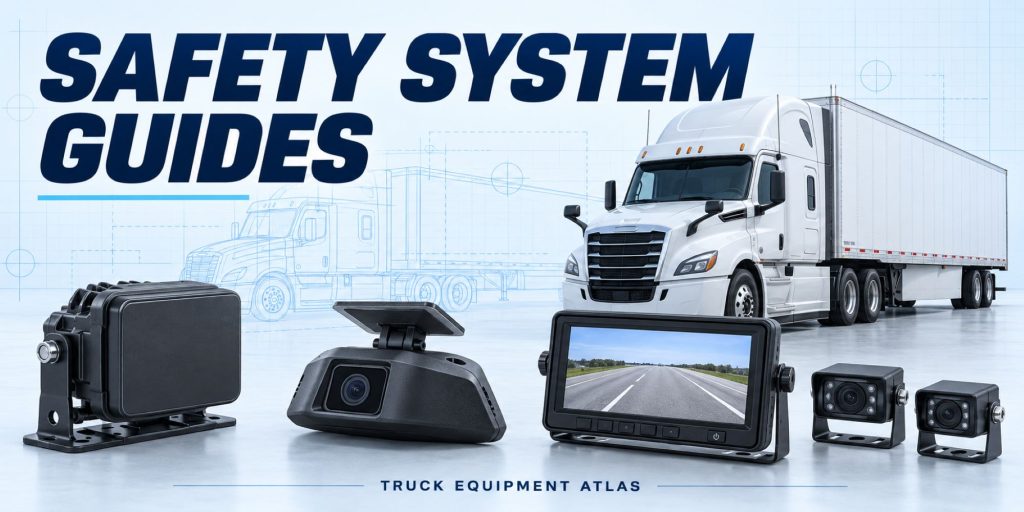
Commercial truck safety systems help drivers monitor surrounding traffic, recognize developing hazards, maintain vehicle awareness, and maneuver around people and equipment. Depending on the installed configuration, these technologies can provide warnings, display camera views, adjust following speed, or assist with braking and steering.
The Truck Equipment Atlas Safety System Guides explain collision warning, automatic emergency braking, adaptive cruise control, lane departure warning, lane keeping assistance, blind-spot detection, and camera monitor equipment. They also introduce reversing safety and audible warning systems used on commercial trucks and trailers.
These guides are designed for drivers, owner-operators, fleet managers, safety managers, technicians, equipment buyers, driver trainers, and CDL students. Use them to understand system functions, compare applications, and identify questions to ask when reviewing a vehicle or product specification.
Explore Safety System Guides
- How Commercial Truck Safety Systems Work — Begin with an overview of sensors, controllers, driver warnings, vehicle interfaces, and the differences between monitoring and active assistance.
- Collision Warning and Automatic Emergency Braking Explained — Learn how forward detection, collision warnings, and supported braking intervention differ, including important operating limits.
- Adaptive Cruise Control for Commercial Trucks Explained — Explore following-distance control, set speed, supported vehicle controls, and the differences between cruise functions and emergency braking.
- Lane Departure Warning and Lane Keeping Assistance Explained — Compare lane warnings, corrective assistance, and other supported steering functions without assuming every system operates the same way.
- Blind-Spot Detection and Camera Monitor Systems Explained — Understand side detection, pedestrian and cyclist warnings, digital camera views, and stitched surround-view displays.
- How to Choose a Commercial Truck Safety System — Review application matching, compatibility, coverage, installation, training, maintenance, and service support.
What These Guides Cover
The Safety System Guides introduce the equipment and operating principles behind commercial-vehicle driver assistance. They explain what a system is designed to do, what equipment it requires, and which capabilities need to be verified for a particular installation.
- Forward collision warning and collision mitigation.
- Automatic emergency braking.
- Adaptive cruise control and following-distance management.
- Lane departure warning and lane keeping assistance.
- Blind-spot and vulnerable road user detection.
- Camera monitors, digital mirror views, and surround-view imaging.
- Reversing detection and exterior warning alarms.
- Sensor mounting, alignment, and calibration.
- Driver displays, audible alerts, and fault indications.
- Vehicle compatibility, maintenance, and driver familiarization.
Understanding Commercial Truck Safety Systems
A safety system may combine external sensors, processing electronics, vehicle information, and a driver interface. Some equipment provides information only. Other systems can request changes to supported vehicle controls when defined conditions are met.
Product names alone do not establish capability. Model year, equipment generation, software, vehicle configuration, and installation details can affect the functions available on a particular truck.
Collision Warning and Automatic Emergency Braking Information
Forward collision warning alerts the driver to a detected collision risk. Automatic emergency braking adds supported braking intervention under the system’s defined operating conditions. These functions can be combined, but they are distinct capabilities.
- Forward-looking radar and camera functions.
- Driver warning stages and alert meanings.
- Supported targets and operating conditions.
- Braking intervention and vehicle integration.
- Sensor obstruction, faults, and performance limits.
- Read Collision Warning and Automatic Emergency Braking Explained
- Explore Collision Warning and Automatic Emergency Braking Systems
Adaptive Cruise Control Information
Adaptive cruise control adjusts supported vehicle controls to manage speed relative to detected traffic ahead. The system operates within its configured limits and does not remove the driver’s responsibility to maintain appropriate speed and spacing.
- Set speed and following-distance settings.
- Detection of traffic ahead.
- Supported engine, retarder, and braking controls.
- Driver override and cancellation behavior.
- Configuration-specific low-speed and stopping functions.
- Read Adaptive Cruise Control for Commercial Trucks Explained
- Explore Adaptive Cruise Control Systems
Lane Departure Warning and Lane Keeping Information
Lane departure warning provides an alert when the system detects a qualifying departure from a recognized lane. Lane keeping assistance can add supported steering intervention. A warning-only installation should not be assumed to control steering.
- Camera recognition of lane markings.
- Lane departure alerts and turn-signal behavior.
- Corrective steering and other supported assistance functions.
- Operating speeds and road conditions.
- Camera alignment, windshield work, and calibration requirements.
- Read Lane Departure Warning and Lane Keeping Assistance Explained
- Explore Lane Departure Warning and Lane Keeping Systems
Blind-Spot and Vulnerable Road User Detection Information
Blind-spot detection monitors specified areas around the vehicle. Vulnerable road user detection identifies supported road users, such as pedestrians or cyclists. Coverage and target recognition depend on the installed product.
- Side radar and camera-based detection.
- Adjacent-lane awareness and turning applications.
- Pedestrian and cyclist warning functions.
- Detection zones and vehicle-body obstructions.
- Differences between warning and active intervention.
- Read Blind-Spot Detection and Camera Monitor Systems Explained
- Explore Blind-Spot and Vulnerable Road User Detection Systems
Camera Monitor and Surround-View Information
Camera monitors display views from cameras mounted around the vehicle. Surround-view systems process multiple images into a combined view. Recording and automatic detection are additional functions that must be verified separately.
- Rear, side, and digital mirror views.
- Multi-camera layouts and stitched bird’s-eye images.
- Monitor placement and image interpretation.
- Camera mounting, calibration, and lens condition.
- Tractor-trailer coverage and interchangeable equipment.
- Read Blind-Spot Detection and Camera Monitor Systems Explained
- Explore Camera Monitor and Surround-View Systems
Reversing Safety and Audible Warning Information
Reversing equipment can warn people outside the vehicle, alert the driver to detected obstacles, or provide assistance through a compatible active system. An exterior alarm, rear camera, and obstacle detector perform different tasks.
- Exterior reversing alarms and in-cab warnings.
- Tonal and broadband sound patterns.
- Fixed-output and self-adjusting alarms.
- Rear detection coverage and warning behavior.
- Compatible braking assistance and installation requirements.
- Explore Reversing Safety and Audible Warning Systems
- Read the Commercial Truck Safety Systems Overview
Safety System Selection and Compatibility
Equipment selection begins with the fleet’s operating environment and the functions needed on each vehicle. Highway collision mitigation, urban cyclist warnings, and low-speed surround visibility can require different equipment and installation approaches.
- Vehicle make, model year, cab, and body configuration.
- Required warning, visibility, and intervention functions.
- Sensor coverage and supported operating conditions.
- Electrical, braking, steering, and communication compatibility.
- Installation, calibration, and commissioning requirements.
- Driver training, maintenance capacity, and service support.
Inspection, Maintenance, and Driver Familiarization
Safety equipment depends on correctly positioned sensors, reliable connections, and a functioning driver interface. Damage, contamination, or changes to vehicle components can affect available functions.
The guides introduce inspection areas and explain when manufacturer procedures are needed. They also help drivers understand warnings, coverage limits, fault indications, and the distinction between assistance and full vehicle control.
- Sensor and camera condition.
- Mounting security and visible damage.
- Wiring, connectors, displays, and warning devices.
- Calibration requirements after relevant repairs.
- Fault reporting and procedures for unavailable functions.
- Driver understanding of the installed system.
Who These Guides Are For
- Commercial truck drivers and owner-operators.
- Fleet managers and equipment buyers.
- Safety managers and driver trainers.
- Maintenance managers and technicians.
- Truck and trailer dealers.
- Highway, regional, and delivery fleets.
- Vocational and specialized vehicle operators.
- CDL students and readers learning about commercial-vehicle technology.
How to Use the Safety System Guides
- Start with How Commercial Truck Safety Systems Work for the overall system structure.
- Use Collision Warning and Automatic Emergency Braking Explained to compare forward warnings and braking intervention.
- Read Adaptive Cruise Control for Commercial Trucks Explained for following-speed and distance management.
- Consult Lane Departure Warning and Lane Keeping Assistance Explained for lane monitoring and supported steering assistance.
- Use Blind-Spot Detection and Camera Monitor Systems Explained to compare detection alerts and camera visibility.
- Finish with How to Choose a Commercial Truck Safety System when reviewing equipment for a specific application.
Related Guide Libraries
- Truck Guides
- Trailer Guides
- Brake System Guides
- Suspension System Guides
- Tire and Wheel Guides
- Equipment System Guides
- Explore All Guides
Related Equipment Systems
- Safety Systems
- Brake Systems
- ABS and Electronic Braking Systems
- Drivelines and Steering Systems
- Electrical Systems
- Telematics and ELD Systems
- Tires and Wheels
- Explore All Equipment Systems
Safety System Guide Library Expansion
The Safety System Guide library will grow alongside additional product profiles and equipment categories. Future topics may examine more specific installation, maintenance, and operating questions.
- Reversing alarms and rear obstacle detection.
- Digital mirror systems and conventional mirror arrangements.
- Surround-view installation and calibration.
- Safety sensor inspection and fault identification.
- Driver familiarization with assistance systems.
- Safety equipment for urban delivery and vocational fleets.
- Factory-installed equipment and retrofit considerations.
- Connections between driver assistance and fleet video systems.
Follow the Growth of Truck Equipment Atlas
Truck Equipment Atlas adds equipment profiles and educational resources to help readers explore commercial trucks, trailers, and the systems used throughout the industry.