
Hendrickson HAULMAAX EX
Quick Facts
- Manufacturer: Hendrickson
- Product Name: HAULMAAX EX
- Suspension Type: Heavy-duty rear rubber suspension
- Primary Configuration: Tandem rear-drive axle suspension
- Available Suspension Ratings: 40,000, 46,000, and 52,000 pounds
- Loaded Ride Heights: Approximately 8 to 18.5 inches, depending on configuration
- Diagonal Articulation: Up to 17 inches
- Available Axle Spacings: Approximately 52 to 72.5 inches, depending on model
- Spring Design: Rubber bolster springs with progressive load springs
- Common Applications: Dump, concrete mixer, refuse, logging, crane or boom, platform, and fire or rescue vehicles
- Lift-Axle Compatibility: Approved when properly specified and operated within published limits
- Shock Absorbers: Required for tractor and logging applications and optional for certain other applications
- Current Models: HAULMAAX EX 400, HAULMAAX EX 460, and HAULMAAX EX 520
Overview
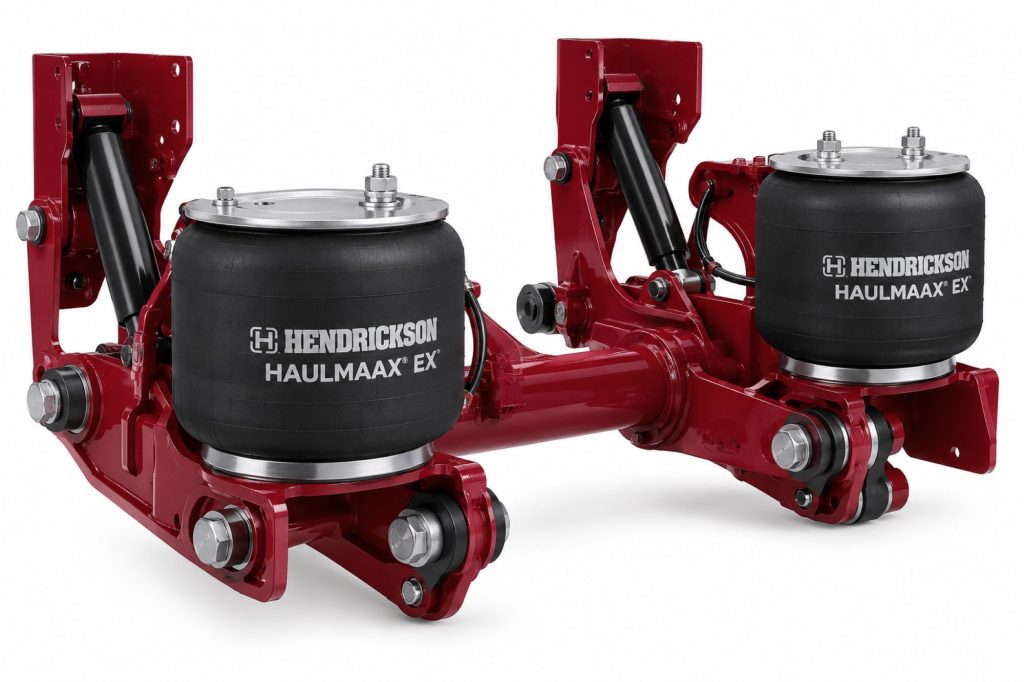
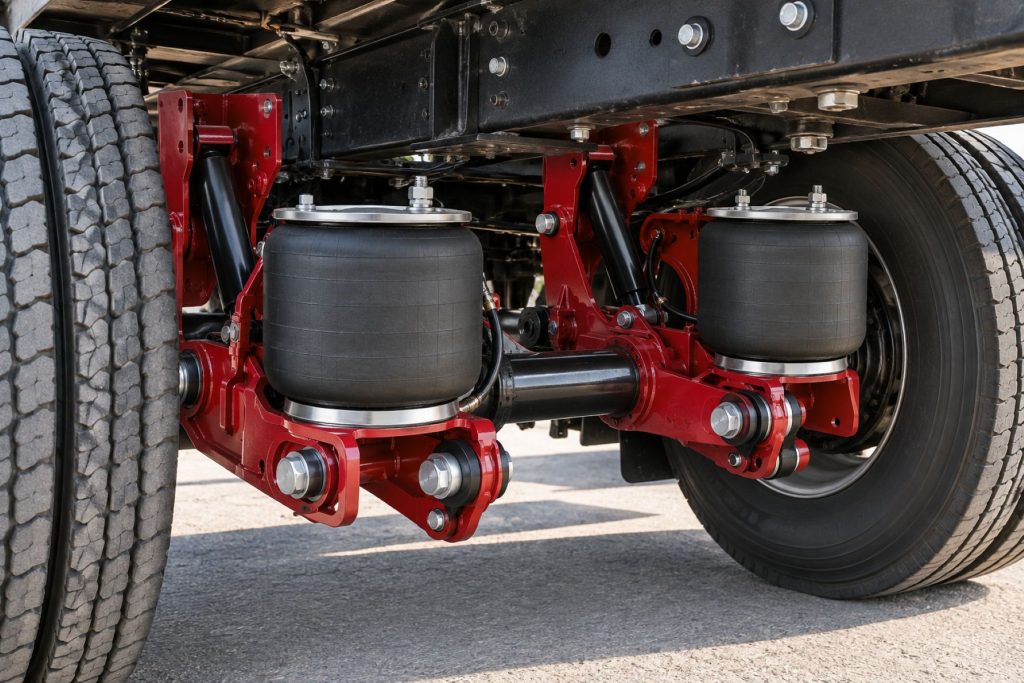
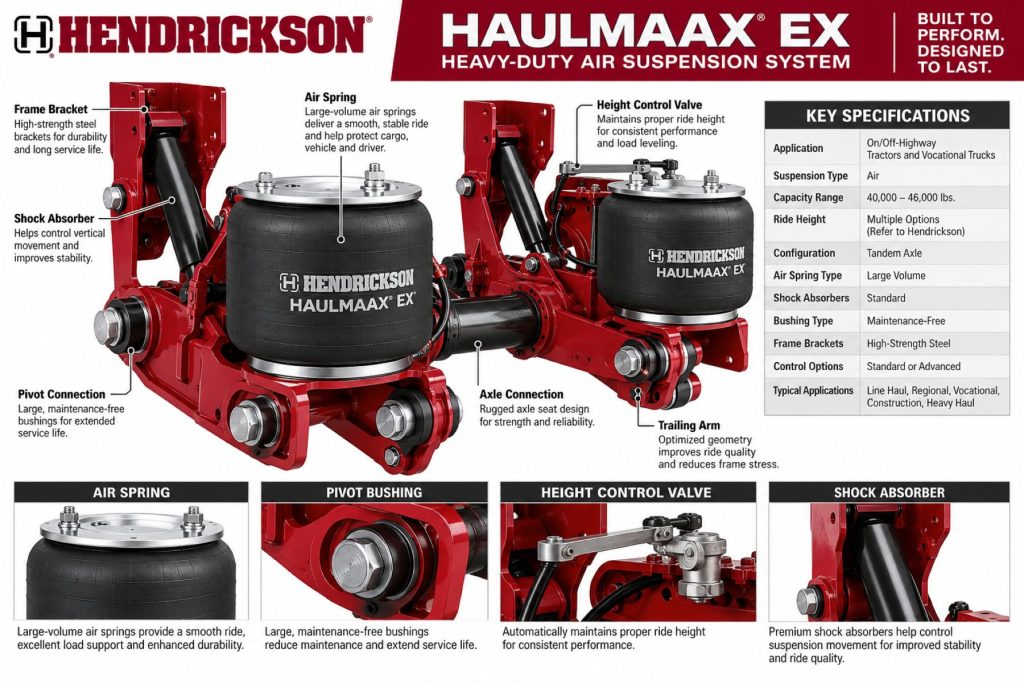
The Hendrickson HAULMAAX EX is a heavy-duty rear rubber suspension designed for vocational trucks operating under demanding on-road and job-site conditions. It combines equalizing beams, rubber bolster springs, progressive load springs, torque rods, and bar-pin axle connections to provide load support, stability, articulation, and axle control without using air springs or conventional steel spring packs.
HAULMAAX EX is intended to balance unloaded ride quality with loaded stability. Its progressive spring system becomes firmer as vehicle weight increases, while the equalizing beams help distribute loads between the tandem drive axles.
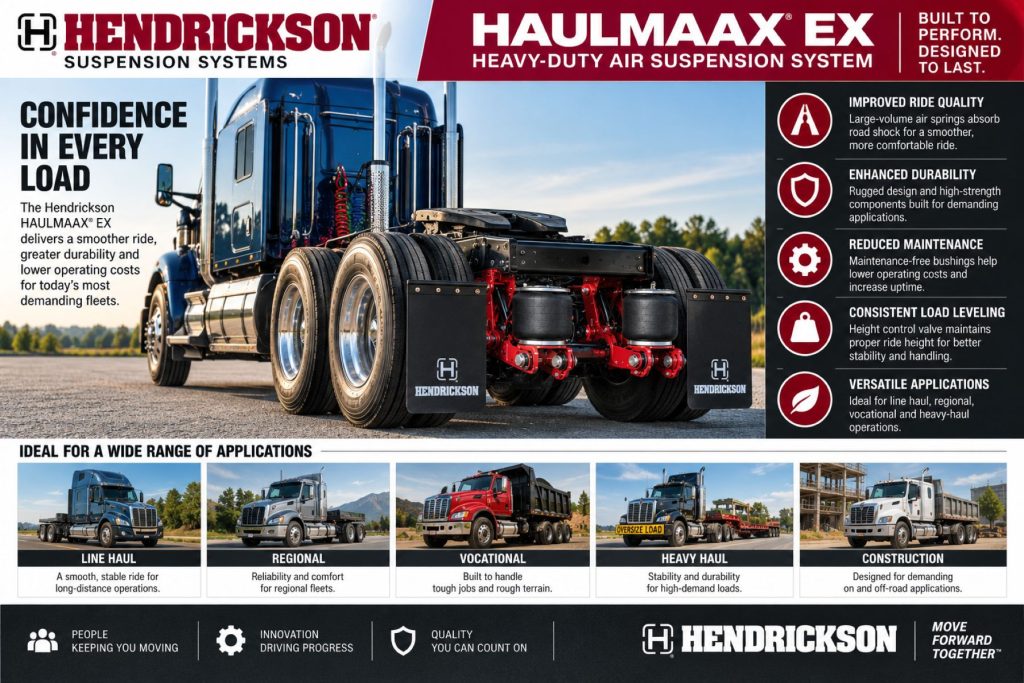
Hendrickson offers the suspension in 40,000-, 46,000-, and 52,000-pound ratings. The system is commonly specified for dump trucks, concrete mixers, refuse trucks, logging equipment, crane and boom vehicles, platform trucks, and fire or rescue apparatus.
Key Characteristics
- Heavy-duty rubber suspension designed for vocational rear-drive axles
- Available in 40,000-, 46,000-, and 52,000-pound suspension ratings
- Rubber bolster springs support most of the vehicle load
- Progressive load springs increase suspension stiffness as weight increases
- Equalizing beams distribute weight between the tandem axles
- Up to 17 inches of diagonal articulation
- Eliminates the fixed center bushings found in many traditional walking-beam suspensions
- Bar-pin end connections provide axle attachment and alignment capability
- Longitudinal torque rods resist axle windup during acceleration and braking
- Transverse torque rods control lateral axle movement
- Optional shock absorbers improve damping and driver comfort
- Shock absorbers are required for tractor and logging applications
- Available in several ride heights and axle spacings
- Compatible with approved lift-axle configurations
- Designed to reduce suspension weight compared with many traditional severe-duty mechanical suspensions
Major Components
Equalizing Beams
The formed and robotically welded equalizing beams connect the tandem drive axles and help distribute vehicle weight between them. Their narrow profile supports component clearance and helps reduce suspension weight.
Rubber Bolster Springs
Angled rubber bolster springs carry most of the vehicle and payload weight. Their placement helps the suspension resist braking, acceleration, and cornering forces while allowing controlled movement.
Progressive Load Springs
The progressive load springs increase stiffness as the load increases. This helps provide a more compliant response when the vehicle is empty while improving stability when fully loaded.
Frame Saddles and Brackets
Frame saddles and mounting brackets connect the suspension to the truck frame. Their configuration must match the chassis width, ride height, beam length, axle spacing, and vehicle application.
Bar-Pin End Bushings
Bar-pin end bushings connect the equalizing beams to the axle brackets. These connections help control axle position and provide the adjustment points used for drive-axle alignment.
Longitudinal Torque Rods
Longitudinal torque rods help control axle rotation and maintain pinion-angle relationships during acceleration and braking.
Transverse Torque Rods
Transverse torque rods control side-to-side axle movement and help maintain lateral alignment beneath the chassis.
Rebound Straps
Rebound straps limit suspension extension and help protect the rubber bolster springs. Dual rebound straps are standard on the 52,000-pound version and are required on vehicles equipped with outriggers.
Shock Absorbers
Shock absorbers control suspension movement and improve damping. They are required in tractor and logging applications and may be added to other approved configurations.
How the Suspension System Works
HAULMAAX EX uses rubber springs and equalizing beams instead of air bags or conventional steel leaf-spring packs.
The rubber bolster springs carry most of the vehicle’s weight. As the load increases, the progressive load springs engage more firmly and increase suspension stiffness. This provides a balance between unloaded ride quality and loaded roll stability.
The equalizing beams transfer and distribute weight between the tandem drive axles. When one axle moves upward over an obstacle, the beam system allows the opposite axle to respond, helping the tires remain in contact with uneven ground.
Longitudinal torque rods limit axle windup caused by engine torque and braking forces. Transverse torque rods restrict lateral axle movement during cornering and operation on uneven surfaces.
Because the system does not depend on compressed air, it does not require air springs, suspension height-control valves, or air-line plumbing to support the vehicle.
Suspension Position and Function
HAULMAAX EX is installed beneath the rear frame of a vocational truck or tractor and supports a tandem-drive axle group.
Its primary functions include:
- Supporting the rear portion of the chassis and payload
- Distributing weight between the tandem drive axles
- Allowing the axles to articulate over uneven surfaces
- Controlling axle movement during acceleration and braking
- Maintaining lateral axle position beneath the frame
- Helping keep the drive tires in contact with the ground
- Providing loaded stability for high-center-of-gravity vocational bodies
- Reducing road shock transferred into the frame, body, equipment, and cab
Common Specifications
HAULMAAX EX 400
- Suspension rating: 40,000 pounds
- Installed suspension weight: Approximately 836 pounds
- Approved gross vehicle weight: Up to approximately 83,000 pounds
- Approved gross combination weight: Up to approximately 200,000 pounds
- Job-site travel rating: Up to 60,000 pounds
- Loaded ride-height range: Approximately 8 to 13.25 inches
- Available axle spacings: Approximately 52, 54, and 60 inches
HAULMAAX EX 460
- Suspension rating: 46,000 pounds
- Installed suspension weight: Approximately 845 pounds
- Approved gross vehicle weight: Up to approximately 88,000 pounds
- Approved gross combination weight: Up to approximately 200,000 pounds
- Job-site travel rating: Up to 70,000 pounds
- Loaded ride-height range: Approximately 8 to 18.5 inches
- Available axle spacings: Approximately 52, 54, 60, and 72.5 inches
HAULMAAX EX 520
- Suspension rating: 52,000 pounds
- Installed suspension weight: Approximately 939 pounds
- Approved gross vehicle weight: Up to approximately 93,000 pounds
- Approved gross combination weight: Up to approximately 250,000 pounds
- Job-site travel rating: Up to 75,000 pounds
- Loaded ride-height range: Approximately 8 to 13.25 inches
- Available axle spacings: Approximately 52, 54, and 60 inches
All three versions provide up to approximately 17 inches of diagonal articulation. Actual vehicle capability may be limited by axle stops, frame design, tires, body equipment, driveline angles, or other manufacturer specifications.
Capacity, Ride Height, and Axle Travel
The HAULMAAX EX suspension rating must be matched to the selected drive axles, tires, wheels, brakes, frame, and vehicle gross-weight ratings. Installing a higher-rated suspension does not increase the legal or structural capacity of the complete vehicle.
Loaded ride height is measured from the drive-axle centerline to the bottom of the truck frame. The correct ride height depends on the suspension model, axle spacing, frame configuration, driveline geometry, tire size, and truck manufacturer’s installation specifications.
HAULMAAX EX provides up to 17 inches of diagonal articulation. This allows one side of an axle to move relative to the opposite side and helps maintain traction on uneven job sites.
Vehicle-installed axle stops or body and equipment clearances may restrict the available articulation
Ride Quality and Load Distribution
HAULMAAX EX uses a progressive spring arrangement to balance two different operating conditions.
When the truck is lightly loaded, the rubber spring system provides a more compliant response than many traditional severe-duty mechanical suspensions.
As payload weight increases, the progressive load springs become more involved and increase suspension stiffness. This helps control roll, body movement, and load shifting during cornering, braking, and job-site operation.
The equalizing beams distribute weight between the two drive axles as the truck moves across uneven terrain. This helps maintain tire contact and reduces extreme loading differences between the tandem axles.
Ride quality can also be influenced by tire pressure, cab suspension, wheelbase, body construction, frame stiffness, road conditions, payload placement, and whether shock absorbers are installed.
Suspension Controls and Adjustment Options
HAULMAAX EX is a passive mechanical rubber suspension. It does not use a height-control valve, electronic suspension controller, or driver-operated air-dump control.
Available adjustment and configuration provisions may include:
- Bar-pin alignment shims
- Transverse torque-rod shims
- Progressive load spring weight-bias shims
- Different loaded ride heights
- Different axle spacings
- Optional shock absorbers
- Optional or required dual rebound straps
- Application-specific torque-rod arrangements
- Available beam lengths
Any alignment, weight-bias, or component adjustment should follow Hendrickson and vehicle-manufacturer procedures.
Alignment and Suspension Geometry
Correct axle alignment is essential for predictable handling, tire life, driveline operation, and suspension durability.
The original position of the frame hangers and axle brackets establishes the basic alignment of the drive axles. Bar-pin shims at the equalizing-beam end connections are used to make drive-axle alignment corrections.
Transverse torque-rod shims may be used to correct lateral axle alignment. Longitudinal torque-rod positioning and shimming can affect axle pinion angle.
Important alignment considerations include:
- Drive-axle thrust angle
- Axle-to-axle alignment
- Lateral axle position
- Pinion angle
- Bar-pin shim position
- Transverse torque-rod position
- Frame-hanger location
- Axle-bracket location
- Ride height
- Tire and suspension clearance
Alignment should be checked after axle or suspension repairs, bushing replacement, collision damage, abnormal tire wear, or complaints about vehicle tracking.
Axle, Brake, and Wheel-End Options
HAULMAAX EX is a suspension system and does not include a single universal axle, brake, or wheel-end package. The truck manufacturer specifies compatible components based on vehicle capacity and application.
The suspension may be paired with approved tandem drive axles using:
- Drum brakes
- Air disc brakes
- Conventional wheel ends
- Preset or unitized wheel ends
- Dual rear wheels
- Application-specific axle housings and ratios
- Driver-controlled differential locks
- Inter-axle differential locks
- Traction-control systems
The selected axles must have ratings appropriate for the suspension capacity and vehicle application. Brake, wheel-end, tire, frame, and driveline clearances must be confirmed for the chosen ride height and axle spacing.
Common Applications
- Dump trucks
- Concrete mixer trucks
- Refuse trucks
- Logging trucks
- Crane and boom trucks
- Platform trucks
- Fire and rescue vehicles
- Heavy vocational tractors
- Construction vehicles
- Utility and infrastructure equipment
- Job-site support vehicles
- Specialized severe-duty vehicles
Additional applications require approval from Hendrickson and the vehicle manufacturer.
Vehicle, Axle, and Frame Compatibility
HAULMAAX EX is intended for approved heavy vocational chassis equipped with tandem rear-drive axles.
Compatibility depends on:
- Truck manufacturer and chassis model
- Vehicle gross and combination weight ratings
- Drive-axle ratings
- Frame width and rail dimensions
- Axle spacing
- Loaded suspension ride height
- Driveshaft and pinion angles
- Tire and wheel dimensions
- Brake configuration
- Body and auxiliary-equipment clearance
- Lift-axle placement and loading
- Outrigger installation
- Required torque-rod configuration
Truck manufacturers may offer HAULMAAX EX as a factory suspension option on selected vocational chassis. Availability varies by model, axle rating, wheelbase, body installation, and production year.
Advantages
- Heavy-duty construction for demanding vocational service
- Available in suspension ratings up to 52,000 pounds
- Up to 17 inches of diagonal articulation
- Progressive spring response balances unloaded ride and loaded stability
- Equalizing beams distribute weight between tandem axles
- Rubber springs do not require an air supply to support the truck
- No suspension air bags or height-control valves
- Eliminates traditional fixed center bushings
- Lower suspension weight than many conventional severe-duty designs
- Strong roll stability for dump, mixer, refuse, and similar applications
- Bar-pin connections permit drive-axle alignment
- Approved for properly configured lift-axle vehicles
- Several ride-height and axle-spacing configurations
- Optional shock absorbers for improved damping
Limitations or Considerations
- Does not provide the same ride characteristics as a full air suspension
- Rubber bolster and progressive load springs require regular inspection
- Bar-pin bushings and axle connections are critical wear points
- Correct alignment depends on proper shim installation
- Vehicle articulation may be limited by axle stops or equipment clearance
- Suspension rating does not override axle, tire, wheel, brake, or legal weight limits
- Shock absorbers are required for tractor and logging applications
- Outrigger-equipped vehicles require dual rebound straps
- Available ride heights and axle spacings vary by suspension rating
- Liftable auxiliary axles can overload the suspension if operated incorrectly
- Repairs may require special tools and heavy-component handling equipment
- Generation-specific components may not always be interchangeable
Driver and Operator Experience
Drivers can expect HAULMAAX EX to feel firmer than many rear air suspensions, particularly when the vehicle is empty. The progressive rubber spring design is intended to reduce the harshness associated with some traditional mechanical suspensions while maintaining stability under load.
On uneven job sites, the equalizing beams and available articulation help the tandem axles follow changing terrain. This can improve tire contact and reduce wheel lift when crossing ruts, ramps, and uneven surfaces.
Operators should watch for:
- Changes in vehicle lean
- Increased rear-suspension noise
- Harshness that was not previously present
- Steering pull or dog-tracking
- Uneven drive-tire wear
- Excessive axle movement
- Damaged rebound straps
- Visible rubber-spring deterioration
- Leaking shock absorbers
- Changes in driveline vibration
These symptoms may indicate wear, misalignment, damaged components, improper loading, or another chassis problem.
Maintenance and Ownership Notes
HAULMAAX EX eliminates several maintenance points associated with air suspensions and traditional center-bushed walking-beam systems, but it still requires regular inspection.
Maintenance areas include:
- Equalizing-beam end connections
- Bar-pin bushings
- Bar-pin alignment shims
- Axle brackets
- Longitudinal torque rods
- Transverse torque rods
- Rubber bolster springs
- Progressive load springs
- Rebound straps
- Shock absorbers when equipped
- Frame saddles and brackets
- Mounting fasteners
- Axle alignment
- Tire-clearance areas
Technicians should inspect the progressive load springs every three months for tearing and deterioration. Hendrickson specifies replacement when a tear exceeds the published service limit.
A light film on a shock-absorber body may be normal misting. Visible fluid running from the seal can indicate an actual leak.
Critical fasteners should be inspected and tightened according to the applicable Hendrickson and truck-manufacturer specifications. Used fasteners identified as non-reusable in the service procedure should be discarded and replaced.
Common Suspension Problems
- Worn bar-pin end bushings
- Loose or incorrectly installed bar-pin shims
- Drive-axle misalignment
- Lateral axle misalignment
- Damaged or deteriorated rubber bolster springs
- Torn or compressed progressive load springs
- Broken or damaged rebound straps
- Leaking or worn shock absorbers
- Loose suspension fasteners
- Worn torque-rod bushings
- Bent or damaged torque rods
- Damaged axle brackets
- Cracked or damaged frame brackets
- Incorrect pinion angle
- Uneven vehicle lean
- Abnormal drive-tire wear
- Excessive suspension noise
- Driveline vibration
- Reduced ride quality
- Insufficient tire or component clearance
Identification Information
HAULMAAX EX can be identified by its tandem equalizing beams, angled rubber bolster springs, progressive load springs, frame saddles, bar-pin axle connections, and absence of conventional rear air bags or steel spring packs.
Before ordering parts, record:
- Truck manufacturer
- Truck model and production year
- Vehicle identification number
- Suspension model
- Suspension capacity
- Axle spacing
- Loaded ride height
- Drive-axle manufacturer and model
- Frame width
- Beam and saddle configuration
- Bolster-spring design
- Progressive load-spring part number
- Torque-rod configuration
- Rebound-strap configuration
- Shock-absorber installation
- Axle-bracket and bar-pin configuration
HAULMAAX EX Generation 1 and Generation 2 systems use updated component designs. Some components are not interchangeable, making accurate generation identification important before ordering replacement parts.
Buying Considerations
- Required suspension capacity
- Vehicle gross and combination weight ratings
- Primary vocational application
- Expected on-road and job-site operation
- Payload requirements
- Desired empty-ride quality
- Loaded roll stability
- Required articulation
- Axle spacing
- Loaded ride height
- Frame dimensions
- Drive-axle compatibility
- Brake and wheel-end clearance
- Lift-axle configuration
- Outrigger installation
- Shock-absorber requirements
- Suspension generation
- Replacement-parts availability
- Dealer and technical support
- Warranty coverage
- Total installed and lifecycle cost
A complete chassis specification should be reviewed with the truck manufacturer, Hendrickson, the body builder, and the axle supplier before the suspension is ordered.
Variants and Configurations
HAULMAAX EX 400
The HAULMAAX EX 400 has a 40,000-pound suspension rating and is intended for vocational tandem applications that do not require the higher ratings of the 460 or 520 models.
HAULMAAX EX 460
The HAULMAAX EX 460 has a 46,000-pound suspension rating and offers the broadest published ride-height and axle-spacing ranges within the family.
HAULMAAX EX 520
The HAULMAAX EX 520 has a 52,000-pound suspension rating. It includes dual rebound straps and additional components appropriate for the higher-capacity configuration.
Generation 1
Earlier HAULMAAX EX systems use the original bolster-spring and saddle configuration. Replacement parts should be confirmed using the suspension identification and production information.
Generation 2
Updated HAULMAAX EX systems use revised bolster-spring and saddle components. Some Generation 1 and Generation 2 components are not interchangeable.
Shock-Equipped Configuration
Shock absorbers are required for tractor and logging applications and may be specified for additional ride control in other approved applications.
Dual-Rebound-Strap Configuration
Dual rebound straps are standard on the 52,000-pound model, required with outriggers, and available for certain 40,000- and 46,000-pound configurations.
Comparison to Similar Equipment
HAULMAAX EX vs Hendrickson PRIMAAX EX
HAULMAAX EX is a rubber mechanical suspension that does not require air springs to carry the vehicle. Hendrickson PRIMAAX EX is a severe-duty vocational air suspension designed to provide air-ride characteristics and controlled ride height.
HAULMAAX EX may be preferred for applications prioritizing loaded stability, articulation, simplicity, and resistance to air-system damage. PRIMAAX EX may be preferred when ride quality and air-suspension operation are greater priorities.
HAULMAAX EX vs Hendrickson HN
HAULMAAX EX uses equalizing beams with rubber bolster and progressive load springs. Hendrickson HN Vocational Suspension uses a different VariRate spring configuration intended for demanding vocational service.
HAULMAAX EX vs Hendrickson RT/RTE
HAULMAAX EX uses rubber springs and a lightweight equalizing-beam design. Hendrickson RT/RTE Mechanical Suspension is a traditional steel-spring walking-beam suspension known for rugged severe-duty service.
HAULMAAX EX vs Rear Air Suspension
HAULMAAX EX avoids air springs, height-control valves, and suspension air plumbing. A rear air suspension may provide a softer and more consistent ride but introduces additional pneumatic components and potential air-leak points.
Best Fit For
- Dump trucks operating on roads and job sites
- Concrete mixers requiring strong loaded stability
- Refuse trucks with frequent loading and unloading cycles
- Logging trucks requiring articulation and traction
- Crane and boom trucks with approved suspension configurations
- Platform and heavy vocational trucks
- Fire and rescue apparatus
- Fleets seeking a rubber suspension without air springs
- Operations prioritizing payload and suspension weight
- Applications requiring up to a 52,000-pound tandem suspension rating
- Vehicles using approved pusher or tag axles
- Operators needing several ride-height and axle-spacing choices
Related Vehicle and Trailer Types
- Dump Trucks
- Concrete Mixer Trucks
- Refuse Trucks
- Logging Trucks
- Heavy vocational tractors
- Crane and boom trucks
- Platform trucks
- Fire and rescue vehicles
- Construction trucks
Related Truck and Trailer Models
- Freightliner 114SD
- International HX Series
- Kenworth T880
- Mack Granite
- Peterbilt 567
- Western Star 47X
Related Suspension Types
- Vocational & Severe-Duty Suspensions
- Mechanical & Leaf Spring Suspensions
- Hendrickson PRIMAAX EX
- Hendrickson PRIMAAX
- Hendrickson HN Vocational Suspension
- Hendrickson RT/RTE Mechanical Suspension
- Hendrickson RS Series Suspension
Related Equipment Systems
Related Guides
- Suspension System Guides
- How Commercial Truck Suspension Systems Work
- Air Suspension vs Leaf Spring Suspension
- How to Choose a Commercial Truck Suspension
- Truck Suspension Components Explained
- Truck vs Trailer Suspension Systems
- Lift Axles Explained
- How Commercial Truck Axles and Differentials Work
Regulatory and Compliance Notes
The suspension’s published capacity does not determine the vehicle’s legal operating weight by itself. The truck must remain within all applicable gross vehicle, gross combination, axle, tire, wheel, brake, bridge-formula, and road-use limits.
Liftable pusher or tag axles can change the weight carried by the tandem suspension. Operators must not raise or unload an auxiliary axle when doing so would overload the HAULMAAX EX suspension, drive axles, tires, wheels, or frame.
Hendrickson’s published job-site travel ratings apply only under specified limited conditions. Job-site ratings are limited to no more than five percent of vehicle operation and speeds not exceeding five miles per hour. The appropriate axle ratings must also support the load.
Application approval should be confirmed with Hendrickson and the truck manufacturer, particularly when the vehicle includes outriggers, lift axles, specialized bodies, unusually high gross weights, or modified chassis components.
Real World Operating Notes
HAULMAAX EX is especially useful on vocational trucks that spend part of their operating time on uneven surfaces but still travel substantial distances on public roads.
The suspension’s articulation helps the drive axles follow uneven ground, but tire contact can still be affected by vehicle loading, axle stops, tire inflation, body stiffness, frame twist, and surface conditions.
A suspension problem may first appear as unusual tire wear, vehicle lean, changed handling, driveline vibration, or increased noise. These symptoms should not automatically be blamed on the rubber springs because axle alignment, torque rods, tires, wheel ends, frame components, or body installation may also be responsible.
When an auxiliary axle is lifted, more vehicle weight can transfer to the tandem drive suspension. Drivers and fleets must understand how auxiliary-axle operation changes individual axle and suspension loads.
Frequently Asked Questions
Is the Hendrickson HAULMAAX EX an air suspension?
No. HAULMAAX EX is a heavy-duty rubber mechanical suspension. It uses rubber bolster springs and progressive load springs rather than air springs to carry the vehicle.
What capacities are available?
HAULMAAX EX is available with published suspension ratings of 40,000, 46,000, and 52,000 pounds.
How much articulation does HAULMAAX EX provide?
Hendrickson publishes up to approximately 17 inches of diagonal articulation. Actual movement may be limited by the truck’s axle stops, frame, body, tires, or other components.
What trucks commonly use HAULMAAX EX?
It is commonly specified for dump trucks, concrete mixers, refuse trucks, logging trucks, cranes, platform trucks, and fire or rescue vehicles.
Does HAULMAAX EX require shock absorbers?
Shock absorbers are required for tractor and logging applications. They may be optional for other approved applications where additional damping or ride control is desired.
Can HAULMAAX EX be used with lift axles?
Yes, approved configurations can use liftable auxiliary axles. However, raising or unloading an auxiliary axle must not overload the rear suspension or other vehicle components.
Does the suspension require lubrication?
The rubber spring system and eliminated center bushings reduce lubrication requirements. Other chassis, axle, driveline, brake, and wheel-end components may still require lubrication according to their manufacturers’ schedules.
How is HAULMAAX EX aligned?
Drive-axle alignment is adjusted using shims at the bar-pin end connections. Transverse torque-rod shims may be used to adjust lateral axle position.
How is ride height measured?
Loaded ride height is measured from the centerline of the drive axle to the bottom of the truck frame.
Are all HAULMAAX EX parts interchangeable?
No. Generation 1 and Generation 2 systems include updated components, and certain parts are not interchangeable. The suspension generation should be confirmed before ordering parts.
What is the difference between HAULMAAX and HAULMAAX EX?
HAULMAAX EX is the updated family with revised suspension geometry, capacity options, materials, spring components, and application capabilities. Parts should be ordered using the exact suspension model and generation.
Availability and Where to Find
HAULMAAX EX is available as a factory-installed suspension option on selected heavy vocational truck chassis. Exact availability depends on the truck manufacturer, model, axle ratings, wheelbase, frame configuration, body installation, and application.
Replacement parts and service components are available through Hendrickson-authorized dealers, commercial truck dealers, suspension specialists, heavy-duty parts suppliers, and qualified truck repair facilities.
Before ordering a replacement component, provide the supplier with the truck identification, suspension rating, axle spacing, ride height, suspension generation, and original component numbers.
Support Trucking Families
Truck Equipment Atlas supports the mission of Grey Cross, a nonprofit dedicated to helping families of truck drivers who lose their lives while on the road. As the site grows, part of its mission is to bring awareness and support to these families.
Podcast or Video Section
Learn More Through Audio and Video
Truck Equipment Atlas will continue expanding with podcast episodes, interviews, and equipment breakdowns to help drivers and fleets better understand trucks and equipment.
Follow the Growth of Truck Equipment Atlas
Truck Equipment Atlas continues to expand with new truck profiles, trailer coverage, diesel engine pages, equipment system resources, manufacturer information, and educational guides.
Visit our Site Updates page to explore recent additions, project milestones, and upcoming resources as we continue building one of the industry’s growing commercial trucking equipment reference libraries.
View the Latest Site Updates: Truck Equipment Atlas Site Updates