
Hendrickson SOFTEK
Quick Facts
- Manufacturer: Hendrickson
- Product Type: Integrated front mechanical suspension and steer-axle system
- Suspension Position: Front steer axle
- Suspension Design: Monoleaf spring suspension
- Integrated Axle: Hendrickson STEERTEK or STEERTEK NXT, depending on configuration
- Common Capacities: Approximately 5,500 to 14,600 pounds across different vehicle applications
- SOFTEK NXT Heavy-Truck Capacities: 12,500 and 13,200 pounds
- Primary Applications: On-highway trucks, buses, step vans, motorhomes, and electric commercial vehicles
- Maximum Wheel Cut: Up to approximately 55 degrees in applicable configurations
- Brake Compatibility: Drum, air disc, or hydraulic disc brakes, depending on the vehicle
- Primary Benefits: Reduced weight, improved ride quality, steering control, and lower maintenance
- Page Slug: hendrickson-softek
Overview
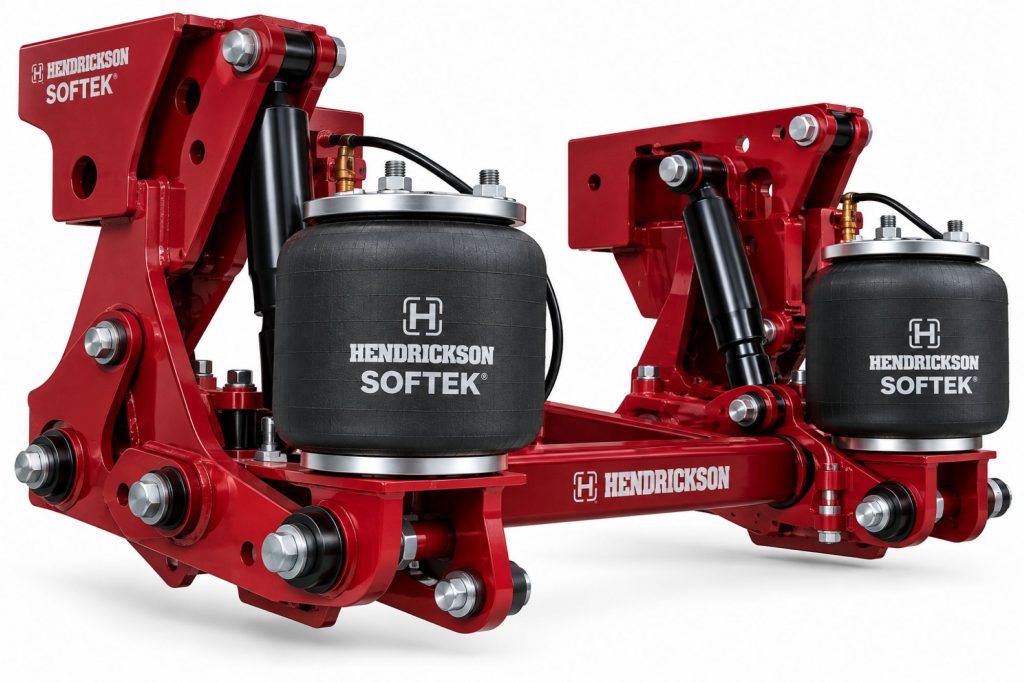
The Hendrickson SOFTEK is an integrated front mechanical suspension and fabricated steer-axle system. It combines lightweight monoleaf spring technology with a Hendrickson STEERTEK or STEERTEK NXT axle to reduce weight while preserving the ride, handling, stability, and durability required by commercial vehicles.
Unlike the air-spring-supported Hendrickson AIRTEK, SOFTEK uses mechanical leaf springs to support the front of the vehicle. Its monoleaf design eliminates the friction between multiple spring leaves, helping provide a smoother ride than many conventional multi-leaf front suspensions.
SOFTEK is available in vehicle-specific configurations for trucks, buses, motorhomes, step vans, and electric commercial vehicles. SOFTEK NXT is the newer version developed around Hendrickson’s STEERTEK NXT fabricated axle, advanced monoleaf technology, and integrated clamp-group design.
Key Characteristics
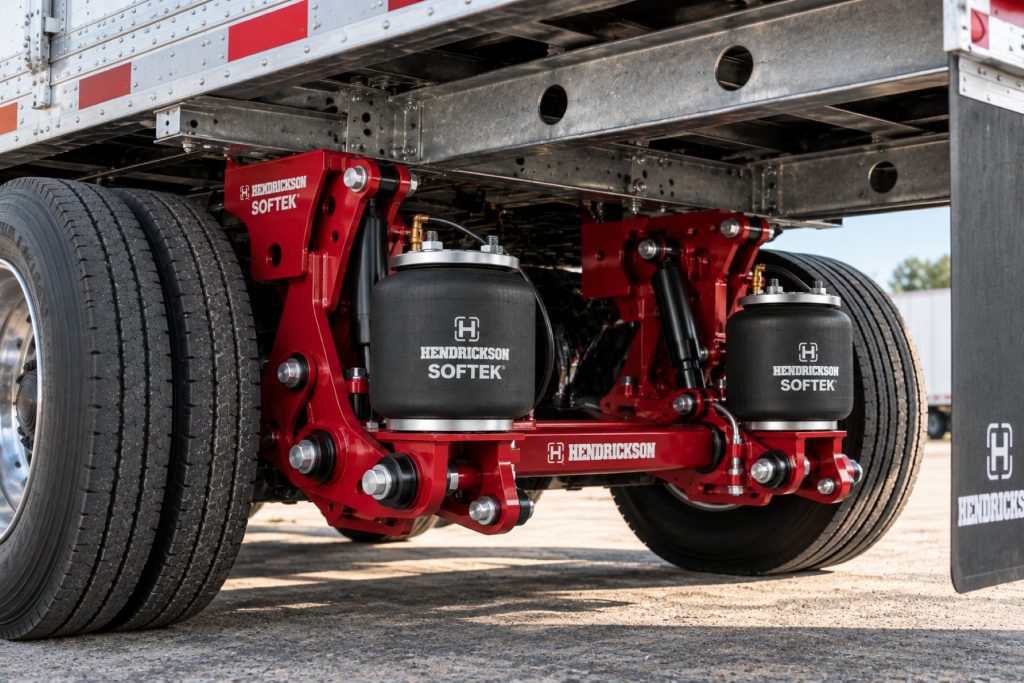
- Integrated front mechanical suspension and steer axle
- Lightweight monoleaf spring construction
- Does not require air pressure to support the front axle
- Reduced weight compared with many traditional two-leaf spring and forged I-beam axle systems
- Eliminates interleaf friction associated with multi-leaf spring packs
- Designed to balance ride quality with steering and roll stability
- Fabricated box-section steer axle resists horizontal, vertical, and twisting forces
- Integrated axle seats improve ground clearance and reduce component count
- Vehicle-specific configurations for conventional and electric commercial vehicles
- Available with several brake and wheel-end packages
- Up to approximately 55 degrees of wheel cut in compatible applications
- Rubber spring-eye bushings require no lubrication in applicable configurations
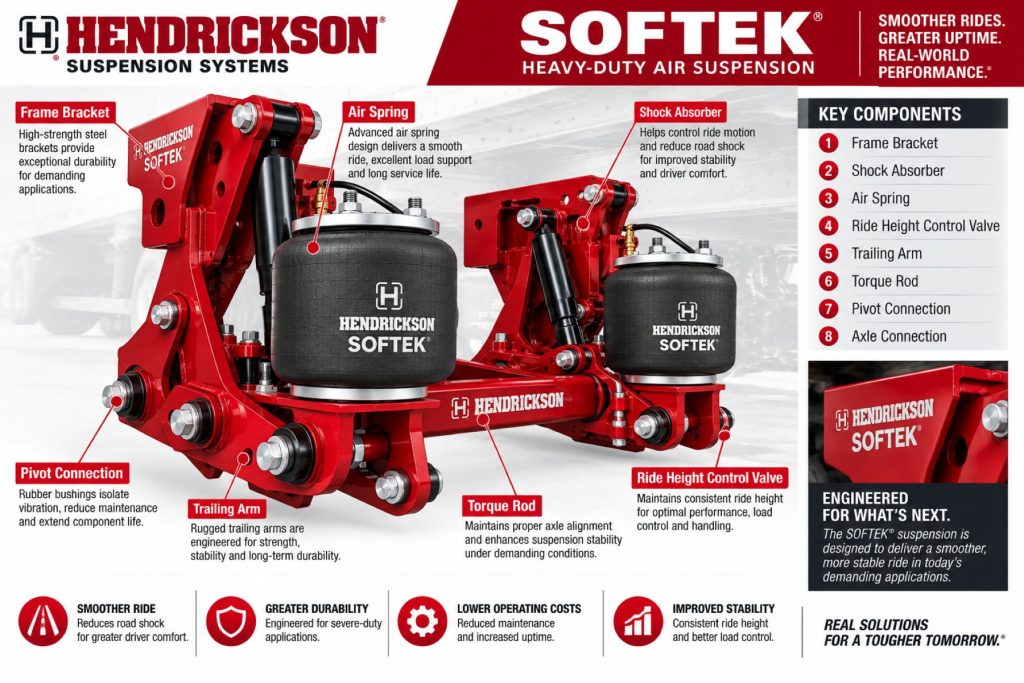
Major Components
- Monoleaf spring assemblies
- Hendrickson STEERTEK or STEERTEK NXT fabricated steer axle
- Front spring hangers
- Rear shackle brackets
- Shackle plates and connecting hardware
- Spring-eye bushings
- Shock absorbers
- Integrated axle seats
- Axle clamp groups
- Top pads
- U-bolts, washers, and locknuts
- Steering knuckles
- Kingpins, bushings, and seals
- Adjustable tie rod and tie-rod ends
- Steering and tie-rod arms
- Rubber axle stops or bump stops
- Brake and wheel-end assemblies
How the Suspension System Works
SOFTEK uses a monoleaf spring on each side of the vehicle to support the chassis above the front steer axle. The springs flex as the axle encounters bumps, dips, bridge joints, and other road irregularities.
Because each side uses a single primary spring leaf, SOFTEK eliminates the interleaf friction present in conventional multi-leaf spring packs. This can produce a more controlled and compliant ride while retaining the simplicity of a mechanical suspension.
Shock absorbers control repeated suspension movement after the springs react to a road impact. The spring hangers, shackles, bushings, and axle clamp groups locate the suspension beneath the frame while allowing the movement required for normal axle travel.
The integrated fabricated axle carries the front vehicle weight and connects the suspension to the steering knuckles, tie rod, wheel ends, and brakes.
Suspension Position and Function
SOFTEK is installed beneath the front of the vehicle at the steer-axle position. It supports the front chassis, engine compartment, cab, occupants, and any portion of the payload transferred to the steer axle.
The system performs several functions:
- Supports the vehicle’s front axle load
- Controls vertical and lateral axle movement
- Absorbs road impacts through the flexing monoleaf springs
- Maintains steering geometry and axle position
- Provides mounting points for the steering knuckles and brakes
- Controls suspension oscillation through tuned shock absorbers
- Helps maintain vehicle roll stability
- Allows the front wheels to turn through the required wheel-cut range
Common Specifications
- Suspension Type: Front mechanical monoleaf suspension
- Axle Arrangement: Single front steer axle
- General Capacity Range: Approximately 5,500 to 14,600 pounds across different SOFTEK applications
- SOFTEK NXT Heavy-Truck Capacities: 12,500 and 13,200 pounds
- Lion Electric Truck Examples: 12,500 pounds for selected Lion6 vehicles and 14,600 pounds for selected Lion8 vehicles
- Lion Electric Bus Example: 10,500 pounds in the referenced configuration
- Maximum Wheel Cut: Up to approximately 55 degrees in some applications
- Lion Electric Truck Wheel Cut: Up to approximately 50 degrees in the referenced installation
- Primary Operating Environment: On-highway
- Limited Off-Highway Use: Certain configurations permit up to 10 percent off-highway operation
- Brake Compatibility: Drum, air disc, or hydraulic disc brakes, depending on application
- Axle Type: Fabricated box-section STEERTEK or STEERTEK NXT axle
Specifications must be verified for the exact vehicle because capacities, wheel cut, spring design, brakes, and maintenance procedures vary by manufacturer and application.
Capacity, Ride Height, and Axle Travel
SOFTEK capacity depends on the selected axle, spring, vehicle, and application. The broader product family covers medium-duty and heavy-duty commercial vehicles, while SOFTEK NXT heavy-truck configurations are commonly rated at 12,500 or 13,200 pounds.
As a mechanical suspension, SOFTEK does not automatically change its ride height as loading changes. The springs deflect under increasing weight, causing the chassis height and available suspension travel to change within the limits established for the vehicle.
Available axle travel depends on the spring design, frame brackets, shock absorbers, bump stops, tire size, steering geometry, and vehicle packaging. Operating beyond the approved front axle load can reduce travel and overload the springs, axle, brakes, wheels, or tires.
Ride Quality and Load Distribution
SOFTEK’s monoleaf design helps improve ride quality by eliminating friction between multiple spring leaves. This allows the spring to move more freely as it responds to road irregularities.
The suspension is engineered as an integrated torsion system to balance ride comfort, handling, and roll stability. Tuned shock absorbers help control spring movement and reduce continued bouncing after the axle passes over a bump.
SOFTEK does not automatically redistribute vehicle weight. The actual steer-axle load is affected by cargo position, wheelbase, body configuration, engine placement, fifth-wheel position, auxiliary equipment, and rear suspension setup.
Suspension Controls and Adjustment Options
SOFTEK does not require a height-control valve, air lines, or driver-operated suspension controls. Its ride characteristics are determined by the installed springs, shock absorbers, bushings, and vehicle geometry.
Service adjustments may include:
- Toe adjustment through the adjustable tie rod
- Caster adjustment where approved shims or wedges are available
- Steering-stop adjustment
- Steering-gear and drag-link adjustment according to the vehicle manufacturer’s procedures
- Wheel-bearing adjustment where applicable
- Front-end alignment
Spring or suspension height is not normally adjusted like an air suspension. Incorrect chassis height may indicate overloaded springs, damaged components, incorrect replacement parts, or permanent spring deformation.
Alignment and Suspension Geometry
Correct front-wheel alignment is essential for predictable handling and acceptable tire life. Toe, caster, axle position, wheel-bearing condition, ride height, and rear-axle alignment can all influence steer-tire wear.
SOFTEK’s adjustable tie rod allows technicians to correct toe within the approved specifications. Caster adjustment depends on the vehicle-specific installation and should only use approved parts and procedures.
Important alignment and geometry checks include:
- Toe setting
- Caster angle
- Axle position beneath the frame
- Vehicle trim or chassis height
- Spring condition and deflection
- Spring-hanger and shackle condition
- Kingpin and bushing wear
- Tie-rod condition
- Drag-link and steering-gear condition
- Wheel-bearing adjustment
- Tire pressure, size, and tread condition
Rear axle alignment should also be checked when front tire wear cannot be explained by front suspension measurements.
Axle, Brake, and Wheel-End Options
SOFTEK is paired with a fabricated Hendrickson STEERTEK or STEERTEK NXT steer axle. The box-shaped axle cross-section is designed to resist horizontal, vertical, and twisting forces while reducing weight compared with many traditional forged I-beam axles.
Available brake configurations depend on the chassis and can include drum brakes, air disc brakes, or hydraulic disc brakes. Certain SOFTEK NXT configurations offer an integrated air-disc-brake knuckle that eliminates separate torque-plate components and related fasteners.
Wheel hubs, bearings, seals, spindles, wheels, and tires are selected as part of the complete vehicle configuration. Every component must be rated for the intended front axle load.
SOFTEK is a non-driven steer-axle suspension. Drive gearing, axle ratios, differential locks, and interaxle differentials do not apply.
Common Applications
- On-highway tractors
- Regional and local-delivery trucks
- Medium-duty commercial trucks
- Step vans
- Electric delivery vehicles
- Electric trucks
- School buses
- Commercial buses
- Motorhomes
- Specialty vehicle chassis
- Vehicles requiring reduced front-suspension weight
- Applications where a mechanical suspension is preferred over front air suspension
Vehicle, Axle, and Frame Compatibility
SOFTEK is engineered as a vehicle-specific suspension and axle package. Compatibility depends on the vehicle manufacturer, model year, frame configuration, front axle rating, spring length, hanger locations, brake system, steering gear, wheel cut, and tire package.
Hendrickson publishes service information for selected SOFTEK installations on Blue Bird buses, FCCC motorhome chassis, Lion buses and trucks, XOS step vans, Shyft Blue Arc vans, Workhorse step vans, and Peterbilt vehicles.
The existence of technical literature for a manufacturer does not mean SOFTEK is available on every vehicle produced by that company. Vehicle build records should be used to confirm the original suspension.
SOFTEK should not be treated as a universal replacement for a traditional leaf-spring front suspension. Retrofitting requires engineering approval because the springs, hangers, axle, steering linkage, brakes, and frame attachments operate as an integrated system.
Advantages
- Lower weight than many conventional two-leaf spring and forged-axle arrangements
- No compressed-air supply required to support the front axle
- Improved ride quality compared with many traditional multi-leaf suspensions
- Eliminates friction between multiple spring leaves
- Integrated suspension and steer-axle engineering
- Reduced component count through integrated axle seats and clamp groups
- Durable fabricated axle construction
- Rubber spring-eye bushings require no lubrication in applicable configurations
- Up to approximately 55 degrees of wheel cut in compatible vehicles
- Adjustable tie rod supports proper toe alignment
- Two-piece steering-knuckle designs can simplify kingpin-bushing service
- Available with multiple brake configurations
- Suitable for conventional and electric commercial vehicles
Limitations or Considerations
- Does not maintain a constant ride height as loading changes
- May not isolate road shock as effectively as a comparable front air suspension
- Monoleaf springs require regular inspection for cracks or damage
- A single damaged primary spring leaf requires prompt attention
- Replacement parts are specific to the vehicle and suspension configuration
- Approved primarily for on-highway operation
- Off-highway use is limited in applicable configurations unless additional approval is obtained
- Suspension capacity does not override axle, brake, wheel, tire, or vehicle ratings
- Incorrect U-bolt torque can allow movement between the axle and spring
- Worn shackle or spring-eye bushings can affect handling and alignment
- Not normally suitable as a simple bolt-on replacement for another front suspension
Driver and Operator Experience
SOFTEK provides the predictable feel of a mechanical front suspension while reducing some of the harshness associated with traditional multi-leaf spring packs. The lack of interleaf friction allows the monoleaf spring to respond more smoothly to road irregularities.
Drivers may notice more direct road feedback than with Hendrickson AIRTEK, especially when the vehicle is lightly loaded. However, SOFTEK avoids the air leakage and height-control issues associated with an air-supported front axle.
Steering pull, wander, shimmy, clunking, excessive bouncing, or irregular tire wear should be reported promptly. These symptoms may originate from the suspension, steering linkage, wheel ends, tires, brakes, or rear axle alignment.
Maintenance and Ownership Notes
- Inspect each monoleaf spring for cracks, bends, surface damage, or permanent deformation.
- Examine the spring eyes and areas near the axle seat for damage.
- Inspect front hangers, rear shackle brackets, and shackle plates.
- Check rubber spring-eye bushings for wear, separation, or excessive movement.
- Inspect shock absorbers for leakage, dents, damaged mounts, and worn bushings.
- Verify U-bolt and clamp-group condition using the approved procedures.
- Inspect the fabricated axle for cracks, dents, or other damage.
- Check steering knuckles, kingpins, bushings, and seals.
- Lubricate applicable steering pivot points at the specified intervals.
- Inspect the tie rod, tie-rod ends, drag link, and steering arms.
- Check wheel bearings, hubs, seals, brakes, tires, and wheels.
- Monitor steer-tire wear for signs of misalignment or loose components.
- Use the applicable Hendrickson and vehicle-manufacturer torque specifications.
- Confirm replacement components using vehicle and axle identification information.
Common Suspension Problems
- Cracked or damaged monoleaf spring
- Permanent spring deformation or reduced chassis height
- Worn spring-eye bushings
- Worn shackle bushings or damaged shackle plates
- Loose or damaged front spring hangers
- Loose U-bolts or movement within the axle clamp group
- Leaking or worn shock absorbers
- Damaged rubber axle stops
- Worn kingpin bushings
- Loose or worn tie-rod ends
- Drag-link or steering-gear wear
- Incorrect toe or caster
- Steering pull, wander, or shimmy
- Irregular steer-tire wear
- Wheel-bearing looseness
- Noise from loose fasteners or worn suspension connections
- Axle damage caused by impact, overloading, or improper service
- Brake pull mistaken for a suspension or alignment problem
- Rear axle misalignment contributing to front tire wear
Identification Information
Begin identification with the vehicle identification number, manufacturer build sheet, front axle rating, and suspension designation. Determine whether the vehicle uses SOFTEK, SOFTEK NXT, STEERTEK, or STEERTEK NXT components.
The axle assembly number identifies the complete axle configuration and may account for the steering knuckles, brackets, tie rod, brakes, and other installed equipment. Individual axle-beam and component numbers may also be required.
Record the following information:
- Vehicle identification number
- Vehicle manufacturer and model
- Model year
- SOFTEK or SOFTEK NXT designation
- STEERTEK or STEERTEK NXT axle type
- Front axle capacity
- Axle assembly number
- Axle-beam part number
- Spring part number
- Brake type
- Wheel and hub configuration
- Steering-knuckle arrangement
- Existing component numbers
Because SOFTEK installations are vehicle-specific, replacement parts should not be selected through appearance alone.
Buying Considerations
- Confirm whether the vehicle has SOFTEK or SOFTEK NXT.
- Identify the installed STEERTEK axle generation.
- Verify the front suspension and axle capacity.
- Compare the front rating with the planned vehicle loading.
- Inspect both monoleaf springs carefully for cracks or impact damage.
- Check spring-eye and shackle bushings for movement.
- Inspect the axle clamp groups and U-bolts.
- Examine the fabricated axle for dents, cracks, or unauthorized repairs.
- Check kingpins, steering knuckles, tie-rod ends, and wheel bearings.
- Inspect the steer tires for feathering, cupping, shoulder wear, or mismatched sizes.
- Road-test the vehicle for pull, wander, shimmy, harshness, and suspension noise.
- Confirm whether the brakes are drum, air disc, or hydraulic disc.
- Review front-end alignment and maintenance records.
- Verify the cost and availability of vehicle-specific springs, axle components, and steering parts.
Variants and Configurations
- SOFTEK with STEERTEK: Earlier integrated configurations combining monoleaf suspension technology with the original STEERTEK fabricated axle.
- SOFTEK with STEERTEK NXT: Vehicle-specific configurations using the updated STEERTEK NXT fabricated axle.
- SOFTEK NXT: Newer integrated monoleaf suspension and steer-axle system using an advanced clamp-group design.
- 12,500-Pound SOFTEK NXT: Heavy-truck configuration offered for approved vehicles.
- 13,200-Pound SOFTEK NXT: Higher-rated heavy-truck configuration offered for approved vehicles.
- Electric Truck Configurations: Vehicle-specific systems developed for electric commercial vehicles, including selected Lion and Workhorse models.
- Bus Configurations: SOFTEK systems engineered for selected conventional and electric bus chassis.
- Step-Van Configurations: Systems developed for selected Workhorse, XOS, Shyft Blue Arc, and Blue Bird commercial vehicles.
- Motorhome Configurations: Vehicle-specific front suspension and axle packages used on selected motorhome chassis.
Comparison to Similar Equipment
Compared with Hendrickson AIRTEK, SOFTEK uses mechanical monoleaf springs instead of air springs. SOFTEK does not require air pressure or ride-height controls, while AIRTEK generally provides greater isolation from road impacts and maintains a more consistent chassis height as loading changes.
Compared with a conventional multi-leaf front suspension, SOFTEK reduces the number of spring leaves and eliminates interleaf friction. This can reduce weight and improve ride quality while preserving a mechanical design.
The Hendrickson STEERTEK NXT Suspension System covers Hendrickson’s fabricated steer-axle technology and its use with compatible suspension systems. SOFTEK is the integrated mechanical monoleaf suspension configuration built around that axle technology.
Best Fit For
- Fleets wanting a lightweight mechanical front suspension
- On-highway trucks that do not require front air suspension
- Applications seeking better ride quality than a traditional multi-leaf spring pack
- Vehicles where reduced front-end weight can improve payload capacity
- Electric trucks and step vans requiring application-specific front suspension packaging
- Bus and motorhome chassis prioritizing reduced weight and predictable handling
- Operators wanting a front suspension without air springs or height-control valves
- Fleets equipped to maintain integrated steer-axle and suspension systems
Related Vehicle and Trailer Types
- Complete Guide to Semi Truck Types
- Class 6 vs Class 7 vs Class 8 Trucks
- On-highway tractors
- Medium-duty trucks
- Pickup-and-delivery trucks
- Step vans
- Electric commercial trucks
- Commercial buses
- School buses
- Motorhomes
- Specialty vehicles
Related Truck and Trailer Models
Related Suspension Types
- Mechanical & Leaf Spring Suspensions
- Steer Axle & Front Suspensions
- Hendrickson AIRTEK
- Hendrickson STEERTEK NXT Suspension System
- Monoleaf front suspensions
- Multi-leaf front suspensions
- Integrated steer-axle and suspension systems
- Front air suspensions
- High-capacity vocational front suspensions
Related Equipment Systems
- Suspension Systems
- Steering Systems
- Axles & Differentials
- Brake Systems
- Tires and Wheels
- Safety Systems
Related Guides
- Suspension System Guides
- How Commercial Truck Suspension Systems Work
- Air Suspension vs Leaf Spring Suspension
- How to Choose a Commercial Truck Suspension
- Truck Suspension Components Explained
- Truck vs Trailer Suspension Systems
- How to Identify a Truck Axle or Differential
Regulatory and Compliance Notes
A SOFTEK-equipped vehicle must remain within its front gross axle weight rating, gross vehicle weight rating, tire capacity, wheel capacity, brake rating, and applicable roadway limits. The suspension’s rated capacity does not increase the legal or manufacturer-approved rating of the complete vehicle.
Steering and suspension repairs must preserve the approved alignment, caster, toe, wheel cut, brake routing, and component clearances. Incorrect or unauthorized modifications can affect vehicle handling and safety.
The fabricated axle and steering components should not be heated, bent, straightened, drilled, welded, or otherwise modified unless an applicable Hendrickson procedure specifically authorizes the work.
Real World Operating Notes
SOFTEK is designed for fleets that want reduced weight and improved front-end ride without depending on air springs. Its monoleaf design retains the direct and predictable characteristics of a mechanical suspension while reducing some of the friction and harshness associated with multi-leaf spring packs.
Monoleaf condition deserves careful attention because each primary spring performs the work that would otherwise be distributed through multiple leaves. Cracks, impact damage, or permanent deformation should not be ignored.
Front tire wear is not always caused by the front suspension. Tire pressure, wheel balance, brake drag, wheel-bearing adjustment, steering components, and rear axle alignment should also be considered during diagnosis.
Frequently Asked Questions
Is Hendrickson SOFTEK an air suspension?
No. SOFTEK is a mechanical front suspension that uses monoleaf springs.
What axle is used with SOFTEK?
SOFTEK is integrated with a Hendrickson STEERTEK or STEERTEK NXT fabricated steer axle, depending on the configuration.
What is SOFTEK NXT?
SOFTEK NXT is the newer system combining a STEERTEK NXT axle, monoleaf spring technology, and an advanced integrated clamp group.
What capacities are available?
The larger SOFTEK family covers several capacities for trucks, buses, motorhomes, and specialty vehicles. Current heavy-truck SOFTEK NXT configurations include 12,500- and 13,200-pound ratings.
How does a monoleaf spring improve ride quality?
A monoleaf spring eliminates the friction created when multiple spring leaves slide against one another. This allows smoother spring movement over road irregularities.
Does SOFTEK require a height-control valve?
No. It is a mechanical suspension and does not use air pressure or an automatic height-control valve to support the front axle.
Can SOFTEK use air disc brakes?
Yes. Approved configurations can use air disc brakes, and certain SOFTEK NXT systems offer integrated air-disc-brake knuckles.
How much wheel cut does SOFTEK provide?
Some configurations provide up to approximately 55 degrees of wheel cut. The exact amount depends on the vehicle and installed steering components.
Can SOFTEK operate off-highway?
SOFTEK is primarily intended for on-highway operation. Certain configurations allow limited off-highway use, but the exact restriction must be confirmed for the vehicle.
What are common SOFTEK maintenance items?
Common inspection points include the monoleaf springs, spring-eye bushings, shackles, shock absorbers, axle clamp groups, kingpins, tie rod, wheel bearings, brakes, and steer tires.
Is SOFTEK lighter than a traditional front suspension?
Yes. Its monoleaf springs, fabricated axle, and integrated clamp group are designed to reduce weight compared with many conventional two-leaf and forged I-beam axle arrangements.
Can SOFTEK replace an existing multi-leaf suspension?
SOFTEK is normally engineered into the original chassis. Converting another suspension requires manufacturer approval and is not generally a simple bolt-on replacement.
Availability and Where to Find
Hendrickson SOFTEK is available as original equipment on approved commercial trucks, buses, step vans, motorhomes, and electric vehicles. Availability depends on the manufacturer, model, model year, axle capacity, brake system, and factory option package.
Replacement springs, bushings, shackles, shocks, steering components, axle parts, brakes, and wheel-end components are available through Hendrickson distributors, participating vehicle dealers, and heavy-duty parts suppliers.
Current information can be found through Hendrickson’s SOFTEK NXT product page, SOFTEK service-publication index, and SOFTEK NXT service-publication index.
Support Trucking Families
Truck Equipment Atlas supports the mission of Grey Cross, a nonprofit dedicated to helping families of truck drivers who lose their lives while on the road. As the site grows, part of its mission is to bring awareness and support to these families.
Podcast or Video Section
Learn More Through Audio and Video
Truck Equipment Atlas will continue expanding with podcast episodes, interviews, and equipment breakdowns to help drivers and fleets better understand trucks and equipment.
Follow the Growth of Truck Equipment Atlas
Truck Equipment Atlas continues to expand with new truck profiles, trailer coverage, diesel engine pages, equipment system resources, manufacturer information, and educational guides.
Visit our Site Updates page to explore recent additions, project milestones, and upcoming resources as we continue building one of the industry’s growing commercial trucking equipment reference libraries.
View the Latest Site Updates: Truck Equipment Atlas Site Updates