
Commercial Truck Drive Axles
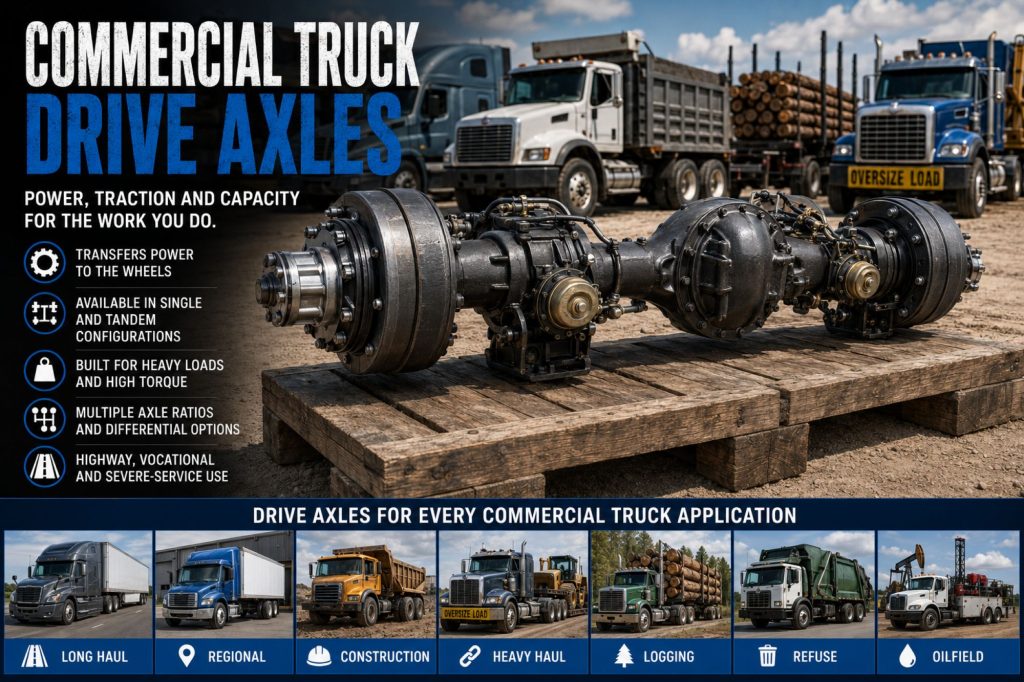
Commercial truck drive axles receive power from the transmission through the driveshaft and transfer that power to the truck’s wheels. They also provide the final gear reduction that helps convert engine power into the torque needed to move the vehicle and its load.
Drive axles are used throughout medium-duty, heavy-duty, vocational, long-haul, construction, logging, heavy-haul, severe-service, and specialized commercial vehicle applications.
Truck Equipment Atlas covers single drive axles, tandem-drive systems, planetary drive axles, electric drive axles, axle carriers, differentials, power dividers, gear ratios, capacities, maintenance considerations, and individual drive-axle models from major commercial drivetrain manufacturers.
Commercial Truck Drive Axles on Truck Equipment Atlas
Explore the commercial truck drive axles and related axle-carrier systems being added to Truck Equipment Atlas:
Cummins-Meritor
- Meritor 14X Tandem Drive Axle
- Meritor 14X HE Tandem Drive Axle
- Meritor 17X Drive Axle
- Meritor 18X Drive Axle
- Meritor P600 Planetary Drive Axle
- Meritor 14Xe Electric Powertrain
Dana Spicer
- Dana Spicer AdvanTEK 40 Tandem Axle
- Dana Spicer AdvanTEK 40 Pro Tandem Axle
- Dana Spicer S140 Series
- Dana Spicer D172 Series
- Dana Spicer D190 Series
- Dana Spicer S172 Series
- Dana Spicer S190 Series
- Dana Spicer eS5700r Electric Drive Axle
Detroit
PACCAR
Mack
- Mack S38 and S40 Axles
- Mack S440 and S462 Axles
- Mack C150 and C151 Axle Carriers
- Mack C200 Series Axle Carriers
Additional single, tandem, planetary, severe-service, and electric drive-axle systems will be added as the Truck Equipment Atlas Axle and Differential Library continues to expand.
How Commercial Truck Drive Axles Work
Power produced by the engine travels through the transmission and into the driveshaft. The driveshaft connects to the input yoke or flange of the drive axle.
Inside the axle carrier, the drive pinion turns the ring gear. This changes the direction of power flow and provides the final mechanical reduction before torque reaches the wheels.
The differential distributes torque between the left and right axle shafts while allowing the wheels to rotate at different speeds during turns. Without this differential action, the tires would scrub across the pavement because the outside wheel must travel farther than the inside wheel.
A single-drive-axle truck sends power to one rear axle. A tandem-drive configuration distributes power between two rear axles through an inter-axle differential or power divider.
Single Drive Axles
A single drive axle uses one powered rear axle assembly to move the vehicle.
Single-drive configurations are commonly used on:
- Medium-duty delivery trucks
- Box trucks
- Beverage trucks
- Municipal vehicles
- Utility trucks
- Buses
- Local tractors
- Regional tractors
- Tow trucks
- Fire and emergency vehicles
A single drive axle generally weighs less and contains fewer drivetrain components than a conventional tandem-drive system. However, its traction and gross axle capacity may be lower.
The axle’s exact capability depends on its gross axle weight rating, torque rating, gear ratio, housing, carrier, axle shafts, wheel ends, suspension, brakes, tires, and vehicle application.
Tandem Drive Axles
A tandem-drive system uses two powered rear axle positions. These are commonly described as the forward-rear axle and rear-rear axle.
An inter-axle differential or power divider distributes torque between the two axle assemblies. This allows both axles to contribute traction while accommodating limited speed differences between them.
Tandem drive axles are commonly used on:
- Class 8 highway tractors
- Dump trucks
- Concrete mixers
- Logging trucks
- Refuse trucks
- Heavy-haul tractors
- Construction trucks
- Oilfield trucks
- Mining vehicles
- Severe-service trucks
- Tank trucks
- Specialized transport equipment
Tandem drive axles provide greater combined load capacity and traction than most single-drive configurations. The tradeoffs include additional weight, friction, components, tires, maintenance, and purchase cost.
6×2 and 6×4 Drive Configurations
Commercial trucks commonly use 6×2 or 6×4 rear-axle configurations.
6×2 Configuration
A 6×2 truck has three primary axle positions, but only one rear axle is powered. The other rear axle functions as a non-driven tag or pusher axle.
Potential advantages can include:
- Reduced vehicle weight
- Fewer powered drivetrain components
- Reduced mechanical losses
- Improved payload potential
- Lower maintenance in certain applications
Considerations can include reduced traction under some conditions, different tire-wear patterns, liftable or load-shifting axle controls, driver familiarity, and resale demand.
6×4 Configuration
A 6×4 truck has three primary axle positions with both rear axles powered.
The 6×4 arrangement is one of the most common configurations used on North American Class 8 tractors and vocational trucks.
Potential advantages include:
- Stronger traction
- Greater application flexibility
- Proven heavy-duty operation
- Broad service familiarity
- Suitability for highway and vocational work
Considerations include greater weight, additional drivetrain components, increased mechanical losses, and higher maintenance costs than a comparable 6×2 configuration.
Planetary Drive Axles
Planetary drive axles provide additional gear reduction near the wheel ends. A planetary gearset distributes torque through multiple gears, reducing the torque load carried by certain upstream components.
These systems are used in applications that require substantial torque multiplication, durability, and severe-duty capability.
Common applications include:
- Mining trucks
- Oilfield vehicles
- Military vehicles
- Extreme heavy-haul trucks
- Construction equipment
- Off-highway vehicles
- Specialized severe-service trucks
Planetary axles can provide exceptional capability but are generally heavier, more complex, and more expensive than conventional single-reduction drive axles.
Electric Drive Axles
Electric drive axles integrate electric propulsion components with the axle assembly.
Depending on the design, an electric axle may include:
- Electric motor
- Reduction gearing
- Differential
- Axle shafts
- Wheel-end connections
- Cooling components
- Electronic controls
- Power-electronics connections
Electric drive axles can reduce the need for some traditional components between the power source and wheels. They are increasingly relevant to electric delivery trucks, buses, refuse vehicles, terminal tractors, regional trucks, and other commercial electric vehicles.
Explore Electric Drive Axles for additional information.
Axle Carriers and Differentials
The axle carrier contains the ring-and-pinion gearing, differential, bearings, and related components that transfer and distribute torque.
Depending on the axle, available differential equipment may include:
- Open differential
- Driver-controlled differential lock
- Limited-slip differential
- Inter-axle differential
- Power divider
- Automatic traction-control features
- Electronic traction-system integration
The axle housing and carrier may be serviced separately on certain systems, but replacement components must match the exact axle model, ratio, spline configuration, housing, and application.
Explore Truck Differentials for more information about differential designs and traction systems.
Axle Ratios and Drive-Axle Selection
Axle ratio describes the relationship between driveshaft rotation and wheel rotation.
For example, a 3.55 axle ratio means the driveshaft rotates approximately 3.55 times for each complete wheel rotation.
A numerically higher axle ratio generally provides:
- Greater torque multiplication
- Stronger startability
- Improved grade capability
- Better support for heavy loads
- Higher engine speed at a given road speed
A numerically lower axle ratio generally provides:
- Lower engine speed at highway speeds
- Potential fuel-efficiency improvements
- Compatibility with downsped powertrains
- Reduced torque multiplication
- Greater dependence on engine torque and transmission gearing
The correct axle ratio depends on:
- Engine torque
- Engine operating range
- Transmission ratios
- Direct-drive or overdrive transmission configuration
- Tire diameter
- Gross vehicle weight
- Gross combination weight
- Highway speed
- Terrain
- Startability
- Gradeability
- Duty cycle
- Heavy-haul requirements
Axle ratio should be selected as part of the complete powertrain rather than as an isolated specification.
Learn more in Commercial Truck Axle Ratios Explained.
Highway Drive-Axle Applications
Long-haul and regional trucks require drive axles capable of transferring substantial engine torque efficiently during extended highway operation.
Important considerations can include:
- Fuel efficiency
- Fast axle ratios
- Downspeeding capability
- Axle weight
- Payload capacity
- Lubrication management
- Highway durability
- Noise and vibration
- Powertrain integration
- Maintenance intervals
- Service availability
Modern highway axle systems may use reduced lubricant levels, precision-finished gears, high-efficiency bearings, optimized housings, and faster ratios to reduce parasitic drivetrain losses.
Vocational Drive-Axle Applications
Vocational trucks can place significantly different demands on drive axles than highway tractors.
Common applications include:
- Dump trucks
- Refuse trucks
- Concrete mixers
- Construction trucks
- Logging trucks
- Heavy-haul tractors
- Utility trucks
- Municipal vehicles
- Snowplows
- Oilfield trucks
- Mining vehicles
- Fire and emergency vehicles
- Severe-service equipment
These applications may require higher axle ratings, stronger housings, deeper ratios, greater ground clearance, differential locks, planetary reduction, additional driven axles, specialized suspension compatibility, or increased resistance to shock loading.
Heavy-Haul and Severe-Service Applications
Heavy-haul and severe-service trucks operate at high gross vehicle or combination weights and may encounter steep grades, loose surfaces, uneven terrain, and frequent low-speed operation.
Drive-axle considerations can include:
- Gross axle weight rating
- Gross combination weight
- Engine torque
- Transmission reduction
- Axle ratio
- Differential locks
- Power-divider design
- Planetary reduction
- Axle housing construction
- Suspension articulation
- Tire capacity
- Wheel-end capacity
- Brake capacity
- Lubrication requirements
- Expected shock loading
Additional axles do not automatically make a heavy load legal or mechanically suitable. Weight must be distributed correctly, and every component must remain within its approved rating.
Advantages of Commercial Truck Drive Axles
Depending on their design and application, modern drive axles can provide:
- High load-bearing capacity
- Effective drivetrain torque transfer
- Multiple capacity ratings
- Broad gear-ratio availability
- Improved traction
- Single and tandem configurations
- Highway-efficiency designs
- Severe-service configurations
- Driver-controlled differential locks
- Power-divider capability
- Planetary reduction for extreme applications
- Integration with modern engines and transmissions
- Electric propulsion options
The actual benefits depend on the axle model and how well it is matched to the truck and operating application.
Drive-Axle Limitations and Considerations
No single drive axle is appropriate for every commercial truck.
Important considerations include:
- Axle capacity
- Axle weight
- Gear ratio
- Engine torque limit
- Transmission compatibility
- Suspension compatibility
- Brake configuration
- Wheel-end configuration
- Differential options
- Tire size and capacity
- Driveline angles
- Lubricant requirements
- Maintenance intervals
- Parts availability
- Service availability
- Application and duty cycle
A lightweight highway axle may not be suitable for severe vocational operation. A heavy planetary axle may provide exceptional capability but add unnecessary weight, cost, and mechanical complexity to a highway truck.
Driver and Operator Considerations
Drivers should understand the truck’s drive-axle configuration and available traction controls.
Important operating considerations include:
- Single versus tandem drive
- Inter-axle differential operation
- Power-divider controls
- Wheel differential locks
- Liftable or load-shifting axles
- Traction-control systems
- Maximum axle ratings
- Proper weight distribution
- Tire matching
- Warning lights and fault messages
Differential locks should be engaged and disengaged according to manufacturer instructions. Using locked differentials while turning on high-traction pavement can cause tire scrub, steering resistance, driveline binding, and component damage.
Drivers should monitor for unusual whining, humming, clunking, vibration, wheel-end heat, lubricant odors, visible leaks, uneven tire wear, or changes in traction-system operation.
Maintenance and Ownership
Commercial drive axles require proper maintenance to provide reliable service.
Important maintenance areas can include:
- Axle lubricant level
- Lubricant condition
- Lubricant replacement intervals
- Pinion seals
- Wheel seals
- Differential and carrier components
- Power-divider operation
- Inter-axle differential operation
- Differential-lock actuators
- Axle shafts
- Wheel bearings
- Hub assemblies
- Axle housings
- Breather vents
- Driveshafts
- Universal joints
- Driveline angles
- Tire matching
- Axle alignment
Maintenance requirements vary between manufacturers, models, lubricants, duty cycles, and axle configurations. Owners and technicians should follow the service procedures specified for the exact axle model and application.
Choosing a Commercial Truck Drive Axle
Selecting a drive axle requires evaluating the complete vehicle specification.
Important factors include:
- Truck class
- Truck configuration
- Engine
- Engine torque
- Transmission
- Transmission ratios
- Gross vehicle weight
- Gross combination weight
- Highway or vocational operation
- Heavy-haul requirements
- Terrain
- Normal road speed
- Tire size
- Axle ratio
- Startability
- Gradeability
- Differential-lock requirements
- Suspension
- Brakes
- Wheel ends
- Maintenance capabilities
- Dealer and service support
There is no single best drive axle for every commercial truck. The best axle is one properly matched to the engine, transmission, tires, vehicle ratings, operating conditions, and work the truck is expected to perform.
Related Axle and Differential Categories
Explore additional axle and differential categories:
- Commercial Truck Steer Axles
- Lift Axles and Auxiliary Axles
- Truck Differentials
- Electric Drive Axles
- Commercial Trailer Axles
- Axle and Differential Guides
Related Truck Equipment Resources
- Commercial Trucks
- Diesel Engines
- Commercial Truck Transmissions
- Suspension Systems
- Brake Systems
- Tires and Wheels
- Equipment Systems
Understanding how the engine, transmission, driveshaft, drive axles, differentials, axle ratios, suspension, tires, and vehicle application work together is essential when evaluating a commercial truck drivetrain.
Explore the Complete Axle and Differential Library
Commercial truck drive axles represent one part of the larger commercial axle and drivetrain landscape.
Visit the Truck Equipment Atlas Axle and Differential Library to explore steer axles, drive axles, lift axles, truck differentials, trailer axles, electric axles, individual equipment profiles, and educational guides.
Additional drive-axle models, historical axle families, manufacturers, differential systems, and educational resources will be added as Truck Equipment Atlas continues to expand.