
Mack C150 and C151 Axle Carriers
Quick Facts
- Manufacturer: Mack Trucks
- Parent Company: Volvo Group
- Product Family: Mack C150 and C151 Axle Carriers
- Alternative Designations: CRD150 and CRD151
- Carrier Type: Top-mounted dual-reduction tandem axle carriers
- C150 Position: Forward carrier in the tandem axle group
- C151 Position: Rear carrier in the tandem axle group
- Published Ratio Range: Approximately 3.11 to 5.66
- Primary Applications: Highway, regional, vocational, construction, refuse, and heavy-haul trucks
- Compatible Axle Families: Application-dependent Mack tandem axle housings, including selected S440 and S462 configurations
- Gear Design: Mack Durapoid bevel gearing with secondary reduction
- Power Divider: Mack automatic interaxle power divider in applicable forward carriers
- Optional Traction Equipment: Power-divider lockout and interwheel differential systems
- Carrier Position: Top-mounted in the axle housing
- Product Page Slug: mack-c150-and-c151-axle-carriers
Overview
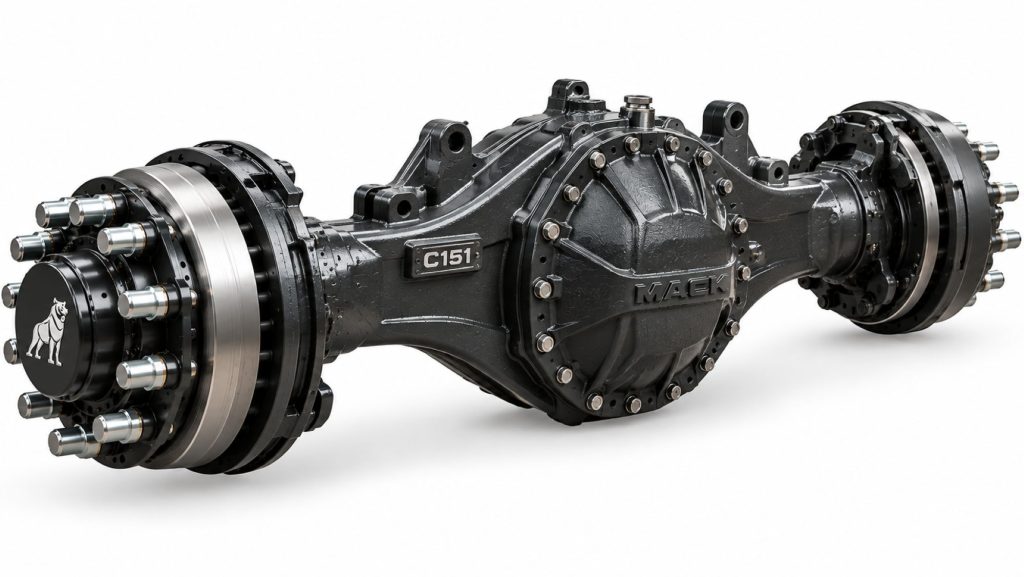
The Mack C150 and C151 are top-mounted, dual-reduction differential carriers used together in compatible Mack tandem drive axle systems. They are also commonly identified in service and parts information as the CRD150 and CRD151.
The C150 is installed in the forward axle of the tandem and includes the input and through-shaft arrangement needed to transfer power toward the rear axle. The C151 is installed in the rear axle and receives torque through the interaxle driveline.
These carriers retain Mack’s traditional top-mounted and dual-reduction architecture while providing ratios suitable for highway and vocational applications. Published ratios extend from approximately 3.11 to 5.66.
Key Characteristics
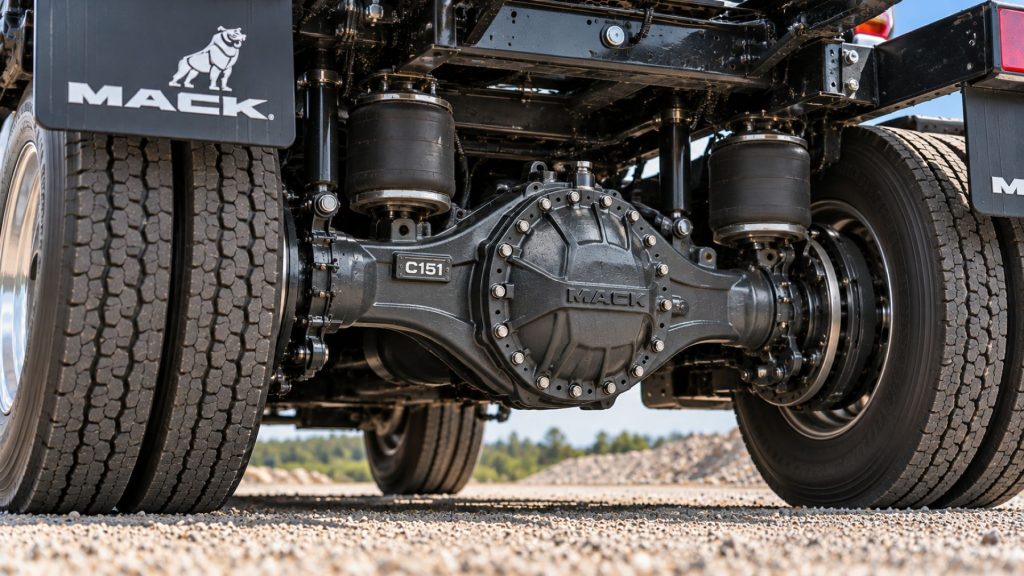
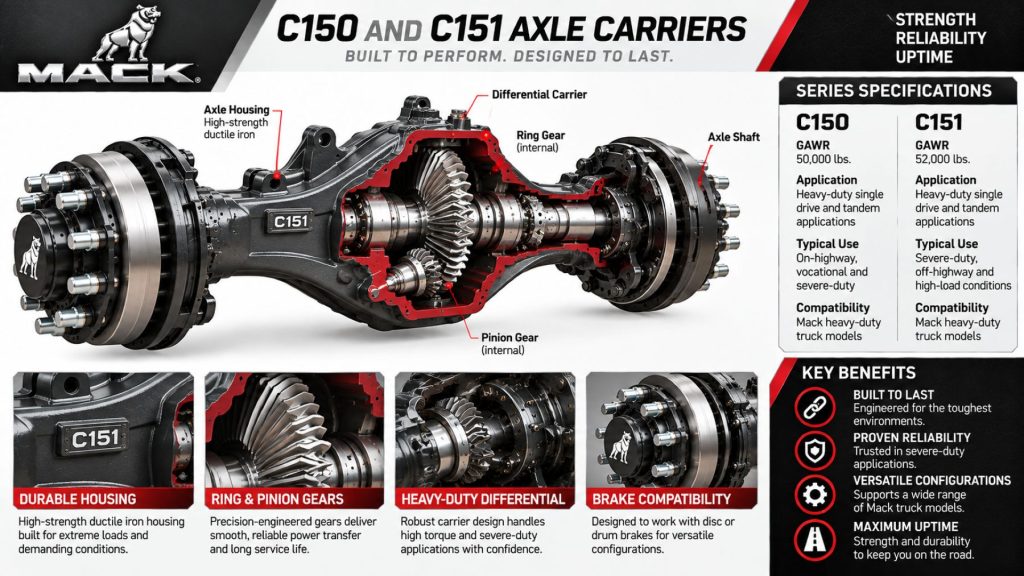
The C150 and C151 use two stages of gear reduction. The first stage uses Mack’s Durapoid bevel gearing, while the secondary stage provides additional reduction before torque reaches the wheel differential and axle shafts.
The top-mounted design positions the carriers and driveshafts higher than many conventional axle arrangements. This improves ground clearance and helps protect the driveline during construction, refuse, logging, and other vocational operations.
The C150 forward carrier can incorporate Mack’s automatic interaxle power divider. This system can transfer up to approximately 75 percent of available torque toward the axle with greater traction.
Optional power-divider lockout and interwheel traction systems may be available, depending on the carrier variation and truck specification.
How the Axle or Differential Works
Engine torque travels through the transmission and main driveshaft to the input of the C150 forward carrier.
The first gear stage changes the direction of power flow and begins the reduction process. The secondary reduction further multiplies torque before it reaches the wheel differential and axle shafts.
The C150’s through-shaft arrangement sends power through the interaxle driveshaft to the C151 rear carrier. The C151 then reduces and distributes torque to the rear axle shafts.
Under normal conditions, the wheel differentials allow the left and right wheels to rotate at different speeds. The interaxle power divider allows the forward and rear axles to compensate for speed differences while helping direct torque toward the axle with better traction.
Axle Position and Function
The C150 is installed in the forward axle housing of a Mack tandem drive system. It receives power from the transmission and distributes that power to the forward axle and the rear carrier.
The C151 is installed in the rear axle housing. It receives torque through the short interaxle driveshaft and transfers it to the rear axle shafts and wheels.
Together, the carriers provide final drive reduction, differential action, torque distribution, and traction management for a conventional Mack 6×4 drivetrain.
The carrier itself does not independently establish the axle’s gross axle weight rating. Capacity depends on the carrier, housing, shafts, suspension, brakes, hubs, wheels, tires, and complete vehicle approval.
Common Specifications
- Carrier Configuration: Matched forward and rear tandem carriers
- Forward Carrier: C150 or CRD150
- Rear Carrier: C151 or CRD151
- Reduction Design: Dual reduction
- First Reduction: Mack Durapoid bevel gearing
- Second Reduction: Application-specific secondary gear reduction
- Carrier Mounting: Top-mounted
- Published Ratio Range: 3.11 to 5.66
- Common Published Ratios: 3.11, 3.25, 3.40, 3.56, 3.79, 3.98, 4.19, 4.50, 4.80, 5.04, 5.31, and 5.66
- Interaxle Power Divider: Automatic torque-biasing system on applicable C150 carriers
- Maximum Automatic Torque Transfer: Up to approximately 75 percent toward the axle with greater traction
- Power-Divider Lockout: Optional on applicable configurations
- Interwheel Traction Option: Available on certain carrier variants
- Related Locking Variants: CRD1501 and CRD1511 configurations may use air-operated interwheel locking differentials
Exact ratios, carrier housings, gearsets, lockout systems, shafts, yokes, bearings, and application ratings must be verified from the carrier identification information.
Axle Ratios and Gearing
The C150 and C151 carrier family covers ratios from approximately 3.11 to 5.66. Both carriers in the tandem must use the same approved ratio.
Ratios such as 3.11, 3.25, and 3.40 may be used with approved Mack automated transmissions in applications requiring lower engine speed during highway travel.
Ratios such as 3.56, 3.79, 3.98, and 4.19 provide progressively greater torque multiplication for regional, construction, and mixed vocational work.
Ratios such as 4.50, 4.80, 5.04, 5.31, and 5.66 are better suited to applications prioritizing low-speed pulling power, heavy starts, gradeability, and vocational performance.
Not every ratio is compatible with every interwheel power divider, differential lock, engine, transmission, tire size, or gross combination weight rating.
Differential and Traction Options
The standard carrier arrangement includes wheel differentials and the Mack interaxle power divider.
Mack’s automatic interaxle power divider uses cam and wedge components rather than a conventional open gear differential. It can direct up to approximately 75 percent of available torque toward the axle with greater resistance and traction.
An optional interwheel power divider operates between the left and right wheels. It can also redirect up to approximately 75 percent of available torque toward the wheel with greater traction without requiring normal driver intervention.
A driver-controlled power-divider lockout may be used in exceptionally slippery conditions. The air-operated lockout couples the tandem carriers into a more direct positive-drive arrangement.
Brake and Wheel-End Options
The C150 and C151 are differential carrier assemblies and do not independently determine the truck’s brake or wheel-end configuration.
Compatible Mack axle housings may use approved air drum or air disc brakes. Wheel-end options can include conventional hubs, aluminum hubs, dual tires, wide-base tires, and extended-maintenance bearing systems.
Brake and wheel-end compatibility depends on the axle housing, suspension, track width, spindle, hub, wheel, tire, and truck specification.
The complete axle assembly must be identified before ordering brake, hub, bearing, seal, or axle-shaft components.
Common Applications
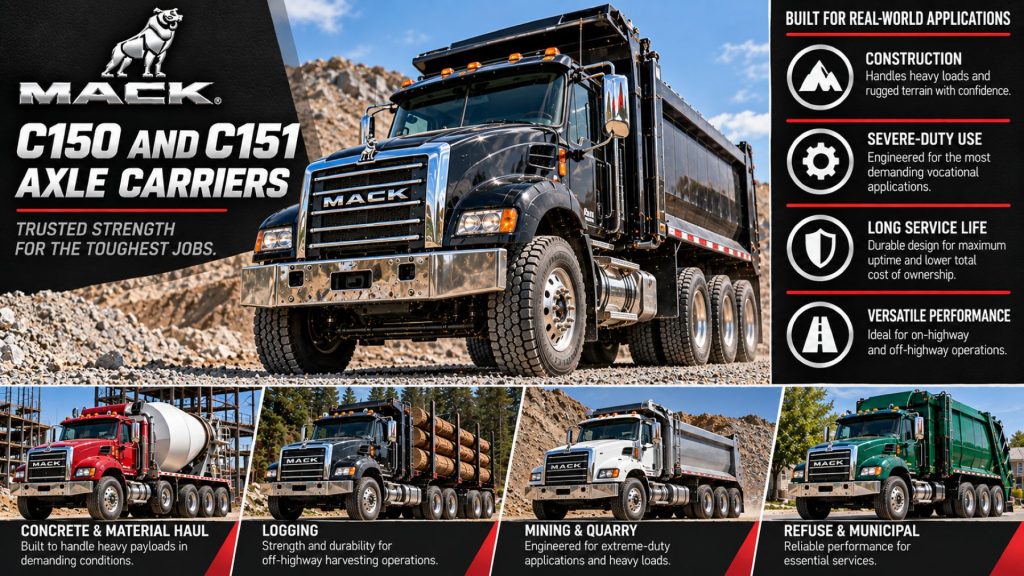
- Highway tractors
- Regional-haul tractors
- Dump trucks
- Concrete mixer trucks
- Concrete pump trucks
- Refuse trucks
- Construction trucks
- Municipal vehicles
- Snowplows
- Logging trucks
- Heavy-haul tractors
- Transfer trucks
- Utility vehicles
- Oilfield service trucks
- Specialized vocational equipment
Truck, Suspension, and Drivetrain Compatibility
The C150 and C151 are used in compatible Mack tandem axle housings and 6×4 drivetrains. Their application depends on axle capacity, housing construction, suspension, ratio, engine torque, and transmission.
Selected Mack S440 and S462 axle configurations can use 150- and 151-series carriers. Other application-approved Mack axle housings may also support these carriers.
The carriers can be paired with Mack engines and Mack manual or automated transmissions when the complete powertrain is approved for the selected ratio and gross combination weight.
Because these carriers use a top-mounted design, replacement components must preserve the original main and interaxle driveshaft geometry.
Advantages
- Mack-designed tandem carrier system
- Top-mounted carrier configuration
- Dual-reduction gearing
- Durapoid bevel gear design
- Ratios for highway and vocational operation
- Automatic interaxle torque biasing
- Transfers up to approximately 75 percent of torque toward the axle with traction
- Optional interwheel torque-biasing system
- Available power-divider lockout
- Improved driveline ground clearance
- Favorable driveshaft alignment
- Reduced exposure to job-site obstacles
- Integration with Mack axles and suspensions
- Strong vocational operating history
- Mack dealer and aftermarket parts support
Limitations or Considerations
- Carriers must be matched as a forward and rear pair
- Both carriers must use the same axle ratio
- Carrier selection alone does not establish axle capacity
- Not every ratio supports every differential option
- Dual-reduction carriers contain more gearing than a single-reduction axle
- Incorrect setup can produce noise, heat, and rapid gear wear
- Top-mounted carriers require compatible axle housings
- Replacement yokes and shafts must match the original configuration
- Power-divider components require correct inspection and adjustment
- Automatic torque biasing cannot overcome a complete lack of resistance in every situation
- Power-divider lockout requires correct driver operation
- Used carriers may contain internal wear not visible externally
- Some parts differ between C150, C151, CRD1501, and CRD1511 variants
Driver and Operator Experience
The automatic interaxle power divider operates without normal driver intervention. When one axle begins to lose traction, the system can redirect additional torque toward the axle with better traction.
Drivers may therefore experience improved mobility without manually locking the tandem during every minor traction event.
The optional power-divider lockout is intended for more difficult conditions. Drivers must follow Mack instructions when engaging or disengaging the lockout.
New gear whine, clunking, vibration, delayed lock engagement, or unusual tire scrub can indicate a problem with the carriers, power divider, driveline, tires, or lubricant.
Maintenance and Ownership Notes
Routine maintenance includes checking carrier lubricant, inspecting axle breathers, examining pinion and housing seals, and monitoring the main and interaxle driveshafts.
The C150 forward carrier contains additional components for the input, through-shaft, and power-divider systems. These parts should receive particular attention when diagnosing vibration, noise, or traction problems.
The correct Mack-approved lubricant must be used. Lubricant requirements and change intervals depend on the axle, application, duty cycle, and operating temperature.
Carrier replacement or rebuilding requires accurate bearing preload, gear backlash, gear contact, shaft adjustment, and seal installation.
Common Axle or Differential Problems
- Input pinion seal leakage
- Carrier bowl lubricant leaks
- Low or contaminated lubricant
- Restricted axle breathers
- Ring-and-pinion gear wear
- Secondary reduction gear wear
- Pinion-bearing wear
- Differential-bearing wear
- Excessive gear backlash
- Incorrect gear contact pattern
- Power-divider cam or wedge wear
- Power-divider lockout problems
- Interwheel power-divider problems
- Air-operated differential-lock problems
- Through-shaft bearing wear
- Interaxle driveshaft vibration
- Yoke or universal-joint wear
- Clunking during acceleration or deceleration
- Whining or humming under load
- Overheating caused by low lubricant or incorrect setup
Identification Information
- Manufacturer: Mack Trucks
- Forward Carrier Designation: C150 or CRD150
- Rear Carrier Designation: C151 or CRD151
- Related Locking Variants: CRD1501 and CRD1511
- Primary Identification Source: Carrier tag, stamped part number, or casting information
- Important Carrier Information: Model, part number, serial number, ratio, and differential configuration
- Important Forward Carrier Information: Input design, through-shaft, power divider, and lockout configuration
- Important Rear Carrier Information: Gearset, differential type, and axle-shaft compatibility
- Vehicle Information: Mack model, year, VIN, and original build sheet
- Axle Information: Axle housing model, capacity, suspension, brakes, hubs, and track width
Both carriers should be identified before ordering gears, bearings, shafts, seals, differential components, power-divider parts, or replacement assemblies.
Buying Considerations
- C150 or C151 carrier position
- CRD150, CRD151, CRD1501, or CRD1511 designation
- Exact carrier part number
- Original axle ratio
- Forward and rear carrier ratio match
- Axle housing model
- Tandem axle rating
- Engine torque
- Transmission model
- Tire size
- Gross combination weight
- Power-divider design
- Power-divider lockout availability
- Interwheel traction system
- Input yoke dimensions
- Through-shaft arrangement
- Axle-shaft spline compatibility
- Condition of gears, bearings, shafts, and differential components
- Evidence of overheating, lubricant contamination, or gear damage
- Availability of rebuild parts and qualified service
Variants and Configurations
- Mack C150 forward carrier
- Mack C151 rear carrier
- Mack CRD150 forward carrier
- Mack CRD151 rear carrier
- Mack CRD1501 locking forward carrier
- Mack CRD1511 locking rear carrier
- Standard interaxle power divider
- Power divider with driver-controlled lockout
- Standard wheel differential
- Interwheel power-divider configuration
- Air-operated interwheel differential lock
- Highway-oriented ratios
- Regional-haul ratios
- Vocational ratios
- Matched carrier sets
- Remanufactured carrier assemblies
- Individual replacement carriers
Comparison to Similar Equipment
The C150 and C151 replaced or supplemented earlier Mack carrier families with updated gearing, lighter construction, and ratios for modern highway and vocational powertrains.
They are used within selected Mack S440 and S462 Axles and related Mack tandem configurations.
The lighter Mack S38 and S40 Axles may use different carrier and housing combinations according to the truck’s capacity and application.
Unlike a complete tandem axle, the C150 and C151 are removable carrier assemblies. The axle housings, shafts, brakes, hubs, suspension, and wheel ends remain separate components.
Best Fit For
- Compatible Mack tandem axle systems
- Mack S440 axle applications
- Selected Mack S462 axle applications
- Highway trucks requiring ratios near 3.11 to 3.40
- Regional trucks requiring balanced gearing
- Vocational trucks requiring higher numerical ratios
- Construction and dump trucks
- Concrete mixer trucks
- Refuse vehicles
- Logging and heavy-haul trucks
- Fleets needing automatic interaxle torque biasing
- Applications requiring a power-divider lockout
- Owners restoring or repairing compatible Mack axles
Related Truck Types
- Vocational Trucks
- Severe-Service Trucks
- Heavy-Haul Trucks
- Dump Trucks
- Concrete Mixer Trucks
- Logging Trucks
Related Truck Models
- Mack Granite
- Mack Pinnacle
- Mack Anthem
- Mack TerraPro
- Mack LR
Related Axle and Differential Types
- Mack S440 and S462 Axles
- Mack S38 and S40 Axles
- Detroit Tandem Rear Axle
- Dana Spicer D172 Series
- Dana Spicer D190 Series
- Commercial Truck Axles and Differentials
Related Equipment Systems
- Transmission Systems
- Suspension Systems
- Driveshaft Systems
- Brake Systems
- Tires and Wheels
- Traction Control Systems
Related Guides
- How Commercial Truck Axles and Differentials Work
- Commercial Truck Axle Ratios Explained
- Open vs Locking vs Limited-Slip Differentials
Regulatory and Compliance Notes
The C150 and C151 carrier ratings and ratios must be approved for the engine torque, transmission, axle housing, suspension, tires, wheels, brakes, and complete vehicle application.
Installing a different carrier or ratio can affect engine speed, road speed, gradeability, emissions-system operation, speedometer calibration, transmission programming, and driveline torque.
Both tandem carriers must use matching ratios. Operating mismatched carriers can cause severe driveline binding and component failure.
Power-divider and differential-lock systems must be operated and repaired according to Mack procedures.
Real World Operating Notes
The C150 and C151 provide the greatest benefit when used as a correctly matched pair within their approved Mack axle housings.
The automatic power divider can improve traction without requiring the driver to operate a switch during every minor traction event. The optional lockout remains useful in exceptionally slippery conditions.
Higher numerical ratios provide stronger pulling performance but increase engine speed and reduce maximum road speed. Ratio selection should reflect the truck’s actual duty cycle.
Frequently Asked Questions
What is the difference between the Mack C150 and C151?
The C150 is the forward tandem carrier. It includes the input, through-shaft, and power-divider arrangements. The C151 is the rear carrier and receives power through the interaxle driveshaft.
Are C150 and CRD150 the same type of carrier?
C150 is commonly used as a shortened product designation, while CRD150 appears in Mack service and parts information. The complete part number should still be verified.
Are these single- or dual-reduction carriers?
They are top-mounted dual-reduction tandem carriers.
What axle ratios are available?
Published ratios extend from approximately 3.11 to 5.66. Exact availability depends on carrier variation and application.
What is the Mack interaxle power divider?
It is an automatic torque-biasing system that can redirect up to approximately 75 percent of available torque toward the axle with greater traction.
Does the power divider require driver operation?
The standard torque-biasing function operates automatically. An optional lockout can be controlled by the driver for exceptionally slippery conditions.
What is an interwheel power divider?
It is an optional system that biases torque between the left and right wheels. It can be combined with the interaxle power divider for improved traction.
Can a C150 be installed in the rear axle position?
No. The C150 is designed for the forward position because it contains the input and through-shaft arrangement. The C151 is designed for the rear position.
Can different ratios be used in the two carriers?
No. The forward and rear carriers must use matching approved ratios.
Which Mack axles use these carriers?
Selected S440, S462, and other application-approved Mack tandem axle housings can use 150- and 151-series carriers.
What commonly causes carrier noise?
Common causes include low lubricant, bearing wear, gear damage, incorrect backlash, improper gear contact, driveline vibration, or previous incorrect assembly.
How should a replacement carrier be identified?
Use the carrier tag, stamped part number, ratio, differential configuration, axle housing model, and Mack vehicle build sheet.
Availability and Where to Find
Mack C150 and C151 axle carriers may be available as new service components, remanufactured exchange units, or used assemblies.
Authorized Mack dealers can use the truck’s VIN and carrier identification to locate compatible replacements. Independent differential rebuilders and heavy-truck parts suppliers may also offer complete carriers and internal components.
Before purchasing, verify the carrier position, complete model, part number, ratio, power-divider configuration, differential options, yokes, axle housing, and original vehicle application.
Current information about Mack carrier technology is available through the Mack Axles and Carriers page.
Support Trucking Families
Truck Equipment Atlas supports the mission of Grey Cross, a nonprofit dedicated to helping families of truck drivers who lose their lives while on the road. As the site grows, part of its mission is to bring awareness and support to these families.
Podcast or Video Section
Learn More Through Audio and Video
Truck Equipment Atlas will continue expanding with podcast episodes, interviews, and equipment breakdowns to help drivers and fleets better understand trucks and equipment.
Follow the Growth of Truck Equipment Atlas
Truck Equipment Atlas continues to expand with new truck profiles, trailer coverage, diesel engine pages, equipment system resources, manufacturer information, and educational guides.
Visit our Site Updates page to explore recent additions, project milestones, and upcoming resources as we continue building one of the industry’s growing commercial trucking equipment reference libraries.
View the Latest Site Updates: Truck Equipment Atlas Site Updates