
Meritor 14Xe Electric Powertrain
Quick Facts
- Manufacturer: Meritor, now part of Cummins and Accelera by Cummins
- Equipment Type: Integrated Electric Axle and Commercial-Vehicle Powertrain
- Base Axle Architecture: Meritor 14X Axle Housing
- Continuous Power Range: Approximately 130 to 200 kW, depending on configuration and generation
- Peak Power: Up to approximately 250 kW on established configurations
- Gross Axle Weight Rating: Approximately 13,600 to 26,000 pounds per axle
- High-Voltage Range: Approximately 450 to 750 volts
- Vehicle Classes: Class 6, Class 7, and Class 8
- Powertrain Configurations: Battery Electric, Series Hybrid, Parallel Hybrid, and Plug-In Hybrid
- Regenerative Braking: Supported
- ePTO Compatibility: Available
- Primary Applications: Pickup and Delivery, School Buses, Transit Buses, Refuse Trucks, Line-Haul Trucks, and Terminal Tractors
- Production Status: Current Electric Powertrain Platform with Multiple Generations
Overview
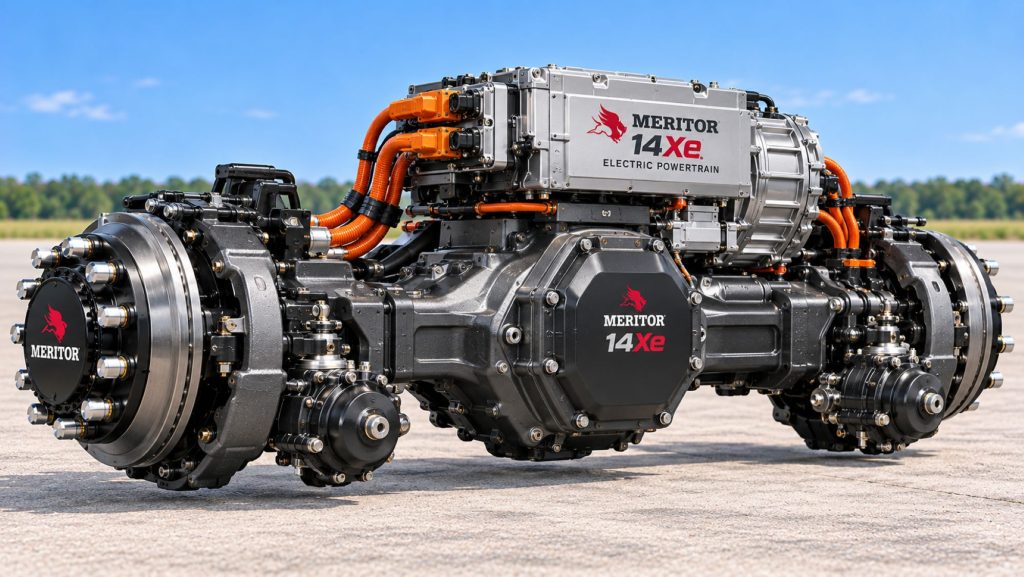
The Meritor 14Xe Electric Powertrain is an integrated electric-drive system developed for medium-duty and heavy-duty commercial vehicles. Instead of placing an electric motor and transmission remotely in the chassis and connecting them to a conventional drive axle, the 14Xe integrates the electric motor, transmission, gearing, and differential into the axle assembly.
The system is built around the proven Meritor 14X axle housing architecture. This allows the 14Xe to retain familiar axle mounting locations and suspension interfaces, helping vehicle manufacturers integrate electric propulsion without completely redesigning the rear chassis.
The modular platform can be configured with different motors, transmissions, gear ratios, brakes, wheel ends, housings, and control systems. This flexibility allows the 14Xe to serve vehicles ranging from Class 6 delivery trucks and school buses to Class 8 refuse trucks and highway tractors.
The 14Xe is part of the broader Electric Drive Axles category within Truck Equipment Atlas.
Key Characteristics
- Integrated electric motor, transmission, and drive axle
- Based on Meritor 14X axle-housing architecture
- Multiple continuous power ratings
- Peak power of up to approximately 250 kW on established configurations
- Multiple transmission options
- Wide range of axle and transmission ratios
- Modular motor and gearing selection
- Regenerative braking capability
- ePTO compatibility
- Optional wheel-end reduction
- Power-dense eCarrier design
- Existing axle mounting-hardware compatibility
- Battery-electric and hybrid compatibility
- High-voltage commercial-vehicle architecture
- Class 6 through Class 8 applications
- Designed to free chassis space for batteries and other equipment
How the Axle or Differential Works
The 14Xe combines functions normally performed by several separate drivetrain components.
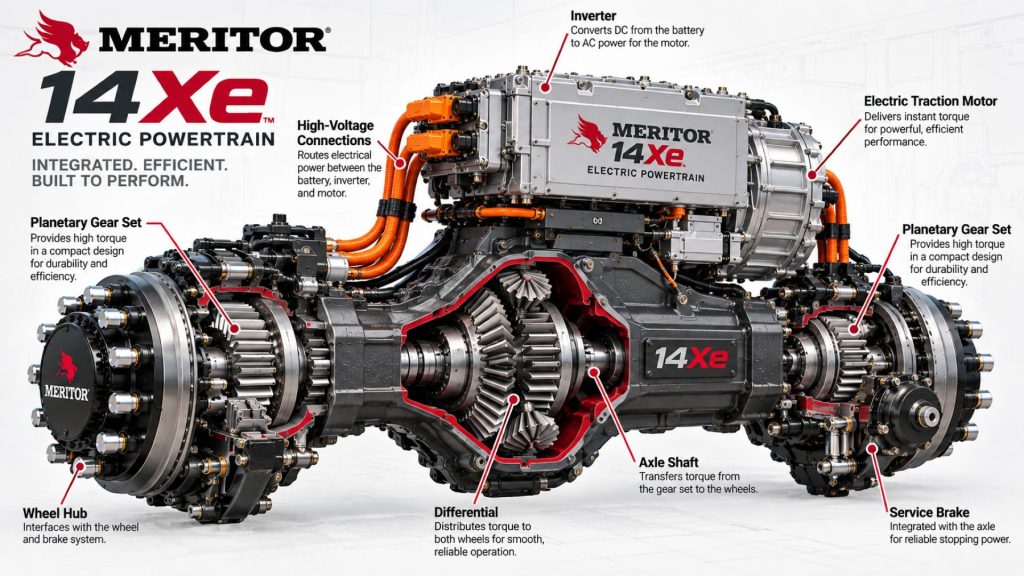
Electrical energy stored in the vehicle’s batteries is delivered through high-voltage cables to the inverter. The inverter controls the electrical power supplied to the traction motor. The motor converts electrical energy into rotational mechanical power.
That power passes through an integrated transmission and reduction gears before reaching the differential. The differential divides torque between the left and right axle shafts while allowing the wheels to rotate at different speeds during turns.
The operating sequence includes:
- The battery stores electrical energy.
- The inverter controls the voltage and current supplied to the motor.
- The traction motor converts electricity into rotational power.
- The integrated transmission selects the appropriate reduction.
- Axle gearing provides additional torque multiplication.
- The differential distributes torque between the left and right wheels.
- The axle shafts and wheel ends transfer torque to the tires.
During deceleration, the system can reverse part of this process. The motor operates as a generator, converting vehicle motion into electrical energy that is returned to the battery through regenerative braking.
Axle Position and Function
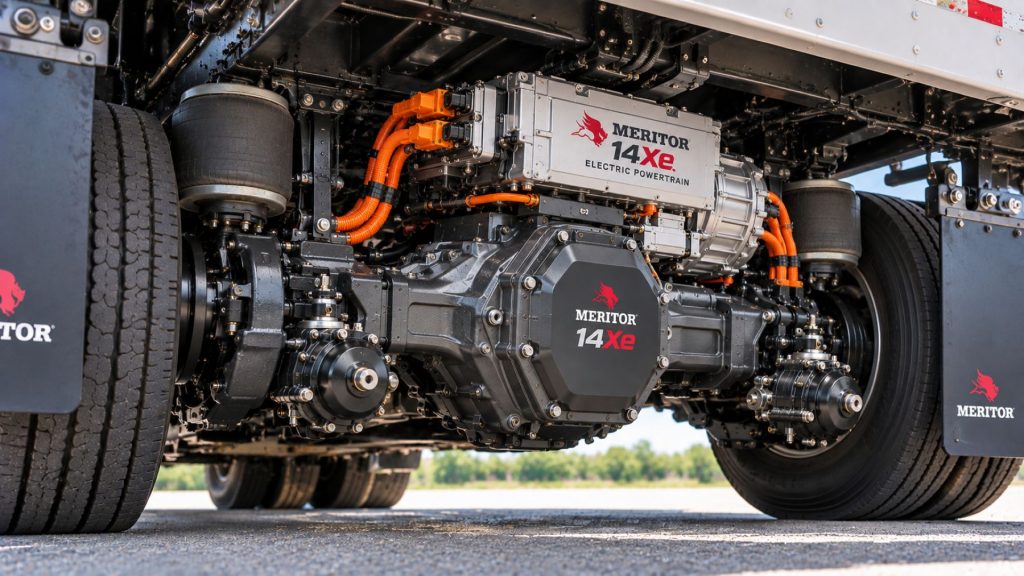
The Meritor 14Xe is installed at a driven axle position beneath the rear portion of the vehicle.
Unlike a conventional axle, the 14Xe does more than support vehicle weight and transfer power from a driveshaft. It actively produces propulsion torque at the axle.
Its primary functions include:
- Supporting vehicle and cargo weight
- Producing electric propulsion
- Providing transmission reduction
- Providing final axle reduction
- Distributing torque between the drive wheels
- Supporting regenerative braking
- Carrying brake and wheel-end components
- Integrating with the suspension
- Reducing the need for a long mechanical driveshaft
- Freeing chassis space for batteries and auxiliary equipment
The integrated layout can improve packaging in short-wheelbase trucks, buses, refuse vehicles, and terminal tractors where chassis space is limited.
Common Specifications
- Powertrain Type: Integrated electric axle
- Continuous Power: Approximately 130, 150, 180, or 200 kW, depending on configuration
- Peak Power: Up to approximately 250 kW on established configurations
- GAWR Range: Approximately 13,600 to 26,000 pounds per axle
- High-Voltage Range: Approximately 450 to 750 volts
- Base Housing: Meritor 14X axle architecture
- Transmission: Multiple integrated transmission options
- Gearing: Multiple axle and transmission ratios
- Wheel-End Reduction: Optional
- Regenerative Braking: Supported
- ePTO: Compatible
- Functional Safety: ISO 26262 and ASIL-C-related design requirements
- Ingress Protection: IP6K6K, IP6K8, and IP6K9K configurations
Specifications vary by product generation. Newer 14Xe Gen 4.5 configurations may use different power, voltage, axle-rating, cooling, inverter, transmission, and control specifications.
Axle Ratios and Gearing
The 14Xe uses a combination of transmission gearing and axle reduction to balance acceleration, gradeability, maximum vehicle speed, efficiency, and regenerative braking.
Depending on the vehicle, the system may use:
- A single-speed transmission
- A two-speed transmission
- A multi-speed transmission
- Different center-carrier ratios
- Optional planetary wheel-end reduction
- Application-specific motor gearing
A delivery truck operating in stop-and-go traffic may require different gearing from a highway tractor. A refuse truck may prioritize launch torque and regenerative braking, while a transit bus may prioritize smooth acceleration and quiet operation.
Lower overall gearing can provide higher road speed and reduced motor RPM. Deeper gearing can provide greater wheel torque, stronger startability, and improved grade performance.
The correct configuration depends on vehicle weight, tire size, route speed, road grades, acceleration requirements, battery capacity, motor operating range, and duty cycle.
Learn more about conventional axle gearing in Commercial Truck Axle Ratios Explained.
Differential and Traction Options
The 14Xe contains a differential that distributes electric-motor torque between the left and right drive wheels.
Depending on the vehicle specification, traction and control systems may include:
- Standard wheel differential
- Differential-lock options
- Electronic traction control
- Anti-lock braking integration
- Electronic stability control
- Motor-torque management
- Wheel-slip control
- Regenerative-braking control
- Friction-brake blending
Electric motors can change torque output very quickly. The vehicle-control system can therefore reduce motor torque when wheel slip is detected and coordinate the electric powertrain with the truck’s braking and stability systems.
Brake and Wheel-End Options
The modular 14Xe architecture supports multiple brake and wheel-end configurations.
Depending on the application, available equipment may include:
- Air disc brakes
- Drum brakes
- Hydraulic brake configurations for applicable vehicle classes
- ABS wheel-speed sensors
- Electronic stability-control integration
- Conventional wheel ends
- Unitized wheel ends
- Dual-wheel configurations
- Wide-base single-tire configurations
- Optional wheel-end reduction
Friction brakes work alongside regenerative braking. During normal deceleration, the motor may recover part of the vehicle’s kinetic energy. The friction brakes provide additional stopping force and remain essential for emergency stops, low-speed braking, parking, and situations where regenerative braking is limited.
Common Applications
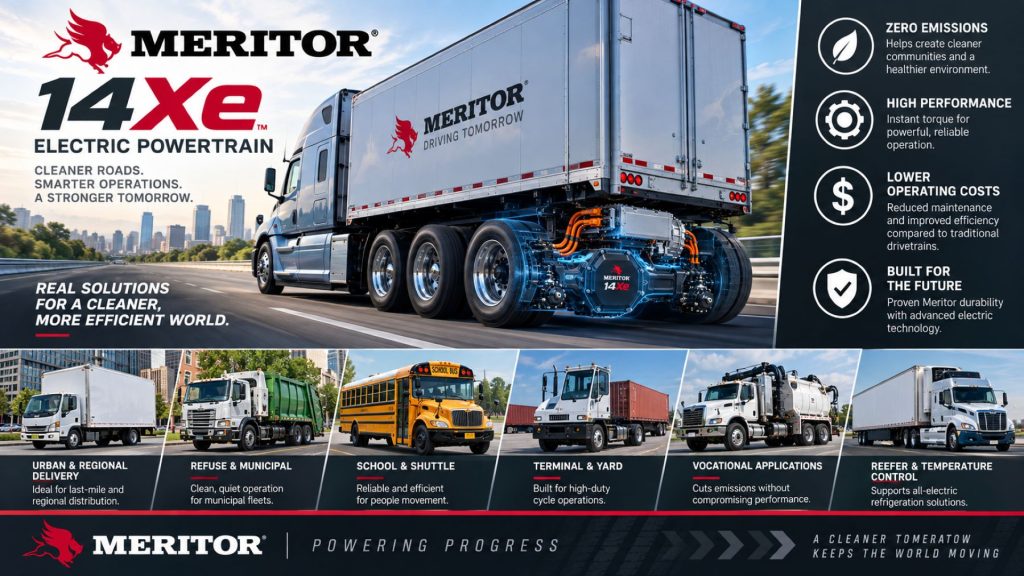
The 14Xe is designed for a broad range of medium-duty and heavy-duty electric vehicles.
Common applications include:
- Class 6 pickup-and-delivery trucks
- Class 7 delivery trucks
- Electric box trucks
- School buses
- Transit buses
- Class 8 refuse trucks
- Regional highway tractors
- Short-haul line-haul trucks
- Drayage tractors
- Terminal tractors
- Yard trucks
- Hydrogen fuel-cell electric vehicles
- Series-hybrid commercial vehicles
- Parallel-hybrid commercial vehicles
- Plug-in hybrid commercial vehicles
Truck, Suspension, and Drivetrain Compatibility
The 14Xe is intended for integration by commercial-vehicle manufacturers rather than universal aftermarket installation.
Its use of the established 14X axle housing helps retain familiar suspension interfaces and axle mounting hardware. However, installation still requires complete vehicle engineering for batteries, high-voltage systems, cooling, controls, brakes, suspension, and software.
Potential Truck Equipment Atlas models related to its application classes include:
These links represent related truck platforms and application types. The presence of a related model on this list does not confirm 14Xe availability for every model year or configuration.
Vehicle integration may require:
- High-voltage battery packs
- Traction inverter
- Electric-drive control unit
- Vehicle control unit
- Battery-management system
- High-voltage junction equipment
- Liquid-cooling system
- Low-voltage electrical system
- Electric air compressor
- Electric power steering
- Electric HVAC systems
- Charging equipment
- Application-specific suspension
Advantages
- Integrated motor, transmission, and axle design
- Compact drivetrain packaging
- Reduced need for a long driveshaft
- Additional chassis space for batteries
- Multiple power ratings
- Multiple transmission options
- Wide range of gearing configurations
- Regenerative braking capability
- Potential reduction in brake wear
- Immediate electric-motor torque
- Lower operational noise
- No tailpipe emissions in battery-electric applications
- Battery-electric and hybrid compatibility
- ePTO capability
- Existing 14X-style mounting interfaces
- Modular brakes, wheel ends, gearing, and housings
- Suitable for Class 6 through Class 8 vehicles
Limitations or Considerations
- Requires a complete high-voltage vehicle architecture
- Not a simple replacement for a conventional axle
- Vehicle range depends heavily on battery capacity and duty cycle
- Battery weight can reduce available payload
- Charging infrastructure may limit deployment
- Cold weather can reduce battery performance and range
- Highway operation may require substantial battery capacity
- Specialized diagnostic tools and technician training are required
- High-voltage repairs require additional safety procedures
- Electronic controls and software are critical to operation
- Motor, inverter, transmission, and axle systems are integrated
- Repair costs may be substantial outside warranty coverage
- Specifications vary between product generations
- Replacement-part availability depends on the vehicle manufacturer
- Actual energy efficiency depends on vehicle design and operating conditions
Driver and Operator Experience
The 14Xe provides driving characteristics that differ from those of a diesel-powered truck.
Electric motors produce torque immediately, allowing smooth launch performance without waiting for engine RPM or turbocharger response. An integrated transmission may change ratios automatically based on vehicle speed, load, motor efficiency, and road grade.
Drivers may experience:
- Immediate acceleration response
- Lower drivetrain noise
- Reduced vibration
- Automatic transmission operation
- Strong regenerative deceleration
- Different brake-pedal feel
- Reduced engine-braking noise
- Energy-use and battery-range displays
- Limited range under heavy or high-speed operation
- Different performance in cold weather
Drivers must learn how regenerative braking affects deceleration. Smooth accelerator release and planned braking can improve energy recovery, vehicle range, and friction-brake life.
Maintenance and Ownership Notes
The 14Xe eliminates several maintenance requirements associated with diesel engines, conventional transmissions, and long mechanical drivelines. However, it introduces high-voltage electrical systems, cooling circuits, power electronics, and specialized control software.
Important maintenance areas include:
- Axle and transmission lubricant
- Electric-motor cooling
- Inverter cooling
- High-voltage cables and connectors
- Low-voltage wiring
- Electrical isolation monitoring
- Battery cooling and thermal management
- Axle seals
- Wheel-end seals
- Wheel bearings
- Differential components
- Integrated transmission components
- Brake system
- ABS sensors
- Regenerative-braking calibration
- Software updates
- Fault-code diagnostics
- Suspension and axle alignment
Only technicians trained in commercial electric vehicles and high-voltage safety should service energized components.
Common Axle or Differential Problems
The 14Xe combines mechanical, electrical, cooling, and electronic systems, creating a wider range of potential problems than a conventional mechanical axle.
Possible problems include:
- Axle lubricant leaks
- Wheel-end seal leaks
- Differential-bearing wear
- Gear or bearing noise
- Integrated transmission faults
- Electric-motor temperature faults
- Inverter faults
- High-voltage isolation faults
- Damaged high-voltage cables
- Connector corrosion or damage
- Cooling-system leaks
- Electric coolant-pump failure
- Position or speed-sensor faults
- ABS sensor faults
- Regenerative-braking faults
- Control-module communication errors
- Software or calibration problems
- Wheel-end overheating
- Uneven tire wear caused by alignment problems
Identification Information
The 14Xe should be identified using its powertrain nameplate, axle tags, motor identification, inverter information, and vehicle-manufacturer build records.
Identification information may include:
- Meritor or Accelera manufacturer name
- 14Xe model designation
- Product generation
- Electric-motor model
- Continuous and peak power rating
- High-voltage rating
- Axle specification number
- Axle weight rating
- Transmission configuration
- Axle ratio
- Motor gear ratio
- Serial number
- Manufacturing date
- Inverter model
- Control-module identification
- Brake configuration
- Wheel-end configuration
- OEM part numbers
- Software and calibration information
Because the 14Xe is modular, two visually similar systems may contain different motors, transmissions, ratios, inverters, brakes, wheel ends, or software.
Buying Considerations
- Confirm the exact 14Xe generation
- Record all powertrain and axle identification numbers
- Verify continuous and peak power ratings
- Confirm the gross axle weight rating
- Identify the high-voltage operating range
- Verify the transmission configuration
- Confirm the axle and motor gearing
- Check vehicle battery capacity
- Evaluate expected operating range
- Review charging requirements
- Confirm charging-connector compatibility
- Review battery and powertrain warranties
- Check high-voltage service history
- Review diagnostic fault history
- Inspect axle and wheel ends for leaks
- Inspect high-voltage cables and connectors
- Check cooling-system condition
- Confirm regenerative-braking operation
- Verify friction-brake condition
- Confirm software and calibration status
- Evaluate parts and technician availability
- Confirm that the vehicle’s duty cycle matches its usable range
- Review battery health before purchasing a used vehicle
Variants and Configurations
- Original Meritor Blue Horizon 14Xe
- Accelera 14Xe Gen 4.5
- Battery-electric configuration
- Series-hybrid configuration
- Parallel-hybrid configuration
- Plug-in hybrid configuration
- Single-axle electric drive
- Tandem electric-powertrain applications
- Multiple continuous power ratings
- Multiple peak power ratings
- Single-speed transmission
- Two-speed transmission
- Multiple-speed transmission options
- Standard axle reduction
- Optional wheel-end reduction
- Air-disc-brake configurations
- Drum-brake configurations
- Different wheel-end and housing packages
- Different voltage and cooling configurations
- Different Class 6, Class 7, and Class 8 calibrations
Comparison to Similar Equipment
The 14Xe differs from a conventional Meritor 14X Tandem Drive Axle because the electric motor and transmission are integrated into the axle assembly.
A conventional drive axle:
- Receives mechanical power through a driveshaft.
- Requires a separate engine or electric motor.
- Requires a separate transmission.
- Provides final reduction and differential action.
The 14Xe:
- Produces propulsion torque at the axle.
- Integrates the motor and transmission.
- Reduces remote drivetrain packaging.
- Supports regenerative braking.
- Can free chassis space for additional batteries.
Compared with a remote-mounted electric motor and conventional axle, the 14Xe offers more integrated packaging. A remote-mounted system may provide different serviceability, motor placement, suspension, and weight-distribution advantages.
The best design depends on vehicle class, wheelbase, battery placement, power requirements, axle loading, maintenance strategy, and duty cycle.
Best Fit For
- Class 6 electric delivery trucks
- Class 7 electric delivery trucks
- Electric box trucks
- Electric school buses
- Electric transit buses
- Class 8 electric refuse trucks
- Regional electric tractors
- Short-haul electric trucks
- Drayage tractors
- Terminal tractors
- Yard trucks
- Hydrogen fuel-cell electric vehicles
- Hybrid commercial vehicles
- Short-wheelbase vehicles needing compact packaging
- Fleets with predictable daily routes
- Fleets with dedicated charging infrastructure
Related Truck Types
Related Truck Models
Related Axle and Differential Types
- Electric Drive Axles
- Commercial Truck Drive Axles
- Truck Differentials
- Axles and Differentials
- Meritor 14X Tandem Drive Axle
Related Equipment Systems
Related Guides
- How Commercial Truck Axles and Differentials Work
- How Commercial Truck Transmissions Work
- Commercial Truck Axle Ratios Explained
Regulatory and Compliance Notes
Vehicles using the 14Xe must comply with the commercial-vehicle regulations applicable to their weight class, configuration, operating region, and intended use.
Important areas include:
- Gross axle weight ratings
- Gross vehicle weight ratings
- Tire and wheel load ratings
- Brake-system requirements
- Federal Motor Vehicle Safety Standards
- High-voltage electrical protection
- Battery installation and crash protection
- Functional-safety requirements
- Electromagnetic compatibility
- Charging-system standards
- Emergency-response labeling
- Commercial vehicle inspections
- Battery transportation and disposal requirements
- State and local weight regulations
An electric powertrain does not exempt a vehicle from axle-weight, brake, tire, suspension, or commercial inspection requirements.
Real World Operating Notes
The 14Xe is particularly well suited to routes where vehicles return to a depot, travel predictable daily distances, and perform frequent stops. Delivery trucks, refuse vehicles, school buses, transit buses, and terminal tractors can recover energy through regenerative braking while returning to a known charging location.
Highway range depends heavily on vehicle speed, aerodynamics, cargo weight, weather, terrain, battery temperature, and accessory demand. Heating or cooling the cab and battery can reduce usable range.
The integrated axle design frees chassis space that may otherwise be occupied by a remote motor, transmission, and driveshaft. Manufacturers can use that space for additional batteries, hydrogen tanks, or vocational equipment.
Fleets should evaluate the entire operation rather than comparing power ratings alone. Charging time, route length, battery health, payload, electricity cost, technician training, parts support, and vehicle downtime all influence the real-world value of an electric powertrain.
Frequently Asked Questions
What is the Meritor 14Xe?
The Meritor 14Xe is an integrated commercial electric powertrain that combines an electric motor, transmission, gearing, differential, and drive axle.
Is the 14Xe only an electric axle?
No. It is a complete integrated electric propulsion system rather than a conventional axle with an electric motor added separately.
How much power does the 14Xe produce?
Established configurations provide continuous power ratings from approximately 130 to 200 kW and peak power up to approximately 250 kW. Newer generations may have different ratings.
What vehicles use the 14Xe?
Applications include Class 6 and Class 7 delivery trucks, school buses, transit buses, Class 8 refuse trucks, regional tractors, terminal tractors, and hybrid commercial vehicles.
What voltage does the system use?
Established configurations operate within an approximate high-voltage range of 450 to 750 volts. Newer versions may extend beyond this range.
Does the 14Xe support regenerative braking?
Yes. Its gearing and control systems are designed to support energy recovery during deceleration.
Does the 14Xe use a transmission?
Yes. The modular platform supports multiple transmission configurations, including single-speed and multi-speed options.
Can it operate in a hybrid truck?
Yes. The 14Xe can support battery-electric, series-hybrid, parallel-hybrid, and plug-in hybrid configurations.
Is an ePTO available?
The system is compatible with electric power-take-off applications that operate vocational equipment without requiring a diesel engine.
Is the 14Xe based on a conventional axle?
Yes. It uses the proven Meritor 14X axle-housing architecture and retains familiar axle mounting interfaces.
Availability and Where to Find
The 14Xe is supplied primarily through commercial-vehicle manufacturers and specialized electric-truck, bus, and vocational-vehicle programs. It is not generally purchased as a simple universal replacement axle.
Availability depends on vehicle manufacturer, model, production program, power rating, voltage system, transmission, battery platform, axle rating, brakes, wheel ends, and duty cycle.
Powertrain service, replacement components, diagnostic support, and warranty coverage should be obtained through the vehicle manufacturer or an authorized Cummins-Meritor or Accelera service provider.
Manufacturer Information: Meritor 14Xe Electric Powertrain
Support Trucking Families
Truck Equipment Atlas supports the mission of Grey Cross, a nonprofit dedicated to helping families of truck drivers who lose their lives while on the road. As the site grows, part of its mission is to bring awareness and support to these families.
Podcast or Video Section
Learn More Through Audio and Video
Truck Equipment Atlas will continue expanding with podcast episodes, interviews, and equipment breakdowns to help drivers and fleets better understand trucks and equipment.
Follow the Growth of Truck Equipment Atlas
Truck Equipment Atlas continues to expand with new truck profiles, trailer coverage, diesel engine pages, equipment system resources, manufacturer information, and educational guides.
Visit our Site Updates page to explore recent additions, project milestones, and upcoming resources as we continue building one of the industry’s growing commercial trucking equipment reference libraries.
View the Latest Site Updates: Truck Equipment Atlas Site Updates