
Detroit Single Rear Axle
Quick Facts
- Manufacturer: Detroit Diesel Corporation
- Parent Company: Daimler Truck North America
- Product Name: Detroit Single Rear Axle
- Axle Type: Single rear drive axle
- Drivetrain Configurations: Commonly used in 4×2 trucks and as the powered axle in selected 6×2 configurations
- Model Families: Model 2, Model 4, and Model 6
- Published Weight Ratings: 13,000 to 23,000 pounds, depending on model
- Available Axle Ratios: Application-dependent ratios for conventional gearing and powertrain downspeeding
- Primary Applications: Medium-duty, linehaul, regional, vocational, bus, and motorhome chassis
- Common Truck Brands: Freightliner and Western Star
- Differential Design: Single-reduction hypoid drive axle with application-specific differential options
- Brake Compatibility: Compatible with approved brake systems offered across supported Daimler Truck North America platforms
- Product Page Slug: detroit-single-rear-axle
Overview
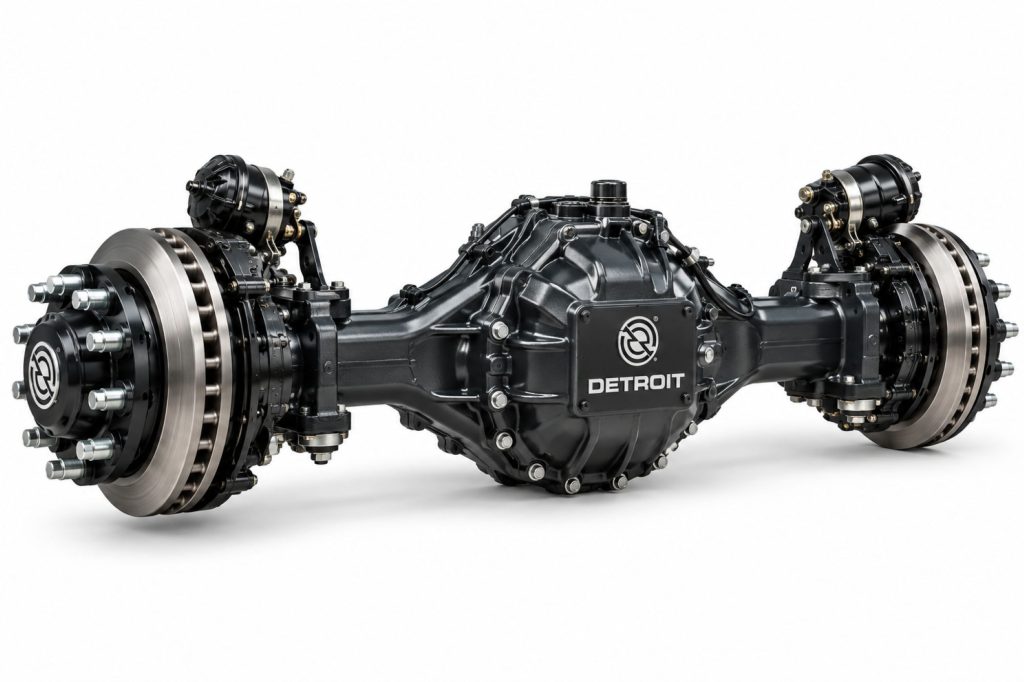
The Detroit Single Rear Axle is a family of commercial vehicle drive axles developed for medium-duty trucks, highway tractors, vocational vehicles, buses, and specialty chassis. The lineup includes multiple weight ratings and gearing configurations for trucks using one powered rear axle.
Detroit designs these axles for efficient power transfer, higher-torque applications, quiet operation, increased payload capacity, and straightforward maintenance. Precision-machined ring-and-pinion gears help create consistent gear contact, reduce operating noise, and support long component life.
The single-rear-axle family includes Model 2, Model 4, and Model 6 configurations with published weight ratings ranging from 13,000 to 23,000 pounds. Model selection depends on the vehicle, duty cycle, engine torque, transmission, axle ratio, suspension, brakes, and required rear gross axle weight rating.
Key Characteristics
Detroit Single Rear Axles use precision-machined ring-and-pinion gears designed to maintain an accurate tooth profile and consistent gear mesh. This supports efficient torque transfer, quieter operation, and improved durability.
Larger differential components are used in selected configurations to improve stability and withstand higher torque loads. Detroit also offers faster numerical axle ratios that support engine downspeeding when paired with an appropriate transmission and tire package.
The Model 2 uses a smaller axle bowl that provides additional ground clearance. This can benefit medium-duty delivery, bus, recreational vehicle, and vocational applications that require a compact axle assembly.
How the Axle or Differential Works
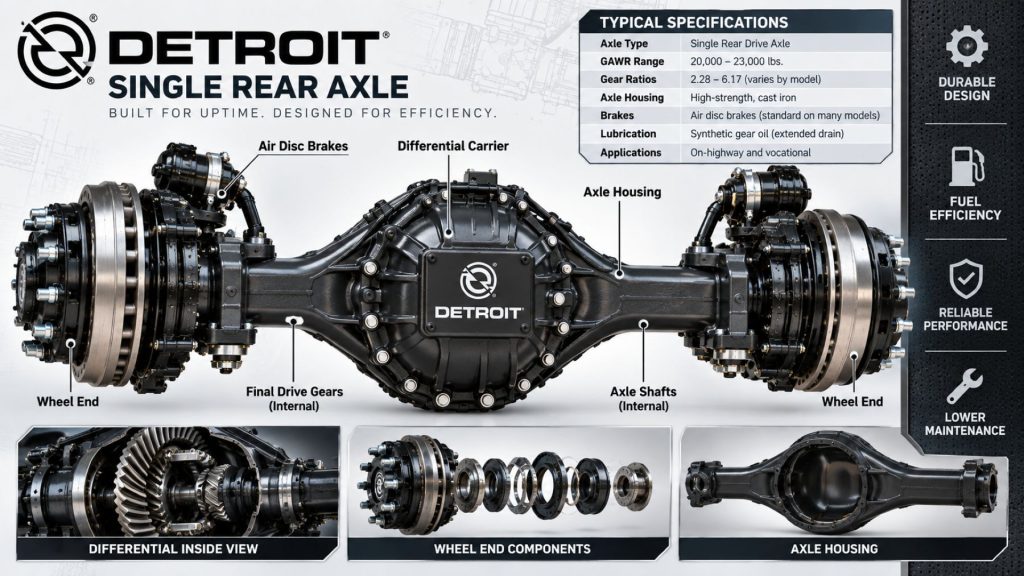
Engine torque travels through the transmission and driveshaft to the axle’s input yoke. The input yoke turns the pinion gear inside the differential carrier.
The pinion drives the larger ring gear, creating the axle’s final reduction ratio. The ring gear is attached to the differential case, which distributes torque through the side gears and axle shafts to the rear wheels.
The differential allows the left and right wheels to rotate at different speeds during a turn. Without this differential action, the tires would scrub against the road and place additional stress on the axle shafts, wheel ends, and drivetrain.
The axle housing supports the vehicle’s rear weight while containing the differential, axle shafts, bearings, lubricant, and seals. It also provides mounting points for the suspension, brakes, and wheel ends.
Axle Position and Function
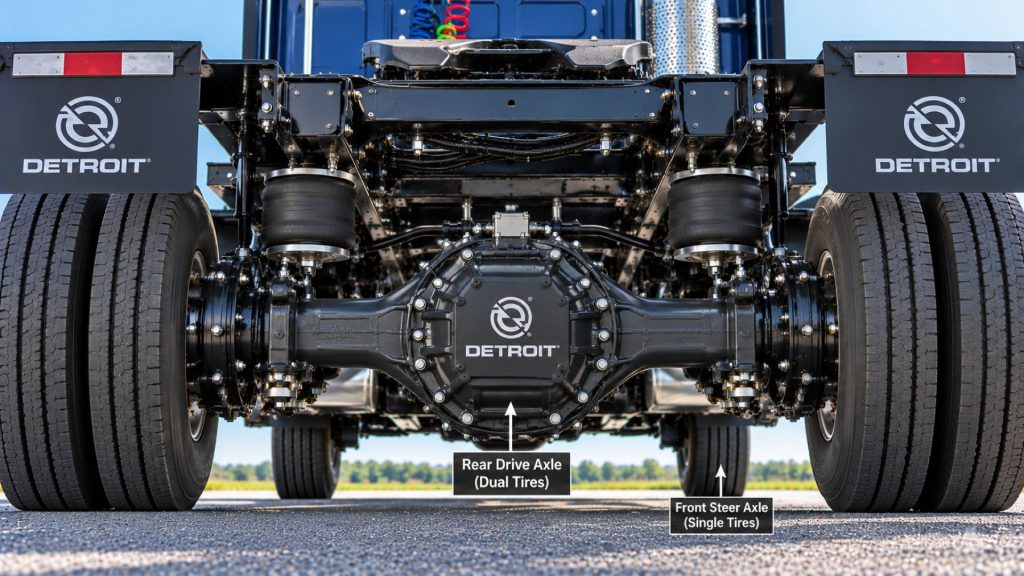
The Detroit Single Rear Axle is positioned at the rear of a 4×2 truck or used as the powered axle within certain 6×2 configurations.
In a 4×2 truck, the single rear axle supports the rear vehicle load and provides all rear-wheel propulsion. This arrangement is common in medium-duty straight trucks, tractors, buses, delivery vehicles, and recreational vehicle chassis.
In a 6×2 configuration, one rear axle provides propulsion while the second rear axle supports additional weight. The non-driven axle may be positioned ahead of or behind the drive axle, depending on the chassis design.
Common Specifications
- Axle Configuration: Single rear drive axle
- Model 2 Weight Ratings: 13,000 to 19,000 pounds
- Model 4 Weight Ratings: 17,500 to 23,000 pounds
- Model 6 Weight Ratings: 20,000 and 23,000 pounds
- Maximum Published Family Rating: 23,000 pounds
- Reduction Type: Single-reduction hypoid gearing
- Differential: Standard differential with application-specific traction options
- Gearing: Precision-machined ring-and-pinion gearset
- Model 2 Feature: Smaller axle bowl for increased ground clearance
- Brake Compatibility: Compatible with approved brake systems offered by Freightliner, Western Star, Thomas Built Buses, and Freightliner Custom Chassis
- Common Drivetrain Layouts: 4×2 single-drive and selected 6×2 configurations
- Primary Chassis Applications: Freightliner, Western Star, Thomas Built Buses, and Freightliner Custom Chassis Corporation products
Exact torque ratings, ratios, axle-track dimensions, housing configurations, brakes, wheel ends, and lubricant requirements vary by axle model and vehicle application.
Axle Ratios and Gearing
Detroit offers single rear axles with different ratios to match the engine, transmission, tire size, operating speed, and duty cycle. Available ratios vary among Model 2, Model 4, and Model 6 configurations.
Lower numerical ratios such as 2.16, 2.28, or 2.41 may be used in powertrain-downspeeding applications. These ratios can reduce engine speed at highway cruise when paired with the correct direct-drive or overdrive transmission.
Higher numerical ratios provide greater torque multiplication and may be better suited to vocational operation, frequent starts, steep grades, heavy loads, or lower average road speeds.
The fastest available ratio is not automatically the most efficient choice. An axle ratio that is too fast for the application can cause poor launch performance, excessive clutch work, frequent transmission shifting, or difficulty maintaining speed on grades.
Differential and Traction Options
A standard differential allows the left and right drive wheels to rotate at different speeds during turns. Under low-traction conditions, however, an open differential may send power toward the wheel with less resistance.
Application-specific traction options may include driver-controlled differential locks or electronically managed traction systems. Availability depends on the axle model, truck manufacturer, and vehicle specification.
A differential lock can improve mobility in mud, snow, loose gravel, construction sites, and other low-traction environments. It should be engaged and operated according to the vehicle manufacturer’s instructions.
Drivers should avoid using a fully locked differential during normal high-traction cornering because driveline binding can damage tires, axle shafts, gears, and differential components.
Brake and Wheel-End Options
Detroit Single Rear Axles are compatible with approved brake systems offered across supported Freightliner, Western Star, Thomas Built Buses, and Freightliner Custom Chassis applications.
Available configurations may use air drum brakes, air disc brakes, hydraulic brakes, or other vehicle-specific brake systems. The exact options depend on axle capacity, chassis type, wheel size, and vehicle class.
Wheel-end configurations may include conventional adjustable bearings or extended-maintenance arrangements selected by the vehicle manufacturer. Hubs, bearings, seals, brakes, wheels, and tires must all support the axle’s intended load.
Technicians should identify the complete axle and wheel-end configuration before adjusting bearings, replacing seals, or ordering brake and hub components.
Common Applications
- Medium-duty delivery trucks
- Box trucks
- Regional-haul tractors
- Less-than-truckload tractors
- Single-axle day cabs
- Municipal trucks
- Utility vehicles
- Tow trucks
- Beverage-delivery trucks
- School buses
- Shuttle buses
- Recreational vehicle chassis
- Emergency vehicles
- Construction service trucks
- Selected 6×2 highway tractors
Truck, Suspension, and Drivetrain Compatibility
Detroit Single Rear Axles are primarily designed for compatible Freightliner, Western Star, Thomas Built Buses, and Freightliner Custom Chassis vehicles.
They can be used with application-approved leaf-spring or air-suspension systems. Compatibility depends on axle capacity, suspension mounts, track width, ride height, brake package, wheel ends, and chassis configuration.
The axle ratio must be matched to the engine, transmission, tire size, gross vehicle weight, cruise speed, and duty cycle. Detroit axles may be combined with Detroit engines and DT12 automated manual transmissions as part of an integrated Detroit powertrain.
Model 6 single-drive axles may also be used in selected 6×2 configurations with a non-driven tag or pusher axle. This arrangement can reduce weight and mechanical losses compared with a tandem configuration in which both rear axles are powered.
Advantages
- Model ratings from 13,000 to 23,000 pounds
- Suitable for medium-duty and heavy-duty vehicles
- Precision-machined ring-and-pinion gears
- Quiet axle operation
- Efficient power transfer
- Larger differential components on selected models
- Ratios suitable for powertrain downspeeding
- Single-axle design with fewer components than a tandem drive system
- Potential weight savings compared with tandem drive axles
- Increased Model 2 ground clearance
- Compatible with multiple Daimler Truck North America chassis platforms
- Broad brake-system compatibility
- Integration with Detroit engines and transmissions
- Strong parts availability through the Detroit dealer network
- Suitable for both conventional 4×2 and selected 6×2 layouts
Limitations or Considerations
- Less traction than a powered tandem axle arrangement
- One powered axle carries the complete propulsion load in a 4×2 truck
- Not ideal for every off-road or severe-service application
- Model and ratio availability varies by truck platform
- Fast axle ratios require correct powertrain matching
- Improper gearing can reduce launch performance and gradeability
- Axle capacity does not override lower suspension, brake, tire, wheel, or frame ratings
- A 6×2 configuration may require careful load management
- Used axles must match the truck’s original dimensions and gearing
- Differential-lock availability varies by configuration
- Heavy vocational operation can accelerate gear, bearing, and wheel-end wear
- Replacement parts must be matched to the exact model and assembly number
Driver and Operator Experience
A correctly specified Detroit Single Rear Axle should provide smooth and quiet power delivery. Precision-machined gears are intended to reduce gear noise and driveline vibration, particularly at highway speeds.
Single-drive configurations may feel lighter and more responsive than comparable tandem-drive trucks. They can also provide reduced rolling and mechanical resistance when used in appropriate applications.
Drivers operating 6×2 vehicles must understand how weight is distributed between the powered axle and the non-driven axle. Insufficient weight on the drive axle can reduce traction during rain, snow, ice, or operation on loose surfaces.
Differential-lock controls, traction systems, and load-transfer features should be used according to the vehicle manufacturer’s instructions.
Maintenance and Ownership Notes
Routine maintenance includes checking the axle lubricant, inspecting the breather, examining the housing and carrier for leaks, inspecting the input seal, and monitoring the wheel ends.
The lubricant type and service interval depend on the vehicle, axle model, duty cycle, and whether petroleum-based or approved synthetic lubricant is used. The correct Detroit maintenance schedule should be followed.
Axle breathers must remain clean and open. A restricted breather can increase internal pressure and force lubricant past the pinion, carrier, or wheel-end seals.
Drivers and technicians should investigate new whining, humming, clunking, vibration, or temperature increases. Early diagnosis may prevent damage to the ring-and-pinion gears, differential bearings, axle shafts, or wheel ends.
Common Axle or Differential Problems
- Pinion seal leakage
- Carrier or housing lubricant leaks
- Wheel-end seal leakage
- Low or contaminated axle lubricant
- Restricted axle breather
- Ring-and-pinion gear wear
- Incorrect gear contact pattern
- Pinion-bearing wear
- Differential-bearing wear
- Axle-shaft damage
- Excessive backlash
- Clunking during acceleration or deceleration
- Whining or humming at road speed
- Differential-lock engagement problems
- Wheel-bearing wear or overheating
- Brake contamination caused by leaking wheel seals
- Driveline vibration caused by incorrect angles or worn components
- Housing damage caused by overloading or impact
Identification Information
- Manufacturer: Detroit Diesel Corporation
- Product Type: Single rear drive axle
- Model Families: Model 2, Model 4, and Model 6
- Primary Identification Source: Axle identification tag or stamped assembly information
- Important Model Information: Model number, assembly number, serial number, and production date
- Important Drivetrain Information: Axle ratio, differential type, input yoke, and torque rating
- Important Chassis Information: Truck VIN, build sheet, suspension, brakes, and wheel-end configuration
- Vehicle Brands: Freightliner, Western Star, Thomas Built Buses, and Freightliner Custom Chassis
- Ratio Verification: Axle tag, vehicle build records, or ring-and-pinion tooth count
The complete axle identification should be recorded before ordering gears, bearings, seals, axle shafts, differential components, hubs, brakes, or a replacement carrier.
Buying Considerations
- Required rear gross axle weight rating
- Exact Detroit axle model
- Truck make, model, year, and VIN
- Axle assembly and serial numbers
- Original axle ratio
- Engine torque rating
- Transmission model and gearing
- Tire size
- 4×2 or 6×2 drivetrain layout
- Standard or locking differential
- Suspension mounting arrangement
- Track width
- Brake type and brake size
- Hub and wheel-end configuration
- Input yoke or flange design
- Intended linehaul or vocational duty cycle
- Availability of replacement parts
- Condition of the gears, bearings, seals, housing, and axle shafts
- Evidence of overheating, lubricant contamination, impact damage, or overloading
- Compatibility with vehicle electronic and traction-control systems
Variants and Configurations
- Model 2 single rear axle
- Model 4 single rear axle
- Model 6 single rear axle
- 13,000-pound configurations
- 17,500-pound configurations
- 19,000-pound configurations
- 20,000-pound configurations
- 23,000-pound configurations
- 4×2 single-drive installations
- 6×2 single-drive installations
- Highway-oriented axle ratios
- Downspeeding axle ratios
- Vocational axle ratios
- Standard differential configurations
- Application-specific differential-lock configurations
- Air drum brake configurations
- Air disc brake configurations
- Vehicle-specific hydraulic brake configurations
- Different suspension and wheel-end arrangements
Comparison to Similar Equipment
Compared with a tandem drive axle, the Detroit Single Rear Axle has fewer powered components, lower system weight, and potentially lower mechanical losses. A tandem system generally provides greater traction and distributes the load across two rear axles.
The Dana Spicer S140 Series is a comparable single drive axle family used in medium- and heavy-duty commercial trucks.
The Dana Spicer S172 Series provides a heavier single-axle option for vocational and higher-load applications.
The Dana Spicer S190 Series is intended for demanding single-drive applications requiring greater capacity and torque capability.
Detroit’s principal advantage is its integration with Freightliner and Western Star vehicles, Detroit engines, DT12 transmissions, and the Daimler Truck North America service network.
Best Fit For
- Medium-duty straight trucks
- Single-axle day cab tractors
- Regional and less-than-truckload operations
- Urban delivery fleets
- Freightliner and Western Star truck buyers
- Fleets wanting an integrated Detroit powertrain
- Applications requiring 13,000- to 23,000-pound rear axle ratings
- Highway trucks using downspeeded powertrains
- Selected 6×2 tractors
- Bus and recreational vehicle chassis
- Operations prioritizing lower weight and mechanical simplicity
- Fleets with access to Detroit parts and service support
Related Truck Types
Related Truck Models
- Freightliner Cascadia
- Freightliner M2 106
- Freightliner M2 112
- Freightliner 108SD
- Freightliner 114SD
- Western Star 47X
- Western Star 49X
Related Axle and Differential Types
- Commercial Truck Drive Axles
- Single Rear Axles
- Dana Spicer S140 Series
- Dana Spicer S172 Series
- Dana Spicer S190 Series
- Commercial Truck Axles and Differentials
Related Equipment Systems
- Driveshaft Systems
- Transmission Systems
- Suspension Systems
- Brake Systems
- Tires and Wheels
- Safety Systems
Related Guides
- How Commercial Truck Axles and Differentials Work
- Commercial Truck Axle Ratios Explained
- Open vs Locking vs Limited-Slip Differentials
Regulatory and Compliance Notes
The axle, suspension, brakes, wheels, tires, hubs, and frame must meet the truck’s required rear gross axle weight rating and applicable commercial vehicle regulations.
The lowest-rated component determines the usable axle capacity. Installing a 23,000-pound axle does not independently increase the vehicle’s certified rear axle rating.
Single-axle trucks are subject to federal, state, provincial, and local axle-weight limits. Legal loading can be lower than the axle’s mechanical rating.
Differential-lock use must follow the vehicle manufacturer’s instructions. Improper engagement at speed or during high-traction cornering can affect vehicle control and damage drivetrain components.
Real World Operating Notes
Single rear axles work especially well in applications that do not require the traction or combined weight capacity of a powered tandem. Their lower weight and reduced mechanical complexity can provide additional payload and lower operating costs.
A 6×2 configuration requires careful load distribution because the powered axle must maintain enough tire loading to provide traction. Some trucks use load-transfer or suspension-management systems to increase drive-axle loading temporarily under low-traction conditions.
Fast axle ratios can improve fuel efficiency when correctly matched to the engine and transmission. They may not be appropriate for operations involving heavy starts, steep grades, soft surfaces, or low-speed vocational work.
Frequently Asked Questions
What is a Detroit Single Rear Axle?
It is a powered rear axle used in commercial vehicles with one rear drive axle. It contains reduction gearing, a differential, axle shafts, and wheel ends that transfer engine torque to the drive wheels.
What weight ratings are available?
Detroit lists Model 2 ratings from 13,000 to 19,000 pounds, Model 4 ratings from 17,500 to 23,000 pounds, and Model 6 ratings of 20,000 and 23,000 pounds.
Which trucks use Detroit single rear axles?
They are offered in compatible Freightliner and Western Star trucks, Thomas Built Buses, and Freightliner Custom Chassis products.
What is the difference between a single and tandem drive axle?
A single-drive truck uses one powered rear axle. A tandem-drive truck uses two powered rear axles, providing greater traction and combined axle capacity but adding weight and mechanical complexity.
Can a single rear axle be used in a 6×2 truck?
Yes. Selected 6×2 configurations use one powered rear axle and one non-driven supporting axle.
Does the axle have a differential?
Yes. The differential transfers torque to both rear wheels while allowing them to rotate at different speeds during turns.
Are differential locks available?
Differential-lock availability depends on the axle model and vehicle specification. The truck’s build sheet or axle identification information should be checked.
What axle ratio is best?
The correct ratio depends on engine torque, transmission gearing, tire size, vehicle weight, road speed, terrain, and duty cycle. There is no single ratio that is best for every truck.
What are downspeeding axle ratios?
Downspeeding uses a faster numerical axle ratio to reduce engine rpm at highway speed. It requires an engine, transmission, driveshaft, and axle designed to handle the resulting torque loads.
What causes a rear axle to whine?
Common causes include worn gears, incorrect gear contact, bearing wear, low lubricant, improper preload, excessive backlash, or previous incorrect repairs.
How can the axle model and ratio be identified?
Check the axle identification tag, stamped assembly information, and vehicle build records. The ratio may also be verified by counting the ring-and-pinion gear teeth.
Can one Detroit axle model directly replace another?
Not automatically. Capacity, ratio, housing dimensions, suspension mounts, track width, brakes, wheel ends, yoke, differential, and electronic compatibility must all be verified.
Availability and Where to Find
Detroit Single Rear Axles are available as original equipment on compatible Freightliner and Western Star trucks, Thomas Built Buses, and Freightliner Custom Chassis products.
Replacement carriers, gears, bearings, seals, axle shafts, wheel-end components, and complete assemblies may be available through authorized Detroit dealers and qualified commercial truck parts suppliers.
Used and remanufactured axles should be matched using the complete model, assembly number, ratio, differential type, track width, suspension mounting arrangement, brakes, and wheel ends.
Current product information and dealer support are available through the Detroit Single Rear Axles product page.
Support Trucking Families
Truck Equipment Atlas supports the mission of Grey Cross, a nonprofit dedicated to helping families of truck drivers who lose their lives while on the road. As the site grows, part of its mission is to bring awareness and support to these families.
Podcast or Video Section
Learn More Through Audio and Video
Truck Equipment Atlas will continue expanding with podcast episodes, interviews, and equipment breakdowns to help drivers and fleets better understand trucks and equipment.
Follow the Growth of Truck Equipment Atlas
Truck Equipment Atlas continues to expand with new truck profiles, trailer coverage, diesel engine pages, equipment system resources, manufacturer information, and educational guides.
Visit our Site Updates page to explore recent additions, project milestones, and upcoming resources as we continue building one of the industry’s growing commercial trucking equipment reference libraries.
View the Latest Site Updates: Truck Equipment Atlas Site Updates