
Electric Drive Axles
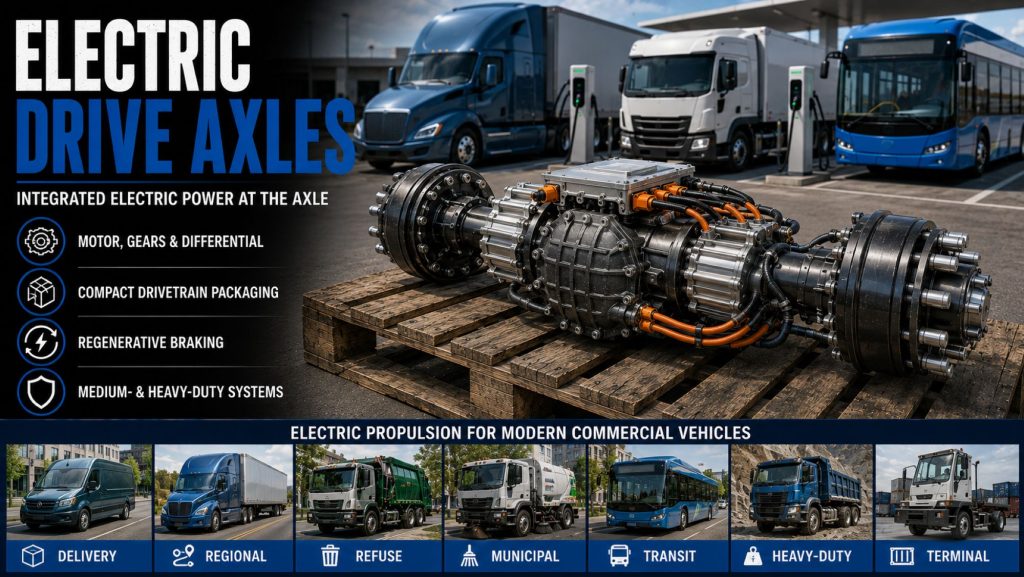
Electric drive axles, commonly called e-axles, combine electric propulsion components with a commercial vehicle’s axle assembly. Depending on the design, an e-axle may integrate one or more electric motors, reduction gearing, a differential, power electronics, and axle components into a compact propulsion system.
Unlike a conventional drivetrain that transfers power from an engine through a transmission and driveshaft, an electric drive axle produces propulsion much closer to the wheels. This can create additional chassis space for batteries, cargo, passengers, or vocational equipment.
Electric drive axles are being developed for medium-duty trucks, heavy-duty trucks, buses, delivery vehicles, refuse trucks, terminal tractors, and other battery-electric or fuel-cell commercial vehicles.
This section of Truck Equipment Atlas organizes electric drive-axle systems, manufacturers, applications, configurations, and related electrified-drivetrain resources.
Electric Drive Axles on Truck Equipment Atlas
Dana Spicer Electrified Drive Axles
- Dana Spicer eS5700r e-Drive Axle
- Dana Spicer eS9000r e-Axle
- Dana Spicer eS13.0Xr e-Drive Axle
- Dana Spicer Zero-8 e-Axle
Cummins-Meritor Electric Powertrains
ZF Electric Axles
Additional electric axle systems and manufacturer platforms will be added as commercial-vehicle electrification continues to develop.
Understanding Electric Drive Axles
An electric drive axle places the vehicle’s propulsion system within or directly alongside the axle assembly. Electrical energy from the traction batteries or fuel-cell system is delivered through the inverter to the electric motor.
The motor turns reduction gears that reduce motor speed and multiply torque. A differential then distributes that torque to the axle shafts and drive wheels while allowing different wheel speeds during turns.
An electric drive-axle system may include:
- One or more electric motors
- Inverter or power electronics
- Reduction gearing
- Multi-speed gearing on certain systems
- Differential assembly
- Differential lock when available
- Axle housing
- Axle shafts
- Wheel ends
- Integrated braking components
- Cooling and lubrication circuits
- Electronic control unit
- Sensors and communication systems
The amount of integration varies. Some manufacturers package most propulsion components into one axle-based system, while others position the inverter, controller, or cooling equipment elsewhere on the vehicle.
Integrated Electric Drive Axles
A fully integrated e-axle combines the electric motor, reduction gearing, differential, and axle structure into one propulsion assembly.
This architecture can replace several components associated with a conventional drivetrain, including:
- Diesel or gasoline engine
- Conventional transmission
- Long driveshaft
- Conventional drive axle
- Separate differential carrier
Integrated systems can simplify drivetrain packaging and reduce the number of separate mechanical connections between the propulsion source and drive wheels.
They also require coordination with the batteries, high-voltage distribution system, thermal-management equipment, vehicle controller, brakes, suspension, and electronic safety systems.
Single-Motor Electric Axles
A single-motor e-axle uses one electric motor to power the axle. Reduction gearing and a differential distribute torque to the drive wheels.
Single-motor systems may provide a useful balance of packaging, efficiency, weight, and power for light- and medium-duty commercial vehicles.
Common applications may include:
- Delivery trucks
- Utility trucks
- School buses
- Shuttle buses
- Municipal vehicles
- Light vocational trucks
- Medium-duty box trucks
Dual-Motor Electric Axles
A dual-motor e-axle uses two electric motors within or alongside the axle-based propulsion system.
Depending on its design, a dual-motor configuration can provide greater power, torque, redundancy, or control than a comparable single-motor system. It may also allow the vehicle controller to manage propulsion more precisely under changing load and traction conditions.
Dual-motor systems can support:
- Heavy-duty trucks
- Class 8 tractors
- Refuse trucks
- Articulated buses
- Heavy vocational vehicles
- High-gross-weight applications
Direct-Drive and Multi-Speed Designs
Electric motors produce strong torque at low speed and can operate across a broad speed range. Some electric axles therefore use a single fixed reduction ratio.
Other e-axles include two-speed or multi-speed gearing. Multiple ratios can help balance low-speed pulling capability, grade performance, acceleration, motor efficiency, and highway speed.
The correct configuration depends on:
- Vehicle weight
- Motor speed range
- Required wheel torque
- Maximum road speed
- Operating terrain
- Route profile
- Gradeability
- Duty cycle
- Energy-efficiency targets
Medium-Duty Electric Drive Axles
Medium-duty e-axles are designed for commercial vehicles such as delivery trucks, utility vehicles, school buses, municipal trucks, and regional distribution vehicles.
These applications frequently operate on predictable routes and return to a central facility where the vehicle can be charged.
An integrated e-axle can provide additional chassis space for batteries while supporting quiet, low-emission operation in residential and urban environments.
Heavy-Duty Electric Drive Axles
Heavy-duty e-axles are engineered for higher vehicle weights, greater torque requirements, and more demanding commercial applications.
A heavy-duty system may use:
- Higher-capacity axle structures
- Dual electric motors
- Multiple gear ratios
- Liquid-cooled motors and inverters
- Heavy-duty wheel ends
- Integrated differential locks
- Advanced thermal management
- High-voltage electrical architecture
Heavy-duty e-axles may be used in linehaul tractors, regional tractors, refuse trucks, construction vehicles, heavy buses, and other high-capacity applications.
Electric Axles for Buses
Electric axles are widely used in city buses, shuttle buses, school buses, and articulated transit vehicles.
Low-floor electric portal axles place propulsion components near the wheels while preserving interior space between them. This allows manufacturers to create a lower and flatter passenger floor.
Bus-focused e-axles may integrate:
- One or two electric motors
- Portal gearing
- Inverters
- Electronic controls
- Disc brakes
- Air-suspension mounting provisions
- Regenerative-braking controls
These systems are designed around passenger capacity, accessibility, route conditions, energy consumption, and frequent stop-and-go operation.
Electric Axles for Trailers
An electric drive axle can also be installed on a commercial trailer. In this configuration, the axle can recover energy during braking and use stored electrical energy to assist the tractor during acceleration or climbing.
Electric trailer axles may help:
- Recover braking energy
- Reduce demand on the tractor’s powertrain
- Support refrigerated-trailer equipment
- Lower fuel or energy consumption
- Improve combination-vehicle efficiency
- Provide electrical energy for auxiliary equipment
Electric trailer-axle systems require batteries, power electronics, controls, thermal management, and communication with the tractor and trailer braking systems.
Regenerative Braking
During regenerative braking, the electric motor operates as a generator. Vehicle movement turns the motor, and the system converts some of that motion into electrical energy.
The recovered energy is returned to the traction battery instead of being lost entirely as heat through the foundation brakes.
Regenerative braking can:
- Recover electrical energy
- Extend operating range
- Reduce foundation-brake use
- Reduce brake wear
- Improve stop-and-go efficiency
- Support vehicle-speed management
The vehicle must coordinate regenerative braking with its air brakes, ABS, stability-control system, and other braking functions.
Battery-Electric and Fuel-Cell Applications
Electric drive axles can be used with battery-electric and hydrogen fuel-cell commercial vehicles.
A battery-electric truck stores electrical energy in onboard battery packs. That energy powers the e-axle through the vehicle’s high-voltage electrical system.
A fuel-cell electric truck generates electricity through a fuel-cell system and normally uses a smaller battery to store energy and manage changes in power demand.
Both vehicle types can use similar electric motors, inverters, reduction gearing, controls, and regenerative-braking systems.
Common Commercial Vehicle Applications
Pickup and Delivery Trucks
Urban and regional delivery trucks can benefit from quiet operation, regenerative braking, predictable routes, and centralized charging.
Medium-Duty Vocational Trucks
Utility, municipal, service, and light construction trucks may use e-axles where daily range and auxiliary-equipment demands fit the electrical system’s capabilities.
Regional-Haul Trucks
Regional tractors operate on repeatable routes that can make battery capacity, charging time, and energy consumption easier to plan.
Long-Haul Trucks
Electric drive axles can support heavy Class 8 tractors, although battery capacity, vehicle range, charging infrastructure, payload, terrain, and operating schedule remain major specification considerations.
Refuse Trucks
Refuse vehicles operate with frequent starts and stops, creating opportunities for regenerative braking. Quiet operation can also benefit residential collection routes.
Buses and Coaches
Transit buses, school buses, shuttle buses, and certain coaches can use integrated or portal-style e-axles to improve packaging and support zero-tailpipe-emission operation.
Terminal and Yard Tractors
Terminal tractors travel predictable distances within ports, warehouses, distribution centers, and freight yards. These operating patterns can be well suited to electrification.
Choosing an Electric Drive Axle
The correct electric drive axle must be selected as part of the vehicle’s complete electrical, mechanical, braking, and thermal-management system.
Important considerations include:
- Vehicle class
- Gross axle weight rating
- Gross vehicle weight
- Gross combination weight
- Continuous motor power
- Peak motor power
- Continuous and peak wheel torque
- Single- or dual-motor design
- Single-speed or multi-speed gearing
- Axle ratio
- Maximum road speed
- Gradeability
- Startability
- Battery voltage
- Battery capacity
- Inverter compatibility
- Cooling requirements
- Regenerative-braking capability
- Suspension compatibility
- Foundation-brake integration
- Electronic control architecture
- Operating range
- Charging availability
- Duty cycle
- Manufacturer service support
An e-axle should not be selected using peak power alone. Continuous performance, thermal limits, loaded grades, road speed, axle capacity, cooling, and energy consumption are equally important.
Related Axle and Differential Categories
- Commercial Truck Drive Axles
- Commercial Truck Steer Axles
- Lift Axles and Auxiliary Axles
- Truck Differentials
- Commercial Trailer Axles
- Axle and Differential Guides
Related Equipment Resources
- Axles and Differentials
- Trucks
- Transmissions
- Electrical Systems
- Brake Systems
- Suspension Systems
- Tires and Wheels
- Safety Systems
Explore the Complete Axle and Differential Library
Visit the Axles and Differentials hub to explore commercial truck drive axles, steer axles, lift axles, auxiliary axles, differentials, electric drive axles, trailer axles, manufacturer profiles, and educational resources.