
Quick Facts
- Manufacturer: ZF
- Product Name: Electrically Powered Hydraulic Steering Pump
- Common Abbreviation: EPHS pump
- Product Type: Electrically driven hydraulic power-steering pump
- Primary Function: Supplies on-demand hydraulic pressure and flow to a commercial vehicle’s steering system
- Power Source: Vehicle electrical system
- Compatible Powertrains: Internal-combustion, hybrid, battery-electric, and other application-approved commercial vehicles
- Engine-Off Operation: Can provide hydraulic steering pressure independently of engine operation
- Control Strategy: On-demand, electronically controlled pump operation
- Steering Integration: Conventional hydraulic steering gears and compatible ZF ReAX adaptive-steering applications
- Primary Benefits: Energy efficiency, powertrain independence, flexible installation, electrification support, and higher automation capability

Overview
The ZF Electrically Powered Hydraulic Steering Pump is designed to produce hydraulic steering pressure without relying on a belt-, gear-, or engine-driven pump. An electric motor drives the hydraulic pump, allowing the steering system to operate independently of the vehicle’s drivetrain.
The system can provide hydraulic flow when steering assistance is required and reduce output when demand is low. This on-demand operation can improve energy efficiency compared with a conventional pump that runs continuously whenever the engine operates.
Drivetrain-independent operation makes the pump suitable for internal-combustion, hybrid, and electric commercial vehicles. It can also provide steering pressure during engine-off operation when the vehicle’s electrical system remains capable of powering the pump.
The pump can operate with an application-approved hydraulic steering gear and may integrate with the ZF ReAX Adaptive Steering System. Exact voltage, pressure, flow, mounting, controller, reservoir, cooling, and steering-gear requirements depend on the vehicle installation.
Key Characteristics
- Electric-motor-driven hydraulic steering pump
- Provides hydraulic flow independently of the drivetrain
- Supports internal-combustion, hybrid, and electric vehicles
- Provides steering pressure during approved engine-off operation
- On-demand pump control
- Can reduce unnecessary parasitic power consumption
- Allows flexible mounting away from the engine accessory drive
- Supports commercial-vehicle electrification
- Compatible with approved hydraulic steering gears
- Can integrate with ZF ReAX adaptive steering
- Uses electronic control and vehicle-network information
- Application-specific pressure, flow, voltage, and calibration
Major Components
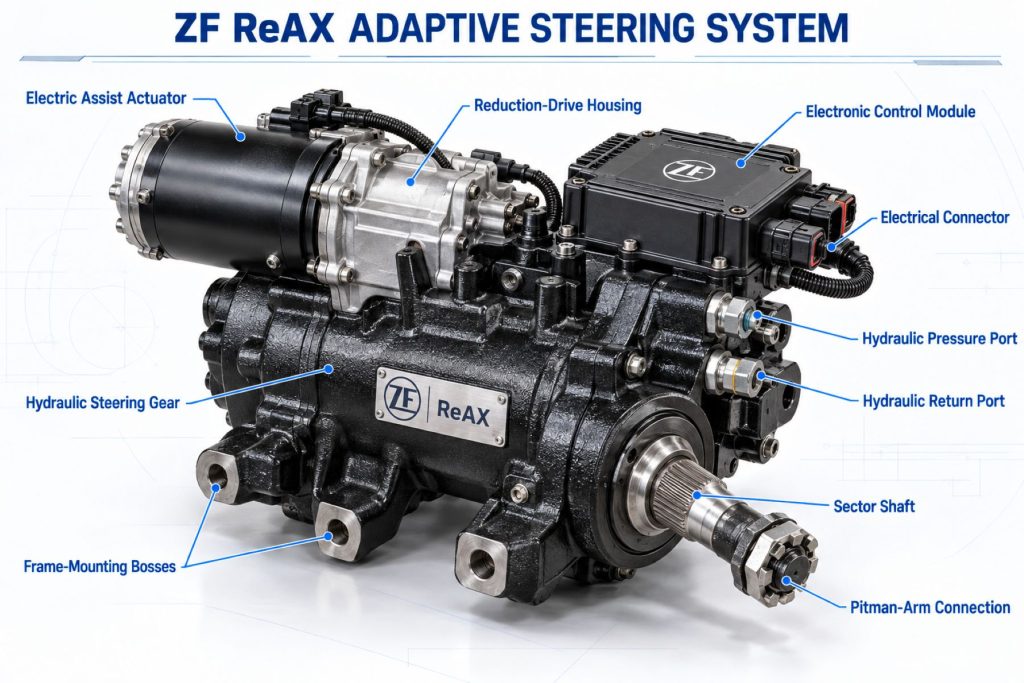
- Electric drive motor
- Hydraulic pump
- Motor controller or integrated power electronics
- Pump housing
- Hydraulic inlet and outlet ports
- Pressure-control and relief components
- Hydraulic-fluid reservoir
- Pressure and return hoses
- Hydraulic fittings and seals
- Filter or filtration provisions
- Cooling equipment where specified
- Electrical power and ground cables
- Vehicle-network wiring
- Temperature, pressure, current, or speed monitoring where equipped
- Mounting brackets and vibration isolators
Product Type and Construction
The EPHS pump combines an electric motor and hydraulic pump into an application-specific commercial-vehicle steering unit. The motor converts electrical energy into rotary motion, and the pump converts that motion into hydraulic flow and pressure.
The assembly may also include integrated control electronics, pressure-management components, sensors, electrical connectors, and mounting provisions. Reservoir and cooling arrangements depend on the vehicle installation.
How the Driveline or Steering Component Works
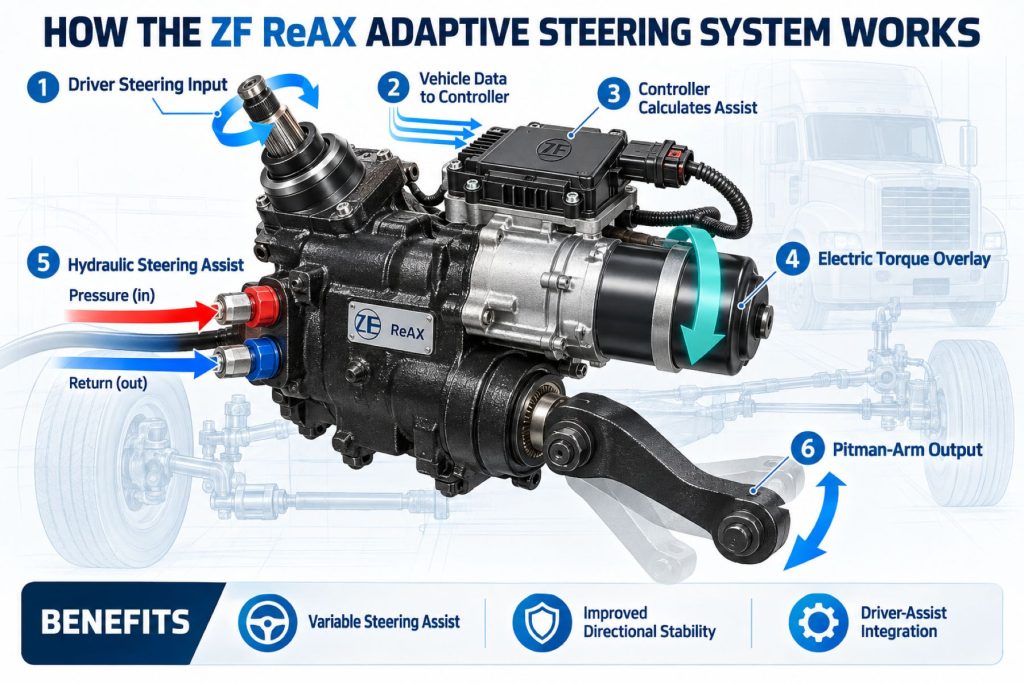
When the steering system requires assistance, the pump controller commands the electric motor to operate. The motor drives the hydraulic pump, which draws fluid from the reservoir and supplies pressurized flow to the hydraulic steering gear.
The steering gear directs pressure to assist the driver in moving the pitman arm, drag link, steering linkage, and steer wheels. Fluid then returns to the reservoir through the return circuit.
Pump output can be adjusted according to steering demand, vehicle speed, operating mode, temperature, and other available vehicle information. Because the pump is electrically powered, steering pressure does not depend directly on engine speed.
Position and Function Within the Vehicle
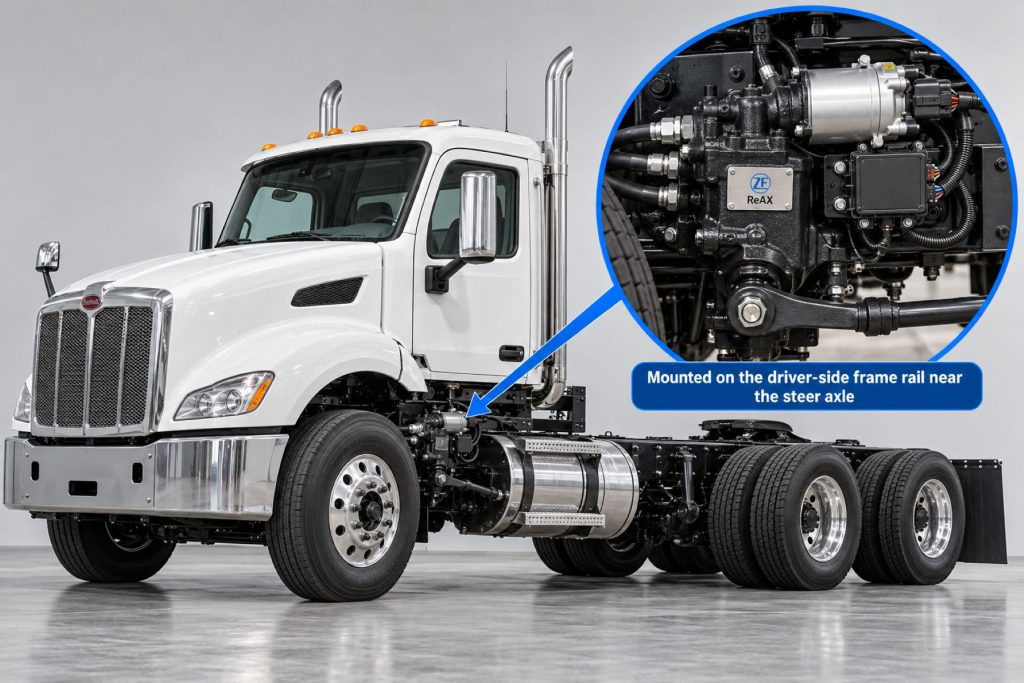
The pump is installed at an application-approved location on the chassis or within the vehicle’s component packaging area. It connects electrically to the vehicle power system and hydraulically to the reservoir and steering gear.
Its function is to supply the pressure and flow required by the hydraulic steering system without requiring a direct mechanical drive from the engine or drivetrain.
Common Specifications
- Product Type: Electrically powered hydraulic steering pump
- Drive Method: Electric motor
- Hydraulic Function: Supplies pressurized fluid to a hydraulic steering gear
- Control Type: Electronically controlled, on-demand operation
- Powertrain Compatibility: Application-approved combustion, hybrid, and electric commercial vehicles
- Engine-Off Capability: Available when the vehicle electrical system can power the pump
- Operating Voltage: Vehicle- and application-specific
- Hydraulic Pressure: Application-specific
- Hydraulic Flow: Application-specific and demand controlled
- Communication: Application-specific vehicle-network integration
- Mounting: Flexible chassis or vehicle-system mounting approved by the original equipment manufacturer
Operating Capacity and Performance
Operating capacity depends on the electric motor, hydraulic-pump displacement, controller, voltage, available electrical current, hydraulic pressure, flow requirements, steering gear, steer-axle load, tire equipment, and duty cycle.
The pump must provide sufficient hydraulic output during low-speed steering and other high-demand conditions without exceeding the electrical, hydraulic, or thermal limits of the system.
Installation Position and System Function
Unlike an engine-driven pump, the electric unit does not have to remain aligned with an accessory-drive pulley or gear train. This allows the original equipment manufacturer greater freedom when selecting a mounting location.
The location must still provide structural support, service access, electrical protection, acceptable hose lengths, proper reservoir relationship, cooling airflow, and protection from road debris, water, and excessive heat.
Torque Transfer or Steering-Assist Function
The pump does not directly turn the steer wheels. It supplies hydraulic pressure and flow to the steering gear, which combines the driver’s mechanical input with hydraulic assistance.
The electric motor’s torque drives the pump rather than being transferred mechanically from the engine. This allows hydraulic assistance to remain available independently of engine speed or operation.
Driveline Geometry and Operating Angles
The pump does not require belt, gear, or shaft alignment with the engine. This eliminates several mechanical-drive geometry requirements associated with conventional power-steering pumps.
Steering-column and steering-linkage geometry remain important. The electric pump cannot compensate for binding shafts, incorrect linkage angles, damaged steering components, or improper alignment.
Steering Geometry and Movement
Correct caster, camber, toe, steering stops, axle position, ride height, linkage travel, wheel offset, and tire size are required for predictable steering performance.
Incorrect geometry can increase hydraulic demand, electrical current, fluid temperature, tire wear, and component loading even when the pump is functioning normally.
Slip, Articulation, and Operating Travel
The pump must supply adequate assistance throughout the steering system’s approved travel. Hose routing must accommodate chassis movement, cab movement, vibration, and service access without pulling, kinking, or rubbing.
Axle stops should correctly limit wheel movement. The steering gear and pump relief system should not be used as substitutes for properly adjusted mechanical steering stops.
Bearings, Joints, Shafts, Gears, and Structural Design
The pump assembly contains motor bearings, a motor shaft, a pump-drive connection, hydraulic pumping elements, and housing supports. Exact internal construction depends on the application-specific design.
The associated steering system includes steering-column joints, a hydraulic steering gear, sector shaft, pitman arm, drag link, tie rod, steering arms, and kingpins. Wear in these components can increase pump demand or create steering complaints.
Materials and Component Construction
The pump uses a structural housing, electric-motor components, precision hydraulic pumping elements, bearings, seals, electronic components, connectors, and corrosion-resistant fittings suitable for commercial-vehicle operation.
Power cables, terminals, mounting brackets, hydraulic hoses, and fittings must be rated for the vehicle’s electrical current, pressure, vibration, temperature, and environmental exposure.
Hydraulic and Electric Steering Assistance
The EPHS pump electrifies the source of hydraulic pressure but retains a conventional hydraulic steering gear. The electric motor replaces the mechanical pump drive, while hydraulic fluid continues transmitting assistance to the steering gear.
This arrangement supports electrification without requiring the vehicle to abandon the hydraulic steering architecture used for heavy commercial-vehicle steering loads.
Electronic Controls and Driver-Assistance Integration
The pump controller may use steering demand, vehicle speed, operating mode, temperature, voltage, current, and network messages to manage output.
ZF identifies integration with the ZF ReAX Adaptive Steering System as an application that can support steering assistance and lateral-control functions used by compatible advanced driver-assistance systems.
The presence of an electric pump alone does not provide automated steering. Driver-assistance functions require the complete approved system of sensors, controllers, software, steering components, and safety strategies.
Speed, Torque, and Load Management
The controller can adjust motor speed and pump output according to steering demand. High steering loads may require greater motor torque, hydraulic flow, and electrical current.
Vehicle speed, axle loading, tire pressure, road surface, steering rate, system voltage, hydraulic temperature, and steering-gear condition affect demand. Output must remain within the application’s electrical and hydraulic limits.
Vibration, Balance, and Noise Control
The motor and pump may create normal operational sound that changes with steering demand. Mounting brackets and isolators must control vibration without allowing excessive movement.
Whining, cavitation, pulsation, or unusually loud operation may indicate low fluid, trapped air, inlet restrictions, contamination, damaged bearings, excessive pressure, or incorrect mounting.
Lubrication, Sealing, and Contamination Protection
Approved hydraulic fluid lubricates the pump and steering gear while transmitting assistance. Seals, hoses, fittings, reservoir caps, and filters help retain fluid and prevent contamination.
Electrical connectors and electronics require protection from moisture, corrosion, road chemicals, and pressure washing. Hydraulic ports and hoses must be capped immediately when opened for service.
Duty Cycle and Operating Conditions
The pump may operate during highway travel, urban maneuvering, terminal work, vocational operation, engine-off movement, hybrid operation, and electric-vehicle use.
Repeated low-speed steering, high axle loads, extreme temperatures, restricted cooling, contaminated fluid, or frequent full-lock operation can increase electrical and hydraulic demand.
Mounting and Installation
Installation requires an approved structural location, mounting bracket, electrical power supply, ground connection, vehicle-network wiring, reservoir, hoses, fittings, filtration, and cooling arrangement.
The pump should be protected from excessive heat, direct impact, road debris, water intrusion, and damaging vibration. Hose routing must avoid sharp bends, abrasion, exhaust heat, moving components, and air-trapping high points where possible.
Alignment, Driveline, and Mounting Geometry
The pump does not require alignment with an engine accessory drive, but its mounting surface and brackets must remain square, secure, and capable of carrying motor and hydraulic loads.
Reservoir height, inlet-hose routing, pump orientation, vibration isolation, service clearance, and hydraulic-hose geometry must follow the approved installation design.
Vehicle, Transmission, Axle, and Steering Compatibility
Compatibility depends on the vehicle manufacturer, chassis, electrical voltage, available current, power-distribution system, steering gear, steer-axle rating, tire equipment, hydraulic pressure and flow requirements, vehicle network, and software.
The pump’s drivetrain independence makes it suitable for multiple powertrain types, but it does not make the unit universally interchangeable. Each installation requires an approved vehicle and steering-system configuration.
Related Component and System Compatibility
The pump must match the hydraulic steering gear, reservoir, fluid, filter, cooler, pressure and return hoses, fittings, electrical power supply, controller, sensors, vehicle network, and steering-assistance calibration.
Integration with ReAX or another driver-assistance system requires approved communication, steering, software, diagnostic, and functional-safety compatibility.
Common Applications
- Battery-electric commercial vehicles
- Hybrid commercial vehicles
- Internal-combustion trucks using on-demand steering pressure
- Heavy-duty highway tractors
- Medium- and heavy-duty vocational trucks
- Commercial buses
- Specialty commercial chassis
- Vehicles requiring engine-off steering assistance
- Vehicles equipped with ZF ReAX adaptive steering
- Commercial vehicles designed for higher automation levels
Advantages
- Provides hydraulic steering pressure independently of the drivetrain
- Supports engine-off steering operation
- Suitable for electrified commercial vehicles
- Supplies hydraulic flow on demand
- Can improve steering-system energy efficiency
- Reduces dependence on engine speed
- Provides flexible mounting options
- Retains heavy-duty hydraulic steering capability
- Can integrate with ZF ReAX
- Supports compatible advanced driver-assistance functions
- Eliminates mechanical pump-drive belts or gears in applicable installations
Limitations or Considerations
- Requires substantial electrical power
- Depends on the vehicle’s electrical supply and control system
- Requires application-specific pressure and flow calibration
- Electrical faults can reduce or disable hydraulic assistance
- Hydraulic leaks and contamination remain possible
- Motor and controller heat must be managed
- High-current cables and connections require careful maintenance
- Installation requires compatible vehicle-network communication
- Diagnosis may require specialized electronic equipment
- Not a universal replacement for an engine-driven steering pump
- Replacement may require programming and system calibration
Driver and Operator Experience
A correctly operating EPHS pump should provide consistent hydraulic steering assistance without noticeable dependence on engine speed. Assistance can remain available during approved engine-off or electrified operating modes.
Drivers should report heavy steering, intermittent assistance, warning indicators, unusual pump noise, steering pulsation, overheating warnings, fluid leakage, or changes in steering response.
Steering Feel and Driver Feedback
Steering feel depends on pump output, steering-gear calibration, vehicle speed, axle loading, tires, alignment, linkage condition, and any adaptive steering system installed on the vehicle.
Because the pump is not mechanically tied to engine speed, assistance can be controlled according to steering demand rather than engine revolutions alone.
Operating Speed, Angle, and Load Management
The controller manages motor and pump speed according to hydraulic demand and system limits. Tight maneuvering, stationary steering, heavily loaded steer axles, wide tires, and soft surfaces can require greater output.
Operators should avoid holding the steering system against full lock. Continuous relief operation generates hydraulic heat and increases electrical current, motor loading, pump wear, and fluid stress.
Control Setup and System Calibration
Setup may include vehicle identification, electrical-system configuration, pump-speed control, pressure and flow management, thermal protection, steering-demand communication, diagnostic settings, and integration with ReAX or other chassis controllers.
Programming or calibration may be required after replacing the pump, controller, hydraulic steering gear, sensors, vehicle-control module, or related wiring.
Inspection and Wear Points
- Electric motor and pump housing
- Mounting brackets and isolators
- Electrical power and ground cables
- High-current terminals and connectors
- Control and communication wiring
- Hydraulic inlet and outlet ports
- Pressure and return hoses
- Reservoir, cap, filter, and fluid
- Hydraulic fittings, seals, and clamps
- Cooling lines or heat exchanger where equipped
- Evidence of leakage, overheating, corrosion, or abrasion
- Stored diagnostic trouble codes
- Hydraulic steering gear and linkage
- Battery, charging, and power-distribution systems
Lubrication Requirements
The pump and steering gear rely on the hydraulic fluid specified for the vehicle. Fluid provides lubrication, heat transfer, sealing support, and hydraulic force transmission.
Do not add unapproved fluids or additives. Incorrect viscosity or chemical compatibility can damage the pump, motor seals, hoses, steering gear, and pressure-control components.
Component Service Life and Rebuildability
Service life depends on electrical quality, hydraulic cleanliness, operating temperature, steering demand, mounting condition, fluid maintenance, cooling, duty cycle, and environmental exposure.
The motor, pump, and controller may be serviced as a complete assembly depending on the application. Internal repair should only be performed through approved service or remanufacturing procedures.
Shaft, Joint, Bearing, Gear, and Linkage Service Life
Motor bearings, the drive shaft, pump elements, and internal hydraulic surfaces experience repeated speed, pressure, and thermal cycles. Contamination or cavitation can shorten their service life.
Wear in the steering gear, pitman arm, drag link, tie rod, kingpins, wheel bearings, or steering column can increase pump demand and should be corrected separately.
Seal, Hose, Sensor, and Electronic Service Life
Hydraulic seals and hoses deteriorate from age, pressure cycling, temperature, abrasion, contamination, and incorrect fluid. Electrical connectors and sensors are affected by heat, vibration, corrosion, moisture, and damaged wiring.
Intermittent pump operation may result from voltage drops, weak grounds, loose terminals, overheated connections, controller faults, communication problems, or sensor errors.
Maintenance and Ownership Notes
Maintenance should include hydraulic-fluid checks, leak inspections, hose and fitting inspection, filter service where applicable, cooling-system inspection, electrical-terminal checks, wiring inspection, and diagnostic scans.
Battery, charging, high-voltage, low-voltage, and power-distribution problems can affect pump performance. Hydraulic and electrical systems should be evaluated together when diagnosing inconsistent steering assistance.
Common Driveline and Steering Problems
- Pump does not operate: Loss of electrical power, a blown fuse, damaged wiring, poor ground, controller fault, communication failure, or failed motor may be responsible.
- Heavy steering: Low fluid, insufficient pump output, voltage loss, trapped air, inlet restriction, controller derating, hydraulic leakage, or steering-gear problems may reduce assistance.
- Intermittent assistance: Loose electrical connections, overheating, low voltage, network faults, damaged wiring, sensor problems, or hydraulic aeration may cause inconsistent operation.
- Pump noise: Low fluid, cavitation, trapped air, restricted inlet flow, contaminated fluid, damaged bearings, or loose mounting may create excessive noise.
- Hydraulic leakage: Damaged hoses, fittings, seals, reservoirs, or pump surfaces may cause fluid loss.
- Overheating: Continuous full-lock operation, restricted cooling, excessive pressure, high electrical resistance, severe duty, low fluid, or internal leakage may increase temperature.
- Low-pressure output: Pump wear, incorrect control commands, motor-speed problems, relief-valve faults, inlet restrictions, or internal leakage may be responsible.
- Warning indicator: Diagnostic trouble codes may identify electrical, thermal, hydraulic, sensor, communication, or controller faults.
Safety and Service Precautions
The EPHS pump is part of a safety-critical steering system and may use high electrical current or high voltage. Service should follow current ZF and vehicle-manufacturer procedures.
- Secure the vehicle before steering-system service.
- Follow approved electrical shutdown and isolation procedures.
- Verify the absence of hazardous voltage when required.
- Relieve hydraulic pressure before disconnecting hoses.
- Keep hydraulic ports and electrical connectors clean.
- Use insulated and properly rated service equipment where required.
- Do not operate the pump without an adequate fluid supply.
- Do not exceed approved pressure, flow, voltage, or current limits.
- Bleed the hydraulic system using the approved procedure.
- Complete programming and calibration when required.
- Verify normal steering assistance before returning the vehicle to service.
Identification Information
Identification information may be located on the pump housing, electric motor, electronic controller, wiring label, hydraulic-system label, or vehicle build records.
- Vehicle manufacturer
- Vehicle identification number
- Vehicle model and model year
- ZF pump assembly number
- Electric-motor identification
- Controller or power-electronics number
- Software and calibration identification
- Operating voltage
- Hydraulic pressure and flow requirements
- Hydraulic-port and fitting configuration
- Steering-gear model and specification
- Reservoir, filter, and cooling configuration
- Vehicle-network and connector information
Buying Considerations
- Confirm the vehicle identification number and original application.
- Match the complete ZF assembly number.
- Verify the electrical-system voltage.
- Confirm current and power-supply requirements.
- Match the required hydraulic pressure and flow.
- Verify hydraulic-port sizes and locations.
- Confirm steering-gear compatibility.
- Match the controller and vehicle-network configuration.
- Confirm software and calibration availability.
- Verify mounting, reservoir, filtration, and cooling requirements.
- Determine whether installation requires dealer-level programming.
- Review warranty and core-return requirements.
Variants and Configurations
- Different electrical-system voltages
- Different motor and pump output levels
- Different hydraulic-pressure and flow calibrations
- Different mounting orientations
- Integrated or externally mounted control electronics
- Application-specific reservoirs and filters
- Different cooling arrangements
- Internal-combustion vehicle configurations
- Hybrid vehicle configurations
- Battery-electric vehicle configurations
- ReAX-integrated configurations
- Application-specific software and network interfaces
Comparison to Similar Equipment
Compared with a conventional engine-driven hydraulic steering pump, the ZF EPHS pump operates independently of engine speed and can provide hydraulic pressure during approved engine-off operation.
Compared with the ZF ReAX Adaptive Steering System, the EPHS pump supplies hydraulic pressure while ReAX modifies steering torque and behavior through electronic steering assistance. The systems can operate together in compatible applications.
Compared with the planned ZF Commercial Vehicle Electric Power Steering, the EPHS pump retains a hydraulic steering circuit. Full electric power steering eliminates the hydraulic pump, fluid, reservoir, and hoses.
Compared with a belt-driven pump, the electric pump offers greater mounting flexibility but requires high-current electrical hardware, electronic control, software, and thermal management.
Best Fit For
- Vehicles originally designed for the ZF electric hydraulic pump
- Battery-electric commercial vehicles
- Hybrid commercial vehicles
- Internal-combustion vehicles seeking on-demand steering pressure
- Vehicles requiring engine-off steering assistance
- Commercial vehicles using hydraulic steering gears
- Vehicles equipped with ZF ReAX
- Applications requiring flexible pump placement
- Vehicles designed for higher levels of steering automation
- Fleets with appropriate electrical and hydraulic diagnostic support
Related Vehicle and Trailer Types
- Electric Trucks
- Highway Tractors
- Class 6, Class 7, and Class 8 Trucks
- Vocational Trucks
- Commercial Buses
- Refuse Trucks
- Delivery Trucks
- Specialty Commercial Vehicles
Related Truck and Trailer Models
- Freightliner eCascadia
- Volvo VNR Electric
- Mack MD Electric
- International eMV Series
- Peterbilt 579EV
- Peterbilt 220EV
- Kenworth T680E
- Freightliner eM2
Related Driveline and Steering System Types
- Power Steering Pumps & Hydraulic Assist
- Advanced Steering & Lane-Keeping Systems
- Steering Gears & Steering Linkage
- Steering Columns & Driver Controls
- Commercial Truck Driveshafts
- Universal Joints, Slip Yokes & Center Bearings
Related Driveline and Steering Products
- ZF ReAX Adaptive Steering System
- ZF Commercial Vehicle Electric Power Steering
- ZF TRW THP Series Steering Gear
- ZF TRW TAS Series Steering Gear
- R.H. Sheppard M-Series Steering Gear
- ZF TRW Power Steering Pump
- Eaton Commercial-Vehicle Power Steering Pump
Related Equipment Systems
- Drivelines & Steering Systems
- Electrical Systems
- Safety Systems
- Suspension Systems
- Axles & Differentials
- Tires & Wheels
- Brake Systems
- Equipment Systems
Related Guides
- Driveline & Steering System Guides
- How Commercial Truck Steering Systems Work
- Hydraulic vs Electric-Assisted Commercial Truck Steering
- Common Commercial Truck Driveline Vibrations and Steering Problems
- Commercial Truck Steering Components Explained
- How to Inspect Commercial Truck Steering Systems
- How Electric Commercial-Vehicle Steering Systems Work
Regulatory and Compliance Notes
The pump is part of a safety-critical steering system. Electrical, hydraulic, mechanical, and electronic components must comply with applicable commercial-vehicle safety, electrical, steering, and inspection requirements.
Installation or replacement must preserve steering performance, electrical protection, electromagnetic compatibility, vehicle-network operation, axle ratings, hydraulic limits, and completed-vehicle certification.
High-voltage vehicle configurations require qualified personnel, appropriate protective equipment, and approved isolation procedures.
Real World Operating Notes
An electric hydraulic pump can continue supplying steering pressure when a combustion engine is stopped, provided the electrical system remains active and the operating mode permits pump operation.
Because the pump draws significant electrical power during high steering demand, weak batteries, damaged cables, poor grounds, or charging-system problems may appear as steering complaints.
Hydraulic fluid condition remains just as important as it is with an engine-driven pump. Electrifying the pump does not eliminate the reservoir, fluid, hoses, seals, filtration, or cooling requirements of the hydraulic circuit.
Repeated full-lock steering can generate substantial hydraulic and electrical heat. Operators should release steering pressure immediately after reaching the travel limit.
Frequently Asked Questions
What is the ZF Electrically Powered Hydraulic Steering Pump?
It is an electric-motor-driven pump that supplies hydraulic pressure and flow to a commercial vehicle’s hydraulic steering gear.
Does the pump require the engine to operate?
No. It operates from the vehicle’s electrical system and can provide steering pressure independently of engine operation when the approved operating conditions are met.
Can it be used on electric trucks?
Yes. ZF designed the pump for application across internal-combustion, hybrid, and electric commercial vehicles.
Does it eliminate hydraulic fluid?
No. The electric motor replaces the mechanical pump drive, but the system still uses hydraulic fluid, hoses, a reservoir, and a hydraulic steering gear.
How can the pump improve efficiency?
Its electronically controlled motor can supply hydraulic flow according to steering demand instead of continuously consuming engine power.
Can it work with ZF ReAX?
Yes. ZF identifies the electric hydraulic pump as capable of integrating with ReAX in compatible vehicle applications.
What causes heavy steering with an electric hydraulic pump?
Possible causes include loss of electrical power, low voltage, controller faults, low fluid, trapped air, pump wear, hydraulic restrictions, steering-gear problems, or excessive steering load.
Does the pump operate continuously?
Its control strategy is designed to provide hydraulic flow on demand. Exact operating behavior depends on the vehicle and steering-system calibration.
Can it replace any conventional power-steering pump?
No. Voltage, pressure, flow, mounting, controller, hydraulic, cooling, network, software, and steering-gear compatibility must all be verified.
How are replacement units identified?
Use the vehicle identification number, ZF assembly number, motor and controller information, operating voltage, hydraulic specifications, steering-gear model, and vehicle build records.
Availability and Where to Find
ZF Electrically Powered Hydraulic Steering Pumps and related components may be available through vehicle manufacturers, authorized commercial-vehicle dealers, ZF service channels, steering-system specialists, and approved heavy-duty parts suppliers.
Availability depends on the vehicle application, electrical voltage, hydraulic pressure and flow, steering gear, controller, mounting arrangement, software, and production status.
Current product information is available through the ZF Electrically Powered Hydraulic Steering Pump page.
Support Trucking Families
Truck Equipment Atlas supports the mission of Grey Cross, a nonprofit dedicated to helping families of truck drivers who lose their lives while on the road. As the site grows, part of its mission is to bring awareness and support to these families.
Podcast or Video Section
Learn More Through Audio and Video
Truck Equipment Atlas will continue expanding with podcast episodes, interviews, and equipment breakdowns to help drivers and fleets better understand trucks and equipment.
Follow the Growth of Truck Equipment Atlas
Truck Equipment Atlas continues to expand with new truck profiles, trailer coverage, diesel engine pages, equipment system resources, manufacturer information, and educational guides.
Visit our Site Updates page to explore recent additions, project milestones, and upcoming resources as we continue building one of the industry’s growing commercial trucking equipment reference libraries.
View the Latest Site Updates: Truck Equipment Atlas Site Updates