
Quick Facts
- Manufacturer: Cummins Drivetrain and Braking Systems, formerly Meritor
- Product Brand: Meritor Permalube
- Product Series: RPL20
- Product Type: Permanently lubricated heavy-duty commercial-vehicle driveline
- Driveline Rating: 12,000 lb-ft
- Metric Driveline Rating: 16,270 N·m
- Tubing Size: 4.095 × 0.180 inches
- Tube Inside Diameter: 3.735 inches
- Swing Diameter: 7.80 inches
- Universal-Joint Design: Permanently lubricated and sealed RPL20 universal joint
- Primary Applications: Linehaul tractors, heavy-duty trucks, buses, vocational vehicles, fire and rescue equipment, construction vehicles, and specialized commercial equipment
- Production Status: Current product family; individual assemblies and components remain application-specific
Overview
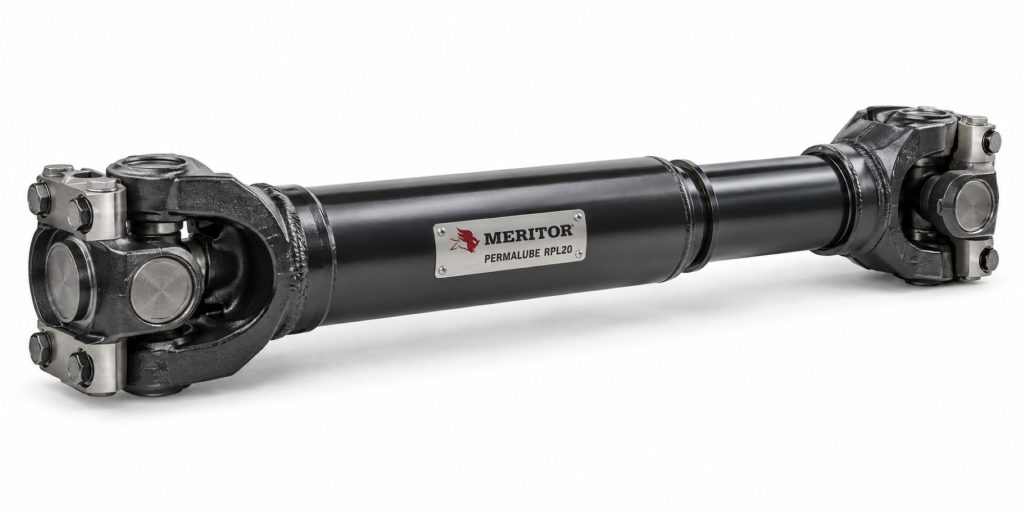
The Meritor Permalube RPL20 Driveline is a heavy-duty commercial-vehicle driveshaft system designed to transfer torque from the transmission to the drive axle while accommodating normal changes in driveline length and operating angle. It occupies the entry position in the heavy-duty RPL family above the medium-duty RPL10 and RPL14 models.
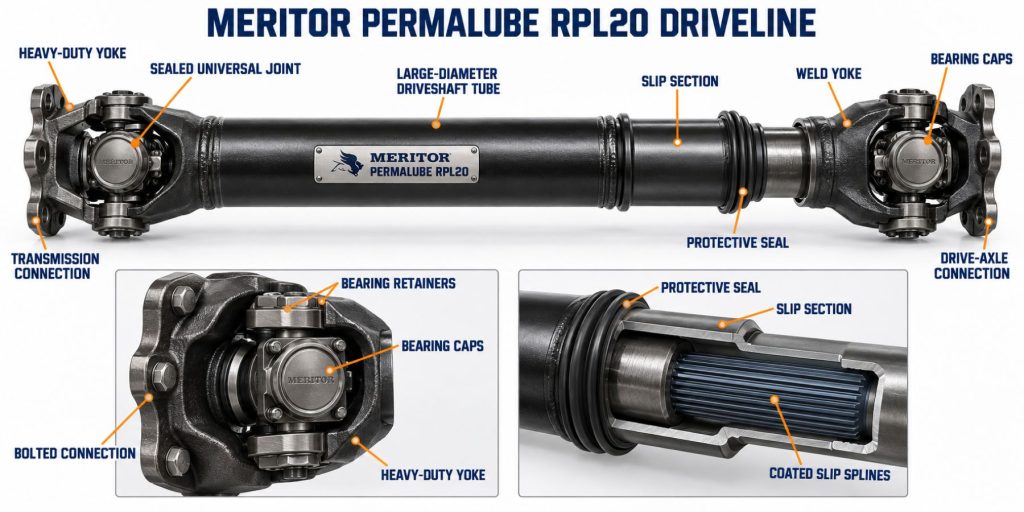
The RPL20 uses permanently lubricated and sealed universal joints to reduce routine lubrication requirements. Triple-lip seals help retain lubricant and prevent contaminants from entering the joint, while nylon thrust washers reduce metal-to-metal contact inside the assembly.
With a published driveline rating of 12,000 lb-ft, the RPL20 is intended for heavy-duty applications that require more torque capacity than the medium-duty Permalube models but do not require the higher ratings of the RPL25 or RPL35 families.
Key Characteristics
- Heavy-duty commercial-vehicle driveline
- 12,000 lb-ft published driveline rating
- Permanently lubricated universal joints
- Sealed-for-life joint design
- Triple-lip universal-joint seals
- Nylon thrust washers that reduce metal-to-metal contact
- Four-bolt flange connections for installation and service
- Steel universal-joint guards with protective coating
- Self-aligning center-bearing options for multi-piece installations
- Designed for linehaul and heavy-service applications
- Multiple end-yoke, flange-yoke, slip-section, and tubing configurations
- Application-specific complete driveline assemblies
Major Components
- Driveshaft tubing
- RPL20 universal-joint assemblies
- Cross and bearing assemblies
- Triple-lip seals
- Nylon thrust washers
- Flange yokes
- End yokes
- Weld yokes
- Slip yoke or slip assembly
- Splined shaft
- Companion flanges
- Four-bolt attachment hardware
- Universal-joint guards
- Center bearing on applicable multi-piece drivelines
- Mounting brackets on center-bearing installations
- Balance weights
Product Type and Construction
The RPL20 is a tubular steel driveshaft system constructed around permanently lubricated RPL universal joints. Its driveshaft tubing, weld yokes, slip components, and flange connections form a rotating assembly that transfers torque while permitting controlled articulation and length change.
Individual RPL20 installations may use a single driveshaft or a multi-piece driveline incorporating an intermediate shaft and center bearing. Component dimensions, shaft lengths, flange patterns, slip travel, and balancing specifications depend on the vehicle.
How the Driveline or Steering Component Works
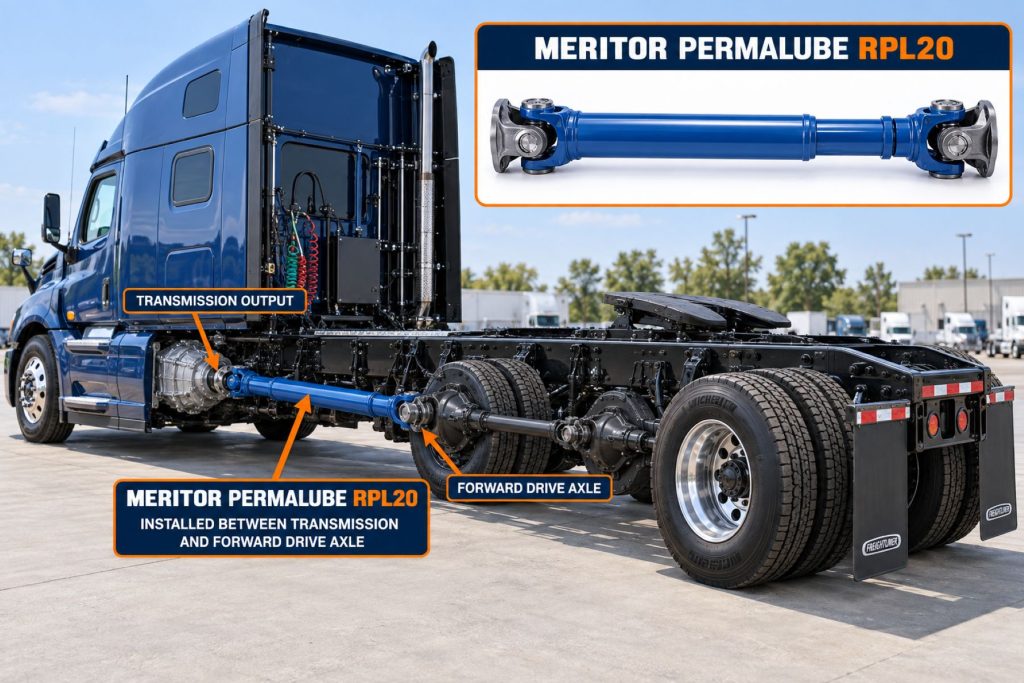
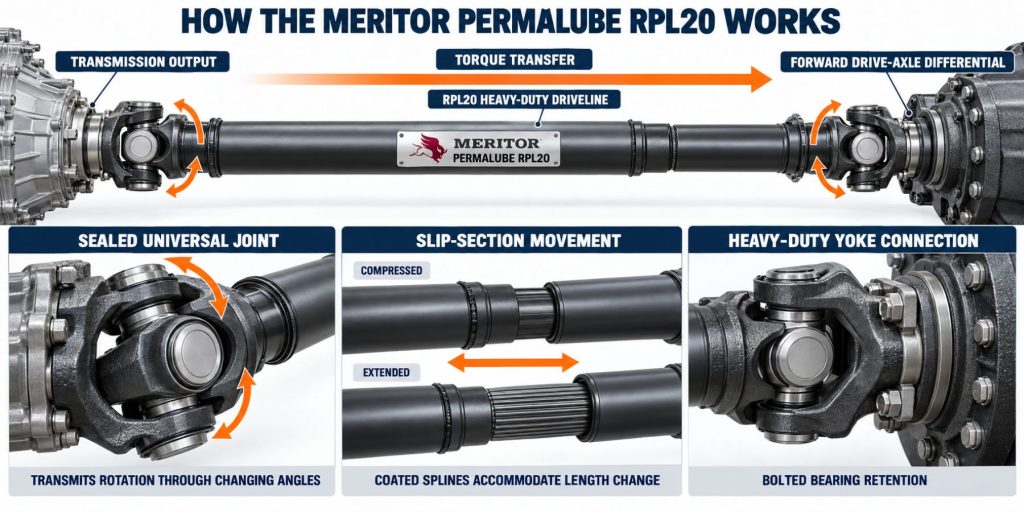
The RPL20 receives rotational force through a transmission output flange and transfers it along the driveshaft to the drive-axle input flange. Universal joints allow the shaft to operate while the transmission and axle are positioned at different heights or angles.
A slip section accommodates changes in the distance between driveline components as the suspension moves and the chassis flexes. The shaft must remain correctly phased, balanced, aligned, and lubricated at its serviceable slip components to operate smoothly.
Position and Function Within the Vehicle
The driveline is installed beneath the vehicle between the transmission and driven axle. On longer-wheelbase trucks, an RPL20 may form one section of a multi-piece driveline supported by a center bearing.
Its primary function is to transfer engine torque through the transmission to the drive axle while accommodating axle movement, chassis deflection, driveline-angle changes, and limited axial movement.
Common Specifications
- Series: RPL20
- Driveline Rating: 12,000 lb-ft
- Metric Rating: 16,270 N·m
- Published Tubing Size: 4.095 × 0.180 inches
- Published Tube Inside Diameter: 3.735 inches
- Published Swing Diameter: 7.80 inches
- Representative Weld-Yoke Bearing-Cap Diameter: 2.06 inches
- Representative Maximum Joint Angle: Up to 44 degrees for certain RPL20 weld-yoke configurations
- Universal-Joint Kit: CP20-RPL-S1 for applicable configurations
- Lubrication: Permanently lubricated universal joints; other driveline components may retain separate service requirements
- Connection Type: Application-specific flange and Easy Service four-bolt connections
Complete assembly specifications must be confirmed using the vehicle identification number, driveline assembly number, engineering drawing, flange dimensions, and operating requirements.
Operating Capacity and Performance
The published RPL20 driveline rating is 12,000 lb-ft, or 16,270 N·m. Actual suitability depends on engine torque, transmission ratios, axle gearing, tire traction, vehicle weight, duty cycle, operating angles, shock loading, and the specifications of every component in the driveline.
A driveline should not be selected solely by matching its published rating to peak engine torque. Lower transmission gears multiply torque before it reaches the shaft, and severe starts, wheel hop, driveline binding, or sudden traction changes can create damaging transient loads.
Installation Position and System Function
The RPL20 can be installed as a main driveshaft or as part of an application-specific multi-piece driveline. Its exact position depends on wheelbase, transmission location, drive-axle position, chassis packaging, and required shaft length.
Any intermediate-shaft or rear-shaft application must preserve the manufacturer’s specified phasing, angles, slip travel, support-bearing location, and critical-speed margin.
Torque Transfer or Steering-Assist Function
The RPL20 is a torque-transfer component and does not provide steering assistance. It carries rotational force from the transmission to the drive axle through its tubing, splines, universal joints, yokes, and flange connections.
The complete assembly must be capable of carrying normal operating torque and short-duration dynamic loads without exceeding its approved rating or creating excessive deflection.
Driveline Geometry and Operating Angles
Correct driveline geometry is essential for smooth RPL20 operation. Transmission, intermediate-shaft, and axle pinion angles must produce compatible universal-joint working angles.
Excessive, unequal, or poorly matched angles can produce vibration, accelerated bearing wear, seal damage, spline loading, and fatigue in the shaft or mounting components. Ride-height changes should be followed by a driveline-angle inspection.
Steering Geometry and Movement
Steering geometry does not directly control the RPL20 because it is a driveline component. However, frame movement, suspension articulation, axle windup, and chassis modifications can change its working angles and available clearances.
Slip, Articulation, and Operating Travel
The universal joints provide angular articulation while the splined slip section accommodates changes in driveline length. Both movements must remain within the limits established for the complete vehicle installation.
Insufficient spline engagement can weaken the connection, while bottoming the slip section can transmit damaging thrust loads into the transmission, center bearing, or axle. The shaft must also maintain adequate clearance from crossmembers, exhaust components, tanks, hoses, wiring, and body equipment.
Bearings, Joints, Shafts, Gears, and Structural Design
The RPL20 combines high-strength tubing, yokes, splined components, cross-and-bearing universal joints, retaining hardware, and flange connections. Its universal-joint seals retain lubricant while excluding water and road contaminants.
Multi-piece installations may include a self-aligning center bearing that supports the intermediate shaft and accommodates limited installation variation. The center-bearing bracket and frame attachment must remain structurally sound and correctly positioned.
Materials and Component Construction
RPL20 assemblies use steel tubing and forged or machined steel driveline components. Protective coatings on exposed components help resist corrosion and environmental damage.
Triple-lip seals, internal lubricant, nylon thrust washers, and precision bearing surfaces support long universal-joint life when the shaft is correctly installed and operated.
Hydraulic and Electric Steering Assistance
Hydraulic and electric steering assistance are not part of the RPL20 driveline. Any nearby steering shafts, hydraulic lines, electrical harnesses, or assistance components must have adequate clearance from the rotating driveshaft.
Electronic Controls and Driver-Assistance Integration
The RPL20 is mechanically operated and does not require a dedicated electronic controller. Vehicle systems such as engine torque management, traction control, stability control, and automated transmission programming can indirectly reduce or increase the loads applied to the driveline.
Speed, Torque, and Load Management
Driveline speed and torque must remain within the approved limits for the complete shaft assembly. Long shafts may reach critical speed at lower rotational speeds than shorter shafts, while steep transmission gearing can generate high torque during low-speed operation.
Drivers can reduce damaging loads by avoiding clutch dumping, aggressive launches, driveline shock, wheel hop, improper differential-lock use, and sudden throttle application when traction changes.
Vibration, Balance, and Noise Control
The RPL20 assembly is dynamically balanced for its intended operating speed. Balance weights, shaft straightness, joint condition, phasing, runout, and mounting-flange condition all affect vibration performance.
Removing a balance weight, denting the tube, separating a slip assembly without preserving its original phasing, or installing the shaft on dirty or damaged flange faces can create vibration.
Lubrication, Sealing, and Contamination Protection
RPL20 universal joints are permanently lubricated and sealed, eliminating routine universal-joint greasing. Triple-lip seals help retain the factory lubricant and protect the bearings against water, dirt, road salt, and other contaminants.
This does not mean every part of every RPL20 installation is maintenance-free. Slip sections, center bearings, or related components may have separate inspection or lubrication requirements depending on the assembly.
Duty Cycle and Operating Conditions
The RPL20 supports heavy-duty linehaul and vocational service when correctly specified. Operating conditions that can shorten service life include severe driveline angles, frequent stop-and-go operation, high gross combination weight, shock loading, contamination, corrosion, off-road articulation, and repeated high-torque starts.
Mounting and Installation
Installation requires the correct flange patterns, pilot diameters, shaft length, slip travel, fasteners, working angles, and mounting hardware. Flange faces must be clean and undamaged before assembly.
Fasteners should be tightened in the specified sequence and to the manufacturer’s torque requirements. A multi-piece driveline also requires correct center-bearing alignment, bracket position, and shaft phasing.
Alignment, Driveline, and Mounting Geometry
Alignment should be checked at the vehicle’s normal operating ride height and loading condition. Transmission mounts, engine mounts, center-bearing supports, suspension ride height, axle position, and pinion angle can all affect the final geometry.
A shaft should not be shortened, lengthened, welded, straightened, or rebalanced without appropriate driveline equipment and approved procedures.
Vehicle, Transmission, Axle, and Steering Compatibility
Compatibility depends on the vehicle, engine output, transmission model, axle gearing, flange connections, wheelbase, suspension, driveline angles, shaft speed, and duty cycle. The RPL20 designation alone does not establish interchangeability.
Replacement assemblies should be matched using the vehicle identification number, original assembly number, build records, engineering drawing, and measured connection dimensions.
Related Component and System Compatibility
An RPL20 installation must be compatible with the transmission output flange, axle input flange, companion flanges, end yokes, universal-joint kits, slip assembly, tubing, center bearing, and mounting brackets.
Components from another RPL series should not be substituted merely because they appear similar. Dimensions, ratings, pilot features, fasteners, and joint geometry may differ.
Common Applications
- Class 8 highway tractors
- Regional-haul tractors
- Heavy-duty straight trucks
- Construction trucks
- Utility vehicles
- Fire and rescue apparatus
- Refuse vehicles
- Transit and coach buses
- Vocational trucks
- Material-handling equipment
- Mobile cranes
- Specialized commercial vehicles
- Defense vehicles
Advantages
- 12,000 lb-ft published driveline rating
- Permanently lubricated universal joints reduce routine service
- Triple-lip seals protect internal bearing surfaces
- Nylon thrust washers reduce metal-to-metal wear
- Four-bolt connections support installation and service
- Suitable for linehaul and heavy-duty applications
- Multiple yoke, flange, slip, and shaft configurations
- Self-aligning center-bearing options for multi-piece drivelines
- Established commercial-vehicle parts and service network
- Positioned between medium-duty and higher-capacity RPL models
Limitations or Considerations
- Not every RPL20 assembly is interchangeable
- Correct shaft length and flange configuration are required
- Improper driveline angles can cause vibration and accelerated wear
- Dented or bent tubing can make the assembly unsafe
- Permanent universal-joint lubrication does not eliminate inspections
- Slip sections or center bearings may have separate service requirements
- Driveline rating must be evaluated against multiplied transmission torque
- Chassis or suspension changes can alter operating geometry
- Repairs require appropriate driveline equipment and balancing procedures
- Higher-torque applications may require an RPL25 or RPL35-series driveline
Driver and Operator Experience
A correctly installed RPL20 should transfer power without noticeable vibration, clunking, shuddering, or speed-related noise. Drivers may first detect problems as a vibration through the floor, a clunk during acceleration or deceleration, or a shudder under heavy torque.
New vibration following suspension, transmission, axle, or driveline work should be investigated promptly rather than treated as a normal operating characteristic.
Steering Feel and Driver Feedback
The RPL20 does not directly affect steering assistance, but severe driveline vibration may be felt through the cab, floor, seat, pedals, or steering column. The vehicle should be inspected to distinguish driveline vibration from tire, wheel, steering, engine, or suspension problems.
Operating Speed, Angle, and Load Management
Operators should avoid unnecessary shock loading and report new noises or vibration. Fleets should verify that shaft speed, working angles, torque demand, gross vehicle weight, and duty cycle remain within the approved design limits.
Control Setup and System Calibration
The mechanical RPL20 does not require electronic calibration. However, automated-transmission shift programming, engine torque limits, traction control, and powertrain-protection strategies can influence driveline loading and should remain correctly configured for the vehicle.
Inspection and Wear Points
- Universal-joint seals
- Cross-and-bearing assemblies
- Flange and end-yoke connections
- Fasteners and retaining hardware
- Driveshaft tubing
- Balance weights
- Slip splines
- Slip-yoke seals
- Center bearing and rubber support
- Center-bearing bracket
- Transmission and axle flange faces
- Clearance around the rotating shaft
- Evidence of corrosion, impact, looseness, or heat
Lubrication Requirements
The RPL20 universal joints are permanently lubricated and do not require normal periodic greasing. Inspection remains necessary because damaged seals, excessive looseness, corrosion, overheating, or contamination can indicate joint failure.
Technicians should follow the lubrication requirements for the exact slip assembly, center bearing, and related components because those requirements can differ from the sealed universal joints.
Component Service Life and Rebuildability
Service life depends on torque, working angles, vehicle loading, shaft speed, contamination, corrosion, installation quality, and driving conditions. Universal-joint kits, yokes, slip components, center bearings, and complete shaft assemblies may be serviceable or replaceable when approved parts and procedures are available.
A damaged, bent, cracked, or severely corroded shaft should be evaluated by a qualified driveline specialist before being returned to service.
Shaft, Joint, Bearing, Gear, and Linkage Service Life
Shaft tubing can provide extended service when it remains straight, balanced, and free from impact damage. Joint and bearing life decreases when operating angles are excessive, flange connections are loose, seals are compromised, or shock loads exceed the design conditions.
Seal, Hose, Sensor, and Electronic Service Life
Triple-lip universal-joint seals are critical to lubricant retention and contamination protection. The RPL20 itself does not use hydraulic hoses, electronic sensors, or a dedicated controller, although nearby vehicle systems must remain protected from contact with the rotating shaft.
Maintenance and Ownership Notes
Inspect the driveline at the intervals established by the vehicle and component manufacturers. Permanent universal-joint lubrication reduces one maintenance task but does not eliminate the need to check the assembly.
- Check universal joints for looseness or binding
- Inspect seals for damage or lubricant leakage
- Check flange bolts and retaining hardware
- Inspect tubing for dents, cracks, corrosion, or missing weights
- Check slip components for wear and adequate engagement
- Inspect center bearings and brackets when equipped
- Verify driveline angles after ride-height or powertrain changes
- Investigate new vibration, noise, or clunking promptly
- Preserve shaft phasing during disassembly
- Use approved replacement parts and service procedures
Common Driveline and Steering Problems
- Speed-related vibration: Shaft imbalance, excessive runout, incorrect phasing, missing balance weights, or damaged tubing may cause vibration that changes with road speed.
- Acceleration shudder: Incorrect working angles, worn joints, loose mounts, excessive axle windup, or improper ride height may cause shudder under torque.
- Clunk during acceleration or deceleration: Worn splines, loose flange hardware, universal-joint clearance, axle backlash, or transmission-related movement may be responsible.
- Universal-joint wear: Seal damage, contamination, excessive angles, shock loading, or incorrect installation can shorten joint life.
- Center-bearing failure: Misalignment, incorrect preload, damaged brackets, driveline imbalance, or worn rubber supports can damage the bearing.
- Slip-section binding: Corrosion, damaged splines, contamination, insufficient clearance, or incorrect assembly can prevent normal length change.
- Loose flange connection: Incorrect fasteners, improper torque, dirty mating surfaces, or repeated shock loading can allow movement at the connection.
- Tube damage: Road debris, improper lifting, contact with chassis equipment, or collision damage can dent or bend the shaft.
Safety and Service Precautions
A damaged or disconnected driveshaft can rotate violently and cause serious injury or additional vehicle damage. The vehicle must be secured against movement, and the driveline must be properly supported before fasteners or center-bearing components are removed.
- Do not work beneath an unsupported vehicle
- Prevent the vehicle from rolling before driveline service
- Support the shaft before disconnecting it
- Mark mating positions and shaft phasing before disassembly
- Use the specified fasteners and tightening procedures
- Do not heat, weld, straighten, or modify the shaft without approved procedures
- Replace components with cracks or severe impact damage
- Keep hands, tools, hoses, and wiring away from rotating components
- Verify clearances before returning the vehicle to service
Identification Information
Identification may be located on a driveshaft label, stamped component, universal-joint kit, yoke, flange, parts record, or vehicle build sheet.
- Vehicle identification number
- Vehicle manufacturer, model, and model year
- Driveline assembly number
- Meritor or Cummins component number
- RPL20 series identification
- Installed shaft length
- Tubing diameter and wall thickness
- Flange and pilot dimensions
- End-yoke specifications
- Slip travel and spline information
- Universal-joint kit number
- Center-bearing number when equipped
- Transmission and axle models
Buying Considerations
- Confirm that the required series is RPL20
- Record the original driveline assembly number
- Verify the 12,000 lb-ft rating is appropriate
- Match the transmission and axle flange patterns
- Confirm pilot diameters and bolt dimensions
- Measure shaft length using the approved method
- Verify required slip travel and spline engagement
- Check working angles and critical-speed requirements
- Determine whether a single- or multi-piece shaft is required
- Match universal-joint and center-bearing components
- Confirm the vehicle’s duty cycle and gross weight
- Use a qualified commercial driveline supplier
- Do not order from appearance alone
Variants and Configurations
- Single-piece driveshaft
- Multi-piece driveline
- Different shaft lengths
- Application-specific tubing configurations
- Different flange-yoke connections
- Different end-yoke arrangements
- Different weld-yoke configurations
- Application-specific slip assemblies
- Different spline lengths and travel
- Center-bearing installations
- Transmission-to-axle main shafts
- Intermediate driveline sections
- OEM and service-replacement assemblies
Comparison to Similar Equipment
Compared with the Meritor Permalube RPL14 Driveline, the RPL20 is a heavy-duty model with a higher published rating. The RPL14 is rated at 10,000 lb-ft, while the RPL20 is rated at 12,000 lb-ft.
Compared with the Meritor Permalube RPL25 Driveline, the RPL20 has a lower torque rating and smaller published tubing dimensions. The RPL25 is intended for applications requiring greater driveline capacity.
Compared with the Meritor Permalube RPL35 Driveline, the RPL20 serves less demanding torque requirements. The RPL35 family supports high-torque, heavy-service, and downsped powertrains.
Compared with the Dana Spicer SPL 250 High-Torque Driveshaft, the RPL20 uses Meritor’s Permalube architecture and application-specific RPL connections. The two systems should not be treated as directly interchangeable without complete engineering verification.
Best Fit For
- Vehicles originally equipped with an RPL20 driveline
- Heavy-duty trucks requiring up to the published RPL20 rating
- Linehaul tractors
- Regional-haul vehicles
- Heavy-duty straight trucks
- Buses and coaches
- Fire and rescue vehicles
- Construction and utility trucks
- Fleets seeking permanently lubricated universal joints
- Applications requiring established RPL service components
Related Vehicle and Trailer Types
- Highway tractors
- Class 8 trucks
- Heavy-duty straight trucks
- Regional-haul tractors
- Construction trucks
- Utility trucks
- Fire and rescue apparatus
- Refuse vehicles
- Transit buses
- Motor coaches
- Specialized vocational vehicles
Related Truck and Trailer Models
- Freightliner Cascadia
- Kenworth T680
- Peterbilt 579
- Volvo VNL
- International LT Series
- Mack Anthem
- Western Star 57X
Related Driveline and Steering System Types
- Commercial Truck Driveshafts
- Universal Joints, Slip Yokes & Center Bearings
- Steering Gears & Steering Linkage
- Power Steering Pumps & Hydraulic Assist
- Steering Columns & Driver Controls
- Advanced Steering & Lane-Keeping Systems
Related Driveline and Steering Products
- Meritor Permalube RPL Series Driveline
- Meritor Permalube RPL10 Driveline
- Meritor Permalube RPL14 Driveline
- Meritor Permalube RPL25 Driveline
- Meritor Permalube RPL35 Driveline
- Meritor Permalube RPL Universal Joint
- Dana Spicer Life Series Commercial Driveshaft
- Dana Spicer SPL High-Torque Series Driveshaft
- Dana Spicer Dura-Tune Center Bearing
Related Equipment Systems
- Drivelines & Steering Systems
- Transmissions
- Axles & Differentials
- Suspension Systems
- Engines
- Brake Systems
- Tires & Wheels
- Equipment Systems
Related Guides
- Driveline & Steering System Guides
- How Commercial Truck Driveline Systems Work
- How Commercial Truck Steering Systems Work
- Single-Piece vs Multi-Piece Truck Driveshafts
- How to Inspect and Maintain Driveshafts and Universal Joints
- Hydraulic vs Electric-Assisted Commercial Truck Steering
- Common Commercial Truck Driveline Vibrations and Steering Problems
Regulatory and Compliance Notes
The driveline must be appropriate for the vehicle’s certified configuration and must not interfere with brakes, steering, fuel systems, air systems, electrical equipment, exhaust components, or required ground clearance.
Powertrain, suspension, axle, wheelbase, or frame modifications should preserve safe driveline angles, shaft containment, component clearances, and the completed vehicle’s applicable safety requirements.
Real World Operating Notes
The permanently lubricated design can reduce fleet maintenance time, but it should never be interpreted as eliminating driveline inspections. Loose connections, damaged tubing, failed seals, or worn support bearings can still create serious problems.
Driveline vibration should be diagnosed as a complete system. Tires, wheels, engine mounts, transmission mounts, suspension ride height, axle alignment, shaft balance, universal-joint angles, and center-bearing position can produce similar symptoms.
When a shaft is removed, technicians should preserve its orientation and phasing. Reinstalling separated components in a different relationship can introduce vibration even when no individual component appears damaged.
Frequently Asked Questions
What is the Meritor Permalube RPL20 Driveline?
It is a heavy-duty commercial-vehicle driveshaft system using permanently lubricated and sealed RPL universal joints.
What is the RPL20 driveline rating?
The published rating is 12,000 lb-ft, equivalent to 16,270 N·m.
What tubing size does the RPL20 use?
The primary published heavy-duty specification lists 4.095 × 0.180-inch tubing with a 3.735-inch inside diameter. Individual service components may support additional approved tubing configurations.
Do RPL20 universal joints require greasing?
No. The RPL20 universal joints are designed to be permanently lubricated and sealed. Other components in the driveline may have separate maintenance requirements.
Is the RPL20 suitable for Class 8 trucks?
Yes, it may be used in compatible Class 8 and heavy-duty applications when its rating, dimensions, speed capability, and connections match the vehicle.
Can an RPL20 replace an RPL14?
Not as a direct assumption. The RPL20 has a higher rating, but shaft length, tubing, flange dimensions, yokes, working angles, clearances, and vehicle engineering must all be verified.
What causes an RPL20 driveline to vibrate?
Possible causes include incorrect working angles, imbalance, excessive runout, damaged tubing, missing balance weights, improper phasing, worn joints, loose flange connections, or center-bearing misalignment.
Are all RPL20 parts interchangeable?
No. RPL20 components can differ by yoke, flange, pilot, spline, tubing, shaft length, slip travel, and complete assembly design.
How should the correct replacement driveline be identified?
Use the vehicle identification number, original shaft assembly number, transmission and axle models, flange dimensions, installed length, tubing size, and component numbers.
Who owns the Meritor driveline product line?
Meritor became part of Cummins, and the commercial driveline products are supported through Cummins Drivetrain and Braking Systems and its distribution network.
Availability and Where to Find
Meritor Permalube RPL20 driveline assemblies and service components may be available through Cummins and Meritor distributors, commercial-truck dealers, driveline specialists, fleet-maintenance suppliers, and heavy-duty parts providers.
Availability depends on the complete assembly number, shaft dimensions, yoke and flange configuration, universal-joint requirements, transmission, axle, and vehicle application.
Current product specifications and support information are available through the Cummins Permalube RPL Driveline Series page. Application-specific service components may also be identified through Meritor Parts Xpress.
Support Trucking Families
Truck Equipment Atlas supports the mission of Grey Cross, a nonprofit dedicated to helping families of truck drivers who lose their lives while on the road. As the site grows, part of its mission is to bring awareness and support to these families.
Podcast or Video Section
Learn More Through Audio and Video
Truck Equipment Atlas will continue expanding with podcast episodes, interviews, and equipment breakdowns to help drivers and fleets better understand trucks and equipment.
Follow the Growth of Truck Equipment Atlas
Truck Equipment Atlas continues to expand with new truck profiles, trailer coverage, diesel engine pages, equipment system resources, manufacturer information, and educational guides.
Visit our Site Updates page to explore recent additions, project milestones, and upcoming resources as we continue building one of the industry’s growing commercial trucking equipment reference libraries.
View the Latest Site Updates: Truck Equipment Atlas Site Updates