
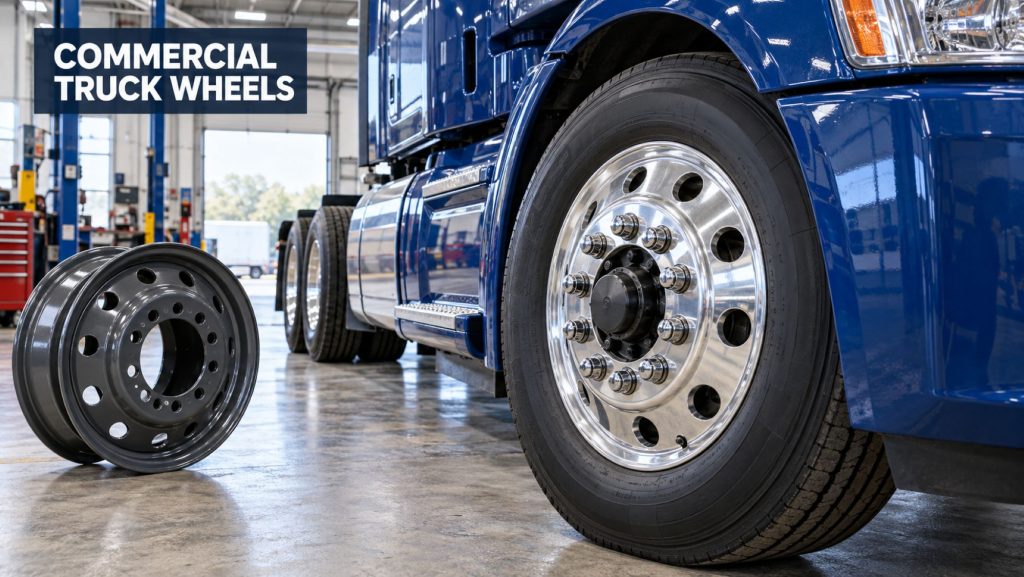
Commercial truck wheels connect the tires to the vehicle’s hubs while supporting heavy loads and transferring acceleration, braking, steering, and cornering forces. Wheel material, size, offset, mounting system, load rating, finish, and maintenance requirements can affect vehicle weight, payload, tire performance, brake cooling, corrosion resistance, and operating cost.
This Truck Equipment Atlas sub-hub covers forged aluminum and steel wheels used on commercial trucks, tractors, trailers, buses, vocational vehicles, and specialized equipment.
Commercial Truck Wheel Products on Truck Equipment Atlas
Explore individual commercial wheel profiles covering materials, dimensions, load ratings, mounting systems, finishes, applications, inspection, maintenance, and replacement considerations.
Alcoa Wheels
Accuride
What Are Commercial Truck Wheels?
Commercial truck wheels are structural components that mount tires to the wheel hubs. They support the vehicle and cargo while transferring forces between the tires, axles, brakes, hubs, and suspension.
Heavy-duty wheels are commonly manufactured from steel or forged aluminum. The correct wheel must match the tire, hub, fasteners, axle, brake system, vehicle application, load requirements, and inflation pressure.
Wheels that appear similar may have different diameters, widths, offsets, bolt patterns, center bores, mounting systems, load ratings, inflation limits, and intended applications.
How Commercial Truck Wheels Work
The wheel fits between the tire and the vehicle hub. The tire bead seats against the wheel’s rim flanges, creating a secure mounting surface and an airtight assembly when used with a tubeless tire.
Wheel fasteners clamp the wheel against the hub or another wheel in a dual assembly. Proper clamping force keeps the wheel securely mounted while the vehicle accelerates, brakes, turns, and travels across uneven surfaces.
Commercial wheels perform several functions:
- Support the tire and vehicle load
- Connect the tire to the hub
- Transfer driving and braking forces
- Maintain correct tire shape and bead seating
- Provide brake and suspension clearance
- Help dissipate wheel-end heat
- Establish tire position and track width
- Maintain correct dual-tire spacing
Major Wheel Components and Features
A commercial wheel includes several surfaces and structural areas that must remain in serviceable condition.
- Rim flanges
- Bead seats
- Drop center
- Disc or wheel center
- Ventilation or hand holes
- Bolt holes
- Center bore
- Hub-contact surface
- Mounting surface
- Valve-stem opening
- Wheel offset
- Protective or appearance finish
Damage or corrosion in any critical area can interfere with tire mounting, wheel clamping, air retention, or safe vehicle operation.
Aluminum Commercial Truck Wheels
Heavy-duty aluminum wheels are commonly forged as a single structural component. They are selected for reduced weight, corrosion resistance, appearance, heat transfer, and potential payload advantages.
Potential advantages of aluminum wheels include:
- Lower weight than many comparable steel wheels
- Potential payload increase
- Reduced unsprung weight
- Resistance to red rust
- Bright polished appearance
- Good heat-transfer characteristics
- Multiple finish and surface-treatment options
Aluminum wheels require correct mounting practices, compatible fasteners, clean contact surfaces, approved cleaning products, and regular inspection for cracks, damage, corrosion, and rim-flange wear.
Steel Commercial Truck Wheels
Steel wheels are widely used on commercial trucks and trailers because of their established service history, application range, durability, availability, and purchase cost.
Potential advantages of steel wheels include:
- Broad vehicle and trailer compatibility
- Durable construction
- Lower initial cost in many applications
- Wide parts and service availability
- Multiple sizes, offsets, and load ratings
- Suitability for many vocational operations
- Protective coating options
Steel wheels require inspection for rust, coating failure, cracks, elongated bolt holes, damaged rims, distortion, and corrosion between mounting surfaces.
Aluminum vs Steel Commercial Truck Wheels
Aluminum and steel wheels can both provide dependable service when correctly specified and maintained. The better choice depends on the vehicle, load, operating environment, maintenance practices, purchase budget, and total ownership goals.
Aluminum wheels are often selected when reducing vehicle weight, improving appearance, or increasing corrosion resistance is important. Steel wheels may be preferred when purchase cost, widespread availability, or compatibility with demanding vocational service is the primary concern.
Explore the complete comparison in Aluminum vs Steel Commercial Truck Wheels.
Common Wheel Sizes
Commercial wheels are produced in multiple diameters and widths for different tires, axles, and applications. Common heavy-duty wheel sizes include 22.5 × 8.25 inches and 24.5 × 8.25 inches, along with wide-base, low-profile, medium-duty, trailer, and specialized configurations.
Other commercial wheel dimensions may include:
- 16-inch wheels
- 17.5-inch wheels
- 19.5-inch wheels
- 22.5-inch wheels
- 24.5-inch wheels
- Wide-base wheels
- Low-profile trailer wheels
- Specialized heavy-load wheels
Wheel diameter and width must match an approved tire size. A tire should never be mounted on a wheel with incompatible dimensions or an insufficient load or pressure rating.
Wheel Load Ratings and Inflation Limits
Every commercial wheel has a maximum load rating and inflation limit. These ratings must meet or exceed the requirements of the tire and vehicle application.
The complete wheel-and-tire assembly remains limited by its lowest-rated component. Relevant limitations may include:
- Wheel load rating
- Wheel inflation rating
- Tire load capacity
- Tire inflation limit
- Valve-stem pressure rating
- Hub and bearing capacity
- Axle rating
- Suspension rating
- Vehicle certification
Installing higher-capacity wheels does not automatically increase the vehicle’s gross axle weight rating, gross vehicle weight rating, or legal payload.
Wheel Offset and Vehicle Track
Wheel offset describes the relationship between the wheel’s centerline and mounting surface. Offset determines where the tire is positioned relative to the hub, axle, suspension, brake system, frame, and vehicle body.
Incorrect offset can cause:
- Improper tire clearance
- Incorrect dual spacing
- Changes to vehicle track width
- Increased bearing loads
- Suspension interference
- Brake-component interference
- Fender or body contact
- Steering-clearance problems
A replacement wheel should match the approved offset for the specific vehicle, axle, hub, and tire configuration.
Hub-Piloted and Stud-Piloted Wheels
Hub-Piloted Wheels
Hub-piloted wheels are centered by machined pilot surfaces on the hub. Two-piece flange nuts clamp the wheel assembly against the hub. This mounting system is widely used on modern North American commercial vehicles.
Stud-Piloted Wheels
Stud-piloted wheels are centered by the wheel studs and matching fasteners. These systems may use inner and outer cap nuts in dual-wheel applications and may use different threads on opposite sides of older vehicles.
Hub-piloted and stud-piloted wheels, nuts, and installation procedures must not be mixed. The complete mounting system must be identified before wheels or fasteners are ordered.
Disc Wheels and Demountable Rims
One-piece disc wheels combine the rim and wheel center into one assembly. These are widely used on modern commercial trucks and trailers.
Some older or specialized vehicles use demountable rims attached to spoke-type wheel hubs. These systems have different mounting, inspection, and service requirements.
Multi-piece rim assemblies require specialized training, approved restraining equipment, and strict safety procedures. Improper servicing can release components with deadly force.
Standard Dual and Wide-Base Wheels
Dual-Wheel Assemblies
A standard dual assembly places two wheels and tires on each end of an axle. The wheels must provide correct spacing so the inflated tires do not contact one another under load.
Wide-Base Wheels
Wide-base wheels support a single wide tire in place of a conventional dual pair when approved for the vehicle and application. These wheels use application-specific widths, offsets, load ratings, and mounting requirements.
A wide-base conversion requires evaluation of axle capacity, track width, bearing loads, suspension clearance, brake clearance, tire availability, payload goals, and applicable regulations.
Wheel Finishes and Surface Treatments
Commercial wheels are available with several finishes and surface treatments. The selected finish affects appearance, cleaning requirements, corrosion resistance, and maintenance.
Common aluminum-wheel finishes may include:
- Brushed finish
- Standard polish
- High polish
- Mirror polish
- Low-maintenance surface treatments
- Protective rim-flange treatments
Steel-wheel protection may include:
- Painted finishes
- Powder coatings
- Corrosion-resistant primers
- Multi-layer protective coatings
- Application-specific colors
Only cleaning products and procedures approved for the wheel material and finish should be used.
Weight, Payload, and Fuel Efficiency
Reducing wheel weight can decrease the vehicle’s empty weight and may allow additional payload when the complete vehicle remains within its legal and certified ratings.
The total weight difference depends on:
- Number of wheels replaced
- Original wheel material and design
- Replacement wheel size and rating
- Dual or wide-base configuration
- Tire selection
- Valve and monitoring equipment
Wheel weight is only one part of vehicle efficiency. Tire rolling resistance, inflation pressure, aerodynamics, vehicle loading, alignment, speed, and driving practices also affect fuel consumption.
Brake Cooling and Wheel-End Heat
Wheel design influences airflow and heat transfer around the brake and hub. Excessive wheel-end heat can damage tires, seals, bearings, lubricants, valves, and wheel finishes.
Possible causes of high wheel-end temperature include:
- Dragging brakes
- Improper brake adjustment
- Seized brake components
- Wheel-bearing problems
- Incorrect bearing adjustment
- Insufficient or contaminated lubricant
- Overloading
- Extended braking on steep grades
Heat discoloration, damaged finishes, melted valve components, lubricant leakage, or unusual odors should be investigated before the vehicle returns to service.
Wheel Installation and Fastener Torque
Correct installation is essential to wheel retention. Mounting surfaces must be clean, flat, undamaged, and free from materials that could reduce clamping force.
Installation procedures should include:
- Confirming the correct wheel and mounting system
- Inspecting the hub, studs, nuts, and wheel
- Cleaning mating surfaces
- Checking wheel and brake clearance
- Installing the correct fasteners
- Following the approved tightening sequence
- Using a calibrated torque wrench
- Applying the specified fastener torque
- Rechecking torque according to the fleet or manufacturer procedure
Impact tools may be used for removal or controlled run-down when permitted, but final torque should be verified using the approved procedure and calibrated equipment.
Wheel Inspection and Maintenance
Commercial wheels should be inspected during pre-trip inspections, tire service, brake service, wheel-end maintenance, and scheduled preventive maintenance.
Inspection points include:
- Cracks around bolt holes, hand holes, and the disc
- Elongated or damaged bolt holes
- Bent or distorted rims
- Damaged rim flanges
- Rim-flange wear
- Corrosion and pitting
- Damaged mounting surfaces
- Loose, missing, or damaged fasteners
- Rust streaks or movement marks
- Valve-stem damage or leakage
- Heat discoloration
- Improper dual-wheel spacing
- Tire or suspension interference
A cracked, distorted, severely corroded, or otherwise unsafe wheel should be removed from service. Structural wheel repairs should only be performed when expressly permitted by the wheel manufacturer and applicable service standards.
Common Wheel Problems
- Loose wheel fasteners: Incorrect torque, dirty mounting surfaces, damaged components, or loss of clamping force can allow wheel movement.
- Cracked wheels: Overloading, impacts, loose fasteners, severe corrosion, or improper mounting may contribute to cracking.
- Elongated bolt holes: Wheel movement around loose fasteners can damage the bolt openings.
- Rim-flange wear: Repeated tire movement can wear the flange and eventually require wheel removal.
- Corrosion: Road salts, moisture, incompatible materials, damaged coatings, and trapped debris can attack wheel and mounting surfaces.
- Air leakage: Valve damage, bead-seat corrosion, rim damage, cracks, or improper tire mounting may allow pressure loss.
- Wheel vibration: Bent wheels, improper mounting, tire imbalance, hub problems, or damaged wheel-end components may cause vibration.
- Heat damage: Brake or bearing problems can overheat the wheel, tire, valve, and surrounding components.
- Dual-tire contact: Incorrect wheel offset, low tire pressure, improper spacing, or excessive loading may allow paired tires to touch.
Common Applications
- Long-haul tractors
- Regional tractors
- Commercial straight trucks
- Dry van trailers
- Refrigerated trailers
- Flatbed trailers
- Tank trailers
- Vocational trucks
- Dump trucks
- Concrete mixers
- Refuse trucks
- Buses and motorcoaches
- Emergency and municipal vehicles
- Heavy-haul and specialized equipment
Choosing the Right Commercial Wheel
A commercial wheel should never be selected by appearance alone. Buyers and service technicians should confirm:
- Wheel material
- Wheel diameter and width
- Load rating
- Maximum inflation pressure
- Hub-piloted or stud-piloted mounting
- Bolt-hole number and pattern
- Center-bore diameter
- Wheel offset
- Brake and suspension clearance
- Single, dual, or wide-base application
- Tire-size compatibility
- Valve-stem requirements
- Finish and corrosion protection
- Vehicle and axle application
The complete wheel part number and manufacturer specifications should be verified before purchase or installation.
Related Tire and Wheel Categories
- Tires & Wheels
- Steer & All-Position Truck Tires
- Drive Tires
- Trailer Tires
- Vocational & Severe-Service Tires
- Tire Pressure Monitoring & Inflation Systems
Related Tire and Wheel Guides
- Tire & Wheel Guides
- Commercial Truck Tire Types Explained
- Steer vs Drive vs Trailer Tires
- How to Read Commercial Truck Tire Sizes and Ratings
- How to Inspect and Maintain Commercial Truck Tires
- Aluminum vs Steel Commercial Truck Wheels
Related Vehicle and Equipment Resources
- Commercial Trucks
- Commercial Trailers
- Axles & Differentials
- Commercial Truck Drive Axles
- Suspension Systems
- Brake Systems
- Tire Pressure Monitoring & Inflation Systems
- Equipment Systems
Expanding the Commercial Truck Wheel Library
Truck Equipment Atlas will continue expanding this section with additional forged aluminum, steel, wide-base, vocational, trailer, medium-duty, heavy-load, and specialty commercial wheels.
Future additions will provide more comparisons covering wheel weight, load capacity, mounting systems, finishes, corrosion protection, inspection, maintenance, and vehicle compatibility.
Explore the Complete Truck Equipment Atlas Library
Truck Equipment Atlas provides educational resources covering commercial trucks, trailers, engines, transmissions, axles, suspension systems, brake systems, fifth wheels, tires, wheels, and other equipment used throughout the trucking industry.
Visit the Equipment Systems section to explore how major commercial vehicle components work together.
Follow the Growth of Truck Equipment Atlas
Truck Equipment Atlas continues to expand with new truck profiles, trailer coverage, diesel engine pages, equipment-system resources, manufacturer information, and educational guides.
Visit our Site Updates page to explore recent additions, project milestones, and upcoming resources as we continue building one of the industry’s growing commercial trucking equipment reference libraries.
View the Latest Site Updates: Truck Equipment Atlas Site Updates