
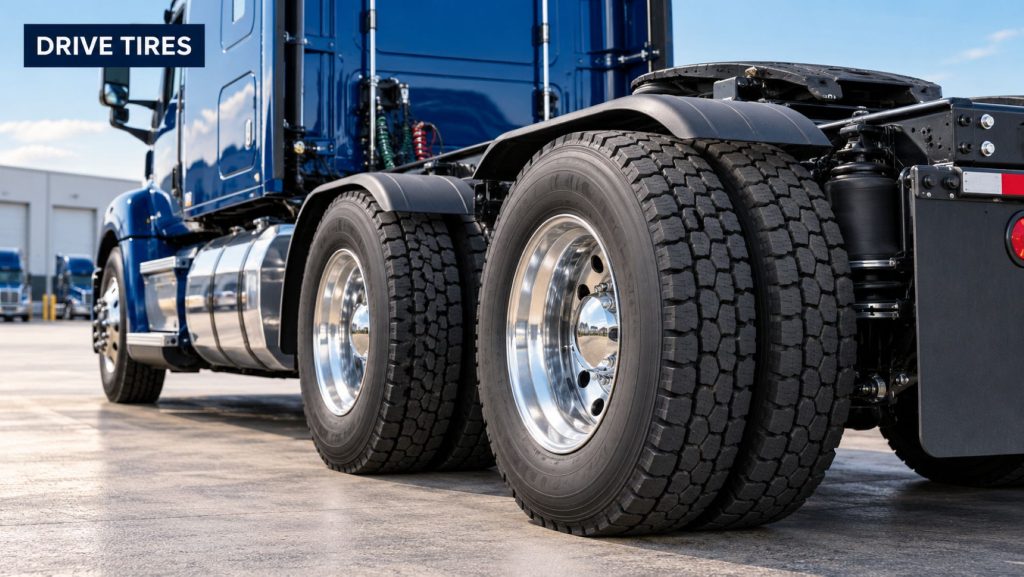
Commercial truck drive tires are designed to transfer engine torque through the drive axles while providing traction, braking control, stability, durability, and predictable wear. Their tread patterns and casing designs are engineered for the demanding forces created during acceleration, climbing, braking, and operation on wet, snowy, loose, or uneven surfaces.
This Truck Equipment Atlas sub-hub covers drive tires used on long-haul tractors, regional trucks, delivery vehicles, vocational equipment, buses, and other commercial vehicles.
Drive Tire Products on Truck Equipment Atlas
Explore individual commercial drive-tire profiles covering tread design, operating applications, fuel efficiency, traction, casing construction, maintenance requirements, and replacement considerations.
Michelin
Bridgestone
Goodyear
Continental
Yokohama
What Are Commercial Truck Drive Tires?
Drive tires are mounted on the powered axles of a commercial vehicle. Engine torque travels through the transmission, driveshaft, differential, axle shafts, wheels, and drive tires before reaching the road.
Because drive tires transmit propulsion and braking forces, they commonly use deeper tread patterns, multiple biting edges, tread blocks, sipes, or open shoulders. The appropriate design depends on the vehicle, operating environment, expected mileage, weather, axle configuration, and traction requirements.
How Drive Tires Work
Drive tires convert rotational force at the wheels into forward movement. Their tread blocks grip the road as torque is applied through the drive axle. During braking, the same contact patches help transfer braking force to the road.
The tread pattern must balance several competing requirements:
- Forward traction
- Wet-road grip
- Snow and mud traction
- Fuel efficiency
- Even tread wear
- Vehicle stability
- Resistance to tread-block movement
- Casing durability and retreadability
Deep or aggressive tread patterns can improve traction but may increase tread movement and rolling resistance. Closed-shoulder and fuel-efficient designs may reduce rolling resistance but must still provide the traction required for the intended operation.
Drive Tire Construction
Commercial radial drive tires combine several structural and tread components. The exact materials, belt construction, tread compounds, and internal technologies vary by manufacturer and tire model.
Major drive-tire components include:
- Tread blocks or ribs
- Open or closed shoulders
- Circumferential and lateral grooves
- Sipes and biting edges
- Tread compound
- Steel belt package
- Radial body plies
- Inner liner
- Sidewalls
- Bead assemblies
- Casing
A durable casing can provide value beyond the original tread life when it remains suitable for professional retreading.
Open-Shoulder and Closed-Shoulder Drive Tires
Open-Shoulder Drive Tires
Open-shoulder drive tires have lateral openings extending toward the outside edges of the tread. This design can improve traction in snow, mud, loose material, and other demanding conditions.
They are commonly selected for regional, vocational, mixed-service, winter, construction, refuse, and other traction-sensitive applications.
Closed-Shoulder Drive Tires
Closed-shoulder drive tires use continuous or substantially supported shoulder areas. They are often designed to promote stability, even wear, reduced tread squirm, and lower rolling resistance during highway operation.
They are commonly used in long-haul, regional-haul, truckload, less-than-truckload, and other primarily paved-road applications.
Long-Haul Drive Tires
Long-haul drive tires are designed for extended highway operation at sustained speeds. Their engineering frequently emphasizes fuel efficiency, removal mileage, tread stability, even wear, heat management, and casing durability.
Common long-haul priorities include:
- Low rolling resistance
- High original-tread mileage
- Predictable highway traction
- Resistance to irregular wear
- Retreadable casing construction
- Stable operation under sustained loads
A fuel-efficient design should still be matched to the vehicle’s operating region, weather exposure, axle loading, and traction needs.
Regional and Urban Drive Tires
Regional and urban trucks experience frequent acceleration, braking, turning, loading changes, and contact with curbs or uneven pavement. Drive tires for these applications may prioritize resistance to scrub, strong traction, durable sidewalls, stable tread blocks, and consistent wear.
Typical regional and urban applications include:
- Less-than-truckload tractors
- Pickup-and-delivery trucks
- Beverage trucks
- Food-service vehicles
- Parcel-delivery trucks
- Transit and shuttle buses
- Municipal vehicles
Vocational and Severe-Service Drive Tires
Vocational drive tires may operate on pavement, gravel, dirt, construction sites, landfills, quarries, logging roads, and other demanding surfaces. These tires often use aggressive tread patterns and compounds designed to resist cuts, chips, tearing, stone damage, and impact-related injuries.
Vehicles requiring specialized vocational drive tires may include:
- Dump trucks
- Concrete mixers
- Refuse trucks
- Logging trucks
- Oilfield vehicles
- Construction trucks
- Utility vehicles
- Heavy-haul tractors
See the Vocational & Severe-Service Tires section for tires developed specifically for demanding on-road and off-road environments.
Drive Tire Sizes and Ratings
Drive tires are available in multiple sizes, load ranges, speed ratings, tread depths, and wheel configurations. Common commercial sizes include 11R22.5, 11R24.5, 295/75R22.5, and 285/75R24.5, although availability depends on the manufacturer and tire model.
The correct tire must match the vehicle manufacturer’s requirements and the approved wheel dimensions. Operators should confirm:
- Tire size
- Load range
- Load index
- Speed rating
- Maximum load and inflation pressure
- Approved rim width
- Overall diameter
- Minimum dual spacing
- Revolutions per mile
- Service and application designation
Use the tire manufacturer’s current load-and-inflation tables when establishing the required cold inflation pressure.
Dual Tires and Wide-Base Drive Tires
Dual Drive Tires
A conventional dual assembly places two tires on each end of the drive axle. Dual tires must be correctly matched for size, inflation pressure, tread depth, and overall diameter. Poor matching can cause one tire to carry more load or scrub against its partner.
Wide-Base Drive Tires
A wide-base tire replaces a dual pair with one larger tire and wheel assembly when the vehicle, axle, wheel, and operating requirements permit it. Potential benefits may include reduced assembly weight and lower rolling resistance.
Wide-base conversions require careful evaluation of axle ratings, wheel offset, track width, suspension clearance, tire availability, emergency replacement needs, and applicable regulations.
Inflation Pressure and Load Capacity
Correct inflation is essential to drive-tire safety, traction, casing life, fuel economy, heat control, and wear performance. The required pressure should be based on the actual load carried by the tire and the manufacturer’s load-and-inflation information.
Underinflation can cause excessive flexing, heat buildup, irregular shoulder wear, reduced fuel efficiency, casing damage, and tire failure. Overinflation may reduce the size of the contact patch, contribute to center wear, increase impact sensitivity, and affect traction.
Pressure should be checked when tires are cold with a calibrated gauge. Fleets should not rely only on visual inspection because a commercial tire can be significantly underinflated without appearing flat.
Traction and Weather Performance
Drive-tire traction is affected by tread depth, tread pattern, rubber compound, road surface, weather, vehicle loading, differential operation, inflation pressure, and driver inputs.
Features that may support traction include:
- Deep tread blocks
- Open shoulders
- Lateral grooves
- Full-depth or regenerating sipes
- Multiple biting edges
- Water-evacuation channels
- Winter-service tread compounds
Drivers should remember that an aggressive tread design cannot overcome excessive speed, poor vehicle control, insufficient stopping distance, or unsafe road conditions.
Fuel Efficiency and Rolling Resistance
Drive tires can significantly affect the fuel consumption of a tractor because multiple tires are installed across the powered axle group. Low-rolling-resistance designs reduce energy loss as the tire flexes and rolls under load.
Actual fuel performance depends on more than the tire model. Important factors include:
- Inflation pressure
- Vehicle loading
- Axle alignment
- Road speed
- Driving behavior
- Terrain and weather
- Tread depth
- Vehicle aerodynamics
- Engine and drivetrain efficiency
Fleets should evaluate fuel economy together with traction, removal mileage, casing value, downtime, and total cost per mile.
Drive Tire Wear Patterns
Drive-tire wear can reveal inflation, alignment, suspension, wheel-end, axle, or application problems. Common patterns include:
- Heel-and-toe wear: Tread blocks wear unevenly from their leading edge to their trailing edge.
- Alternating lug wear: Adjacent tread lugs wear at different rates.
- Center wear: The middle of the tread wears faster than the shoulders.
- Shoulder wear: One or both shoulders wear faster than the center.
- Cupping or scalloping: Repeated high and low areas develop around the tread.
- Diagonal wear: Angled wear patterns form across the tread surface.
- Spot wear: Isolated portions of the tread wear faster than surrounding areas.
- Irregular dual wear: One tire in a dual assembly wears differently because of mismatched diameter, pressure, load, or mechanical conditions.
The underlying cause should be corrected before a replacement tire is installed. Otherwise, the new tire may develop the same wear pattern.
Inspection and Maintenance
Routine drive-tire inspections should include:
- Cold inflation pressure
- Tread depth across the full tread width
- Irregular or rapid wear
- Cuts, punctures, cracks, bulges, and exposed cords
- Objects trapped between dual tires
- Sidewall contact between duals
- Valve stems, caps, and extensions
- Wheel and rim condition
- Loose or damaged wheel fasteners
- Oil or grease contamination
- Signs of wheel-bearing or brake overheating
- Correct spacing and matching of dual assemblies
Any tire with structural damage, exposed reinforcement, severe underinflation, excessive heat, or other unsafe conditions should be evaluated by a qualified commercial-tire professional.
Drive Tire Rotation and Matching
Rotation practices depend on the tire design, tread direction, axle configuration, wear pattern, and manufacturer recommendations. Some directional tires must remain oriented correctly unless the manufacturer provides an approved procedure for reversing them.
Dual tires should be matched closely for overall diameter and tread depth. Significant differences can cause the larger tire to carry more weight while the smaller tire drags or scrubs, increasing heat and wear in both tires.
Tires installed across tandem drive axles should also be evaluated for circumference and gearing compatibility. Incorrect matching can contribute to driveline stress and irregular tire wear.
Retreading Drive Tires
Drive positions are a common application for professionally retreaded commercial-tire casings. Retreading allows a serviceable casing to receive a replacement tread after the original tread has reached its removal point.
A casing must be inspected and approved before retreading. Its suitability depends on age, previous service, maintenance history, repairs, operating conditions, casing construction, and the retreader’s inspection standards.
Potential benefits include lower tire cost per mile, extended casing use, reduced raw-material consumption, and improved fleet tire-program efficiency.
Common Drive Tire Applications
- Long-haul tractors
- Regional tractors
- Less-than-truckload equipment
- Pickup-and-delivery trucks
- Commercial straight trucks
- Heavy-haul tractors
- Vocational trucks
- Construction vehicles
- Dump trucks
- Refuse trucks
- Buses and motorcoaches
- Emergency and municipal vehicles
Choosing the Right Drive Tire
The best drive tire is the one matched to the vehicle’s actual work. Buyers should consider:
- Long-haul, regional, urban, vocational, or mixed service
- Annual mileage
- Highway and off-road operating percentages
- Required load capacity
- Typical road and weather conditions
- Open- or closed-shoulder design
- Dual or wide-base configuration
- Fuel-efficiency goals
- Expected removal mileage
- Casing value and retread strategy
- Local dealer and roadside-service availability
- Total cost per mile
Fleets should compare verified operating results from similar vehicles and routes instead of choosing a tire only by purchase price or advertised mileage.
Related Tire and Wheel Categories
- Tires & Wheels
- Steer & All-Position Truck Tires
- Trailer Tires
- Vocational & Severe-Service Tires
- Commercial Truck Wheels
- Tire Pressure Monitoring & Inflation Systems
Related Tire and Wheel Guides
- Tire & Wheel Guides
- Commercial Truck Tire Types Explained
- Steer vs Drive vs Trailer Tires
- How to Read Commercial Truck Tire Sizes and Ratings
- How to Inspect and Maintain Commercial Truck Tires
- Aluminum vs Steel Commercial Truck Wheels
Related Vehicle and Equipment Resources
- Commercial Trucks
- Axles & Differentials
- Commercial Truck Drive Axles
- Suspension Systems
- Brake Systems
- Equipment Systems
Expanding the Drive Tire Library
Truck Equipment Atlas will continue expanding this section with additional long-haul, regional, urban, winter, vocational, wide-base, and severe-service drive tires.
Future additions will provide more comparisons covering traction, tread design, fuel efficiency, casing construction, retreadability, maintenance, and application-specific tire selection.
Explore the Complete Truck Equipment Atlas Library
Truck Equipment Atlas provides educational resources covering commercial trucks, trailers, engines, transmissions, axles, suspension systems, brake systems, fifth wheels, tires, wheels, and other equipment used throughout the trucking industry.
Visit the Equipment Systems section to explore how major commercial vehicle components work together.
Follow the Growth of Truck Equipment Atlas
Truck Equipment Atlas continues to expand with new truck profiles, trailer coverage, diesel engine pages, equipment-system resources, manufacturer information, and educational guides.
Visit our Site Updates page to explore recent additions, project milestones, and upcoming resources as we continue building one of the industry’s growing commercial trucking equipment reference libraries.
View the Latest Site Updates: Truck Equipment Atlas Site Updates