
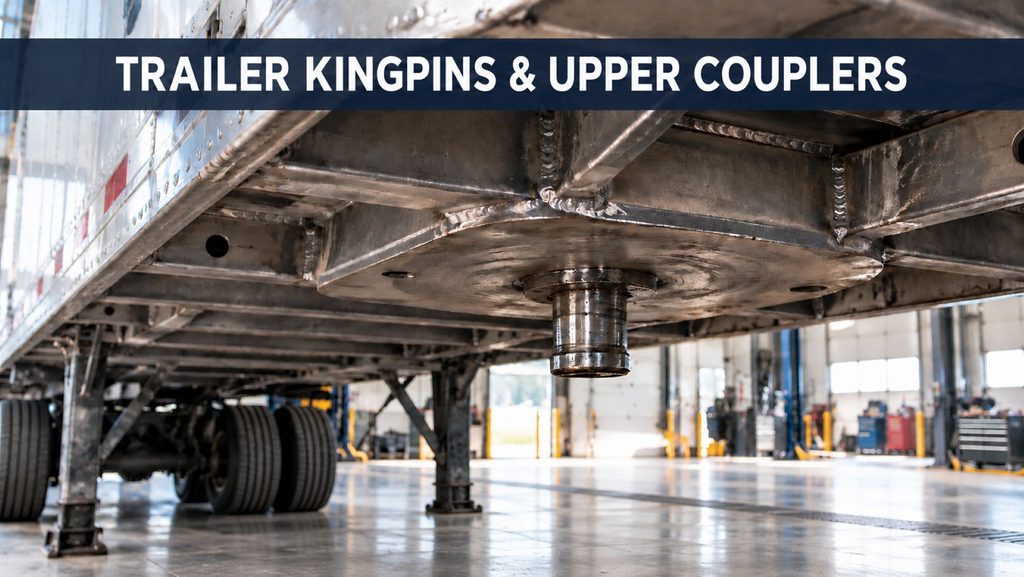
Trailer kingpins and upper couplers form the trailer side of the connection between a commercial tractor and semitrailer. The kingpin enters the tractor’s fifth wheel, while the upper-coupler structure transfers vertical, pulling, braking, cornering, and articulation forces into the trailer frame.
Although the kingpin is relatively small compared with the tractor and trailer, it is one of the most safety-critical components in the entire combination. Kingpin wear, structural cracking, corrosion, incorrect installation, or upper-coupler damage can affect coupling security and vehicle control.
This section of Truck Equipment Atlas covers standard and heavy-duty kingpins, weld-in and replaceable designs, upper-coupler assemblies, bolster plates, kingpin housings, inspection procedures, replacement considerations, and related tractor-trailer coupling equipment.
Trailer Kingpin and Upper-Coupler Products on Truck Equipment Atlas
Explore the kingpin and upper-coupler products being added to the Truck Equipment Atlas library.
SAF-Holland
How Trailer Kingpins and Upper Couplers Work
The kingpin projects downward from the trailer’s upper-coupler or bolster plate. When the tractor backs beneath the trailer, the fifth-wheel top plate slides against the trailer’s lower coupling surface and guides the kingpin into the fifth-wheel throat.
The fifth-wheel locking mechanism closes around the kingpin’s locking surface. Once properly coupled, the kingpin permits the tractor and trailer to rotate horizontally during turns while the fifth wheel provides the required fore-and-aft articulation.
The upper coupler distributes the forces concentrated around the kingpin into the trailer’s crossmembers, side members, floor structure, and main frame. Its design must match the trailer type, operating weight, loading conditions, and expected service environment.
Major Upper-Coupler Components
A trailer upper-coupler assembly may include the following components:
- Trailer kingpin
- Bolster plate or rubbing plate
- Kingpin mounting plate or housing
- Retention plate on replaceable systems
- Upper-coupler crossmembers
- Longitudinal support members
- Reinforcement plates
- Bolts or welds securing the kingpin
- Trailer frame connections
- Corrosion-protection coatings
- Trailer apron or skid-plate surface
Two-Inch Trailer Kingpins
The 2-inch kingpin is the standard coupling size used on most North American commercial semitrailers. It is compatible with fifth wheels designed and approved for a standard 2-inch kingpin.
Common applications include dry vans, refrigerated trailers, flatbeds, tank trailers, dump trailers, container chassis, hopper trailers, automobile transporters, and many specialized semitrailers.
Kingpin dimensions, mounting style, material, upper-coupler thickness, and rated capacity must be confirmed before replacement. Two kingpins with the same nominal diameter may not be interchangeable.
3.5-Inch Heavy-Duty Kingpins
A 3.5-inch kingpin may be used on certain heavy-haul, industrial, mining, logging, military, and specialized transport equipment. It requires a fifth wheel designed specifically for the larger kingpin.
The 3.5-inch design is not interchangeable with a standard 2-inch kingpin. The kingpin, fifth wheel, trailer upper coupler, mounting structure, and tractor frame must be engineered as a complete coupling system.
A larger kingpin does not independently determine the allowable trailer weight. The combination remains limited by the lowest-rated component and the vehicle’s approved configuration.
Weld-In Kingpins
A weld-in kingpin is permanently installed within the trailer’s upper-coupler structure. Weld-in designs may be used during original trailer construction or when rebuilding an upper-coupler assembly.
Welding must follow the kingpin and trailer manufacturers’ specifications. Improper welding location, heat input, filler material, penetration, or cooling can weaken the kingpin or surrounding structure.
A worn weld-in kingpin may require removal and structural repair of the upper coupler. The complete assembly should be inspected before a replacement kingpin is installed.
Bolt-In and Replaceable Kingpins
Replaceable kingpin systems use bolts, retention plates, housings, or other approved mounting components to secure the kingpin within the upper coupler.
These systems can simplify kingpin replacement when the surrounding upper-coupler structure remains serviceable. Replacement still requires the correct kingpin model, plate thickness, fasteners, torque procedure, and installation sequence.
A bolt-in kingpin should never be substituted for a weld-in design unless the complete conversion has been approved for the trailer and application.
Mushroom and Cruciform Kingpin Designs
Kingpins are available with different upper mounting shapes. Mushroom-style kingpins use an enlarged upper section that is integrated into the upper-coupler structure. Cruciform designs use cross-shaped mounting sections that distribute loads into the surrounding assembly.
The mounting style affects how the kingpin is installed and how loads are transferred into the trailer. One design should not be substituted for another based only on the exposed portion of the kingpin.
Upper-Coupler and Bolster-Plate Construction
The upper coupler is more than the visible plate beneath the front of the trailer. It is a structural assembly that supports the trailer’s front load and transfers forces between the kingpin and trailer frame.
Construction may include a steel rubbing plate supported by crossmembers, channels, reinforcements, and longitudinal members. Materials and structural layout depend on the trailer type, kingpin load, frame design, and intended service.
Aluminum trailers may use application-specific steel or aluminum upper-coupler structures designed to control stress and prevent incompatible-metal corrosion.
Kingpin Location and Trailer Geometry
The kingpin’s location beneath the trailer affects tractor-to-trailer clearance, weight distribution, turning behavior, bridge dimensions, and compatibility with the tractor’s fifth-wheel position.
Important dimensions include:
- Kingpin setback from the trailer front
- Upper-coupler height
- Trailer width and front-corner shape
- Landing-gear location
- Tractor frame and mudflap clearance
- Cab, sleeper, and fairing clearance
- Refrigeration-unit clearance
- Maximum turning and articulation angles
Kingpin and Fifth-Wheel Compatibility
The trailer kingpin must match the fifth wheel’s approved kingpin diameter, locking design, capacity, and operating application. Both components should be inspected when excessive coupling clearance, difficult locking, or unusual movement is discovered.
A worn kingpin can damage the fifth-wheel locking mechanism. Worn or incorrectly adjusted fifth-wheel locks can also accelerate kingpin wear.
Drivers should never attempt to couple visibly damaged or incompatible equipment.
Kingpin Wear and Measurement
Kingpins wear where the fifth-wheel locking mechanism contacts the kingpin and where the fifth-wheel throat guides the kingpin during coupling.
Inspection should look for:
- Excessive reduction in kingpin diameter
- Uneven or tapered wear
- Grooves or scoring
- Cracks or impact damage
- Bending or misalignment
- Loose mounting components
- Damage from high or low coupling
An approved kingpin wear gauge should be used according to the kingpin and fifth-wheel manufacturers’ procedures. Visual inspection alone may not reveal an out-of-limit kingpin.
Upper-Coupler Inspection
The upper coupler should be inspected whenever the kingpin is inspected, replaced, or involved in a coupling incident. The surrounding structure must remain capable of supporting the kingpin and distributing forces into the trailer frame.
Inspection points include:
- Cracks around the kingpin mounting area
- Broken or incomplete welds
- Bent or distorted rubbing plates
- Loose or missing fasteners
- Corrosion and metal loss
- Damaged crossmembers or support channels
- Separation from the trailer frame
- Evidence of previous unapproved repairs
- Raised welds or obstructions on the rubbing surface
- Damage caused by incorrect coupling height
High Coupling and Low Coupling
High coupling occurs when the trailer is positioned too high and the kingpin passes over or above the fifth-wheel locking mechanism. The trailer may appear connected even though the kingpin is not properly captured.
Low coupling occurs when the trailer is positioned too low for the fifth wheel to slide properly beneath the upper coupler. This can cause the tractor frame or fifth wheel to strike the trailer and may damage the kingpin, apron, landing gear, or tractor components.
The trailer should be positioned so the fifth wheel makes firm contact with the upper-coupler plate as the tractor backs beneath it.
Corrosion and Contamination
Road salt, moisture, chemicals, dirt, and trapped debris can corrode upper-coupler plates, support members, kingpin housings, welds, and fasteners.
Corrosion protection may include paint, protective coatings, galvanizing, sealants, drainage provisions, and regular cleaning. Coatings should not interfere with required kingpin dimensions, fastener seating, welding procedures, or fifth-wheel contact.
Heavy corrosion should be evaluated structurally rather than covered with new coating.
Common Applications
- Dry van trailers
- Refrigerated trailers
- Flatbed and drop-deck trailers
- Lowboy and removable-gooseneck trailers
- Tank trailers
- Dump trailers
- Hopper and grain trailers
- Intermodal container chassis
- Automobile transporters
- Logging trailers
- Heavy-haul platform trailers
- Specialized industrial trailers
- Rail-compatible intermodal equipment
Advantages of Replaceable Kingpin Systems
- May simplify replacement of a worn kingpin
- Can reduce extensive cutting and welding
- Allows inspection of the kingpin housing
- Supports application-specific replacement parts
- May reduce trailer downtime when properly supported
Limitations and Considerations
- Kingpins are not interchangeable based only on diameter
- Upper-coupler plate thickness must match the kingpin design
- Incorrect installation can compromise coupling security
- A new kingpin will not repair a damaged upper coupler
- Unapproved welding can weaken heat-treated components
- Corrosion can remain hidden inside the upper-coupler structure
- Heavy-haul systems may require specialized kingpins and fifth wheels
- Replacement may require structural inspection and engineering approval
Driver and Operator Inspection
Drivers should inspect the visible kingpin and upper-coupler surface during the pre-trip inspection whenever access permits.
After coupling, the driver should verify:
- The fifth wheel is fully beneath the upper-coupler plate
- No visible gap exists between the fifth wheel and trailer
- The kingpin is captured by the locking mechanism
- The fifth-wheel release handle is in its locked position
- The trailer is not high coupled
- The landing gear and tractor have adequate clearance
- A controlled tug test confirms coupling
Maintenance and Ownership Notes
Kingpins and upper couplers should be inspected according to the trailer manufacturer’s maintenance schedule and whenever coupling problems, impacts, excessive movement, or structural damage are reported.
Maintenance practices include:
- Cleaning the kingpin and upper-coupler surface
- Measuring kingpin wear with an approved gauge
- Inspecting welds, bolts, housings, and retention plates
- Checking the rubbing plate for cracks and deformation
- Removing accumulated grease and debris before structural inspection
- Checking crossmembers and frame connections
- Correcting corrosion and drainage problems
- Inspecting the fifth wheel when kingpin wear is found
- Using approved replacement parts and installation procedures
Common Kingpin and Upper-Coupler Problems
Excessive kingpin wear: A worn or incorrectly adjusted fifth wheel, poor coupling practices, contamination, inadequate inspection, or high coupling-cycle frequency may accelerate wear.
Loose kingpin: Damaged mounting components, cracked welds, loose fasteners, structural deformation, or an incorrect installation may allow movement.
Upper-coupler cracking: Overloading, fatigue, corrosion, impact damage, improper repairs, or stress concentration around the kingpin structure may produce cracks.
Bent rubbing plate: Incorrect coupling height, impact loading, landing-gear failure, or trailer overloading may deform the plate.
Difficult coupling: Kingpin damage, incorrect trailer height, fifth-wheel contamination, lock problems, misalignment, or upper-coupler distortion may prevent normal engagement.
Excessive tractor-trailer movement: Kingpin wear, fifth-wheel lock wear, incorrect lock adjustment, loose mounting components, or upper-coupler damage may be responsible.
Corrosion around the kingpin: Failed coatings, trapped moisture, road salt, chemical exposure, or poor drainage can cause metal loss around the mounting structure.
Choosing Replacement Components
Replacement kingpins and upper-coupler components should be identified using the trailer manufacturer’s information and the complete specifications of the original assembly.
Important identification details include:
- Trailer manufacturer
- Trailer model and model year
- Vehicle identification number
- Kingpin manufacturer and part number
- Two-inch or 3.5-inch kingpin diameter
- Weld-in or replaceable mounting design
- Mushroom, cruciform, or other mounting style
- Upper-coupler plate thickness
- Trailer capacity and application
- Applicable structural and coupling standards
Related Fifth-Wheel and Coupling Categories
- Commercial Truck Fifth Wheels
- Fifth Wheel Sliders & Mounting Systems
- Heavy-Haul & Severe-Duty Fifth Wheels
- Terminal Tractor & Yard Coupling Systems
- Pintle Hooks & Drawbar Couplings
Related Fifth-Wheel and Coupling Guides
- Fifth-Wheel Systems Explained
- Fixed vs Sliding Fifth Wheels
- How to Couple and Uncouple a Semitrailer
- How to Inspect and Maintain a Commercial Fifth Wheel
- Fixed vs Sliding Fifth Wheels
- Fifth Wheels & Coupling Equipment
- How to Inspect and Maintain a Fifth Wheel and Kingpin
Related Truck and Trailer Resources
- Commercial Trucks
- Commercial Trailers
- Axles & Differentials
- Suspension Systems
- Brake Systems
- Tires & Wheels
- Equipment Systems
Explore the Complete Fifth-Wheel and Coupling Library
Visit the Fifth Wheels & Coupling Equipment hub to explore commercial fifth wheels, slider systems, mounting equipment, heavy-haul couplings, terminal tractor systems, trailer kingpins, upper couplers, pintle hooks, drawbar equipment, product profiles, and educational guides.