
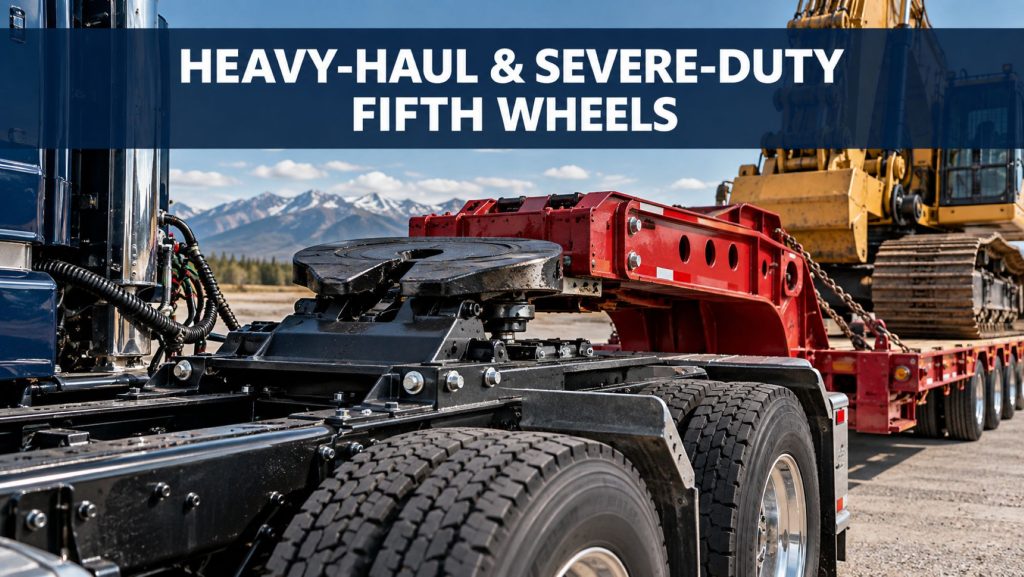
Heavy-haul and severe-duty fifth wheels are designed for tractors and specialized vehicles operating with exceptionally heavy trailers, concentrated vertical loads, demanding terrain, or high articulation requirements.
These coupling systems use reinforced top plates, high-capacity mounting structures, heavy-duty locking mechanisms, and application-specific configurations to connect the tractor with the semitrailer while allowing controlled rotation and articulation.
This section of Truck Equipment Atlas covers severe-duty fifth wheels, heavy-haul mounting systems, fully oscillating fifth wheels, no-tilt configurations, severe-duty sliders, and related coupling components.
Heavy-Haul and Severe-Duty Fifth-Wheel Products on Truck Equipment Atlas
Explore the heavy-haul and severe-duty fifth-wheel products being added to the Truck Equipment Atlas library.
SAF-Holland
Fontaine
How Heavy-Haul Fifth Wheels Work
A heavy-haul fifth wheel couples the tractor to the semitrailer through the trailer’s kingpin. During coupling, the kingpin enters the throat of the fifth-wheel top plate and engages the locking mechanism.
Once properly locked, the fifth wheel transfers the trailer’s vertical load into the tractor frame while transmitting acceleration, braking, cornering, and articulation forces between the two vehicles.
The top plate pivots fore and aft as the tractor and trailer travel over changes in road elevation. Fully oscillating systems may also provide controlled side-to-side articulation for uneven terrain and specialized off-highway operation.
Major Fifth-Wheel Components
A heavy-haul fifth-wheel assembly may include the following components:
- Cast-steel or fabricated fifth-wheel top plate
- Kingpin throat and locking jaws
- Locking wedge or secondary lock
- Operating handle and release mechanism
- Pivot pins and bracket bushings
- Mounting brackets or pedestals
- Stationary mounting plate
- Severe-duty slider rails and carriage
- Slider locking pins
- Air-release or manual-release equipment
- No-tilt brackets where required
- Oscillating pivots on compatible systems
- Mounting fasteners and frame reinforcements
Capacity and Operating Forces
Fifth-wheel selection must account for both the vertical load imposed on the tractor and the horizontal forces created by pulling, braking, grade changes, and trailer movement.
A fifth wheel’s published capacity does not independently establish the tractor’s allowable payload or gross combination weight. The complete vehicle remains limited by its frame, axles, suspension, brakes, tires, wheels, mounting system, and certified ratings.
Heavy-haul applications should be evaluated using the complete operating configuration, including trailer type, kingpin design, load distribution, road surface, terrain, axle arrangement, and expected articulation.
Reinforced Fifth-Wheel Construction
Severe-duty fifth wheels commonly use reinforced cast-steel top plates, heavy pivot structures, high-capacity brackets, and robust locking components. These features help the assembly withstand repeated loading and high forces in demanding operations.
The mounting system must be designed to distribute these forces into the tractor frame. Installing a high-capacity top plate on an unsuitable mounting structure does not produce a properly rated coupling system.
Locking Mechanisms and Kingpin Engagement
The locking mechanism captures the trailer kingpin and prevents it from leaving the fifth-wheel throat. Heavy-duty designs may use opposing jaws, a movable jaw and stationary lock, or another manufacturer-specific arrangement.
Correct adjustment is critical. Excessive clearance between the lock and kingpin can create chucking, impact loading, poor ride quality, and accelerated wear. A lock that is adjusted too tightly may bind or fail to close properly.
Drivers should always perform a visual lock inspection and coupling test before moving the vehicle.
Two-Inch and 3.5-Inch Kingpins
Standard commercial semitrailers commonly use a 2-inch kingpin. Certain heavy-haul and specialized equipment may use a larger 3.5-inch kingpin and a compatible fifth wheel.
The fifth wheel and kingpin must be designed for one another. A 2-inch kingpin cannot be safely coupled to a fifth wheel intended for a 3.5-inch kingpin, and the larger kingpin cannot be forced into a standard fifth wheel.
The trailer upper coupler, kingpin, fifth wheel, mounting system, and tractor frame must be evaluated as one complete coupling arrangement.
Stationary Fifth-Wheel Mounts
A stationary fifth wheel is mounted in a fixed longitudinal position on the tractor. Stationary systems are frequently used when the tractor and trailer combination has a consistent configuration and does not require routine fifth-wheel repositioning.
Fixed mounting can reduce weight and mechanical complexity compared with a slider. It also eliminates slider rails and locking pins that require inspection and maintenance.
The mounting position must be engineered correctly because it determines trailer-to-cab clearance and influences weight distribution across the tractor axles.
Severe-Duty Sliding Fifth Wheels
A severe-duty slider allows the fifth wheel to move forward or rearward along reinforced mounting rails. Repositioning the fifth wheel changes weight distribution and can provide additional clearance for different trailer configurations.
Severe-duty sliding assemblies may use reinforced carriages, high-capacity rails, multiple locking pins, and air-operated release systems. The top plate, slider, brackets, mounting hardware, and tractor frame must all be suitable for the intended load.
Before road operation, all slider locking pins must be fully engaged and visually verified.
Fully Oscillating Fifth Wheels
A fully oscillating fifth wheel permits both fore-and-aft movement and controlled side-to-side articulation. This can help the tractor and trailer remain coupled while crossing uneven terrain where the two vehicles may operate at different angles.
These systems may be used in oilfield, mining, construction, logging, military, and specialized heavy-haul applications. Their additional pivots and structural components require application-specific inspection and lubrication.
No-Tilt Fifth-Wheel Systems
Some specialized trailers require a fifth wheel with restricted or eliminated top-plate tilt. No-tilt brackets may be installed when the trailer design provides its own articulation or when uncontrolled fifth-wheel movement could interfere with the equipment.
No-tilt equipment should only be used in approved applications. Restricting fifth-wheel movement on an incompatible trailer can introduce damaging forces into the coupling, mounting system, frame, or trailer structure.
Mounting Height and Vehicle Clearance
Fifth-wheel mounting height affects trailer level, landing-gear clearance, frame clearance, deck height, and overall vehicle height. A fifth wheel that is too high or too low can alter trailer geometry and load distribution.
Heavy-haul tractors may require specialized mounting heights to match lowboy trailers, platform trailers, jeep dollies, boosters, modular equipment, or other specialized combinations.
Clearance should be checked throughout the expected range of turning and articulation.
Frame and Chassis Integration
The fifth wheel must be mounted to the tractor using an approved structure capable of transferring vertical and horizontal forces into the frame rails.
Chassis integration may require:
- Application-specific mounting brackets
- Reinforced mounting plates
- Inner frame reinforcement
- Crossmember evaluation
- Approved fastener patterns
- Clearance for suspension and drivetrain movement
- Protection of air lines, wiring, tanks, and exhaust components
Frame drilling, welding, and reinforcement should follow the tractor manufacturer’s requirements and applicable engineering procedures.
Weight Distribution and Fifth-Wheel Position
The longitudinal position of the fifth wheel affects how trailer weight is divided between the tractor steer axle, drive axles, and trailer axles.
Moving a sliding fifth wheel forward generally transfers more weight toward the tractor’s steer axle. Moving it rearward generally shifts weight away from the steer axle and toward the drive and trailer axle groups.
Heavy-haul configurations should be weighed using certified scales. Fifth-wheel position must also preserve adequate cab, frame, tire, landing-gear, and trailer clearance.
Common Heavy-Haul Applications
- Heavy-haul tractors
- Lowboy and detachable-gooseneck trailers
- Multi-axle platform trailers
- Jeep and booster combinations
- Modular heavy-transport systems
- Construction-equipment transporters
- Oilfield equipment haulers
- Mining and quarry vehicles
- Logging tractors
- Military transport vehicles
- Specialized industrial transporters
- Oversize and overweight load combinations
Vocational and Severe-Duty Applications
Severe-duty fifth wheels are also used where operating conditions are demanding even if the vehicle does not always carry an extreme gross combination weight.
These applications may include repeated starts and stops, steep grades, rough access roads, tight maneuvering, concentrated loads, high coupling cycles, and exposure to mud, dust, moisture, or abrasive materials.
Rough-Terrain Operation and Articulation
Uneven terrain can place substantial twisting forces on the tractor, trailer, fifth wheel, and mounting structure. The selected coupling must provide the required articulation without allowing interference between the trailer, tractor frame, tires, suspension, or cab.
A fully oscillating system may be appropriate for certain off-highway applications, but additional movement can change vehicle behavior. Drivers should understand the system’s operating limits before entering steep or uneven terrain.
Advantages
- Designed for demanding heavy-haul and vocational service
- Reinforced construction supports higher operating forces
- Available with stationary or sliding mounts
- Specialized kingpin configurations may be available
- Fully oscillating systems support uneven-terrain operation
- Severe-duty sliders provide weight-distribution adjustment
- Application-specific mounting options support specialized tractors
- Replaceable wear components may extend service life
Limitations and Considerations
- Heavy-duty construction adds tractor weight
- Specialized fifth wheels may require reinforced mounting systems
- Higher capacity does not automatically increase the vehicle’s certified ratings
- Fully oscillating systems require additional inspection and maintenance
- Specialized kingpins are not interchangeable with standard equipment
- Incorrect mounting height can affect trailer geometry and clearance
- Slider systems introduce additional pins, rails, and moving components
- Off-highway operation can accelerate wear and contamination
- Application engineering may be required before installation
Driver and Operator Experience
Drivers must confirm that the tractor and trailer are correctly aligned before coupling. The trailer should be positioned at the proper height so the fifth wheel makes firm contact with the trailer’s upper coupler as the tractor backs underneath it.
After coupling, the driver should verify:
- The locking mechanism is fully closed around the kingpin
- The release handle is in its locked position
- No gap exists between the fifth wheel and upper coupler
- Slider pins are fully engaged when equipped
- Air and electrical connections are secure
- Landing gear is fully raised
- Tractor-to-trailer clearance is adequate
- A controlled tug test has confirmed coupling
Maintenance and Inspection
Heavy-haul fifth wheels should be inspected and serviced according to the manufacturer’s schedule and the severity of the operating environment.
Regular service should include:
- Cleaning the top plate and locking mechanism
- Lubricating the top plate or inspecting approved lubrication plates
- Lubricating lock, pivot, and release components
- Checking lock adjustment and kingpin clearance
- Inspecting the top plate for cracks, deformation, and abnormal wear
- Inspecting mounting brackets and pivot pins
- Checking slider rails and locking pins
- Inspecting air-release lines and actuators
- Checking mounting fasteners and frame structure
- Measuring kingpin wear with an approved gauge
- Removing dirt, abrasive material, and hardened grease
Common Heavy-Duty Fifth-Wheel Problems
Excessive kingpin movement: Worn locking components, incorrect adjustment, or a worn kingpin can create excessive clearance and driveline shock.
Difficulty coupling: Incorrect trailer height, damaged locks, hardened grease, contamination, poor alignment, or an incompatible kingpin may prevent proper engagement.
Fifth wheel will not release: Binding caused by tractor-to-trailer pressure, damaged release components, corrosion, contamination, or inadequate lubrication may prevent unlocking.
Slider will not move: Locked pins, low air pressure, damaged air lines, corrosion, frame twist, debris, or excessive load on the locking mechanism may be responsible.
Slider pins will not engage: Misalignment between the carriage and rail openings, damaged pins, weak springs, contamination, or air-system problems may prevent complete engagement.
Abnormal top-plate wear: Insufficient lubrication, a damaged trailer upper coupler, excessive contamination, incorrect loading, or incompatible equipment can accelerate wear.
Mounting cracks: Overloading, severe impacts, loose fasteners, improper installation, frame flex, or unsuitable mounting structures can damage brackets and mounting plates.
Choosing a Heavy-Haul Fifth Wheel
Selection should begin with the complete tractor, trailer, load, and operating environment rather than the fifth wheel alone.
Important selection factors include:
- Maximum vertical load
- Gross combination weight
- On-highway or off-highway service
- Two-inch or 3.5-inch kingpin
- Stationary or sliding mount
- Required fore-and-aft adjustment
- Required side-to-side articulation
- Mounting height
- Tractor frame strength and configuration
- Trailer upper-coupler design
- Cab, tire, frame, and landing-gear clearance
- Service and replacement-parts availability
Related Fifth-Wheel and Coupling Categories
- Commercial Truck Fifth Wheels
- Fifth Wheel Sliders & Mounting Systems
- Kingpins & Upper Couplers
- Pintle Hooks & Drawbar Couplings
Related Fifth-Wheel and Coupling Guides
- Fifth-Wheel Systems Explained
- Fixed vs Sliding Fifth Wheels
- How to Couple and Uncouple a Semitrailer
- How to Inspect and Maintain a Commercial Fifth Wheel
- Fixed vs Sliding Fifth Wheels
- Fifth Wheels & Coupling Equipment
- Heavy-Haul Freight Guide
Related Truck Equipment Resources
- Commercial Trucks
- Commercial Trailers
- Axles & Differentials
- Suspension Systems
- Brake Systems
- Tires & Wheels
- Equipment Systems
Explore the Complete Fifth-Wheel and Coupling Library
Visit the Fifth Wheels & Coupling Equipment hub to explore commercial fifth wheels, slider systems, mounting equipment, kingpins, upper couplers, pintle hooks, drawbar couplings, severe-duty systems, individual product profiles, and educational guides.