
Tractor vs Trailer Brake Systems
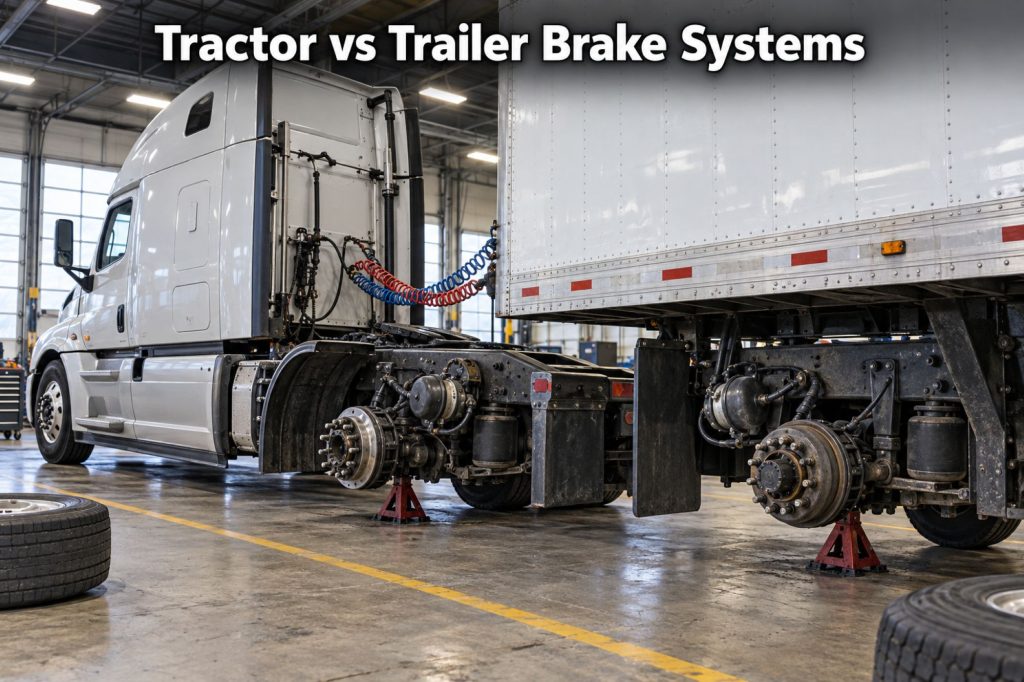
A tractor and semitrailer operate as one combination vehicle, but they do not share a single physical brake system. The tractor and trailer each have their own reservoirs, valves, brake chambers, foundation brakes, antilock braking components, and parking-brake equipment.
The tractor produces the compressed air and sends both supply air and brake-control signals to the trailer. The trailer stores its own compressed air and uses that stored air to apply its brakes when the driver presses the tractor’s brake pedal.
Understanding the differences between tractor and trailer brake systems helps drivers, technicians, fleet managers, and equipment buyers identify air leaks, brake imbalance, connection problems, delayed applications, ABS faults, and other conditions that can affect combination-vehicle braking.
This guide explains how tractor and trailer brake systems work independently, how they communicate, and how they operate together during service, parking, and emergency braking.
Understanding Combination-Vehicle Braking
A tractor-trailer brake system can be divided into two connected systems:
- The tractor brake system
- The trailer brake system
The tractor contains the air compressor that supplies the complete combination. However, the trailer stores air in its own reservoirs and uses its own valves to apply its wheel-end brakes.
The tractor and trailer are connected through:
- The trailer air-supply line
- The trailer service-control line
- Gladhand connectors
- Electrical connections
- ABS power and communication circuits
- Tractor and trailer protection valves
These connections allow the driver to control the brakes on both vehicles from the tractor cab.
Tractor vs Trailer Brakes: Main Differences
| System Area | Tractor Brake System | Trailer Brake System |
|---|---|---|
| Air source | Engine-driven or electrically driven air compressor | Receives compressed air from the tractor |
| Air storage | Primary and secondary reservoirs | One or more trailer reservoirs |
| Driver control | Brake pedal and parking-brake controls | Responds to tractor controls |
| Service-brake signal | Created by the tractor brake valve | Received through the service line |
| Brake application air | Supplied from tractor reservoirs | Supplied from trailer reservoirs |
| Parking brakes | Usually spring brakes on drive axles | Usually spring brakes on one or more trailer axles |
| Emergency function | Protects tractor air supply and applies applicable spring brakes | Loss of supply pressure causes trailer spring brakes to apply |
| ABS | Tractor ABS and stability-control components | Separate trailer ABS components |
| Foundation brakes | Air disc or drum brakes | Air disc or drum brakes |
| Driver warning | Tractor dash gauges and warning devices | Trailer ABS lamp and tractor-observed symptoms |
| Protection equipment | Tractor-protection valve | Trailer emergency and relay valve functions |
The exact arrangement depends on the vehicle’s age, manufacturer, configuration, and application.
How the Tractor Brake System Works
The tractor contains the main air-producing and driver-control components.
A simplified tractor air-brake system includes:
- Air compressor
- Compressor governor
- Air dryer
- Supply reservoir
- Primary reservoir
- Secondary reservoir
- Safety valves
- Pressure-protection valves
- Brake pedal or foot valve
- Relay valves
- Quick-release valves
- Brake chambers
- Spring brakes
- Foundation brakes
- Air-pressure gauges
- Low-air warning devices
- Parking-brake control
- Trailer air-supply control
- Tractor-protection valve
- ABS and stability-control components
The compressor produces compressed air while the engine operates. The air dryer removes moisture and contaminants before the air enters the reservoirs.
When the driver presses the brake pedal, the foot valve controls air pressure to the tractor’s service brakes and sends a braking signal to the trailer through the service line.
How the Trailer Brake System Works
The trailer does not normally have its own engine-driven air compressor.
Instead, the tractor sends compressed air through the trailer air-supply line. That air charges one or more reservoirs mounted on the trailer.
A typical trailer brake system includes:
- Trailer reservoirs
- Supply air line
- Service-control line
- Gladhand connectors
- Relay emergency valve
- Brake chambers
- Spring-brake chambers
- Air hoses and tubing
- Air disc or drum foundation brakes
- ABS electronic control unit
- Wheel-speed sensors
- ABS modulator valves
- ABS warning lamp
- Electrical wiring and connectors
When the driver applies the tractor’s brake pedal, the trailer receives a control signal through the service line.
A trailer relay valve responds by releasing compressed air from the trailer reservoir into the trailer brake chambers. This allows the trailer brakes to apply quickly without requiring all of the application air to travel from the tractor to each trailer wheel end.
The Two Air Lines Between the Tractor and Trailer
A standard tractor-trailer uses two air connections.
Trailer Air-Supply Line
The supply line is often called the emergency line.
Its main functions include:
- Charging the trailer reservoirs
- Maintaining trailer air pressure
- Supplying air needed to release the trailer spring brakes
- Supporting emergency operation if the connection is broken or pressure is lost
The supply line does not normally control the pressure of each routine service-brake application.
Trailer Service Line
The service line carries a brake-control signal from the tractor to the trailer.
When the driver presses the brake pedal, pressure in the service line tells the trailer relay valve how strongly to apply the trailer brakes.
A light pedal application creates a lighter control signal. A stronger application creates a stronger signal.
The trailer relay valve then meters air from the trailer reservoir to the trailer brake chambers.
How the Tractor and Trailer Brakes Apply Together
During a normal service-brake application:
- The driver presses the brake pedal.
- The tractor’s foot valve responds.
- Compressed air applies the tractor’s service brakes.
- A control signal travels through the trailer service line.
- The trailer relay valve receives the signal.
- Air stored in the trailer reservoir enters the trailer brake chambers.
- The tractor and trailer foundation brakes apply.
- Tractor and trailer ABS systems monitor their respective wheels.
- Brake pressure is released when the driver releases the pedal.
Although the systems respond to the same driver input, their valves, reservoirs, chambers, and foundation brakes remain physically separate.
Why the Trailer Uses Stored Air
Using air stored on the trailer helps reduce application delay.
If every trailer brake application depended on moving a large volume of air from the tractor reservoirs to the trailer wheel ends, response could be slower—especially on long combinations.
The service line instead carries a control signal. The trailer relay valve uses that signal to release nearby reservoir air into the trailer brake chambers.
This arrangement provides:
- Faster trailer-brake response
- More consistent application
- Reduced air-travel distance
- Better coordination between the tractor and trailer
- Support for longer combination vehicles
Valve condition, air-line condition, reservoir pressure, and system configuration can still affect response time.
Tractor Foundation Brakes
The tractor normally has foundation brakes on:
- The steer axle
- The forward drive axle
- The rear drive axle
- Additional powered or auxiliary axles when equipped
The tractor may use:
- Air disc brakes at every wheel position
- Drum brakes at every wheel position
- Air disc brakes on the steer axle with drum brakes on the drive axles
- Another manufacturer-approved mixed configuration
Explore the two major foundation-brake designs in Air Disc Brakes vs Drum Brakes.
Trailer Foundation Brakes
Commercial trailers commonly use foundation brakes on each primary load-carrying axle.
Depending on the trailer, the system may include:
- S-cam drum brakes
- Air disc brakes
- Spring-brake chambers
- Service-only brake chambers in certain configurations
- Lift-axle brakes
- Self-steering-axle brakes
- Multiple relay or modulator valves
- Separate systems for additional trailer units
The correct brake design depends on axle ratings, gross vehicle weight, trailer application, duty cycle, and manufacturer specifications.
Service Brakes
Service brakes are the brakes used during normal driving.
The driver controls both tractor and trailer service brakes with the tractor’s brake pedal.
On the tractor, the application air comes from the tractor’s reservoirs.
On the trailer, the service signal comes from the tractor, but the application air generally comes from the trailer’s own reservoirs.
Service brakes should apply smoothly and proportionally throughout the combination.
Parking Brakes
The tractor and trailer generally use spring brakes for parking.
Spring brakes use powerful mechanical springs to apply the brakes when air pressure is removed from the spring-brake chambers.
Compressed air holds the springs back while the vehicle is operating.
When the driver activates the parking-brake controls:
- Air is released from applicable tractor spring-brake chambers
- Air is released from applicable trailer spring-brake chambers
- Mechanical springs apply the foundation brakes
- The tractor and trailer are held without depending on continuous air pressure
Parking-brake arrangements vary by vehicle, axle, and manufacturer.
Emergency Braking
The term emergency braking can describe several different conditions.
These may include:
- Loss of trailer supply pressure
- Separation of the trailer air lines
- Major air-system leakage
- Low tractor air pressure
- Driver-controlled emergency braking
- ABS-controlled braking during wheel slip
If trailer supply pressure is lost, the trailer’s emergency system is designed to protect reservoir air and apply the trailer spring brakes as pressure decreases.
This helps stop or secure a disconnected trailer, but it should not be treated as a substitute for controlled service braking.
A sudden spring-brake application can affect vehicle stability, tire traction, and component loading.
The Tractor-Protection Valve
The tractor-protection valve helps prevent a major trailer air-system failure from draining the tractor’s air supply.
If the trailer separates or an air line fails, the tractor-protection system closes the connections between the tractor and trailer.
Its functions can include:
- Protecting tractor reservoir pressure
- Closing the trailer service and supply circuits
- Preventing uncontrolled air loss
- Supporting automatic trailer spring-brake application
- Allowing the driver to retain braking capability on the tractor
The tractor-protection valve works with the trailer air-supply control located in the cab.
The Trailer Relay Emergency Valve
The trailer relay emergency valve combines important service and emergency functions.
Depending on the design, it can:
- Control reservoir charging
- Relay the tractor’s service-brake signal
- Deliver reservoir air to the trailer chambers
- Protect stored trailer air
- Respond to a loss of supply pressure
- Support trailer spring-brake application
A defective relay emergency valve can cause:
- Delayed trailer-brake application
- Slow brake release
- Air leakage
- Trailer brake drag
- Improper reservoir charging
- Weak trailer braking
- Unexpected spring-brake application
Valve diagnosis should follow the manufacturer’s testing procedure.
Gladhand Connections
Gladhands connect the tractor’s air lines to the trailer.
A typical system uses one gladhand for the service line and another for the supply line.
Inspect gladhands for:
- Damaged seals
- Cracks
- Corrosion
- Contamination
- Loose connections
- Air leakage
- Incorrect coupling
- Missing or damaged covers
- Improper support
- Strain from tightly stretched air lines
Color coding is commonly used to help identify the lines, but drivers should confirm the connections rather than relying only on color.
Crossed lines can prevent proper trailer-brake operation and may keep the trailer spring brakes from releasing.
Tractor and Trailer ABS
The tractor and trailer have separate ABS and Electronic Braking Systems.
Tractor ABS
Tractor ABS may monitor:
- Steer-axle wheel speed
- Drive-axle wheel speed
- Brake applications
- Vehicle movement
- Yaw
- Steering input
- Lateral acceleration
Depending on the vehicle, the tractor may also include:
- Automatic traction control
- Electronic stability control
- Roll-stability control
- Collision-mitigation braking
- Electronic brake controls
Trailer ABS
Trailer ABS commonly includes:
- Wheel-speed sensors
- Tone rings
- Modulator valves
- Electronic control unit
- ABS warning lamp
- Electrical power connection
- Diagnostic wiring
The trailer ABS controls only the trailer wheels connected to its system. It does not directly control the tractor’s foundation brakes.
Likewise, tractor ABS does not replace trailer ABS.
Trailer ABS Warning Lamp
The trailer ABS warning lamp is normally mounted where it can be seen from outside the trailer, commonly near the left rear side.
The lamp performs a self-check when the system receives power.
A lamp that remains illuminated may indicate:
- A wheel-speed sensor problem
- Damaged wiring
- Incorrect sensor clearance
- Tone-ring damage
- Modulator-valve failure
- ECU problems
- Low or missing electrical power
- Connector corrosion
- Stored diagnostic faults
An illuminated warning lamp does not necessarily mean the trailer has lost all braking capability. It means the antilock function may be limited or unavailable and the fault requires diagnosis.
Electronic Stability Systems
Electronic stability systems are generally located on the tractor, although trailers may use their own roll-stability technologies.
A tractor stability system may use:
- Wheel-speed sensors
- Steering-angle data
- Yaw sensors
- Lateral-acceleration sensors
- Brake-pressure control
- Engine-torque reduction
When the system detects instability, it may reduce engine torque and apply selected tractor or trailer brakes, depending on the system architecture.
Electronic stability technology supports the driver but cannot overcome excessive speed, unsafe loading, inadequate traction, or poorly maintained brakes.
Trailer Hand Control
Many tractors include a hand-operated trailer brake control.
This control can apply the trailer service brakes independently of the tractor service brakes.
It may be used for specific operational checks or limited situations identified by the vehicle manufacturer and driver-training procedures.
The hand control should not be used:
- As a parking brake
- As the normal method of stopping
- To control speed on a long descent
- In a way that causes trailer-wheel lock
- As a substitute for properly balanced tractor and trailer brakes
When the hand control is released, the trailer service brakes release. It does not mechanically secure the trailer like the spring-brake system.
Brake Balance Between the Tractor and Trailer
Brake balance describes how braking effort is distributed throughout the combination.
Proper balance helps the tractor and trailer slow together.
If the trailer brakes apply too weakly, the trailer may push against the tractor.
If the trailer brakes apply too aggressively, the trailer wheels may lock or the trailer may become unstable.
Brake imbalance can be caused by:
- Air leaks
- Restricted air lines
- Incorrect valves
- Improper brake adjustment
- Excessive pushrod stroke
- Contaminated friction material
- Incorrect brake chambers
- Mixed friction materials
- Seized calipers
- Worn drums or rotors
- Damaged foundation-brake components
- Incorrect repairs
- ABS faults
- Different brake response characteristics
The tractor and trailer do not need identical foundation-brake designs, but the complete combination must operate correctly.
Can a Tractor With Disc Brakes Pull a Trailer With Drum Brakes?
Yes. A tractor with air disc brakes can pull a trailer equipped with drum brakes when both vehicles are properly designed, compatible, inspected, and maintained.
Other acceptable combinations may include:
- Disc-brake tractor with disc-brake trailer
- Disc-brake tractor with drum-brake trailer
- Drum-brake tractor with disc-brake trailer
- Drum-brake tractor with drum-brake trailer
The service line controls the requested trailer application. The trailer’s own valves, chambers, and foundation brakes produce its wheel-end braking force.
Different brake designs may have different response, heat, wear, and maintenance characteristics, making brake balance and inspection especially important.
Why Trailer Brakes May Feel Delayed
A noticeable delay between tractor and trailer braking can indicate a problem.
Possible causes include:
- Air-line restrictions
- Excessively long or damaged hoses
- Leaking connections
- Low trailer reservoir pressure
- Defective relay valve
- Contaminated air system
- Incorrect valve selection
- Brake adjustment problems
- Excessive chamber stroke
- Foundation-brake wear
- Multiple-trailer configuration
- Improper repairs
A small engineered timing difference may exist within a system, but a new or pronounced delay should be inspected.
Why Trailer Brakes May Drag
Trailer brakes that apply slowly or fail to release can overheat.
Possible causes include:
- Restricted air lines
- Defective relay valve
- Damaged brake chambers
- Broken return springs
- Binding S-cams
- Seized air disc brake calipers
- Frozen moisture
- Incorrect adjustment
- Kinked hoses
- Contamination
- Parking-brake control problems
- Insufficient release pressure
Warning signs include smoke, burning odor, excessive heat, rapid lining wear, wheel-end discoloration, and poor fuel economy.
What Happens During Trailer Separation?
If a trailer separates from the tractor, several events are intended to occur:
- The supply and service connections separate.
- Trailer supply pressure is lost.
- The trailer emergency system responds.
- Trailer spring brakes apply as release pressure decreases.
- The tractor-protection valve closes.
- The tractor retains air pressure for its own braking system.
The trailer’s emergency response depends on correct reservoir pressure, valve operation, spring-brake condition, and air-system maintenance.
The mechanical fifth wheel, kingpin, locking jaws, safety systems, and air connections must all be inspected because emergency braking cannot prevent every consequence of a separation.
Tractor Brake Inspection
A tractor brake inspection should include:
- Compressor operation
- Pressure build-up
- Governor operation
- Air dryer
- Reservoirs
- Air-pressure gauges
- Low-air warning devices
- Foot valve
- Parking-brake control
- Trailer air-supply control
- Tractor-protection valve
- Air lines and fittings
- Relay valves
- Brake chambers
- Spring brakes
- Pushrod stroke where applicable
- Automatic slack adjusters
- Air disc or drum foundation brakes
- Drums or rotors
- Pads or linings
- ABS warning lamps
- Wheel-speed sensors
- Stability-system components
Inspection methods and allowable measurements depend on the vehicle and component specifications.
Trailer Brake Inspection
A trailer brake inspection should include:
- Gladhands
- Gladhand seals
- Supply line
- Service line
- Air reservoirs
- Drain valves
- Relay emergency valve
- Air tubing
- Brake chambers
- Spring-brake chambers
- Pushrod stroke where applicable
- Automatic slack adjusters
- Air disc or drum foundation brakes
- Brake drums or rotors
- Pads or linings
- ABS warning lamp
- ABS wiring
- Wheel-speed sensors
- Modulator valves
- Electrical connector
- Lift-axle brake components when equipped
Learn more in How to Inspect and Maintain Commercial Truck Brakes.
Common Tractor Brake Problems
Common tractor-side problems include:
- Slow air-pressure build-up
- Compressor problems
- Air-dryer failure
- Excessive air leakage
- Low-air warning failure
- Tractor-protection valve problems
- Parking-brake control problems
- Brake imbalance between axles
- Excessive pushrod stroke
- Worn pads or linings
- Cracked drums or rotors
- Contaminated foundation brakes
- ABS or stability-control faults
- Seized calipers
- Worn S-cam components
- Damaged brake chambers
A tractor defect can also affect the air supply or control signal sent to the trailer.
Common Trailer Brake Problems
Common trailer-side problems include:
- Leaking gladhands
- Damaged service or supply lines
- Poor reservoir charging
- Relay emergency valve failure
- Excessive chamber stroke
- Out-of-adjustment drum brakes
- Seized disc-brake calipers
- Worn linings or pads
- Cracked drums or rotors
- Wheel-seal contamination
- Spring brakes that do not release
- Delayed brake application
- Brake drag
- ABS warning-lamp faults
- Damaged sensor wiring
- Incorrect tractor-trailer connections
Trailers may be paired with many different tractors, making consistent inspection and maintenance especially important.
Maintenance Differences
Tractor Maintenance
Tractor brake maintenance includes the equipment that creates, stores, and controls compressed air.
Important areas include:
- Air compressor
- Governor
- Air dryer
- Primary and secondary reservoirs
- Control valves
- Driver warning devices
- Tractor-protection equipment
- Brake chambers
- Foundation brakes
- ABS and stability systems
Trailer Maintenance
Trailer maintenance focuses on receiving, storing, and responding to tractor-supplied air and electrical power.
Important areas include:
- Gladhands
- Service and supply lines
- Trailer reservoirs
- Relay emergency valve
- Spring brakes
- Foundation brakes
- Trailer ABS
- Electrical connections
- Air-line routing
A trailer may spend time disconnected or out of service, but its reservoirs, valves, brakes, and ABS still require scheduled inspection.
Matching a Tractor and Trailer
Before operating a tractor-trailer combination, confirm:
- The fifth wheel is correctly locked
- Air lines are properly connected
- Gladhands are sealed
- Air lines have enough turning clearance
- Electrical connections are secure
- Trailer reservoirs charge
- Trailer spring brakes release
- Service brakes apply
- Parking brakes hold
- ABS warning lamps complete their checks
- No major air leaks are present
- The trailer follows the tractor correctly during a low-speed brake test
A successful coupling does not end with the fifth wheel. The pneumatic and electrical connections are essential parts of the combination.
Which System Does More of the Braking?
Neither the tractor nor trailer should be treated as the only braking vehicle.
The distribution of braking force depends on:
- Vehicle design
- Number of axles
- Axle loading
- Gross combination weight
- Brake size
- Chamber size
- Foundation-brake design
- Air pressure
- Valve timing
- Tire traction
- Road conditions
- ABS operation
- Load transfer during braking
During braking, weight transfers toward the front of the combination. However, the trailer axles still provide an essential portion of the total braking force.
A trailer with weak or inoperative brakes places excessive demand on the tractor brakes and can increase stopping distance and heat.
Final Thoughts
The tractor and trailer have separate brake systems that work together through pneumatic and electrical connections.
The tractor produces compressed air, stores it in its own reservoirs, controls the driver’s brake request, and sends supply air and a service signal to the trailer.
The trailer stores its own compressed air and uses a relay system to apply its wheel-end brakes in response to the tractor’s service signal.
The tractor-protection valve helps preserve tractor air pressure if a trailer connection fails. The trailer emergency system responds to supply-pressure loss by applying the trailer spring brakes.
Both units have their own foundation brakes, brake chambers, air lines, ABS components, inspection requirements, and maintenance needs.
Safe combination braking depends on both systems applying promptly, releasing completely, remaining balanced, and receiving regular inspection and preventive maintenance.
Continue Exploring Commercial Truck Brake Systems
Explore these related Truck Equipment Atlas pages: