
Link ROI Auxiliary Suspension
Quick Facts
- Manufacturer: Link Manufacturing
- Product Type: Liftable auxiliary-axle suspension system
- Suspension Category: Auxiliary and lift-axle suspension
- Installation Positions: Pusher or tag axle position
- Steering Configurations: Steerable or non-steerable, depending on model
- Suspension Medium: Air springs
- Primary Applications: Construction, refuse, concrete, heavy haul, utility, and specialized commercial vehicles
- Mounting Technology: Application-specific frame brackets, including Swift Mount configurations
- Primary Function: Adds load-supporting axle capacity when lowered and reduces unnecessary tire contact when raised
- Primary Benefit: Helps distribute vehicle weight across additional axles while preserving maneuverability when the axle is lifted
Overview
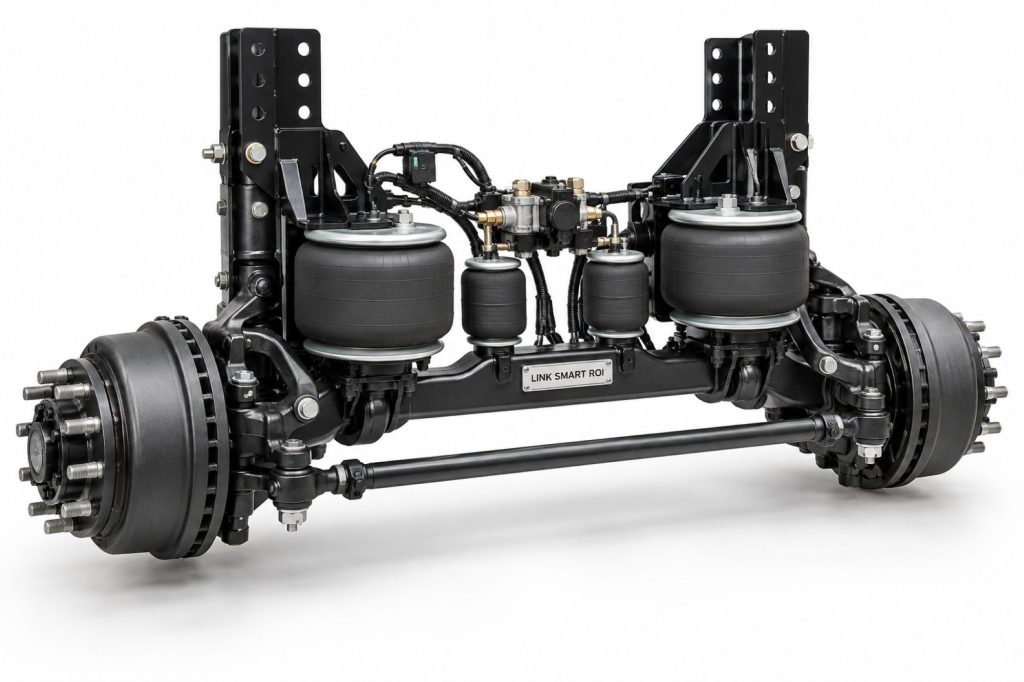
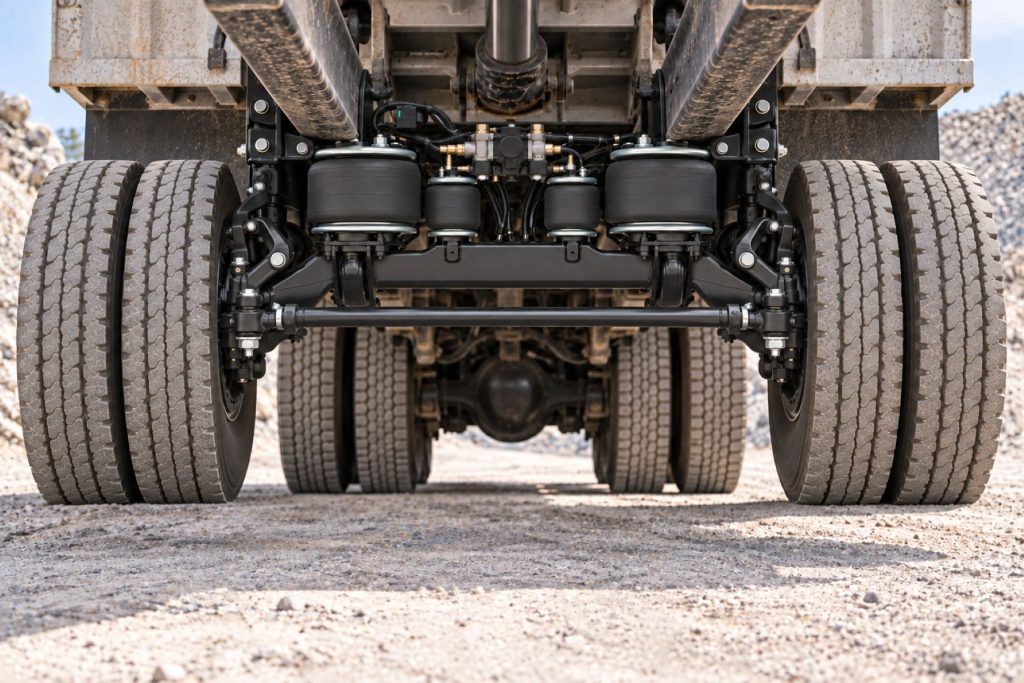
The Link ROI Auxiliary Suspension is a liftable axle-suspension solution for commercial trucks that need additional load-carrying support. It can be installed ahead of the primary rear axle group as a pusher axle or behind it as a tag axle.
When the auxiliary axle is lowered, its air springs transfer part of the vehicle’s weight to the additional axle and tires. This can help the truck comply with axle-weight and bridge requirements while carrying heavy vocational bodies, equipment, or payloads.
When additional support is unnecessary, the axle can be lifted away from the road. Raising the axle can improve maneuverability and reduce tire wear and rolling resistance when the vehicle is empty or lightly loaded.
Link auxiliary suspensions are available in application-specific steerable and non-steerable configurations. Exact capacity, axle travel, ride height, wheel equipment, steering geometry, and control requirements depend on the selected suspension model and truck installation.
Key Characteristics
- Liftable auxiliary-axle suspension
- Available for pusher or tag positions
- Air-spring load support
- Lift mechanism raises the axle when it is not required
- Steerable and non-steerable configurations
- Designed for vocational and specialized trucks
- Helps distribute weight across additional tires
- Can support compliance with axle-weight requirements
- Application-specific capacity and ride-height options
- Swift Mount bracket technology on applicable systems
- Designed for efficient chassis installation
- Compatible with drum- or disc-brake equipment when properly specified
- Manual and automatic control options may be available
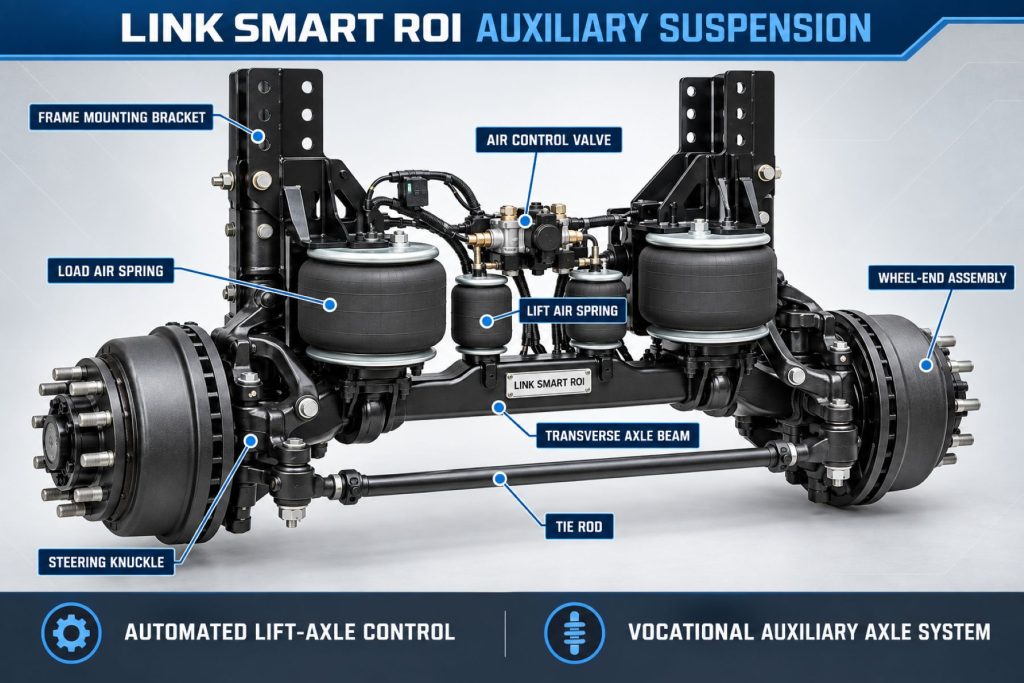
Major Components
- Auxiliary axle
- Suspension arms
- Frame brackets
- Swift Mount brackets on applicable configurations
- Load air springs
- Lift air springs or lift chambers
- Pivot connections and bushings
- Shock absorbers where specified
- Steering knuckles on steerable models
- Tie rod
- Steering dampers
- Caster-control components
- Air-pressure regulator
- Air-control valves
- Air lines and fittings
- Axle raise and lower controls
- Brake chambers
- Foundation brakes
- Hubs, bearings, seals, wheels, and tires
- Electronic controls on automatic systems
How the Suspension System Works
When additional load support is required, the control system supplies air to the suspension’s load springs. The axle moves downward until its tires contact the road and begin carrying part of the vehicle’s weight.
Regulated air pressure controls how much load is transferred to the auxiliary axle. Increasing pressure generally increases the weight supported by the axle, while reducing pressure transfers weight back to the truck’s other axles.
When the axle is no longer needed, air is released from the load springs and directed to the lift mechanism. The lift springs or chambers raise the axle and tires away from the road.
On steerable systems, the wheels turn in response to vehicle movement. Correct caster and steering geometry allow the wheels to follow the direction of travel instead of scrubbing sideways during turns.
Suspension Position and Function
A pusher axle is installed ahead of the truck’s primary rear axle or tandem. A tag axle is positioned behind the primary rear axle group.
The suspension’s functions include:
- Supporting part of the truck and payload weight
- Distributing weight across an additional axle
- Helping reduce load on the primary rear axles
- Supporting compliance with bridge and axle-spacing requirements
- Raising the axle when additional capacity is unnecessary
- Reducing tire wear when the axle is lifted
- Improving maneuverability in the raised position
- Supporting vehicle stability when correctly adjusted
The correct position depends on the truck’s frame, body, wheelbase, center of gravity, and weight-distribution requirements.
Common Specifications
- Suspension Type: Liftable auxiliary air suspension
- Axle Position: Pusher or tag
- Steering Type: Steerable or non-steerable
- Capacity: Model- and application-specific
- Ride Height: Determined by the truck and suspension configuration
- Axle Track: Application-specific
- Wheel Configuration: Single or dual tires, depending on the system
- Brake Options: Drum or disc brakes when required and approved
- Air Supply: Truck compressed-air system
- Controls: Manual, pressure-regulated, or automatic
- Mounting: Application-specific frame-bracket system
Capacity, ride height, frame width, axle track, wheel equipment, and control settings must be confirmed using the exact Link suspension model and vehicle information.
Capacity, Ride Height, and Axle Travel
Auxiliary suspension capacity depends on the selected model, axle, tires, wheels, brakes, frame, and installation. The load carried by the axle is controlled through the suspension’s regulated air pressure.
The auxiliary axle should carry enough weight to support the intended load-distribution plan without exceeding its suspension, axle, tire, wheel, or brake ratings.
Ride height determines the relationship between the suspension, frame, and road surface when the axle is lowered. Correct height is necessary for proper air-spring operation, axle travel, tire loading, steering geometry, and ground clearance.
Lift clearance must be sufficient to keep the tires away from the road when the axle is raised. Insufficient clearance can allow the tires to contact pavement during turns, driveway transitions, or suspension movement.
Ride Quality and Load Distribution
The air springs help the auxiliary axle respond to road irregularities while carrying its assigned portion of the vehicle weight. Correct pressure allows the tires to remain in contact with the road without excessively unloading the primary steer or drive axles.
Improper pressure can create several problems. Too much pressure may transfer excessive weight to the auxiliary axle and reduce traction at the drive axles. Too little pressure may leave the auxiliary axle underloaded and fail to provide the required weight distribution.
The correct setting depends on:
- Vehicle loading
- Axle position
- Axle spacing
- Body and equipment placement
- Primary axle ratings
- Auxiliary axle rating
- Tire and wheel capacity
- Applicable weight regulations
Actual scale measurements should be used when establishing operating pressure.
Suspension Controls and Adjustment Options
Auxiliary suspension controls may be mounted in the cab, on the chassis, or inside a protected control enclosure.
Available control functions may include:
- Axle raise and lower switch
- Air-pressure regulator
- Suspension pressure gauge
- Automatic axle deployment
- Speed-sensitive axle control
- Reverse-lift function
- Load-sensitive control
- Traction-assist programming
- Warning indicator
- Automatic dump function
- Interlocks with body equipment
- Regulatory control logic
Some jurisdictions restrict when an auxiliary axle can be raised or require automatic control. The system must be configured for the locations where the truck operates.
Alignment and Suspension Geometry
Correct alignment is particularly important on a liftable auxiliary axle. A misaligned axle can cause tire scrub, steering instability, rapid tire wear, and increased rolling resistance.
Steerable models also require correct caster, toe, steering-stop, and tie-rod adjustment. These settings allow the wheels to track properly when the truck moves forward.
Alignment should be inspected after:
- Initial installation
- Frame or suspension repair
- Axle replacement
- Steering-component replacement
- Tire replacement following abnormal wear
- Curb strikes or collisions
- Changes to ride height
- Changes to vehicle loading or body equipment
Reverse operation may affect self-steering axle behavior. Some systems automatically raise or lock the axle while backing.
Axle, Brake, and Wheel-End Options
Link auxiliary suspensions may be configured with application-specific axle, brake, and wheel-end equipment.
Possible equipment includes:
- Steerable auxiliary axle
- Non-steerable auxiliary axle
- Straight or dropped axle beam
- Single-wheel configuration
- Dual-wheel configuration
- Hydraulic disc brakes
- Air disc brakes
- Air drum brakes
- Hydraulic drum brakes
- Conventional wheel ends
- Unitized hub assemblies
- Automatic lubrication systems
- Tire-pressure monitoring equipment
- Automatic tire-inflation systems where applicable
The axle, brakes, tires, wheels, and wheel ends must match the required capacity and complete vehicle braking system.
Common Applications
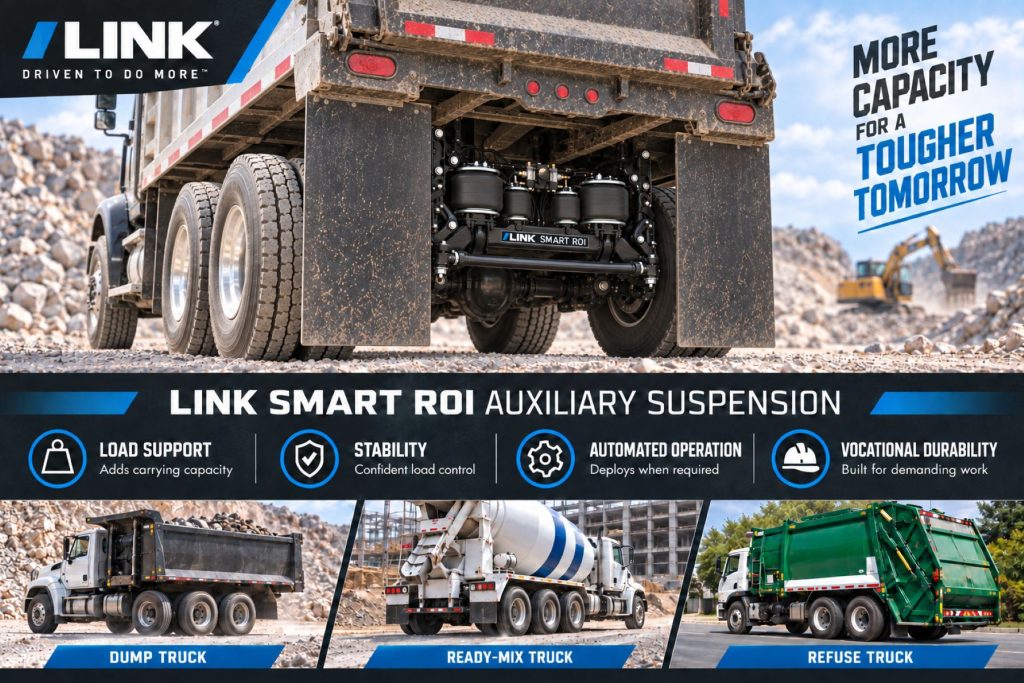
- Dump trucks
- Concrete mixers
- Refuse trucks
- Roll-off trucks
- Heavy-haul tractors
- Construction trucks
- Utility trucks
- Crane trucks
- Tank trucks
- Logging trucks
- Fire apparatus
- Recovery vehicles
- Municipal trucks
- Specialized vocational vehicles
Vehicle, Axle, and Frame Compatibility
A Link auxiliary suspension must be matched to the truck’s frame, body, axle layout, brake system, air supply, and weight-distribution requirements.
Compatibility depends on:
- Truck manufacturer and model
- Model year
- Frame width and rail strength
- Available frame space
- Pusher or tag position
- Primary axle spacing
- Driveshaft clearance
- Exhaust-system placement
- Fuel and hydraulic tanks
- Battery-box placement
- Body outriggers and hoists
- Brake-system type
- Tire and wheel dimensions
- Turning and articulation clearance
- Gross axle and vehicle weight ratings
A qualified installer should inspect the chassis before selecting the suspension.
Advantages
- Adds load-supporting axle capacity
- Helps distribute weight across more axles
- May improve compliance with bridge requirements
- Axle can be lifted when it is not needed
- Reduces unnecessary tire wear in the raised position
- Improves maneuverability when lifted
- Air pressure permits adjustable load transfer
- Steerable models reduce tire scrub during turns
- Pusher and tag configurations support different chassis layouts
- Swift Mount brackets can simplify installation
- Can be integrated with automatic controls
- Supports many vocational applications
Limitations or Considerations
- Adds weight to the empty vehicle
- Reduces available frame space
- Requires compressed air and additional controls
- May require frame reinforcement
- Improper pressure can unload the steer or drive axles
- Incorrect alignment can cause rapid tire wear
- Self-steering axles may require special procedures when reversing
- Legal recognition varies by jurisdiction
- Some states require automatic deployment or specific controls
- Raised-axle operation may be restricted when the truck is loaded
- Additional tires, brakes, wheel ends, and bushings increase maintenance
- The suspension does not automatically increase the truck’s certified ratings
Driver and Operator Experience
A correctly adjusted auxiliary axle can improve vehicle stability and reduce overloading of the truck’s primary axle groups. The driver may notice a change in steering effort, turning radius, traction, and braking response when the axle is lowered.
A steerable auxiliary axle generally follows turns more easily than a rigid non-steer axle. A non-steer axle may scrub its tires during tight turns if it remains lowered.
Drivers should monitor:
- Auxiliary suspension pressure
- Axle position
- Warning indicators
- Tire contact
- Steering behavior
- Drive-axle traction
- Vehicle lean
- Brake response
- Unusual tire wear
- Air leaks
The driver remains responsible for confirming legal axle weights after loading.
Maintenance and Ownership Notes
- Inspect load and lift air springs for damage or leaks.
- Check air lines, fittings, regulators, and control valves.
- Inspect suspension arms and pivot bushings.
- Check frame brackets and mounting fasteners.
- Inspect the auxiliary axle for bends or cracks.
- Verify ride height and lifted tire clearance.
- Check suspension operating pressure.
- Inspect steering knuckles and kingpins on steerable models.
- Lubricate steering and suspension points as required.
- Check tie-rod ends and steering dampers.
- Inspect caster-control components.
- Service brakes and wheel ends.
- Monitor tires for scrub and irregular wear.
- Test automatic raise and lower controls.
- Inspect electrical wiring and sensors.
- Recheck installation fasteners after initial service.
Common Suspension Problems
- Axle will not lower: Insufficient air pressure, a faulty control valve, damaged air line, electrical failure, or binding suspension component may be responsible.
- Axle will not raise: Air leakage, damaged lift springs, control-valve failure, excess loading, or mechanical interference can prevent lifting.
- Incorrect axle loading: Improper regulator adjustment, air leaks, incorrect ride height, or vehicle overloading may cause improper weight transfer.
- Rapid tire wear: Axle misalignment, incorrect toe or caster, excessive load, improper tire pressure, or operation through tight turns can cause wear.
- Wheel shimmy: Worn kingpins, loose tie-rod ends, incorrect caster, tire imbalance, or a damaged steering damper may cause oscillation.
- Poor drive-axle traction: Excessive auxiliary suspension pressure can transfer too much weight away from the drive axles.
- Vehicle lean: Uneven air pressure, improper loading, damaged components, or frame problems may cause the chassis to lean.
- Air leaks: Damaged springs, fittings, hoses, valves, or reservoirs can prevent normal suspension operation.
- Insufficient lift clearance: Incorrect ride height, worn components, tire-size changes, or installation problems can allow raised tires to contact the road.
Identification Information
Identification information may be found on a suspension tag, axle tag, frame bracket, or control-system label.
Record the following information:
- Truck manufacturer
- Vehicle identification number
- Truck model and model year
- Link suspension model
- Suspension kit or assembly number
- Rated capacity
- Pusher or tag configuration
- Steerable or non-steerable design
- Ride height
- Frame width
- Axle track
- Axle identification
- Brake type and size
- Wheel and tire configuration
- Air-spring part numbers
- Control-system information
Do not identify replacement components by appearance alone. Similar auxiliary suspensions may use different axles, springs, brackets, bushings, and controls.
Buying Considerations
- Determine the additional axle capacity required.
- Choose between a pusher and tag location.
- Decide whether a steerable axle is needed.
- Measure available chassis space.
- Verify frame strength and mounting requirements.
- Confirm suspension ride height.
- Select the correct axle track.
- Choose single or dual wheels.
- Match the truck’s air or hydraulic brake system.
- Review tire and wheel capacity.
- Determine applicable state and provincial regulations.
- Select manual or automatic controls.
- Check reverse-operation requirements.
- Confirm body and equipment clearance.
- Compare installation weight with usable payload benefits.
- Choose an experienced auxiliary-axle installer.
Variants and Configurations
Link auxiliary suspensions are available in multiple application-specific configurations.
Variations may include:
- Pusher axle
- Tag axle
- Steerable axle
- Non-steerable axle
- Different suspension capacities
- Different ride heights
- Single-wheel arrangement
- Dual-wheel arrangement
- Air brakes
- Hydraulic brakes
- Drum brakes
- Disc brakes
- Manual controls
- Automatic controls
- Swift Mount frame brackets
- Application-specific axle tracks
- Different lift mechanisms
Model and component availability can change. The complete Link model and kit number should be verified before purchasing or ordering parts.
Comparison to Similar Equipment
Compared with the Hendrickson COMPOSILITE EXS Lift Axle, the Link auxiliary suspension provides an alternative steerable lift-axle system with different mounting, steering, and control designs.
Compared with the Link UltraRide Suspension, the ROI Auxiliary Suspension supports an additional liftable axle. UltraRide is a primary rear-axle suspension for medium-duty and specialty vehicles.
Compared with the Link Cabmate Suspension, the auxiliary suspension supports vehicle weight through an additional road axle. Cabmate only isolates the truck cab from chassis movement.
Compared with a fixed auxiliary axle, a liftable system can raise its tires when additional capacity is unnecessary. A fixed axle may be mechanically simpler but remains in contact with the road.
Best Fit For
- Vocational trucks approaching primary axle limits
- Dump trucks
- Concrete mixers
- Refuse vehicles
- Roll-off trucks
- Heavy-haul tractors
- Municipal vehicles
- Utility and crane trucks
- Vehicles requiring bridge-law weight distribution
- Trucks operating both loaded and unloaded
- Applications requiring a pusher or tag axle
- Fleets wanting a liftable auxiliary-axle solution
Related Vehicle and Trailer Types
- Complete Guide to Semi Truck Types
- Class 6 vs Class 7 vs Class 8 Trucks
- Heavy Haul Freight Guide
- Vocational trucks
- Dump trucks
- Concrete mixers
- Refuse trucks
- Heavy-haul tractors
- Roll-off trucks
- Utility vehicles
- Municipal trucks
- Crane trucks
- Recovery vehicles
Related Truck and Trailer Models
- Mack Granite
- Kenworth T880
- Peterbilt 567
- Freightliner 114SD
- Freightliner 122SD
- International HX Series
- Western Star 47X
- Western Star 49X
- Volvo VHD
Related Suspension Types
- Auxiliary & Lift Axle Suspensions
- Air Suspension Systems
- Hendrickson COMPOSILITE EXS Lift Axle
- Link UltraRide Suspension
- Steerable lift axles
- Non-steerable lift axles
- Pusher axles
- Tag axles
- Fixed auxiliary axles
- Self-steering auxiliary axles
Related Equipment Systems
- Suspension Systems
- Axles & Differentials
- Air Brake Systems Explained
- Steering systems
- Truck air systems
- Brake systems
- Tires and wheels
- Axle-weight monitoring systems
- Body-control systems
Related Guides
- Suspension System Guides
- Lift Axles Explained
- How Commercial Truck Suspension Systems Work
- Air Suspension vs Leaf Spring Suspension
- How to Choose a Commercial Truck Suspension
- Truck Suspension Components Explained
- Single Axle vs Tandem Axle Trucks
- Oversize Load Transportation Guide
Regulatory and Compliance Notes
Auxiliary-axle rules vary significantly by state, province, and operating jurisdiction. An axle recognized for weight purposes in one location may receive different treatment elsewhere.
Regulations may control:
- Axle spacing
- Maximum axle weight
- Minimum tire width
- Steerable or non-steerable configuration
- Automatic axle deployment
- When the axle may be raised
- Reverse operation
- Brake requirements
- Control location
- Pressure settings
- Bridge-formula calculations
The suspension’s mechanical capacity does not increase the truck’s certified ratings unless the complete vehicle has received appropriate engineering approval and certification.
Real World Operating Notes
The auxiliary axle should be adjusted using certified scale weights. Suspension pressure alone does not confirm the amount of weight carried by the axle.
Too much auxiliary axle pressure can reduce drive-axle traction or make the steering axle feel light. Too little pressure may leave the primary rear axles overloaded.
Self-steering axles may behave differently in reverse. The axle may need to lift or lock according to the system design before backing through a tight turn.
Drivers should know the auxiliary-axle rules for every state or province on their route. Lift-axle regulations are not uniform across North America.
Frequently Asked Questions
What is the Link ROI Auxiliary Suspension?
It is a liftable auxiliary-axle suspension designed to add load support and improve weight distribution on commercial trucks.
Can it be installed as a pusher or tag axle?
Depending on the selected model, it may be installed ahead of the drive axles as a pusher or behind them as a tag axle.
Is the axle steerable?
Link offers application-specific steerable and non-steerable auxiliary suspension configurations.
How does the lift axle carry weight?
Air pressure in the load springs pushes the axle downward and transfers part of the vehicle’s weight to its tires.
Why is the axle lifted?
Raising the axle when it is not needed can reduce tire wear, rolling resistance, and interference during tight turns.
Does installing an auxiliary axle increase the truck’s GVWR?
Not automatically. The frame, brakes, axles, tires, wheels, and completed vehicle certification must support any rating change.
How is the correct operating pressure determined?
The truck should be weighed on a certified scale, and pressure should be adjusted according to the suspension, vehicle, and regulatory requirements.
Can the axle remain raised while the truck is loaded?
That depends on axle weights and local regulations. Some jurisdictions require automatic deployment under load.
Why do auxiliary axle tires wear quickly?
Common causes include misalignment, incorrect caster or toe, excessive loading, low tire pressure, worn steering components, and operating a non-steer axle through tight turns.
How can the correct replacement parts be identified?
Use the Link suspension model, kit number, axle tag, ride height, capacity, brake type, and wheel configuration.
Availability and Where to Find
Link auxiliary suspensions and replacement components may be available through Link Manufacturing distributors, commercial-truck dealers, body builders, vocational-equipment installers, heavy-duty parts suppliers, and lift-axle specialists.
Availability depends on the required capacity, axle position, steering configuration, brake system, frame dimensions, and completed vehicle application.
Before ordering, buyers should confirm that the package includes the required axle, suspension arms, frame brackets, air springs, lift mechanism, brakes, wheel ends, controls, air lines, hardware, and installation instructions.
Current application information, technical support, replacement parts, and distributor resources are available through the Link Manufacturing website.
Support Trucking Families
Truck Equipment Atlas supports the mission of Grey Cross, a nonprofit dedicated to helping families of truck drivers who lose their lives while on the road. As the site grows, part of its mission is to bring awareness and support to these families.
Podcast or Video Section
Learn More Through Audio and Video
Truck Equipment Atlas will continue expanding with podcast episodes, interviews, and equipment breakdowns to help drivers and fleets better understand trucks and equipment.
Follow the Growth of Truck Equipment Atlas
Truck Equipment Atlas continues to expand with new truck profiles, trailer coverage, diesel engine pages, equipment system resources, manufacturer information, and educational guides.
Visit our Site Updates page to explore recent additions, project milestones, and upcoming resources as we continue building one of the industry’s growing commercial trucking equipment reference libraries.
View the Latest Site Updates: Truck Equipment Atlas Site Updates