
Link UltraRide Suspension
Quick Facts
- Manufacturer: Link Manufacturing
- Product Family: UltraRide
- Product Type: Rear chassis air-suspension system
- Suspension Category: Medium-duty and specialty-vehicle air suspension
- Primary Position: Rear axle
- Common Axle Configuration: Single rear axle
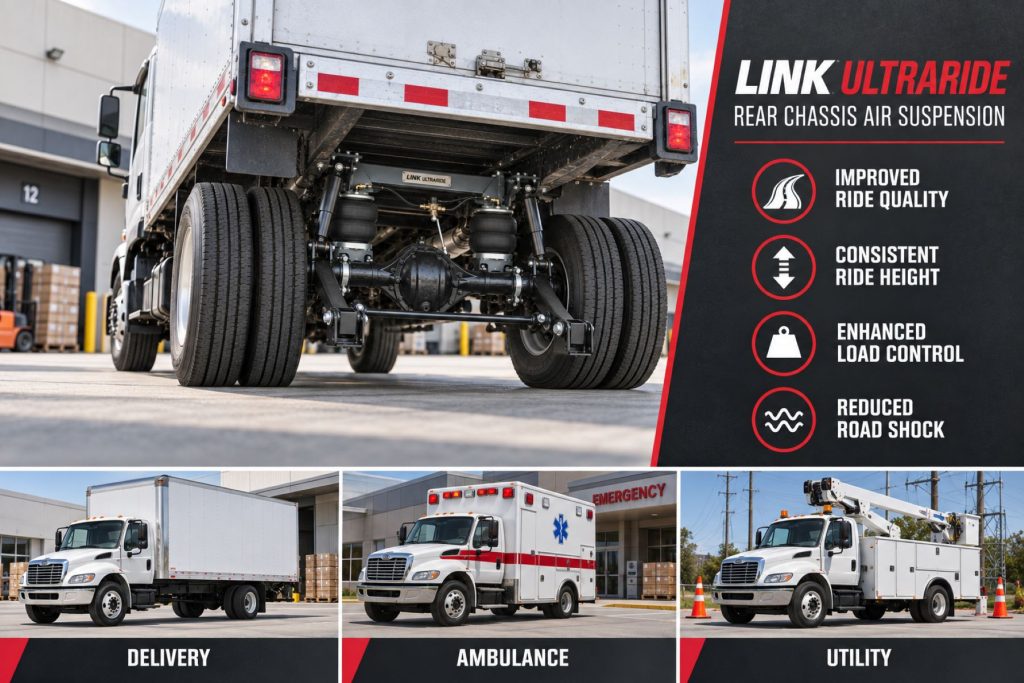
- Primary Applications: Work trucks, ambulances, shuttle buses, recreational vehicles, delivery trucks, and specialty commercial vehicles
- Suspension Medium: Air springs
- Installation Type: Original-equipment or application-specific conversion system
- Primary Benefit: Replaces or supplements a conventional rear suspension to improve ride quality, stability, and load management
Overview
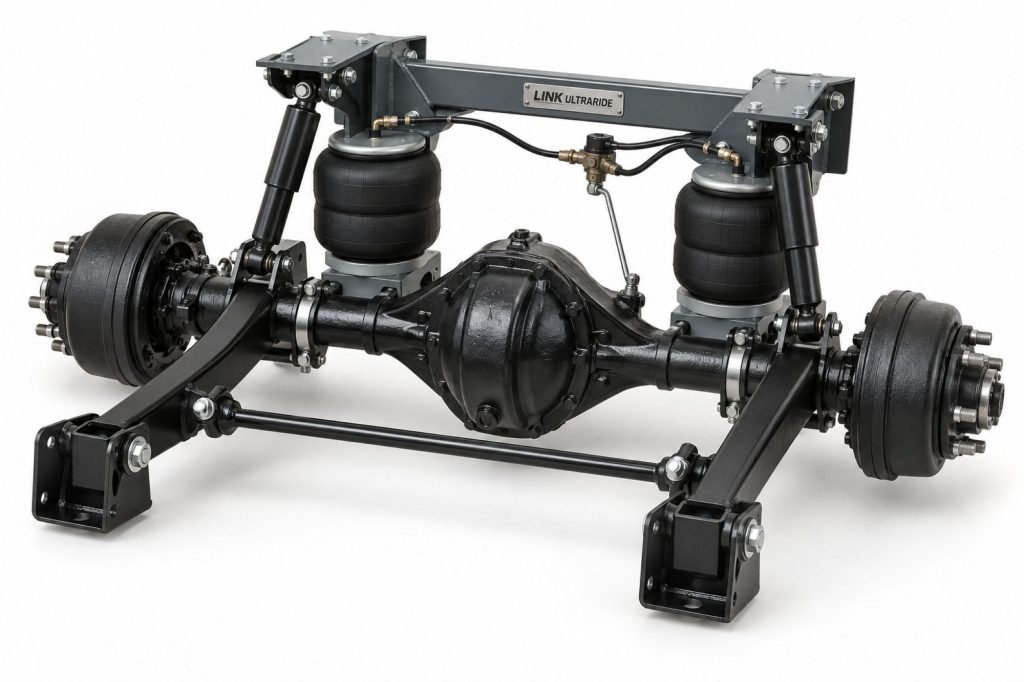
The Link UltraRide is a rear air-suspension system designed for medium-duty trucks, commercial chassis, buses, ambulances, recreational vehicles, and specialty equipment. It provides an alternative to a conventional rear leaf-spring suspension for applications that require improved ride quality and more consistent handling.
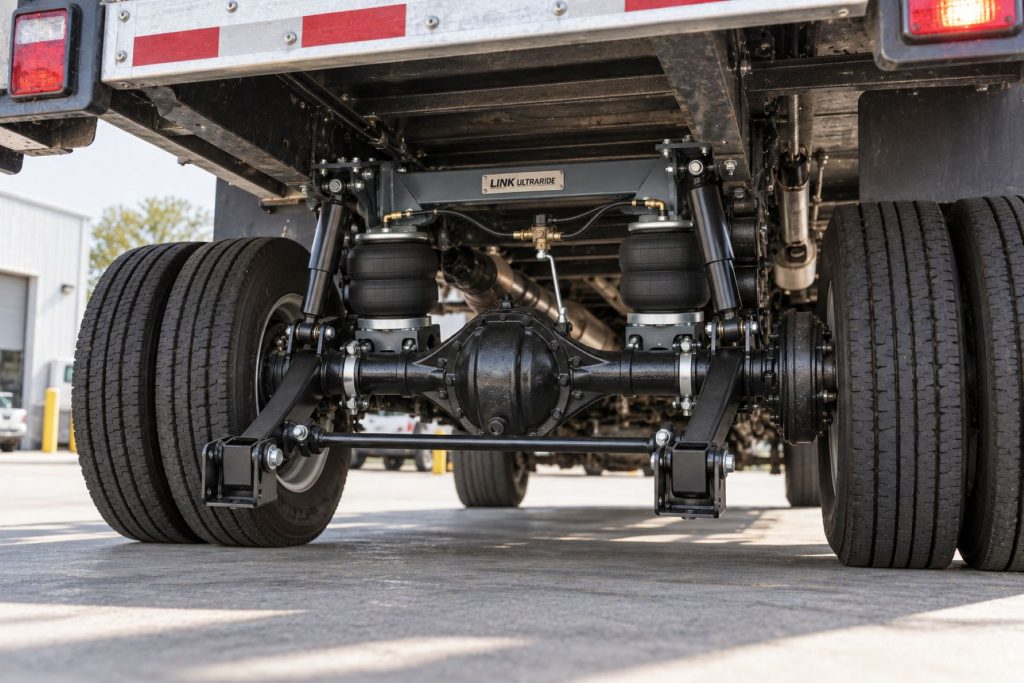
UltraRide uses air springs to support the chassis while suspension links control axle movement. Shock absorbers provide damping, and a height-control system maintains the designed chassis position as the vehicle’s payload changes.
The suspension can improve comfort for drivers, passengers, patients, and equipment carried inside the vehicle. It may also help reduce vibration and impact loads reaching sensitive cargo, emergency equipment, service bodies, and recreational-vehicle interiors.
UltraRide systems are application-specific. Capacity, ride height, frame brackets, axle connections, air controls, and available options depend on the chassis manufacturer, model, wheelbase, axle rating, and intended vehicle use.
Key Characteristics
- Rear single-axle air suspension
- Designed for medium-duty and specialty vehicles
- Air springs replace or supplement conventional steel springs
- Maintains a consistent chassis ride height
- Improves ride quality under loaded and unloaded conditions
- Suspension links control axle movement
- Shock absorbers manage vertical motion
- Can improve passenger and cargo comfort
- Supports application-specific commercial chassis
- Available in different capacities and mounting arrangements
- Can be installed during vehicle construction or as an approved conversion
- Designed to work with the vehicle’s existing rear axle
Major Components
- Frame mounting brackets
- Axle mounting brackets
- Trailing arms or suspension links
- Air springs
- Shock absorbers
- Height-control valve
- Ride-height linkage
- Lateral-control rod
- Pivot bushings
- Crossmember
- Air reservoir
- Air compressor when required
- Air dryer or moisture-control components
- Pressure-protection valve
- Air lines and fittings
- Electronic or manual controls, depending on configuration
- Structural fasteners
How the Suspension System Works
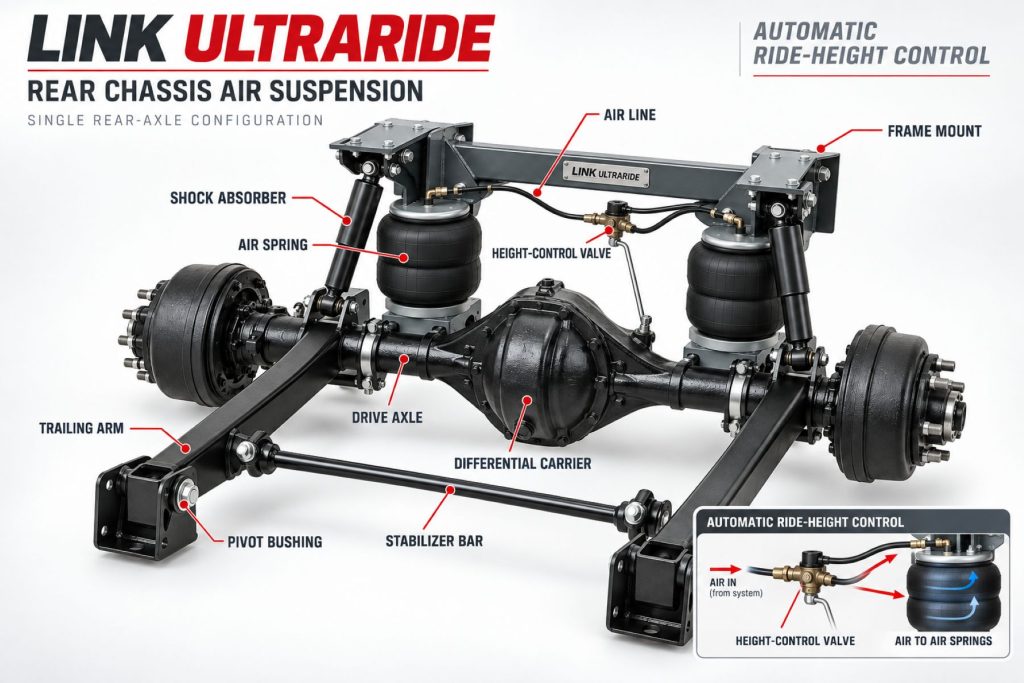
Compressed air inside the suspension’s air springs supports the vehicle frame and payload. When additional weight lowers the chassis, the height-control valve adds air to the springs until the vehicle returns to its designed ride height.
When weight is removed, the valve releases excess air. This allows the suspension to maintain a relatively consistent height as passengers, cargo, fluids, or equipment are added and removed.
Suspension links guide the rear axle through its vertical travel and manage acceleration and braking forces. A lateral-control component limits unwanted side-to-side axle movement.
Shock absorbers control the rate of suspension movement and help prevent the body from continuing to bounce after the vehicle encounters a bump or depression.
Suspension Position and Function
The UltraRide is installed between the vehicle’s rear axle and chassis frame. It supports the rear portion of the vehicle while allowing controlled vertical axle movement.
The system performs several functions:
- Supports the rear chassis and payload
- Maintains the designed ride height
- Allows controlled axle travel
- Reduces road shock transmitted into the body
- Controls axle position during acceleration and braking
- Limits unwanted lateral axle movement
- Helps the rear tires maintain road contact
- Improves loaded and unloaded ride consistency
- Supports stable operation of specialized vehicle bodies
Common Specifications
- Suspension Type: Rear air suspension
- Common Axle Arrangement: Single rear axle
- Vehicle Classes: Application-specific medium-duty and heavy commercial chassis
- Suspension Capacity: Determined by the UltraRide model and chassis application
- Ride Height: Application-specific
- Axle Compatibility: Approved original-equipment rear axles
- Damping: Heavy-duty shock absorbers
- Lateral Control: Panhard rod or application-specific lateral member
- Air Supply: Vehicle air system or dedicated compressor package
- Brake Compatibility: Retains approved chassis brake equipment
- Installation: Vehicle-specific frame and axle mounting kit
Exact capacities, dimensions, ride heights, and air-system requirements must be confirmed using the UltraRide kit number and vehicle information.
Capacity, Ride Height, and Axle Travel
UltraRide capacity varies by vehicle and suspension model. The suspension must be matched to the chassis gross axle weight rating, frame capacity, tires, wheels, brakes, and intended body installation.
The system does not increase the original vehicle’s legal payload or certified rear axle rating unless the complete vehicle has been properly recertified by an authorized manufacturer or final-stage builder.
Correct ride height is essential for:
- Full jounce and rebound travel
- Proper air-spring shape
- Correct shock-absorber position
- Stable driveline angles
- Rear axle alignment
- Tire and body clearance
- Proper vehicle handling
- Consistent loading height
Axle travel allows the wheels to follow road irregularities while the air springs reduce shock transmitted to the frame and body.
Ride Quality and Load Distribution
UltraRide is intended to provide a smoother rear suspension response than many conventional leaf-spring systems. Traditional steel springs must be stiff enough to carry the vehicle’s maximum load, which can create a harsh ride when the vehicle is lightly loaded.
Air springs adjust their internal pressure according to the supported weight. This can provide more consistent ride characteristics across different payload conditions.
The suspension does not move weight between separate axle groups. Proper cargo and equipment placement remains necessary to keep the front and rear axles within their ratings.
Suspension Controls and Adjustment Options
Most UltraRide systems use an automatic height-control valve. The valve maintains the specified ride height without requiring the driver to adjust air pressure for normal load changes.
Application-specific options may include:
- Dedicated electric air compressor
- Auxiliary air reservoir
- Manual suspension dump
- Automatic suspension dump
- Temporary kneeling or lowering function
- Loading-height control
- Electronic compressor controls
- Low-air-pressure warning
- Dash-mounted controls
- Emergency inflation connection
- Automatic leveling equipment
Controls depend on the vehicle and body application. The suspension should normally return to its designed ride height before road operation.
Alignment and Suspension Geometry
Correct axle alignment is necessary for predictable handling and acceptable tire life. The trailing arms, pivot bushings, lateral-control rod, frame brackets, and axle mounts keep the rear axle positioned beneath the chassis.
Worn bushings, loose fasteners, incorrect ride height, or damaged brackets can allow the axle to shift. This may cause:
- Vehicle dog-tracking
- Steering corrections
- Irregular tire wear
- Driveline vibration
- Body lean
- Unusual suspension noise
Alignment should be checked after suspension repairs, axle replacement, collision damage, frame work, or the discovery of abnormal tire wear.
Axle, Brake, and Wheel-End Options
UltraRide is a chassis suspension and normally works with the vehicle’s approved rear axle, brakes, hubs, and wheel ends.
Compatible equipment may include:
- Single rear drive axle
- Full-floating rear axle
- Single-reduction drive axle
- Hydraulic disc brakes
- Air disc brakes
- Hydraulic drum brakes
- Air drum brakes
- Single rear wheels
- Dual rear wheels
- Conventional wheel ends
- Unitized wheel bearings
- Parking-brake equipment
- Antilock braking systems
The suspension kit must be designed for the axle, brake, track-width, and wheel configuration installed on the vehicle.
Common Applications
- Ambulances
- Emergency medical vehicles
- Shuttle buses
- Paratransit buses
- Recreational vehicles
- Motorhomes
- Delivery trucks
- Service trucks
- Utility vehicles
- Mobile medical units
- Broadcast and communications vehicles
- Specialty work trucks
- Armored vehicles
- Commercial vehicles carrying sensitive equipment
Vehicle, Axle, and Frame Compatibility
UltraRide systems are developed for specific commercial chassis. A suspension kit for one vehicle should not be assumed to fit another chassis with a similar axle rating.
Compatibility depends on:
- Vehicle manufacturer
- Model and model year
- Chassis cab configuration
- Frame width and rail strength
- Wheelbase
- Rear axle model
- Rear axle weight rating
- Brake system
- Single or dual rear wheels
- Driveshaft length and angles
- Fuel-tank location
- Battery-box location
- Exhaust-system clearance
- Body and floor structure
- Original rear suspension
- Final vehicle weight distribution
The correct Link application guide and installation instructions should be used before ordering or installing a system.
Advantages
- Improved ride quality
- More consistent operation between loaded and unloaded conditions
- Automatic maintenance of chassis ride height
- Reduced vibration reaching passengers and cargo
- Can improve comfort in ambulances and buses
- Can help protect sensitive equipment
- May reduce stress on vehicle bodies and interior components
- Provides controlled rear axle movement
- Can support temporary lowering or kneeling functions
- Application-specific conversion packages are available
- Works with approved original-equipment axles
- Useful for specialty vehicles where ride quality is a priority
Limitations or Considerations
- Does not increase the original axle or vehicle weight rating
- Requires a dependable compressed-air supply
- Dedicated compressors add electrical and maintenance requirements
- Air leaks can lower the rear chassis
- Ride height must be adjusted correctly
- Suspension kits are vehicle-specific
- Installation may require removal of original suspension components
- Frame drilling, brackets, or structural changes may be required
- Driveline angles must be checked after installation
- Body and equipment clearances must be maintained
- Air springs, shocks, bushings, and valves require inspection
- Not every commercial chassis has an approved UltraRide application
Driver and Operator Experience
Drivers may notice less rear-body shock, reduced vibration, and a more controlled ride over broken pavement, bridge joints, and uneven roads. The improvement can be especially noticeable when the vehicle is lightly loaded.
Passengers and patients may experience less harsh movement than they would with a conventional leaf-spring rear suspension. Equipment stored inside the body may also be subjected to lower impact loads.
Drivers should report:
- Rear chassis sitting too low
- Vehicle leaning to one side
- Frequent compressor operation
- Low-air warnings
- Excessive bouncing
- Unusual clunking
- Driveline vibration
- Changes in vehicle handling
- Tires contacting the body or wheel openings
Maintenance and Ownership Notes
- Inspect air springs for cracks, cuts, abrasion, and leaks.
- Check air lines, fittings, valves, and reservoirs.
- Inspect dedicated compressors and electrical connections.
- Drain moisture from applicable air reservoirs.
- Check the air dryer or moisture separator.
- Measure ride height at scheduled intervals.
- Inspect height-control linkage.
- Check shock absorbers for leakage and worn mounts.
- Inspect suspension links and pivot bushings.
- Check the lateral-control rod and bushings.
- Inspect frame and axle brackets for cracks.
- Verify critical fastener torque.
- Check driveshaft clearance and operating angles.
- Monitor rear tires for alignment-related wear.
- Test manual lowering or dump controls when equipped.
- Support the chassis correctly before working beneath the vehicle.
Common Suspension Problems
- Air leaks: Damaged air springs, hoses, fittings, reservoirs, or valves can cause the chassis to settle.
- Compressor runs frequently: Air leakage, insufficient reservoir capacity, a failing compressor, or incorrect pressure controls may be responsible.
- Vehicle will not reach ride height: A failed compressor, restricted air line, faulty valve, overloaded vehicle, or damaged air spring may prevent inflation.
- Incorrect ride height: Damaged linkage, improper adjustment, or height-control valve failure can position the chassis too high or too low.
- Vehicle leaning: Uneven loading, an air restriction, damaged suspension parts, or incorrect adjustment can cause side-to-side height differences.
- Excessive bouncing: Worn shock absorbers, incorrect ride height, unsuitable air pressure, or damaged suspension components may reduce control.
- Driveline vibration: Incorrect ride height or altered axle position can change driveshaft operating angles.
- Irregular tire wear: Rear axle misalignment, worn bushings, incorrect tire pressure, or wheel-end problems may be responsible.
- Structural noise: Loose fasteners, worn pivots, damaged brackets, or component interference may produce clunks or rattles.
Identification Information
UltraRide identification may be found on a suspension label, air-system component, frame bracket, or installation documentation.
Record the following information:
- Vehicle manufacturer
- Vehicle identification number
- Model and model year
- Chassis configuration
- Wheelbase
- UltraRide kit number
- Suspension assembly number
- Rated suspension capacity
- Designed ride height
- Rear axle manufacturer and model
- Rear axle weight rating
- Brake type
- Single or dual rear wheels
- Air-spring part number
- Shock-absorber part number
- Height-control valve number
- Compressor and control-system information
The vehicle VIN alone may not identify an aftermarket suspension. The Link kit number and component identification should also be recorded.
Buying Considerations
- Confirm that Link offers a system for the exact vehicle.
- Verify the chassis model, VIN, wheelbase, and model year.
- Confirm rear axle capacity and configuration.
- Determine the completed vehicle’s actual rear axle weight.
- Match the correct ride height.
- Review body and equipment clearances.
- Check fuel-tank, battery, exhaust, and driveline placement.
- Determine whether a dedicated compressor is required.
- Review electrical requirements for the compressor and controls.
- Evaluate kneeling, lowering, or dump options.
- Compare the complete installed cost with expected ride benefits.
- Confirm replacement-parts availability.
- Choose an installer familiar with chassis air-suspension conversions.
- Determine whether certification or inspection is required after installation.
Variants and Configurations
UltraRide is an application-specific family rather than one universal suspension.
Configurations may differ by:
- Vehicle manufacturer
- Truck model
- Model year
- Chassis class
- Wheelbase
- Rear axle rating
- Single or dual rear wheels
- Suspension capacity
- Ride height
- Frame width
- Air-spring arrangement
- Shock-absorber placement
- Air-compressor package
- Manual or automatic controls
- Kneeling capability
- Body and specialty-equipment application
The complete kit number should be used when identifying parts or comparing systems.
Comparison to Similar Equipment
Compared with the Link Cabmate Suspension, UltraRide supports the vehicle frame above the rear axle. Cabmate is installed between the cab and chassis and does not replace the axle suspension.
Compared with a conventional rear leaf-spring suspension, UltraRide generally provides a smoother unloaded ride and more consistent chassis height as payload changes.
Compared with a full-size Class 8 tandem-drive air suspension, UltraRide is commonly used on single-rear-axle medium-duty and specialty chassis.
Compared with auxiliary air-helper springs, UltraRide is a complete axle-control suspension system rather than an add-on spring intended only to assist the original suspension.
Compared with the Link ROI Auxiliary Suspension, UltraRide supports a primary rear axle. The ROI Auxiliary Suspension is intended for an additional liftable or load-supporting axle.
Best Fit For
- Ambulances requiring improved patient ride quality
- Shuttle and paratransit buses
- Recreational vehicles and motorhomes
- Medium-duty delivery trucks
- Mobile medical and communications vehicles
- Service trucks carrying sensitive equipment
- Vehicles with large differences between loaded and unloaded weight
- Specialty fleets prioritizing passenger comfort
- Commercial chassis requiring automatic leveling
- Vehicles with an approved UltraRide application
Related Vehicle and Trailer Types
- Class 6 vs Class 7 vs Class 8 Trucks
- Complete Guide to Semi Truck Types
- Medium-duty trucks
- Straight trucks
- Ambulances
- Shuttle buses
- Paratransit vehicles
- Recreational vehicles
- Service trucks
- Utility trucks
- Delivery trucks
- Specialty commercial vehicles
Related Truck and Trailer Models
- International CV Series
- Freightliner M2 106
- Kenworth T280
- Peterbilt 536
- Ford F-450 and F-550 chassis cabs
- Ram 4500 and 5500 chassis cabs
- Chevrolet Silverado medium-duty chassis cabs
- GMC Sierra medium-duty chassis cabs
Related Suspension Types
- Air Suspension Systems
- Link Cabmate Suspension
- Link ROI Auxiliary Suspension
- Single-rear-axle air suspensions
- Medium-duty air suspensions
- Specialty-vehicle suspensions
- Leaf-spring suspensions
- Auxiliary air-helper springs
- Cab air suspensions
Related Equipment Systems
- Suspension Systems
- Air Brake Systems Explained
- Axles & Differentials
- Rear drive axles
- Hydraulic brake systems
- Air brake systems
- Tires and wheels
- Driveshafts and drivelines
- Electronic leveling systems
- Vehicle air compressors
Related Guides
- Suspension System Guides
- How Commercial Truck Suspension Systems Work
- Air Suspension vs Leaf Spring Suspension
- How to Choose a Commercial Truck Suspension
- Truck Suspension Components Explained
- Truck vs Trailer Suspension Systems
- Single Axle vs Tandem Axle Trucks
Regulatory and Compliance Notes
Installing UltraRide does not automatically increase the vehicle’s gross axle weight rating, gross vehicle weight rating, legal payload, tire capacity, wheel capacity, or brake rating.
Suspension conversions must preserve the structural integrity of the chassis and the safe operation of the brakes, steering, driveline, parking brake, fuel system, exhaust system, electrical wiring, and body equipment.
Final-stage manufacturers and vehicle modifiers may be responsible for confirming that the completed vehicle continues to meet applicable safety, weight, labeling, and certification requirements.
Modifications to frame rails, crossmembers, brake lines, or driveshaft geometry should follow approved engineering and installation procedures.
Real World Operating Notes
A smoother ride does not mean the vehicle can safely carry more weight. Actual axle weights should be verified after installing heavy bodies, tanks, medical equipment, generators, lifts, or passenger accommodations.
Dedicated electric air compressors should be inspected when they run longer or more frequently than normal. Repeated compressor cycling usually indicates an air leak or system problem.
Ride-height problems should be corrected before diagnosing driveline vibration or rear axle alignment. A vehicle aligned at the wrong height may still track incorrectly during normal operation.
Body builders should check suspension clearance through the full range of travel. Air springs, shocks, tires, brake hoses, and suspension links must not contact the body or mounted equipment.
Frequently Asked Questions
What is the Link UltraRide?
UltraRide is an application-specific rear air suspension for medium-duty trucks and specialty commercial chassis.
Is UltraRide a cab suspension?
No. It supports the vehicle frame above the rear axle. The Link Cabmate Suspension supports and isolates the cab.
Does UltraRide replace leaf springs?
Many UltraRide configurations replace the original rear leaf-spring suspension with an air-suspension system. The exact installation depends on the vehicle.
Does UltraRide increase payload capacity?
Not automatically. The vehicle remains limited by its certified axle, frame, brake, tire, wheel, and gross vehicle weight ratings.
What vehicles use UltraRide?
Applications may include ambulances, shuttle buses, recreational vehicles, service trucks, delivery vehicles, and specialty commercial chassis.
Does the system require an air compressor?
Vehicles without an existing compressed-air supply may require a dedicated electric compressor, reservoir, controls, and moisture-management components.
Can the suspension lower the vehicle for loading?
Some application-specific systems may offer dump, kneeling, or temporary lowering functions.
What causes an UltraRide-equipped vehicle to sit low?
Possible causes include an air leak, failed compressor, damaged air spring, faulty height-control valve, restricted air line, overloading, or incorrect adjustment.
Why is correct ride height important?
It preserves suspension travel, driveline angles, air-spring shape, axle alignment, tire clearance, and vehicle handling.
How can the correct replacement parts be identified?
Use the vehicle VIN, Link kit number, suspension label, ride height, rear axle information, and individual component numbers.
Availability and Where to Find
Link UltraRide systems and replacement parts may be available through Link Manufacturing distributors, commercial-truck dealers, emergency-vehicle builders, bus and recreational-vehicle manufacturers, specialty suspension installers, and heavy-duty parts suppliers.
Availability depends on the exact chassis manufacturer, model, model year, wheelbase, rear axle, frame, and completed vehicle application.
Before ordering, buyers should confirm that the kit includes the required suspension brackets, links, air springs, shocks, valves, air lines, compressor equipment, controls, fasteners, and installation instructions.
Current application information, technical support, replacement parts, and distributor resources are available through the Link Manufacturing website.
Support Trucking Families
Truck Equipment Atlas supports the mission of Grey Cross, a nonprofit dedicated to helping families of truck drivers who lose their lives while on the road. As the site grows, part of its mission is to bring awareness and support to these families.
Podcast or Video Section
Learn More Through Audio and Video
Truck Equipment Atlas will continue expanding with podcast episodes, interviews, and equipment breakdowns to help drivers and fleets better understand trucks and equipment.
Follow the Growth of Truck Equipment Atlas
Truck Equipment Atlas continues to expand with new truck profiles, trailer coverage, diesel engine pages, equipment system resources, manufacturer information, and educational guides.
Visit our Site Updates page to explore recent additions, project milestones, and upcoming resources as we continue building one of the industry’s growing commercial trucking equipment reference libraries.
View the Latest Site Updates: Truck Equipment Atlas Site Updates