
Allison 3000 Series Transmission
Quick Facts
- Manufacturer: Allison Transmission
- Transmission Type: Fully Automatic Commercial Transmission
- Series: Allison 3000 Series
- Common Models: 3000 HS, 3000 RDS, 3000 EVS, 3000 MH, 3000 SP, 3200, 3300, and 3500 configurations
- Number of Forward Speeds: Six
- Number of Reverse Speeds: One on most on-highway configurations
- Maximum Engine Power: Up to 450 hp depending on model and application rating
- Maximum Input Torque: Up to 1,250 lb-ft depending on model
- Supported Gross Vehicle Weight: Up to approximately 98,100 lbs depending on configuration and application
- Control Type: Electronic Automatic Controls
- Launch System: Hydraulic Torque Converter
- Lockup System: Automatic Lockup Clutch
- Common Truck Classes: Class 7 and Class 8
- Common Applications: Refuse Trucks, Fire Apparatus, Dump Trucks, Utility Trucks, Distribution Trucks, Transit Buses, Motorhomes, Construction Trucks, and Specialty Vehicles
- PTO Compatibility: Available with transmission-mounted PTO provisions
- Retarder Availability: Optional Integral Hydraulic Retarder on compatible configurations
- Recommended Fluid: Allison TES 668-approved automatic transmission fluid for current service recommendations
- Production Status: Active Production
Overview
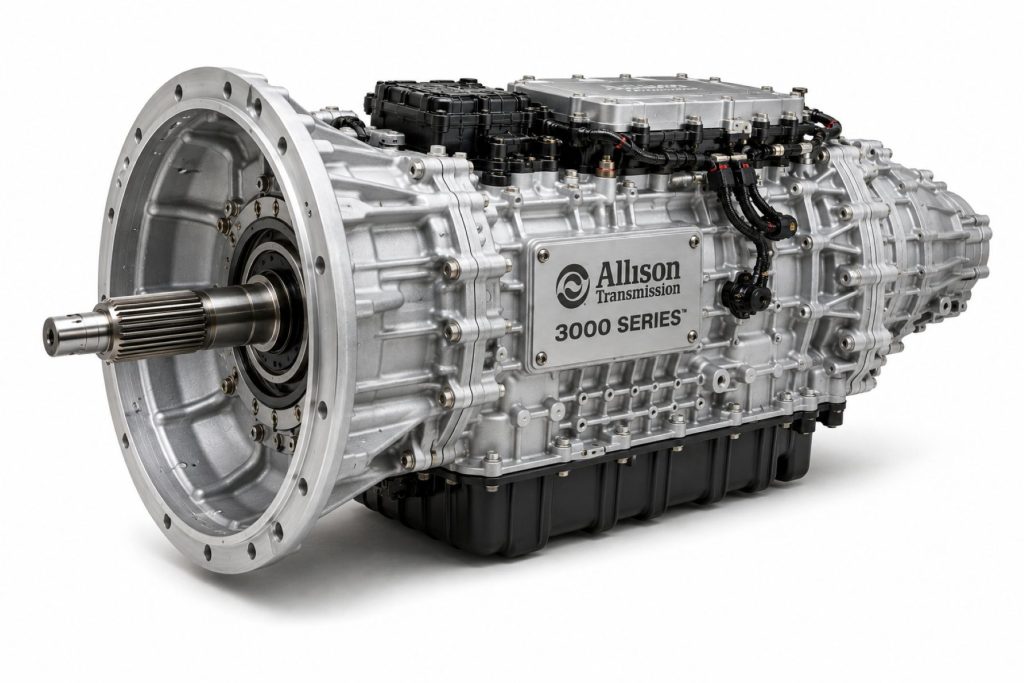
The Allison 3000 Series is a family of fully automatic commercial transmissions designed for medium- and heavy-duty trucks, buses, emergency vehicles, motorhomes, and vocational equipment.
It occupies the range above the Allison 1000 and 2000 Series while remaining lighter and more compact than the larger Allison 4000 Series. This makes it well suited to vehicles that require more torque capacity and vocational durability than lighter automatic transmissions can provide without moving to the largest heavy-duty models.
Allison rates the series for engines producing between approximately 210 and 450 horsepower, input torque of up to 1,250 lb-ft, and gross vehicle weights reaching approximately 98,100 pounds. The exact rating depends on the transmission model, vehicle vocation, engine calibration, axle ratio, cooling system, and OEM installation.
Unlike a manual or automated manual transmission, the Allison 3000 Series does not use a conventional dry clutch to start the vehicle. A hydraulic torque converter transfers engine power during launch and low-speed operation. An automatic lockup clutch then creates a more direct mechanical connection as operating conditions permit.
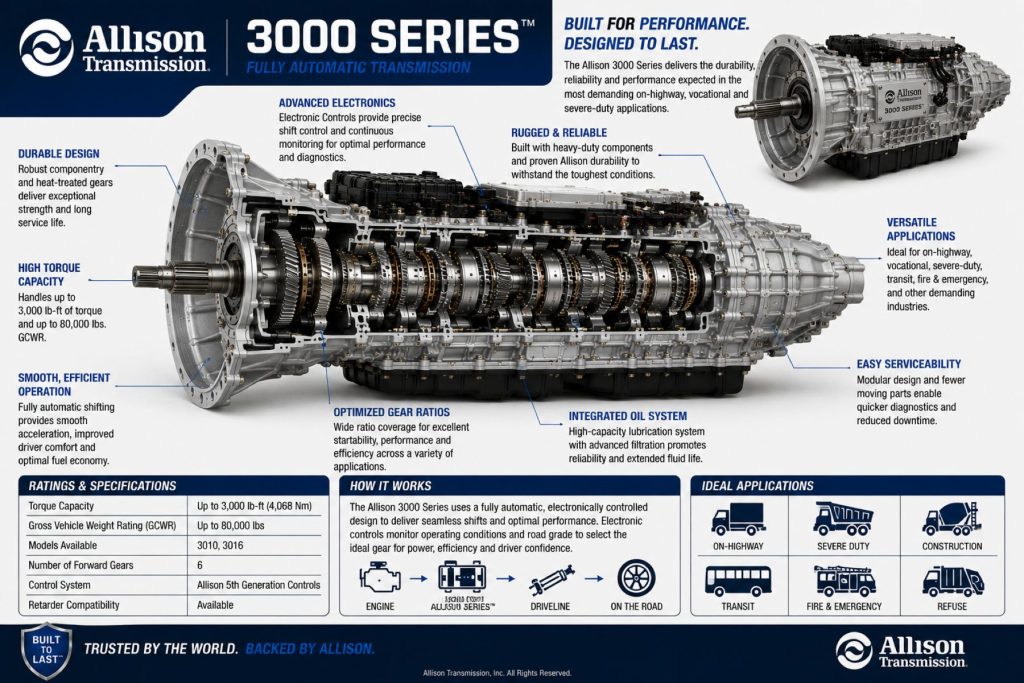
The transmission is widely used in vehicles that perform repeated stops, low-speed maneuvering, frequent direction changes, or demanding vocational work. Common examples include refuse trucks, fire apparatus, utility vehicles, dump trucks, municipal equipment, buses, and local distribution trucks.
Key Characteristics
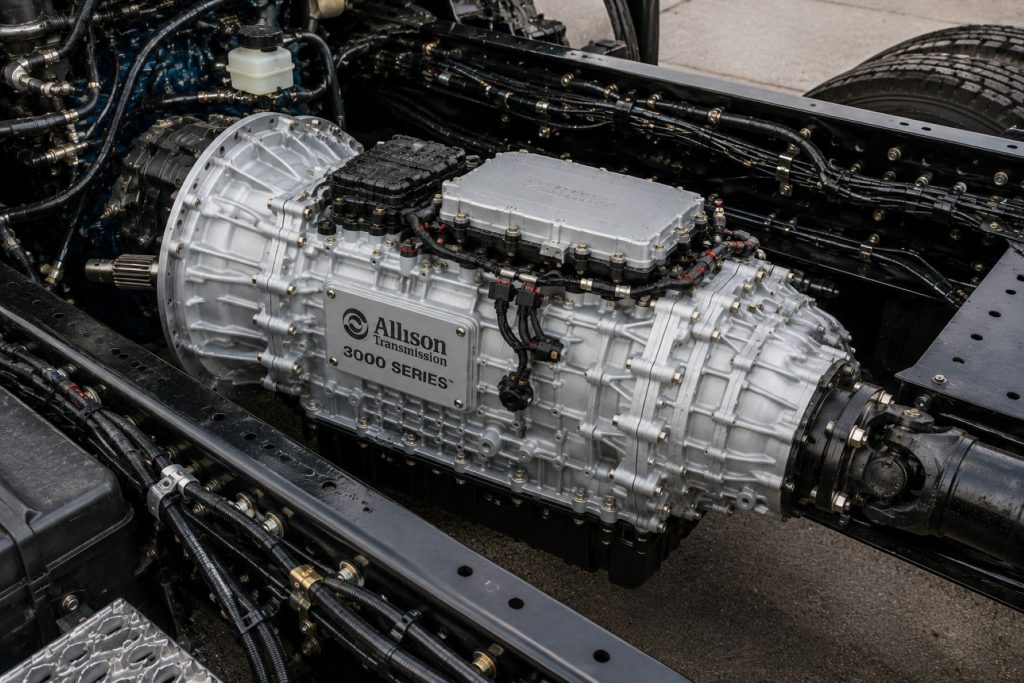
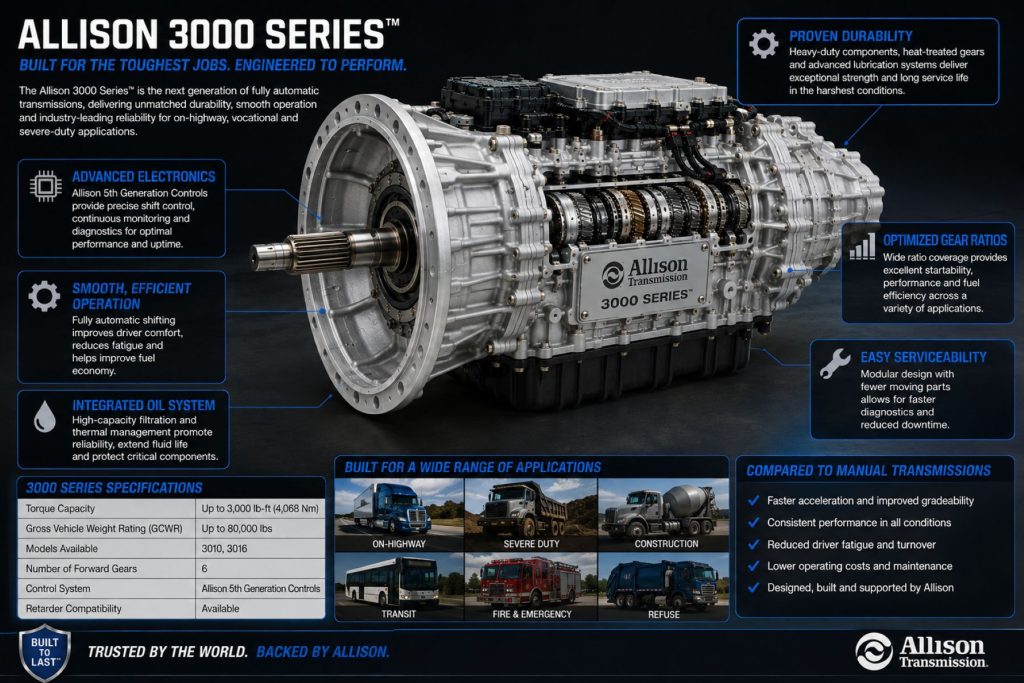
The Allison 3000 Series combines a torque converter, electronically controlled planetary gearsets, hydraulic clutch packs, and adaptive shift programming in one fully automatic transmission.
Its torque converter provides torque multiplication during vehicle launch. This helps heavy trucks begin moving smoothly without requiring the driver to operate a clutch pedal or manually select starting gears.
Six forward ranges allow the transmission to balance low-speed pulling ability with efficient road-speed operation. Fifth and sixth ranges are overdrive ratios on common configurations, reducing engine speed during highway travel.
Electronic controls monitor throttle position, engine load, vehicle speed, selected range, fluid temperature, brake inputs, and other vehicle data. The transmission control module uses this information to determine shift timing and lockup-clutch operation.
Compatible models can be equipped with PTO provisions for hydraulic pumps, refuse bodies, aerial devices, utility equipment, dump bodies, mixers, fire pumps, and other vocational systems.
An optional integral hydraulic retarder is available on certain configurations. The retarder uses transmission fluid resistance to help slow the vehicle, reducing demand on the service brakes during repeated stops or downhill operation.
How the Transmission Works
Engine power enters the transmission through the torque converter. The converter uses transmission fluid to transfer power from the engine-driven impeller to the turbine connected to the transmission input.
When the vehicle begins moving, the torque converter can multiply engine torque. This provides smooth acceleration and helps the vehicle move away from a stop under heavy load.
As vehicle speed increases, the lockup clutch engages when operating conditions permit. Lockup reduces hydraulic slip inside the torque converter and improves power-transfer efficiency.
Inside the transmission, planetary gearsets create the available forward and reverse ratios. Electronically controlled hydraulic clutch packs hold or release different components of the planetary gearsets to select each range.
The transmission control module coordinates these clutch applications to complete shifts. Because one clutch can release as another applies, the transmission maintains power delivery without the interruption normally experienced during shifts in a manual or automated manual transmission.
The transmission also communicates with the engine control module through the vehicle’s electronic network. During a shift, the transmission may request a temporary change in engine torque to improve shift quality and protect drivetrain components.
When a PTO is installed, the transmission can provide mechanical power to compatible vocational equipment. PTO operation and interlocks may be controlled through the transmission, body controller, engine control module, or a separate equipment-control system.
On retarder-equipped models, the retarder creates resistance inside the transmission when commanded. The resulting heat is carried away by the transmission fluid and vehicle cooling system.
Common Specifications
Transmission Type
The Allison 3000 Series is a fully automatic transmission. Gear selection, clutch application, torque-converter lockup, and shift timing are managed electronically and hydraulically.
Gear Configuration
Most on-highway 3000 Series configurations provide six forward ranges and one reverse range.
A common close-ratio gear set includes:
- First Gear: 3.49:1
- Second Gear: 1.86:1
- Third Gear: 1.41:1
- Fourth Gear: 1.00:1
- Fifth Gear: 0.75:1
- Sixth Gear: 0.65:1
- Reverse: Approximately 5.03:1
Ratios can vary by model, market, calibration, and vocational configuration. The identification tag and Allison model documentation should be used when exact ratios are required.
Engine Power Rating
The 3000 Series supports engines within an approximate range of 210 to 450 horsepower. The maximum permitted rating depends on the exact transmission model and approved application.
Torque Capacity
Maximum input torque reaches approximately 1,250 lb-ft on applicable models. Not every 3000 Series configuration carries the maximum rating.
Engine peak torque, torque-converter selection, duty cycle, gross vehicle weight, axle gearing, and vocational use must remain within the approved rating for the individual transmission.
Gross Vehicle Weight
Allison lists gross vehicle weight capability reaching approximately 98,100 pounds for the series. This is a transmission application rating rather than permission to exceed federal, state, provincial, axle, tire, chassis, or bridge-formula limits.
Torque Converter
Multiple torque-converter configurations are available to match different engines, vehicle weights, launch requirements, and operating conditions.
Converter selection affects starting performance, heat generation, low-speed control, and compatibility with the engine’s torque curve.
Lockup Clutch
An electronically controlled lockup clutch reduces torque-converter slip after launch. Depending on the calibration, lockup may operate in multiple forward ranges.
Electronic Controls
Current configurations use Allison electronic controls integrated with the engine, brakes, body equipment, and other vehicle systems.
Available functions may include prognostics, diagnostic codes, range inhibition, engine-brake coordination, retarder control, neutral-at-stop programming, and vocational operating modes.
Shift Selector
Shift selectors can include push-button, lever-style, or OEM-integrated controls. The selector normally provides Drive, Neutral, Reverse, and manual range-selection functions.
Some selectors also display oil level information, prognostic warnings, diagnostic codes, and the selected versus attained range.
PTO Compatibility
The transmission can be ordered with provisions for one or more PTO installations depending on the model and vehicle specification.
PTO location, rotation, torque rating, speed ratio, lubrication requirements, and operating restrictions must be matched to the equipment.
Integral Retarder
An optional integral hydraulic retarder is available on compatible models. It provides auxiliary braking through the driveline and can reduce service-brake wear.
Retarder-equipped trucks require sufficient cooling capacity because the retarder converts vehicle motion into heat that must be removed through the transmission cooling system.
Lubrication System
The transmission uses pressurized automatic transmission fluid for lubrication, hydraulic clutch operation, torque-converter operation, cooling, and retarder operation when equipped.
Allison currently recommends TES 668-approved fluids for the 3000 Series. The correct fluid and service interval should be confirmed for the transmission’s serial number and operating duty.
Fluid Capacity
Fluid capacity varies with the oil-pan design, cooler, lines, filter arrangement, retarder equipment, and whether the transmission is being serviced or completely filled after overhaul.
Operators should not rely on a single universal capacity figure. Fluid level must be checked using the approved Allison procedure.
Filtration
The transmission uses serviceable filtration to control contamination. Filter type, quantity, and replacement interval vary by model generation and sump configuration.
Transmission Weight
Dry weight generally falls within an approximate 530-to-650-pound range depending on the model, torque converter, output arrangement, PTO provisions, retarder, and installed accessories.
The certified specification for the exact transmission should be used when calculating chassis weight or payload.
Cooling Requirements
The transmission requires an appropriately sized oil-to-coolant or oil-to-air cooling system. Required cooling capacity increases with heavy loads, repeated launches, low-speed operation, high ambient temperatures, PTO use, and retarder operation.
Installation Requirements
Installation must account for engine compatibility, bellhousing and flexplate specifications, driveline angles, rear support, electronic controls, cooling capacity, shift-selector programming, output-flange dimensions, PTO clearance, and approved transmission calibration.
Common Applications
- Refuse collection trucks
- Rear loaders, front loaders, and side loaders
- Fire engines and rescue apparatus
- Utility service trucks
- Aerial-lift and bucket trucks
- Dump trucks
- Municipal snowplow trucks
- Construction service vehicles
- Local and regional distribution trucks
- Beverage-delivery trucks
- Transit and shuttle buses
- School and commercial buses
- Emergency vehicles
- Motorhomes
- Airport support vehicles
- Concrete and construction-support equipment
- Specialty and defense vehicles
- Agricultural service trucks
Truck and Engine Compatibility
The Allison 3000 Series is commonly installed in heavier medium-duty trucks and vocational trucks. It is generally selected when the engine, vehicle weight, or duty cycle exceeds the practical range of the Allison 1000 or 2000 Series.
Potential truck platforms include the Freightliner M2, Freightliner 114SD, Western Star 47X, International MV and HV Series, Kenworth T280 through T480, Peterbilt 536 through 548, Mack vocational trucks, fire-apparatus chassis, transit buses, and specialty vehicles.
Availability differs by model year, axle configuration, engine rating, vocation, and OEM order code. The presence of an Allison automatic option on a truck does not guarantee that every version of the truck uses the 3000 Series.
Common engine families may include the Cummins L9, Cummins ISL, PACCAR PX-9, Detroit DD8, and other medium- or heavy-duty diesel engines operating within Allison’s approved power and torque limits.
Compatibility must be determined using more than horsepower alone. The engine’s peak torque, governed speed, torque curve, gross combination weight, intended vocation, cooling requirements, and electronic calibration must all be approved for the selected transmission.
PTO-driven vehicles also require confirmation that the transmission, PTO, hydraulic system, and body equipment can operate together at the required speed and torque.
Advantages
- Fully automatic operation reduces driver workload
- No conventional dry clutch requires routine driver operation
- Torque converter provides smooth vehicle launch
- Torque multiplication improves starting performance under load
- Continuous power delivery supports faster acceleration
- Six forward ranges provide vocational and highway flexibility
- Automatic shifting can reduce driver-training requirements
- Well suited to repeated stop-and-go operation
- Strong low-speed control benefits refuse and utility work
- Compatible with numerous vocational PTO systems
- Optional integral retarder can reduce service-brake wear
- Electronic controls can communicate with engines and body equipment
- Multiple vocational calibrations are available
- Prognostic functions can assist maintenance planning
- Broad service and parts network
- Can improve consistency between different drivers
- Useful in emergency vehicles where the driver must concentrate on traffic and vehicle positioning
Limitations or Considerations
- Higher initial cost than many manual transmissions
- Greater parasitic loss than a direct mechanical transmission under some conditions
- Transmission fluid and filters require scheduled service
- Cooling-system condition is critical
- Overheating can damage fluid, seals, and clutch materials
- Repairs require Allison-specific diagnostic knowledge
- Internal repairs can be expensive
- The correct electronic calibration is essential
- Incorrect engine or axle matching can reduce performance
- PTO installation requires careful specification
- Integral-retarder operation adds heat to the cooling system
- The transmission is heavier than some manual or automated manual alternatives
- Not every 3000 Series model supports the maximum published torque rating
- Used transmissions may require electronic reprogramming for a different truck
- Driveline and output arrangements vary between applications
- Fuel economy depends heavily on gearing, programming, vehicle weight, and duty cycle
Driver and Operator Experience
The Allison 3000 Series provides a driving experience similar to other fully automatic commercial transmissions. The driver selects Drive or Reverse and controls the vehicle primarily with the accelerator and brake pedals.
The torque converter allows the truck to begin moving without manual clutch engagement. This is valuable in traffic, refuse collection, emergency response, construction sites, and other operations involving frequent starts.
Automatic shifting keeps both of the driver’s hands available for steering and equipment controls. It also eliminates missed shifts, gear grinding, and clutch-stalling problems associated with manual transmissions.
Creep behavior can assist with precise low-speed positioning. Drivers must still control the vehicle carefully because a heavy truck may begin moving when a drive range is selected and the service brake is released.
Range-selection controls allow the driver to limit the highest available gear. This can improve control on grades, during equipment operation, or in conditions where repeated shifting is undesirable.
On retarder-equipped trucks, the driver may have a lever, pedal-integrated control, or programmed automatic retarder operation. Drivers should understand how the retarder interacts with the service brakes, engine brake, traction conditions, and cooling system.
Transmission programming can make two trucks with similar hardware feel different. Shift timing, torque-converter lockup, economy programming, vocational modes, and axle ratios all influence drivability.
Maintenance and Ownership Notes
Correct fluid is essential to transmission life and shift quality. Allison-approved fluid should be used, and different fluid specifications should not be mixed without confirming compatibility.
Fluid and filter intervals depend on the fluid specification, transmission model, filters, vocation, annual mileage, operating hours, and severity of service.
Refuse, construction, fire, and utility trucks may accumulate substantial operating hours without traveling high mileage. Maintenance programs should therefore consider both mileage and operating time.
The fluid level should be checked using the approved electronic or dipstick procedure. The vehicle must be in the correct operating condition because fluid temperature and drain-back can affect the reading.
Cooling-system maintenance is especially important. A restricted cooler, contaminated heat exchanger, damaged line, low coolant level, or failed fan can cause the transmission to overheat.
Electrical connectors, harnesses, speed sensors, shift selectors, power supplies, and vehicle-network connections should be protected from corrosion and physical damage.
PTO-equipped transmissions require inspection of the PTO mounting, fasteners, seals, wiring, hoses, lubrication, output shaft, and driven equipment.
Retarder-equipped vehicles place additional demand on the cooling system. Operators should monitor temperature during extended descents and repeated severe braking.
Allison prognostic functions can help identify fluid, filter, and clutch-maintenance needs, but the functions must be correctly enabled and reset after service.
Common Transmission Problems
Fluid Leaks
Leaks may develop at the oil pan, cooler lines, output seal, input area, PTO opening, filter cover, electrical connector, or retarder housing.
A minor leak should be corrected before low fluid causes clutch damage, overheating, or loss of hydraulic pressure.
Overheating
Common causes include low fluid, incorrect fluid, restricted coolers, damaged cooler lines, excessive torque-converter operation, heavy PTO use, overloaded vehicles, or inadequate engine cooling.
Repeated overheating can oxidize the fluid and damage internal seals and clutch materials.
Harsh or Delayed Shifting
Harsh engagement or delayed shifts may result from low fluid, contaminated fluid, incorrect calibration, sensor faults, valve-body problems, clutch wear, engine-data errors, or electrical issues.
Diagnosis should begin with fault codes, fluid condition, operating temperature, and vehicle-network information.
Failure to Engage Drive or Reverse
Possible causes include insufficient fluid, low hydraulic pressure, electrical faults, range-selector problems, failed solenoids, damaged wiring, internal clutch failure, or an active range-inhibit condition.
Torque-Converter Problems
A worn converter clutch can cause slipping, shuddering, excess heat, abnormal engine speed, or lockup-related diagnostic codes.
Converter problems can also send debris through the transmission and cooling circuit.
Speed Sensor or Wiring Faults
Input, turbine, and output speed sensors help the control module manage shifts. Damaged wiring or sensor failure can cause improper shifting, warning lights, range inhibition, or limp-home operation.
Shift Selector Problems
A failed push-button pad, lever selector, power supply, data connection, or ground can prevent normal range selection even when the internal transmission is mechanically sound.
PTO Problems
PTO complaints may involve incorrect programming, failed interlocks, insufficient hydraulic output, improper gear backlash, lubrication problems, damaged wiring, or an incorrectly matched PTO.
Retarder Problems
Retarder faults can include overheating, fluid leaks, control problems, weak braking effect, or improper coordination with the brake system.
Contaminated Cooling System
Debris remaining in the cooler after a transmission failure can contaminate a replacement or rebuilt unit. Cooler flushing or replacement must follow the repair provider’s instructions.
Buying Considerations
- Identify the exact model rather than purchasing only by the “3000 Series” name.
- Record the transmission serial number and assembly number.
- Confirm the engine horsepower and peak torque rating.
- Verify that the transmission is approved for the intended vocation.
- Check the truck’s gross vehicle and combination weight requirements.
- Confirm the number of forward ranges and gear ratios.
- Determine whether PTO provisions are required.
- Verify the PTO location, ratio, rotation, and torque capacity.
- Determine whether an integral retarder is needed.
- Confirm the torque-converter model and stall characteristics.
- Check the output-flange or yoke configuration.
- Verify shift-selector and electronic-control compatibility.
- Confirm cooling-system requirements.
- Inspect the fluid for discoloration, odor, metal, clutch material, or coolant contamination.
- Check for active and inactive diagnostic codes.
- Operate the transmission from cold start through full operating temperature.
- Test forward engagement, reverse engagement, shifts, lockup, downshifts, and manual range selection.
- Inspect the housing, oil pan, cooler lines, connectors, PTO openings, and output seal for leaks.
- Review maintenance and overhaul records.
- Confirm whether the control module must be reprogrammed for the vehicle.
- Investigate parts, service, warranty, and extended-coverage availability.
- When buying a used takeout transmission, confirm that the torque converter, control module, wiring, shift selector, flexplate components, and installation hardware are included or separately available.
Variants and Configurations
- Allison 3000 HS Highway Series
- Allison 3000 RDS Rugged Duty Series
- Allison 3000 EVS Emergency Vehicle Series
- Allison 3000 MH Motorhome Series
- Allison 3000 SP Specialty Series
- Allison 3200 Series configurations
- Allison 3300 RDS
- Allison 3500 RDS
- Close-ratio configuration
- Wide-ratio configuration where available
- Standard-output configuration
- PTO-ready configuration
- Single-PTO configuration
- Dual-PTO configuration
- Integral-retarder configuration
- Non-retarder configuration
- Standard-sump configuration
- Deep-sump configuration
- Push-button shift selector
- Lever-style shift selector
- FuelSense-equipped configuration
- Vocationally programmed configuration
Comparison to Similar Equipment
Compared with the Allison 1000 and 2000 Series, the Allison 3000 Series supports greater engine torque, heavier vehicle applications, and more demanding vocational work. The smaller Allison transmissions are generally lighter and better suited to lower-power medium-duty trucks.
Compared with the Allison 4000 Series, the 3000 Series is intended for less extreme power and torque requirements. The 4000 Series is better suited to the heaviest construction, mining, energy, and severe heavy-haul applications but adds size, weight, and cost.
Compared with an Eaton Fuller manual transmission, the Allison eliminates manual clutch operation and shifting. It generally provides easier low-speed operation and more consistent acceleration but costs more and depends on hydraulic and electronic systems.
Compared with an automated manual transmission such as the Eaton UltraShift PLUS, Endurant HD, or Detroit DT12, the Allison uses a torque converter instead of an automated dry clutch. This provides smoother launch behavior and uninterrupted power during shifts, especially in repeated stop-and-go service.
An automated manual may offer lower weight and strong highway fuel efficiency, while the Allison is often favored for refuse, emergency, utility, bus, and construction work requiring frequent launches and precise low-speed control.
Best Fit For
- Refuse fleets operating repeated stop-and-go routes
- Fire departments and emergency-response fleets
- Utility companies using PTO-driven equipment
- Municipal public-works departments
- Dump-truck and construction fleets
- Local and regional distribution operations
- Transit and shuttle-bus fleets
- Motorhome manufacturers and owners
- Vocational fleets requiring smooth low-speed control
- Vehicles operating with multiple drivers
- Applications where clutch replacement and driver shifting are undesirable
- Trucks requiring an integral hydraulic retarder
- Class 7 and Class 8 vehicles operating within the series ratings
- Fleets with access to Allison-trained service support
Related Truck Types
- Medium-Duty Trucks
- Vocational Trucks
- Day Cab Trucks
- Heavy Haul Trucks
- Emergency Vehicles
- Refuse Trucks
- Dump Trucks
- Utility Trucks
- Fire Apparatus
- Transit Buses
Related Truck Models
- Freightliner M2 106
- Freightliner 114SD
- Western Star 47X
- International MV Series
- International HV Series
- Kenworth T280
- Kenworth T380
- Kenworth T480
- Peterbilt 536
- Peterbilt 537
- Peterbilt 548
- Mack Granite
- Mack TerraPro
- Volvo VHD
Related Engines
Related Transmission Types
- Automatic Transmissions
- Heavy-Duty Automatic Transmissions
- Medium-Duty Automatic Transmissions
- Vocational Transmissions
- Torque-Converter Transmissions
- Electronic Automatic Transmissions
Related Equipment Systems
- Drivetrain Systems
- Torque Converters
- Transmission Control Modules
- Transmission Cooling Systems
- Transmission Retarders
- Clutches and Clutch Packs
- Driveshafts
- Axles and Differentials
- PTO Systems
- Electronic Control Systems
- Hydraulic Systems
Related Guides
Understand the operating principles in How Commercial Truck Transmissions Work, compare drivetrain designs in Manual vs Automated Manual vs Automatic Transmissions, and evaluate gearing, application, and compatibility in How to Choose a Commercial Truck Transmission.
Regulatory and Compliance Notes
The Allison 3000 Series must be installed within the power, torque, weight, cooling, and vocational limits approved by Allison and the vehicle manufacturer.
A transmission’s maximum gross vehicle weight rating does not override federal, state, provincial, axle, tire, chassis, or bridge-formula restrictions.
Electronic communication between the engine, transmission, brakes, and body equipment must remain compatible with the vehicle’s certified configuration. Unauthorized calibration changes can affect drivability, component protection, emissions-system operation, and warranty coverage.
PTO-driven equipment must include the appropriate controls and safety interlocks. Depending on the application, operation may require the parking brake to be applied, the transmission to be in Neutral, or engine speed to remain within a programmed range.
The transmission must not be programmed or installed in a way that exceeds the approved engine torque input. Engine modifications can overload the torque converter, clutch packs, geartrain, output shaft, driveline, and axles.
Repairs involving the vehicle’s electronic network, braking system, retarder, or emergency equipment should follow the procedures established by Allison, the chassis manufacturer, and the body-equipment manufacturer.
Real World Operating Notes
The Allison 3000 Series is particularly effective in vehicles that start and stop throughout the workday. The torque converter allows smooth launches without repeated dry-clutch engagement.
Refuse trucks benefit from uninterrupted power delivery and the ability to maneuver at low speed. Fire apparatus benefits from rapid acceleration and reduced driver workload during emergency response.
Utility and construction fleets often choose the transmission because it can support PTO-driven equipment while providing conventional automatic operation on the road.
Heat management remains one of the most important ownership considerations. A truck that spends extended periods at low speed, operates heavily loaded, uses a PTO, or relies on the retarder requires a clean and correctly sized cooling system.
Two trucks with Allison 3000 Series transmissions may perform differently because of torque-converter selection, axle ratio, tire size, engine programming, shift calibration, and vehicle weight.
Drivers should avoid shifting between Drive and Reverse while the truck is still moving. The vehicle should come to a complete stop before direction changes.
A warning light, inhibited range, unusual shift, or high-temperature indication should be investigated promptly. Continuing to operate with low fluid or excessive heat can turn a smaller problem into a major internal failure.
Frequently Asked Questions
What is the Allison 3000 Series?
The Allison 3000 Series is a family of electronically controlled, fully automatic commercial transmissions for medium- and heavy-duty trucks, buses, emergency vehicles, motorhomes, and vocational equipment.
How many speeds does the Allison 3000 Series have?
Most on-highway models provide six forward ranges and one reverse range.
How much torque can the Allison 3000 Series handle?
Applicable models can support input torque of up to approximately 1,250 lb-ft. The exact limit depends on the model and approved application.
What horsepower can be used with an Allison 3000 Series?
The series is designed for engines producing approximately 210 to 450 horsepower, depending on the transmission model and vehicle application.
Does the Allison 3000 Series have a clutch?
It contains internal hydraulic clutch packs and a torque-converter lockup clutch, but it does not use a driver-operated dry clutch like a conventional manual transmission.
Is the Allison 3000 Series a true automatic?
Yes. It uses a hydraulic torque converter, automatic clutch application, planetary gearing, and electronic shift controls.
Can the Allison 3000 Series operate a PTO?
Yes. PTO-capable configurations are available for vocational equipment. The correct PTO must be matched to the transmission, hydraulic system, and application.
Is a transmission retarder available?
An integral hydraulic retarder is available on certain configurations. It provides auxiliary braking through the driveline.
What fluid does the Allison 3000 Series use?
Allison currently recommends TES 668-approved automatic transmission fluid for the 3000 Series. The transmission’s serial number and service information should be checked before adding or replacing fluid.
Can an Allison 3000 Series replace a manual transmission?
A conversion may be possible, but it requires more than changing the transmission. The truck may need different mounting equipment, driveline components, cooling capacity, wiring, controls, programming, flexplate components, and PTO equipment.
What is the difference between 3000 HS and 3000 RDS?
The 3000 HS is oriented toward highway applications such as distribution, while the 3000 RDS is configured for rugged vocational work such as refuse, utility, dump, and construction service.
What is the difference between the Allison 3000 and 4000 Series?
The 4000 Series supports greater engine power, torque, and vehicle weight. The 3000 Series is more compact and is commonly used in medium- and heavy-duty applications that do not require the 4000 Series’ higher ratings.
Why does an Allison transmission show an inhibited range?
The control system can prevent a shift when speed, engine rpm, throttle position, equipment interlocks, temperature, or another operating condition makes the requested range unsafe or unsuitable.
How long does an Allison 3000 Series last?
Service life depends on vehicle weight, duty cycle, heat control, fluid maintenance, calibration, driver operation, and repair quality. Properly specified and maintained units can provide long commercial service, but no single mileage figure applies to every vocation.
Availability and Where to Find
The Allison 3000 Series remains available for current medium- and heavy-duty commercial vehicles. New-transmission availability depends on the truck manufacturer, chassis model, engine, vocation, and regional order options.
Used and rebuilt transmissions are available through Allison-authorized distributors, commercial truck dealers, transmission rebuilders, salvage operations, fleet-equipment sales, auctions, and used-parts marketplaces.
Buyers should use the transmission’s serial and assembly numbers to verify its model, ratings, gear ratios, torque converter, electronic generation, PTO provisions, retarder equipment, and original configuration.
Current ratings, applications, and product information can be confirmed through the official Allison 3000 Series product page.
Support Trucking Families
Truck Equipment Atlas supports the mission of Grey Cross, a nonprofit dedicated to helping families of truck drivers who lose their lives while on the road. As the site grows, part of its mission is to bring awareness and support to these families.
Podcast or Video Section
Learn More Through Audio and Video
Truck Equipment Atlas will continue expanding with podcast episodes, interviews, and equipment breakdowns to help drivers and fleets better understand trucks and equipment.
Follow the Growth of Truck Equipment Atlas
Truck Equipment Atlas continues to expand with new truck profiles, trailer coverage, diesel engine pages, equipment system resources, manufacturer information, and educational guides.
Visit our Site Updates page to explore recent additions, project milestones, and upcoming resources as we continue building one of the industry’s growing commercial trucking equipment reference libraries.
View the Latest Site Updates: Truck Equipment Atlas Site Updates