
Detroit DT12 Automated Manual Transmission
Quick Facts
- Manufacturer / Brand: Detroit, a Daimler Truck North America brand
- Transmission Family: Detroit DT12
- Transmission Type: Heavy-duty automated manual transmission (AMT)
- Speeds: 12 forward and 4 reverse ratios
- Driver Controls: Two-pedal operation with electronically managed clutch engagement and gear changes
- Power Transfer: Automated friction clutch; no torque converter
- Highway Models: DT12-HE and DT12-HL in the current highway specification sheet; older configurations must be identified by model and build date
- Vocational Models: DT12-V, DT12-VX and DT12-VL
- Maximum Input Torque: Model-dependent; current published examples range from 1,650 to 2,500 lb-ft
- Gearing: Direct-drive or overdrive configurations depending on model
- Engine Pairings: Approved Detroit DD13, DD15 or DD16 combinations, depending on transmission and chassis
- Primary Applications: Class 8 highway, regional and approved vocational operations
- PTO: Rear and/or bottom provisions depending on model and build
- Status: Current Detroit transmission family; equipment availability depends on chassis and model year
Overview
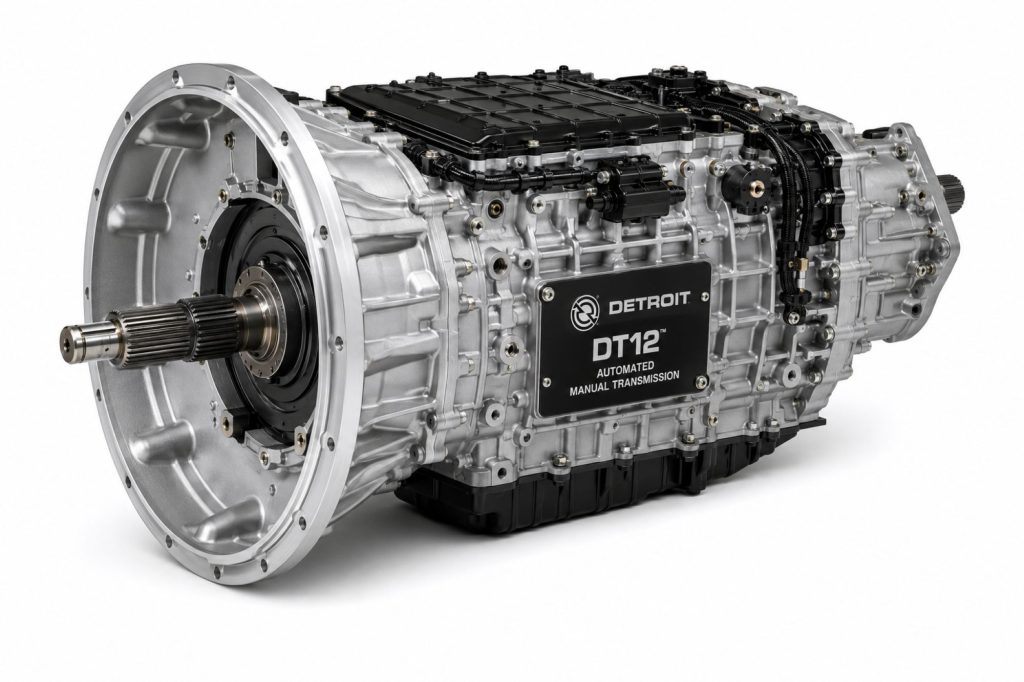
The Detroit DT12 is a family of automated manual transmissions used in Freightliner and Western Star trucks. It automates the clutch and gear changes while retaining a geared mechanical power path. The driver normally uses only the accelerator and brake pedals.
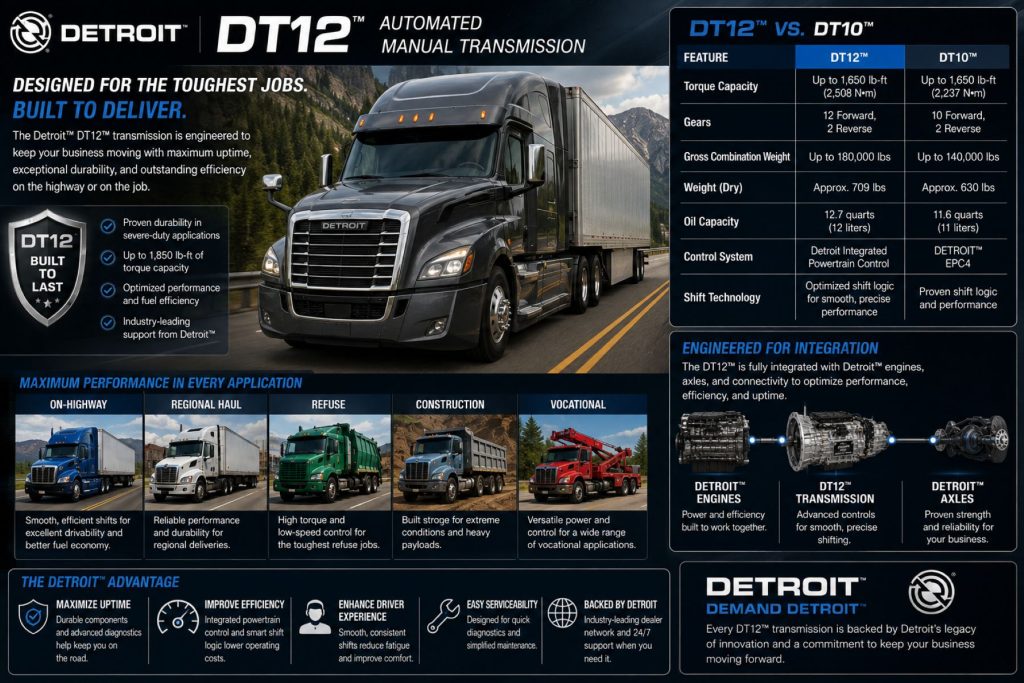
Highway and vocational DT12 versions serve different jobs. A transmission selected for regional or long-haul freight should not automatically be treated as suitable for severe-service work. Identify the exact variant and approved vehicle specification before comparing ratings.
Key Characteristics
- Automated clutch engagement and gear selection reduce the need for manual shifting.
- Electronic coordination links transmission decisions with engine operation and vehicle information.
- Twelve forward ratios provide gearing choices for launch, acceleration and cruising.
- Available operating modes and features depend on vehicle configuration and programming.
- A DT12 rating belongs to a specific model and application, not every transmission carrying the DT12 name.
How the Transmission Works
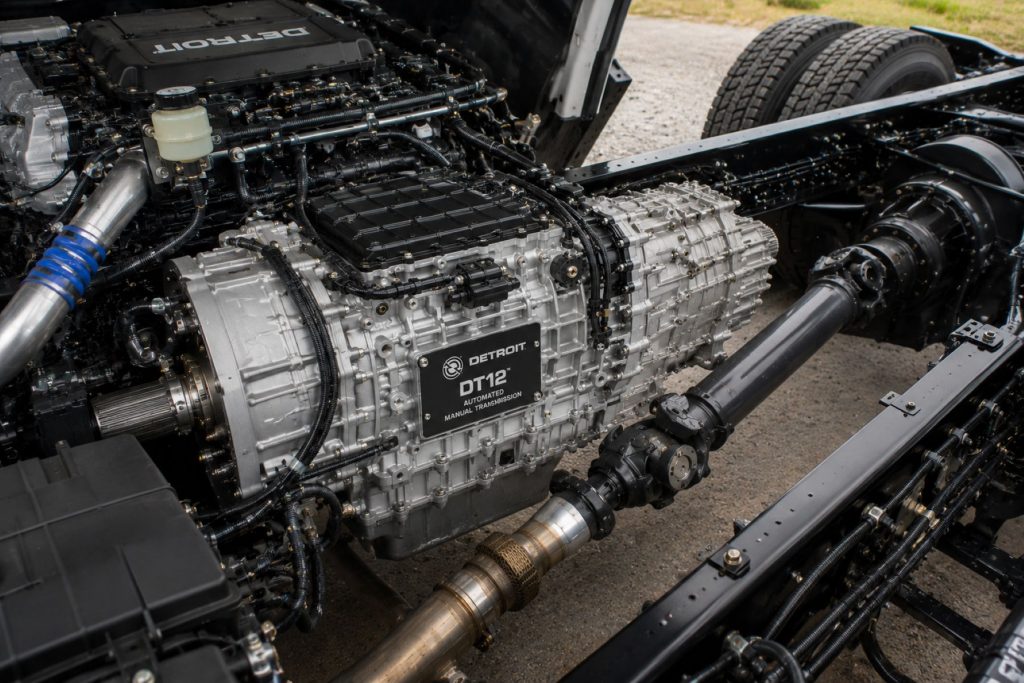
Engine torque passes through an automatically controlled clutch into the transmission gearing, then to the driveshaft and drive axles. The transmission controller coordinates clutch movement, gear engagement and engine torque during shifts. The controller handles the clutch and gear changes without a floor-mounted manual shift lever.
Automatic operation selects gears according to operating conditions. Manual requests may be available through the vehicle controls, but protective limits can prevent an unsuitable shift. Follow the truck’s operator manual for selecting direction, starting, stopping and using any special mode.
An AMT can interrupt drive torque while changing gears. Its launch and low-speed behavior differs from a torque-converter automatic; the comparison is explained in the transmission guides below.
Common Specifications
The following are published model ratings, not interchangeable limits for every DT12. Confirm the exact transmission, engine, chassis and application approval. Gross combination weight figures do not override the truck’s other component ratings or legal limits.
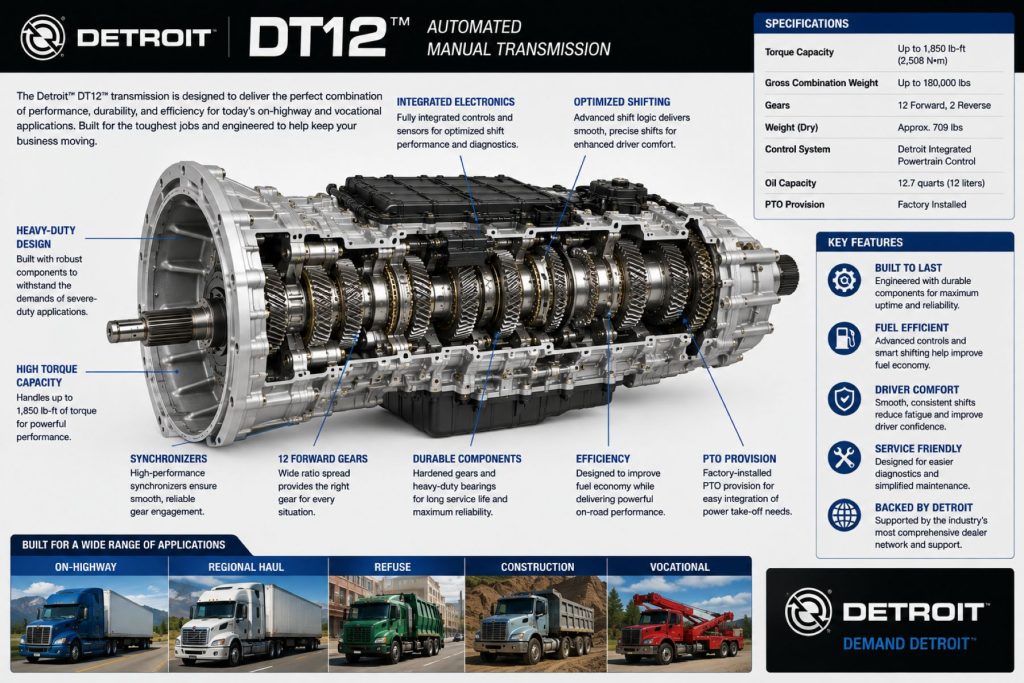
- DT12-HE: Up to 2,250 lb-ft input torque and 160,000 lb maximum gross combination weight rating in Detroit’s current highway sheet.
- DT12-HL: Up to 1,650 lb-ft and 80,000 lb; the current highway sheet lists the DD13 pairing.
- DT12-V: Up to 2,250 lb-ft and 140,000 lb; published ratios span 14.56–0.78 in overdrive form or 18.80–1.00 in direct-drive form.
- DT12-VX: Up to 2,500 lb-ft and 275,000 lb; published overdrive ratios span 12.79–0.78.
- DT12-VL: Up to 1,650 lb-ft and 80,000 lb; published ratios span 11.67–0.78 overdrive or 14.93–1.00 direct drive.
Detroit lists 12 forward and 4 reverse ratios for these families. The number of reverse ratios does not mean that every reverse speed is suitable for every load or maneuver.
Oil capacity, installed weight, dimensions, clutch specification and maintenance requirements must come from the exact unit’s documentation. Do not substitute specifications from another transmission family.
Sources: Detroit DT12 highway technical specification sheet and Detroit DT12 vocational specifications.
Common Applications
- Long-haul and regional freight tractors
- Distribution and other approved highway duty cycles
- Construction, dump and jobsite trucks using appropriate vocational versions
- Logging, oilfield and heavy-haul work within the specific vocational model’s approval
- PTO-equipped vocational trucks with a compatible transmission and upfit
Truck and Engine Compatibility
DT12 availability is tied to an approved Freightliner or Western Star chassis, engine, model year and build configuration. Highway use includes the Freightliner Cascadia; vocational offerings include appropriate Western Star 47X/49X and Freightliner Plus-series configurations.
Detroit lists DD13, DD15 and DD16 pairings across the family, with narrower compatibility on particular variants. This is not a universal retrofit transmission for trucks with Cummins, Caterpillar, PACCAR or Volvo engines.
Use the truck VIN and transmission identification to confirm fitment. Engine torque calibration, bellhousing and clutch, driveline, cooling, electronics, software, axle ratio and PTO installation all need to match the approved build.
Advantages
- Less routine shifting workload than a driver-shifted manual
- Coordinated engine and transmission control
- Different highway and vocational choices within one product family
- Potential for consistent gear selection across multiple drivers
- Application-specific features that can support highway efficiency or jobsite maneuvering
Limitations or Considerations
Automated operation does not remove the need for driver training. Low-speed clutch behavior, backing, grades, traction and special modes require familiarity with the actual truck.
Clutch wear, actuators, air supply, sensors, wiring and control software remain ownership considerations. Fuel economy and service life depend on the complete vehicle, duty cycle and maintenance; they should not be promised from the transmission name alone.
Driver and Operator Experience
Learn the installed selector, gear display, manual-request controls and warning messages before operating the truck. Use the correct mode for the work and follow the vehicle manual when changing direction.
Use the service brakes to hold the vehicle rather than balancing it on accelerator input and clutch slip. Follow manufacturer instructions for hill-start assistance, creeping, PTO engagement and recovery from low-traction conditions.
Maintenance and Ownership Notes
Identify the transmission model and follow the maintenance schedule for the vehicle’s actual work. Inspect for leaks and review lubricant requirements, clutch condition, air-system condition, wiring, connectors and stored fault information.
Use the Detroit-approved fluid specified for the exact unit. Do not substitute another transmission’s lubricant recommendations or apply one DT12 oil-change interval to every highway and vocational truck.
Have an authorized or appropriately equipped technician determine whether calibration, clutch adaptation, actuator repair or mechanical service is needed. Maintain service records and investigate a change in shift or launch behavior.
Common Transmission Problems
Symptoms that merit diagnosis include delayed engagement, harsh launches, repeated missed shifts, abnormal noises, leaks, overheating warnings or loss of available gears. These are symptoms to investigate, not evidence that every DT12 has a particular defect.
Diagnosis should consider clutch wear or calibration, actuator operation, air supply, electrical power and connections, sensor signals, lubrication and internal damage. Read fault information and follow the model-specific troubleshooting process before replacing major components.
Buying Considerations
- Verify the complete transmission model, serial identification and truck VIN.
- Confirm engine torque, working combination weight and approved duty cycle.
- Match launch gearing and top gear to axle ratios and tires.
- Check PTO provisions and the exact equipment requirements.
- Review service history, fault records and prior clutch or transmission work.
- Evaluate cold and warm engagement, backing and representative loaded operation with a qualified operator.
- Confirm parts support, warranty terms, repair scope and any required programming before purchase.
Variants and Configurations
Detroit’s current highway specification sheet identifies DT12-HE and DT12-HL. The vocational lineup includes DT12-V, DT12-VX and DT12-VL. Earlier DT12 builds and naming should be checked against their own documentation.
Features such as skip shifting, eCoast and Intelligent Powertrain Management depend on the truck and configuration. Vocational programming can include Off-Road, Rock-Free, Power Launch and Paver modes. Availability of one feature should not be assumed for every DT12.
Rear and bottom PTO support varies: Detroit lists rear/bottom capability for V and VX and rear-only capability for VL. The current HE highway sheet also lists rear/bottom provisions. Verify the build and upfit approval rather than assuming highway models cannot support PTO.
Comparison to Similar Equipment
Compare the DT12 with other automated manuals by examining approved truck and engine combinations, ratings, gearing, controls, service support and the actual application. Brand names or equal gear counts do not establish interchangeability.
A driver-shifted manual requires the operator to manage clutch and gear selection. A torque-converter automatic uses a different launch mechanism. The manual, AMT and automatic transmission comparison guide explains those distinctions.
Best Fit For
The DT12 is best evaluated as part of an approved Detroit-powered vehicle specification. Highway operators should compare cruising efficiency and route demands; vocational operators should assess launch conditions, maneuvering, working weight and PTO needs.
Choose the exact model that fits the job, supported by the vehicle manufacturer or application engineer.
Related Truck Types
Related Truck Models
Explore related chassis families. A general model page does not establish DT12 availability for every generation or engine option.
Related Engines
Related Transmission Types
Related Equipment Systems
- Clutch Systems
- Clutch Brakes
- Driveshafts
- Axles and Differentials
- Transmission Lubrication Systems
- Transmission Cooling Systems
- Range-Shift Air Systems
- Splitter Systems
- Gearshift Controls
- PTO Systems
Related Guides
Understand the operating principles in How Commercial Truck Transmissions Work, compare drivetrain designs in Manual vs Automated Manual vs Automatic Transmissions, and evaluate gearing, application, and compatibility in How to Choose a Commercial Truck Transmission.
Regulatory and Compliance Notes
Transmission capability does not establish the complete vehicle’s legal payload, towing limit or permitted gross combination weight. Observe the chassis and component ratings, applicable operating requirements and the vehicle’s approved specification.
Replacement programming and PTO work must preserve required vehicle, braking and safety functions. Confirm the correct installation and operating procedure with the vehicle and equipment manufacturers.
Real World Operating Notes
A highway specification and a jobsite specification can behave differently even when both carry the DT12 name. Axle ratio, tires, engine calibration, vehicle weight and software settings all influence the result.
When assessing a truck, include the work that matters: repeated starts, backing, grades, traffic and any PTO operation. Record specific symptoms or operating limitations so a dealer or technician can evaluate the actual configuration.
Frequently Asked Questions
Is the DT12 an automatic transmission?
It is an automated manual transmission. It shifts automatically and uses an automated clutch rather than a torque converter.
How many gears does it have?
Detroit lists 12 forward and 4 reverse ratios.
Does the driver operate a clutch pedal?
Normal DT12 operation uses two pedals: accelerator and brake. The transmission controls clutch operation.
Is every DT12 rated for 2,500 lb-ft?
No. That published maximum applies to the DT12-VX; other variants have lower ratings.
Can a DT12 operate a PTO?
Compatible configurations can. Mounting provisions, engagement conditions and equipment ratings must be confirmed for the exact build.
Does it fit any Class 8 truck?
No. The truck, engine, transmission hardware and electronic integration require an approved combination.
Which service interval should I use?
Use the maintenance information for the exact transmission and duty cycle. A general family-level description is not a service schedule.
Availability and Where to Find
Consult Freightliner, Western Star or Detroit service channels for new-vehicle availability, replacement units, service support and identification of older builds. For used or remanufactured units, verify the model, configuration, warranty, core terms and programming requirements.
Official technical resources:
- Detroit DT12 On-Highway
- Detroit DT12 Vocational
- Detroit DT12 On-Highway technical specification sheet
Support Trucking Families
Truck Equipment Atlas supports the mission of Grey Cross, a nonprofit dedicated to helping families of truck drivers who lose their lives while on the road. As the site grows, part of its mission is to bring awareness and support to these families.
Podcast or Video Section
Learn More Through Audio and Video
Truck Equipment Atlas will continue expanding with podcast episodes, interviews, and equipment breakdowns to help drivers and fleets better understand trucks and equipment.
Follow the Growth of Truck Equipment Atlas
Truck Equipment Atlas continues to expand with new truck profiles, trailer coverage, diesel engine pages, equipment system resources, manufacturer information, and educational guides.
Visit our Site Updates page to explore recent additions, project milestones, and upcoming resources as we continue building one of the industry’s growing commercial trucking equipment reference libraries.
View the Latest Site Updates: Truck Equipment Atlas Site Updates