
Hyundai Translead Reefer
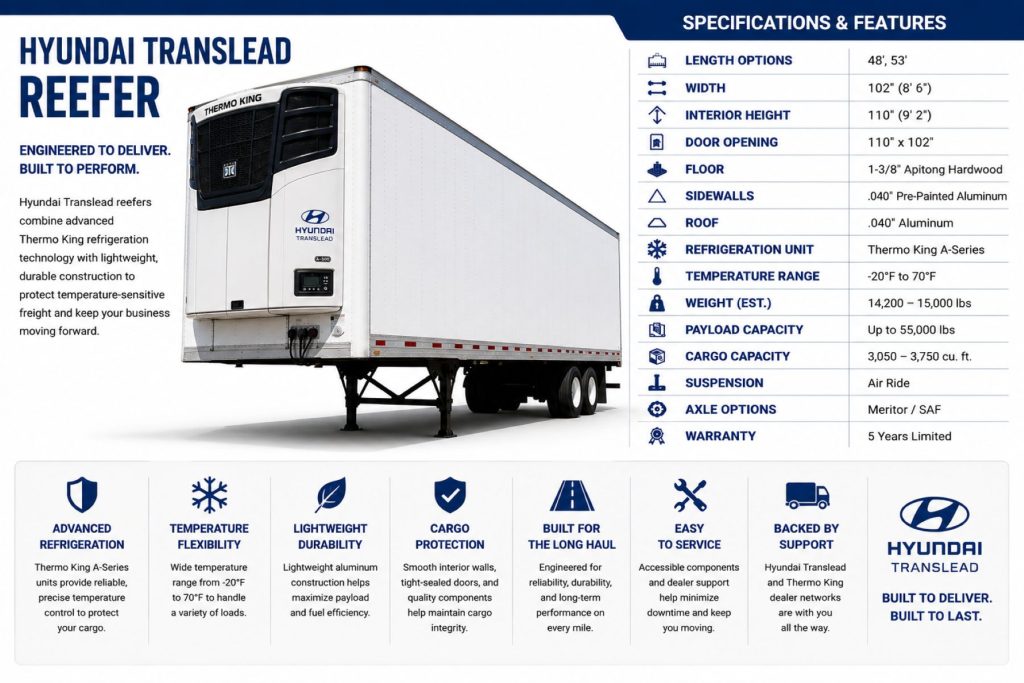
Quick Facts
- Manufacturer: Hyundai Translead
- Trailer Type: Refrigerated Trailer
- Model Name: ThermoTech
- Standard Trailer Length: 53 ft
- Exterior Width: Approximately 102.36 inches
- Exterior Height: Approximately 13 ft 6 in
- Interior Length: Approximately 52 ft 2 in
- Interior Width: Approximately 97.4 inches
- Interior Height: Approximately 105.5 inches
- Interior Volume: Approximately 3,722 cubic feet
- Typical GVWR: Approximately 68,000 lbs
- Standard Trailer Weight: Approximately 11,950 lbs excluding the refrigeration unit
- Standard Floor Rating: Approximately 20,000 lbs
- Common Axle Configuration: Tandem Axle Sliding Suspension
- Common Door Options: Rear Swing Doors, Roll-Up Doors, and Side Doors
- Insulation Type: Injected Urethane Foam Insulation
- Primary Applications: Temperature-Controlled Food, Produce, Frozen Products, Pharmaceuticals, Beverages, Floral Products, and Other Perishable Freight
- Production Status: Active Production
Overview
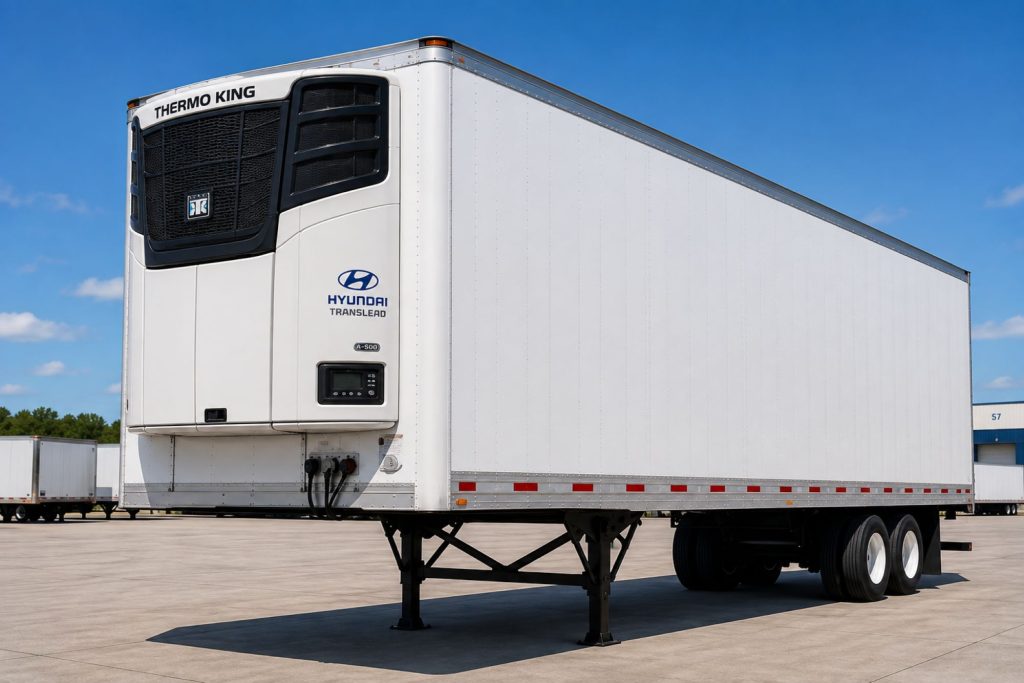
The Hyundai Translead ThermoTech is a commercial refrigerated trailer designed to transport temperature-sensitive freight across local, regional, and long-haul routes.
Common cargo includes fresh produce, frozen food, meat, dairy products, beverages, pharmaceuticals, floral products, and other commodities requiring controlled temperatures.
The ThermoTech combines an insulated trailer body with a nose-mounted refrigeration unit. Its insulation, door seals, floor design, airflow system, and refrigeration equipment work together to maintain cargo temperature throughout transportation.
Hyundai Translead designed the ThermoTech around reduced trailer weight, thermal efficiency, durability, customization, and long-term fleet operation.
The standard configuration is a 53 ft refrigerated trailer with approximately 3,722 cubic feet of interior volume and a 68,000-pound GVWR.
Key Characteristics
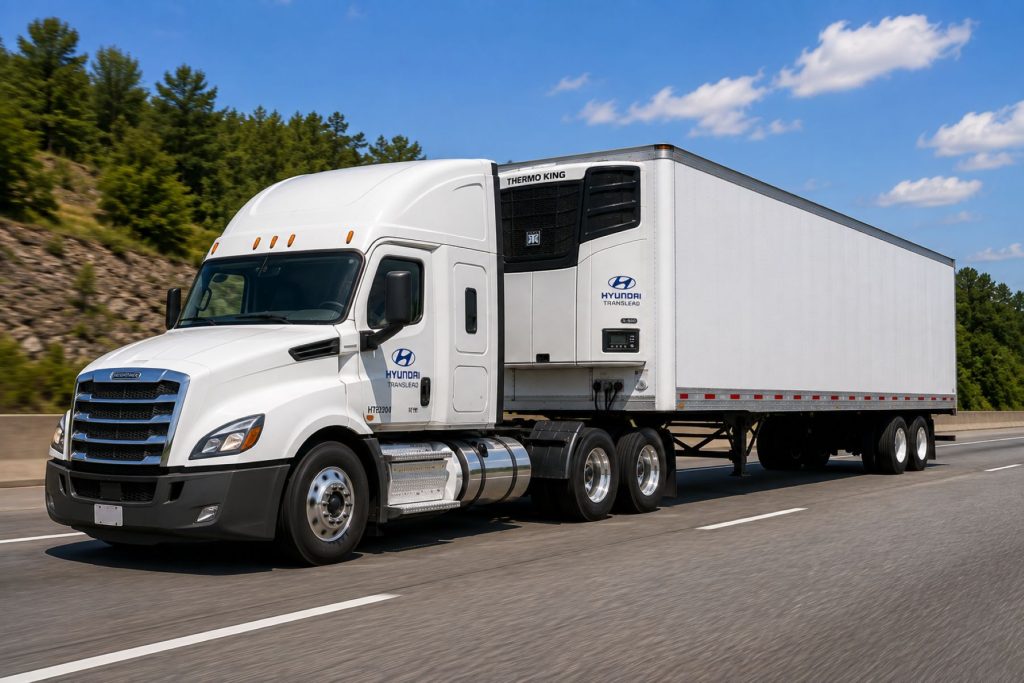
The Hyundai Translead ThermoTech is designed around thermal efficiency, cargo protection, reduced weight, and durability.
Its body uses injected urethane foam insulation and tightly sealed construction to reduce outside heat transfer. The roof, sidewalls, floor, doors, and front wall are insulated to support temperature-controlled freight.
Key characteristics include:
- Standard 53-foot trailer length
- Approximately 102.36-inch exterior width
- Approximately 13-foot-6-inch exterior height
- Approximately 3,722 cubic feet of interior volume
- Approximately 68,000-pound GVWR
- Approximately 20,000-pound floor rating
- Injected urethane foam insulation
- Insulated walls, floor, roof, front wall, and rear doors
- Nose-mounted refrigeration-unit compatibility
- Airflow channels for temperature distribution
- Tandem sliding suspension
- Rear swing-door availability
- Roll-up-door availability
- Side-door options
- Multi-temperature capability
- Air-disc-brake availability
- Automatic tire-inflation-system availability
- Aerodynamic side-skirt availability
- Hot-dipped galvanized components
- Stainless steel rear frame
Common Specifications
Trailer Length
The Hyundai Translead ThermoTech has a standard exterior length of approximately 53 feet.
Interior length is approximately 52 feet 2 inches. The difference accounts for the insulated front wall, rear doors, and structural components.
The 53 ft refrigerated trailer is commonly used for regional and long-haul temperature-controlled freight.
Width
Exterior width is approximately 102.36 inches.
Interior width is approximately 97.4 inches between the interior liners.
The insulated walls reduce interior width compared with many dry van trailers.
Height
Exterior height is approximately 13 feet 6 inches.
Interior height is approximately 105.5 inches.
Usable loading height can be affected by rear-door style, refrigeration ducts, interior bulkheads, floor design, and other installed equipment.
Interior Volume
The ThermoTech provides approximately 3,722 cubic feet of interior cargo volume.
Actual usable space depends on pallets, load bars, bulkheads, partitions, airflow requirements, and cargo placement.
Cargo must be loaded with sufficient space for refrigerated air to circulate around and through the load.
GVWR
The standard ThermoTech configuration has a GVWR of approximately 68,000 pounds.
The trailer’s legal payload is determined by the combined weight of the tractor, trailer, refrigeration unit, fuel, driver, accessories, and cargo.
The weight of the refrigeration unit and its fuel tank must be included when calculating available payload.
Standard Weight
The standard trailer body weighs approximately 11,950 pounds before the refrigeration unit is installed.
The complete empty weight increases after adding the refrigeration unit, fuel tank, aerodynamic equipment, tire-inflation system, cargo-control equipment, additional doors, liftgate, batteries, and other options.
Floor Rating
The standard floor rating is approximately 20,000 pounds.
The floor must support forklifts and other loading equipment entering the trailer. Operators should follow manufacturer loading procedures and avoid concentrated loads that exceed floor or crossmember ratings.
Sidewall Construction
The ThermoTech uses pre-painted aluminum exterior side sheets supported by extruded aluminum Z-shaped side posts.
Side-post spacing is designed to provide structural support while allowing insulation to be installed throughout the trailer walls.
Interior liners protect the insulated walls from cargo and loading damage.
Roof Construction
The roof uses a one-piece aluminum sheet with extruded aluminum roof bows.
Its design allows the roof to expand and contract while reducing the risk of insulation delamination or structural weakening.
The roof is insulated to reduce heat transfer and improve refrigeration efficiency.
Front Wall
The front wall includes a stainless steel impact plate, aluminum exterior sheets, insulation, and reinforced mounting provisions for a nose-mounted refrigeration unit.
The front wall is generally insulated more heavily than the sidewalls, floor, and roof because of the refrigeration-unit opening and increased exposure to airflow and vibration.
Rear Frame
The ThermoTech uses a stainless steel rear frame, including the corner posts, door header, hinge supports, and rear sill.
Stainless steel construction helps resist corrosion from moisture, temperature changes, road salt, wash chemicals, and refrigerated operating environments.
Rear Doors
Rear swing doors use insulated construction, aluminum frames, weather-resistant seals, hinges, and locking bars.
Roll-up doors may be installed for operations requiring access in locations with limited swing-door clearance.
Rear-door seals are critical to temperature retention. Damaged or compressed seals can cause air leakage, increased fuel use, temperature variation, and moisture entry.
Insulation
The ThermoTech uses injected urethane foam insulation.
Typical insulation thickness includes approximately two inches in the sidewalls, floor, and roof, three inches in the rear doors, and four inches in the front wall.
Actual insulation specifications can vary according to trailer configuration and intended temperature range.
Refrigeration Unit
The trailer is designed to support a commercial nose-mounted refrigeration unit.
The refrigeration unit maintains cargo temperature by cooling and circulating air throughout the trailer.
The refrigeration unit, fuel system, controls, electrical connections, sensors, and airflow equipment require separate maintenance from the trailer chassis.
Multi-Temperature Configuration
Optional partitions and airflow systems can divide the trailer into multiple temperature zones.
A multi-temperature configuration can transport frozen, refrigerated, and temperature-sensitive products in separate compartments.
Partitions reduce usable cargo space and add weight, but they improve flexibility for grocery, food-service, and mixed-temperature distribution.
Suspension and Axles
A tandem-axle sliding air-ride suspension is common.
The sliding tandem allows drivers to adjust axle position for cargo distribution, bridge-law compliance, maneuverability, and loading-dock access.
Tri-axle configurations may be available for applicable markets and operations.
More information is available through Suspension Systems and Axles and Differentials.
Braking System
Common configurations use commercial trailer air brakes with ABS.
Air-disc brakes may be available for fleets seeking different braking and maintenance characteristics.
Additional information is available through Brake Systems and Air Brake Systems Explained.
Aerodynamic Equipment
Available aerodynamic equipment includes side skirts and other drag-reduction components.
Aerodynamic equipment can help reduce tractor fuel consumption during highway operations.
More information is available through Aerodynamics and Fairings.
Common Applications
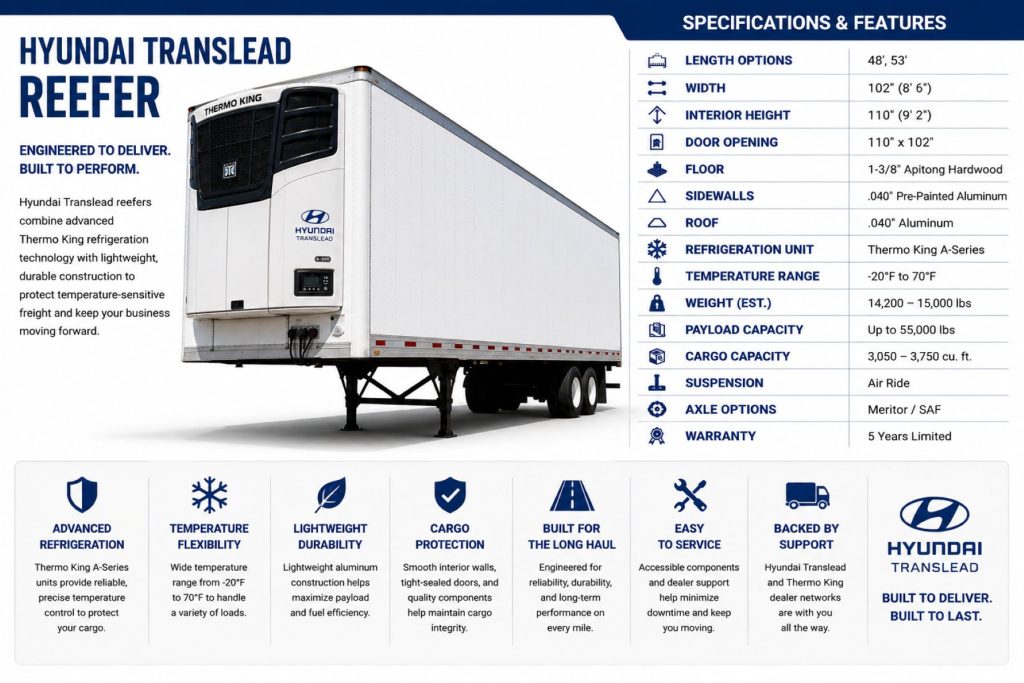
The Hyundai Translead ThermoTech is used for numerous temperature-controlled freight applications.
- Refrigerated Freight
- Fresh produce
- Frozen food
- Meat and poultry
- Dairy products
- Seafood
- Beverages
- Packaged foods
- Pharmaceuticals
- Medical products
- Floral products
- Temperature-sensitive chemicals
- Grocery distribution
- Food-service distribution
- Restaurant supplies
- Cold-storage distribution
- Multi-temperature freight
Temperature requirements vary significantly by commodity. Operators must confirm the correct set point, airflow, loading method, and sanitation procedure for each shipment.
Advantages
The Hyundai Translead ThermoTech offers several advantages for refrigerated carriers.
- Strong thermal efficiency
- Injected urethane foam insulation
- Lighter trailer-body construction
- Approximately 3,722 cubic feet of cargo volume
- Approximately 20,000-pound floor rating
- Stainless steel rear frame
- Hot-dipped galvanized components
- Protected air and electrical lines
- Multiple rear-door options
- Side-door availability
- Multi-temperature capability
- Air-disc-brake availability
- Automatic tire-inflation-system availability
- Aerodynamic side-skirt availability
- Factory customization
- Strong compatibility with temperature-sensitive freight
- Potentially reduced refrigeration-unit workload
- Broad suitability for regional and long-haul operations
Limitations or Considerations
The ThermoTech also has limitations and ownership considerations.
- Higher purchase cost than a standard dry van
- Additional refrigeration-unit maintenance
- Refrigeration fuel increases operating expenses
- Insulation reduces interior cargo dimensions
- Refrigeration equipment increases empty weight
- Insulation damage can reduce thermal efficiency
- Door-seal damage can cause air leakage
- Interior damage can expose insulation to moisture
- Multi-temperature equipment reduces available cargo space
- Washouts and sanitation require additional time and expense
- Temperature records may be required for some cargo
- Refrigeration-unit failure can cause cargo loss
- Aerodynamic equipment can be damaged by curbs and road debris
- Floor drains and interior seams require regular inspection
- Used reefers require careful evaluation for hidden moisture damage
Driver and Operator Considerations
Drivers operating a Hyundai Translead ThermoTech must manage both the trailer chassis and the refrigeration system.
Before loading, the trailer should be clean, dry, odor-free, and pre-cooled when required. The driver should verify the requested temperature, operating mode, fuel level, temperature sensors, airflow, and refrigeration-unit condition.
The refrigeration unit is intended primarily to maintain cargo temperature. It may not be capable of rapidly cooling products loaded above the required shipping temperature.
Cargo must be loaded to preserve airflow. Blocking return-air passages or loading freight against the ceiling can create temperature differences throughout the trailer.
Before departure, the driver should inspect the kingpin, landing gear, air lines, electrical connection, brakes, tires, wheels, suspension, lights, doors, seals, roof, sidewalls, refrigeration unit, fuel tank, and temperature display.
The driver should continue monitoring trailer temperature throughout the trip and respond promptly to alarms, warning lights, fuel problems, and unexpected temperature changes.
Maintenance and Ownership Notes
Refrigerated trailers require maintenance of both the trailer structure and the refrigeration system.
Routine maintenance should include:
- Refrigeration-unit service
- Refrigeration fuel-system inspection
- Temperature-sensor calibration
- Battery and charging-system testing
- Door-seal inspection
- Insulation inspection
- Interior-liner inspection
- Floor and drain inspection
- Air-chute and duct inspection
- Bulkhead and partition inspection
- Brake inspection and adjustment
- ABS warning-system inspection
- Tire-pressure and tread inspection
- Wheel-end and bearing service
- Suspension inspection
- Axle-alignment checks
- Landing-gear lubrication
- Kingpin and upper-coupler inspection
- Roof inspection
- Sidewall inspection
- Rear-frame inspection
- Lighting and electrical-system testing
- Automatic tire-inflation-system inspection when equipped
- Aerodynamic side-skirt inspection
Trailers should be checked for water intrusion, damaged insulation, broken interior liners, floor separation, mold, corrosion, and air leakage.
Refrigeration units should be serviced according to their engine hours and manufacturer schedules rather than trailer mileage alone.
Buying Considerations
Before purchasing a Hyundai Translead ThermoTech, buyers should determine the cargo temperatures, route lengths, loading methods, sanitation requirements, and refrigeration capabilities needed.
Important considerations include:
- Required temperature range
- Frozen or refrigerated cargo
- Single-temperature or multi-temperature operation
- Refrigeration-unit make and model
- Refrigeration-unit hours
- Trailer empty weight
- Expected payload
- Interior dimensions
- Floor rating
- Swing doors or roll-up door
- Side-door requirements
- Partition and bulkhead requirements
- Airflow system
- Suspension configuration
- Axle ratings
- Brake specifications
- Tire-inflation system
- Aerodynamic equipment
- Telematics and temperature monitoring
- Dealer and parts support
- Warranty coverage
- Used-trailer maintenance history
Buyers evaluating a used reefer should inspect the refrigeration unit, operating hours, fault-code history, insulation, interior liners, floor, roof, doors, seals, rear frame, suspension, brakes, tires, and electrical system.
Evidence of water intrusion, damaged insulation, inconsistent temperatures, excessive refrigeration-unit hours, or poorly completed body repairs can indicate significant future expenses.
Common Brands or Manufacturers
Hyundai Translead competes with several established refrigerated trailer manufacturers.
- Great Dane
- Utility Trailer Manufacturing Company
- Wabash
- Stoughton Trailers
- Vanguard National Trailer Corporation
- Manac
Variants and Related Configurations
The Hyundai Translead ThermoTech can be configured for different refrigerated operations.
Standard Tandem-Axle ThermoTech
The standard configuration uses a 53-foot insulated body with a tandem sliding suspension and nose-mounted refrigeration unit.
Swing-Door Configuration
Insulated rear swing doors provide a wide opening and strong sealing capability for loading-dock operations.
Roll-Up-Door Configuration
A roll-up rear door can improve access where swing-door clearance is limited. It may reduce usable opening height and requires additional track and seal maintenance.
Side-Door Configuration
Side doors can support food-service and multi-stop delivery operations. Steps and lift equipment may also be installed.
Multi-Temperature Configuration
Partitions divide the trailer into separate temperature zones for mixed refrigerated and frozen cargo.
Tri-Axle Configuration
Tri-axle configurations may be available for markets or applications requiring different weight distribution.
Liftgate Configuration
A liftgate can support deliveries to locations without loading docks. The liftgate, batteries, and supporting equipment increase empty weight and maintenance requirements.
Telematics-Equipped Configuration
Temperature sensors, door sensors, location tracking, and refrigeration-unit monitoring can provide fleets with real-time information about cargo conditions.
Comparison to Similar Trailers
The Hyundai Translead ThermoTech is commonly compared with the Great Dane Everest Refrigerated Trailer, Utility 3000R Refrigerated Trailer, and Wabash ArcticLite Refrigerated Trailer.
The upcoming Stoughton Reefer page will also represent a closely related competing model, but it will remain unlinked until that page is published.
Compared with a standard dry van trailer, the ThermoTech includes insulated construction and refrigeration-unit compatibility but provides less interior space and greater operating complexity.
Compared with other refrigerated trailers, the ThermoTech emphasizes reduced body weight, tighter seals, thermal efficiency, stainless steel rear-frame construction, and customization.
The best refrigerated trailer depends on thermal performance, empty weight, refrigeration-unit compatibility, dealer support, repair network, acquisition cost, and expected ownership period.
Best Fit For
- Refrigerated truckload carriers
- Regional refrigerated fleets
- Long-haul refrigerated carriers
- Grocery distributors
- Food-service companies
- Produce carriers
- Frozen-food distributors
- Meat and poultry transportation
- Dairy distribution
- Seafood transportation
- Pharmaceutical logistics
- Floral transportation
- Private food-distribution fleets
- Multi-temperature delivery operations
- Carriers prioritizing thermal efficiency
- Fleets seeking a lighter refrigerated trailer body
Related Equipment
- Refrigeration Units
- Brake Systems
- Suspension Systems
- Axles and Differentials
- Tires and Wheels
- Electrical Systems
- Aerodynamics and Fairings
- Telematics and ELD Systems
- Safety Systems
Related Freight Types
- Refrigerated Freight
- Dedicated Refrigerated Freight
- Regional Refrigerated Freight
- Long-Haul Refrigerated Freight
- Specialty and Niche Freight
Related Trailer Types
Related Trailer Models
- Great Dane Everest Refrigerated Trailer
- Utility 3000R Refrigerated Trailer
- Wabash ArcticLite Refrigerated Trailer
- Stoughton Reefer
Related Guides
- Refrigerated Freight Guide
- Dry Van vs Refrigerated Trailer
- Choosing the Right Trailer for Your Freight
Regulatory and Compliance Notes
The Hyundai Translead ThermoTech must comply with regulations governing commercial trailers, dimensions, axle weights, braking systems, lighting, tires, cargo securement, sanitation, food transportation, and temperature records.
Operators should monitor:
- Trailer GVWR
- Actual loaded trailer weight
- Gross combination weight
- Individual axle weights
- Sliding-tandem position
- Bridge-formula requirements
- Brake and ABS requirements
- Lighting and conspicuity requirements
- Tire and wheel ratings
- Cargo-securement requirements
- Trailer inspection requirements
- Rear-impact-guard condition
- Required cargo temperature
- Temperature-monitoring records
- Food-sanitation requirements
- Refrigeration-fuel levels
- Multi-temperature cargo separation
Carriers transporting human or animal food may be subject to additional sanitary transportation requirements. The trailer must be clean, suitable for the cargo, and capable of maintaining required temperatures.
Real World Operating Notes
In real-world operation, the Hyundai Translead ThermoTech depends on proper loading, airflow, insulation condition, door sealing, and refrigeration-unit maintenance.
The trailer should be pre-cooled when required before temperature-sensitive cargo is loaded. Product should enter the trailer at the correct shipping temperature because the refrigeration unit is intended primarily to maintain temperature.
Cargo should not block the return-air path or ceiling air chute. Proper airflow helps prevent warm zones, frozen areas, and inconsistent cargo temperatures.
Door openings should be kept as brief as practical because warm outside air and moisture enter the trailer whenever the doors are open.
Operators should monitor refrigeration-unit fuel carefully. Running out of fuel can cause temperature loss, shipment rejection, cargo claims, and expensive product damage.
Regular washouts and sanitation protect food safety, but the trailer should be dried properly to prevent trapped moisture, mold, corrosion, and insulation damage.
Frequently Asked Questions
What type of trailer is the Hyundai Translead ThermoTech?
The ThermoTech is a refrigerated trailer designed to transport temperature-sensitive freight.
How long is the Hyundai Translead ThermoTech?
The standard ThermoTech is approximately 53 feet long, with an interior length of approximately 52 feet 2 inches.
What is the GVWR of the ThermoTech?
The standard configuration has a GVWR of approximately 68,000 pounds.
How much does the ThermoTech weigh?
The standard trailer body weighs approximately 11,950 pounds before installation of the refrigeration unit and optional equipment.
What is the floor rating?
The standard floor rating is approximately 20,000 pounds.
What type of insulation does the ThermoTech use?
It uses injected urethane foam insulation in the sidewalls, roof, floor, front wall, and rear doors.
Can the ThermoTech carry frozen freight?
Yes. It can transport frozen products when equipped with an appropriate refrigeration unit and loaded according to temperature and airflow requirements.
Can the ThermoTech carry multiple temperature zones?
Yes. Optional partitions can create multiple compartments for frozen, refrigerated, and other temperature-sensitive products.
Does the ThermoTech include a refrigeration unit?
The trailer is designed for a nose-mounted refrigeration unit, but the published standard body weight excludes that unit. Refrigeration equipment is selected according to fleet requirements.
What is the difference between a reefer and a dry van?
A reefer uses insulation and a refrigeration unit to control cargo temperature. A dry van protects freight from weather but does not actively heat or cool the cargo.
Availability and Where to Find
New Hyundai Translead ThermoTech trailers are available through Hyundai Translead dealers, refrigerated-trailer distributors, fleet-purchasing programs, and commercial-equipment sales organizations.
Availability depends on production schedules, refrigeration-unit selection, door configuration, suspension, axles, brakes, tires, partitions, telematics, aerodynamic equipment, and other fleet-specific options.
Used ThermoTech trailers may be available through trailer dealers, fleet-retirement sales, leasing companies, auctions, and online commercial-trailer marketplaces.
When evaluating a used ThermoTech, buyers should inspect the refrigeration unit, operating hours, temperature history, insulation, roof, sidewalls, interior liners, floor, drains, doors, seals, rear frame, suspension, axles, brakes, tires, wheel ends, electrical system, and aerodynamic equipment.
Maintenance records, previous cargo, washout history, water intrusion, refrigeration-unit fault codes, temperature consistency, and evidence of body repairs should also be reviewed before purchase.
Support Trucking Families
Truck Equipment Atlas supports the mission of Grey Cross, a nonprofit dedicated to helping families of truck drivers who lose their lives while on the road. As the site grows, part of its mission is to bring awareness and support to these families.
Podcast or Video Section
Learn More Through Audio and Video
Truck Equipment Atlas will continue expanding with podcast episodes, interviews, and equipment breakdowns to help drivers and fleets better understand trucks and equipment.
Follow the Growth of Truck Equipment Atlas
Truck Equipment Atlas continues to expand with new truck profiles, trailer coverage, diesel engine pages, equipment system resources, manufacturer information, and educational guides.
Visit our Site Updates page to explore recent additions, project milestones, and upcoming resources as we continue building one of the industry’s growing commercial trucking equipment reference libraries.
View the Latest Site Updates: Truck Equipment Atlas Site Updates