
Volvo VNX
Quick Facts
- • Manufacturer: Volvo Trucks North America
• Truck Class: Class 8 Heavy-Haul and Specialized Transport Truck
• Common Configurations: Day Cab, Flat-Roof Sleeper, Mid-Roof Sleeper, Tandem Axle, Tridem Drive, Lift Axle Configurations
• Primary Applications: Heavy Haul, Oversized Loads, Construction Equipment Transport, Logging, Mining Support, Oilfield Operations, Specialized Freight
• Common Engine Options: Volvo D13, Cummins X15
• Typical Transmission Options: Volvo I-Shift Automated Manual, Volvo I-Shift with Crawler Gears, Eaton Fuller Manual
• Common Axle Setups: 6×4 Tandem, 8×4 Tandem, 8×6 Tridem, Lift Axle Configurations
• GCWR Range: Up to approximately 225,000 lbs depending on configuration and approval
• Front Axle Capacity: Approximately 16,500–20,000 lbs
• Rear Axle Capacity: Up to approximately 55,000 lbs depending on configuration
• Cab Style: Heavy-Haul Conventional Cab with Day Cab and Sleeper Options
• Production Status: Active Production
Overview
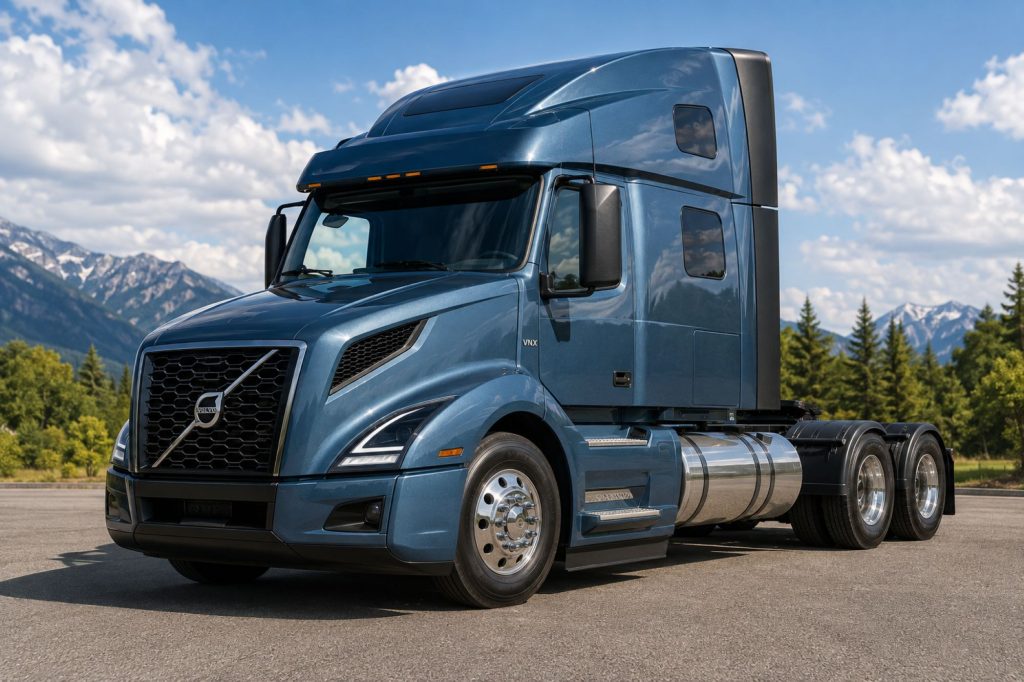
The Volvo VNX is a Class 8 heavy-haul truck platform developed for oversized loads, specialized freight, construction equipment transportation, logging, mining support, and other applications requiring greater pulling capacity than a standard highway tractor.
Built on Volvo’s conventional truck architecture, the VNX combines heavy-duty frame construction, high-capacity axles, powerful diesel engines, specialized gearing, reinforced towing equipment, and advanced driver-assistance systems.
Unlike the highway-focused Volvo VNL, the VNX is engineered specifically for operations involving extreme gross combination weights, steep grades, difficult terrain, and specialized trailers. Its available day cab and sleeper configurations allow the platform to serve both local and long-distance heavy-haul operations.
The VNX can be configured for gross combination weights reaching approximately 225,000 pounds, depending on the truck specification, operating conditions, and required approvals.
Key Characteristics
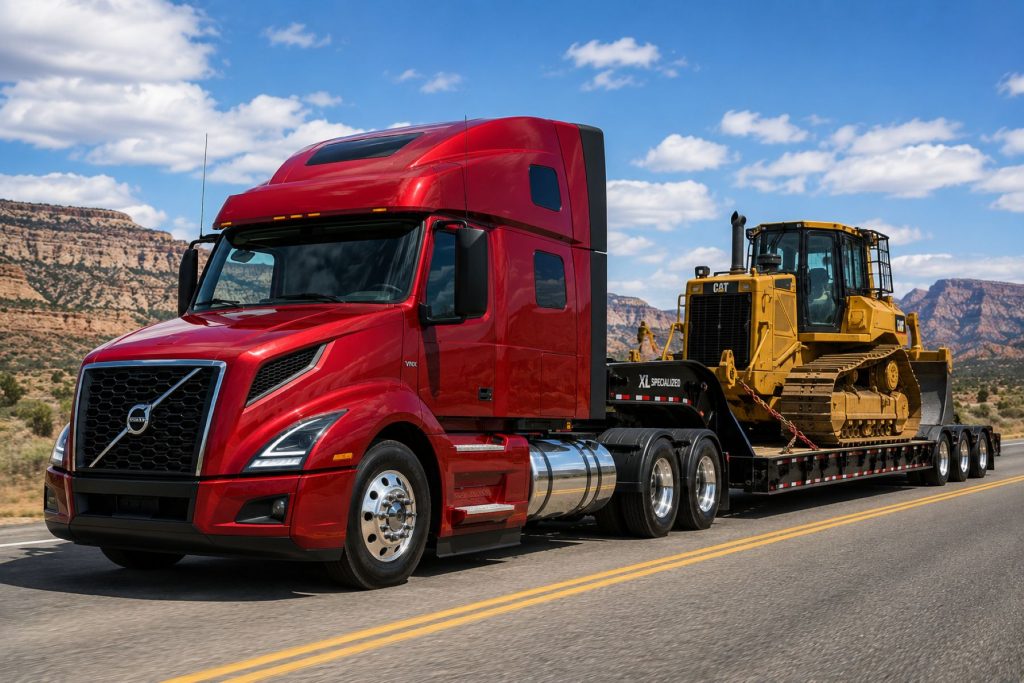
The Volvo VNX is distinguished by its reinforced chassis, high-capacity axles, heavy-duty suspension, specialized towing components, and drivetrain options designed for extreme loads.
Its frame rails are constructed from high-strength, heat-treated alloy steel with a yield strength of approximately 120,000 psi. Multiple frame heights, thicknesses, reinforcements, and liner combinations are available to match different heavy-haul requirements.
Heavy-duty front axles, drive axles, suspensions, brakes, fifth wheels, and towing equipment support applications that exceed normal highway freight weights. The truck can also be equipped with lift axles and tridem-drive configurations to improve weight distribution and traction.
Despite its severe-duty capability, the VNX retains Volvo’s emphasis on driver comfort, visibility, safety, cab construction, and integrated powertrain technology.
Common Specifications
Engine Options
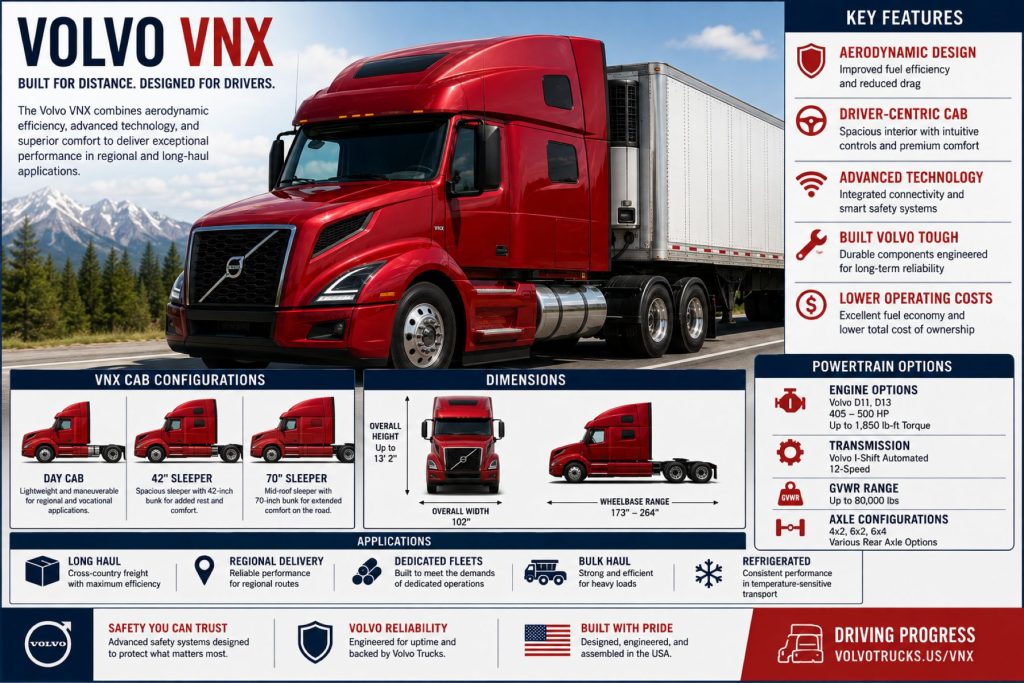
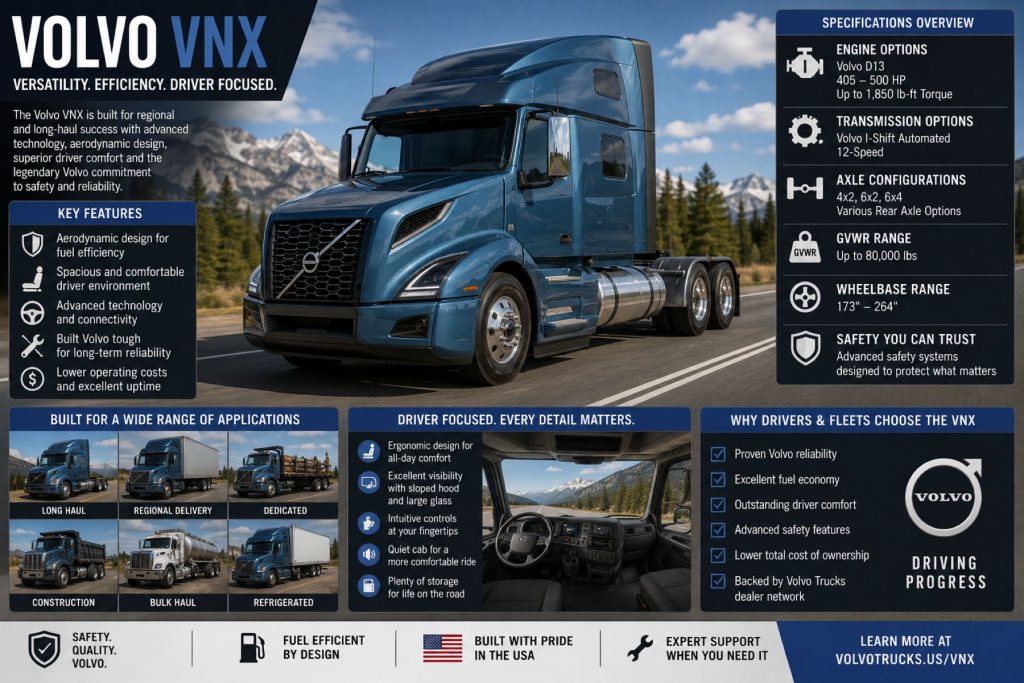
The Volvo VNX is commonly available with the Volvo D13 or Cummins X15, depending on horsepower requirements and truck configuration.
The Volvo D13 can provide up to approximately 500 horsepower and 1,850 lb-ft of torque in VNX applications.
The Cummins X15 can provide up to approximately 605 horsepower and 2,050 lb-ft of torque for demanding heavy-haul operations.
Engine availability and power ratings can vary according to production year, emissions requirements, drivetrain selection, and application.
Transmission Options
The Volvo I-Shift automated manual transmission is available for the VNX and is closely integrated with the Volvo D13 engine.
For maximum low-speed control, the truck can be equipped with Volvo I-Shift with Crawler Gears. The crawler-gear system provides additional low and ultra-low ratios for starting heavy loads on steep grades and maneuvering trailers at extremely low speeds.
Eaton Fuller manual transmissions may also be found in certain configurations and earlier model years, particularly when paired with the Cummins X15.
Axle Configurations
The VNX is available with several axle arrangements, including 6×4 tandem-drive, 8×4 tandem-drive, and 8×6 tridem-drive configurations.
Front steer axles are available with capacities ranging from approximately 16,500 to 20,000 pounds. Rear drive axles can be rated up to approximately 55,000 pounds, depending on configuration.
Lift axles may be added to improve weight distribution and help the truck comply with state and provincial axle-weight requirements.
Suspension Options
Heavy-duty rear suspension systems are available with capacities reaching approximately 52,000 pounds.
Suspension selection depends on gross vehicle weight, trailer type, axle configuration, terrain, ride requirements, and the amount of off-highway operation.
Fifth-Wheel Capacity
Heavy-duty fifth wheels can provide vertical load capacities of approximately 55,000 pounds or more and pull capacities of approximately 150,000 pounds or more.
Actual fifth-wheel selection must match the truck, trailer, kingpin, load, and intended gross combination weight.
Common Applications
- Heavy-haul transportation
- Oversized-load transportation
- Construction equipment hauling
- Lowboy and RGN operations
- Mining equipment transportation
- Logging operations
- Oilfield transportation
- Industrial equipment hauling
- Transformer and power-generation equipment transport
- Multi-axle specialized trailer operations
- Regional heavy haul
- Long-distance heavy haul
Advantages
- Gross combination ratings up to approximately 225,000 lbs
- Available power up to approximately 605 horsepower
- Available torque up to approximately 2,050 lb-ft
- Heavy-duty frame construction
- Multiple high-capacity axle configurations
- Tridem-drive availability
- Lift-axle compatibility
- Volvo I-Shift with Crawler Gears availability
- High-capacity fifth-wheel options
- Heavy-duty air-disc brakes
- Day cab and sleeper configurations
- Advanced driver-assistance technology
- Strong driver comfort for long-distance heavy haul
- Integrated Volvo powertrain systems
Limitations or Considerations
- Higher purchase cost than standard highway tractors
- Greater empty weight reduces available payload in some operations
- Lower fuel efficiency than standard highway trucks
- Long wheelbases reduce maneuverability
- Specialized components can increase maintenance costs
- Heavy-haul operations accelerate tire and brake wear
- Multi-axle configurations require careful weight management
- Certain repairs require heavy-duty service facilities
- Oversized loads require permits and route planning
- Some configurations may not be legal in every jurisdiction
- Drivers may require specialized heavy-haul experience
- Trailer and fifth-wheel ratings must match the intended load
Driver and Operator Experience
The Volvo VNX is designed to combine extreme heavy-haul capability with a driver environment suited to extended commercial operation.
Drivers benefit from Volvo’s cab visibility, ergonomic control placement, adjustable steering system, seating options, climate controls, storage, and available advanced safety systems. Sleeper configurations allow the VNX to support regional and long-distance heavy-haul routes where drivers may spend several nights away from home.
The I-Shift transmission reduces the amount of manual shifting required when moving heavy loads. Its electronic controls monitor grade, speed, engine load, vehicle weight, and operating conditions to select appropriate gears.
I-Shift with Crawler Gears is especially valuable when starting on steep grades, moving slowly through jobsites, positioning specialized trailers, or operating at extreme gross combination weights.
Although the VNX offers a more refined driver environment than many traditional heavy-haul trucks, its ride and handling still depend heavily on wheelbase, axle configuration, suspension, trailer type, and total vehicle weight.
Maintenance and Ownership Notes
Maintenance requirements for the Volvo VNX are influenced by gross combination weight, terrain, axle configuration, trailer type, and the amount of off-highway operation.
Heavy-haul trucks place significant stress on engines, transmissions, cooling systems, driveshafts, differentials, axles, suspensions, brakes, tires, fifth wheels, frame rails, and towing equipment.
Operators should inspect frame components, crossmembers, suspension mounts, fifth-wheel assemblies, driveline components, axle seals, wheel ends, braking systems, and tires regularly.
Trucks operating on construction sites, logging roads, mines, or oilfield locations may require more frequent service because of dust, mud, vibration, steep grades, and rough terrain.
Preventive maintenance is essential because a mechanical failure involving a specialized load can create significant towing, recovery, delay, and permit-related costs.
Buying Considerations
When purchasing or specifying a Volvo VNX, buyers should begin with the maximum expected gross combination weight, trailer configuration, route, terrain, and axle-weight requirements.
Important considerations include:
• Maximum gross combination weight
• Volvo D13 or Cummins X15 engine
• Required horsepower and torque
• I-Shift or manual transmission
• Crawler-gear requirements
• 6×4, 8×4, or 8×6 axle configuration
• Front and rear axle capacities
• Lift-axle requirements
• Suspension capacity
• Frame thickness and reinforcement
• Fifth-wheel load and pull ratings
• Wheelbase and turning requirements
• Day cab or sleeper configuration
• Cooling-system capacity
• Brake configuration
• Trailer type and kingpin requirements
• State and provincial weight laws
• Dealer support along primary routes
When purchasing a used VNX, buyers should review its previous operating weight, maintenance records, driveline condition, frame history, axle specifications, fifth-wheel rating, and emissions-system condition.
Variants and Configurations
• VNX 300: Day cab for local and regional heavy-haul operations
• VNX 400: Flat-roof 42-inch sleeper for regional heavy haul
• VNX 740: Mid-roof 70-inch sleeper for long-distance heavy haul
• 6×4 tandem-drive configuration
• 8×4 tandem-drive configuration
• 8×6 tridem-drive configuration
• Lift-axle configuration
• Volvo D13 powertrain configuration
• Cummins X15 powertrain configuration
• I-Shift with Crawler Gears configuration
• Multi-axle specialized transport configuration
Comparison to Similar Trucks
The Volvo VNX is commonly compared with heavy-haul trucks such as the Kenworth C500, Western Star 6900XD, International HX Series, Freightliner 122SD, and Peterbilt 389.
Compared with traditional heavy-haul platforms, the VNX places greater emphasis on integrated powertrain technology, automated shifting, advanced safety systems, driver comfort, and long-distance operating efficiency.
The Kenworth C500 and Western Star 6900XD are often configured for more extreme off-road and severe-service applications. The VNX is especially well suited for operators who need high gross combination ratings while spending substantial time on paved highways.
Compared with the standard Volvo VNL, the VNX offers heavier frame, axle, suspension, braking, fifth-wheel, towing, and drivetrain configurations intended for specialized transportation.
Best Fit For
- Heavy-haul carriers
- Oversized-load specialists
- Construction equipment transporters
- Mining equipment haulers
- Logging companies
- Oilfield transportation fleets
- Industrial machinery movers
- Utility and transformer transporters
- Regional heavy-haul operators
- Long-distance specialized carriers
- Fleets requiring tridem-drive configurations
- Operators prioritizing integrated safety and driver comfort
Regulatory and Compliance Notes
The Volvo VNX must comply with federal, state, provincial, and local regulations governing commercial vehicle weight, axle capacity, axle spacing, vehicle dimensions, emissions, braking systems, and specialized transportation.
Loads exceeding legal weight or dimensional limits may require oversize or overweight permits, approved routes, escort vehicles, warning signs, flags, lighting, restricted travel times, and additional insurance.
Gross combination ratings do not automatically establish the legal weight allowed on public roads. Legal operating weight depends on axle spacing, tire ratings, bridge formulas, permits, road restrictions, and the laws of each jurisdiction.
Operators must confirm that the truck, engine, transmission, frame, axles, suspension, tires, wheels, fifth wheel, trailer, kingpin, and load-securing equipment are properly rated for the intended operation.
Real World Operating Notes
In real-world heavy-haul service, the Volvo VNX is valued for its combination of pulling capacity, low-speed control, highway comfort, visibility, and integrated safety technology.
The truck is particularly effective for operations that move extreme loads over long distances but still require controlled maneuvering at construction sites, mines, industrial facilities, and equipment yards.
Drivers commonly benefit from the I-Shift transmission when operating across changing grades and load conditions. Crawler gears help with controlled starts and precise trailer positioning without requiring excessive clutch slip.
Successful VNX operation depends heavily on proper specification. Engine power alone does not determine heavy-haul performance. Axle ratios, transmission gearing, cooling capacity, frame strength, suspension ratings, tire capacity, fifth-wheel ratings, trailer configuration, and route conditions must all work together.
Related Truck Types
• Heavy Haul Trucks
• Sleeper Trucks
• Day Cab Trucks
• Vocational Trucks
Related Freight Types
• Heavy Haul Freight
• Construction & Aggregate Freight
• Logging & Forestry Freight
• Specialized & Niche Freight
• Flatbed Freight
Related Trailer Types
• Lowboy / RGN Trailers
• Flatbed Trailers
• Step Deck Trailers
• Extendable Trailers
• Specialty Trailers
Related Equipment Systems
• Engines
• Transmissions
• Axles & Differentials
• Suspension Systems
• Brake Systems
• Fifth Wheel Systems
• Tires & Wheels
• Safety Systems
Related Guides
• Heavy Haul Freight Guide
• Oversize Load Transportation Guide
• Lift Axles Explained
Frequently Asked Questions
What is the Volvo VNX designed for?
The Volvo VNX is designed for heavy-haul, oversized-load, logging, mining, oilfield, construction equipment, and specialized transportation applications.
How much horsepower does the Volvo VNX offer?
Depending on engine selection and configuration, the VNX can provide up to approximately 605 horsepower.
How much torque does the Volvo VNX offer?
The VNX can provide up to approximately 2,050 lb-ft of torque when equipped with the appropriate Cummins X15 rating.
What is the maximum gross combination weight of the Volvo VNX?
Properly configured VNX trucks may be approved for gross combination weights reaching approximately 225,000 pounds. Actual legal operating weight depends on configuration, permits, and jurisdiction.
Is the Volvo VNX available with a sleeper?
Yes. The VNX 400 offers a flat-roof 42-inch sleeper, while the VNX 740 provides a mid-roof 70-inch sleeper for long-distance heavy-haul operations.
What axle configurations are available?
Common VNX axle arrangements include 6×4 tandem, 8×4 tandem, and 8×6 tridem-drive configurations.
Availability and Where to Find
The Volvo VNX is available through authorized Volvo Trucks dealerships and specialized heavy-haul equipment distributors.
New trucks are normally ordered according to the buyer’s required gross combination weight, engine, transmission, axle arrangement, frame reinforcement, suspension, wheelbase, fifth wheel, sleeper, and trailer configuration.
Used Volvo VNX trucks can be found through Volvo dealerships, heavy-haul truck dealers, commercial equipment brokers, fleet resellers, auctions, and online truck marketplaces.
Because VNX specifications vary significantly, buyers should verify the truck’s original build information and component ratings before determining whether it is suitable for a particular heavy-haul operation.
Support Trucking Families
Truck Equipment Atlas supports the mission of Grey Cross, a nonprofit dedicated to helping families of truck drivers who lose their lives while on the road. As the site grows, part of its mission is to bring awareness and support to these families.
Podcast or Video Section
Learn More Through Audio and Video
Truck Equipment Atlas will continue expanding with podcast episodes, interviews, and equipment breakdowns to help drivers and fleets better understand trucks and equipment.
Follow the Growth of Truck Equipment Atlas
Truck Equipment Atlas continues to expand with new truck profiles, trailer coverage, diesel engine pages, equipment system resources, manufacturer information, and educational guides.
Visit our Site Updates page to explore recent additions, project milestones, and upcoming resources as we continue building one of the industry’s growing commercial trucking equipment reference libraries.
View the Latest Site Updates: Truck Equipment Atlas Site Updates