
Flatbed vs Step Deck vs Double Drop: Which Trailer Is Right for Your Freight?
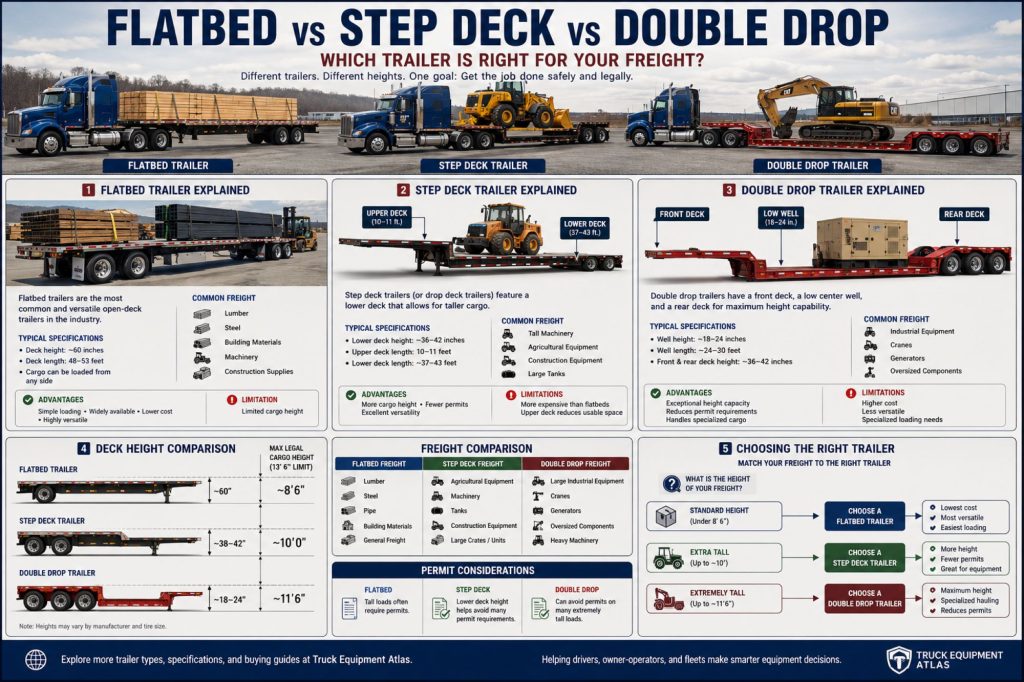
Choosing the right trailer is one of the most important decisions in open-deck freight transportation. While Flatbed Trailers, Step Deck Trailers, and Double Drop Trailers may appear similar at first glance, each one is designed for different cargo dimensions, loading needs, height restrictions, and freight applications.
The biggest difference between these trailer types is deck height. Deck height affects how tall the freight can be while remaining within legal height limits. Using the wrong trailer can lead to unnecessary permits, loading problems, higher costs, or freight that cannot legally move without specialized routing.
This guide explains the differences between flatbed, step deck, and double drop trailers, including common freight, advantages, limitations, deck height differences, and how to choose the right trailer for your operation.
Why Trailer Deck Height Matters
Deck height is one of the most important factors when choosing between a flatbed, step deck, or double drop trailer.
Most highway freight must stay within legal height limits. In many areas, the standard maximum legal height is around 13 feet 6 inches, although rules can vary by state, route, and load type.
The lower the trailer deck sits, the taller the freight can be while staying within legal limits.
This is why tall machinery, construction equipment, tanks, and industrial components often require step deck or double drop trailers instead of standard flatbeds.
Quick Comparison
| Trailer Type | Best For | Main Advantage | Main Limitation |
|---|---|---|---|
| Flatbed Trailers | General open-deck freight | Maximum versatility | Limited cargo height |
| Step Deck Trailers | Taller freight and machinery | Lower deck height | Less deck flexibility |
| Double Drop Trailers | Extremely tall oversized freight | Very low center well | Specialized use |
What Is a Flatbed Trailer?
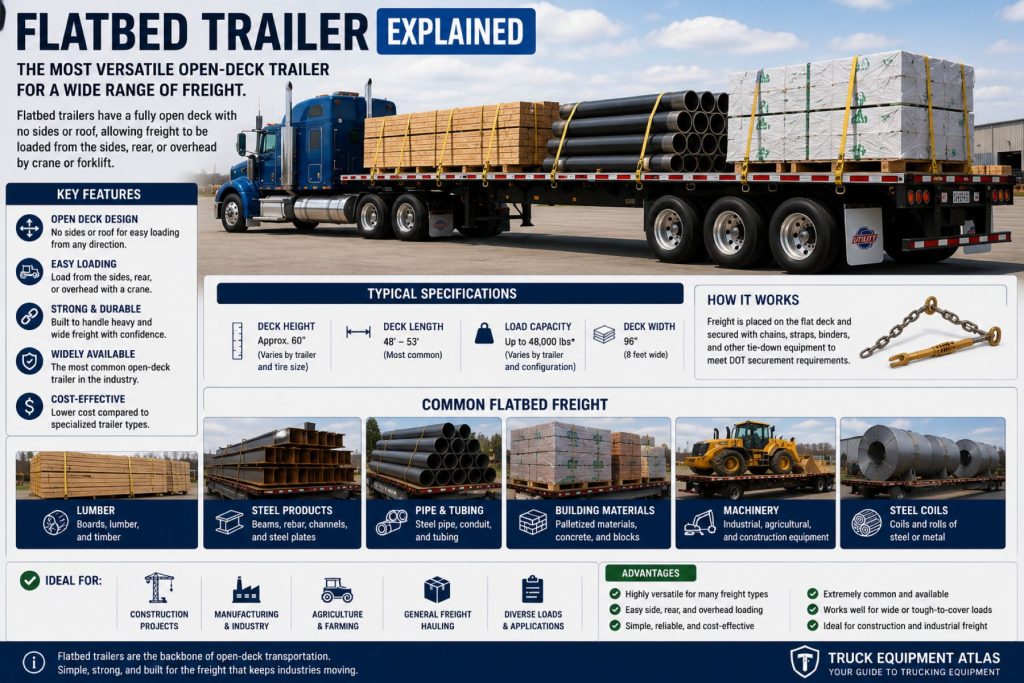
A Flatbed Trailer is one of the most common and versatile trailer types in commercial trucking. It has a flat, open deck with no permanent roof or side walls, allowing freight to be loaded from the sides, rear, or overhead by crane.
Flatbeds are commonly used when freight does not require enclosed protection and can be secured with chains, straps, binders, tarps, or other cargo securement equipment.
Common Flatbed Freight
Flatbed trailers are commonly used to haul:
- Lumber
- Steel coils
- Steel beams
- Pipe
- Building materials
- Palletized construction supplies
- Machinery
- Farm equipment
- Concrete products
Advantages of Flatbed Trailers
Flatbeds are popular because they are simple, widely available, and highly versatile.
Key advantages include:
- Easy side loading
- Easy overhead loading
- Broad freight compatibility
- Lower cost compared to specialized trailers
- Strong availability across the freight market
- Useful for construction, manufacturing, and industrial freight
Limitations of Flatbed Trailers
The main limitation of a flatbed trailer is cargo height.
Because the deck sits higher than a step deck or double drop, taller freight may exceed legal height limits. When that happens, the load may require permits, route planning, or a different trailer.
Flatbeds also offer no built-in weather protection, so some freight may require tarping.
Best Fit For
A flatbed trailer is usually the best choice when freight is not too tall, does not require enclosed protection, and can be safely loaded onto a standard open deck.
What Is a Step Deck Trailer?
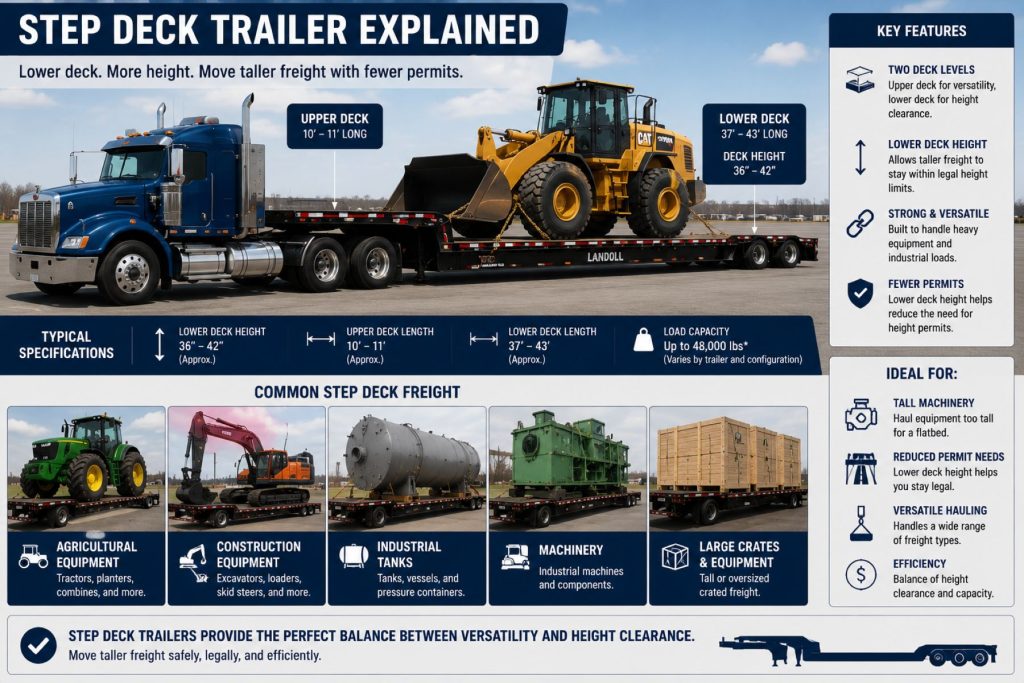
A Step Deck Trailer, also called a drop deck trailer, is an open-deck trailer with two deck levels. It has a short upper deck near the front and a longer lower deck behind it.
The lower rear deck sits closer to the ground than a standard flatbed, allowing the trailer to carry taller freight while staying within legal height limits.
Common Step Deck Freight
Step deck trailers are commonly used for:
- Tall machinery
- Agricultural equipment
- Construction equipment
- Skid steers
- Small excavators
- Industrial tanks
- Large crates
- Equipment with extra height
Advantages of Step Deck Trailers
Step decks are useful when freight is too tall for a standard flatbed but does not require the extremely low deck height of a double drop or lowboy.
Key advantages include:
- Lower deck height than flatbeds
- Better cargo height clearance
- Useful for machinery and equipment
- Can reduce permit requirements
- More versatile than many specialized trailers
Limitations of Step Deck Trailers
Step deck trailers are less flexible than flatbeds because the deck is split into upper and lower sections. Freight must fit properly across the available deck areas.
They may also cost more to purchase or operate than standard flatbeds.
Best Fit For
A step deck trailer is usually the best choice when freight is too tall for a flatbed but still fits on a standard lower deck without needing a deeper well section.
What Is a Double Drop Trailer?
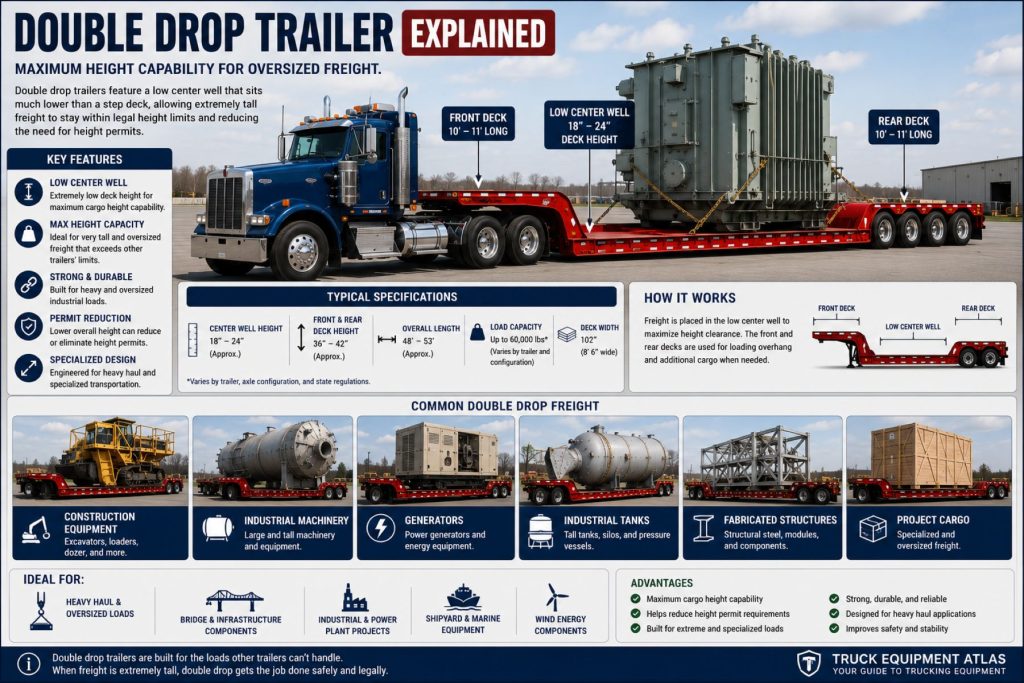
A Double Drop Trailer is an open-deck trailer designed for tall and oversized freight. It has three deck sections: a front deck, a low center well, and a rear deck.
The center well sits much lower than both a flatbed and a step deck, making double drop trailers ideal for cargo that would otherwise exceed legal height limits.
Common Double Drop Freight
Double drop trailers are commonly used to haul:
- Tall industrial machinery
- Large construction equipment
- Generators
- Fabricated structures
- Oversized tanks
- Cranes
- Large manufacturing components
- Specialty project cargo
Advantages of Double Drop Trailers
The biggest advantage of a double drop trailer is its low center well.
Key advantages include:
- Maximum cargo height capability
- Useful for oversized freight
- Can reduce or avoid height permits
- Designed for specialized industrial loads
- Handles cargo that flatbeds and step decks cannot
Limitations of Double Drop Trailers
Double drops are more specialized than flatbeds or step decks. They are usually more expensive, less available, and less flexible for general freight.
The center well also limits usable deck length, meaning freight must fit within the well section or be properly supported across multiple deck areas.
Best Fit For
A double drop trailer is usually the best choice when freight is extremely tall and cannot legally or safely move on a flatbed or step deck.
Deck Height Comparison
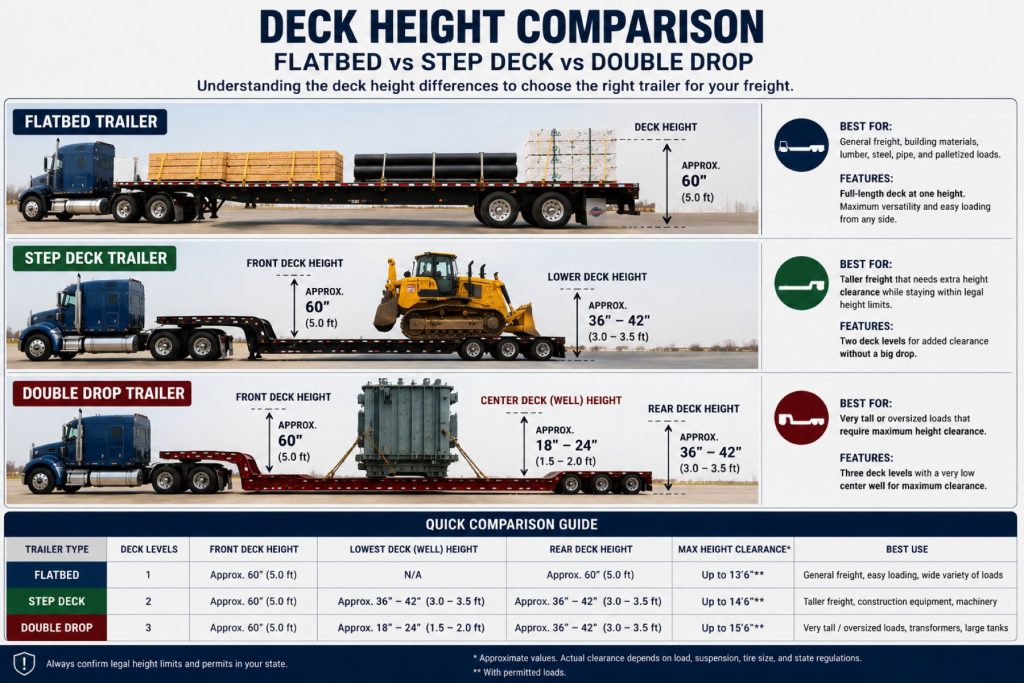
Deck height is the main difference between these three trailer types.
| Trailer Type | Approximate Deck Height | Common Cargo Height Advantage |
|---|---|---|
| Flatbed Trailer | Around 60 inches | Best for standard-height open-deck freight |
| Step Deck Trailer | Around 36–42 inches on lower deck | Allows taller cargo than a flatbed |
| Double Drop Trailer | Around 18–24 inches in center well | Allows extremely tall cargo |
These measurements can vary depending on trailer manufacturer, tire size, suspension, and configuration.
Freight Comparison
Each trailer type works best for different freight needs.
Flatbed Freight
Flatbeds are best for standard open-deck freight that does not exceed height limits.
Common examples include:
- Lumber
- Steel
- Pipe
- Palletized materials
- Construction supplies
Step Deck Freight
Step decks are best for freight that needs more vertical clearance.
Common examples include:
- Tall machinery
- Agricultural equipment
- Construction equipment
- Large tanks
- Crated equipment
Double Drop Freight
Double drops are best for very tall or oversized freight.
Common examples include:
- Industrial equipment
- Oversized machinery
- Large generators
- Specialty manufacturing components
- Project cargo
Permit Considerations
Trailer choice can directly affect whether permits are required.
Flatbed Permit Considerations
Flatbeds may require permits when cargo exceeds legal height, width, length, or weight limits.
Tall freight is the most common reason a load may need a different trailer.
Step Deck Permit Considerations
Step decks often reduce height-related permit issues because the lower deck provides additional clearance.
However, wide, long, or overweight freight may still require permits.
Double Drop Permit Considerations
Double drops are frequently used to reduce overall load height, but they are still common in oversize and heavy-haul operations where permits may be required.
Loading Considerations
Loading method is another major difference between these trailer types.
Flatbed Loading
Flatbeds are the easiest of the three to load because freight can be placed from the side, rear, or overhead.
Step Deck Loading
Step decks may require ramps or careful placement depending on the cargo. Freight must be positioned correctly between the upper and lower deck.
Double Drop Loading
Double drops often require more planning. Some loads may require cranes, forklifts, ramps, or specialized loading areas.
Cost Comparison
| Category | Flatbed | Step Deck | Double Drop |
|---|---|---|---|
| Purchase Cost | Lowest | Moderate | Highest |
| Availability | Highest | Good | More limited |
| Freight Flexibility | Highest | High | Specialized |
| Cargo Height Capability | Lowest | Higher | Highest |
| General Freight Use | Excellent | Good | Limited |
| Specialized Freight Use | Moderate | High | Very high |
Flatbeds are usually the most affordable and versatile. Step decks offer a balance between versatility and height clearance. Double drops are the most specialized of the three.
Which Trailer Should You Choose?
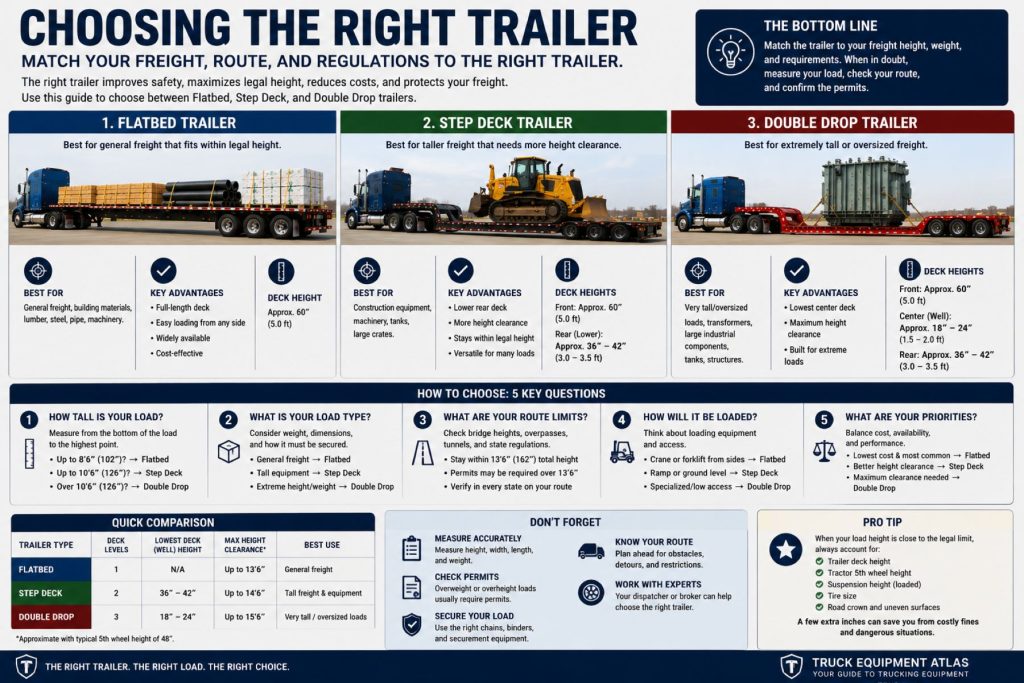
The best trailer depends on freight height, weight, loading method, and route requirements.
Choose a Flatbed Trailer If:
A flatbed is usually the best choice if:
- Freight is standard height
- Cargo does not need enclosed protection
- Side loading is needed
- Maximum trailer availability matters
- Cost efficiency is important
Choose a Step Deck Trailer If:
A step deck is usually the best choice if:
- Freight is too tall for a flatbed
- Machinery or equipment is being hauled
- You want to reduce permit issues
- You still need open-deck flexibility
Choose a Double Drop Trailer If:
A double drop is usually the best choice if:
- Freight is extremely tall
- Cargo requires a very low deck
- Oversized machinery is being moved
- Specialized industrial transportation is required
Common Mistakes When Choosing a Trailer
Focusing Only on Weight
Weight matters, but height, length, and loading method are just as important.
Ignoring Route Restrictions
Bridges, power lines, turns, and state regulations can affect trailer selection.
Assuming All Open-Deck Trailers Are the Same
Flatbeds, step decks, and double drops serve different purposes.
Choosing the Cheapest Trailer
The cheapest trailer is not always the best trailer. The wrong equipment can create delays, permit costs, or unsafe loading conditions.
Frequently Asked Questions
Is a step deck the same as a drop deck?
Yes. Step deck and drop deck are commonly used to describe the same trailer type.
What is the difference between a step deck and a double drop?
A step deck has an upper deck and a lower deck. A double drop has a front deck, a very low center well, and a rear deck.
Which trailer is best for heavy equipment?
It depends on the equipment dimensions. Many machines can move on a step deck, while taller or larger machines may require a double drop, Lowboy Trailer, or RGN Trailer.
Can a flatbed haul tall equipment?
Yes, but if the load exceeds legal height limits, permits may be required or a lower trailer may be needed.
Which trailer is the most versatile?
Flatbed trailers are generally the most versatile open-deck trailers.
Which trailer has the lowest deck height?
Double drop trailers have a much lower center well than standard flatbeds or step decks.
Related Trailer Types
Related Freight Types
- Heavy Haul Freight
- Construction Freight
- Machinery Freight
- Oversized Freight
Related Guides
- How to Choose the Right Commercial Trailer
- Complete Guide to Trailer Types
- Complete Guide to Freight Types
Final Thoughts
Flatbed, step deck, and double drop trailers all play important roles in open-deck freight transportation. Flatbeds provide maximum versatility for standard freight, step decks offer additional cargo height clearance, and double drops provide the low deck height needed for extremely tall and specialized loads.
Understanding the differences between these trailer types helps carriers, shippers, owner-operators, and equipment buyers choose the right trailer for each freight application. The right trailer can improve safety, reduce costs, avoid unnecessary permits, and make transportation operations more efficient.