
MAC Tank Trailer
Quick Facts
- Manufacturer: MAC Trailer
- Trailer Type: Tank Trailer
- Model: MAC Tank Trailer
- Common Lengths: 40 ft to 53 ft
- Common Width: 102 inches
- Trailer Construction: Aluminum or Stainless Steel Tank Construction
- Common Axle Configurations: Tandem Axle, Tri-Axle, Spread Axle
- Tank Capacities: Approximately 5,000 to 11,600+ Gallons
- Tank Shape: Elliptical, Round, Barrel, and Specialized Configurations
- Primary Applications: Petroleum, Chemical, Food Grade, Agricultural, and Industrial Liquid Transportation
- Common Freight Types: Gasoline, Diesel Fuel, Aviation Fuel, Chemicals, Milk, Food Products, Liquid Fertilizer
- Compartment Options: Single Compartment or Multi-Compartment Designs
- Loading Method: Top Load, Bottom Load, or Combination Systems
- Unloading Method: Gravity, Pump, Air, or Specialized Discharge Systems
- Production Status: In Production
Overview
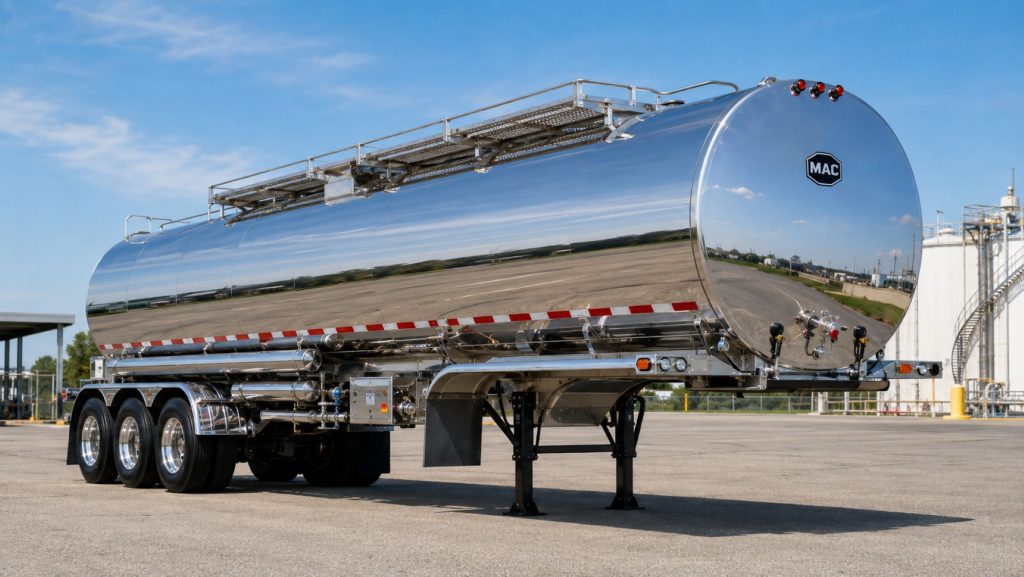
MAC Trailer is one of North America’s leading trailer manufacturers and is widely recognized for producing durable, high-quality transportation equipment across multiple trailer categories. Its tank trailer division serves petroleum, chemical, agricultural, food-grade, and industrial liquid transportation markets.
MAC tank trailers are designed to provide a balance of durability, payload capacity, corrosion resistance, and operational efficiency. The company’s focus on engineering, quality manufacturing, and customer support has helped establish a strong reputation throughout the trucking industry.
Available in multiple tank configurations, capacities, and construction materials, MAC tank trailers can be tailored to meet a wide variety of hauling requirements. Their versatility makes them a popular choice for private fleets, fuel distributors, chemical carriers, agricultural operators, and specialized transportation companies.
Many operators choose MAC because of the company’s long-standing reputation for producing rugged equipment capable of handling demanding real-world operating conditions.
Key Characteristics
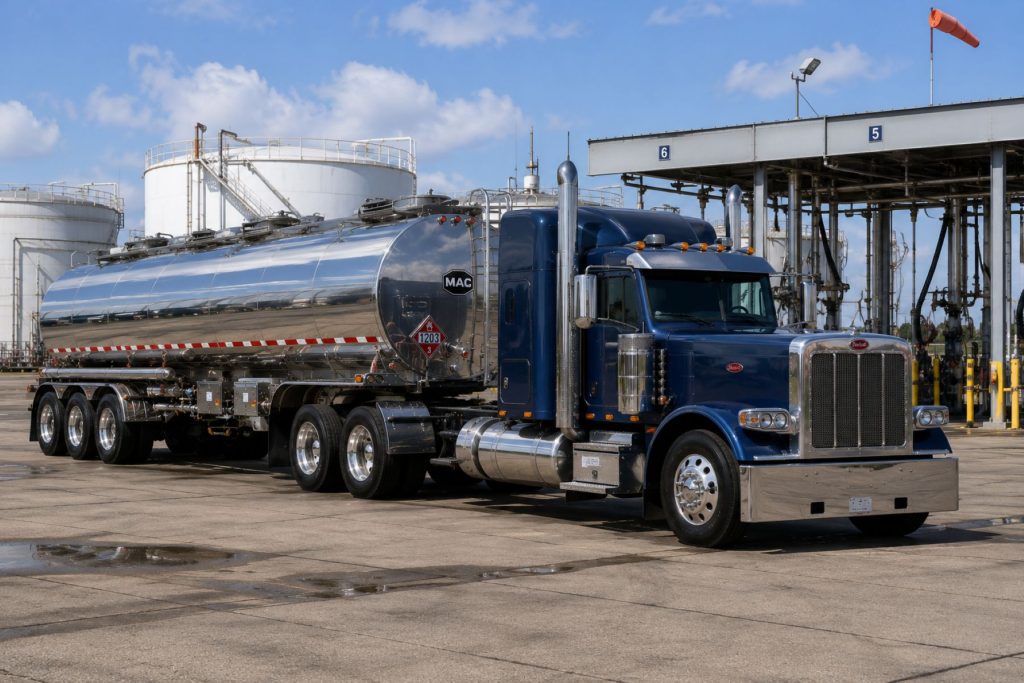
MAC tank trailers are engineered to safely transport liquid cargo while meeting strict regulatory requirements and industry performance standards.
Available in aluminum and stainless-steel construction, MAC trailers support numerous liquid transportation applications ranging from petroleum products and chemicals to food-grade liquids and agricultural commodities.
Strong corrosion resistance, quality construction, customizable compartment designs, and dependable performance have helped make MAC tank trailers a trusted choice among fleets throughout North America.
Common Specifications
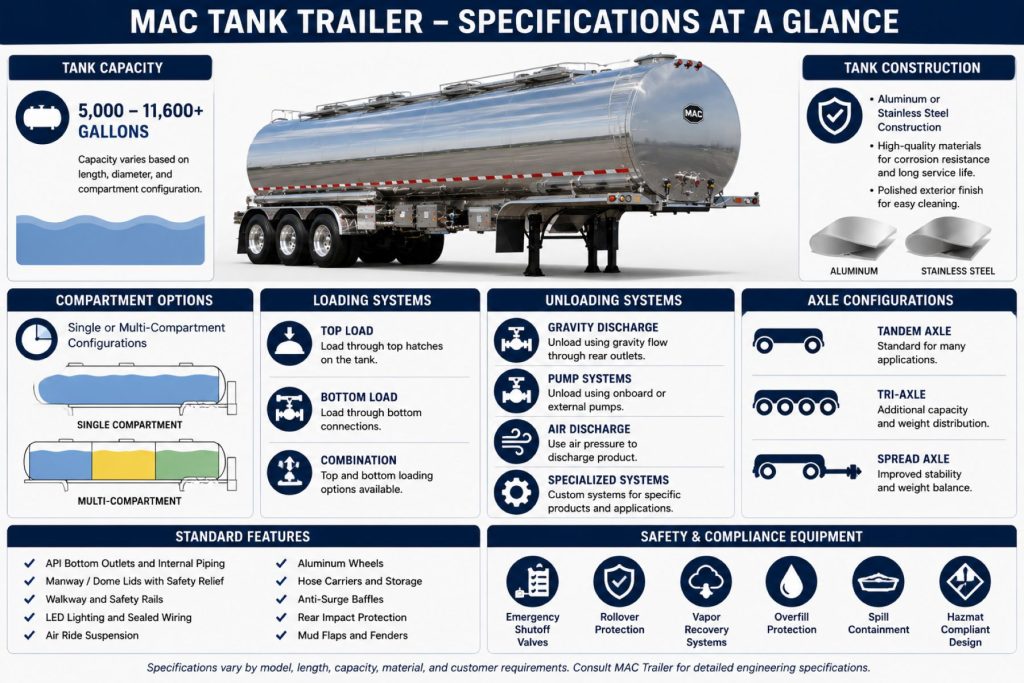
Overall Length
Typically ranges from 40 to 53 feet depending on application.
Width
102 inches.
Tank Capacity
Approximately 5,000 to 11,600+ gallons depending on configuration.
Construction
Aluminum or stainless-steel tank construction.
Axle Configurations
Tandem axle, tri-axle, and spread axle configurations.
Compartment Options
Single compartment or multiple compartment designs.
Loading Systems
Top load, bottom load, or combination systems.
Unloading Systems
Gravity discharge, pumping systems, air discharge, or specialized unloading systems.
Safety Equipment
Emergency shutoffs, rollover protection, vapor recovery systems, overfill protection, and spill containment systems.
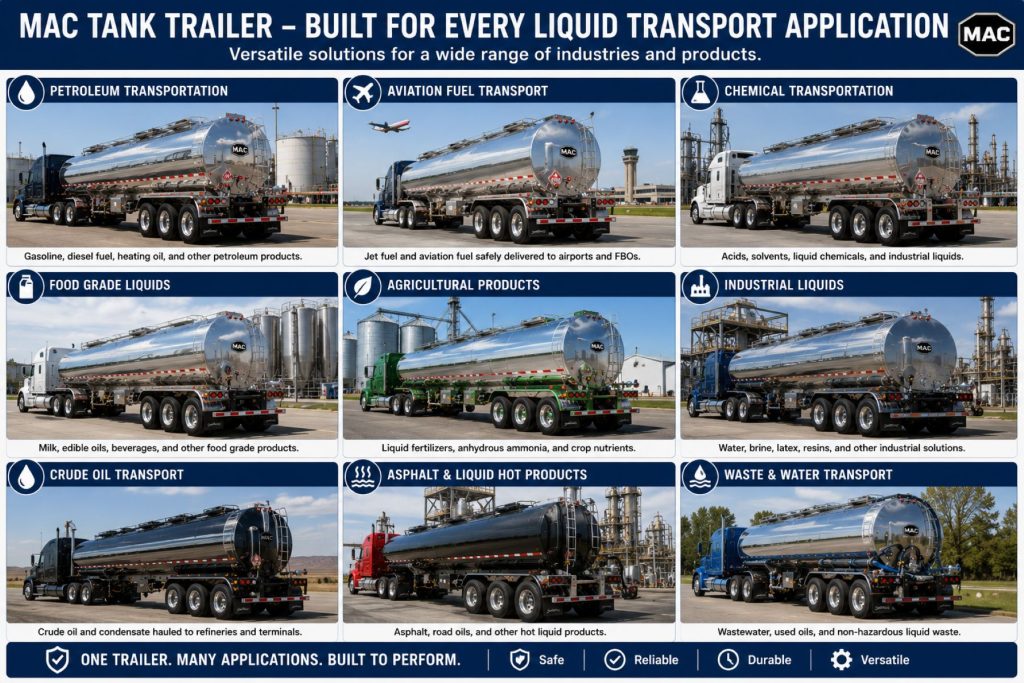
Common Applications
- Petroleum Transportation
- Gasoline Distribution
- Diesel Fuel Delivery
- Aviation Fuel Transport
- Chemical Transportation
- Food Grade Liquid Transport
- Milk Transportation
- Liquid Fertilizer Hauling
- Industrial Liquid Transport
- Agricultural Product Transportation
Advantages
- Strong industry reputation
- Excellent corrosion resistance
- Multiple tank configurations
- High resale value
- Excellent safety systems
- Broad dealer support network
- Customizable compartment layouts
- Long service life
Limitations or Considerations
- Specialized operating requirements
- Higher acquisition costs
- Strict regulatory compliance requirements
- Product-specific cleaning requirements
- Specialized maintenance procedures
- Requires tanker endorsement for many operations
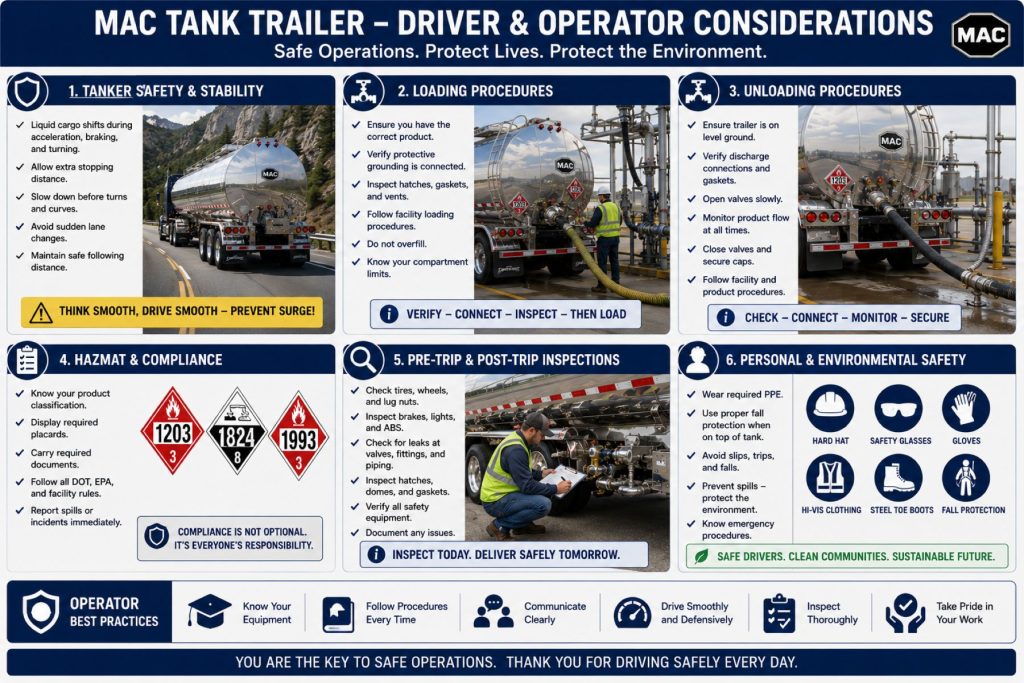
Driver and Operator Considerations
Operating a MAC tank trailer requires specialized training and a thorough understanding of liquid cargo transportation.
Unlike dry freight, liquid cargo can create surge during acceleration, braking, and cornering. Drivers must understand how shifting liquid weight affects vehicle stability, stopping distances, and overall handling characteristics.
Loading and unloading operations require careful attention to procedures, product compatibility, safety requirements, and environmental regulations. Many tanker operations also involve hazardous materials that require additional training and certifications.
Drivers should routinely inspect valves, fittings, hoses, dome lids, emergency shutoff systems, vapor recovery equipment, pumps, and discharge systems before every trip.
Successful tanker operations depend on proper training, attention to detail, and strict adherence to safety procedures.
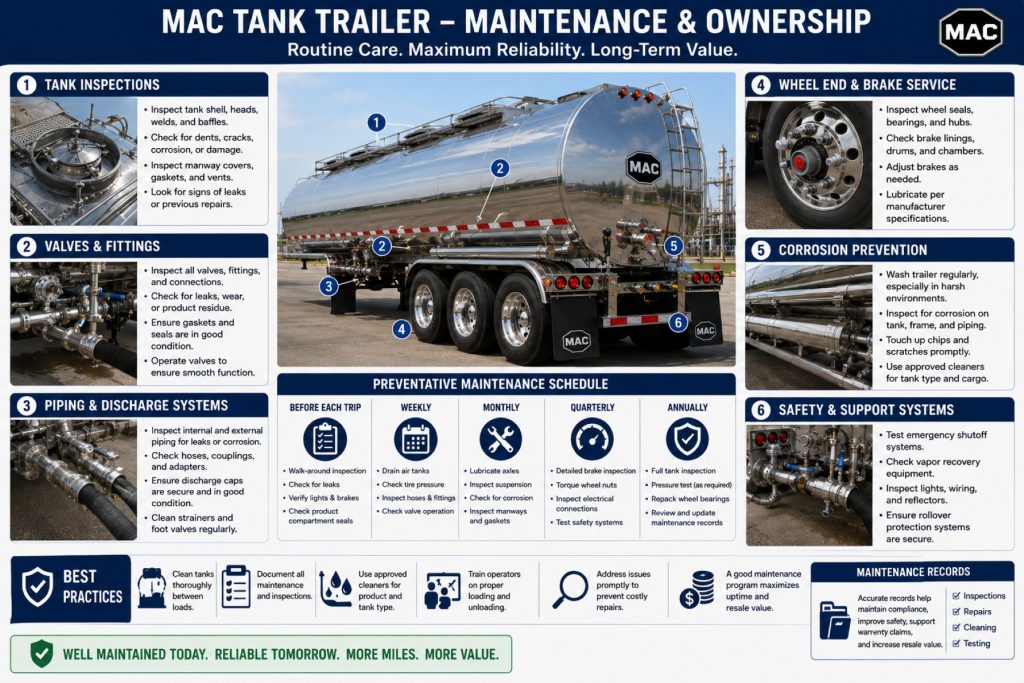
Maintenance and Ownership Notes
MAC tank trailers are designed for long service life but require regular preventative maintenance to maintain safety, reliability, and regulatory compliance.
Routine inspections should focus on tank integrity, suspension systems, brakes, wheel ends, piping systems, valves, pumps, fittings, lighting systems, and safety equipment.
Particular attention should be given to corrosion prevention, gasket condition, discharge equipment, vapor recovery systems, and compartment cleanliness.
Food-grade and chemical tankers often require specialized cleaning procedures and documentation between loads to prevent contamination and maintain compliance.
A strong preventative maintenance program helps maximize trailer lifespan and reduce downtime.
Buying Considerations
- Determine product type requirements
- Verify tank capacity needs
- Select proper tank construction material
- Evaluate compartment requirements
- Inspect valves and fittings
- Review cleaning history
- Inspect suspension and brake systems
- Check tank integrity
- Verify regulatory compliance
- Review maintenance records
- Evaluate dealer support
- Consider long-term resale value
Common Brands or Manufacturers
- MAC Trailer
- Polar Tank Trailer
- Heil Trailer International
- Brenner Tank
- Dragon Products
- Tremcar
- Walker Transport
- LBT Inc.
- Beall Corporation
- Wabash National
Variants and Related Configurations
- Petroleum Tank Trailer
- Chemical Tank Trailer
- Food Grade Tank Trailer
- Dry Bulk Tank Trailer
- Asphalt Tank Trailer
- Crude Oil Tank Trailer
- Multi-Compartment Fuel Tank Trailer
- Insulated Tank Trailer
- Stainless Steel Tank Trailer
- Aluminum Tank Trailer
Comparison to Similar Trailers
MAC tank trailers are commonly compared to Polar, Heil, Brenner, Tremcar, Dragon, Walker, and Beall tanker products.
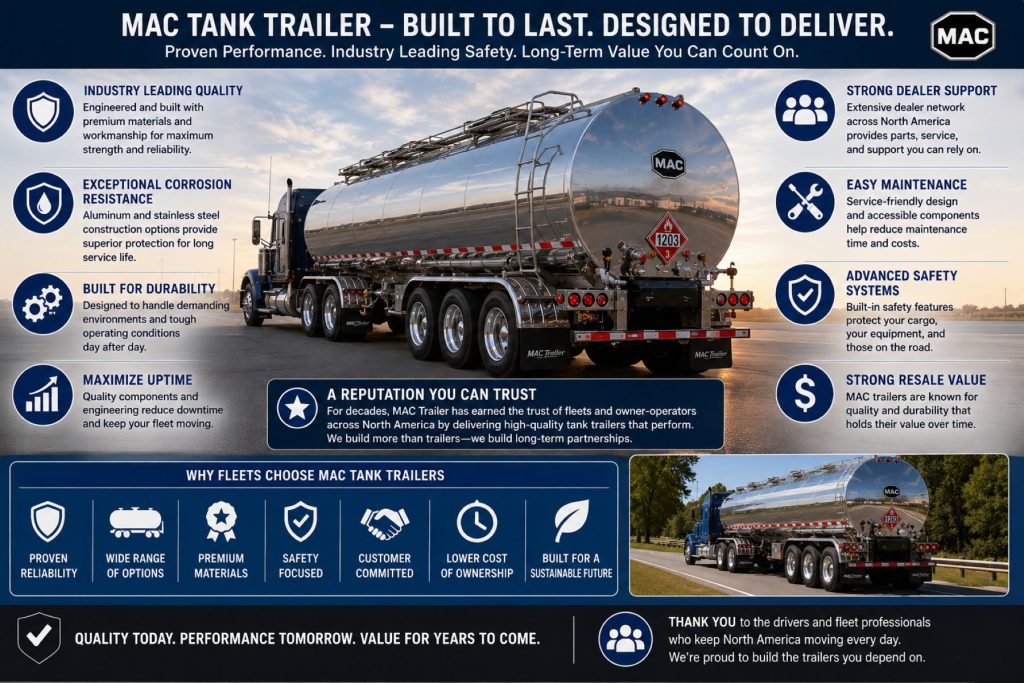
MAC has earned a strong reputation for producing durable, reliable transportation equipment with a focus on quality manufacturing and long-term ownership value.
Many fleets choose MAC because of its broad dealer network, strong product support, and reputation for building trailers capable of handling demanding operating environments.
Compared to many competitors, MAC trailers are often viewed as a dependable balance between performance, durability, and overall value.
Best Fit For
- Fuel Distributors
- Petroleum Carriers
- Chemical Transportation Companies
- Food Grade Liquid Haulers
- Agricultural Transportation Fleets
- Bulk Liquid Carriers
- Industrial Product Transporters
- Private Fuel Fleets
- Hazmat Transportation Companies
- Specialized Tanker Operators
Related Equipment
- Petroleum Freight
- Fuel Freight
- Chemical Freight
- Hazmat Freight
- Food Grade Freight
- Agricultural Freight
- Industrial Liquid Freight
- Bulk Liquid Freight
- Fertilizer Freight
- Energy Sector Freight
Related Freight Types
- Petroleum Freight
- Fuel Freight
- Chemical Freight
- Hazmat Freight
- Food Grade Freight
- Agricultural Freight
- Industrial Liquid Freight
- Bulk Liquid Freight
- Fertilizer Freight
- Energy Sector Freight
Related Trailer Types
- Tank Trailers
- Chemical Tank Trailers
- Petroleum Tank Trailers
- Food Grade Tank Trailers
- Dry Bulk Tank Trailers
Related Trailer Models
- Polar Tank Trailer
- Heil Tank Trailer
- Brenner Chemical Tank Trailer
- Dragon Crude Oil Tank Trailer
- Tremcar Fuel Tank Trailer
Related Guides
- Choosing the Right Trailer for Your Freight
- Complete Guide to Trailer Types
- Complete Guide to Freight Types
Regulatory and Compliance Notes
MAC tank trailers frequently operate under strict federal, state, and local transportation regulations depending on the products being transported.
Many tanker operations involve hazardous materials, requiring compliance with FMCSA, DOT, PHMSA, EPA, and state-specific regulations. Drivers may require tanker endorsements, hazardous materials endorsements, or both depending on the cargo being transported.
Operators must comply with cargo documentation requirements, placarding regulations, emergency response procedures, inspection requirements, loading protocols, unloading procedures, and product-specific transportation regulations.
Food-grade tankers may also be subject to additional sanitation standards and product handling requirements.
Routine inspections, employee training, maintenance programs, and proper documentation are essential for maintaining regulatory compliance and safe operation.
Real World Operating Notes
MAC tank trailers are widely used throughout North America’s petroleum, chemical, agricultural, food-grade, and industrial transportation sectors.
These trailers routinely transport gasoline, diesel fuel, aviation fuel, fertilizer, food-grade liquids, chemicals, and various industrial liquid products.
Many fuel distributors, private fleets, agricultural carriers, and specialized transportation companies utilize MAC tank trailers because of their durability, reliability, and strong support network.
MAC’s reputation for producing dependable transportation equipment across multiple trailer categories has helped establish the company as one of the industry’s most respected manufacturers.
Frequently Asked Questions
What is a MAC tank trailer?
A MAC tank trailer is a liquid transportation trailer manufactured by MAC Trailer and designed to transport petroleum products, chemicals, food-grade liquids, agricultural products, and other bulk liquid cargo.
Are MAC tank trailers still in production?
Yes. MAC Trailer continues to manufacture a variety of tanker trailer products serving multiple liquid transportation industries.
What products can MAC tank trailers haul?
Depending on configuration, MAC tank trailers can transport gasoline, diesel fuel, aviation fuel, chemicals, milk, food-grade liquids, fertilizer, industrial liquids, and other bulk liquid products.
Are MAC tank trailers available in multiple compartments?
Yes. Many MAC petroleum tankers are available with multiple compartments that allow transportation of different products within a single trailer.
What materials are MAC tanks made from?
MAC commonly offers aluminum and stainless-steel tank construction depending on the intended application.
What industries use MAC tank trailers?
Petroleum distribution, fuel transportation, chemical transportation, food-grade transportation, agriculture, energy, and industrial transportation.
Do MAC tank trailers require special driver endorsements?
Many operations require a tanker endorsement, and some may also require a hazardous materials endorsement depending on the cargo being transported.
What makes MAC different from other tanker manufacturers?
MAC is known for quality construction, dependable performance, strong dealer support, customization options, and long-term ownership value.
Availability and Where to Find
MAC tank trailers are available through authorized MAC Trailer dealers, tanker trailer dealerships, transportation equipment brokers, fleet resale programs, commercial trailer marketplaces, and equipment auctions throughout North America.
Availability varies based on tank capacity, compartment configuration, construction material, age, condition, and market demand.
Support Trucking Families
Truck Equipment Atlas supports the mission of Grey Cross, a nonprofit dedicated to helping families of truck drivers who lose their lives while on the road. As the site grows, part of its mission is to bring awareness and support to these families.
Podcast or Video Section
Learn More Through Audio and Video
Truck Equipment Atlas will continue expanding with podcast episodes, interviews, and equipment breakdowns to help drivers and fleets better understand trucks and equipment.
Follow the Growth of Truck Equipment Atlas
Truck Equipment Atlas continues to expand with new truck profiles, trailer coverage, diesel engine pages, equipment system resources, manufacturer information, and educational guides.
Visit our Site Updates page to explore recent additions, project milestones, and upcoming resources as we continue building one of the industry’s growing commercial trucking equipment reference libraries.
View the Latest Site Updates: Truck Equipment Atlas Site Updates