
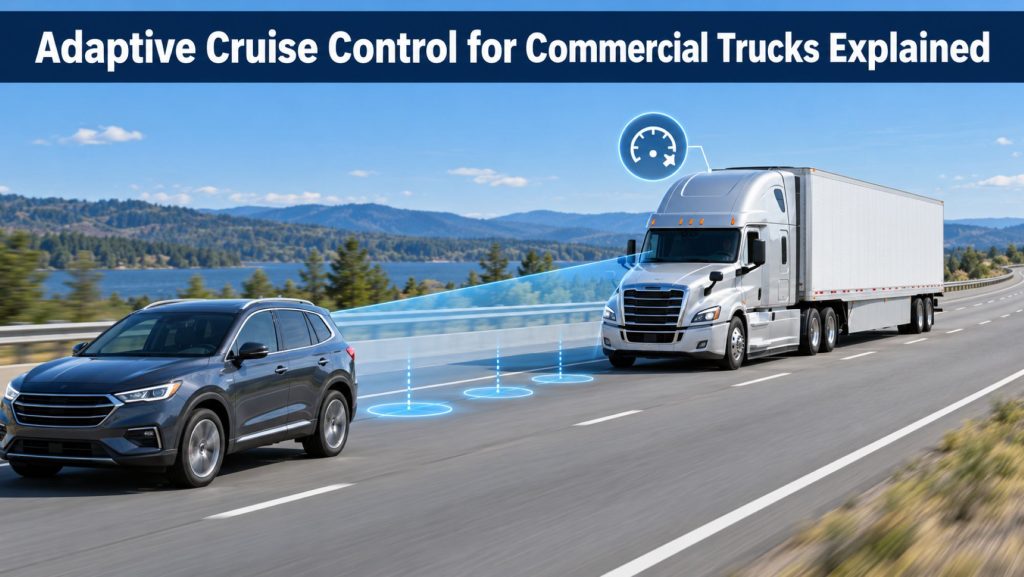
Adaptive cruise control helps a commercial truck maintain a selected cruising speed while automatically adjusting that speed when it approaches slower traffic. Using forward-facing sensors and vehicle controls, the system can reduce engine power, activate an engine retarder, or apply the service brakes to help preserve a programmed following interval.
For long-haul and regional drivers, adaptive cruise control can reduce the number of routine speed corrections required in changing traffic. It may also work with forward-collision warning and automatic emergency braking, but those functions serve different purposes and operate under different levels of urgency.
This guide explains how commercial-truck adaptive cruise control works, how it differs from standard cruise control and emergency braking, what components it uses, where it performs best, and what fleets should consider when selecting and maintaining a system.
What Is Adaptive Cruise Control?
Adaptive cruise control, commonly abbreviated ACC, is a driver-assistance feature that manages vehicle speed in response to traffic ahead. The driver selects a cruising speed and, on most systems, a following-distance setting. When the lane ahead is clear, the truck operates near the selected speed. When it approaches a slower vehicle, ACC reduces speed to help maintain the selected interval.
When the slower vehicle moves away or leaves the lane, the system may gradually return the truck to its original set speed. The driver remains responsible for steering, observing traffic, selecting a safe speed, and braking whenever conditions require.
Standard Cruise Control vs Adaptive Cruise Control
| Feature | Standard cruise control | Adaptive cruise control |
|---|---|---|
| Primary function | Maintains a driver-selected road speed | Maintains a selected speed and adjusts for traffic ahead |
| Forward sensor | Not normally required | Uses radar, a camera, or both |
| Traffic response | Driver must cancel cruise or change speed | Can reduce speed when approaching a slower vehicle |
| Following interval | Managed entirely by the driver | Driver selects an available interval setting |
| Brake integration | Usually limited or absent | May use engine control, retarder, transmission, and service brakes |
| Return to set speed | Resumes when commanded by the driver | May automatically accelerate when the lane clears |
Neither system chooses a safe speed for every situation. The driver must reduce or cancel cruise control when weather, visibility, traffic, construction, road surface, grade, or vehicle condition makes automated speed control unsuitable.
Main Components of a Truck Adaptive Cruise Control System
Forward Radar
A forward radar sensor is commonly mounted in the grille, bumper, or another protected location at the front of the truck. It measures the range and relative speed of objects ahead. Radar works in darkness but can be affected by damage, contamination, obstruction, incorrect mounting, or misalignment.
Forward Camera
Some systems combine radar with a windshield-mounted camera. The camera can help identify vehicles, lane markings, and roadway features, allowing the controller to add visual context to radar measurements. Camera performance depends on a clear view, proper windshield installation, correct calibration, lighting, and weather.
Adaptive Cruise Controller
The electronic controller evaluates sensor data, vehicle speed, selected following interval, driver input, steering information, brake status, and other network messages. It determines whether to maintain speed, coast, reduce torque, request retarder operation, brake, or accelerate toward the set speed.
Engine and Transmission Controls
ACC communicates with the engine to reduce or restore torque. On compatible powertrains, it may also coordinate with an automated transmission to select an appropriate gear. Integrated systems can make smoother adjustments than a standalone speed controller because they understand the truck’s powertrain state.
Engine Retarder and Service Brakes
When coasting or torque reduction is not enough, the system may use the engine retarder and then request service braking. The order and strength of these actions vary by vehicle and system. The driver may need to add braking when traffic slows quickly, the grade becomes steep, or available deceleration is insufficient.
Driver Controls and Display
Steering-wheel or column controls allow the driver to set speed, resume, cancel, and choose among available following-distance settings. The instrument cluster may display the set speed, detected lead vehicle, selected interval, system status, warnings, and diagnostic messages.
How Adaptive Cruise Control Works
- The driver activates cruise control. The desired road speed and available following-distance setting are selected.
- The sensors scan ahead. Radar, a camera, or both monitor vehicles and objects in the truck’s projected path.
- The controller identifies a lead vehicle. It calculates range, relative speed, and estimated time gap.
- The system compares actual and selected spacing. If the truck is closing on slower traffic, ACC begins reducing speed.
- Powertrain response begins. The controller may reduce throttle, coordinate a gear change, or engage an engine retarder.
- Service brakes may be applied. If additional deceleration is needed and the system supports it, ACC requests braking.
- The truck follows at an adjusted speed. ACC continues monitoring the lead vehicle while the driver steers and supervises.
- The system returns toward set speed. When the lane clears, the truck may accelerate smoothly without exceeding the selected cruise speed.
Following Distance, Time Gap, and Headway
Commercial-truck ACC systems often manage following separation as a time interval rather than a fixed number of feet. A time gap accounts for speed: the physical distance associated with a given interval becomes longer as vehicle speed increases.
Driver controls may offer several interval settings represented by bars, icons, or seconds. These settings do not guarantee sufficient stopping distance in every situation. Vehicle load, road grade, brake condition, tire traction, visibility, and weather must still be considered.
How ACC Uses the Truck’s Powertrain and Brakes
Integrated systems usually apply speed-control methods in stages so routine traffic adjustments remain smooth and efficient:
- Throttle reduction: Engine torque is reduced when the truck begins closing on a slower vehicle.
- Coasting: The system may allow the truck to slow naturally before requesting additional action.
- Engine retarding: An engine brake or retarder can add controlled deceleration without relying entirely on the service brakes.
- Transmission coordination: A compatible automated transmission may change gears to support speed control.
- Service braking: The foundation brakes may be applied when more deceleration is required.
- Torque restoration: Power is gradually restored when the following path opens.
The exact sequence depends on the truck’s configuration. Fleets should confirm how the ACC system interacts with the engine brake, transmission, and service brakes on each vehicle model.
Adaptive Cruise Control vs Automatic Emergency Braking
ACC and automatic emergency braking may share the same radar and camera, but their objectives are different. ACC makes routine, gradual speed adjustments to maintain a following interval. Automatic emergency braking responds when the system determines that a collision may be imminent.
An ACC brake application does not mean the truck has entered an emergency event. Likewise, the AEB function may remain available even when adaptive cruise control is not engaged. Read Collision Warning and Automatic Emergency Braking Explained for a closer comparison.
Stop-and-Go and Low-Speed Adaptive Cruise Control
Selected commercial systems can continue adaptive operation at very low speeds or bring the truck to a stop behind traffic. Depending on the design, the system may hold the vehicle briefly and then require a driver command, accelerator input, or another condition before moving again.
Stop-and-go capability should not be assumed. Operating speed, hold time, restart behavior, transmission requirements, and brake-system integration vary by vehicle. The driver must remain ready to brake and control the truck in congested traffic.
Predictive and Map-Based Cruise Functions
Some trucks combine adaptive cruise control with GPS, digital map, grade, and powertrain information. A predictive function may adjust speed, gear selection, or momentum before a hill or other known road feature. This is different from traffic-responsive ACC, although both functions may operate within the same powertrain-management strategy.
Map-based systems depend on accurate positioning and current road data. The driver must still manage temporary speed restrictions, construction, weather, traffic control, and conditions not represented in the map.
Benefits of Adaptive Cruise Control
- Reduces repeated throttle and cruise-control adjustments in changing highway traffic
- Helps maintain a more consistent following interval
- Can coordinate engine, retarder, transmission, and braking responses
- May support smoother speed changes and reduced driver workload
- Can complement forward-collision warning and automatic emergency braking
- May help fleets encourage more consistent following practices
- Can provide driver and fleet feedback through connected safety platforms
Results depend on the vehicle, route, calibration, driver use, and system design. ACC should be evaluated as part of the complete fleet safety and operating program rather than as a substitute for driver training.
When Adaptive Cruise Control Should Not Be Used
- On icy, snowy, muddy, gravel, or otherwise low-traction roads
- During heavy rain, fog, blowing dust, or limited visibility
- In construction zones with shifting or unclear lanes
- On roads with frequent sharp curves or steep grades beyond system guidance
- In dense urban traffic when the system is not designed for low-speed operation
- When sensors are blocked, damaged, dirty, or misaligned
- When warning lamps or unavailable-system messages are present
- When the driver cannot maintain full attention and immediate control
The vehicle manufacturer’s driver manual defines the approved operating conditions. Drivers should cancel cruise control whenever they are uncertain that automated speed management is appropriate.
Common Limitations
- A vehicle cutting closely into the lane may provide limited reaction time.
- Motorcycles, narrow vehicles, unusual equipment, or partially overlapping vehicles may be harder to track.
- Curves and hill crests can temporarily change which object the sensor considers to be in the truck’s path.
- Radar may detect roadside structures or traffic in another lane under some conditions.
- Camera performance can be reduced by glare, darkness, precipitation, windshield damage, or contamination.
- ACC may not recognize traffic signals, stop signs, or every stationary object.
- The system cannot overcome inadequate tire traction or poor brake condition.
- Available braking may be insufficient for rapid traffic changes or steep downhill grades.
Driver Overrides and System Cancellation
The driver can generally cancel ACC with the brake pedal, cruise-control cancel switch, or another vehicle-specific control. Accelerator input may temporarily override the commanded speed, although the forward-warning and emergency-braking functions may remain active.
Override behavior differs among systems. Drivers should learn what happens when they press the accelerator, apply the brakes, activate the engine brake manually, change the following-distance setting, or encounter a system fault.
Commercial-Truck Adaptive Cruise Control Product Examples
Adaptive cruise control is often included within a broader collision-mitigation or safety package. Relevant Truck Equipment Atlas product profiles include:
- Bendix Wingman Fusion Collision Mitigation System
- Bendix Wingman Advanced Collision Mitigation System
- ZF WABCO OnGuardACTIVE Collision Mitigation System
- Detroit Assurance with Active Brake Assist 6
Feature availability can differ by truck manufacturer, model, powertrain, production date, sensor hardware, and software level. Confirm the exact adaptive-cruise functions before ordering or purchasing a vehicle.
How to Compare Commercial-Truck ACC Systems
- Confirm the operating speed range. Determine the minimum and maximum speeds at which adaptive control is available.
- Review following-distance settings. Compare the number of settings, display method, and fleet-adjustment options.
- Check low-speed capability. Determine whether the system can operate to zero speed and how restart is handled.
- Identify available deceleration methods. Confirm engine-torque, transmission, retarder, and service-brake integration.
- Compare sensor design. Understand whether the system uses radar only or combined radar and camera information.
- Review target and curve performance. Examine manufacturer guidance for motorcycles, cut-in vehicles, curves, grades, and stationary objects.
- Evaluate driver controls. Compare displays, warnings, distance selection, overrides, and fault messages.
- Plan service support. Account for diagnostics, calibration equipment, technician training, parts, and software updates.
- Confirm complete-vehicle compatibility. Verify the chassis, brake system, engine, transmission, axle ratio, tire size, and intended application.
For a broader evaluation of collision, lane, blind-spot, and camera technologies, visit How to Choose a Commercial Truck Safety System.
Inspection, Maintenance, and Calibration
- Keep radar covers, the grille area, windshield, and camera lens clean.
- Inspect sensor brackets and surrounding bodywork for damage or movement.
- Do not cover sensor areas with accessories, decals, paint, snow, or temporary equipment.
- Investigate unavailable-system messages, diagnostic trouble codes, and repeated nuisance responses.
- Inspect wiring, connectors, power supply, grounds, and vehicle-network communication.
- Calibrate sensors after required windshield, collision, alignment, suspension, or sensor repairs.
- Maintain tires, brakes, ABS, stability control, engine controls, and suspension.
- Verify operation using the manufacturer’s diagnostic and road-test procedures.
Changes in ride height, tire size, alignment, bumper position, windshield specification, or sensor mounting can affect system operation. Repairs should follow the exact vehicle and safety-system service information.
Driver Training and Fleet Use
Driver training should cover activation, set-speed controls, following-distance settings, displayed targets, normal deceleration behavior, low-speed operation, overrides, warnings, faults, and conditions that require cancellation.
Fleets should reinforce that ACC is a convenience and assistance feature. It does not authorize closer following, distracted driving, or cruise-control use in unsuitable conditions. Driver feedback and event data can help identify calibration concerns, recurring route challenges, or training needs.
Frequently Asked Questions
Does adaptive cruise control steer the truck?
No. ACC manages longitudinal movement by adjusting speed. Lane-keeping or steering assistance is a separate function, even when both technologies are included in the same safety package.
Will ACC bring a commercial truck to a complete stop?
Some systems offer operation to zero speed or stop-and-go capability, while others disengage below a specified speed. The exact function depends on the vehicle, transmission, brake system, and safety package.
Can adaptive cruise control be used in rain or snow?
Drivers should follow the vehicle manufacturer’s instructions. Cruise control is generally unsuitable when traction, visibility, or sensor performance is reduced. The driver should cancel it whenever conditions make automated speed control unsafe.
Does ACC save fuel?
ACC can support smoother speed management in suitable traffic, but fuel results depend on route, traffic, grade, vehicle configuration, calibration, following-distance setting, and driver use. Frequent braking and reacceleration may reduce potential efficiency benefits.
Can adaptive cruise control be retrofitted?
Retrofitting full ACC can be difficult because it requires compatible sensors, engine controls, brake integration, network communication, driver controls, displays, software, and validated calibration. Only manufacturer-approved upgrade paths should be considered.
Related Commercial Truck Safety Guides
- How Commercial Truck Safety Systems Work
- Collision Warning and Automatic Emergency Braking Explained
- Lane Departure Warning and Lane Keeping Assistance Explained
- Blind-Spot Detection and Camera Monitor Systems Explained
- How to Choose a Commercial Truck Safety System
Final Thoughts
Adaptive cruise control can make highway operation smoother by managing routine speed changes and helping preserve a selected following interval. Its value comes from coordinated sensing, engine control, retarding, transmission communication, and service braking.
The system remains an aid rather than a replacement for attentive driving. Correct vehicle integration, clean and calibrated sensors, well-maintained brakes and tires, suitable road conditions, and driver understanding are all necessary for safe and effective operation.