
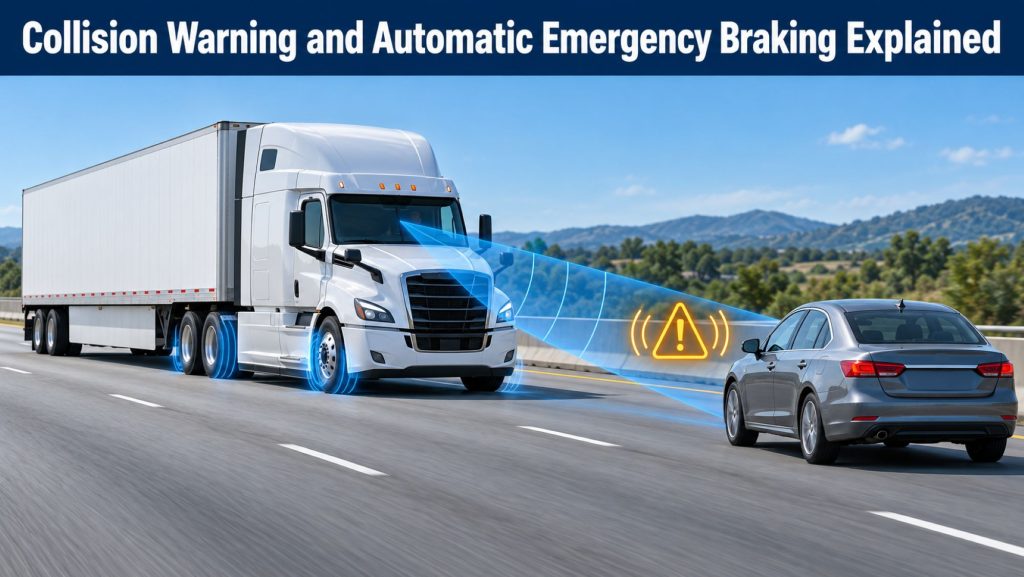
Forward-collision warning and automatic emergency braking systems are designed to help commercial drivers recognize rapidly developing hazards ahead. They use sensors and electronic controls to monitor closing distance, warn the driver, and—in equipped vehicles—apply the brakes when the system determines that a collision may be imminent.
These technologies are especially important on heavy trucks because vehicle weight, speed, road conditions, brake condition, and driver reaction time all affect stopping distance. A warning may provide valuable additional time, while automatic braking may help avoid a collision or reduce its severity.
This guide explains how commercial-truck collision warning and automatic emergency braking work, how the two functions differ, what components they use, what operating conditions affect performance, and what fleets should consider when selecting and maintaining a system.
What Is Forward-Collision Warning?
Forward-collision warning, commonly abbreviated FCW, monitors the truck’s forward path and alerts the driver when closing speed and distance indicate a possible collision. The alert may appear as a warning lamp, instrument-panel message, head-up display, audible tone, seat vibration, or combination of signals.
FCW is a warning function. It does not necessarily apply the brakes. The driver must recognize the warning, evaluate the situation, and respond by braking, steering, or taking another appropriate action.
What Is Automatic Emergency Braking?
Automatic emergency braking, or AEB, builds on forward object detection by adding an automatic brake response. If the system determines that a forward collision is imminent and the driver has not responded sufficiently, it can request a service-brake application to slow the truck.
Some systems apply partial braking, while others can request stronger braking when system criteria are met. The exact response depends on the vehicle, product generation, software, road speed, target type, available traction, and manufacturer programming.
AEB is often described as collision mitigation because it may reduce impact speed without preventing every collision. Under favorable conditions, it may help avoid some crashes entirely. Fleets should use the manufacturer’s stated capabilities rather than assuming every system responds to the same hazards.
Forward-Collision Warning vs Automatic Emergency Braking
| Function | Forward-collision warning | Automatic emergency braking |
|---|---|---|
| Primary purpose | Alert the driver to a developing forward hazard | Automatically slow the vehicle when a collision appears imminent |
| Typical output | Visual, audible, or haptic warning | Brake application, usually with driver warning |
| Driver action | Driver must initiate the response | Driver remains responsible and may need to add braking or steering |
| Vehicle integration | May operate as a standalone warning system | Requires communication with the vehicle braking system |
| Possible result | Earlier driver recognition and reaction | Collision avoidance in some situations or reduced impact severity |
Main Components of a Commercial-Truck FCW and AEB System
Forward Radar
A radar sensor is commonly mounted in the bumper, grille, or another forward-facing location. It sends radio-frequency signals and analyzes their return to estimate an object’s range, relative speed, and position. Radar can operate in darkness, but damage, contamination, obstruction, or misalignment can affect detection.
Windshield Camera
A forward-facing camera can help classify vehicles, pedestrians, lane markings, and roadway features. Systems that combine radar and camera information may use the two sensors to confirm a target and better understand the driving scene. Glare, darkness, precipitation, a damaged windshield, or a blocked camera view may limit performance.
Electronic Control Unit
The control unit evaluates sensor data, vehicle speed, closing rate, driver input, brake-system status, and other network information. Its software determines when to issue an alert and whether the conditions for automatic braking have been met.
Electronic Braking System
AEB depends on an electronically controlled braking system capable of receiving a brake request. The safety controller may work with antilock braking, electronic stability control, and the vehicle’s service brakes to produce a controlled deceleration while helping maintain stability.
Driver Interface
The driver interface communicates following-distance information, system availability, faults, forward-collision warnings, and braking events. Alert design varies among manufacturers, so drivers need training on the specific lights, tones, messages, and system states used in their trucks.
How the System Calculates Collision Risk
The system continuously compares the truck’s movement with objects in or near its projected path. One important concept is time to collision—the estimated time remaining before the truck reaches an object if the present closing rate continues.
The calculation may consider:
- Truck speed and acceleration
- Target speed and direction
- Closing rate and following distance
- Whether the target is in the truck’s projected travel path
- Steering angle and road curvature
- Brake, throttle, cruise-control, and turn-signal inputs
- Available sensor confidence
- System-specific activation thresholds
The controller does not rely on distance alone. A nearby vehicle moving at the same speed may present less immediate risk than a more distant stopped vehicle when the truck is closing rapidly.
Typical Warning and Braking Sequence
- Object detection: Radar, a camera, or both detect an object ahead.
- Path prediction: The controller estimates whether the truck and object are on a conflicting path.
- Following-distance information: Some systems provide a continuous distance or headway indication before an urgent condition develops.
- Forward-collision warning: The system alerts the driver when risk crosses a programmed threshold.
- Initial intervention: The system may reduce engine torque, cancel adaptive cruise control, or begin a brake application.
- Emergency braking: If the threat continues and operating criteria are met, the system may request stronger braking.
- Driver response: The driver may brake harder, steer if a safe escape path exists, or otherwise take control.
Not every system follows the same sequence, and some warning-only products never request vehicle braking.
Moving, Stopped, and Stationary Targets
Moving Vehicles
Closing on a slower moving vehicle is a common detection scenario. The system can compare both vehicles’ speeds and warn when the following distance becomes unsafe or the closing rate rises rapidly.
Stopped Vehicles
A stopped vehicle was previously moving and came to a stop within the sensor’s observation. Some systems can track that transition and respond with warnings or braking. Performance depends on product generation, speed, visibility, curvature, and other operating conditions.
Stationary Objects
A stationary object may already be stopped when it first enters the detection area. Correctly distinguishing a true roadway obstruction from signs, bridges, guardrails, or roadside objects can be challenging. Buyers should verify exactly which stationary-object scenarios a particular system is designed to address.
Pedestrians and Other Road Users
Selected newer systems can recognize pedestrians or other vulnerable road users in defined situations. This capability should never be assumed from the presence of AEB alone. Detection classes, speed ranges, daylight requirements, and crossing scenarios vary by system.
How AEB Works with Adaptive Cruise Control
Adaptive cruise control and AEB may use the same forward sensors, but they serve different purposes. Adaptive cruise control makes routine speed adjustments to maintain a selected following interval. AEB responds to a more urgent collision threat.
A truck may use engine torque reduction, an engine brake, transmission coordination, or light service braking during normal adaptive-cruise operation. Emergency braking can request a more rapid service-brake response. Learn more in Adaptive Cruise Control for Commercial Trucks Explained.
How Vehicle Weight and Road Conditions Affect Performance
An electronic system can request braking, but it cannot eliminate the physical limits of a loaded commercial vehicle. Actual stopping performance depends on the complete vehicle and operating environment.
- Gross vehicle and axle weight
- Vehicle speed and closing rate
- Brake adjustment and component condition
- Tire condition, inflation, and available traction
- Wet, icy, snowy, gravel, or contaminated pavement
- Road grade and curvature
- Trailer stability and load distribution
- Driver response after the warning or brake application
AEB should be treated as an additional safety layer—not as permission to follow more closely, drive faster, or postpone brake and tire maintenance.
Common System Limitations
- Heavy rain, snow, fog, dust, spray, ice, or mud can reduce sensor visibility.
- A damaged, blocked, painted, or misaligned radar sensor may provide unreliable information.
- Windshield contamination, glare, darkness, cracks, or improper replacement glass can affect a camera.
- Sharp curves, hill crests, construction zones, and unusual road geometry can complicate path prediction.
- Vehicles entering or leaving the lane suddenly may provide limited response time.
- Narrow vehicles, motorcycles, pedestrians, animals, debris, and unusual cargo may not be recognized in every situation.
- Traction limits can prevent the truck from achieving the requested deceleration.
- System faults or communication problems may disable warning or braking functions.
The applicable driver’s manual and system documentation define the actual limitations for each truck. Drivers should understand any unavailable-system message and report recurring faults.
Nuisance Alerts and False Interventions
A nuisance alert occurs when the system warns about an object that the driver does not consider an immediate threat. Examples may involve vehicles in another lane, roadside structures, overhead signs, tight curves, or traffic entering and exiting the truck’s path.
Repeated alerts should not automatically be dismissed as normal. They may indicate sensor contamination, alignment problems, incorrect calibration, outdated software, damaged mounting hardware, or a route condition that requires review. Fleets should document the location, weather, vehicle state, and driver account before diagnosing the event.
Factory-Integrated vs Aftermarket Systems
Factory-Integrated AEB
Factory-integrated systems are designed around the truck’s braking, engine, transmission, stability-control, steering, instrument, and diagnostic networks. They can provide coordinated braking and consolidated fault reporting, but service often requires vehicle-specific diagnostic tools and calibration procedures.
Aftermarket Warning Systems
Aftermarket products can add forward-collision alerts to older trucks or mixed fleets. Many are warning-only because automatic braking requires deeper integration with the vehicle’s brake controls. Installation quality, sensor location, power supply, driver-display placement, and calibration strongly influence performance.
Commercial-Truck Collision Warning and AEB Product Examples
Commercial systems differ by vehicle application, sensor package, feature generation, and installation. The following Truck Equipment Atlas profiles provide more detail about major examples:
- Bendix Wingman Fusion Collision Mitigation System
- Bendix Wingman Advanced Collision Mitigation System
- ZF WABCO OnGuardACTIVE Collision Mitigation System
- Detroit Assurance with Active Brake Assist 6
- Mobileye 8 Connect Collision Avoidance System
Some of these products provide integrated automatic braking, while others emphasize driver warning and fleet connectivity. Confirm the exact functions for the vehicle, model year, hardware, and software being considered.
How to Compare FCW and AEB Systems
- Define the application. Record highway, regional, urban, vocational, and construction-site exposure.
- Identify target capabilities. Compare moving-vehicle, stopped-vehicle, stationary-object, pedestrian, and other detection functions.
- Compare speed ranges. Determine when warnings and braking are available and whether functions change at low or high speed.
- Review braking authority. Understand whether the system warns only, applies partial braking, or can request stronger emergency braking.
- Confirm vehicle integration. Verify compatibility with the chassis, brake system, stability control, engine, transmission, and instrument cluster.
- Evaluate diagnostics and calibration. Identify required tools, procedures, technician training, and post-repair checks.
- Review driver controls. Understand alert settings, temporary disable functions, startup status, and fault messages.
- Consider data access. Determine whether events can be recorded, reviewed, or connected to a telematics platform.
- Assess lifecycle support. Compare warranty, parts availability, software updates, repair coverage, and manufacturer support.
For a broader selection process covering multiple safety technologies, visit How to Choose a Commercial Truck Safety System.
Inspection, Maintenance, and Calibration
- Keep the radar cover, grille area, windshield, and camera lens clean.
- Inspect sensor brackets and mounting points after impacts or body repairs.
- Do not place accessories, decals, lighting, or equipment in a sensor’s field of view.
- Investigate warning lamps and unavailable-system messages promptly.
- Check wiring, connectors, grounds, network communication, and power supply.
- Follow calibration procedures after sensor, windshield, alignment, suspension, or collision repair.
- Maintain foundation brakes, ABS, stability control, tires, and suspension.
- Confirm system operation with approved diagnostic and road-test procedures.
- Document faults, repairs, calibration results, and software versions.
Driver Training and Fleet Policies
Drivers should receive vehicle-specific training before operating an FCW- or AEB-equipped truck. Training should explain alert meanings, typical intervention behavior, system limitations, fault indications, cleaning requirements, and the correct response to unexpected braking.
Fleet policy should reinforce that the technology does not change safe-following-distance requirements or transfer responsibility from the driver. Event reviews should consider road conditions, system data, dash-camera footage when available, maintenance history, and the driver’s account.
Heavy-Vehicle AEB Regulation in the United States
In 2023, the National Highway Traffic Safety Administration and Federal Motor Carrier Safety Administration proposed requirements for automatic emergency braking on heavy vehicles with a gross vehicle weight rating above 10,000 pounds. Because regulatory requirements and implementation schedules can change, fleets and buyers should review current federal rules and official agency guidance before purchasing or specifying equipment.
Independent of a federal requirement, AEB and collision-warning availability varies by truck manufacturer, model, configuration, and production date.
Frequently Asked Questions
Can automatic emergency braking stop a fully loaded tractor-trailer?
A properly integrated system can request braking on a loaded combination vehicle, but the resulting deceleration depends on speed, weight, brake condition, tire traction, road grade, surface conditions, and available distance. It may reduce impact speed without preventing the collision.
Does AEB work when cruise control is off?
Many integrated systems can provide collision warning and emergency braking even when cruise control is not active, but the exact operating conditions must be confirmed in the vehicle documentation.
Can the driver override automatic braking?
Override behavior varies by system and event. Driver steering, throttle, or braking inputs may change the response, but drivers should follow the manufacturer’s instructions and should never test an override on public roads.
Why is the collision system unavailable after windshield replacement?
The forward camera may require approved glass, correct mounting, initialization, or calibration. A fault can also result from disturbed wiring, an obstructed view, or an incomplete service procedure.
Can AEB be added to an older truck?
Warning-only systems are often easier to retrofit. Adding automatic braking requires compatible electronic brake controls, vehicle-network access, approved hardware, and validated integration. Not every truck supports a safe or manufacturer-approved conversion.
Related Commercial Truck Safety Guides
- How Commercial Truck Safety Systems Work
- Adaptive Cruise Control for Commercial Trucks Explained
- Lane Departure Warning and Lane Keeping Assistance Explained
- Blind-Spot Detection and Camera Monitor Systems Explained
- How to Choose a Commercial Truck Safety System
Final Thoughts
Forward-collision warning gives the driver earlier notice of a developing threat, while automatic emergency braking adds an active response when a collision appears imminent. Together, they can provide an important additional layer of protection for heavy commercial vehicles.
The technology is most effective when the system matches the vehicle and application, sensors remain clean and calibrated, the brake and tire systems are maintained, and drivers understand both the capabilities and the limits. No electronic system replaces attentive driving, safe following distance, or sound fleet maintenance.