
Quick Facts
- Manufacturer: Phillips Industries
- Product Family: STA-DRY QCS2
- Product Type: Quick-change commercial trailer electrical connection system
- Primary Connector: Seven-way female trailer socket
- Connection Standard: SAE J560-compatible configurations
- Socket Type: Replaceable QCS2 quick-change socket
- Electrical Architecture: Tractor-to-trailer and trailer wiring connection
- Termination Options: Molded harness, blunt-cut cable, ring terminals, or application-specific modular connections
- Environmental Protection: Molded, moisture-resistant STA-DRY connection with corrosion-inhibiting grease
- Primary Applications: Dry vans, refrigerated trailers, flatbeds, container chassis, doubles, vocational trailers, and commercial tractors
- Primary Benefit: Allows a damaged or corroded socket to be replaced without replacing or rewiring the complete harness
- Production Status: Current product family with application-specific parts and replacement kits
Overview
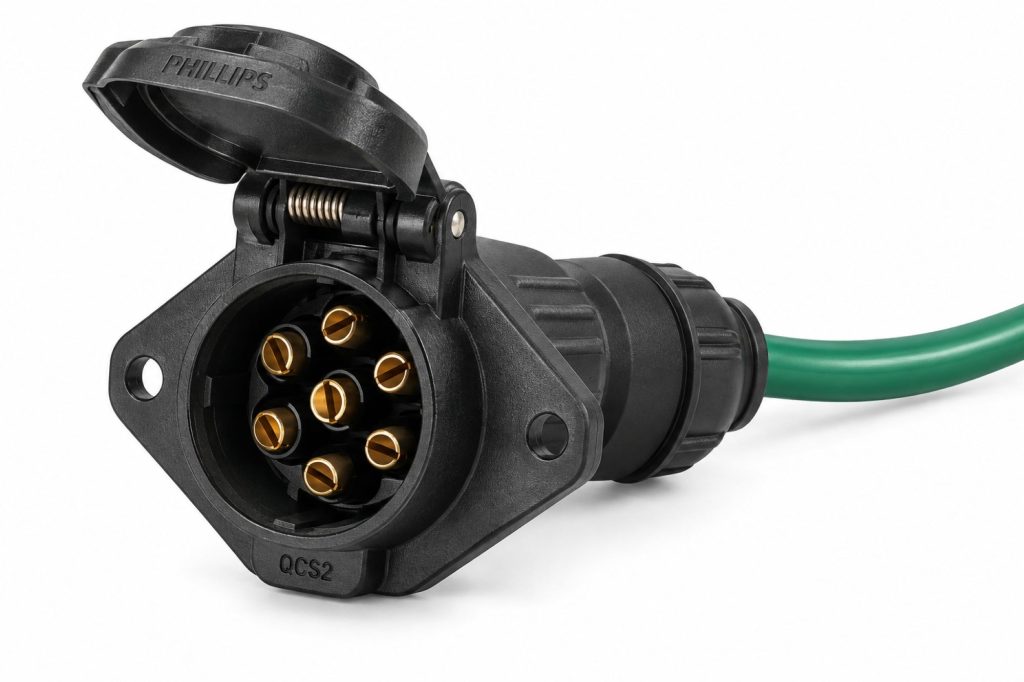
The Phillips STA-DRY QCS2 Electrical Connection System is a modular commercial-vehicle wiring system designed to protect tractor and trailer electrical circuits against moisture, road chemicals, corrosion, and connection damage.
QCS2 stands for Quick-Change Socket. The system places a removable seven-way socket at the exposed trailer connection while the wiring harness remains protected inside a molded STA-DRY boot. If the socket becomes worn, damaged, or corroded, technicians can replace the socket without cutting apart or replacing the complete harness.
Phillips offers QCS2 components in tractor, trailer, nosebox, junction-box, ABS, modular lighting-harness, and replacement-kit configurations. The exact harness length, conductor sizes, wire termination, socket orientation, and mating components depend on the vehicle or trailer application.
Key Characteristics
- Replaceable QCS2 quick-change socket
- Seven-way commercial trailer electrical connection
- Molded STA-DRY harness boot
- Moisture-resistant connection design
- Corrosion-inhibiting grease applied to system modules
- Non-corrosive molded socket housing
- Socket replacement without rewiring the complete harness
- Available with solid or split contact configurations depending on the component
- Application-specific harness and replacement-kit options
- Compatible with standard commercial trailer electrical circuits when correctly specified
- Available for ABS-equipped trailer wiring systems
- Factory-tested components
Major Components
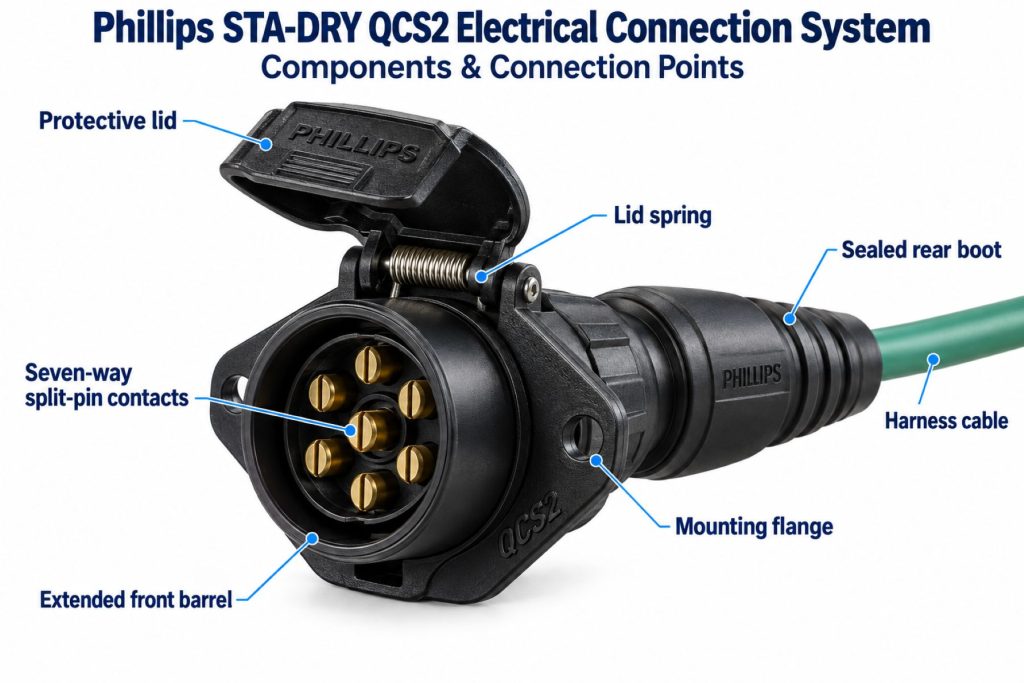
- QCS2 seven-way socket
- Molded STA-DRY harness boot
- Seven electrical contacts
- Socket housing
- Socket cover
- Mounting flange
- Sealing surfaces
- Socket-retaining features
- Color-coded electrical conductors
- Molded cable jacket
- Corrosion-inhibiting grease
- Ring terminals, bullet terminals, blunt-cut leads, or modular connectors depending on configuration
- Mounting fasteners
- Junction box or nosebox on applicable systems
- Circuit breakers on selected assemblies
Product Type and Construction
The QCS2 is a modular socket-and-harness system rather than a conventional socket requiring each vehicle wire to be attached directly during every socket replacement. Its replaceable socket connects to terminals retained inside the molded harness boot.
The molded boot protects the rear of the socket connection from moisture and road contamination. The exposed socket can be removed as a service component while the main harness and its sealed termination remain installed.
How the Electrical Component or System Works
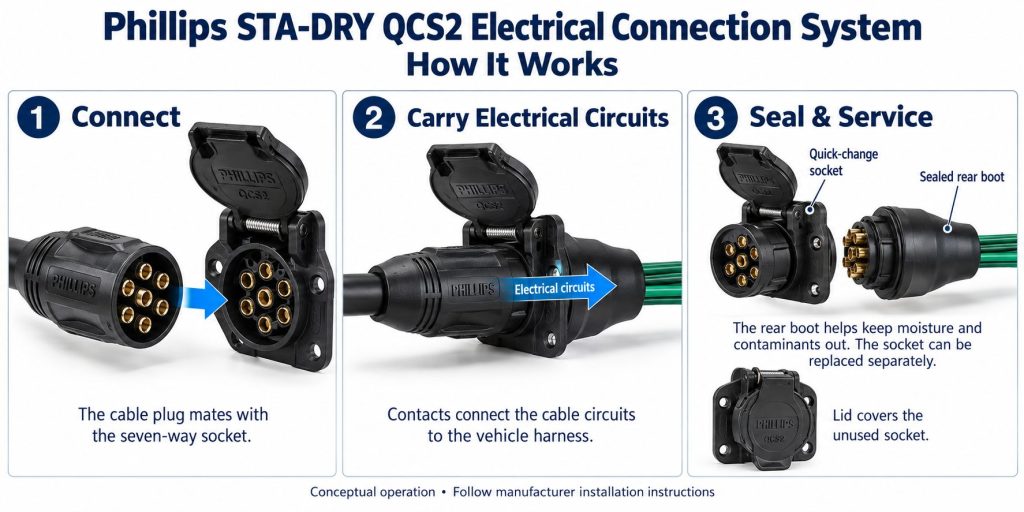
The tractor’s seven-way electrical cable plugs into the QCS2 socket mounted at the front of the trailer or at another designated connection point. Individual socket contacts route power, ground, lighting, auxiliary, and brake-related electrical circuits into the trailer harness.
The rear of the socket connects to terminals protected inside the molded STA-DRY boot. Sealing surfaces and corrosion-inhibiting material help prevent water, road salt, deicing chemicals, and dirt from reaching the protected harness connection.
When the exposed socket wears out or becomes damaged, the technician disconnects it from the boot and installs a compatible replacement socket. This reduces the need to cut wires, install multiple individual terminals, or replace the complete main harness.
Position and Function Within the Vehicle
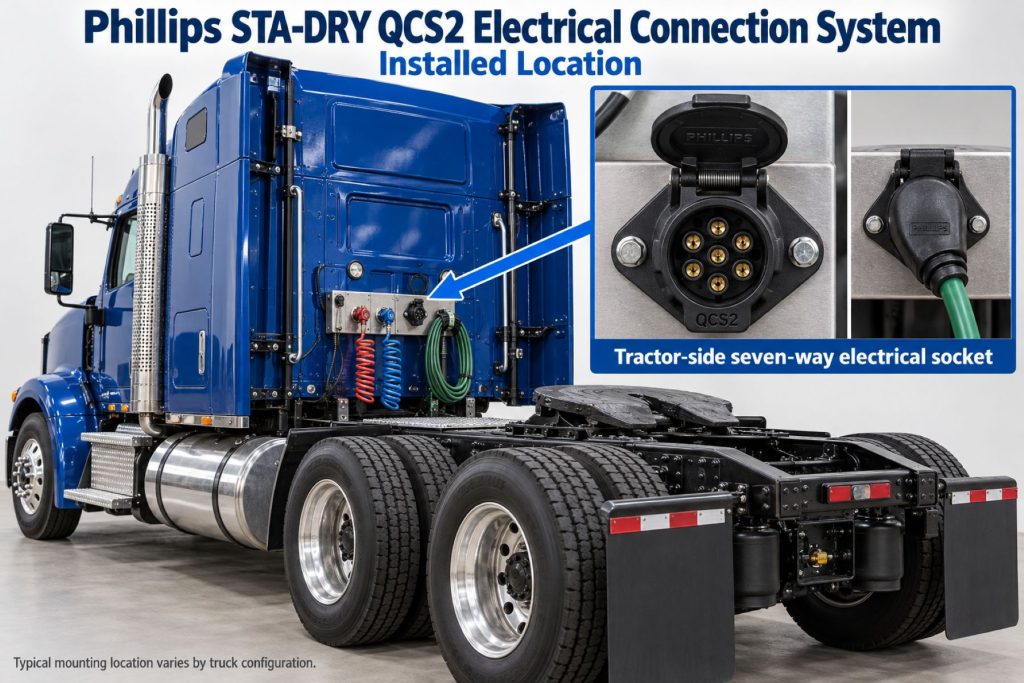
A trailer-side QCS2 socket is commonly mounted at the trailer nose, nosebox, or front electrical connection panel. Tractor-side and intermediate configurations may also be used within compatible Phillips electrical assemblies.
The system provides the electrical interface required to operate trailer lighting, turn signals, stop lamps, marker lamps, the ground circuit, auxiliary circuits, and ABS power according to the vehicle’s wiring architecture.
Common Specifications
- Connector Type: Commercial seven-way socket
- Socket Design: QCS2 quick-change female socket
- Electrical Circuits: Seven application-specific circuits
- Typical System Voltage: Commercial 12-volt tractor and trailer electrical systems
- Common Socket Part Number: Phillips 16-724 for specified seven-way QCS2 applications
- Housing: Molded non-corrosive material
- Harness Protection: Molded STA-DRY sealed boot
- Conductor Sizes: Application-specific; selected Phillips main harnesses use combinations of 8-, 10-, and 12-gauge conductors
- Termination Options: Molded harness, blunt-cut conductors, ring terminals, bullet contacts, or modular plugs
- Mounting: Application-specific socket flange, nosebox, junction box, or trailer front panel
- ABS Compatibility: Available in configurations designed for standard commercial trailer ABS wiring systems
- Harness Length: Application-specific
Operating Capacity and Performance
The system’s operating capacity depends on the wire gauge, contact design, circuit protection, connector condition, vehicle voltage, and electrical load assigned to each circuit. The selected assembly must match the tractor and trailer manufacturers’ electrical requirements.
High resistance caused by loose contacts, contamination, damaged pins, poor grounds, or overheated conductors can reduce voltage reaching trailer equipment even when the circuit remains partially functional.
Installation Position and System Function
The socket should be installed where the tractor electrical cable can connect without excessive tension, sharp bending, contact with the deck, or interference with trailer movement.
The mounting position should allow the socket cover to close when the connection is not in use. The rear boot and harness must be protected against crushing, abrasion, impact, excessive heat, and sharp edges.
System Voltage and Electrical Architecture
QCS2 assemblies are commonly used in 12-volt commercial tractor-trailer systems. The seven-way connection distributes separate electrical circuits according to the applicable vehicle wiring standard and equipment configuration.
The system does not create or regulate electrical power. It provides the connection path between the tractor’s electrical system and the trailer’s wiring, lights, ABS equipment, and approved auxiliary devices.
Electrical Input, Output, and Power Function
Electrical input comes from the tractor through the seven-way cable. The QCS2 socket transfers the individual circuits into the trailer harness, which distributes power and ground connections to the appropriate trailer equipment.
- Ground circuit
- Tail and marker lamp circuit
- Left-turn and stop-lamp circuit
- Right-turn and stop-lamp circuit
- ABS or auxiliary power circuit
- Application-specific auxiliary circuit
- Application-specific brake or control circuit
Exact circuit assignments must be confirmed from the applicable wiring diagram and connector standard.
Voltage, Current, and Electrical Load Management
Each conductor, socket contact, connector, and protective device must have sufficient capacity for its assigned load. Additional equipment should not be attached to an existing circuit unless the complete circuit has been verified for the increased demand.
Voltage-drop testing under load is more useful than an unloaded voltage reading when diagnosing dim lamps, intermittent ABS power, overheated contacts, or unreliable auxiliary equipment.
Connector, Harness, and Circuit Design
The QCS2 design separates the replaceable external socket from the protected harness termination. This allows the component most exposed to plug wear and road contamination to be serviced independently.
Phillips offers different harness layouts for trailers, tractors, noseboxes, junction boxes, modular lighting systems, and ABS electrical systems. Harnesses must be identified by their complete part numbers because similar-looking assemblies may have different lengths, branches, connectors, and conductor sizes.
Internal Components and Electrical Design
The socket contains seven electrical contacts positioned to mate with a compatible commercial trailer plug. At the rear, the contacts engage the QCS2 harness terminals retained within the molded boot.
The boot, sealing surfaces, terminal retention, and corrosion-inhibiting material work together to protect the rear connection. The design reduces the number of exposed service connections compared with rewiring an individually terminated socket.
Materials and Component Construction
- Molded non-corrosive socket housing
- Conductive socket contacts
- Insulated copper conductors
- Weather-resistant harness jacket
- Molded elastomeric or polymer harness boot
- Corrosion-inhibiting grease
- Application-specific terminals and connectors
- Metal mounting hardware
- Protective socket cover
Wiring, Terminals, Connectors, and Grounding
System reliability depends on the condition of the complete circuit, not only the QCS2 socket. Ground connections, junction-box terminals, chassis wiring, tractor cables, trailer harnesses, lamp connectors, and ABS connections should be inspected together.
Ground circuits require particular attention. A poor ground can cause dim lamps, backfeeding between circuits, intermittent ABS operation, or multiple lamps operating incorrectly.
Circuit Protection and Electrical Safety
Trailer circuits should be protected by correctly rated circuit breakers, fuses, or tractor electrical protection according to the vehicle design. Selected Phillips assemblies incorporate junction boxes or noseboxes with application-specific circuit protection.
A larger fuse or breaker should never be installed to compensate for a repeated circuit fault. The short circuit, overload, damaged conductor, or defective component must be located and repaired.
Controls, Monitoring, and Diagnostics
The QCS2 system has no independent driver-operated controls. It transfers electrical signals and power commanded by the tractor switches, brake controls, lighting controls, ABS system, and auxiliary equipment.
Diagnosis may involve visual inspection, circuit continuity checks, loaded voltage measurements, voltage-drop testing, resistance testing, pin-tension inspection, trailer-light testing, and ABS diagnostic procedures.
Electronic Controls and Driver-Assistance Integration
The seven-way electrical connection can supply power and ground paths required by trailer ABS and other approved electronic systems. It may also carry lighting and auxiliary circuits monitored by tractor or trailer controllers.
The QCS2 is not itself an electronic control module. Fault codes or warning lamps associated with the connection normally originate from the tractor, trailer ABS controller, lighting controller, or another monitored system.
Power Demand, Capacity, and Energy Management
Trailer lighting, ABS, auxiliary equipment, liftgate charging systems, and other electrical loads must remain within the capacity of their assigned conductors and connections.
High-current auxiliary equipment may require a separate connection system rather than relying on a standard seven-way circuit. Equipment requirements should be compared with the approved ratings of the complete tractor-to-trailer electrical path.
Heat, Efficiency, and Electrical Loss Management
A clean, tight connection limits resistance and heat generation. Worn contacts, loose terminals, corrosion, inadequate pin tension, damaged conductors, or overloaded circuits can create voltage loss and localized heating.
Discoloration, softened plastic, melted insulation, burned grease, or a hot socket indicates a condition requiring immediate inspection and repair.
Environmental Sealing and Contamination Protection
Environmental protection is a primary purpose of the STA-DRY design. The molded boot and sealed connection help prevent moisture and road contaminants from reaching the rear electrical terminals.
The exposed front contacts still require inspection and maintenance. The socket cover should remain closed when the connection is unused, and damaged seals, boots, covers, or housings should be replaced.
Duty Cycle and Operating Conditions
The system is designed for commercial vehicles exposed to repeated coupling, vibration, rain, snow, temperature changes, road spray, dust, salt, and chemical deicers.
Service life depends on connector support, cable routing, coupling frequency, plug condition, electrical loading, road environment, maintenance practices, and whether the socket cover is used when disconnected.
Mounting and Installation
The QCS2 socket must be mounted securely to a compatible bracket, trailer panel, nosebox, or junction-box assembly. The mounting surface should support the socket without distortion and allow the cover and tractor plug to operate normally.
The harness should be routed with sufficient support and strain relief. It must not be stretched, sharply bent, crushed, or positioned where trailer movement can pull directly on the socket or wiring.
Wiring, Grounding, and Installation Requirements
- Disconnect electrical power before service
- Confirm the complete Phillips part number
- Match the QCS2 socket to the correct boot or harness
- Verify circuit assignments before connecting wires
- Use the approved mounting pattern and hardware
- Protect the harness from sharp edges
- Provide proper cable support and strain relief
- Inspect and test the ground circuit
- Use correctly rated circuit protection
- Test every trailer circuit after installation
Vehicle and Electrical-System Compatibility
Compatibility depends on the connector standard, socket type, harness series, vehicle voltage, wire gauge, circuit arrangement, mounting pattern, cable length, termination style, trailer ABS configuration, and connected electrical loads.
Phillips notes that its 34 Series STA-DRY SLIM-7 system and 36 Series STA-DRY system are not interchangeable except where specifically identified. Adapters may be available for certain applications.
Harness and Connector Compatibility
The replacement socket must match the installed QCS2 boot, harness generation, pin configuration, and application. A conventional seven-way socket may physically resemble the QCS2 component but may not attach to the protected harness correctly.
Replacement kits with ring terminals are available for certain Phillips i-BOX, QBOX, S7 PERMALOGIC, and related junction-box configurations. The specified kit number should be confirmed before ordering.
Related Component and System Compatibility
- SAE J560-compatible tractor electrical cables
- Phillips QCS2 harnesses
- Phillips STA-DRY modular wiring systems
- Phillips STA-DRY SLIM-7 systems where specifically approved
- Trailer noseboxes and junction boxes
- Commercial trailer ABS systems
- Trailer lighting harnesses
- Marker and clearance lamp modules
- Rear lighting modules
- Application-specific circuit breakers
- Phillips QCMS2 connection systems
Common Applications
- Dry van trailers
- Refrigerated trailers
- Flatbed trailers
- Container chassis
- Double trailers
- Detachable-gooseneck trailers
- Equipment trailers
- Utility trailers
- Landscape trailers
- Commercial tractors
- Trailer fleets using modular wiring systems
- ABS-equipped commercial trailers
Advantages
- Quick socket replacement
- Reduces the need to replace the complete harness
- Reduces individual wire termination during socket service
- Helps protect the rear connection against moisture
- Helps reduce corrosion-related electrical failures
- Non-corrosive molded socket housing
- Corrosion-inhibiting grease included within applicable assemblies
- Supports standardized fleet maintenance
- Available in multiple application-specific harness configurations
- Can reduce trailer downtime during socket replacement
Limitations or Considerations
- The replacement socket must match the installed QCS2 harness
- Not every Phillips harness series is interchangeable
- Front contacts remain exposed while the tractor cable is disconnected
- A damaged molded boot may require harness repair or replacement
- Incorrect cable support can damage the socket and harness
- Road contamination can still enter through damaged sealing surfaces
- The system cannot correct poor grounds elsewhere on the trailer
- Circuit capacity remains limited by the complete wiring system
- Improper probing can spread or damage socket contacts
- Part numbers must be verified before components are ordered
Driver and Operator Experience
The driver uses the electrical connection in the same general manner as a standard seven-way trailer connection. The plug should be fully inserted and secured before departure, with the cable supported so it cannot drag, bind, or pull against the socket during turns.
Before moving the vehicle, the driver should confirm trailer lighting and review the tractor’s ABS indicators. Intermittent lamps, an ABS warning, a loose plug, or visible socket damage should be reported before the vehicle returns to service.
Controls, Indicators, and Driver Feedback
The QCS2 has no separate dashboard control. Driver feedback comes through trailer lamps, tractor indicators, trailer ABS warning behavior, auxiliary-equipment operation, or electrical warning messages on equipped vehicles.
A connection may appear secure while one individual circuit remains open or resistive. A complete pre-trip lighting and ABS check is therefore necessary after every trailer connection.
Common Electrical Tests and Diagnostic Information
- Visual inspection of the socket and plug
- Socket contact-tension inspection
- Trailer-light operational test
- ABS power and warning-lamp test
- Ground-circuit voltage-drop test
- Individual circuit voltage test
- Loaded voltage test
- Circuit continuity test with power disconnected
- Short-to-ground inspection
- Harness movement and intermittent-fault test
- Temperature inspection for overheated contacts
Inspection and Wear Points
- Socket contact surfaces
- Socket contact tension
- Socket housing
- Hinged cover and spring
- Mounting flange
- Mounting fasteners
- QCS2 boot and sealing surfaces
- Harness jacket
- Harness support points
- Ring or bullet terminals
- Junction-box connections
- Ground connection
- Tractor plug condition
- Signs of heat, corrosion, moisture, or abrasion
Cooling, Ventilation, and Environmental Requirements
The system does not normally require active cooling or ventilation. Electrical connections should remain within their rated current range so resistance does not generate excessive heat.
The socket, boot, and harness should be protected against direct exhaust heat, pressure-washing directed into open connections, standing water, impact damage, and prolonged contact with sharp metal edges.
Component Service Life and Replacement
The QCS2 socket is intended to be the readily replaceable portion of the connection. Replacement frequency depends on coupling cycles, plug condition, electrical loading, contamination, physical damage, and maintenance practices.
The molded boot and main harness may remain in service through multiple socket replacements if their seals, terminals, conductors, and jacket remain undamaged.
Maintenance and Ownership Notes
Routine maintenance should focus on keeping the connector clean, supported, securely mounted, and protected when disconnected. Both the tractor plug and trailer socket should be inspected because damage to one component can damage the other.
- Close the socket cover when the connection is not in use
- Inspect the tractor plug before insertion
- Keep the cable supported above the deck
- Clean connections using approved procedures
- Maintain the specified corrosion protection
- Replace worn or burned sockets promptly
- Inspect the molded boot during socket replacement
- Test trailer lighting and ABS operation after service
- Repair damaged harness supports
- Use genuine or confirmed compatible replacement components
Common Electrical-System Problems
- Intermittent trailer lighting: Worn contacts, poor plug engagement, loose terminals, damaged conductors, or a weak ground may interrupt individual circuits.
- Socket corrosion: An open cover, damaged seal, incompatible plug, contaminated connection, or compromised boot can allow moisture and road chemicals to reach electrical contacts.
- Trailer ABS warning: Loss of power, poor ground continuity, voltage drop, wiring damage, or an unrelated ABS fault may activate the warning system.
- Overheated contacts: Loose contact pressure, corrosion, overloading, damaged pins, or repeated arcing can create excessive resistance and heat.
- Plug will not remain connected: Socket wear, plug damage, cover-latch problems, cable tension, or an incorrect mating connector may be responsible.
- Repeated socket damage: Poor cable support, excessive lead length, trailer articulation, connector misalignment, or physical impact may repeatedly overload the socket.
- Multiple lamps operate incorrectly: A defective ground can cause current to backfeed through other trailer-light circuits.
- Water inside the connection: A torn boot, damaged housing, missing cover, improperly seated socket, or incompatible component may compromise the seal.
Safety and Service Precautions
Electrical power should be disconnected before the socket, harness, junction box, or exposed terminals are serviced. Testing should follow approved procedures that prevent short circuits and connector damage.
- Disconnect tractor and trailer electrical power before repair
- Confirm circuit identity before cutting or connecting wires
- Do not install oversized fuses or circuit breakers
- Do not probe contacts with tools that can spread or damage them
- Replace melted or overheated components
- Protect repaired wiring against abrasion and moisture
- Use insulated tools where appropriate
- Support the trailer cable correctly after service
- Test all lighting and ABS functions before operation
- Follow Phillips and vehicle-manufacturer service instructions
Identification Information
Identification may be found on the socket, harness label, replacement-kit packaging, junction box, nosebox, or trailer build records.
- Phillips product family
- Complete part number
- QCS2 socket number
- Harness series
- Harness length
- Wire gauge and circuit arrangement
- Straight-back or angled configuration
- Termination style
- Trailer ABS compatibility
- Junction-box or nosebox type
- 34 Series, 36 Series, or other system identification
- Trailer manufacturer and vehicle identification number
Do not identify the replacement assembly by appearance alone. Similar Phillips products may use different connectors, circuit layouts, wire lengths, and system generations.
Buying Considerations
- Confirm whether only the socket or the complete harness requires replacement
- Record the complete Phillips part number
- Verify seven-way connector compatibility
- Match the installed QCS2 boot and harness series
- Confirm straight-back or angled harness routing
- Match the required harness length
- Verify conductor sizes
- Confirm ring, bullet, blunt-cut, or modular termination
- Check ABS and auxiliary-circuit requirements
- Identify the nosebox or junction-box configuration
- Confirm mounting dimensions
- Inspect the mating tractor cable and plug
Variants and Configurations
- QCS2 seven-way replacement socket
- Straight-back QCS2 harness
- Angled QCS2 harness
- Blunt-cut main harness
- Ring-terminal replacement kit
- Bullet-terminal configuration
- i-BOX-compatible replacement kit
- QBOX-compatible replacement kit
- S7 PERMALOGIC-compatible replacement kit
- Trailer nosebox assembly
- STA-DRY modular trailer harness
- STA-DRY SLIM-7 application-specific system
- ABS-compatible trailer system
- Dual-pole QCS2 liftgate connection system
Comparison to Similar Equipment
Compared with a conventional wire-insertion seven-way socket, the QCS2 allows the exposed socket to be replaced without individually reconnecting every trailer wire. This can reduce service time and the possibility of wiring errors.
Compared with the Phillips STA-DRY QCMS2 Electrical Connection System, the QCS2 uses a conventional removable socket at the connection point. The QCMS2 combines plug-and-socket functions and mates directly with a compatible QCS or QCS2 boot.
Compared with the Phillips STA-DRY SLIM-7 Trailer Wiring System, QCS2 identifies the quick-change socket technology. SLIM-7 describes a broader application-specific modular trailer harness system that may incorporate a QCS2 socket.
Compared with an unsealed replacement socket, the STA-DRY system provides a molded rear connection intended to reduce moisture and contaminant intrusion.
Best Fit For
- Trailers originally equipped with a Phillips QCS2 harness
- Fleets seeking faster seven-way socket replacement
- Trailers operating in wet or corrosive environments
- Dry van and refrigerated fleets
- Flatbeds and container chassis
- ABS-equipped commercial trailers
- Fleets standardizing modular trailer wiring
- Applications requiring a serviceable external socket
- Maintenance programs seeking to reduce wiring repairs
Related Vehicle and Trailer Types
- Dry Van Trailers
- Refrigerated Trailers
- Flatbed Trailers
- Container Chassis Trailers
- Lowboy Trailers
- Equipment Trailers
- Double trailers
- Utility trailers
- Commercial tractors
Related Truck and Trailer Models
- Utility 3000D Dry Van Trailer
- Wabash DuraPlate Dry Van Trailer
- Great Dane Champion Dry Van Trailer
- Great Dane Everest Refrigerated Trailer
- Utility 3000R Refrigerated Trailer
- Freightliner Cascadia
- Kenworth T680
- Peterbilt 579
Related Electrical System Types
- Wiring, Connectors & Power Distribution
- Truck & Trailer Lighting Systems
- Alternators & Charging Systems
- Commercial Truck Batteries & Energy Storage
- Seven-way trailer connectors
- Trailer wiring harnesses
- Trailer junction boxes
- Trailer noseboxes
- ABS power connections
- Modular trailer lighting harnesses
Related Electrical Products
- Phillips STA-DRY QCMS2 Electrical Connection System
- Phillips STA-DRY SLIM-7 Trailer Wiring System
- Phillips QCP Quick-Change Plug
- Phillips PERMALOGIC Trailer Electrical System
- Phillips 7-Way Tractor-Trailer Electrical Cable
- Grote Ultra-Blue-Seal Trailer Wiring System
- Truck-Lite Marker and Clearance Lighting System
Related Equipment Systems
- Electrical Systems
- Brake Systems
- Tires & Wheels
- Suspension Systems
- Telematics & ELD Systems
- Trailer ABS systems
- Trailer lighting systems
- Trailer power-distribution systems
Related Guides
- Electrical System Guides
- How Commercial Truck Electrical Systems Work
- How to Inspect and Maintain Truck Wiring and Electrical Connections
- Commercial Truck and Trailer Lighting Systems Explained
- Commercial Truck Batteries Explained
- Commercial Truck Alternators and Charging Systems Explained
Regulatory and Compliance Notes
Commercial trailer lighting, reflective equipment, ABS operation, wiring protection, and electrical connections are subject to applicable vehicle-safety regulations and inspection requirements.
The QCS2 system must be installed and maintained so required lighting and ABS circuits operate correctly. Connector compatibility and circuit assignments should follow applicable SAE practices, vehicle-manufacturer specifications, and Phillips installation information.
Real World Operating Notes
A replacement socket will not correct corrosion or wiring damage located deeper within the trailer harness. The protected boot, terminals, ground circuit, junction box, tractor cable, and connected equipment should be inspected whenever repeated socket problems occur.
Many intermittent trailer electrical faults appear only when the circuit is loaded or when the harness moves. Loaded voltage-drop testing and movement testing can reveal faults that are not visible during a basic continuity check.
Cable support is essential. A heavy electrical cable hanging directly from the socket can accelerate wear and allow the connection to loosen during vehicle operation.
Frequently Asked Questions
What is the Phillips STA-DRY QCS2 system?
It is a commercial tractor-and-trailer electrical connection system using a replaceable seven-way socket and a protected molded harness boot.
What does QCS2 mean?
QCS2 identifies Phillips’ second-generation Quick-Change Socket design.
Why is the socket considered quick-change?
The exposed socket can be disconnected from a compatible QCS2 boot and replaced without individually rewiring every harness conductor.
Is QCS2 a seven-way connection?
The primary QCS2 commercial trailer system uses a seven-way socket. Phillips also uses QCS2 technology in selected dual-pole and application-specific products.
Does the system power trailer ABS?
Compatible configurations provide the electrical circuits needed by standard commercial trailer ABS installations. The complete vehicle wiring and ABS requirements must be verified.
Are all Phillips QCS2 harnesses interchangeable?
No. Harness length, connector style, system series, circuit arrangement, conductor size, socket orientation, and termination method can differ.
Can a standard seven-way socket replace a QCS2 socket?
A standard socket may not connect to the molded QCS2 boot or protected terminals. The replacement should be selected using the complete Phillips part number.
What causes a QCS2 socket to overheat?
Possible causes include loose or worn contacts, corrosion, damaged pins, overloaded circuits, poor terminal engagement, or inadequate ground connections.
Can the QCS2 boot be reused?
The boot and harness may remain in service if their terminals, seals, jacket, and molded housing are undamaged. They should be inspected during every socket replacement.
How can the correct replacement parts be identified?
Use the socket number, harness label, complete Phillips part number, harness series, length, termination type, trailer application, and junction-box or nosebox information.
Availability and Where to Find
Phillips STA-DRY QCS2 sockets, harnesses, replacement kits, noseboxes, junction-box components, and related electrical products are available through Phillips distributors, commercial-truck dealers, trailer dealers, heavy-duty parts suppliers, fleet-maintenance providers, and trailer-parts specialists.
Availability depends on the socket type, harness series, wire length, termination configuration, trailer application, and required replacement-kit number.
Current product information, replacement-part identification, technical support, and distributor resources are available through the Phillips Industries website.
Support Trucking Families
Truck Equipment Atlas supports the mission of Grey Cross, a nonprofit dedicated to helping families of truck drivers who lose their lives while on the road. As the site grows, part of its mission is to bring awareness and support to these families.
Podcast or Video Section
Learn More Through Audio and Video
Truck Equipment Atlas will continue expanding with podcast episodes, interviews, and equipment breakdowns to help drivers and fleets better understand trucks and equipment.
Follow the Growth of Truck Equipment Atlas
Truck Equipment Atlas continues to expand with new truck profiles, trailer coverage, diesel engine pages, equipment system resources, manufacturer information, and educational guides.
Visit our Site Updates page to explore recent additions, project milestones, and upcoming resources as we continue building one of the industry’s growing commercial trucking equipment reference libraries.
View the Latest Site Updates: Truck Equipment Atlas Site Updates