
Quick Facts
- Manufacturer: Grote Industries
- Product Family: MicroNova® LED
- Product Type: LED clearance and marker lamp
- Lighting Category: Commercial truck and trailer signal lighting
- Primary Functions: Clearance-light, side-marker, or combined PC operation depending on part number
- Lighting Technology: Sealed LED
- Available Output Colors: Red or amber, depending on configuration
- Lens Options: Colored or clear lens, depending on part number
- Mounting Options: Screw, grommet, or application-specific bezel mounting
- Common Connection: Standard .180-inch male bullet connection
- Primary Applications: Trucks, tractors, trailers, buses, vocational vehicles, and specialized equipment
- Primary Benefit: Compact, low-profile marker lighting for narrow or damage-prone mounting locations
- Production Status: Product-family availability varies by color, mounting system, connector, and part number
Overview
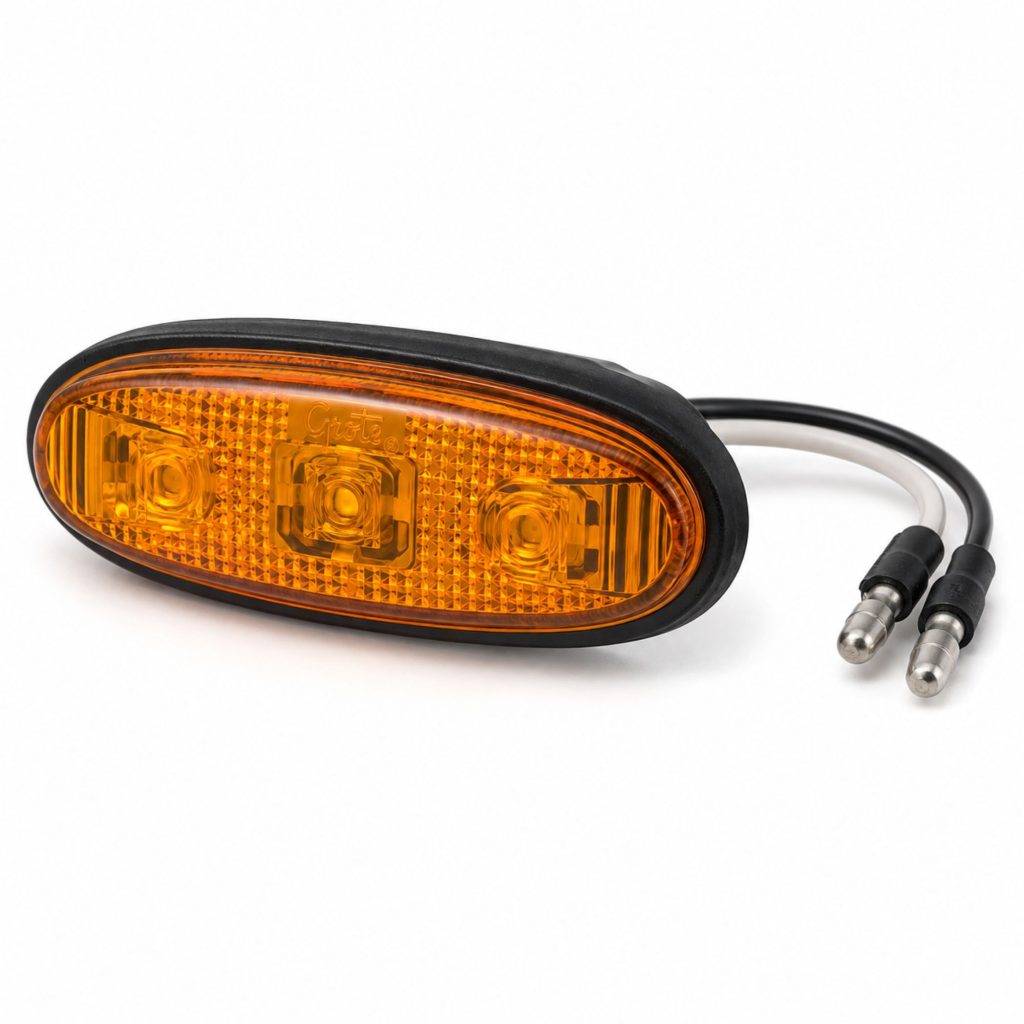
The Grote MicroNova LED Clearance and Marker Lamp is a compact signal lamp designed for commercial vehicles and trailers. Its low-profile housing allows it to fit narrow body panels and other locations where a larger clearance or marker lamp could be difficult to install or more vulnerable to damage.
Depending on the selected part number, a MicroNova lamp may provide red or amber output through a colored or clear lens. Configurations are available for clearance-light, side-marker, or combined PC applications.
The lamp uses a sealed LED design with an encapsulated circuit board to protect its electronics from vibration, corrosion, and environmental exposure. Mounting, color, lens, bezel, connection, voltage, and regulatory function must be confirmed using the complete Grote part number.
Key Characteristics
- Compact LED clearance and marker lamp
- Low-profile aerodynamic design
- Suitable for narrow mounting locations
- Red and amber output options
- Clear and colored lens configurations
- P2 and PC functional classifications, depending on part number
- Sealed LED construction
- Hermetic lens-to-housing seal
- Encapsulated circuit-board protection
- Resistance to vibration and corrosion
- Screw- and grommet-mount configurations
- Multiple bezel finishes available
- Low electrical demand
- Application-specific FMVSS 108 compliance
Major Components
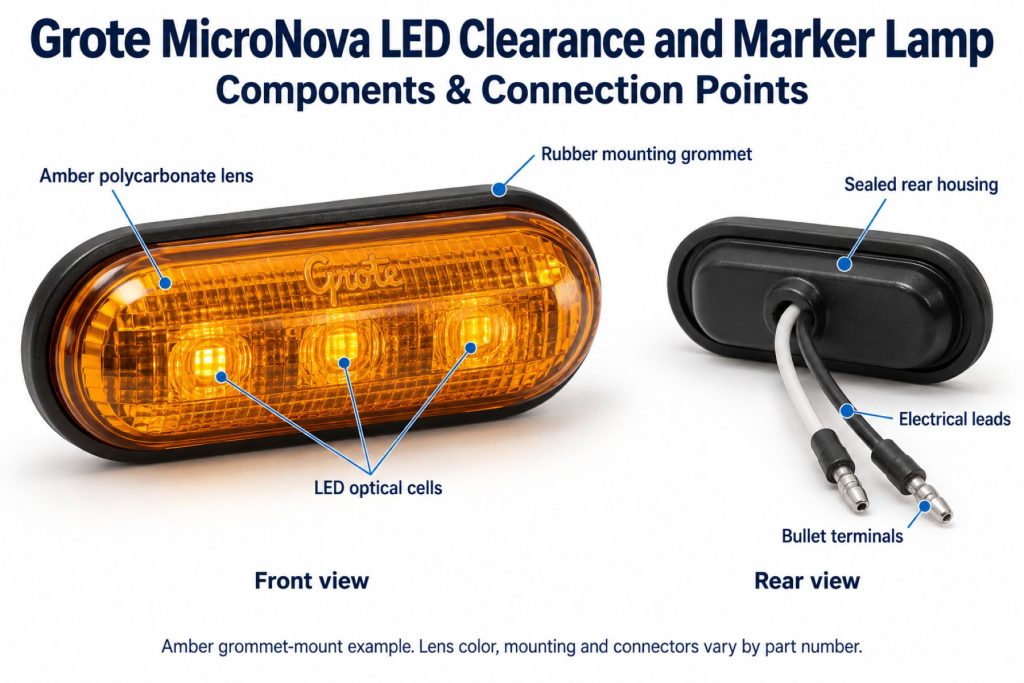
- Outer lens
- LED light source
- Internal circuit board
- Electronic current-control components
- Optical elements
- Sealed lamp housing
- Protective circuit-board encapsulant
- Electrical terminals
- Mounting bezel or flange
- Mounting grommet where equipped
- Mounting screws on applicable versions
- Vehicle wiring connector or pigtail
Product Type and Construction
The MicroNova is a sealed LED lamp rather than a replaceable-bulb assembly. Its LED, circuit board, lens, optics, terminals, and housing operate as one component.
Common configurations use polycarbonate lenses and housings with application-specific bezels. The lens-to-housing interface is hermetically sealed, while protective encapsulant surrounds the circuit board to reduce damage from vibration, moisture, contaminants, and corrosion.
The complete lamp is normally replaced if its lens, housing, LEDs, electronics, or seals fail.
How the LED Lamp Works
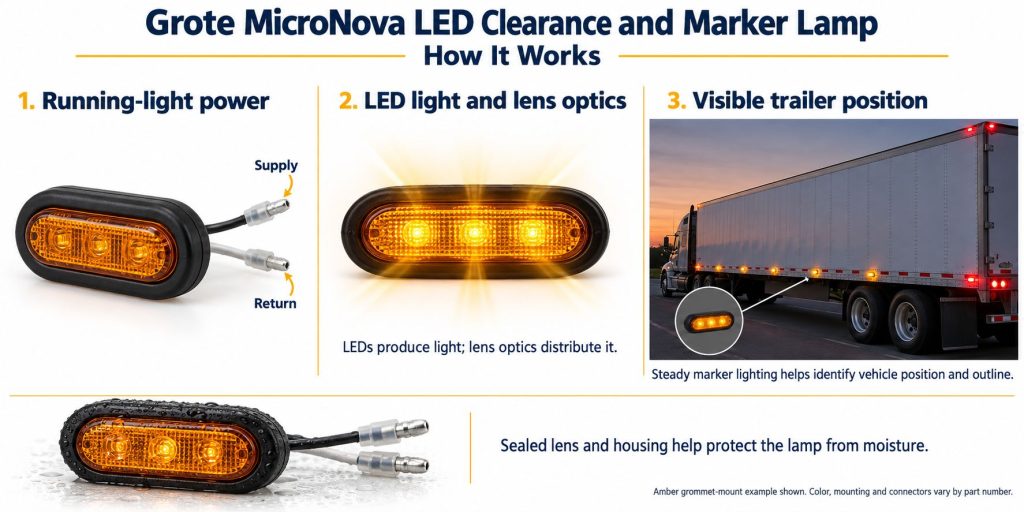
Vehicle-system voltage enters the lamp through its power and ground connections. Internal electronic components regulate current to the LED, which converts electrical energy into visible red or amber light.
The lens and optical design distribute the light through the viewing angles required for the lamp’s approved function. The vehicle normally energizes the lamp whenever its clearance, side-marker, or related running-light circuit is switched on.
Dual-intensity or specialized versions may operate differently and must be connected according to their individual wiring instructions.
Position and Function Within the Vehicle
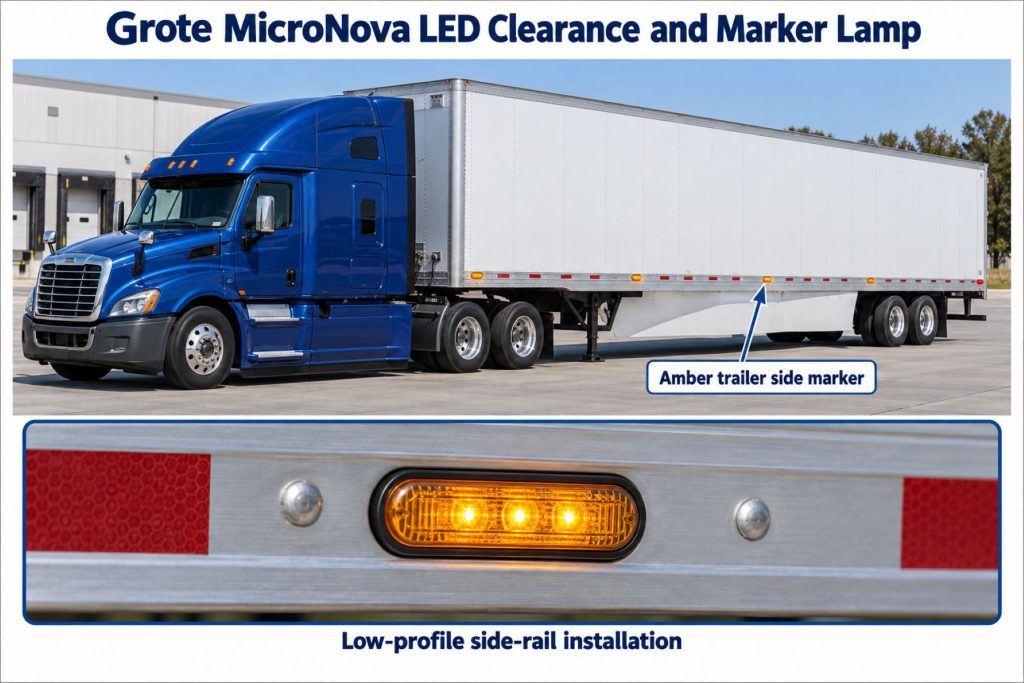
MicroNova lamps may be installed along the front, sides, upper body, rear corners, fenders, or other approved locations on a truck or trailer. The correct position depends on the lamp’s color, function, photometric classification, and vehicle dimensions.
Clearance lamps communicate the vehicle’s overall width and outline. Side-marker lamps help identify the vehicle’s length and presence when viewed from the side. A PC-rated lamp can perform clearance and side-marker functions from one approved installation when mounted in the correct position and orientation.
Common Specifications
- Product Line: Grote MicroNova LED
- Product Type: Clearance and marker lamp
- Lighting Technology: LED
- Common Output Colors: Red or amber
- Lens Options: Red, amber, or clear depending on configuration
- Common Lens Material: Polycarbonate
- Common Housing Material: Polycarbonate
- Common Current Draw: Approximately 0.05 amp on selected configurations
- Mounting Options: Screw or grommet mounting, depending on model
- Connection: Standard .180-inch male bullet on common configurations
- Functional Ratings: P2 or PC depending on part number
- Common Regulation: FMVSS 108, with configuration-specific SAE or additional approvals
- Warranty: Three years on listed MicroNova configurations
Voltage, dimensions, current draw, color, lens, bezel, connector, mounting design, functional classification, and compliance markings must be verified using the exact Grote part number.
Voltage, Current Draw, and Light Output
MicroNova lamps are offered in application-specific electrical configurations. The lamp must be matched to the vehicle’s electrical-system voltage rather than selected only by appearance or color.
Selected versions draw approximately 0.05 amp, allowing multiple clearance and marker lamps to operate with relatively low total electrical demand. Exact current varies by voltage, output color, circuitry, and part number.
Light output must remain sufficient for the lamp’s approved function throughout the required viewing angles. Low voltage, excessive circuit resistance, lens contamination, or incorrect mounting can reduce effective visibility.
Clearance and Side-Marker Performance
A P2-rated lamp may be used as a clearance lamp or side-marker lamp when installed in an approved position, but it does not automatically perform both functions simultaneously.
A PC-rated lamp is designed to provide both clearance and side-marker photometric performance from one lamp when mounted in the required location and orientation. Some PC configurations meet their requirements when installed at a 45-degree angle.
The function marked on the individual lamp should determine how it is installed and used.
Lens, Optics, and Visibility
The lens and internal optics distribute light across the viewing angles required for the approved clearance or marker function. Clear-lens versions use colored LEDs to produce the required red or amber output.
Visibility can be reduced by dirt, road film, snow, ice, paint, body damage, or an incorrect mounting angle. The lens should be cleaned using materials that will not scratch or chemically damage polycarbonate.
Housing, Circuit Board, and LED Design
Grote uses a sealed lens-to-housing design and protective circuit-board encapsulation. These features help isolate the LED electronics from vibration, moisture, corrosion, and road contaminants.
The low-profile housing reduces the distance the lamp projects from the vehicle body. This can help protect it from contact with loading equipment, branches, cargo, and other objects.
Electrical Connection and Circuit Integration
Common MicroNova configurations use standard .180-inch male bullet terminals. The mating connector or vehicle pigtail supplies power and ground from the clearance or marker-light circuit.
The lamp should be connected with correct polarity and through properly protected vehicle wiring. Terminal fit, conductor condition, connector sealing, and strain relief should be checked during installation.
Grounding and Voltage Management
A reliable ground circuit and adequate supply voltage are necessary for normal lamp output. Corrosion, loose terminals, undersized repairs, damaged wiring, or poor frame grounds can create excessive voltage drop.
Voltage should be tested while the lighting circuit is operating. An unloaded circuit can show normal voltage even when resistance prevents the lamp from receiving adequate current.
Environmental Sealing and Corrosion Protection
The hermetic lens-to-housing seal and encapsulated circuit board help protect the lamp from water, road spray, salt, vibration, and corrosion. This protection depends on the housing and lens remaining intact.
The external wiring connection still requires inspection and protection. A sealed lamp can malfunction if the mating connector, pigtail, ground, or vehicle harness becomes corroded or damaged.
Mounting and Installation
Installation depends on whether the lamp uses a grommet, screw-mounted bezel, or another approved mounting arrangement.
Installation should include:
- Confirming lamp color and functional classification
- Matching the lamp to the vehicle voltage
- Verifying the mounting-hole pattern
- Inspecting the body panel for damage or corrosion
- Using the correct grommet, bezel, bracket, or fasteners
- Following the required mounting angle and orientation
- Protecting wiring from sharp edges and moving equipment
- Providing proper connector sealing and strain relief
- Testing the completed lamp from required viewing directions
Vehicle Body and Mounting Compatibility
The vehicle body must provide a suitable mounting surface, correct hole pattern, adequate rear clearance, and an approved location for the lamp’s function.
Compatibility depends on:
- Body-panel material and thickness
- Mounting-hole size and pattern
- Screw, grommet, or bezel mounting
- Available clearance behind the lamp
- Required red or amber output
- P2 or PC function
- Required viewing angles
- Wiring and connector type
- Vehicle-system voltage
- Exposure to impact or abrasion
Vehicle and Electrical-System Compatibility
The replacement lamp must match the vehicle’s voltage, wiring polarity, connector, mounting method, output color, functional classification, and installed position.
A lamp that physically fits may still be unsuitable if its output color, PC or P2 rating, voltage, viewing angle, or compliance markings differ from the original installation.
Common Applications
- Class 7 and Class 8 tractors
- Commercial straight trucks
- Dry-van trailers
- Refrigerated trailers
- Flatbed and platform trailers
- Tank trailers
- Dump trailers
- Lowboy and equipment trailers
- Commercial buses
- Vocational vehicles
- Utility and service bodies
- Construction and agricultural equipment
- Specialized commercial vehicles
Advantages
- Compact size supports narrow installations
- Low-profile housing is less exposed to impact
- LED technology reduces electrical demand
- No replaceable incandescent filament
- Hermetically sealed lens and housing
- Encapsulated circuit-board protection
- Resistance to vibration and corrosion
- Red and amber configurations
- Clear- and colored-lens options
- P2 and PC versions available
- Multiple mounting and bezel choices
- Can simplify replacement in compatible existing mounting locations
Limitations or Considerations
- The sealed lamp is normally replaced as a complete assembly
- Specifications vary significantly by part number
- Red and amber versions are not interchangeable by location
- P2 and PC ratings serve different installation requirements
- Some PC versions require a specific mounting angle
- Physical fit does not confirm regulatory compatibility
- External connectors remain vulnerable to corrosion
- Lens contamination can reduce visibility
- Incorrect voltage can damage the lamp or reduce output
- Improper wiring support can strain the terminals
- Bezel and grommet designs must match the lamp and body opening
Driver and Operator Experience
The lamp normally requires no driver adjustment. Its operation should be confirmed during pre-trip and post-trip inspections by switching on the vehicle’s clearance and marker lights.
Drivers should report lamps that are dark, dim, flickering, loose, cracked, missing, water-damaged, or obscured by dirt, snow, ice, cargo, or vehicle equipment.
Inspection and Wear Points
- Outer lens
- Lamp housing
- Lens-to-housing seal
- Mounting grommet
- Bezel or mounting flange
- Mounting screws and body panel
- Electrical terminals
- Mating connector or pigtail
- Ground circuit
- Wiring near the mounting opening
- Harness clips and strain relief
- Evidence of impact, abrasion, or corrosion
Testing and Electrical Diagnosis
Diagnosis should begin by determining whether the fault affects one lamp, one lighting branch, or the complete clearance and marker circuit.
Testing may include:
- Checking source voltage at the lamp connection
- Performing loaded power-side voltage-drop testing
- Performing loaded ground-side voltage-drop testing
- Inspecting terminals for corrosion or looseness
- Checking fuses or circuit breakers
- Testing the trailer’s tractor-to-trailer connection
- Inspecting the harness for abrasion or broken conductors
- Comparing operation with another identical lamp
- Verifying lamp voltage and polarity
Lamp, Connector, and Wiring Service Life
Service life depends on voltage quality, vibration, installation, sealing, connector condition, wiring support, environmental exposure, and physical impact.
Although the sealed LED lamp is designed for long service, its external connector, pigtail, bezel, grommet, fasteners, and vehicle wiring may require attention sooner. Damaged supporting components should be corrected when the lamp is replaced.
Maintenance and Ownership Notes
Clean the lens regularly and inspect lamp operation during required vehicle inspections. Keep mounting hardware secure, connectors protected, grounds clean, and wiring supported.
Do not open, drill, paint, or modify the sealed housing. Replace the lamp when the lens or housing is cracked, the seal is compromised, internal output has failed, or the terminals are damaged beyond approved repair.
Common Electrical and Lighting Problems
- Lamp does not illuminate: Loss of power, poor grounding, corroded terminals, damaged wiring, reversed polarity, or failed internal electronics may be responsible.
- Dim output: Voltage drop, poor grounding, low system voltage, connector resistance, or a contaminated lens can reduce visible output.
- Intermittent operation: A loose terminal, broken conductor, vibration-related connection problem, or corrosion may interrupt the circuit.
- Water inside the lamp: A cracked lens, damaged housing, failed seal, or impact may have compromised the assembly.
- Lamp becomes loose: Damaged mounting holes, loose screws, a hardened grommet, or an incorrect bezel can reduce retention.
- Connector overheats: Loose terminal contact, corrosion, incorrect repair wiring, or excessive resistance can generate heat.
- Replacement lamp is not compliant: The wrong color, function, mounting angle, voltage, or photometric classification may have been selected.
- Multiple lamps fail together: A fuse, circuit breaker, tractor connection, main harness, switch, controller, or shared ground may be faulty.
Safety and Service Precautions
Secure the vehicle before inspecting or servicing its lighting. Disconnect or isolate the applicable circuit when repairing damaged wiring or terminals.
- Use electrical test equipment rated for the circuit
- Do not short lamp terminals during testing
- Never install a larger fuse to compensate for a fault
- Protect wiring from heat, sharp edges, tires, and moving components
- Do not work beneath unsupported bodies or trailer equipment
- Restore connector sealing and strain relief after service
- Use the correct lamp color and functional classification
- Test all required lighting before returning the vehicle to operation
Identification Information
Product identification may be molded, printed, or labeled on the lamp housing, lens, bezel, packaging, vehicle build records, or lighting-system documentation.
Record the following information before ordering a replacement:
- Complete Grote part number
- MicroNova product-family identification
- Red or amber output
- Clear or colored lens
- P2 or PC functional marking
- System voltage
- Screw- or grommet-mount design
- Bezel color and finish
- Connector and terminal type
- Compliance markings
- Installed position and mounting angle
- Vehicle or trailer manufacturer and model
Buying Considerations
- Confirm the complete Grote part number
- Select the legally required red or amber output
- Match P2 or PC functional requirements
- Verify the vehicle-system voltage
- Choose the correct clear or colored lens
- Match screw, grommet, bezel, or bracket mounting
- Measure the mounting hole and available space
- Confirm the required mounting angle
- Match the terminal and connector arrangement
- Check whether mounting hardware is included
- Verify regulatory markings for the intended position
- Inspect the existing wiring and ground before installation
Variants and Configurations
- Red LED lamps
- Amber LED lamps
- Clear-lens configurations
- Colored-lens configurations
- P2-rated lamps
- PC-rated lamps
- Screw-mounted lamps
- Grommet-mounted lamps
- Chrome-bezel configurations
- Black- or application-specific bezel configurations
- Standard .180-inch bullet connections
- Application-specific electrical configurations
- Individual lamps and mounting assemblies
Comparison to Similar Equipment
Compared with an incandescent clearance lamp, the MicroNova LED uses less current, eliminates the replaceable filament, and offers sealed electronic construction.
Compared with the Grote MicroNova Dot LED Clearance and Marker Lamp, the original MicroNova uses a different housing and mounting architecture. The Dot family includes extremely compact one-inch round configurations and should not be assumed interchangeable.
Compared with the Grote SuperNova LED Clearance and Marker Lamp, the MicroNova emphasizes compact dimensions and narrow mounting locations. SuperNova configurations use larger lamp formats for other commercial-vehicle applications.
Best Fit For
- Narrow truck and trailer body panels
- Locations requiring low-profile marker lighting
- Commercial vehicles exposed to vibration
- Fleets replacing incandescent clearance lamps
- Applications requiring red or amber LED output
- Installations requiring P2 or PC-rated lamps
- Locations where larger protruding lamps are vulnerable to damage
- Vehicle bodies requiring multiple bezel or mounting choices
- Fleets seeking sealed, low-current LED lighting
Related Vehicle and Trailer Types
- Complete Guide to Semi Truck Types
- Dry Van Trailers
- Refrigerated Trailers
- Flatbed Trailers
- Tank Trailers
- Dump Trailers
- Lowboy Trailers
- Vocational Trucks
Related Truck and Trailer Models
- Great Dane Champion
- Great Dane Everest
- Hyundai Translead Dry Van
- Utility 3000D
- Utility 3000R
- Vanguard VXP
- Wabash DuraPlate Dry Van
Related Electrical System Types
- Truck & Trailer Lighting Systems
- Wiring, Connectors & Power Distribution
- LED clearance lamps
- LED side-marker lamps
- PC-rated combination lamps
- Identification lamps
- Stop-turn-tail lamps
- Trailer wiring harnesses
Related Electrical Products
- Grote MicroNova Dot LED Clearance and Marker Lamp
- Grote SuperNova LED Clearance and Marker Lamp
- Grote Turtleback LED Clearance and Marker Lamp
- Grote BriteZone LED Clearance and Marker Lamp
- Truck-Lite Model 33 LED Clearance and Marker Lamp
- Truck-Lite Super 44 LED Stop-Turn-Tail Lamp
- Truck-Lite Model 60 LED Stop-Turn-Tail Lamp
- Grote 4SEE Smart Trailer System
Related Equipment Systems
- Electrical Systems
- Telematics & ELD Systems
- Safety Systems
- Brake Systems
- Tires & Wheels
- Suspension Systems
Related Guides
- Electrical System Guides
- How Commercial Truck Electrical Systems Work
- Commercial Truck and Trailer Lighting Systems Explained
- How to Inspect and Maintain Truck Wiring and Electrical Connections
- LED vs Incandescent Commercial-Vehicle Lighting
- How to Diagnose Commercial Trailer Lighting Problems
Regulatory and Compliance Notes
Commercial vehicles must maintain all clearance, side-marker, and identification lamps required for their width, length, type, and operating jurisdiction.
Lamp color, quantity, mounting height, longitudinal position, spacing, viewing angle, orientation, and functional classification must satisfy applicable requirements. Red lamps are generally used toward the rear, while amber lamps are generally used toward the front and along forward side positions.
A lamp carrying an appropriate compliance marking can still be installed incorrectly. The vehicle manufacturer’s lighting layout and the requirements for the exact lamp function should be followed.
Real World Operating Notes
A dark marker lamp does not always indicate an internal lamp failure. The shared lighting circuit, ground, tractor connection, trailer harness, terminal, fuse, and connector should be tested before the lamp is replaced.
When replacing a lamp, compare the part number and functional markings rather than relying only on color and appearance. Similar MicroNova configurations can have different lenses, bezels, mounting systems, voltage ratings, or photometric functions.
Low-profile lamps are less exposed than larger housings, but they can still be damaged by cargo equipment, pressure washing, body flex, incorrect fasteners, and wiring pulled too tightly behind the panel.
Frequently Asked Questions
What is the Grote MicroNova LED lamp?
It is a compact, low-profile LED clearance and marker lamp designed for commercial trucks, trailers, and equipment.
Is MicroNova the same as MicroNova Dot?
No. They are related Grote product families, but they use different lamp shapes, housings, dimensions, and mounting arrangements.
Is the LED replaceable?
No. The lamp is a sealed assembly and is normally replaced as one component after an internal failure.
What colors are available?
The MicroNova family includes red and amber output configurations. Lens and bezel colors vary by part number.
What is the difference between P2 and PC?
A P2 lamp can serve as a clearance lamp or side-marker lamp in an approved installation. A PC-rated lamp can perform both functions from one correctly positioned and oriented lamp.
Can an amber lamp replace a red lamp?
Not unless amber is permitted for that exact installed location and function. Lamp color is regulated according to vehicle position.
Why does a new lamp remain dark?
The vehicle may have a blown fuse, poor ground, incorrect polarity, damaged wire, corroded connector, voltage problem, or fault elsewhere in the shared lighting circuit.
How is the correct replacement identified?
Use the complete Grote part number and verify output color, lens, voltage, P2 or PC function, mounting system, connector, bezel, and compliance markings.
Availability and Where to Find
Grote MicroNova LED clearance and marker lamps may be available through Grote distributors, commercial-truck dealers, trailer dealers, fleet-parts suppliers, heavy-duty electrical specialists, and online commercial-vehicle parts sellers.
Availability depends on output color, lens, bezel, mounting design, voltage, connector, functional classification, and part number. Current product information and distributor resources are available through the Grote Industries website.
Support Trucking Families
Truck Equipment Atlas supports the mission of Grey Cross, a nonprofit dedicated to helping families of truck drivers who lose their lives while on the road. As the site grows, part of its mission is to bring awareness and support to these families.
Podcast or Video Section
Learn More Through Audio and Video
Truck Equipment Atlas will continue expanding with podcast episodes, interviews, and equipment breakdowns to help drivers and fleets better understand trucks and equipment.
Follow the Growth of Truck Equipment Atlas
Truck Equipment Atlas continues to expand with new truck profiles, trailer coverage, diesel engine pages, equipment system resources, manufacturer information, and educational guides.
Visit our Site Updates page to explore recent additions, project milestones, and upcoming resources as we continue building one of the industry’s growing commercial trucking equipment reference libraries.
View the Latest Site Updates: Truck Equipment Atlas Site Updates