
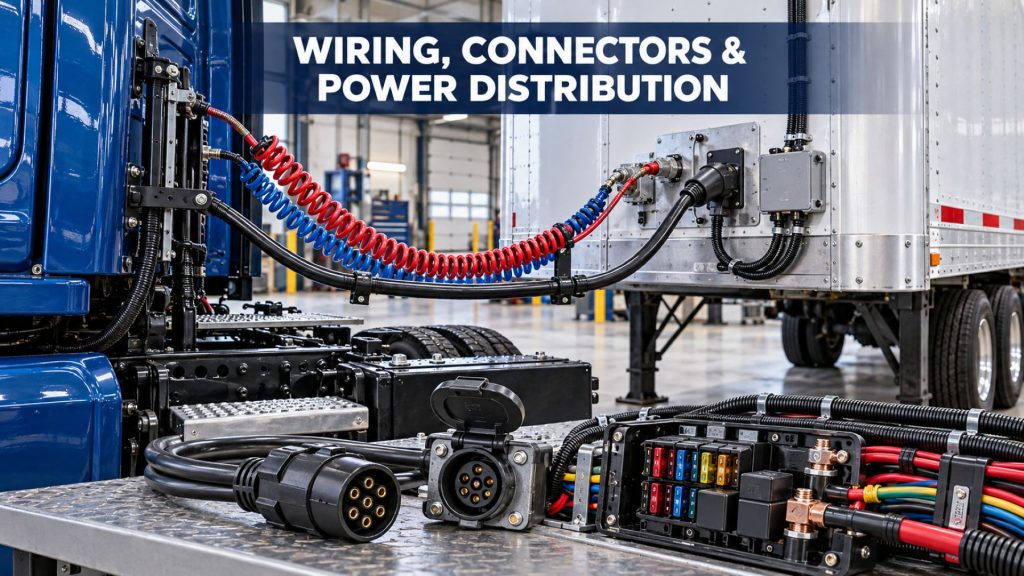
Commercial truck and trailer wiring, connectors, and power-distribution systems route electrical power and control signals between batteries, alternators, starters, lighting, electronic controls, trailers, liftgates, auxiliary equipment, and vocational body systems.
These components must operate while exposed to vibration, moisture, road salt, chemicals, temperature changes, abrasion, repeated coupling cycles, and the high electrical demands found throughout commercial transportation.
Truck Equipment Atlas covers wiring harnesses, battery cables, tractor-trailer electrical cables, seven-way plugs and sockets, junction boxes, nose boxes, relays, fuses, circuit breakers, power-distribution modules, grounding systems, combination air-and-electrical assemblies, maintenance, troubleshooting, and individual products from major manufacturers.
Commercial Wiring and Electrical-Connection Products on Truck Equipment Atlas
Explore the commercial-truck and trailer wiring, connector, and power-distribution products being added to Truck Equipment Atlas:
Phillips Industries
- Phillips STA-DRY QCS2 Electrical Connection System
- Phillips QCP Quick-Change Electrical Plug
- Phillips STA-DRY S7 Seven-Way Connection System
- Phillips 3-in-1 Electrical and Air Combo Assembly
- Phillips STA-DRY QCMS2 Junction Box
- Phillips STA-DRY SLIM-7 Electrical System
Additional wiring harnesses, seven-way connectors, electrical cables, junction boxes, nose boxes, battery cables, grounds, relays, switches, circuit-protection devices, and power-distribution products will be added as the Truck Equipment Atlas Electrical Systems Library continues to expand.
How Commercial Vehicle Wiring Systems Work
Commercial vehicle wiring systems create controlled electrical paths between the power source and the equipment that consumes electricity. Conductors carry current, while connectors, relays, switches, fuses, circuit breakers, controllers, and grounding paths manage how and when that current flows.
The batteries provide stored electrical energy, and the alternator supplies power while the engine is running. Power-distribution equipment divides this electrical supply among starting, lighting, control, body-equipment, trailer, and accessory circuits.
Each circuit must use wiring and protection capable of carrying its expected current without excessive voltage loss or heat. Connectors must also maintain secure electrical contact while protecting terminals from moisture, corrosion, dirt, and physical damage.
Major Wiring and Power-Distribution Components
A commercial truck or trailer electrical-distribution system can include:
- Battery cables and interconnects
- Engine and chassis wiring harnesses
- Cab and body wiring harnesses
- Trailer main harnesses
- Seven-way electrical cables
- Plugs and sockets
- Junction boxes and nose boxes
- Ground straps and ground cables
- Relays and solenoids
- Switches and control modules
- Fuses and fusible links
- Circuit breakers
- Power-distribution centers
- Bulkhead connectors
- Sealed terminal systems
- Liftgate and auxiliary-power connections
The exact arrangement depends on the truck, trailer, electrical architecture, body equipment, control systems, and operating application.
Seven-Way Tractor-Trailer Electrical Connections
A seven-way electrical connection transfers power and control signals between a tractor and semitrailer. The cable connects the tractor socket with the trailer receptacle or nose-box connection.
Depending on the vehicle and wiring standard, the connection may carry circuits for:
- Ground return
- Clearance, marker, and identification lamps
- Left-turn and stop lamps
- Right-turn and stop lamps
- Tail and license-plate lamps
- Antilock braking system power
- Auxiliary or application-specific electrical functions
Pin assignments, voltage, cable capacity, connector style, and vehicle wiring must be verified before installation or repair. Similar-looking connectors may use different wiring arrangements.
Electrical Cables and Combination Assemblies
Tractor-trailer electrical cables must flex as the combination turns while maintaining enough length for articulation without dragging, stretching, or becoming trapped between vehicle components.
Coiled cables help manage excess length by retracting when the tractor and trailer move closer together. Straight cables may be supported by hangers, tender springs, or other cable-management equipment.
Combination assemblies package electrical cables with trailer air-brake lines. These systems can simplify routing and help keep the lines organized, but each electrical and pneumatic connection must remain correctly identified, supported, and protected.
Sealed Connectors and Corrosion Protection
Moisture and road contaminants can enter electrical connectors and create corrosion at terminals, wires, sockets, and splices. Corrosion increases electrical resistance and can cause voltage loss, intermittent operation, heat, and component failure.
Sealed connector systems may use molded housings, protective boots, replaceable cartridges, gaskets, locking rings, strain relief, and corrosion-resistant terminal materials to reduce contaminant entry.
Sealing equipment cannot compensate for damaged housings, incorrect assembly, loose connections, missing protective covers, improper cable routing, or water entering through another part of the harness.
Junction Boxes and Trailer Nose Boxes
A trailer junction box provides an organized location where the main electrical cable connects with trailer wiring circuits. The box may contain terminals, studs, circuit connections, replaceable components, sealing equipment, and labeled wiring positions.
A nose box is generally mounted near the front of the trailer and provides the connection point for the tractor’s electrical cable. It must be positioned where the cable can connect without excessive strain or interference during turning.
Junction boxes and nose boxes should protect electrical connections while remaining accessible for inspection, testing, and repair. Covers, seals, mounting hardware, cable entries, and strain relief should be maintained in serviceable condition.
Wire Size, Current Capacity, and Voltage Drop
Electrical wire must be sized for circuit current, circuit length, allowable voltage drop, insulation temperature, routing environment, and protection requirements.
A wire that is too small can create excessive resistance, voltage loss, and heat. Long cable runs may require larger conductors than short circuits carrying the same current.
Voltage drop can also develop through:
- Loose terminals
- Corroded connectors
- Damaged conductors
- Poor splices
- Undersized wiring
- Worn switches or relays
- Damaged circuit-protection devices
- Poor ground connections
Voltage-drop testing under operating load can reveal circuit resistance that may not appear during an unloaded voltage or continuity test.
Grounding and Return Circuits
Electrical current must return to its source through a dependable ground or return circuit. Commercial trucks and trailers may use dedicated ground wiring, frame-ground connections, or a combination of both approaches.
Poor grounds can cause dim lighting, erratic electronic controls, slow starter operation, incorrect sensor readings, charging problems, intermittent trailer functions, overheated connections, and multiple seemingly unrelated electrical faults.
Ground connections should be clean, tight, protected from corrosion, and attached to approved locations. Paint, rust, undercoating, damaged fasteners, loose straps, and contaminated mounting surfaces can increase resistance.
Fuses, Circuit Breakers, and Power Distribution
Fuses, fusible links, and circuit breakers protect wiring and electrical equipment from excessive current. These devices should be matched to the conductor size, circuit design, expected operating load, and manufacturer requirements.
Power-distribution centers organize multiple protected circuits in one enclosure. They may contain fuses, relays, circuit breakers, terminals, bus bars, electronic modules, and labeled service positions.
A larger fuse or breaker should never be installed to stop repeated openings without identifying the underlying fault. Increasing protection-device capacity can allow the wiring to overheat before the circuit is interrupted.
Harness Routing and Physical Protection
Electrical harnesses must be routed to avoid heat, sharp edges, moving components, pinch points, excessive tension, road debris, and exposure to damaging chemicals.
Harness-protection equipment can include:
- Abrasion-resistant loom
- Heat-resistant sleeving
- Grommets
- Clamps and insulated supports
- Strain-relief fittings
- Sealed bulkhead connectors
- Protective conduit
- Terminal boots and covers
Harnesses should be supported at appropriate intervals without being pulled tightly enough to restrict vehicle articulation, cab movement, suspension travel, or body movement.
Common Wiring and Connection Problems
Electrical wiring and connection problems may be constant or intermittent. Vehicle vibration, movement, temperature, moisture, and electrical load can change how a damaged circuit behaves.
Common problems include:
- Corroded terminals
- Loose connectors
- Damaged connector housings
- Bent or pushed-back terminals
- Broken or partially broken wires
- Chafed insulation
- Short circuits to ground
- Open circuits
- High-resistance connections
- Damaged ground straps
- Water inside junction boxes
- Overheated terminals and connectors
- Incorrectly sized fuses or breakers
- Trailer cables dragging or stretching
- Incorrect pin assignments
Replacing the affected lamp, control, or electronic component without testing its power, ground, connector, and wiring circuits can leave the original fault unresolved.
Wiring and Connector Inspection
Commercial wiring, connectors, and power-distribution equipment should be inspected according to vehicle-manufacturer instructions, component-manufacturer guidance, fleet procedures, and operating conditions.
Important inspection areas include:
- Harness routing and support
- Insulation damage and abrasion
- Connector locking and retention
- Terminal corrosion and heat damage
- Connector seals and protective boots
- Junction-box covers and cable entries
- Tractor-trailer cable length and support
- Battery and high-current cable condition
- Ground straps and attachment points
- Fuse and circuit-breaker condition
- Relay and switch operation
- Voltage drop under load
- Evidence of moisture intrusion
- Evidence of overheating or electrical odor
Electrical testing should use the correct wiring diagrams, connector information, test procedures, and properly rated equipment for the circuit being serviced.
Common Applications
- Long-haul highway tractors
- Regional and day-cab tractors
- Dry van trailers
- Refrigerated trailers
- Flatbed and step-deck trailers
- Container chassis
- Tank trailers
- Dump trailers
- Liftgate-equipped trucks and trailers
- Dump trucks
- Refuse trucks
- Utility and service trucks
- Tow and recovery vehicles
- Construction equipment
- Specialized commercial vehicles
Selecting Wiring, Connectors, and Distribution Equipment
Electrical equipment selection should be based on verified circuit, vehicle, trailer, environmental, mounting, and operating requirements.
Important selection factors include:
- Vehicle electrical-system voltage
- Maximum circuit current
- Wire size and circuit length
- Allowable voltage drop
- Connector type and pin arrangement
- Terminal material and current capacity
- Water and corrosion protection
- Vibration and abrasion exposure
- Operating temperature
- Tractor-trailer articulation
- Cable length and support
- Fuse or circuit-breaker requirements
- Mounting location and service access
- Vehicle and trailer wiring standards
- Replacement-component availability
Purchase price should not be considered separately from sealing, durability, serviceability, electrical capacity, installation requirements, replacement availability, downtime, and expected operating life.
Related Electrical System Categories
- Commercial Truck Batteries & Energy Storage
- Alternators & Charging Systems
- Starters & Starting Systems
- Truck & Trailer Lighting Systems
- Inverters, Converters & Auxiliary Electrical Power
Related Electrical System Guides
- Electrical System Guides
- How Commercial Truck Electrical Systems Work
- Commercial Truck Batteries Explained
- Commercial Truck Alternators and Charging Systems Explained
- Commercial Truck Starters and Starting Systems Explained
- How to Inspect and Maintain Truck Wiring and Electrical Connections
- Commercial Truck and Trailer Lighting Systems Explained
Related Truck and Equipment Resources
- Electrical Systems
- Commercial Trucks
- Commercial Trailers
- Brake Systems
- Telematics & ELD Systems
- Safety Systems
- Equipment Systems
Wiring, Connector, and Power-Distribution Library Expansion
Truck Equipment Atlas will continue expanding its wiring, connector, and power-distribution coverage as additional manufacturers, connection standards, circuit-protection products, vehicle applications, and electrical technologies are added.
Future coverage may include:
- Additional seven-way plugs and sockets
- Tractor-trailer electrical cables
- Trailer nose boxes and junction boxes
- Electrical and air combo assemblies
- Single-pole auxiliary-power connectors
- Liftgate charging connections
- Battery and starter cables
- Ground straps and return circuits
- Power-distribution centers
- Heavy-duty relays and solenoids
- Fuses, breakers, and circuit-protection equipment
- Commercial electrical-connection comparisons
The goal is to build an organized commercial wiring and connection reference that helps drivers, owner-operators, fleets, technicians, students, and equipment buyers understand how these systems operate and where individual products fit within the trucking industry.
Explore the Complete Electrical Systems Library
Visit the Electrical Systems hub to explore batteries, alternators, starters, wiring, electrical connectors, power-distribution equipment, truck and trailer lighting, inverters, converters, auxiliary electrical-power systems, product profiles, and educational guides.
Follow the Growth of Truck Equipment Atlas
Truck Equipment Atlas continues to expand with new truck profiles, trailer coverage, diesel engine pages, equipment-system resources, manufacturer information, and educational guides.
Visit our Truck Equipment Atlas Site Updates page to explore recent additions, project milestones, and upcoming resources.