
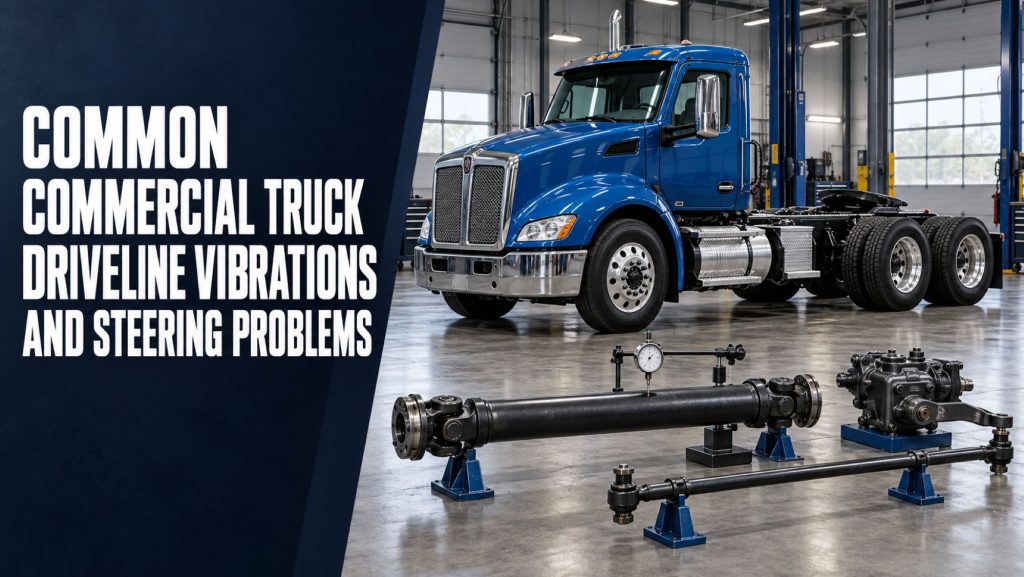
Commercial truck vibrations and steering problems can come from the driveline, tires, wheels, steering system, suspension, axles, brakes, wheel ends, engine, transmission, or several systems acting together. Because many faults create similar symptoms, replacing the first component that appears suspicious can waste time and leave the original problem unresolved.
This guide explains common commercial truck driveline vibrations and steering problems, how operating conditions can help identify their source, and what drivers, owners, and technicians should examine before deciding on repairs.
For an overview of how power travels from the transmission to the drive axles, begin with How Commercial Truck Driveline Systems Work. For steering components and operation, see How Commercial Truck Steering Systems Work.
Why Vibration and Steering Complaints Are Difficult to Diagnose
A vibration felt through the steering wheel may originate at the steer tires, wheel ends, steering linkage, suspension, brakes, or even farther back in the chassis. A vibration felt through the seat or floor may come from the driveshaft, drive tires, engine, transmission, rear suspension, differential, or trailer.
The truck frame can transmit vibration away from its source. A problem at a rear drive axle may therefore be felt in the cab, while an engine or transmission disturbance can appear to come from the driveshaft.
Successful diagnosis begins by documenting exactly when the symptom appears, where it is felt, and what causes it to change.
Important Details to Record
- Road speed when the vibration begins and ends
- Engine speed and transmission gear
- Whether the truck is accelerating, pulling, cruising, coasting, or braking
- Whether the vehicle is loaded, empty, or connected to a trailer
- Whether the symptom changes on smooth and rough roads
- Whether it is felt in the steering wheel, seat, floor, pedals, mirrors, or entire cab
- Whether it occurs during left turns, right turns, or straight-ahead travel
- Whether temperature or operating time affects it
- Whether recent tire, wheel, driveline, axle, suspension, or alignment work was performed
Common Types of Commercial Truck Vibration
| Symptom Pattern | Common Areas to Investigate |
|---|---|
| Changes mainly with road speed | Tires, wheels, hubs, driveshaft balance, driveshaft runout, axle components |
| Changes mainly with engine speed | Engine, accessories, clutch, flywheel, torque converter, mounts, transmission input |
| Worse under acceleration or heavy torque | Universal joints, driveline angles, slip joint, carrier bearing, engine or transmission mounts, pinion movement |
| Worse while coasting | Driveline angles, universal joints, differential bearings, pinion bearings, loose components |
| Appears during braking | Brake drums, rotors, wheel ends, suspension movement, brake imbalance |
| Felt mainly through steering wheel | Steer tires, wheels, balance, runout, kingpins, tie rod, drag link, wheel bearings, front suspension |
| Felt mainly through seat or floor | Drive tires, wheels, driveshafts, carrier bearings, rear suspension, drive axles |
| Changes after connecting a trailer | Trailer tires and wheels, fifth-wheel load, axle alignment, driveline angles, suspension ride height |
Road-Speed-Related Vibration
A road-speed-related vibration increases or changes as vehicle speed changes, regardless of engine rpm or transmission gear. It commonly points toward a rotating component whose speed follows the wheels or driveshaft.
Possible causes include tire imbalance, radial or lateral tire runout, bent wheels, improper wheel mounting, hub runout, driveshaft imbalance, excessive driveshaft runout, damaged universal joints, or worn axle and wheel-end components.
A vibration limited to a narrow speed range can result from resonance, where a small disturbance is amplified by the chassis, cab, suspension, or driveline. The speed at which the vibration is strongest should be recorded before parts are removed.
Engine-Speed-Related Vibration
An engine-speed-related vibration follows engine rpm and may occur while the truck is stationary. This points away from the tires and wheel-driven components and toward the engine, accessories, flywheel, clutch, torque converter, transmission input, exhaust mounting, or powertrain mounts.
A stationary engine-speed test can help separate engine-related vibration from road-speed-related vibration, but it must be conducted safely and within manufacturer procedures. High engine speed should never be used to compensate for an incomplete inspection.
Torque-Related Driveline Vibration
A vibration that becomes stronger during acceleration, hill climbing, or heavy pulling may be related to driveline torque. Torque can change powertrain position, compress suspension components, rotate axle housings, and alter universal-joint operating angles.
Common causes include worn universal joints, incorrect driveline angles, loose yokes, a worn slip joint, failed carrier-bearing support, damaged engine or transmission mounts, worn suspension torque-rod bushings, loose axle mounting, or pinion movement.
When the symptom began after a ride-height adjustment, suspension repair, transmission replacement, axle repair, frame modification, or wheelbase change, driveline geometry should receive immediate attention.
Driveshaft Imbalance and Runout
A driveshaft must rotate around its intended centerline. Missing balance weights, dents, accumulated material, corrosion damage, improper repairs, incorrect assembly, or a bent tube can create imbalance or runout.
Possible symptoms include a speed-sensitive buzz or shake through the floor, seat, sleeper, mirrors, or chassis. The vibration may increase rapidly because driveshaft speed can be several times wheel speed.
Driveshaft runout should be measured at the locations and by the procedures specified for the driveline. A shaft that appears straight during a visual inspection may still exceed its allowable runout. Review Single-Piece vs Multi-Piece Truck Driveshafts for information about common driveline layouts.
Universal-Joint Problems
Universal joints allow power to pass between driveline components operating at changing angles. Wear, inadequate lubrication, contamination, brinelling, loose bearing cups, incorrect installation, improper fastener torque, or joint seizure can create vibration and looseness.
- Clunking when power is applied or released
- Squeaking or chirping at low speed
- Vibration under load
- Visible rust-colored powder near bearing seals
- Loose or rotating bearing cups
- Binding during joint movement
- Heat at a bearing cup after operation
- Damage around yokes, straps, bolts, or retainers
Use How to Inspect and Maintain Driveshafts and Universal Joints for a more detailed inspection and maintenance overview.
Incorrect Driveline Angles
Universal joints operating at an angle do not transmit rotation at perfectly uniform instantaneous speed. A correctly engineered driveline arranges the joints so their speed fluctuations cancel or remain within acceptable limits.
Incorrect transmission, driveshaft, or pinion angles can create a repeating vibration that becomes more noticeable at certain speeds or loads. Causes can include incorrect suspension ride height, worn springs or bushings, loose axle mounting, damaged mounts, axle rotation, frame modifications, or improper component installation.
Angles should be measured with the truck at the specified ride height and operating condition. Changing one component angle without evaluating the entire driveline can make the problem worse.
Driveshaft Phasing
Driveshaft phasing describes the relationship between the yokes in a shaft assembly. Incorrect spline assembly or mismatched yoke orientation can prevent universal-joint speed changes from canceling correctly.
A phasing problem may appear after a slip joint, driveshaft, transmission, carrier bearing, or axle has been removed and reinstalled. Alignment marks and manufacturer specifications should be used rather than assuming the shaft is correctly assembled.
Slip-Joint and Spline Problems
A slip joint allows the driveline to change length as the suspension and powertrain move. Worn splines can create looseness, clunking, imbalance, or poor shaft alignment. Binding splines can prevent normal length change and force loads into the transmission, carrier bearing, universal joints, or axle pinion.
Lubrication, spline condition, seal condition, assembly orientation, and usable travel should be checked according to the exact driveline design. Excessive grease or incorrect assembly can also interfere with proper movement on some systems.
Carrier-Bearing and Multi-Piece Driveshaft Problems
Multi-piece drivelines use a center support or carrier bearing to support an intermediate shaft. The bearing, rubber support, bracket, frame crossmember, and related shaft angles must work together.
- Torn, cracked, collapsed, or softened rubber support
- Rough, loose, or noisy bearing
- Loose mounting bracket or crossmember
- Incorrect bracket height or installed position
- Driveshaft misalignment
- Improper preload where the design specifies it
- Incorrect phasing after driveline service
A replacement bearing may not solve the vibration if incorrect shaft angles, damaged supports, or mounting-position problems remain.
Drive Axle and Differential Problems
Drive axle and differential problems can produce vibration, humming, growling, whine, clunking, or changes between acceleration and coast. Possible sources include pinion bearings, carrier bearings, gear contact, axle shafts, wheel bearings, interaxle components, or incorrect lubricant condition.
A noise that changes distinctly between pull and coast can provide useful diagnostic information, but noise alone does not identify a failed component. Lubricant level, metal contamination, temperature, backlash, bearing condition, and complete axle operation should be evaluated.
Learn how these assemblies transfer power in How Commercial Truck Axles and Differentials Work.
Suspension Ride Height and Axle Movement
Drive-axle suspension geometry directly affects driveshaft and pinion angles. Incorrect air-suspension ride height, leaking air springs, damaged height-control valves, worn bushings, loose torque rods, broken springs, or axle-mounting problems can change driveline alignment.
Worn torque-rod bushings may allow an axle to move or rotate under power and braking. This can create intermittent vibration, clunking, steering correction, rear-axle steer, and irregular tire wear.
Review Truck Suspension Components Explained and How Commercial Truck Suspension Systems Work for additional information about ride height and axle control.
Tire and Wheel Vibration
Tires and wheels are among the most common sources of commercial vehicle vibration. Imbalance is only one possibility. Radial runout, lateral runout, irregular wear, flat spotting, separated components, incorrect mounting, mismatched duals, damaged wheels, and hub-piloting problems can create similar complaints.
- Incorrect inflation pressure
- Uneven or cupped tread wear
- Out-of-round tire or wheel assembly
- Improper wheel centering
- Missing balance weights
- Bent, cracked, corroded, or damaged wheel
- Tire flat spotting after parking
- Mismatched dual-tire size or circumference
- Foreign material inside a tire or attached to a wheel
- Loose or incorrectly tightened wheel fasteners
Use How to Inspect and Maintain Commercial Truck Tires and Aluminum vs Steel Commercial Truck Wheels when checking the tire and wheel assemblies.
Steering-Wheel Shimmy
Shimmy is a rapid side-to-side oscillation felt through the steering wheel. It may occur at a specific speed, after striking a bump, during braking, or under a combination of tire, suspension, and steering conditions.
Possible causes include steer-tire imbalance or runout, loose wheel bearings, worn kingpins, loose tie-rod ends, drag-link wear, steering-gear looseness, damaged wheels, weak shock absorbers, incorrect caster or toe, worn suspension bushings, or bent components.
Shimmy should not be hidden by tightening the steering gear or installing parts without measuring looseness and alignment. The complete steer axle and front suspension must be inspected.
Steering Wander
Wander requires frequent steering corrections to keep the truck traveling straight. It can result from excessive free play, incorrect alignment, low caster, worn linkage, steering-gear problems, tire conditions, suspension movement, rear-axle misalignment, or trailer tracking problems.
- Incorrect steer-tire pressure or mismatched tires
- Worn kingpins or steering knuckles
- Loose tie-rod ends or drag-link joints
- Steering-column or intermediate-shaft wear
- Loose steering-gear mounting
- Incorrect caster, toe, thrust angle, or ride height
- Worn front or rear suspension bushings
- Rear axle or trailer axle misalignment
- Excessive fifth-wheel or coupling movement
Truck Pulls to One Side
A constant pull may come from tire pressure or construction differences, road crown, unequal caster, axle misalignment, suspension ride-height differences, brake drag, wheel-bearing problems, or damaged steering components.
A pull that appears only during braking should direct attention toward brake balance, brake adjustment, friction condition, drum or rotor condition, wheel ends, tires, and suspension movement. Explore the Air Brake Systems library for related braking components.
Steering Looseness and Excessive Free Play
Free play can accumulate through multiple components. A small amount of wear at the column, intermediate shaft, steering gear, pitman arm, drag link, steering arms, tie rod, kingpins, and wheel bearings can combine into a noticeable steering problem.
The system should be observed while an assistant moves the steering wheel through the approved inspection range. The truck must be secured correctly, and the inspection should follow manufacturer and workplace safety procedures.
Hard, Binding, or Inconsistent Steering
High or uneven steering effort can result from low hydraulic fluid, a worn pump, restricted hoses, air in the system, steering-gear problems, seized linkage joints, dry kingpins, excessive front-axle load, tire problems, or electronic steering-assist faults.
Steering that binds at a repeatable wheel position may indicate a mechanical restriction, damaged shaft, incorrect adjustment, kingpin problem, steering-stop interference, or component contact. A sudden change in steering effort requires immediate inspection.
The guide Hydraulic vs Electric-Assisted Commercial Truck Steering explains the differences between common assist-system designs and their service requirements.
Brake-Related Vibration
A vibration or pulsation that occurs mainly during brake application may involve drums, rotors, hubs, wheel bearings, friction components, brake adjustment, or suspension movement. Heat checking, thickness variation, out-of-round drums, rotor runout, contamination, or improper mounting can all affect braking smoothness.
Brake-related steering-wheel movement can also result from unequal braking at the steer axle. Brake components should be inspected together with tires, wheel ends, steering linkage, and front suspension rather than treated as an isolated vibration.
Trailer-Induced Vibration and Steering Correction
A trailer can introduce vibration, pushing, dog tracking, or steering correction through its tires, wheels, axles, suspension, brakes, frame, or coupling. Incorrect trailer axle alignment may cause the trailer to pull sideways and require continuous correction from the driver.
Fifth-wheel position and trailer loading affect tractor axle weights and driveline operating height. Excessive or insufficient steer-axle load can change steering response, while changes in drive-axle suspension height can influence driveline angles.
A Practical Diagnostic Sequence
A consistent diagnostic sequence helps prevent unrelated adjustments and unnecessary parts replacement.
- Verify the complaint and record speed, load, engine rpm, gear, road surface, and operating condition.
- Determine where the vibration is felt and whether it follows road speed, engine speed, torque, braking, or steering input.
- Review recent repairs, tire changes, alignment work, driveline removal, suspension adjustment, and collision history.
- Inspect tires, wheels, wheel fasteners, hubs, wheel bearings, and visible brake condition.
- Inspect steering linkage, kingpins, steering-gear mounting, suspension components, and ride height.
- Inspect driveshaft tubes, yokes, universal joints, slip joints, carrier bearings, fasteners, and balance weights.
- Measure tire and wheel runout, driveline runout, operating angles, ride height, alignment, and component looseness as required.
- Check engine, transmission, axle, and suspension mounts under the conditions that reproduce the symptom.
- Road-test after repair and verify that the original complaint is corrected.
Why Parts Should Not Be Replaced Based on Symptoms Alone
A steering-wheel vibration does not automatically mean a steer tire is out of balance. A driveline vibration does not automatically mean the driveshaft needs balancing. A truck that pulls does not automatically need an alignment.
Measurements should confirm the fault. Tire and wheel runout, wheel-bearing play, steering-linkage movement, ride height, driveline angles, driveshaft runout, universal-joint condition, axle alignment, and brake operation provide better evidence than replacing components by trial and error.
Problems That Require Immediate Attention
- Sudden or severe steering vibration
- Loss or major reduction of steering assistance
- Binding, locking, or inconsistent steering
- Loose steering gear, pitman arm, drag link, tie rod, or steering arm
- Loose wheel, wheel bearing, yoke, universal joint, or driveshaft
- Cracked wheel, driveshaft, axle, frame, or mounting bracket
- Separated tire or rapidly developing tire bulge
- Driveshaft contact with another component
- Severe clunking when power is applied or released
- Vibration accompanied by smoke, overheating, lubricant loss, or burning odor
A vehicle with a serious steering, wheel, tire, brake, axle, or driveline defect should not remain in operation until it has been properly evaluated.
Preventing Driveline and Steering Problems
- Maintain correct tire pressure and inspect tread wear regularly
- Follow wheel-installation and fastener-torque procedures
- Lubricate serviceable universal joints, slip joints, and steering components
- Maintain suspension ride height and replace worn bushings or torque rods
- Inspect driveshafts for dents, missing weights, looseness, and contact
- Keep steering and driveline fasteners properly tightened
- Correct fluid leaks and lubricant-level problems promptly
- Check alignment after suspension, steering, axle, or tire repairs
- Preserve driveline phasing and orientation during disassembly
- Investigate new vibration before it damages additional components
Final Thoughts
Commercial truck vibration and steering problems should be diagnosed as vehicle-system problems rather than isolated component failures. The driveline, tires, wheels, steering, suspension, brakes, axles, wheel ends, engine, transmission, frame, and trailer all influence what the driver feels.
The most useful clues are when the symptom occurs, what changes it, and where it is felt. Combining those observations with physical inspection and accurate measurements helps identify the source without unnecessary adjustments or parts replacement.
Early inspection is important because a minor vibration or steering change can be the first warning of a tire, wheel, universal-joint, bearing, steering-linkage, suspension, or axle problem that may become more serious with continued operation.
Related Truck Equipment Atlas Guides
- How Commercial Truck Driveline Systems Work
- Single-Piece vs Multi-Piece Truck Driveshafts
- How to Inspect and Maintain Driveshafts and Universal Joints
- How Commercial Truck Steering Systems Work
- Hydraulic vs Electric-Assisted Commercial Truck Steering
- How Commercial Truck Axles and Differentials Work
- How Commercial Truck Suspension Systems Work
- How to Inspect and Maintain Commercial Truck Tires
- Explore Equipment System Guides