
Link Cabmate Suspension
Quick Facts
- Manufacturer: Link Manufacturing
- Product Family: Cabmate
- Product Type: Commercial-truck cab air-suspension system
- Suspension Category: Cab suspension
- Installation Position: Between the truck cab and chassis frame
- Primary Applications: Class 7 and Class 8 trucks, highway tractors, vocational trucks, and specialty vehicles
- Suspension Medium: Air springs
- Primary Function: Isolates the cab and occupants from chassis vibration and road shock
- Control Type: Mechanical or electronically controlled, depending on configuration
- Notable Variant: ROI Cabmate semi-active suspension
- Primary Benefit: Improves driver comfort without changing the truck’s axle suspension
Overview
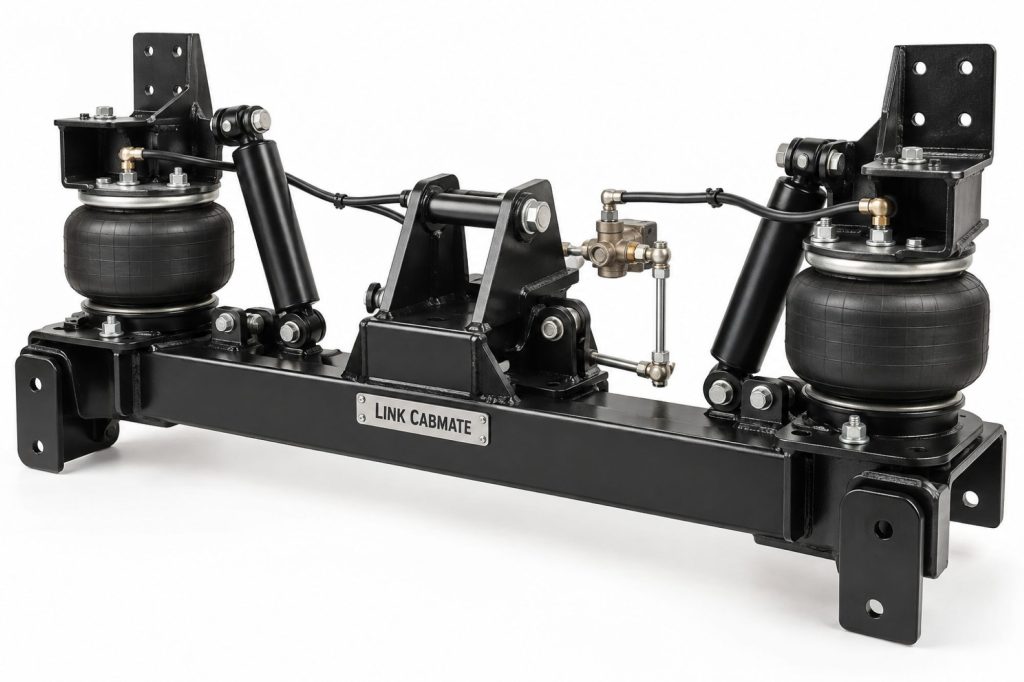
The Link Cabmate is a cab air-suspension system designed to reduce the vibration, shock, and harsh movement transmitted from a commercial-truck chassis into the cab. It is installed between the cab and frame rather than between the frame and axles.
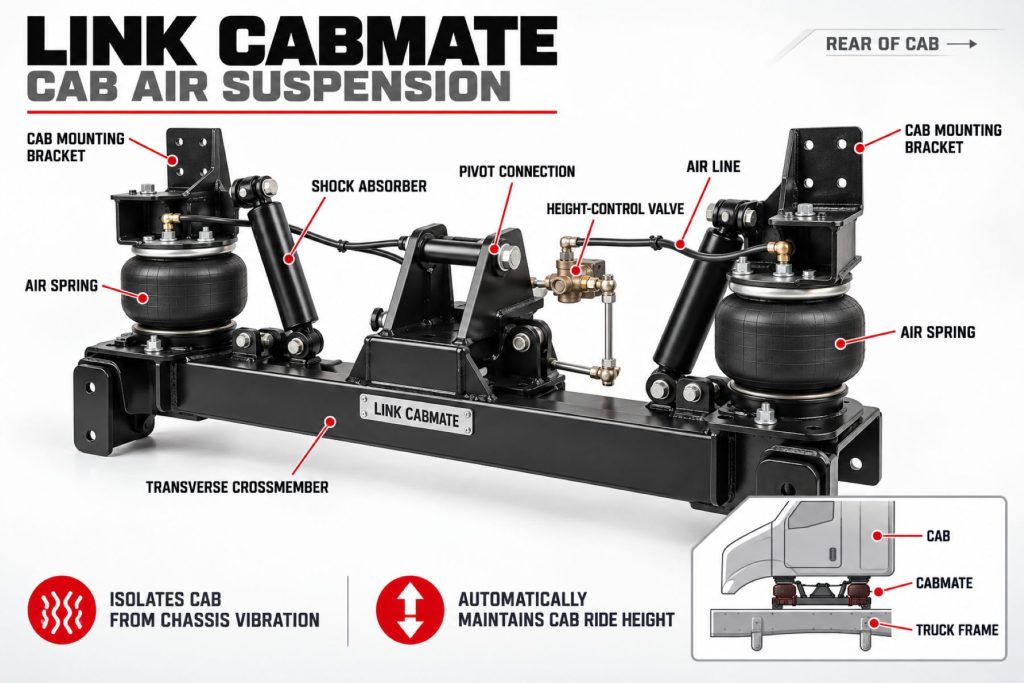
Cabmate systems use air springs, shock absorbers, structural brackets, pivots, and control components to allow limited movement between the cab and chassis. This additional isolation can improve driver comfort on rough highways, construction routes, and other demanding surfaces.
The Cabmate family includes application-specific systems for different truck manufacturers, cab designs, and duty cycles. Link also offers ROI Cabmate technology, which uses electronically controlled semi-active damping to adjust suspension response as operating conditions change.
Because cab mounting arrangements differ among trucks, Cabmate systems are not universal. The correct kit must match the truck manufacturer, model, cab configuration, production year, and original cab-mounting structure.
Key Characteristics
- Commercial-truck cab air suspension
- Installed between the cab and chassis
- Helps isolate occupants from road shock and vibration
- Uses air springs for cab support
- Shock absorbers control cab movement
- Application-specific brackets and mounting hardware
- Available for highway and vocational trucks
- Can supplement the vehicle’s axle suspension
- Designed to improve long-distance driver comfort
- May reduce vibration reaching cab-mounted components
- Mechanical and electronically controlled configurations
- ROI Cabmate offers semi-active damping
Major Components
- Cab support brackets
- Chassis mounting brackets
- Air springs
- Shock absorbers
- Cab pivot or hinge components
- Height-control valve
- Ride-height linkage
- Air lines and fittings
- Lateral-control components
- Crossmembers
- Structural fasteners
- Cab safety restraints
- Optional electronic control module
- Optional sensors
- Optional electronically controlled dampers
- Wiring harnesses on ROI-equipped systems
How the Suspension System Works
The Cabmate supports part of the truck cab on air springs rather than relying entirely on rigid mounts or conventional rubber isolators. This allows controlled movement between the cab and chassis.
When the truck passes over a bump, the chassis moves first. The air springs compress and expand to reduce how much of that movement reaches the cab. Shock absorbers control the cab’s motion and help prevent excessive bouncing, pitching, or rocking.
A height-control valve maintains the designed cab position by adding or releasing air as needed. The valve compensates for changes that may occur when occupants enter the cab or equipment is added.
ROI Cabmate systems add sensors and electronically controlled damping. The system monitors vehicle and cab movement and changes the damper response to balance ride comfort with cab control.
Suspension Position and Function
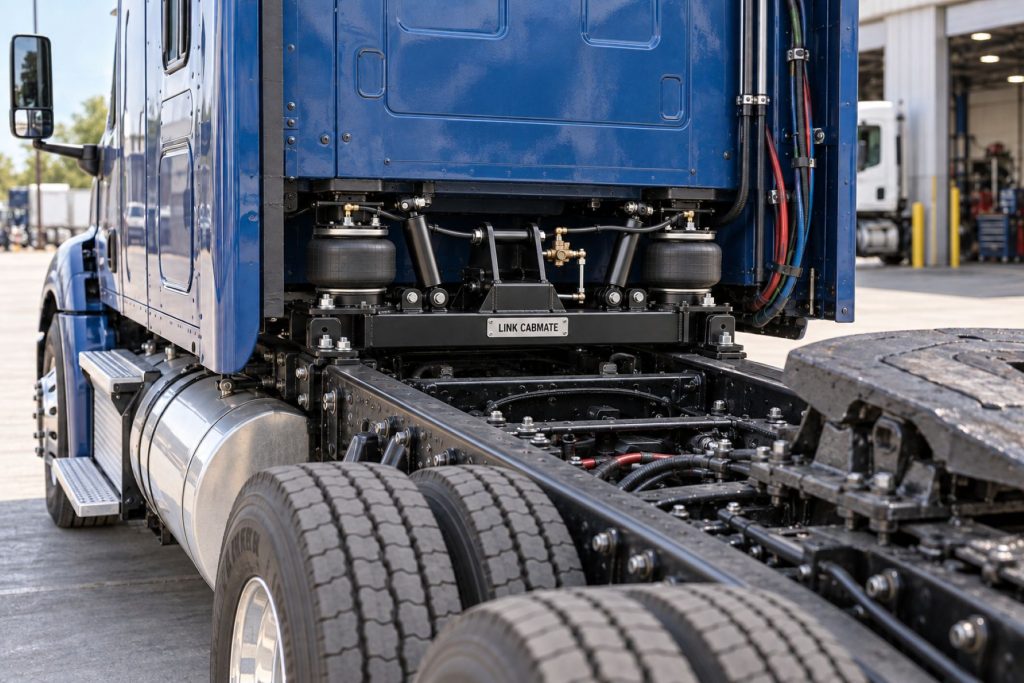
The Cabmate is positioned between the truck cab and chassis frame. Depending on the truck, the air-suspension assembly may support the rear of the cab while front pivots or mounts allow controlled movement.
Its purpose is separate from the truck’s steer- and drive-axle suspensions. The axle suspension manages wheel and chassis movement, while Cabmate provides an additional isolation layer between the moving chassis and cab.
The system helps control:
- Vertical cab movement
- Fore-and-aft pitching
- Side-to-side cab roll
- Road-shock transmission
- Chassis vibration
- Movement caused by rough pavement
- Cab response during braking and acceleration
- Driver exposure to repeated vibration
Common Specifications
- System Type: Cab air suspension
- Installation: Application-specific cab and frame mounting system
- Air Supply: Connected to the truck’s compressed-air system
- Ride Height: Determined by the Cabmate kit and truck application
- Damping: Conventional or electronically controlled shock absorbers
- Cab Support: One or more air springs, depending on design
- Vehicle Classes: Primarily Class 7 and Class 8 commercial vehicles
- Truck Applications: Highway, regional, vocational, and specialty trucks
- Control System: Mechanical height control or semi-active electronic control
- Axle Capacity: Not applicable because Cabmate does not support the vehicle axles
Exact dimensions, air-spring specifications, ride height, brackets, shocks, and control components depend on the individual Cabmate kit.
Capacity, Ride Height, and Axle Travel
Cabmate capacity refers to the portion of cab weight supported by the system rather than the truck’s gross axle weight rating. The correct kit is engineered for a particular cab structure and vehicle application.
Cab ride height must be adjusted to the manufacturer’s specification. Incorrect height can reduce cab travel, change shock-absorber position, damage air springs, create component interference, or affect cab alignment.
The Cabmate does not change axle travel. Steer- and drive-axle movement continues to be controlled by the truck’s main suspension systems.
Available cab travel allows the suspension to absorb chassis movement while preventing the cab from contacting the frame, hood, sleeper, exhaust equipment, or other vehicle components.
Ride Quality and Load Distribution
Cabmate improves ride quality by adding another suspension layer above the chassis. It does not redistribute weight between the truck’s axles.
The system can reduce:
- Sharp impacts entering the cab
- High-frequency chassis vibration
- Repeated vertical movement
- Driver-seat and steering-column vibration
- Harshness from expansion joints
- Cab movement on rough roads
- Vibration reaching interior components
Actual ride improvement depends on the truck’s axle suspension, wheelbase, tires, cab design, seat suspension, payload, road conditions, and Cabmate configuration.
Suspension Controls and Adjustment Options
Standard Cabmate systems typically use a mechanical height-control valve to maintain the required cab position. Air is added or released as the supported weight and cab position change.
Available or application-specific controls may include:
- Mechanical height-control valve
- Adjustable ride-height linkage
- Pressure protection valve
- Air-pressure regulation
- Manual air shutoff for service
- Electronically controlled dampers
- Cab-position sensors
- Acceleration and motion sensors
- ROI electronic control module
- Diagnostic connections
Cabmate ride height should not be adjusted in an attempt to make the suspension softer or firmer. The specified height is necessary for correct travel and component clearance.
Alignment and Suspension Geometry
Cabmate does not control wheel alignment, but its mounting geometry affects cab position relative to the chassis, hood, steering column, pedals, shift controls, sleeper connections, and body panels.
The system should keep the cab centered and level. Worn pivots, loose brackets, damaged bushings, incorrect ride height, or bent mounting components can allow the cab to lean or shift.
Cab-suspension geometry should be checked after:
- Cab removal or replacement
- Cabmate installation
- Collision damage
- Frame repair
- Air-spring replacement
- Pivot or bushing replacement
- Ride-height adjustment
- Appearance of uneven cab gaps
- Discovery of cab-to-frame contact
Axle, Brake, and Wheel-End Options
The Link Cabmate does not include axles, brakes, hubs, bearings, or wheel-end equipment. It operates independently of these systems.
Cab ride quality is still influenced by:
- Steer-axle suspension
- Drive-axle suspension
- Axle ratings
- Tire construction
- Tire pressure
- Wheelbase
- Brake-induced chassis movement
- Wheel and tire balance
- Drive-axle torque reaction
Cabmate can supplement these systems, but it cannot correct worn axle-suspension components, damaged tires, wheel imbalance, or improper chassis alignment.
Common Applications
- Long-haul tractors
- Regional-haul tractors
- Day-cab trucks
- Sleeper tractors
- Vocational trucks
- Dump trucks
- Concrete mixers
- Refuse trucks
- Heavy-haul tractors
- Recovery vehicles
- Municipal trucks
- Specialty commercial vehicles
- Trucks operating on rough roads
- Vehicles with rigid or harsh factory cab mounts
Vehicle, Axle, and Frame Compatibility
Cabmate systems are designed around specific truck, cab, and chassis combinations. A kit for one model should not be assumed to fit another vehicle.
Compatibility depends on:
- Truck manufacturer
- Truck model
- Model year
- Cab type
- Day-cab or sleeper configuration
- Cab width and weight
- Frame width
- Factory cab-mount design
- Exhaust-system placement
- Battery-box and fuel-tank placement
- Steering-shaft clearance
- Shift and control linkage
- Electrical and air-line routing
- Body-builder modifications
Installation should use the application-specific Link kit and approved instructions.
Advantages
- Improves driver comfort
- Reduces vibration entering the cab
- Helps isolate the cab from harsh road impacts
- Can supplement both air and mechanical axle suspensions
- May reduce fatigue during long driving periods
- Can improve ride quality on older trucks
- Application-specific kits simplify installation
- Air springs automatically adjust for normal cab-load changes
- Conventional systems use familiar air-suspension components
- ROI Cabmate provides variable electronic damping
- Can reduce vibration affecting cab-mounted equipment
- Does not require replacement of the truck’s axle suspension
Limitations or Considerations
- Cabmate does not improve axle articulation or load distribution
- It cannot correct worn steer- or drive-axle suspension components
- Requires a dependable compressed-air supply
- Air leaks can cause the cab to sit low
- Incorrect ride height can create cab-to-frame interference
- Mounting kits are vehicle-specific
- Installation may require changes to air lines or cab components
- Cab movement requires clearance around exhaust and body equipment
- Additional pivots, shocks, bushings, and air components require maintenance
- Electronic ROI systems require compatible sensors, wiring, and diagnostics
- Not every truck model has an available Cabmate application
Driver and Operator Experience
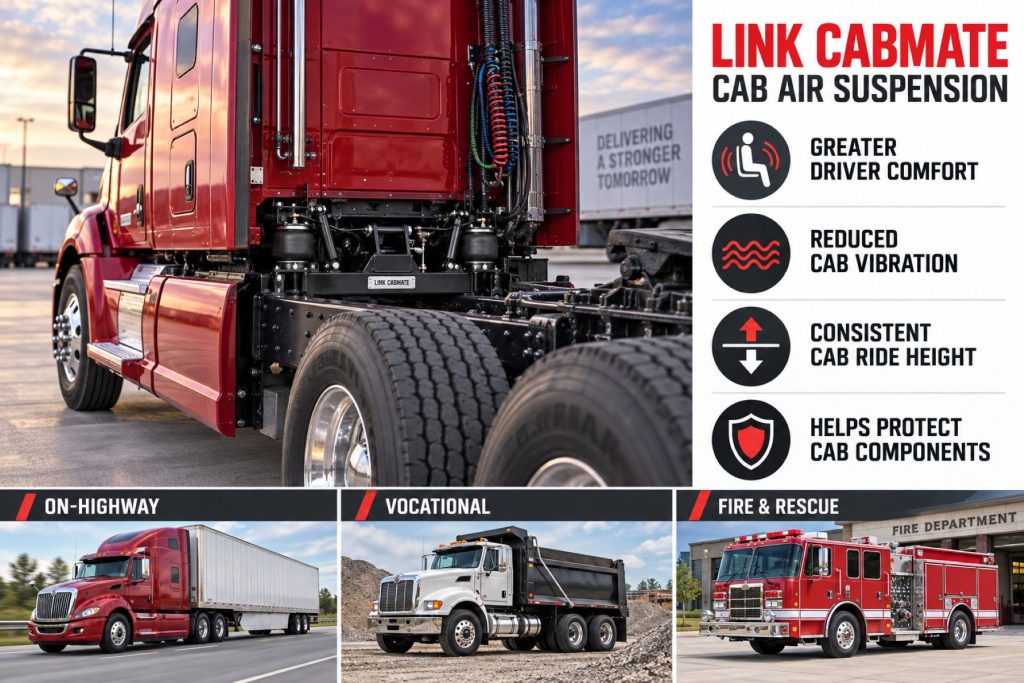
Drivers may notice reduced vertical shock, vibration, pitching, and harsh movement inside the cab. The improvement can be particularly noticeable on older trucks, short-wheelbase tractors, vocational vehicles, and equipment operating on rough pavement.
A cab suspension works alongside the driver’s seat suspension. The two systems should control movement without creating excessive bouncing or an unstable floating sensation.
Warning signs include:
- Cab sitting lower on one side
- Excessive cab bouncing
- Cab contacting the frame
- Frequent air-compressor cycling
- Air leaking behind or beneath the cab
- Unusual clunking from cab mounts
- Changes in hood or body-panel alignment
- Warning lights on ROI-equipped systems
Maintenance and Ownership Notes
- Inspect air springs for cracks, abrasion, cuts, and leaks.
- Check air lines, fittings, valves, and pressure-protection equipment.
- Measure cab ride height at recommended intervals.
- Inspect shock absorbers for leakage and damaged mounts.
- Check pivots and bushings for wear.
- Inspect frame and cab brackets for cracks or looseness.
- Verify critical fastener torque.
- Check safety restraints and travel-limiting components.
- Inspect for cab contact with the frame or surrounding equipment.
- Check steering-shaft and control-linkage clearances.
- Inspect wiring and sensors on ROI-equipped systems.
- Keep electronic connectors clean and protected.
- Check the truck’s main axle suspensions when diagnosing poor ride quality.
- Support the cab correctly before servicing the suspension.
Common Suspension Problems
- Air leaks: Damaged air springs, hoses, fittings, or valves can cause the cab to settle.
- Incorrect cab ride height: A faulty height-control valve, bent linkage, incorrect adjustment, or air restriction can position the cab too high or too low.
- Excessive bouncing: Worn shock absorbers, incorrect ride height, damaged air springs, or unsuitable damper control can allow too much movement.
- Cab leaning: Uneven air pressure, damaged brackets, worn bushings, incorrect installation, or cab-weight imbalance may be responsible.
- Clunking noises: Loose fasteners, worn pivots, damaged bushings, or cab-to-frame contact can produce noise.
- Air-spring abrasion: Incorrect positioning or interference with brackets, lines, or debris can damage the air spring.
- Cab misalignment: Worn mounts, bent brackets, frame damage, or incorrect ride height can alter cab position.
- Electronic faults: ROI-equipped systems may develop sensor, wiring, connector, control-module, or electronically controlled damper problems.
- Poor ride after installation: Incorrect ride height, unsuitable shock absorbers, loose mounting hardware, or problems elsewhere in the vehicle suspension may be responsible.
Identification Information
Cabmate identification may be found on labels attached to the suspension assembly, brackets, air springs, shocks, or electronic components.
Record the following information:
- Truck manufacturer
- Truck model
- Vehicle identification number
- Model year
- Cab type
- Day-cab or sleeper configuration
- Cabmate kit number
- Cabmate assembly number
- Air-spring part number
- Shock-absorber part number
- Height-control valve number
- Bracket identification
- ROI control-module number when equipped
- Sensor and wiring-harness numbers
Do not order a Cabmate system based solely on the truck’s exterior appearance. Cab mounting structures can change within the same truck model or production year.
Buying Considerations
- Confirm that Link offers a kit for the exact truck application.
- Verify the truck model, VIN, model year, and cab type.
- Determine whether the truck has a day cab or sleeper.
- Inspect the factory cab mounts and frame.
- Choose between conventional Cabmate and ROI Cabmate where available.
- Review required air-system connections.
- Confirm clearance around exhaust and emissions components.
- Check compatibility with steering and shift controls.
- Determine whether installation requires cab lifting.
- Review replacement-parts availability.
- Compare the purchase and installation cost with expected comfort benefits.
- Inspect used systems for missing brackets, worn pivots, and damaged air springs.
- Use a complete application-specific kit whenever possible.
Variants and Configurations
Cabmate is a family of application-specific cab suspensions rather than one universal assembly.
Configurations may differ by:
- Truck manufacturer
- Truck model
- Model year
- Day-cab or sleeper application
- Cab size and weight
- Frame width
- Mounting-bracket design
- Number and position of air springs
- Shock-absorber arrangement
- Ride-height specification
- Mechanical height control
- Electronically controlled damping
- Highway or vocational duty cycle
- Original-equipment or retrofit installation
The correct kit number should be used when identifying parts or comparing configurations.
Comparison to Similar Equipment
Compared with rigid cab mounts, Cabmate allows controlled cab movement and provides greater isolation from chassis vibration and road shock.
Compared with rubber cab isolators, Cabmate uses air springs and shock absorbers to provide a greater range of controlled movement.
Compared with a suspended driver’s seat, Cabmate supports and isolates the entire cab rather than only the driver. The two systems can work together.
Compared with the Link ROI Cabmate, a conventional Cabmate system uses passive shock absorbers. ROI Cabmate uses electronically controlled semi-active damping to respond to changing road and vehicle conditions.
Compared with the Link UltraRide Suspension, Cabmate supports the truck cab rather than the vehicle frame and axles. UltraRide is a chassis and axle suspension system.
Best Fit For
- Long-haul drivers seeking improved comfort
- Trucks with harsh factory cab mounts
- Older highway tractors
- Regional trucks operating on uneven roads
- Vocational trucks exposed to repeated impacts
- Short-wheelbase vehicles
- Heavy-haul tractors
- Fleets focused on driver retention
- Operators experiencing excessive cab vibration
- Vehicles with an approved Cabmate application
- Trucks where replacing the axle suspension is impractical
Related Vehicle and Trailer Types
- Complete Guide to Semi Truck Types
- Day Cab vs Sleeper Truck: Which Is Right for Your Operation?
- Class 6 vs Class 7 vs Class 8 Trucks
- Sleeper tractors
- Day-cab tractors
- Vocational trucks
- Heavy-haul tractors
- Regional-haul trucks
- Construction trucks
- Municipal trucks
- Specialty commercial vehicles
Related Truck and Trailer Models
- Freightliner Cascadia
- Freightliner 114SD
- Freightliner 122SD
- International LT Series
- International HX Series
- Kenworth T680
- Kenworth T880
- Peterbilt 567
- Peterbilt 579
- Mack Anthem
- Mack Granite
- Volvo VNL
- Volvo VHD
- Western Star 47X
- Western Star 49X
Related Suspension Types
- Air Suspension Systems
- Link UltraRide Suspension
- Cab air suspensions
- Semi-active cab suspensions
- Passive cab suspensions
- Driver-seat suspensions
- Rear drive-axle air suspensions
- Steer-axle suspensions
Related Equipment Systems
- Suspension Systems
- Steer Axle & Front Suspensions
- Air Brake Systems Explained
- Cab mounting systems
- Driver-seat suspensions
- Truck air systems
- Shock absorbers
- Steering systems
- Tires and wheels
- Electronic control systems
Related Guides
- Suspension System Guides
- How Commercial Truck Suspension Systems Work
- Air Suspension vs Leaf Spring Suspension
- How to Choose a Commercial Truck Suspension
- Truck Suspension Components Explained
- Truck vs Trailer Suspension Systems
- Understanding Horsepower vs Torque
Regulatory and Compliance Notes
Cabmate does not change the truck’s gross axle weight rating, gross vehicle weight rating, legal carrying capacity, or axle-weight limits.
Installation must preserve the safe operation of the steering shaft, brake controls, accelerator controls, shift linkage, electrical wiring, air lines, hood, cab latches, and occupant-restraint systems.
Cab and frame modifications should follow Link’s application instructions and any requirements established by the truck manufacturer or a qualified engineer.
The cab must remain securely attached to the chassis even if an air spring, shock absorber, or air-system component fails.
Real World Operating Notes
Poor truck ride quality does not always originate in the cab suspension. Tires, wheel balance, steer-axle shocks, drive-axle suspension, fifth-wheel position, driveline vibration, and the driver’s seat should also be inspected.
A Cabmate system adjusted too high may feel stiff because it has insufficient rebound travel. A system adjusted too low may bottom against the frame or operate with reduced jounce travel.
Cab movement should be checked after exhaust, sleeper, body, or chassis equipment is modified. Components that were clear with rigid mounts may contact the cab after an air-suspension conversion.
Electronic ROI systems should be diagnosed using the correct service information. Replacing electronically controlled dampers without testing sensors, wiring, and power supply may not correct the problem.
Frequently Asked Questions
What is the Link Cabmate?
The Link Cabmate is an air-suspension system installed between a commercial-truck cab and chassis to reduce vibration and road shock reaching the driver.
Is Cabmate an axle suspension?
No. It supports the cab rather than the truck’s axles. The original steer- and drive-axle suspensions remain in place.
Does Cabmate increase the truck’s payload capacity?
No. It is designed to improve cab ride quality and does not increase axle or vehicle weight ratings.
Can Cabmate be installed on any truck?
No. Cabmate systems use application-specific brackets and components. The correct kit must match the truck, model year, and cab configuration.
What is ROI Cabmate?
ROI Cabmate is a semi-active version that uses sensors, electronic controls, and variable damping to adjust cab-suspension response.
Does Cabmate replace the driver’s air-ride seat?
No. Cabmate supports the cab while the seat suspension supports the driver. Both systems can be used together.
What causes a Cabmate-equipped cab to sit low?
Possible causes include an air leak, damaged air spring, faulty height-control valve, restricted air line, incorrect adjustment, or damaged mounting component.
Why is Cabmate ride height important?
Correct height preserves suspension travel, cab alignment, shock position, air-spring shape, and clearance around the cab.
Can Cabmate reduce driver fatigue?
Reducing repeated vibration and harsh impacts may improve comfort and help reduce physical fatigue, although individual results depend on the truck, route, and driver.
How can the correct Cabmate parts be identified?
Use the truck VIN, model year, cab configuration, Cabmate kit number, and component part numbers.
Availability and Where to Find
Link Cabmate systems and replacement components may be available through Link Manufacturing distributors, commercial-truck dealers, specialty suspension installers, heavy-duty parts suppliers, and truck-restoration shops.
Availability depends on the truck manufacturer, model, model year, cab style, and current application listing. Older kits may require superseded components or individual replacement parts.
Before purchasing a complete system, confirm that the kit includes all application-specific brackets, pivots, air springs, shocks, valves, air lines, fasteners, and installation instructions.
Current product information, application assistance, service resources, and distributor support are available through the Link Manufacturing website.
Support Trucking Families
Truck Equipment Atlas supports the mission of Grey Cross, a nonprofit dedicated to helping families of truck drivers who lose their lives while on the road. As the site grows, part of its mission is to bring awareness and support to these families.
Podcast or Video Section
Learn More Through Audio and Video
Truck Equipment Atlas will continue expanding with podcast episodes, interviews, and equipment breakdowns to help drivers and fleets better understand trucks and equipment.
Follow the Growth of Truck Equipment Atlas
Truck Equipment Atlas continues to expand with new truck profiles, trailer coverage, diesel engine pages, equipment system resources, manufacturer information, and educational guides.
Visit our Site Updates page to explore recent additions, project milestones, and upcoming resources as we continue building one of the industry’s growing commercial trucking equipment reference libraries.
View the Latest Site Updates: Truck Equipment Atlas Site Updates