
Hendrickson HAS Air Suspension
Quick Facts
- Manufacturer: Hendrickson
- Product Type: Rear drive-axle air suspension
- Suspension Family: HAS
- Primary Configurations: Single- and tandem-drive axle systems
- Common Tandem Ratings: 40,000 and 46,000 pounds
- Primary Use: On-highway and moderate vocational operation
- Off-Highway Approval: Up to 25 percent of operation for approved HAS 40K and HAS 46K applications
- Lift-Axle Compatibility: Approved configurations are available for vehicles equipped with lift axles
- Optional Feature: Hendrickson EDGE System for reducing driveline vibration
- Page Slug: hendrickson-has-air-suspension
Overview
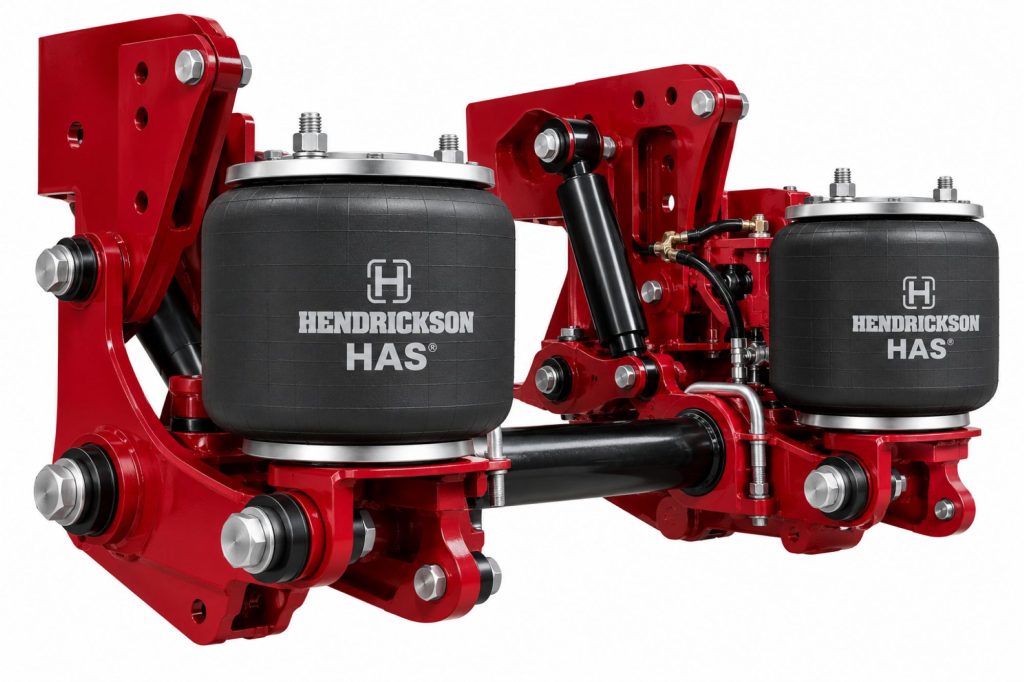
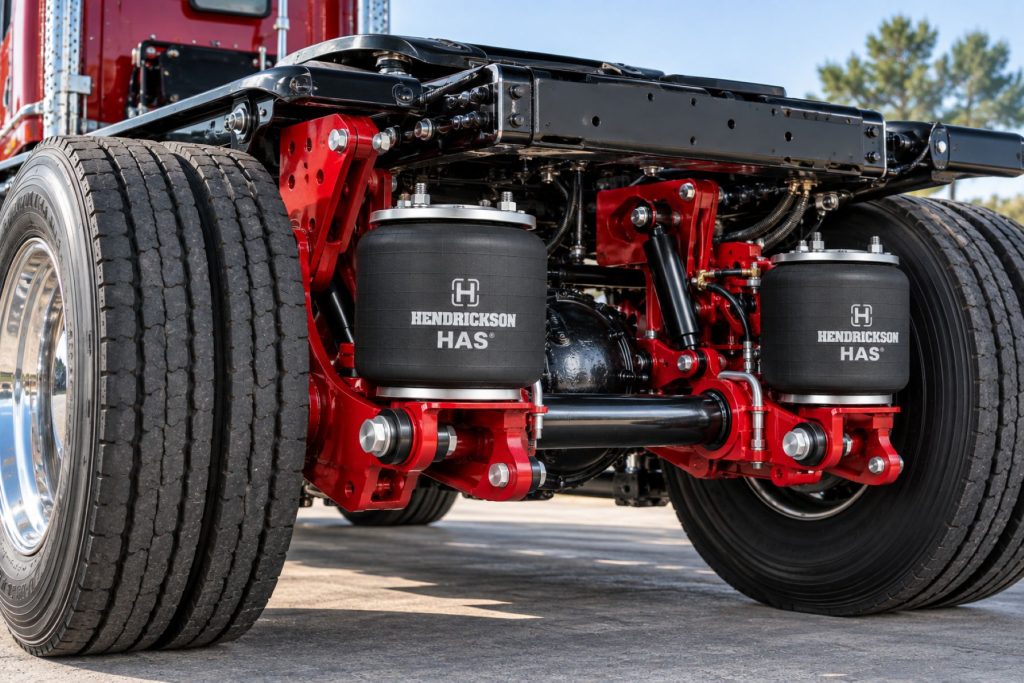
The Hendrickson HAS is a lightweight rear drive-axle air suspension family designed for commercial trucks and tractors that need improved ride quality without giving up vocational capability. It combines air springs, structural suspension members, axle-control components, shock absorbers, and ride-height controls to support the vehicle while isolating the frame and cargo from road impacts.
HAS 40K and HAS 46K tandem configurations are designed for fleets that divide their time between paved highways and moderate off-highway environments. Approved applications can operate off-highway for up to 25 percent of their duty cycle, making the suspension suitable for vocational vehicles that still accumulate substantial highway mileage.
Key Characteristics
- Lightweight air-suspension design for rear drive axles
- Available in single- and tandem-axle configurations
- Improved ride quality compared with many traditional mechanical suspensions
- Designed to help protect the vehicle, driver, and cargo from road shock
- HAS 40K and HAS 46K versions support moderate on/off-highway duty cycles
- Approved configurations can be used with auxiliary lift axles
- Optional EDGE System can help reduce driveline vibration
- Application details vary according to vehicle manufacturer, axle arrangement, frame layout, and intended duty cycle
Major Components
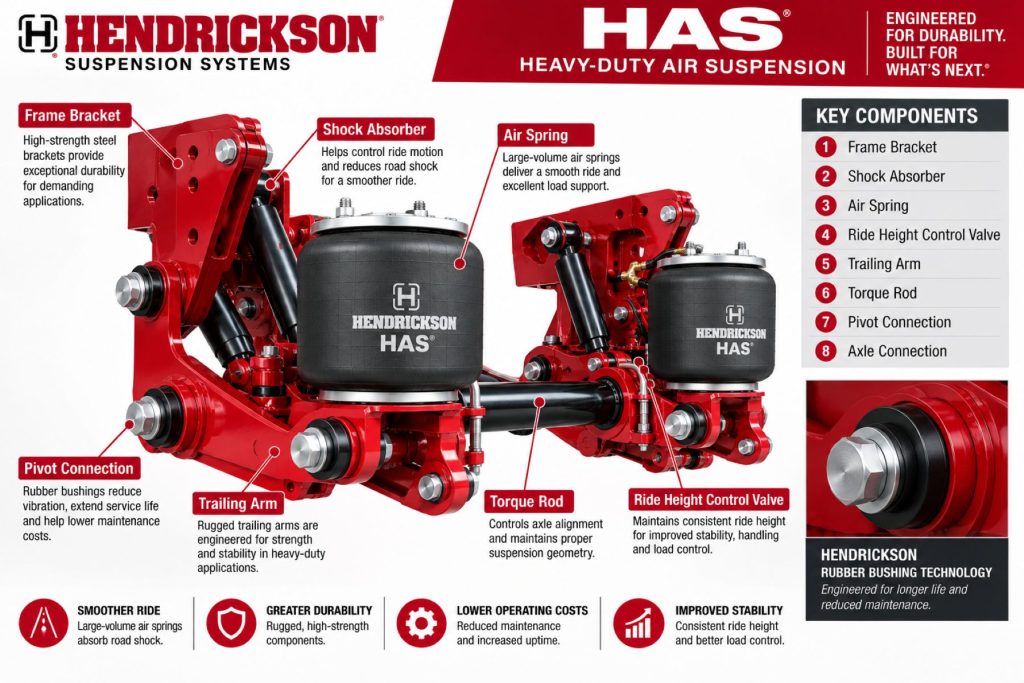
- Air springs supporting the chassis above the drive axles
- Structural suspension members connecting the axles to the vehicle frame
- Longitudinal and transverse torque rods controlling axle movement
- Shock absorbers controlling suspension oscillation
- Height-control valve and connecting linkage
- Air lines, fittings, mounting brackets, and related hardware
- Axle seats, frame brackets, and suspension attachment points
- Optional inboard rear shock-absorber mounting system on compatible HAS 40K and HAS 46K installations
- Optional Hendrickson EDGE driveline-management components where specified
How the Suspension System Works
The HAS suspension carries the rear portion of the vehicle on compressed-air springs. The air springs compress and expand as the axles move over bumps, dips, and uneven surfaces, reducing the amount of road shock transferred directly into the frame.
A height-control valve monitors the relationship between the axle and chassis. When vehicle loading changes, the valve adds or releases air to return the suspension to its specified ride height. This allows the suspension to maintain relatively consistent chassis height across a range of payload conditions.
Torque rods and structural suspension members control longitudinal, lateral, and rotational axle movement. Shock absorbers damp repeated movement after the suspension reacts to a road impact.
Suspension Position and Function
The HAS is installed at the rear drive-axle position of a truck or tractor. Tandem versions support and locate both rear drive axles while distributing vehicle weight across the axle group.
Its primary functions are to support the rear chassis, maintain the designed ride height, control axle movement, improve loaded and unloaded ride quality, and keep the drive axles properly positioned relative to the frame and driveline.
Common Specifications
- HAS 40K Rated Capacity: 40,000 pounds
- HAS 46K Rated Capacity: 46,000 pounds
- Axle Arrangement: Tandem rear drive axles for HAS 40K and HAS 46K
- Operating Environment: On-highway with approved moderate off-highway use
- Approved Off-Highway Operation: Up to 25 percent for compatible HAS 40K and HAS 46K applications
- Lift-Axle Use: Permitted in approved vehicle configurations
- Shock Configuration: Standard mounting or an available inboard rear shock arrangement on certain HAS 40K and HAS 46K installations
- Ride Height: Varies by model, axle spacing, chassis, and OEM installation
- Installed Weight: Varies by configuration and included mounting hardware
Specifications must be confirmed using the vehicle manufacturer’s build information and the applicable Hendrickson literature. Suspension capacity does not automatically increase the legal rating of the axles, tires, wheels, brakes, frame, or complete vehicle.
Capacity, Ride Height, and Axle Travel
HAS capacity depends on the selected model and complete vehicle configuration. The 40,000-pound HAS 40K is intended for common tandem-drive applications, while the HAS 46K provides a higher nominal suspension rating for approved vocational configurations.
Correct ride height is essential. It affects available suspension travel, air-spring position, driveline angles, shock-absorber travel, and load distribution. A suspension operating above or below its specified ride height can experience poor ride quality, reduced component life, or driveline vibration.
Axle travel varies according to the HAS model, ride height, axle spacing, frame configuration, and installed components. Operators should not assume that every HAS installation has identical articulation or clearance.
Ride Quality and Load Distribution
The HAS uses air springs to provide a more compliant ride than many mechanical tandem suspensions. This can improve driver comfort and reduce shock transferred into the cab, chassis-mounted equipment, and cargo.
The leveling system helps maintain chassis height when payload changes, but it does not replace proper loading practices. Cargo placement, auxiliary-axle deployment, fifth-wheel position, axle spacing, and chassis configuration continue to determine the actual weight carried by each axle.
Suspension Controls and Adjustment Options
The principal automatic control is the ride-height control system. Its valve and linkage add or exhaust air as loading changes.
Depending on the vehicle, additional controls may include suspension air-pressure gauges, dump valves, auxiliary-axle controls, or interlocks. These features are normally supplied as part of the truck’s chassis and pneumatic-control package rather than as universal components of every HAS installation.
Ride height, axle alignment, and driveline angles must be adjusted according to the specifications for the exact suspension and chassis configuration.
Alignment and Suspension Geometry
Correct axle alignment limits irregular tire wear, vehicle pull, increased rolling resistance, and unstable tracking. Alignment should be checked after collision damage, suspension repairs, torque-rod replacement, axle movement, or persistent tire-wear complaints.
Ride height must be checked before diagnosing driveline-angle or alignment problems. A vehicle with incorrect ride height may produce symptoms that resemble an axle-alignment or driveline defect.
Torque rods, bushings, frame brackets, axle attachments, and fasteners should be inspected whenever unexplained axle movement is found.
Axle, Brake, and Wheel-End Options
The HAS is used with compatible commercial drive axles and can be installed with drum- or disc-brake packages according to the vehicle manufacturer’s specifications. Wheel hubs, bearings, seals, tires, and wheels are selected as part of the complete axle and chassis package.
The suspension’s rated capacity does not override the ratings of the connected components. The usable vehicle rating is limited by the lowest-rated part of the complete system.
Common Applications
- Vocational trucks that operate primarily on paved roads
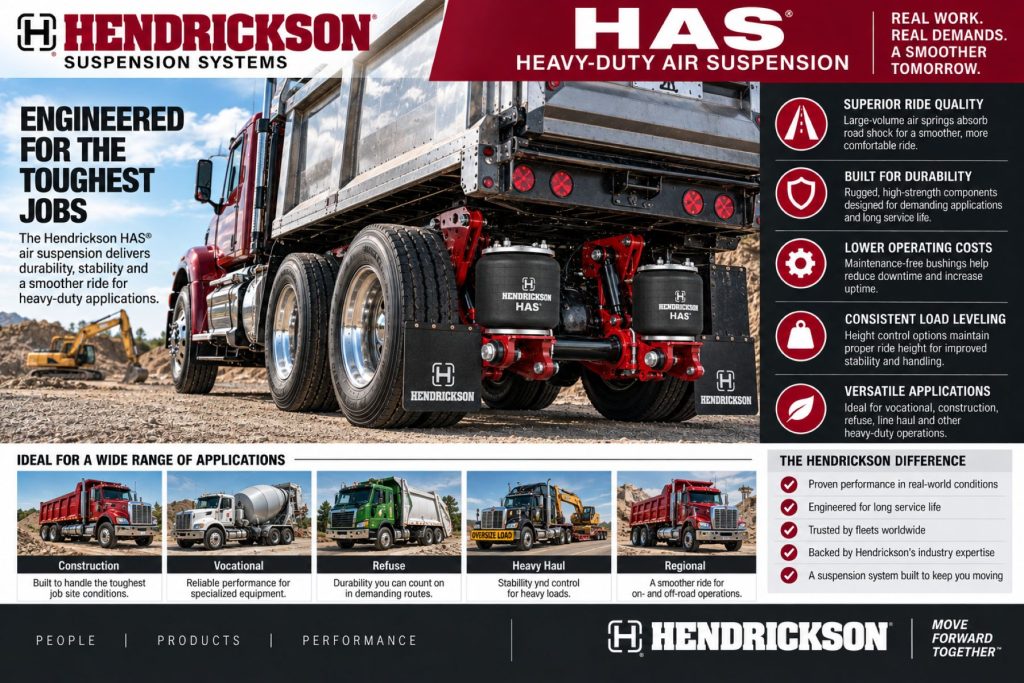
- Dump trucks with moderate off-highway exposure
- Bulk-haul and construction-material vehicles
- Refuse and municipal equipment in approved configurations
- Vocational tractors
- Platform, tank, and specialized hauling vehicles
- Trucks using an auxiliary lift axle in an approved chassis configuration
- Vehicles requiring improved ride quality and cargo protection compared with a mechanical suspension
Vehicle, Axle, and Frame Compatibility
Compatibility depends on the exact HAS model, frame dimensions, axle spacing, drive-axle model, driveline geometry, brake package, crossmember placement, and vehicle manufacturer approval.
HAS 40K and HAS 46K are intended for tandem-drive applications. The broader HAS family has also included single-drive axle arrangements for selected truck and tractor applications.
A suspension should not be selected only by its nominal capacity. Frame strength, axle ratings, tire and wheel capacity, braking capability, gross vehicle weight rating, and gross combination weight rating must support the intended operation.
Advantages
- Improved loaded and unloaded ride quality compared with many mechanical suspensions
- Reduced road shock transmitted into the chassis, cargo, and cab
- Relatively consistent chassis height as payload changes
- Lightweight construction for a vocational-capable rear air suspension
- 40,000- and 46,000-pound tandem configurations
- Approved moderate off-highway capability in applicable installations
- Compatibility with lift axles in approved vehicle configurations
- Optional EDGE System for addressing driveline vibration
- Inboard shock options for certain applications requiring reduced rear-frame overhang
Limitations or Considerations
- Not intended to replace a severe-duty mechanical suspension in every off-road application
- HAS 40K and HAS 46K off-highway operation is limited to approved duty cycles
- Air leaks can lower the chassis or produce uneven ride height
- The suspension depends on the truck’s compressed-air system
- Incorrect ride height can affect suspension travel and driveline angles
- Lift-axle use must follow the applicable vehicle and suspension restrictions
- Air springs and pneumatic components may be vulnerable to abrasion, heat, impact damage, and contamination
- Nominal suspension capacity does not determine the legal payload by itself
- Some shock-absorber kits and component arrangements apply only to particular HAS models
Driver and Operator Experience
Drivers generally experience a smoother ride than with a conventional mechanical rear suspension, especially when the vehicle is lightly loaded. Reduced vibration and impact can make long highway runs more comfortable and may help protect sensitive cargo or chassis-mounted equipment.
Operators should watch for slow chassis recovery, excessive leaning, abnormal driveline vibration, repeated air-compressor cycling, or a vehicle that sits low after parking. These symptoms may indicate an air leak, height-control problem, damaged air spring, worn shock absorber, or loose suspension component.
Maintenance and Ownership Notes
- Inspect air springs for cracking, abrasion, exposed cord, contamination, and incorrect inflation.
- Check air lines, fittings, and valves for leakage.
- Verify ride height using the procedure specified for the exact suspension model.
- Inspect torque rods, bushings, frame brackets, axle connections, and mounting fasteners.
- Check shock absorbers for leakage, damaged mounts, worn bushings, and loss of damping.
- Examine the height-control linkage for bending, looseness, interference, or incorrect adjustment.
- Inspect driveline angles if vibration develops after ride-height or suspension work.
- Follow the correct torque procedure when servicing structural suspension fasteners.
- Confirm replacement components using the suspension identification and vehicle build records.
Common Suspension Problems
- Air leakage from an air spring, fitting, air line, or height-control valve
- Vehicle sitting low after being parked
- Uneven chassis height from side to side
- Incorrect ride height
- Bent, disconnected, or misadjusted height-control linkage
- Worn torque-rod bushings
- Loose or damaged suspension mounting brackets
- Shock-absorber leakage or reduced damping
- Irregular tire wear caused by axle misalignment
- Driveline vibration associated with incorrect ride height or operating angles
- Air-spring abrasion caused by interference or misalignment
- Repeated air-compressor operation caused by a suspension-system leak
- Uneven loading between the drive axles or an improperly operated lift axle
Identification Information
Begin with the vehicle identification number, manufacturer build sheet, axle configuration, and any suspension identification label or component numbers. Record the suspension capacity, axle spacing, ride height, and truck manufacturer before ordering parts.
Air springs, torque rods, shock absorbers, frame brackets, and height-control components may differ between HAS configurations. Visual resemblance alone is not sufficient for identifying replacement parts.
An HAS 40K or HAS 46K installation should also be checked for optional components such as the EDGE System, lift-axle integration, or an inboard rear shock-absorber package.
Buying Considerations
- Confirm whether the vehicle has HAS 40K, HAS 46K, or another HAS configuration.
- Verify the suspension rating against the planned payload and operating environment.
- Determine the actual percentage of off-highway operation.
- Check whether an auxiliary lift axle is installed or planned.
- Confirm the approved ride height and axle spacing.
- Review drive-axle, frame, brake, tire, and wheel ratings.
- Inspect air springs, torque rods, bushings, shock absorbers, and mounting brackets.
- Check for air leaks and confirm that the vehicle maintains its ride height.
- Road-test the vehicle for vibration, harshness, axle hop, and poor tracking.
- Verify the availability of model-specific replacement components.
- Review maintenance records for alignment work, air-spring replacement, and driveline complaints.
Variants and Configurations
- HAS 40K: Tandem rear air suspension with a nominal 40,000-pound capacity.
- HAS 46K: Tandem rear air suspension with a nominal 46,000-pound capacity.
- HAS Single-Axle Configurations: HAS-family systems designed for selected single-drive axle truck and tractor applications.
- Lift-Axle-Compatible Installations: Approved chassis configurations incorporating an auxiliary axle.
- EDGE-Equipped Configuration: An optional system intended to help reduce driveline vibration.
- Inboard Rear Shock Configuration: Available for certain HAS 40K and HAS 46K applications requiring reduced rear-frame length or suspension overhang. The identified Hendrickson kit is for the rear drive-axle position and is not approved for every HAS variant.
Comparison to Similar Equipment
Compared with the Hendrickson PRIMAAX EX, the HAS is generally positioned toward applications that place greater emphasis on low weight, highway ride quality, and moderate vocational operation. PRIMAAX EX is intended for more demanding vocational environments requiring greater stability and articulation.
The Hendrickson PRIMAAX is another vocational air-suspension option, but its architecture and application range differ from those of the HAS family.
Compared with the Hendrickson HAULMAAX EX, the HAS provides the ride characteristics of a full air suspension. HAULMAAX EX is a rubber-spring mechanical suspension designed for severe vocational service.
The Hendrickson HN Vocational Suspension may be preferable where simplicity, stability, and severe-duty mechanical-suspension characteristics matter more than unloaded ride quality.
Best Fit For
- Fleets combining highway mileage with moderate vocational operation
- Vehicles needing better ride quality than a traditional mechanical suspension
- Operations seeking a lightweight tandem rear air suspension
- Approved trucks equipped with an auxiliary lift axle
- Dump, bulk, municipal, and specialized vehicles that remain within the permitted off-highway duty cycle
- Operators who value consistent ride height and improved cargo protection
Related Vehicle and Trailer Types
- Complete Guide to Semi Truck Types
- Dump trucks
- Vocational tractors
- Refuse trucks
- Tank trucks
- Bulk-haul trucks
- Municipal service trucks
- Platform and specialized hauling vehicles
Related Truck and Trailer Models
- Freightliner 114SD
- International HX Series
- Kenworth T880
- Mack Granite
- Peterbilt 567
- Western Star 47X
Related Suspension Types
- Air Suspension Systems
- Vocational & Severe-Duty Suspensions
- Hendrickson PRIMAAX EX
- Hendrickson PRIMAAX
- Hendrickson HAULMAAX EX
- Hendrickson HN Vocational Suspension
- Hendrickson COMFORT AIR
- Hendrickson HTB Rear Air Suspension
Related Equipment Systems
Related Guides
- Suspension System Guides
- How Commercial Truck Suspension Systems Work
- Air Suspension vs Leaf Spring Suspension
- How to Choose a Commercial Truck Suspension
- Truck Suspension Components Explained
- Truck vs Trailer Suspension Systems
- Lift Axles Explained
Regulatory and Compliance Notes
A vehicle equipped with an HAS suspension must remain within all applicable gross vehicle, axle-group, bridge-formula, tire, wheel, brake, and roadway limits. A higher suspension rating does not authorize operation above the legal or manufacturer-approved rating of the complete vehicle.
Lift-axle operation must comply with local weight-distribution and axle-control requirements. Drivers and fleets must also follow any Hendrickson and vehicle-manufacturer restrictions covering site travel, off-highway use, axle loading, and lift-axle position.
Real World Operating Notes
HAS is most effective when its duty cycle matches the application. It gives vocational fleets the comfort and cargo-protection benefits of air suspension while retaining limited off-highway capability, but it should not be treated as an unrestricted severe-service suspension.
Ride-height problems deserve prompt attention because they can affect more than comfort. Incorrect height can change driveline angles, reduce axle travel, alter air-spring geometry, and create vibration or premature component wear.
Vehicles with lift axles require careful load management. Raising, lowering, or loading an auxiliary axle changes weight distribution across the steer and drive axles even when the HAS suspension itself is working correctly.
Frequently Asked Questions
Is the Hendrickson HAS an air suspension?
Yes. HAS is a rear drive-axle air-suspension family using air springs and an automatic ride-height control system.
What is the capacity of the HAS 40K?
The HAS 40K has a nominal suspension capacity of 40,000 pounds in its tandem-drive configuration.
What is the capacity of the HAS 46K?
The HAS 46K has a nominal suspension capacity of 46,000 pounds in its tandem-drive configuration.
Can the Hendrickson HAS operate off-highway?
Approved HAS 40K and HAS 46K applications can operate off-highway for up to 25 percent of their duty cycle. Exact application restrictions must be confirmed for the vehicle.
Can HAS be used with a lift axle?
Yes, approved HAS configurations can be used with lift axles. The number, placement, loading, and operation of auxiliary axles must comply with Hendrickson and vehicle-manufacturer requirements.
What is the Hendrickson EDGE System?
EDGE is an optional system offered for certain HAS applications to help reduce driveline vibration.
Why is correct ride height important?
Correct ride height preserves suspension travel, air-spring geometry, driveline angles, and intended ride performance. An incorrect setting can contribute to vibration, harshness, or premature component wear.
What commonly causes an HAS-equipped truck to sit low?
Common causes include an air leak, damaged air spring, leaking fitting, faulty height-control valve, disconnected linkage, or insufficient air-system pressure.
Is HAS suitable for severe off-road work?
HAS is intended for approved on-highway and moderate vocational duty. Vehicles with sustained severe off-road operation may be better served by a suspension designed specifically for that environment.
Availability and Where to Find
The Hendrickson HAS may be found on new or used vocational trucks and tractors configured through participating vehicle manufacturers. Availability depends on the truck brand, model year, axle spacing, drive-axle selection, frame arrangement, and intended application.
Replacement air springs, valves, torque rods, shocks, bushings, and mounting components are available through Hendrickson distributors, commercial truck dealers, suspension specialists, and heavy-duty parts suppliers. Use the vehicle identification number and exact suspension configuration when ordering parts.
Current product and application information can be checked through Hendrickson’s official HAS product page. Hendrickson also publishes an official HAS 40K/46K inboard shock-absorber kit bulletin.
Support Trucking Families
Truck Equipment Atlas supports the mission of Grey Cross, a nonprofit dedicated to helping families of truck drivers who lose their lives while on the road. As the site grows, part of its mission is to bring awareness and support to these families.
Podcast or Video Section
Learn More Through Audio and Video
Truck Equipment Atlas will continue expanding with podcast episodes, interviews, and equipment breakdowns to help drivers and fleets better understand trucks and equipment.
Follow the Growth of Truck Equipment Atlas
Truck Equipment Atlas continues to expand with new truck profiles, trailer coverage, diesel engine pages, equipment system resources, manufacturer information, and educational guides.
Visit our Site Updates page to explore recent additions, project milestones, and upcoming resources as we continue building one of the industry’s growing commercial trucking equipment reference libraries.
View the Latest Site Updates: Truck Equipment Atlas Site Updates