
Hendrickson PRIMAAX
Quick Facts
- Manufacturer: Hendrickson
- Product Name: PRIMAAX
- Suspension Type: Heavy-duty vocational rear air suspension
- Product Status: Earlier-generation suspension largely succeeded by PRIMAAX EX
- Axle Configurations: Single, tandem, and tridem configurations were produced
- Common Capacities: Approximately 23,000 to 78,000 pounds, depending on the original configuration
- Primary Suspension Medium: Large-volume air springs
- Alignment System: Hendrickson QUIK-ALIGN
- Common Applications: Vocational trucks, heavy-haul tractors, dump trucks, concrete mixers, logging trucks, cranes, refuse trucks, and specialty vehicles
- Brake Compatibility: Drum and application-specific air disc brake configurations
- Replacement Parts: Available according to the original vehicle, suspension, axle, and production configuration
- Important Identification Note: PRIMAAX and PRIMAAX EX are different suspension generations, and parts should not be assumed interchangeable
Overview
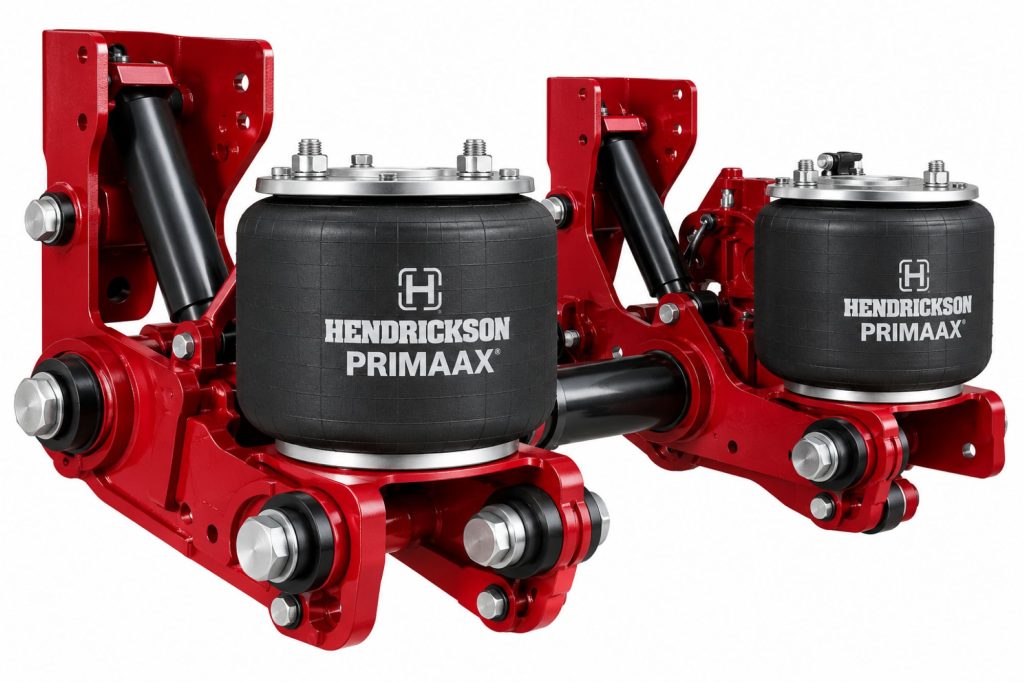
The Hendrickson PRIMAAX is an earlier-generation heavy-duty rear air suspension developed for vocational, severe-service, and heavy-haul commercial vehicles. It was designed to combine air-ride comfort with the axle control, stability, durability, and articulation required for demanding truck applications.
PRIMAAX uses air springs, structural support beams, a cross-tube assembly, pivot connections, torque rods, shock absorbers, frame hangers, and the Hendrickson QUIK-ALIGN axle-alignment system.
The suspension was produced in several vehicle-specific configurations for single-, tandem-, and tridem-drive axles. Exact specifications vary considerably because PRIMAAX systems were engineered around individual truck manufacturers, chassis models, axle capacities, ride heights, axle spacings, and brake packages.
PRIMAAX was followed by the updated Hendrickson PRIMAAX EX, which introduced revised components and suspension geometry. The original PRIMAAX remains important because many trucks equipped with it are still operating and require correct identification, maintenance, and replacement parts.
Key Characteristics
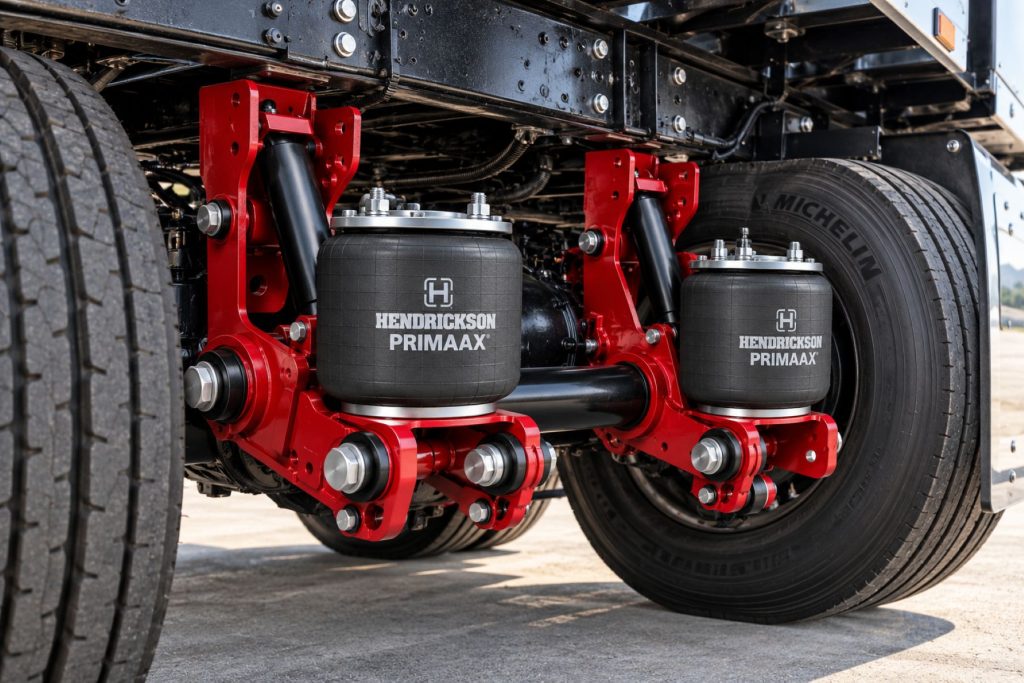
- Heavy-duty vocational rear air suspension
- Earlier generation of the PRIMAAX suspension family
- Available in single-, tandem-, and tridem arrangements
- Designed for vocational and heavy-haul vehicles
- Large-volume air springs
- Structural support beams and cross-tube assembly
- QUIK-ALIGN axle-alignment system
- Longitudinal and transverse torque rods
- Heavy-duty shock absorbers
- Non-lubricated rubber suspension bushings
- Designed to control axle windup and frame rise
- Multiple capacities, ride heights, and axle spacings
- Truck-manufacturer-specific configurations
- Drum and application-specific air disc brake compatibility
- Requires accurate model identification before ordering parts
Major Components
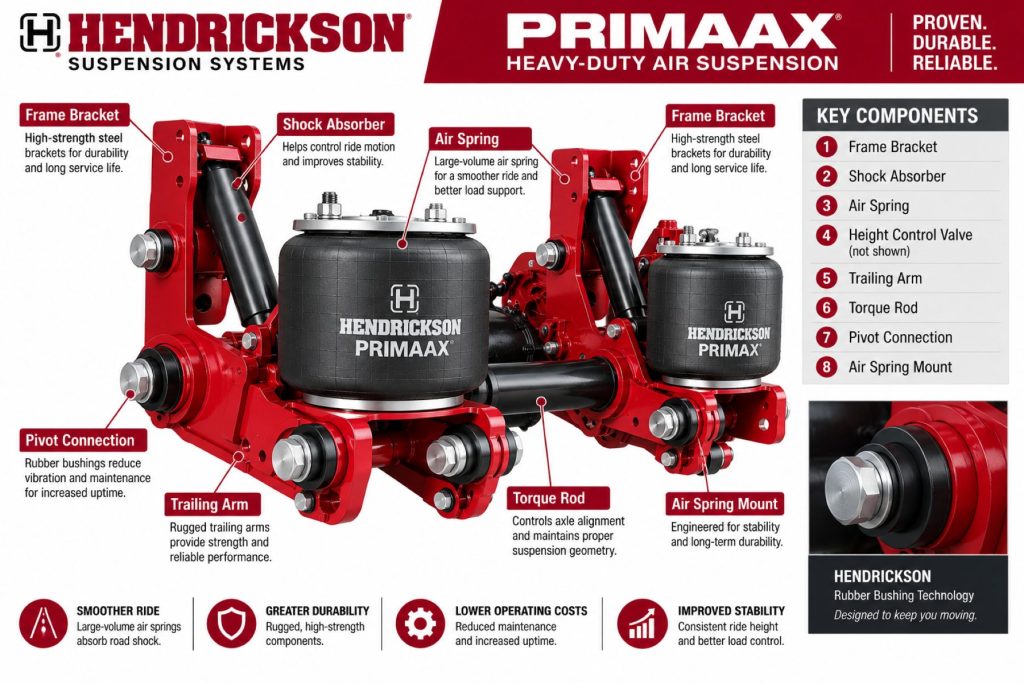
- Support Beams: Connect the drive axles to the suspension pivot points and transfer vehicle loads into the frame.
- Cross Tube: Joins the support beams and contributes to the suspension’s roll control and structural stability.
- Air Springs: Support the vehicle and payload with compressed air while helping isolate the frame and body from road impacts.
- Frame Hangers: Attach the suspension pivot connections to the vehicle’s frame rails.
- QUIK-ALIGN Pivot Connections: Connect the support beams to the frame hangers and provide the adjustment used for drive-axle alignment.
- Pivot Bushings: Permit controlled suspension movement without requiring routine lubrication.
- D-Pin Connections: Form part of the beam-to-axle connection used on applicable PRIMAAX configurations.
- Top Pads and Bottom Caps: Secure and position the suspension and axle components within the clamp group.
- U-Bolts and Clamp Hardware: Attach the axle to the support-beam assembly on applicable configurations.
- Longitudinal Torque Rods: Control axle windup and help maintain the proper pinion-angle relationship.
- Transverse Torque Rods: Restrict side-to-side axle movement beneath the chassis.
- Shock Absorbers: Control suspension movement and protect the air springs from excessive extension.
- Height-Control Valve: Adds or releases air to maintain the specified suspension ride height.
- Air Lines and Fittings: Carry compressed air between the vehicle air supply, height-control valve, and air springs.
How the Suspension System Works
PRIMAAX uses compressed air within flexible air springs to support the rear of the truck. When the vehicle is loaded, the suspension compresses and activates the height-control valve. The valve supplies additional air until the frame returns to the specified ride height.
When weight is removed, the height-control valve exhausts excess air and lowers the frame to its designed position.
The support beams locate the axles and transfer vertical, braking, acceleration, and cornering forces through the suspension. The cross tube connects the beams and helps the system resist roll and twisting movement.
Longitudinal torque rods help control axle windup during acceleration and braking. Transverse torque rods restrict lateral axle movement and help maintain the correct axle position beneath the chassis.
Shock absorbers damp repeated suspension movement and help prevent the air springs from overextending.
The suspension’s geometry allows the axles to move over uneven surfaces while helping maintain proper driveline angles and vehicle stability.
Suspension Position and Function
PRIMAAX is installed beneath the rear section of the vehicle frame and connects the chassis to its drive axle or drive-axle group.
Its primary functions include:
- Supporting the rear chassis and payload
- Maintaining the specified ride height
- Connecting the drive axles to the frame
- Absorbing road and job-site impacts
- Allowing controlled axle travel
- Helping maintain drive-tire contact
- Controlling axle windup
- Restricting lateral axle movement
- Improving ride quality
- Helping protect the body and mounted equipment
- Providing roll control for vocational applications
Common Specifications
PRIMAAX was produced in multiple OEM-specific versions, so exact specifications must be confirmed using the truck manufacturer’s build information and Hendrickson service literature.
Common original configurations included:
- Single-drive axle arrangements in approximately 23,000- and 26,000-pound classes
- Tandem-drive axle arrangements in approximately 40,000-, 46,000-, and 52,000-pound classes
- Tridem-drive axle arrangements reaching approximately 69,000 to 78,000 pounds in certain applications
- Multiple loaded ride heights
- Multiple tandem and tridem axle spacings
- Drum-brake configurations
- Application-specific air disc brake configurations
- Vocational and heavy-haul approvals
- Hendrickson QUIK-ALIGN axle adjustment
- Large-volume air springs
- Heavy-duty shock absorbers
Available specifications changed according to truck manufacturer, model, production year, frame width, brake system, and intended application.
Capacity, Ride Height, and Axle Travel
PRIMAAX capacity depends on the exact suspension and axle configuration installed by the vehicle manufacturer. The suspension identification and vehicle build information should be checked before using any published capacity figure.
The suspension must be paired with appropriately rated:
- Drive axles
- Truck frame
- Tires and wheels
- Brakes
- Wheel ends
- Driveline components
- Body and mounted equipment
Ride height is measured from the drive-axle centerline to the bottom of the truck frame. The correct measurement varies by the original vehicle and suspension configuration.
An incorrect ride height can affect:
- Air-spring position
- Available axle travel
- Shock-absorber movement
- Driveshaft operating angles
- Axle pinion angles
- Ground clearance
- Vehicle roll stability
- Tire and component clearance
The truck manufacturer’s axle stops, body installation, driveline, tires, and auxiliary equipment may limit the suspension’s available travel.
Ride Quality and Load Distribution
PRIMAAX was designed to provide improved ride quality compared with traditional vocational steel-spring suspensions while maintaining the stability required for heavy truck applications.
The air springs adjust to changes in vehicle loading. The height-control valve increases or decreases suspension air pressure to maintain the designed frame-to-axle relationship.
In tandem and tridem configurations, the suspension helps distribute load across the drive axles. Correct load distribution depends on proper ride height, air pressure, axle alignment, tire inflation, and vehicle loading.
The suspension’s structural arrangement also helps control axle windup and frame rise during acceleration and braking. This can reduce suspension-related driveline vibration and improve vehicle handling.
Suspension Controls and Adjustment Options
PRIMAAX may include several pneumatic and mechanical controls.
- Height-control valve
- Suspension air-dump valve when specified
- Air-pressure protection components
- Air-supply lines and fittings
- QUIK-ALIGN axle adjustment
- Transverse torque-rod shims
- Available ride-height settings
- Application-specific axle stops
- Application-specific shock absorbers
- Single or dual height-control valve arrangements
- Driver-operated dump controls on certain vehicles
The availability and operation of these controls depend on the truck manufacturer and original vehicle specification.
A suspension dump control should only be used according to the instructions provided by the vehicle, body, and suspension manufacturers.
Alignment and Suspension Geometry
The QUIK-ALIGN system allows technicians to adjust axle alignment at the suspension pivot connection. The system uses an eccentric alignment collar to reposition the axle and correct thrust angle.
Important alignment and geometry considerations include:
- Drive-axle thrust angle
- Axle-to-axle alignment
- Lateral axle position
- Suspension ride height
- Axle pinion angle
- Driveshaft operating angle
- Pivot-bushing position
- Torque-rod length and position
- Frame-hanger location
- Axle-bracket position
- Air-spring alignment
- Shock-absorber travel
- Tire and brake clearance
Ride height should be checked before final axle alignment because an incorrect height can change suspension and driveline geometry.
PRIMAAX systems were produced with different pivot fastener sizes and component configurations. The existing hardware should be physically identified before replacement parts or torque specifications are selected.
Axle, Brake, and Wheel-End Options
PRIMAAX is a suspension system and does not include one universal axle, brake, or wheel-end package.
Depending on the original truck specification, it may be paired with:
- Single drive axles
- Tandem drive axles
- Tridem drive axles
- Drum brakes
- Application-specific air disc brakes
- Conventional wheel ends
- Preset wheel ends
- Unitized wheel ends
- Dual rear tires
- Approved wide-base single tires
- Inter-axle differential locks
- Driver-controlled differential locks
- Electronic traction-control systems
PRIMAAX applications using air disc brakes may require different longitudinal torque rods or other components to provide adequate brake clearance.
Axle, brake, wheel-end, tire, and suspension capacities must be compatible with the complete vehicle rating.
Common Applications
- Vocational trucks
- Heavy-haul tractors
- Dump trucks
- Concrete mixer trucks
- Refuse trucks
- Logging trucks
- Crane-mounted trucks
- Boom trucks
- Platform trucks
- Fire and rescue vehicles
- Construction vehicles
- Specialty trucks
- Vehicles equipped with outriggers
- Certain medium-duty vehicles
- Certain bus and motorhome chassis
Vehicle, Axle, and Frame Compatibility
PRIMAAX was installed on selected commercial chassis from several truck manufacturers. Compatibility depends on the exact factory-designed configuration.
Important compatibility factors include:
- Truck manufacturer
- Truck model
- Production year
- Vehicle identification number
- Suspension capacity
- Single-, tandem-, or tridem-axle arrangement
- Drive-axle manufacturer and model
- Frame width
- Frame-rail dimensions
- Ride height
- Axle spacing
- Wheelbase
- Brake configuration
- Tire and wheel dimensions
- Driveline geometry
- Body installation
- Lift-axle position
- Outrigger installation
- Air-system capacity
- Available component clearance
A used PRIMAAX suspension should not be transferred to another chassis without engineering approval from the appropriate manufacturers.
Advantages
- Air-ride comfort for vocational trucks
- Designed for heavy-duty and severe-service applications
- Single-, tandem-, and tridem configurations
- Multiple capacity ranges
- Automatic ride-height control
- Controlled axle movement
- Strong roll stability
- Reduced suspension-related driveline vibration
- QUIK-ALIGN axle adjustment
- Non-lubricated pivot bushings
- Large-volume air springs
- Multiple axle-spacing options
- Vocational and heavy-haul compatibility
- Replacement support remains available for many existing systems
Limitations or Considerations
- An earlier-generation suspension rather than Hendrickson’s current PRIMAAX EX design
- Exact specifications vary by truck manufacturer and configuration
- Air springs, valves, fittings, and lines can leak
- Incorrect ride height can affect driveline geometry
- Pivot bushings and torque rods are wear components
- QUIK-ALIGN hardware must remain correctly tightened
- Different pivot fastener sizes were used
- Brake configurations may require different components
- PRIMAAX and PRIMAAX EX parts may not be interchangeable
- Legacy parts may require additional identification work
- Not every component remains available as an individual replacement
- Complete beam or service kits may replace earlier individual components
- Air springs can be damaged by abrasion, heat, debris, or incorrect alignment
- Improper dump-valve use can damage the suspension
Driver and Operator Experience
PRIMAAX generally provides a smoother ride than traditional mechanical vocational suspensions, especially when the truck is empty or lightly loaded.
The air springs help reduce road shock reaching the cab, body, cargo, and mounted equipment. The suspension’s structural geometry helps maintain stability when the truck is loaded.
Drivers should watch for:
- Vehicle leaning
- Incorrect rear ride height
- Continuous height-control valve activity
- Audible air leaks
- Harsh or bouncy ride
- Increased body roll
- Driveline vibration
- Vehicle pulling or dog-tracking
- Uneven drive-tire wear
- Suspension clunks or knocks
- Air springs rubbing nearby components
- Slow suspension recovery after loading
A noticeable change in ride height, handling, or vibration should be inspected before the truck returns to severe-duty operation.
Maintenance and Ownership Notes
PRIMAAX requires regular inspection even though its pivot bushings do not require routine lubrication.
Important maintenance areas include:
- Air springs
- Height-control valve
- Air lines and fittings
- Shock absorbers
- Support beams
- Cross tube
- Frame hangers
- Pivot bushings
- QUIK-ALIGN connections
- D-pin connections
- U-bolts and clamp hardware
- Longitudinal torque rods
- Transverse torque rods
- Axle brackets
- Mounting fasteners
- Suspension ride height
- Drive-axle alignment
- Brake-hose clearance
- ABS wiring
- Tire-wear patterns
Technicians should inspect for air leaks, rubber deterioration, loose fasteners, damaged brackets, worn bushings, shock-absorber leakage, and evidence of component movement.
PRIMAAX service procedures and parts often differ according to the original truck manufacturer. The correct vehicle-specific Hendrickson technical publication should be used.
Fasteners identified as non-reusable should be replaced rather than reinstalled.
Common Suspension Problems
- Air-spring leaks
- Cracked or abraded air springs
- Incorrect ride height
- Damaged height-control valve
- Leaking air lines or fittings
- Worn pivot bushings
- Loose QUIK-ALIGN hardware
- Worn D-pin bushings
- Loose U-bolts or clamp hardware
- Drive-axle misalignment
- Lateral axle misalignment
- Worn torque-rod bushings
- Bent or damaged torque rods
- Leaking shock absorbers
- Damaged support beams
- Cracked or damaged cross tube
- Damaged frame hangers
- Damaged axle brackets
- Air-spring misalignment
- Restricted axle travel
- Incorrect pinion angle
- Driveline vibration
- Uneven tire wear
- Vehicle lean
- Brake-hose or ABS-wire interference
- Insufficient tire or component clearance
Identification Information
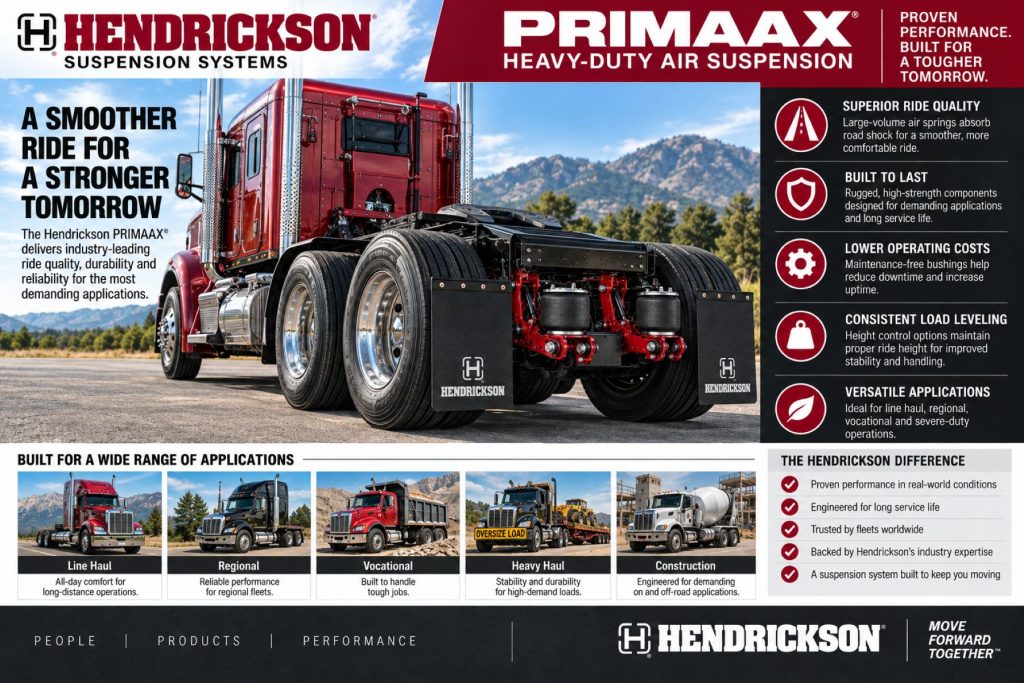
PRIMAAX can be identified by its large rear air springs, support-beam and cross-tube assembly, frame hangers, torque rods, shock absorbers, D-pin axle connections, and QUIK-ALIGN pivot hardware.
Before ordering replacement parts, record:
- Truck manufacturer
- Truck model
- Production year
- Vehicle identification number
- Suspension name
- Suspension capacity
- Axle configuration
- Ride height
- Axle spacing
- Frame width
- Drive-axle manufacturer
- Drive-axle model
- Brake type
- Support-beam part number
- Cross-tube part number
- Air-spring part number
- Shock-absorber part number
- Torque-rod configuration
- Frame-hanger design
- Axle-connection design
- QUIK-ALIGN fastener size
- Original casting and assembly numbers
The PRIMAAX name is sometimes used informally when referring to PRIMAAX EX. The installed system must be physically identified before parts are ordered.
Buying Considerations
- Original suspension identification
- Truck manufacturer and model
- Production year and VIN
- Suspension capacity
- Single-, tandem-, or tridem arrangement
- Ride height
- Axle spacing
- Frame width
- Drive-axle compatibility
- Brake configuration
- Pivot fastener size
- Support-beam and cross-tube design
- Air-spring part numbers
- Replacement-parts availability
- Complete service-kit availability
- Previous repairs or modifications
- Vehicle alignment
- Suspension air leaks
- Condition of bushings and torque rods
- Condition of frame and axle brackets
- Dealer and technical support
- Repair cost compared with vehicle value
When buying a used truck, the suspension should be inspected for mismatched components, previous welding, nonstandard fasteners, incorrect ride height, and air-spring interference.
Variants and Configurations
- Single-Axle PRIMAAX: Produced for selected medium- and heavy-duty chassis requiring a vocational rear air suspension.
- Tandem-Axle PRIMAAX: Used on many heavy vocational trucks and tractors, with several capacity, ride-height, and axle-spacing combinations.
- Tridem-Axle PRIMAAX: Used on specialized heavy-haul and severe-duty vehicles requiring three rear drive axles.
- Drum-Brake Configuration: Uses suspension and torque-rod components designed around drum-brake clearance.
- Air Disc Brake Configuration: Certain applications use alternate torque rods, brackets, or other components to provide adequate air disc brake clearance.
- Truck-Manufacturer-Specific Configuration: PRIMAAX systems were produced for specific chassis from Mack, Volvo, Kenworth, International, Freightliner, Western Star, and other manufacturers.
Comparison to Similar Equipment
PRIMAAX vs Hendrickson PRIMAAX EX
PRIMAAX is the earlier suspension generation. Hendrickson PRIMAAX EX uses revised structural components, axle connections, geometry, and application options.
Both are heavy-duty rear air suspensions, but replacement components should not be selected by appearance alone.
PRIMAAX vs Hendrickson HAULMAAX EX
PRIMAAX uses air springs and automatic ride-height control. Hendrickson HAULMAAX EX uses rubber bolster and progressive load springs without suspension air bags.
PRIMAAX generally provides a softer air-ride response. HAULMAAX EX eliminates several pneumatic suspension components.
PRIMAAX vs Hendrickson HAS
PRIMAAX was designed for severe-duty vocational and heavy-haul applications. Hendrickson HAS Air Suspension is a lighter vocational rear air-suspension family commonly used in 40,000- and 46,000-pound tandem applications.
PRIMAAX vs Hendrickson RT/RTE
PRIMAAX uses air springs and height-control valves. Hendrickson RT/RTE Mechanical Suspension uses steel springs and walking beams for traditional severe-duty mechanical operation.
Best Fit For
- Owners maintaining trucks originally equipped with PRIMAAX
- Vocational fleets requiring air-ride comfort
- Heavy-haul tractors
- Dump trucks
- Concrete mixers
- Logging trucks
- Refuse trucks
- Crane and boom vehicles
- Platform trucks
- Specialty vocational equipment
- Single-, tandem-, and tridem-drive axle vehicles
- Fleets needing correct legacy suspension identification
- Buyers evaluating used vocational trucks
Related Vehicle and Trailer Types
- Dump Trucks
- Concrete Mixer Trucks
- Refuse Trucks
- Logging Trucks
- Heavy-Haul Trucks
- Crane and boom trucks
- Platform trucks
- Fire and rescue vehicles
- Specialty vocational trucks
Related Truck and Trailer Models
- Freightliner 114SD
- International HX Series
- Kenworth C500
- Kenworth T800
- Kenworth T880
- Mack Granite
- Volvo VHD
- Volvo VNX
Related Suspension Types
- Air Suspension Systems
- Vocational & Severe-Duty Suspensions
- Hendrickson PRIMAAX EX
- Hendrickson HAULMAAX EX
- Hendrickson HAS Air Suspension
- Hendrickson HN Vocational Suspension
- Hendrickson RT/RTE Mechanical Suspension
Related Equipment Systems
Related Guides
- Suspension System Guides
- How Commercial Truck Suspension Systems Work
- Air Suspension vs Leaf Spring Suspension
- How to Choose a Commercial Truck Suspension
- Truck Suspension Components Explained
- Truck vs Trailer Suspension Systems
- How Commercial Truck Axles and Differentials Work
Regulatory and Compliance Notes
The suspension’s original capacity does not independently determine the truck’s legal operating weight. The vehicle must remain within all applicable axle, tire, wheel, brake, gross vehicle weight, gross combination weight, and bridge-formula limits.
Repairs should preserve the truck manufacturer’s original suspension geometry, ride height, axle spacing, brake clearance, and driveline relationships.
Substituting PRIMAAX EX or unrelated components into an original PRIMAAX installation without approval may change the suspension’s performance and structural integrity.
Vehicles with liftable auxiliary axles must not be operated in a way that overloads the PRIMAAX drive suspension or other chassis components.
Real World Operating Notes
Many PRIMAAX-equipped trucks have been in service for years, making previous repairs and component substitutions important inspection considerations.
A truck may contain updated replacement assemblies while retaining other original PRIMAAX components. Parts should be identified individually instead of assuming the complete suspension remains in its original configuration.
Air leaks, incorrect ride height, worn pivot bushings, loose clamp hardware, and axle misalignment can produce similar handling or tire-wear symptoms.
When inspecting a used vehicle, compare components on both sides and across all drive axles. Mismatched air springs, beams, shocks, torque rods, or pivot hardware may indicate an incomplete or incorrect repair.
Frequently Asked Questions
Is Hendrickson PRIMAAX still a current suspension?
The original PRIMAAX is an earlier-generation system that has largely been succeeded by PRIMAAX EX. Replacement parts and service support remain relevant for trucks still equipped with PRIMAAX.
Is PRIMAAX an air suspension?
Yes. PRIMAAX is a rear air suspension that uses air springs and a height-control system to support the vehicle.
Is PRIMAAX the same as PRIMAAX EX?
No. PRIMAAX and PRIMAAX EX are different generations. They share some design concepts, but their components should not be assumed interchangeable.
What capacities were available?
PRIMAAX was produced in multiple configurations ranging from single-axle vocational applications to high-capacity tandem and tridem systems. The exact rating must be confirmed from the original vehicle and suspension information.
What is QUIK-ALIGN?
QUIK-ALIGN is Hendrickson’s adjustable pivot connection used to correct drive-axle alignment.
Does PRIMAAX require suspension lubrication?
Its rubber pivot bushings do not require routine lubrication. Other chassis, axle, brake, driveline, and wheel-end components may still require lubrication.
How is the ride height measured?
Ride height is generally measured from the drive-axle centerline to the bottom of the truck frame. The correct specification depends on the vehicle configuration.
Can PRIMAAX use air disc brakes?
Certain PRIMAAX configurations were designed for air disc brakes. These systems may use different torque rods, brackets, or suspension components for clearance.
Can PRIMAAX EX parts be installed on PRIMAAX?
Some service kits may update or replace earlier components, but interchangeability must be confirmed through the correct Hendrickson parts and service literature.
How can I identify PRIMAAX correctly?
Record the truck VIN, suspension capacity, ride height, axle spacing, beam numbers, air-spring numbers, pivot hardware, and axle configuration before ordering parts.
Availability and Where to Find
Original PRIMAAX suspensions are generally found on existing vocational trucks, heavy-haul tractors, specialty vehicles, and used chassis rather than being selected for new production.
Replacement parts may be available through Hendrickson-authorized dealers, commercial truck dealerships, heavy-duty suspension suppliers, salvage-equipment suppliers, and qualified repair facilities.
Some original components may have been superseded by updated service assemblies or replacement kits. The truck VIN, suspension model, axle arrangement, ride height, and original component numbers should be provided when locating parts.
Support Trucking Families
Truck Equipment Atlas supports the mission of Grey Cross, a nonprofit dedicated to helping families of truck drivers who lose their lives while on the road. As the site grows, part of its mission is to bring awareness and support to these families.
Podcast or Video Section
Learn More Through Audio and Video
Truck Equipment Atlas will continue expanding with podcast episodes, interviews, and equipment breakdowns to help drivers and fleets better understand trucks and equipment.
Follow the Growth of Truck Equipment Atlas
Truck Equipment Atlas continues to expand with new truck profiles, trailer coverage, diesel engine pages, equipment system resources, manufacturer information, and educational guides.
Visit our Site Updates page to explore recent additions, project milestones, and upcoming resources as we continue building one of the industry’s growing commercial trucking equipment reference libraries.
View the Latest Site Updates: Truck Equipment Atlas Site Updates