
Truck vs Trailer Suspension Systems
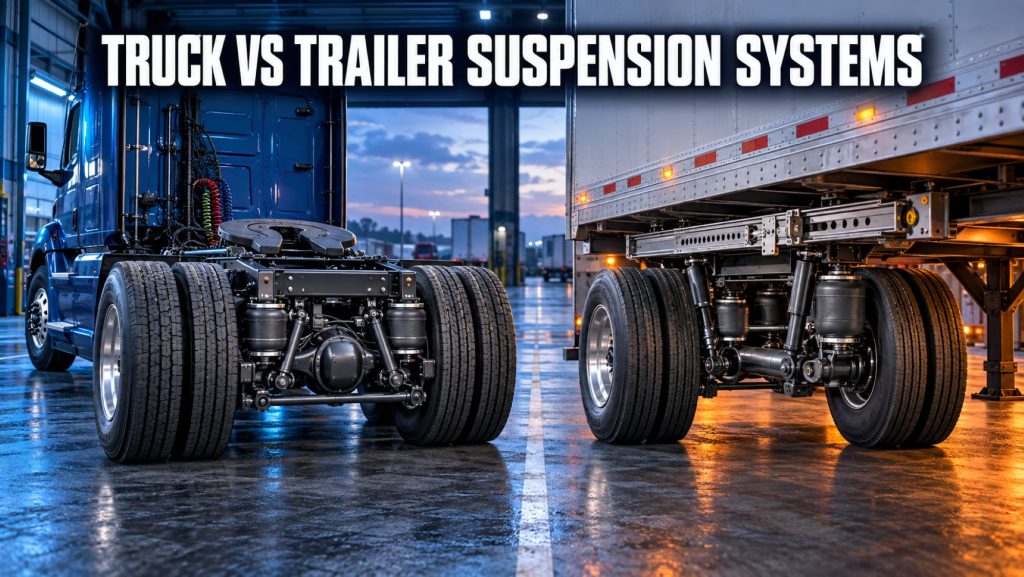
Truck and trailer suspension systems perform many of the same basic functions, but they operate within different vehicle structures and face different mechanical demands.
Both systems connect a frame to one or more axles, support weight, allow controlled axle movement, absorb road impacts, distribute axle loads, and help keep the tires in contact with the road.
A truck suspension must also manage steering, engine torque, braking forces, driveline geometry, cab ride, and the weight transferred through a fifth wheel or mounted body.
A trailer suspension supports the trailer frame and cargo while controlling trailer axles, maintaining load distribution, protecting freight, and helping the trailer track correctly behind the truck.
This guide explains the differences between truck and trailer suspension systems, the components they share, their different operating requirements, and how suspension design affects ride quality, traction, stability, tire wear, cargo protection, and maintenance.
The Basic Suspension Function
A suspension operates between the vehicle frame and axles.
The basic relationship can be simplified as:
- Vehicle Frame → Springs and Suspension Components → Axles → Wheels and Tires → Road Surface
- Road forces also move in the opposite direction:
- Road Surface → Tires and Wheels → Axles → Suspension → Vehicle Frame
The suspension manages these forces while allowing controlled movement between the frame and axles.
Truck and trailer suspensions both perform this function, but the forces entering each system are different.
Learn more about complete suspension operation in How Commercial Truck Suspension Systems Work.
What Truck and Trailer Suspensions Have in Common
Truck and trailer suspensions can share many components and operating principles.
Both may use:
- Air springs
- Leaf springs
- Shock absorbers
- Torque rods
- Trailing arms
- Equalizers
- Bushings
- Hangers
- Brackets
- Crossmembers
- Height-control valves
- Air lines and fittings
- U-bolts
- Axle seats
- Alignment hardware
Both systems must:
- Support vehicle weight
- Support cargo or equipment
- Control axle movement
- Absorb road impacts
- Maintain tire contact
- Distribute axle loads
- Control body or trailer movement
- Protect structural components
- Reduce vibration
- Maintain alignment
Although the components may appear similar, their size, capacity, geometry, mounting, and function can differ.
See Truck Suspension Components Explained for a detailed look at individual suspension parts.
The Primary Difference
The primary difference is the role each vehicle performs.
The truck contains the engine, transmission, steering system, cab, and other components required to power and control the combination.
The trailer is unpowered and follows the tractor through the fifth wheel, kingpin, or another coupling system.
Because of this difference, truck suspensions must manage forces that may not be present in a conventional trailer suspension, including:
- Engine torque
- Driveline reaction
- Powered axle forces
- Steering inputs
- Cab movement
- Fifth-wheel load transfer
- Mounted vocational equipment
Trailer suspensions must manage requirements associated with:
- Cargo distribution
- Trailer tracking
- Tandem position
- Trailer height
- Dock compatibility
- Sliding suspension assemblies
- Spread-axle configurations
- Trailer loading and unloading
Truck Suspension Systems
A commercial truck may have several different suspension systems on the same chassis.
These can include:
- Steer axle suspension
- Single drive axle suspension
- Tandem drive axle suspension
- Tridem drive axle suspension
- Auxiliary axle suspension
- Lift axle suspension
- Cab suspension
Each system performs a different role.
Steer Axle Suspension
The steer axle suspension supports the front of the truck and directly influences steering response, alignment, directional stability, ride quality, and front tire wear.
Commercial truck front suspensions commonly use leaf springs, although air-assisted, full-air, coil, rubber, and independent configurations may also be used.
Common steer axle suspension components include:
- Leaf springs
- Spring hangers
- Shackles
- Bushings
- U-bolts
- Shock absorbers
- Stabilizer components
- Axle seats
- Frame brackets
The front suspension must maintain proper axle position while allowing the wheels to respond to road conditions.
Wear or damage can contribute to:
- Steering wander
- Vehicle pulling
- Uneven ride height
- Irregular tire wear
- Harsh ride quality
- Reduced directional control
Explore these systems in Steer Axle & Front Suspensions.
Drive Axle Suspension
The drive axle suspension supports the rear of the truck and controls the powered axles.
It must manage:
- Engine torque
- Acceleration forces
- Braking forces
- Axle rotation
- Pinion angles
- Driveline geometry
- Traction
- Tandem articulation
- Fifth-wheel or body loads
A highway tractor commonly uses a tandem drive suspension with two powered rear axles.
Drive suspensions may use:
- Air springs
- Leaf springs
- Walking beams
- Rubber springs
- Torque rods
- Trailing arms
- Shock absorbers
- Equalizers
- Other specialized components
The suspension must prevent uncontrolled axle movement while allowing enough travel and articulation to maintain tire contact.
Fifth-Wheel Load Transfer
A tractor’s drive suspension supports the portion of the trailer’s weight transferred through the fifth wheel.
This load is commonly called kingpin weight or fifth-wheel load.
Its distribution across the truck’s steer and drive axles is affected by:
- Fifth-wheel position
- Tractor wheelbase
- Trailer kingpin position
- Cargo placement
- Suspension geometry
- Vehicle loading
Moving the fifth wheel changes how weight is distributed between the steer and drive axles.
The truck suspension must have sufficient capacity for the maximum expected load while maintaining appropriate axle weights.
Vocational Truck Suspension
Vocational trucks carry mounted bodies and equipment instead of supporting a trailer only through a fifth wheel.
Examples include:
- Dump trucks
- Concrete mixers
- Refuseuseuse vehicles
- Cranes
- Utility trucks
- Tow trucks
- Vacuum trucks
- Fire apparatus
- Logging trucks
- Service trucks
The suspension may experience concentrated loads, high centers of gravity, repeated loading, severe braking, uneven terrain, and equipment-generated forces.
These applications may prioritize:
- Durability
- Roll stability
- Articulation
- Ground clearance
- Load capacity
- Resistance to damage
- Controlled body movement
Explore these systems in Vocational & Severe-Duty Suspensions.
Auxiliary Truck Suspensions
Auxiliary axles help distribute additional truck weight.
They can include:
- Pusher axles
- Tag axles
- Lift axles
- Steerable auxiliary axles
- Non-steerable auxiliary axles
Auxiliary suspension components may include air springs, lift springs, control valves, pressure regulators, pivot arms, steer-lock mechanisms, and electronic controls.
These systems affect:
- Legal axle weights
- Steering
- Traction
- Braking
- Stability
- Tire wear
- Turning behavior
Explore these systems in Auxiliary & Lift Axle Suspensions.
Trailer Suspension Systems
A trailer suspension connects the trailer frame to its axles.
The system supports the trailer and cargo while helping manage axle loads, road impacts, trailer movement, cargo vibration, and tracking.
Commercial trailer suspensions may use:
- Air springs
- Leaf springs
- Equalizers
- Trailing arms
- Torque arms
- Shock absorbers
- Sliding tandem assemblies
- Fixed tandem assemblies
- Spread-axle configurations
- Specialized heavy-haul systems
Explore these systems in Trailer Suspension Systems.
Trailer Air Suspension
Air suspension is widely used on dry vans, refrigerated trailers, tank trailers, flatbeds, car haulers, and specialized trailers.
A trailer air suspension commonly includes:
- Air springs
- Trailing arms
- Axle connections
- Height-control valve
- Air lines
- Air reservoirs
- Shock absorbers
- Frame brackets
- Alignment components
The tractor supplies compressed air to the trailer through the air connections. Trailer reservoirs store air for the brake and suspension systems.
A height-control valve adds or releases air to maintain the intended distance between the trailer frame and axles.
Potential benefits include:
- Improved cargo protection
- Smoother trailer ride
- Automatic leveling
- Consistent trailer height
- Reduced vibration
- Adaptability to changing loads
Trailer Leaf Spring Suspension
Mechanical trailer suspensions commonly use leaf springs and equalizers.
A tandem leaf spring suspension may include:
- Front and rear spring hangers
- Leaf springs
- Center equalizer
- Spring eyes
- Bushings
- U-bolts
- Axle seats
- Shackles
- Mounting hardware
As one axle encounters a bump, the equalizer helps transfer part of the movement and load to the other axle.
Mechanical trailer suspensions can provide:
- Simple construction
- Proven durability
- Strong load support
- Straightforward inspection
- Reduced dependence on air components
- Suitability for vocational service
They are commonly found on equipment trailers, dump trailers, agricultural trailers, and other mechanically straightforward designs.
Sliding Trailer Tandems
Many dry van and refrigerated trailers use a sliding tandem assembly.
The suspension and axles are mounted to a subframe that can move forward or rearward beneath the trailer.
Moving the tandem changes:
- Weight carried by the trailer axles
- Weight transferred to the tractor
- Trailer wheelbase
- Turning characteristics
- Rear overhang
- Dock positioning
The sliding assembly may include:
- Sliding subframe
- Locking pins
- Pin-release mechanism
- Rails
- Stops
- Suspension crossmembers
- Axle and suspension mounts
A truck drive suspension does not normally slide beneath the tractor frame in this manner.
Fixed Trailer Suspensions
A fixed suspension is mounted in a permanent position beneath the trailer.
Fixed suspensions are common on:
- Flatbeds
- Tank trailers
- Dump trailers
- Lowboys
- Heavy-haul trailers
- Specialized equipment trailers
- Certain dry vans and refrigerated trailers
The axle position is determined during trailer design and cannot normally be adjusted by the operator.
Cargo must be positioned with the fixed axle location in mind.
Spread-Axle Trailer Suspensions
A spread-axle trailer places greater distance between individual axles than a conventional tandem group.
Spread axles are common on certain flatbeds, step decks, refrigerated trailers, and specialized trailers.
Potential considerations include:
- Axle weight distribution
- Tire scrub during turns
- Suspension articulation
- Trailer maneuverability
- State weight laws
- Cargo placement
- Frame stress
A spread-axle suspension must allow sufficient movement while controlling the forces created by the longer axle spacing.
Heavy-Haul Trailer Suspensions
Heavy-haul trailers can use specialized suspension systems designed for high capacity, multiple axles, adjustable ride height, hydraulic load equalization, and extreme operating conditions.
These may include:
- Mechanical beam suspensions
- Air suspensions
- Hydraulic suspensions
- Pendular axle systems
- Walking-beam systems
- Multiple independently controlled axle groups
Heavy-haul suspension systems can help distribute extraordinary loads across numerous axles.
They are significantly different from standard highway trailer suspensions and must be specified for the exact trailer and load.
Air Suspension on Trucks and Trailers
Both trucks and trailers can use air springs, but their air systems operate within different vehicle structures.
Truck Air Suspension
A truck air suspension receives compressed air from the truck’s engine-driven air compressor and vehicle reservoirs.
It may support:
- Drive axles
- Steer axles
- Auxiliary axles
- Cab
- Other chassis components
Trailer Air Suspension
A trailer does not normally have an engine-driven compressor. It receives compressed air from the tractor and stores it in trailer reservoirs.
Trailer suspension controls operate independently once air is available, but they remain dependent on the tractor-trailer air connection for replenishment.
Both systems require properly operating air springs, valves, lines, fittings, reservoirs, and controls.
Explore these systems in Air Suspension Systems.
Mechanical Suspensions on Trucks and Trailers
Mechanical suspensions can also be used on both vehicles.
Truck mechanical suspensions must often manage engine torque, drive axle forces, body loads, and severe vocational conditions.
Trailer mechanical suspensions primarily support the trailer and cargo while controlling trailer axle movement and load distribution.
Mechanical designs can include:
- Leaf spring suspensions
- Equalized tandem suspensions
- Walking-beam suspensions
- Rubber spring suspensions
- Multi-leaf spring packs
- Auxiliary spring systems
Explore these designs in Mechanical & Leaf Spring Suspensions.
Ride Quality
Ride quality matters on both trucks and trailers, but it affects them differently.
Truck Ride Quality
Truck suspension movement is transferred into:
- Frame
- Cab
- Driver’s seat
- Steering system
- Mounted body
- Chassis components
Poor truck ride quality can contribute to driver fatigue, cab vibration, component stress, and reduced control.
Trailer Ride Quality
Trailer suspension movement is transferred into:
- Trailer frame
- Floor
- Cargo
- Body panels
- Refrigeration equipment
- Load securement systems
Poor trailer ride quality can contribute to cargo movement, freight damage, loosened securement, and trailer structural stress.
Air suspension is frequently selected on both vehicles when ride quality and cargo protection are priorities.
Cargo Protection
Trailer suspension normally has the most direct effect on cargo ride because the freight is carried above the trailer axles.
A smoother trailer suspension can help protect:
- Electronics
- Furniture
- Appliances
- Machinery
- Packaged products
- Vehicles
- Refrigerated freight
- Fragile materials
The tractor suspension still matters because movement at the fifth wheel is transferred into the front of the trailer.
Cargo protection depends on the entire combination, including both suspensions, tires, loading, securement, speed, and road conditions.
Traction
Traction is primarily a truck suspension concern because the truck contains the powered drive axles.
The drive suspension helps maintain tire contact while managing:
- Engine torque
- Acceleration
- Braking
- Uneven surfaces
- Load transfer
- Axle articulation
Conventional trailer axles are not powered, so their suspensions do not transmit engine torque to the road.
Trailer tire contact remains important for braking, stability, tracking, and tire wear.
Steering
Truck front suspension directly affects steering because it supports the steer axle.
It influences:
- Steering response
- Alignment
- Caster and axle position
- Directional stability
- Front tire contact
- Steering tire wear
Conventional trailer suspensions do not control the tractor’s steering.
However, trailer axle alignment and suspension condition affect how the trailer tracks. Certain trailers and auxiliary axles may also use steerable axle systems.
Braking Forces
Both truck and trailer suspensions must manage braking forces.
When the brakes are applied, forces move from the tires and brake assemblies through the axles and suspension into the frame.
Truck drive suspensions must manage braking forces along with engine torque and driveline reaction.
Trailer suspensions must control axle position while trailer brakes slow the trailer and cargo.
Worn bushings, loose mounts, broken springs, damaged torque rods, or axle misalignment can reduce braking stability on either vehicle.
Ride Height
Ride height is important for both truck and trailer air suspensions.
Truck Ride Height
Truck ride height can affect:
- Driveline angles
- Suspension travel
- Fifth-wheel height
- Axle alignment
- Shock-absorber position
- Tire clearance
Trailer Ride Height
Trailer ride height can affect:
- Overall trailer height
- Dock compatibility
- Trailer floor height
- Suspension travel
- Tire clearance
- Trailer attitude
- Cargo loading
A tractor and trailer should be compatible so the trailer operates near its intended level position.
Incorrect ride height on either vehicle can create suspension, tire, driveline, or clearance problems.
Axle Alignment
Truck and trailer suspensions must hold their axles in proper alignment.
Truck axle misalignment can affect:
- Steering
- Traction
- Tire wear
- Driveline position
- Vehicle tracking
Trailer axle misalignment can cause:
- Dog-tracking
- Tire scrub
- Irregular tire wear
- Increased rolling resistance
- Poor handling
- Stress on suspension components
Alignment adjustments should be performed only after worn or damaged suspension components have been corrected.
Tire Wear
Suspension condition affects tire wear on both trucks and trailers.
Possible suspension-related causes include:
- Worn bushings
- Loose U-bolts
- Incorrect ride height
- Broken springs
- Damaged torque rods
- Misaligned axles
- Worn shock absorbers
- Unequal loading
- Bent brackets
- Worn equalizers
Replacing tires without correcting the underlying suspension or alignment issue can allow the same wear pattern to return.
Stability
Truck and trailer suspensions contribute to the stability of the complete combination.
Truck stability is affected by:
- Steer and drive suspension design
- Fifth-wheel position
- Axle loading
- Center of gravity
- Mounted body or equipment
- Tire condition
Trailer stability is affected by:
- Cargo position
- Cargo movement
- Trailer suspension design
- Axle spacing
- Tandem position
- Trailer height
- Tire condition
A problem on either vehicle can affect the behavior of the entire combination.
Suspension Maintenance Differences
Truck and trailer suspensions share many inspection requirements, but each has unique areas of attention.
Truck Suspension Inspection
Common inspection areas include:
- Steer axle springs
- Drive axle air springs
- Torque rods
- Trailing arms
- Shock absorbers
- Height-control valves
- Ride height
- Driveline angles
- Auxiliary axles
- Frame mounts
- Steering-related components
Trailer Suspension Inspection
Common inspection areas include:
- Trailer air springs
- Leaf springs
- Equalizers
- Trailing arms
- Shock absorbers
- Sliding tandem assembly
- Locking pins
- Height-control valve
- Axle alignment
- Hangers and brackets
- Air lines and fittings
Both vehicles should be inspected for cracks, leaks, worn bushings, loose fasteners, component contact, and irregular tire wear.
Can Truck and Trailer Suspension Parts Be Interchanged?
Truck and trailer components should not be assumed to be interchangeable.
Parts that appear similar may have different:
- Dimensions
- Load ratings
- Mounting points
- Materials
- Travel limits
- Bushing designs
- Pressure requirements
- Alignment procedures
- Intended applications
Replacement parts should be identified using the suspension manufacturer, model, part number, axle configuration, and vehicle information.
Choosing Truck and Trailer Suspensions
The suspension on each vehicle should be selected for its own job while remaining compatible with the complete combination.
Important truck considerations include:
- Steer and drive axle loads
- Engine torque
- Driveline geometry
- Fifth-wheel load
- Traction
- Cab ride
- Vocational body requirements
- Auxiliary axles
Important trailer considerations include:
- Cargo
- Trailer type
- Axle configuration
- Tandem position
- Cargo protection
- Trailer height
- Loading method
- Highway or vocational operation
See How to Choose a Commercial Truck Suspension for a complete selection process.
Air or Mechanical Suspension
Both trucks and trailers may be equipped with air or mechanical suspension.
Air suspension is often selected for:
- Highway ride quality
- Cargo protection
- Automatic leveling
- Changing loads
- Consistent ride height
Mechanical suspension is often selected for:
- Durability
- Simplicity
- Vocational work
- Rough terrain
- Straightforward inspection
- Reduced pneumatic complexity
See Air Suspension vs Leaf Spring Suspension for a detailed comparison.
Explore Truck and Trailer Suspension Categories
Air Suspension Systems
Explore air suspensions used on commercial trucks, tractors, trailers, buses, and auxiliary axles.
Mechanical & Leaf Spring Suspensions
Explore leaf spring, equalizer, walking-beam, rubber, and other mechanically supported systems.
Vocational & Severe-Duty Suspensions
Explore suspensions used on construction, logging, refuse, mining, heavy-haul, and off-highway vehicles.
Auxiliary & Lift Axle Suspensions
Explore suspension systems used with pusher, tag, lift, and other auxiliary axles.
Steer Axle & Front Suspensions
Explore commercial-truck front suspensions and the components that support steer axles.
Trailer Suspension Systems
Explore suspension systems designed specifically for commercial trailers.
Continue Learning About Commercial Truck Suspensions
Continue with the other Truck Equipment Atlas suspension guides:
- How Commercial Truck Suspension Systems Work
- Air Suspension vs Leaf Spring Suspension
- How to Choose a Commercial Truck Suspension
- Truck Suspension Components Explained
Visit the Commercial Truck Suspension Systems Library to explore air, mechanical, vocational, auxiliary, steer axle, and trailer suspension systems.
Visit Equipment System Guides to explore additional educational resources covering suspension systems and other commercial-truck equipment.
Final Thoughts
Truck and trailer suspension systems share many components and basic operating principles, but they perform different roles.
A truck suspension supports the powered and steering portions of the vehicle. It must manage engine torque, braking, steering, driveline geometry, fifth-wheel loading, cab ride, and vocational equipment.
A trailer suspension supports the trailer and cargo. It must manage trailer axle loads, cargo vibration, tracking, tandem position, trailer height, and loading requirements.
Both systems affect ride quality, braking, stability, tire wear, load distribution, and the behavior of the complete vehicle combination.
Understanding these differences helps drivers, fleets, technicians, and equipment buyers inspect each system correctly, select compatible equipment, and recognize how suspension condition on either vehicle can affect overall performance.