
Truck Suspension Components Explained
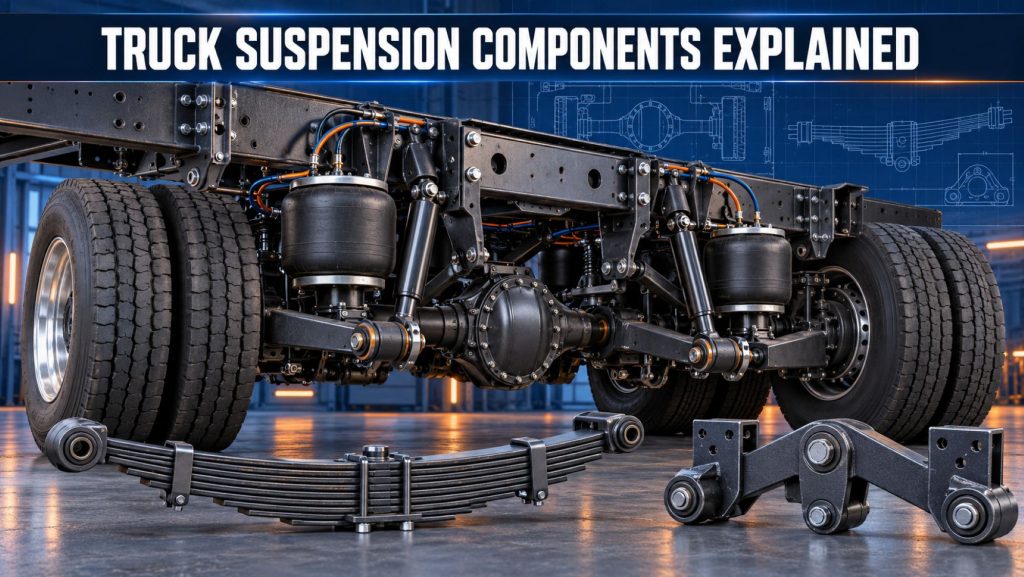
A commercial truck suspension is made up of springs, links, mounting hardware, dampers, valves, and other components that connect the vehicle’s frame to its axles.
These components work together to support the truck and its load, allow controlled axle movement, absorb road impacts, maintain tire contact, distribute weight, and control the forces created by acceleration, braking, cornering, and uneven terrain.
The exact components vary according to the suspension type. An air suspension uses air springs, height-control valves, air lines, and axle-locating links. A mechanical suspension may use leaf springs, equalizers, walking beams, spring hangers, and related hardware.
Understanding these components can help drivers, technicians, fleet managers, and equipment buyers recognize suspension designs, identify potential problems, and choose systems appropriate for different applications.
This guide explains the major components used throughout commercial truck suspension systems and the function each component performs.
How Suspension Components Work Together
A commercial truck suspension operates between the frame and axles.
The basic relationship can be simplified as:
Vehicle Frame → Suspension Components → Axles → Wheels and Tires → Road Surface
Springs support weight and allow movement. Shock absorbers control that movement. Torque rods, control arms, and leaf springs help locate the axles. Bushings permit controlled movement at connection points. Hangers, brackets, and crossmembers attach the suspension to the frame.
In an air suspension, valves and air lines regulate air pressure and ride height. In a mechanical suspension, springs, equalizers, beams, and pivots provide support and distribute weight.
No single component performs every suspension function. The system depends on all its components working together.
Learn more about overall suspension operation in How Commercial Truck Suspension Systems Work.
Springs
Springs support the vehicle’s weight and allow controlled movement between the frame and axles.
Commercial vehicles may use:
- Air springs
- Leaf springs
- Coil springs
- Rubber springs
- Elastomeric springs
- Combination spring systems
The spring type influences ride quality, load support, suspension travel, durability, weight, maintenance, and application suitability.
Air Springs
An air spring is a flexible, reinforced rubber assembly that supports weight using compressed air.
Air springs are sometimes called:
- Air bags
- Air bellows
- Rolling-lobe air springs
- Convoluted air springs
The term air bag is common in trucking, although air spring is the more precise suspension term.
An air spring generally includes:
- Reinforced rubber body
- Upper mounting plate
- Lower mounting plate or piston
- Air inlet
- Internal air chamber
- Mounting hardware
As compressed air enters the spring, pressure inside the flexible chamber supports the vehicle. When weight changes, the suspension can add or release air to maintain ride height.
Air springs are used extensively on:
- Highway tractors
- Straight trucks
- Commercial trailers
- Buses
- Vocational trucks
- Auxiliary axles
- Cab suspensions
Air springs should be inspected for:
- Cracks
- Cuts
- Abrasion
- Bulges
- Leaks
- Loose mounting hardware
- Misalignment
- Contact with nearby components
- Rubber deterioration
A damaged air spring may lose pressure, alter ride height, or allow other suspension components to operate outside their intended positions.
Explore these systems in Air Suspension Systems.
Leaf Springs
A leaf spring is made from one or more curved steel strips called leaves.
The leaves are stacked to create a spring assembly that supports weight and flexes as the axle moves.
A leaf spring assembly may include:
- Main leaf
- Additional spring leaves
- Center bolt
- Spring clips
- Spring eyes
- Bushings
- U-bolts
- Auxiliary or overload leaves
Leaf springs can perform several functions:
- Support vehicle weight
- Absorb road impacts
- Help locate the axle
- Transfer braking forces
- Transfer acceleration forces
- Control axle movement
Leaf springs are commonly used on:
- Steer axles
- Medium-duty trucks
- Dump trucks
- Construction vehicles
- Service trucks
- Logging trucks
- Commercial trailers
- Severe-duty vehicles
Leaf springs should be inspected for cracks, broken leaves, shifting, corrosion, worn spring eyes, damaged bushings, loose U-bolts, and contact between components.
Explore leaf spring and related designs in Mechanical & Leaf Spring Suspensions.
Main Leaf
The main leaf is the longest leaf in a conventional spring pack.
It commonly contains the spring eyes used to attach the spring to the suspension hangers or shackles.
Because the main leaf carries significant loads and helps position the axle, cracks or damage can affect both load support and axle control.
Auxiliary and Overload Springs
Some mechanical suspensions use auxiliary or overload springs.
These components provide additional support as vehicle weight increases. The primary spring supports lighter loads, while the auxiliary spring becomes engaged as the suspension compresses.
This creates a progressive response across changing loads.
Auxiliary springs should not be confused with auxiliary axles, although both may be used on the same vehicle.
Coil Springs
Coil springs use steel formed into a spiral shape.
They are less common than leaf springs on traditional heavy commercial truck axles but may appear in certain front suspensions, independent suspension systems, cab suspensions, and specialized commercial vehicles.
Because a coil spring primarily supports vertical load, additional control arms or links are normally required to locate the axle or wheel assembly.
Rubber and Elastomeric Springs
Some vocational and severe-duty suspensions use rubber or elastomeric spring components.
These systems use the compression, shear, or deformation of engineered rubber materials to support weight and control movement.
Potential advantages can include:
- Compact construction
- Progressive spring response
- Resistance to certain environmental conditions
- Reduced dependence on compressed air
- Low routine maintenance
- Suitability for severe-duty applications
The exact operation varies considerably among suspension designs.
Shock Absorbers
Shock absorbers control the movement created by the springs.
A spring stores and releases energy. Without damping, the vehicle could continue bouncing after encountering a bump, dip, or sudden load change.
A shock absorber uses hydraulic resistance to slow suspension movement and convert part of that movement into heat.
Shock absorbers help:
- Reduce repeated bouncing
- Maintain tire contact
- Control body movement
- Improve steering response
- Protect cargo
- Improve ride quality
- Reduce stress on suspension components
Signs of worn or damaged shock absorbers can include:
- Excessive bouncing
- Irregular tire wear
- Reduced stability
- Oil leakage
- Damaged mounts
- Broken bushings
- Unusual noise
- Excessive heat or discoloration
- Physical dents or deformation
Shock absorbers do not normally support the vehicle’s primary weight. Springs support the load, while shocks control movement.
Torque Rods
Torque rods connect the axle or suspension assembly to the frame and help control axle movement.
They may be arranged longitudinally, transversely, or in other configurations.
Torque rods can help control:
- Forward and rearward axle movement
- Side-to-side axle movement
- Axle rotation
- Pinion angle
- Braking forces
- Acceleration forces
- Axle alignment
A longitudinal torque rod generally runs in the same direction as the frame and helps control forward and rearward movement or axle rotation.
A transverse torque rod runs across the vehicle and helps control side-to-side axle position.
Torque rods should be inspected for:
- Bent or damaged rods
- Worn bushings
- Loose fasteners
- Cracked mounts
- Shifted axle position
- Evidence of contact
- Deteriorated rubber
Worn torque-rod bushings can contribute to axle movement, driveline vibration, alignment problems, instability, and irregular tire wear.
Control Arms and Trailing Arms
Control arms guide axle movement relative to the frame.
A trailing arm generally extends forward or rearward from the axle and pivots as the suspension moves.
Depending on the design, a trailing arm may:
- Locate the axle
- Support an air spring
- Transfer braking forces
- Transfer acceleration forces
- Control axle rotation
- Maintain suspension geometry
Control arms and trailing arms are commonly found in air suspension systems because air springs support weight but do not independently locate the axle.
These components should be inspected for cracks, bending, corrosion, worn bushings, damaged mounts, and loose hardware.
Radius Rods
Radius rods perform axle-control functions similar to certain torque rods and control arms.
They help maintain axle position as the suspension moves.
Terminology varies among manufacturers, and component names should be confirmed using the correct suspension documentation.
Bushings
Bushings are flexible components installed at suspension pivot and mounting points.
They allow controlled movement while helping isolate vibration and prevent direct metal-to-metal contact.
Suspension bushings may be made from:
- Rubber
- Polyurethane
- Composite materials
- Metal-and-rubber assemblies
- Other engineered materials
Bushings are used in:
- Torque rods
- Control arms
- Spring eyes
- Shackles
- Walking beams
- Equalizers
- Shock absorbers
- Stabilizer components
Worn bushings can cause:
- Excessive axle movement
- Clunking or knocking
- Steering wander
- Poor tracking
- Alignment changes
- Driveline-angle changes
- Irregular tire wear
- Reduced stability
Bushing wear may not always be obvious during a visual inspection. Some inspections require the suspension to be unloaded or components to be checked for movement.
Suspension Hangers
Suspension hangers attach springs, control arms, equalizers, or other components to the frame.
Hangers carry substantial loads and transfer suspension forces into the chassis.
They should be inspected for:
- Cracks
- Corrosion
- Loose fasteners
- Elongated mounting holes
- Broken welds
- Distortion
- Worn pins
- Damaged bushings
A damaged hanger can affect axle alignment, spring position, suspension movement, and vehicle stability.
Shackles
A shackle provides a movable connection between a leaf spring and the frame.
As the spring flexes, its effective length changes. The shackle pivots to accommodate that movement.
Shackles may include:
- Side plates
- Pins or bolts
- Bushings
- Mounting hardware
Worn shackles or bushings can allow excessive spring movement and contribute to noise, misalignment, uneven ride height, and tire wear.
U-Bolts
U-bolts clamp an axle to the leaf spring or other suspension assembly.
They are critical structural fasteners that help maintain the relationship between the axle and suspension.
Loose, stretched, damaged, or improperly tightened U-bolts can allow the axle to shift.
Possible consequences include:
- Axle misalignment
- Driveline vibration
- Spring damage
- Broken center bolts
- Irregular tire wear
- Damaged axle seats
- Reduced vehicle control
U-bolts should be inspected and tightened according to the correct manufacturer procedures and specifications.
Spring Seats and Axle Seats
Spring seats provide the mounting surface between an axle and spring assembly.
They help position the axle and distribute clamping forces from the U-bolts.
Damage, wear, corrosion, or movement at the spring seat can affect axle position and alignment.
Equalizers
Equalizers are commonly used in mechanical tandem trailer and truck suspensions.
An equalizer pivots between adjacent axles and helps distribute load as those axles move over uneven surfaces.
When one axle rises, the equalizer transfers part of the movement and load toward the other axle.
Equalizers can help:
- Share load between axles
- Allow tandem articulation
- Maintain tire contact
- Reduce concentrated loading
- Coordinate spring movement
Equalizer components may include:
- Equalizer beam
- Pivot
- Bushings
- Hangers
- Spring connections
- Mounting hardware
Worn equalizers or pivot bushings can cause uneven axle loading, poor tracking, noise, alignment problems, and irregular tire wear.
Walking Beams
A walking-beam suspension uses strong beams that pivot to help distribute weight and allow movement between tandem axles.
These systems are commonly associated with demanding vocational applications.
Walking-beam suspensions can provide:
- High load capacity
- Tandem axle articulation
- Durable mechanical construction
- Load equalization
- Performance on uneven terrain
- Resistance to severe operating conditions
They may use steel springs, rubber springs, torque rods, pivots, bushings, crossmembers, and other supporting components.
Explore these systems in Vocational & Severe-Duty Suspensions.
Suspension Beams
Suspension beams form major structural members in many air, mechanical, and vocational suspensions.
A beam may:
- Connect suspension components
- Support an air spring
- Carry axle loads
- Control axle movement
- Transfer forces into the frame
- Provide mounting points for shocks or torque rods
Beams should be inspected for cracks, bending, corrosion, damaged mounting points, and loose fasteners.
Crossmembers
Crossmembers connect the left and right frame rails and may support or reinforce suspension mounting points.
Suspension-related crossmembers can help manage:
- Side loads
- Torque-rod forces
- Frame stability
- Suspension alignment
- Auxiliary axle mounting
- Tandem suspension loads
Cracks, loose fasteners, damaged brackets, or frame movement around a crossmember can affect suspension integrity.
Height-Control Valves
A height-control valve regulates air pressure to maintain the specified distance between the frame and axle.
The valve is connected to the suspension by a linkage.
When the vehicle is loaded and the frame moves downward, the valve adds air to the air springs. When weight is removed and the frame rises, the valve releases excess air.
A faulty or incorrectly adjusted height-control valve can cause:
- Incorrect ride height
- Uneven vehicle height
- Reduced suspension travel
- Driveline-angle problems
- Air spring damage
- Poor handling
- Frequent air-system cycling
Ride height should be measured and adjusted according to the suspension manufacturer’s procedure.
Height-Control Valve Linkage
The linkage connects the height-control valve to the axle or suspension assembly.
As the distance between the frame and axle changes, the linkage moves the valve.
A bent, disconnected, worn, or incorrectly adjusted linkage can prevent proper ride-height control even when the valve itself remains functional.
Air Lines and Fittings
Air lines carry compressed air among the reservoirs, valves, controls, and air springs.
Fittings connect those lines to other suspension components.
Air lines should be routed to avoid:
- Heat
- Abrasion
- Sharp edges
- Moving components
- Kinking
- Tire contact
- Exhaust components
- Road debris
Leaks can reduce suspension pressure, change ride height, increase compressor operation, and affect suspension performance.
Air Reservoirs
Air reservoirs store compressed air for vehicle systems.
Depending on the truck or trailer design, suspension components may receive air from reservoirs that also support other pneumatic systems.
Reservoirs should be drained and maintained according to the vehicle manufacturer’s procedures. Moisture and contamination can affect valves and other air-system components.
Pressure Regulators
Some suspension and auxiliary axle systems use pressure regulators to control the air pressure supplied to specific components.
Regulated pressure can help manage:
- Auxiliary axle loading
- Lift axle operation
- Suspension response
- Air spring pressure
- Specialized equipment functions
Incorrect pressure adjustment can affect axle loading, steering, traction, braking, and tire wear.
Dump Valves
An air suspension dump valve releases air from the suspension.
Dumping the suspension can lower the frame for certain operations, including:
- Loading
- Unloading
- Trailer coupling
- Trailer uncoupling
- Dock positioning
- Specialized body operation
The suspension should be reinflated before normal operation unless the manufacturer specifies otherwise.
Driving with the suspension improperly deflated can damage air springs, shocks, driveline components, tires, and other equipment.
Leveling and Electronic Controls
Some modern suspension systems use electronic controls and sensors to monitor or adjust vehicle height.
These systems may include:
- Electronic height sensors
- Control modules
- Solenoid valves
- Wiring
- Connectors
- Driver controls
- Diagnostic functions
Electronic controls can provide more precise height management or integration with other vehicle systems.
Electrical faults, damaged wiring, failed sensors, or calibration problems can affect suspension operation.
Stabilizer Bars
A stabilizer bar, sometimes called an anti-roll bar, helps resist body roll by connecting suspension movement from one side of the vehicle to the other.
These components may be used on:
- Steer axles
- Vocational trucks
- High-center-of-gravity vehicles
- Independent suspensions
- Specialized commercial vehicles
Stabilizer-bar bushings, links, brackets, and mounting hardware should be inspected for wear or damage.
A stabilizer bar contributes to roll control but does not eliminate the effects of excessive speed, improper loading, cargo movement, or a high center of gravity.
Rebound Limiters and Suspension Stops
Suspension stops limit movement before components travel beyond their intended range.
These can include:
- Bump stops
- Rebound straps
- Limiting cables
- Internal travel stops
- Frame-mounted contact pads
They help protect air springs, shocks, driveline components, brake hoses, and other equipment from excessive compression or extension.
Damaged or missing stops can allow suspension components to contact the frame or operate beyond safe travel limits.
Axle Stops
Axle stops limit upward axle movement and help prevent contact between the axle and frame.
Repeated contact with an axle stop may indicate:
- Overloading
- Incorrect ride height
- Weak or damaged springs
- Insufficient suspension capacity
- Excessive impact loading
- Worn suspension components
The cause should be identified rather than treating repeated bottoming as normal operation.
Lift Axle Components
Lift axle suspensions use additional components to raise, lower, and load an auxiliary axle.
These can include:
- Load air springs
- Lift air springs
- Control valves
- Pressure regulators
- Solenoids
- Air lines
- Pivot arms
- Steer-lock mechanisms
- Driver controls
- Electronic controls
Improper lift axle pressure or operation can affect legal axle weights, steering, traction, braking, tire wear, and stability.
Explore these systems in Auxiliary & Lift Axle Suspensions.
Steer Axle Suspension Components
Commercial truck front suspensions commonly include:
- Leaf springs
- Spring hangers
- Shackles
- Bushings
- U-bolts
- Shock absorbers
- Stabilizer components
- Axle seats
- Mounting brackets
These components support the front axle and influence steering response, directional stability, ride quality, alignment, and tire wear.
Front suspension wear may be experienced by the driver as steering wander, pulling, vibration, harsh ride quality, or unusual tire wear.
Explore these systems in Steer Axle & Front Suspensions.
Drive Axle Suspension Components
Drive axle suspensions must support vehicle weight while managing engine torque and braking forces.
Components may include:
- Air springs or mechanical springs
- Trailing arms
- Torque rods
- Walking beams
- Equalizers
- Bushings
- Shock absorbers
- Height-control valves
- Hangers
- Crossmembers
- Mounting brackets
These components help maintain axle position, pinion angle, driveline geometry, traction, and tandem load distribution.
Trailer Suspension Components
Trailer suspension systems use many of the same components found on trucks, but they are arranged around the trailer frame and axle configuration.
Trailer components may include:
- Air springs
- Leaf springs
- Equalizers
- Torque arms
- Trailing arms
- Shock absorbers
- Height-control valves
- Sliding tandem frames
- Hangers
- Axle seats
- U-bolts
- Alignment hardware
Explore trailer-specific designs in Trailer Suspension Systems.
The guide Truck vs Trailer Suspension Systems explains how the two applications differ.
Suspension Mounting Hardware
Suspension systems depend on fasteners to keep structural components correctly positioned.
Mounting hardware can include:
- Bolts
- Nuts
- U-bolts
- Washers
- Pins
- Retainers
- Locking devices
- Rivets
- Clamps
Loose, missing, damaged, or incorrectly installed hardware can allow movement that damages the suspension, axle, frame, tires, or driveline.
Fasteners should be inspected and tightened according to the correct specifications. Critical suspension hardware should not be replaced with unapproved general-purpose fasteners.
Axle Alignment Components
Some suspensions include adjustable components used to align the axles.
These can include:
- Adjustable torque rods
- Eccentric bushings
- Alignment collars
- Shims
- Sliding mounts
- Adjustable hangers
Axle alignment affects:
- Tire wear
- Vehicle tracking
- Steering
- Fuel consumption
- Driveline position
- Trailer alignment
Alignment adjustments should be made only after worn or damaged suspension components have been repaired.
Common Signs of Component Wear
Possible signs of suspension component problems include:
- Uneven ride height
- Excessive bouncing
- Harsh ride quality
- Clunking or knocking
- Air leaks
- Frequent compressor operation
- Broken spring leaves
- Worn bushings
- Loose U-bolts
- Cracked brackets
- Steering wander
- Poor tracking
- Driveline vibration
- Irregular tire wear
- Trailer dog-tracking
- Excessive body roll
- Suspension bottoming
- Visible component contact
A symptom may have more than one cause. A complete inspection is often needed to identify the failed component.
Inspect Components as a Complete System
Suspension components should not be evaluated in isolation.
For example:
- A leaking air spring may result from misalignment or contact.
- Irregular tire wear may result from worn bushings or axle misalignment.
- Driveline vibration may result from incorrect ride height.
- A broken leaf spring may place additional stress on hangers and U-bolts.
- A damaged shock may allow excessive movement that affects tires and bushings.
Repairs should address the cause of the problem as well as the damaged component.
Choosing the Correct Suspension Components
Replacement parts should match the suspension manufacturer’s requirements.
Important information can include:
- Suspension manufacturer
- Suspension model
- Vehicle identification number
- Axle rating
- Suspension capacity
- Component part number
- Ride-height specification
- Axle configuration
- Vehicle application
Components that appear similar may have different dimensions, capacities, materials, or operating characteristics.
For help selecting a complete suspension, see How to Choose a Commercial Truck Suspension.
Continue Learning About Commercial Truck Suspensions
Continue with the other Truck Equipment Atlas suspension guides:
- How Commercial Truck Suspension Systems Work
- Air Suspension vs Leaf Spring Suspension
- How to Choose a Commercial Truck Suspension
- Truck vs Trailer Suspension Systems
Visit the Commercial Truck Suspension Systems Library to explore air, mechanical, vocational, auxiliary, steer axle, and trailer suspension systems.
Visit Equipment System Guides to explore additional educational guides covering suspension systems and other critical commercial-truck equipment.
Final Thoughts
A commercial truck suspension is a complete system rather than a single spring or axle connection.
Springs support the vehicle and allow movement. Shock absorbers control that movement. Torque rods, trailing arms, control arms, and leaf springs help locate the axles. Bushings provide flexible pivot points. Hangers, brackets, crossmembers, U-bolts, and other hardware connect the suspension to the frame and axles.
Air suspension systems add air springs, height-control valves, air lines, fittings, reservoirs, and pneumatic controls. Mechanical systems may use leaf springs, equalizers, walking beams, rubber springs, shackles, and related components.
Each part affects the operation of the larger system.
Understanding these components makes it easier to recognize suspension types, identify warning signs, communicate with technicians, plan maintenance, and evaluate which suspension is appropriate for a particular commercial truck or trailer.