
How to Choose a Commercial Truck Suspension
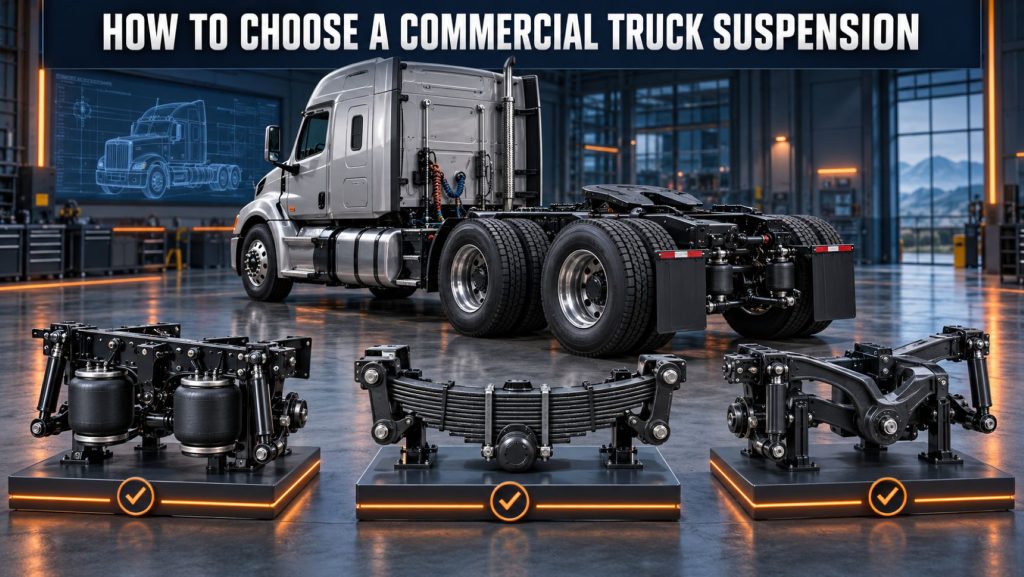
Choosing the correct commercial truck suspension requires more than deciding between air springs and leaf springs.
The suspension must support the truck and its load while controlling axle movement, maintaining tire contact, distributing weight, protecting cargo, and contributing to steering, braking, traction, stability, and ride quality.
A suspension that performs well on a long-haul highway tractor may not be appropriate for a dump truck, logging truck, refuse vehicle, heavy-haul tractor, utility truck, or specialized trailer.
The best suspension is one properly matched to the vehicle’s weight, axle configuration, body, cargo, terrain, duty cycle, maintenance capabilities, and expected operating environment.
This guide explains the factors to consider when choosing a commercial truck suspension and how air, mechanical, steer axle, drive axle, auxiliary axle, and vocational suspension systems fit different applications.
Begin With the Truck’s Actual Job
The first step is defining what the truck will do.
Important operating information includes:
- Truck type
- Vehicle class
- Body or equipment type
- Cargo
- Typical payload
- Maximum payload
- Highway mileage
- Urban operation
- Jobsite operation
- Road conditions
- Terrain
- Operating speed
- Loading and unloading method
- Daily starts and stops
- Annual mileage
- Expected service life
The truck’s primary application should guide the suspension decision.
A suspension should not be chosen only because it is popular, inexpensive, familiar, or available on another truck. The system must match the work performed by the specific vehicle.
Understand What the Suspension Must Do
Commercial truck suspensions perform several functions at the same time:
- Support the vehicle and its load
- Connect the axles to the frame
- Allow controlled wheel and axle movement
- Absorb road impacts
- Maintain tire contact
- Control body roll
- Help distribute weight between axles
- Transfer acceleration and braking forces
- Maintain driveline geometry
- Protect cargo and mounted equipment
- Support steering stability
- Improve driver comfort
Different applications place different priorities on these functions.
A highway truck may prioritize ride quality and cargo protection. A severe-duty vocational truck may place greater emphasis on durability, stability, articulation, and resistance to damage.
Learn more in How Commercial Truck Suspension Systems Work.
Determine the Vehicle’s Weight Requirements
The suspension must have sufficient capacity for the truck and its expected loads.
Important weight ratings include:
- Gross Vehicle Weight Rating
- Gross Axle Weight Rating
- Gross Combination Weight Rating
- Front axle rating
- Rear axle rating
- Auxiliary axle rating
- Suspension rating
- Tire and wheel ratings
The suspension rating should be considered alongside the ratings of the frame, axles, brakes, wheels, tires, steering system, and other chassis components.
A high-capacity suspension does not increase the legal or mechanical capacity of components with lower ratings.
Estimate Realistic Axle Loads
Total vehicle weight does not explain how weight will be distributed among the axles.
The suspension must be selected according to the load carried by each axle or axle group.
Axle loading can be affected by:
- Wheelbase
- Cab configuration
- Engine and transmission
- Fuel tanks
- Truck body
- Fifth-wheel position
- Trailer kingpin position
- Cargo placement
- Mounted equipment
- Lift axles
- Pusher or tag axles
- Load transfer during operation
A truck may remain below its total gross weight rating while exceeding the rating of an individual axle, suspension, tire, or wheel position.
Accurate weight distribution calculations are especially important for vocational trucks with cranes, dump bodies, concrete mixers, refuse equipment, towing systems, tanks, and other concentrated loads.
Choose the Correct Axle Configuration
Suspension selection is closely connected to axle configuration.
Commercial truck configurations can include:
- Single steer axle
- Twin-steer axles
- Single drive axle
- Tandem drive axles
- Tridem drive axles
- Pusher axles
- Tag axles
- Lift axles
- Steerable auxiliary axles
- Non-steerable auxiliary axles
A single-drive truck has different suspension requirements from a tandem-drive highway tractor or a multi-axle heavy-haul vehicle.
The number, position, and function of the axles affect capacity, traction, maneuverability, legal weight distribution, tire wear, and suspension design.
Highway or Vocational Operation
The operating environment is one of the most important suspension-selection factors.
Highway Operation
Highway trucks spend most of their time on paved roads at sustained speeds.
Important priorities may include:
- Ride quality
- Driver comfort
- Cargo protection
- Low suspension weight
- Consistent ride height
- Aerodynamic vehicle height
- Tire life
- Fuel efficiency
- Low maintenance
- Parts availability
Air suspension is widely used on long-haul and regional highway tractors because it performs well across changing loads and can provide a smoother ride.
Vocational Operation
Vocational trucks may operate on construction sites, forest roads, mines, farms, landfills, urban streets, and other demanding surfaces.
Important priorities may include:
- Durability
- Roll stability
- Axle articulation
- Ground clearance
- Resistance to impact
- High load capacity
- Protection from debris
- Low-speed control
- Straightforward repair
- Severe-duty mounting components
Mechanical, rubber, walking-beam, and severe-duty air suspensions may all be appropriate depending on the application.
Explore these systems in Vocational & Severe-Duty Suspensions.
Air Suspension or Leaf Springs
Air and leaf spring suspensions support vehicle weight in different ways.
Air suspension uses compressed air inside flexible air springs. Leaf spring suspension uses curved steel spring assemblies that flex under load.
Consider Air Suspension When Priorities Include:
- Improved ride quality
- Cargo protection
- Automatic ride-height control
- Frequently changing loads
- Driver comfort
- Highway operation
- Adjustable suspension height
- Reduced vibration
- Consistent trailer or fifth-wheel height
Consider Leaf Spring Suspension When Priorities Include:
- Mechanical simplicity
- Severe-duty durability
- Off-highway operation
- Straightforward inspection
- Resistance to harsh environments
- Strong mechanical load support
- Lower initial cost
- Reduced dependence on pneumatic components
Neither system is automatically better for every truck.
See Air Suspension vs Leaf Spring Suspension for a detailed comparison.
Ride Quality
Ride quality affects the driver, truck, cargo, and mounted equipment.
A smoother suspension can help reduce:
- Driver fatigue
- Cargo movement
- Freight damage
- Cab vibration
- Equipment vibration
- Stress on body mounts
- Shock transferred into the frame
Air suspension generally provides a smoother ride, especially when the truck is empty or operating across changing loads.
Mechanical suspensions may provide a firmer ride but can deliver the durability, stability, and load support required for vocational work.
Ride quality also depends on:
- Wheelbase
- Tires
- Tire pressure
- Shock absorbers
- Cab suspension
- Seat suspension
- Vehicle speed
- Road conditions
- Load placement
The suspension should be evaluated as part of the complete vehicle.
Cargo Protection
Cargo type should influence suspension selection.
Ride-sensitive cargo can include:
- Electronics
- Furniture
- Appliances
- Glass
- Machinery
- Vehicles
- Packaged consumer goods
- Refrigerated freight
- Livestock
- Other fragile materials
Air suspension is frequently selected for cargo-sensitive operations because it can reduce the vibration and impact transferred through the frame.
Mechanical suspension may be appropriate when the cargo is less sensitive or when durability is a greater priority.
Cargo protection also depends on packaging, load securement, trailer construction, tire condition, road quality, and driver behavior.
Driver Comfort
Driver comfort is particularly important for trucks that operate long hours or cover high annual mileage.
A suspension that reduces road shock and vibration can improve the driving environment.
Air suspension is commonly preferred for long-haul and regional tractors because of its ride characteristics.
However, total driver comfort also depends on:
- Cab suspension
- Air-ride seat
- Wheelbase
- Tire selection
- Cab design
- Vehicle loading
- Road conditions
- Maintenance
A truck suspension should not be selected solely by an unloaded test drive. Its behavior should be considered under the loads and conditions it will actually encounter.
Roll Stability
Roll stability is critical for vehicles with high or shifting centers of gravity.
Applications that may require additional stability consideration include:
- Tank trucks
- Concrete mixers
- Dump trucks
- Refuse vehicles
- Car haulers
- Cranes
- Aerial equipment
- Heavy-haul vehicles
- Livestock trucks
- Trucks carrying suspended loads
Suspension characteristics affecting stability include:
- Spring stiffness
- Air spring spacing
- Suspension geometry
- Track width
- Anti-roll components
- Shock absorbers
- Axle configuration
- Frame height
- Ride height
- Load distribution
A suspension with excellent highway ride quality may not provide the roll characteristics needed for every vocational body or operating condition.
The truck, body, suspension, tires, and center of gravity must be evaluated together.
Axle Articulation
Trucks operating on uneven surfaces may require substantial axle articulation.
Articulation allows the axles and wheels to move relative to the frame and one another while maintaining useful tire contact.
This is particularly important for:
- Construction trucks
- Logging trucks
- Mining vehicles
- Oilfield equipment
- Heavy-haul tractors
- Agricultural vehicles
- Off-highway trucks
Walking-beam and other mechanical suspensions are often selected for applications requiring durability and articulation.
Vocational air suspensions can also provide controlled axle movement when designed for the operating environment.
The amount of articulation required should be established before choosing the suspension.
Traction Requirements
Drive axle suspension design affects how effectively the truck maintains tire contact and uses available traction.
Traction is influenced by:
- Axle loading
- Suspension articulation
- Spring response
- Shock-absorber condition
- Differential configuration
- Tire selection
- Tire pressure
- Road surface
- Vehicle speed
- Driver inputs
A highway tractor operating on pavement has different traction requirements from a logging truck traveling across mud, ruts, and uneven ground.
The suspension should maintain appropriate axle loading and tire contact throughout the truck’s expected operating conditions.
Ground Clearance
Ground clearance matters for trucks operating on jobsites, forest roads, mines, farms, and other uneven surfaces.
Suspension components should not become vulnerable contact points.
Consider the location of:
- Air springs
- Shock absorbers
- Torque rods
- Spring hangers
- Equalizers
- Crossmembers
- Air lines
- Height-control valves
- Lift mechanisms
- Axle-control components
Air lines and valves may require additional protection in environments with rocks, branches, mud, or debris.
The suspension must also provide adequate travel without allowing axles, tires, or other components to contact the frame or body.
Suspension Travel
Suspension travel is the available movement between the axles and frame.
The correct amount of travel helps the wheels follow the road while reducing harsh impacts.
Insufficient travel can cause:
- Suspension bottoming
- Harsh ride quality
- Frame impacts
- Reduced tire contact
- Component damage
- Driver discomfort
- Cargo shock
The suspension must provide adequate compression and rebound travel at the vehicle’s operating ride height.
Body equipment, driveshafts, brake hoses, air lines, exhaust components, fenders, and tire clearances must remain compatible throughout the suspension’s movement.
Ride Height and Vehicle Height
Ride height affects more than appearance.
It can influence:
- Driveline angles
- Suspension travel
- Shock-absorber position
- Fifth-wheel height
- Trailer height
- Tire clearance
- Frame height
- Body installation
- Dock compatibility
- Overall vehicle height
Air suspension can maintain a relatively consistent ride height as load changes.
Leaf spring suspensions normally compress as load is added, causing the frame height to change.
The selected suspension must provide a vehicle height compatible with the intended body, trailer, fifth wheel, loading equipment, and operating environment.
Driveline Compatibility
Drive axle suspension geometry affects driveline angles.
The suspension must maintain acceptable relationships among:
- Transmission output
- Driveshaft
- Universal joints
- Interaxle driveshaft
- Drive axles
- Pinion angles
Incorrect ride height or axle position can contribute to driveline vibration and premature component wear.
The suspension, wheelbase, axle spacing, and driveline layout should be specified as a complete system.
Steer Axle Suspension Selection
The front suspension supports the steer axle and influences steering response, directional control, ride quality, alignment, and tire wear.
Important considerations include:
- Front axle load
- Engine weight
- Cab configuration
- Bumper and equipment weight
- Snowplow or front-mounted equipment
- Crane or body load transfer
- Steering geometry
- Tire capacity
- Spring rating
- Shock absorbers
- Stabilizer components
Selecting a front suspension with significantly more capacity than required may produce an unnecessarily firm ride.
Selecting insufficient capacity can cause poor ride height, spring damage, steering problems, or overloading.
Explore these systems in Steer Axle & Front Suspensions.
Drive Axle Suspension Selection
Drive axle suspensions must support weight while controlling acceleration, braking, axle rotation, articulation, and driveline geometry.
Important factors include:
- Single, tandem, or tridem axles
- Suspension capacity
- Expected drive axle load
- Engine torque
- Transmission gearing
- Highway or vocational use
- Traction requirements
- Articulation
- Ride quality
- Pinion-angle control
- Tire clearance
Highway tractors commonly use tandem air suspensions.
Vocational trucks may use air, leaf spring, walking-beam, rubber, or other mechanical systems depending on the application.
Auxiliary and Lift Axles
Some trucks require additional axles to distribute weight or meet operating requirements.
These can include:
- Pusher axles
- Tag axles
- Lift axles
- Steerable auxiliary axles
- Non-steerable auxiliary axles
Auxiliary axle selection must consider:
- Required axle capacity
- Available frame space
- Steering behavior
- Turning radius
- Tire scrub
- Load control
- Lift mechanism
- Ground clearance
- Body placement
- Legal axle spacing
- State operating requirements
Improperly specified or adjusted auxiliary axles can negatively affect steering, traction, braking, stability, and tire wear.
Explore these systems in Auxiliary & Lift Axle Suspensions.
Body and Equipment Compatibility
Vocational bodies and mounted equipment can place unique forces on a truck’s suspension and frame.
Examples include:
- Dump bodies
- Refuse bodies
- Concrete mixers
- Cranes
- Aerial lifts
- Tow and recovery equipment
- Vacuum tanks
- Utility bodies
- Fire apparatus
- Snowplows
- Roll-off systems
The body manufacturer or installer may have specific suspension, frame, stability, and axle requirements.
Suspension selection should account for the vehicle during:
- Normal travel
- Loading
- Unloading
- Dumping
- Lifting
- Towing
- Equipment operation
- Off-road positioning
A suspension suitable while driving may react differently when the body is raised or equipment is operating.
Truck and Trailer Compatibility
A tractor and trailer operate as a combination, but their suspensions perform different roles.
Tractor suspension affects:
- Fifth-wheel height
- Drive axle loading
- Traction
- Cab ride
- Driveline geometry
- Coupling position
Trailer suspension affects:
- Trailer axle loading
- Cargo protection
- Trailer ride
- Dock height
- Tandem positioning
- Trailer tracking
The guide Truck vs Trailer Suspension Systems explains these differences in greater detail.
Explore trailer-specific systems in Trailer Suspension Systems.
Suspension Weight
Suspension weight affects vehicle payload.
A lighter suspension may allow the truck to carry more revenue-producing cargo, provided the system still delivers the required capacity and durability.
Weight comparisons must be made between complete systems designed for equivalent axle capacities and applications.
Consider the weight of:
- Springs
- Beams
- Torque rods
- Control arms
- Hangers
- Crossmembers
- Brackets
- Air system components
- Lift equipment
- Mounting hardware
The lightest suspension is not necessarily the best choice if it cannot withstand the vehicle’s operating environment.
Maintenance Capabilities
Fleet maintenance capabilities should influence suspension selection.
Air suspension requires attention to:
- Air springs
- Height-control valves
- Air lines
- Fittings
- Ride-height adjustment
- Torque rods
- Bushings
- Shock absorbers
Mechanical suspension requires attention to:
- Spring leaves
- U-bolts
- Equalizers
- Walking beams
- Hangers
- Shackles
- Bushings
- Torque rods
- Shock absorbers
Consider whether technicians have the training, tools, service information, and parts needed to maintain the selected system.
A suspension that cannot be properly inspected and repaired may create higher costs and longer downtime.
Parts and Service Availability
Commercial trucks may operate far from their home terminal.
Before selecting a suspension, consider:
- Dealer network
- Independent repair availability
- Replacement-part availability
- Manufacturer support
- Technical documentation
- Warranty coverage
- Component lead times
- Fleet parts inventory
A specialized suspension may deliver excellent performance but create downtime if replacement components are difficult to obtain.
Initial Price vs Lifecycle Cost
Purchase price is only one part of suspension cost.
Lifecycle considerations can include:
- Initial cost
- Maintenance
- Replacement components
- Labor
- Downtime
- Tire wear
- Cargo damage
- Driver comfort
- Suspension weight
- Fuel use
- Vehicle resale value
- Expected service life
A lower-cost suspension may become expensive if it produces excessive downtime or does not match the operation.
A higher-cost system may be justified when it protects cargo, reduces vibration, improves productivity, or better supports the vehicle’s duty cycle.
Avoid Overspecifying the Suspension
Choosing more suspension capacity than the truck requires can create disadvantages.
An oversized or unnecessarily stiff suspension may:
- Increase vehicle weight
- Raise purchase cost
- Reduce ride quality
- Add unnecessary components
- Reduce payload
- Increase maintenance expense
The goal is not to select the highest available rating. The goal is to select sufficient capacity with an appropriate margin for the actual application.
Avoid Underspecifying the Suspension
A suspension without adequate capacity or durability may experience:
- Excessive deflection
- Incorrect ride height
- Suspension bottoming
- Broken springs
- Damaged air springs
- Worn bushings
- Loose mounts
- Poor stability
- Irregular tire wear
- Frame stress
- Reduced service life
Expected maximum loads and severe operating conditions should be identified before the truck is ordered or modified.
Questions to Ask a Truck Dealer or Suspension Supplier
Useful questions include:
- What suspension capacity is required?
- What are the expected front and rear axle loads?
- Is this system designed for the intended application?
- How does it perform when the truck is empty?
- How does it perform at maximum load?
- What suspension travel is available?
- What ride height must be maintained?
- What maintenance is required?
- What are the common wear components?
- Are parts readily available?
- Is the suspension compatible with the body?
- Is it appropriate for the expected terrain?
- How does it affect vehicle height?
- Does it support auxiliary axles?
- What warranty applies?
- What inspections are required?
- Are there body-builder restrictions?
Written specifications should be reviewed before the vehicle is purchased.
A Practical Suspension-Selection Process
A simplified selection process includes:
- Define the truck’s primary application.
- Calculate expected vehicle and axle weights.
- Identify the required axle configuration.
- Determine highway and off-highway usage.
- Establish ride-quality and cargo-protection needs.
- Evaluate stability and articulation requirements.
- Compare air and mechanical suspension options.
- Confirm compatibility with the truck body and equipment.
- Review ride height, driveline, and tire clearances.
- Evaluate maintenance and parts availability.
- Compare initial and lifecycle costs.
- Confirm the final specification with the chassis, suspension, and body manufacturers.
The suspension should be selected as part of the complete vehicle specification rather than as an isolated component.
Explore Suspension Systems by Category
Air Suspension Systems
Explore commercial suspension systems that use compressed air and flexible air springs to support vehicle weight and maintain ride height.
Mechanical & Leaf Spring Suspensions
Explore leaf spring, equalizer, walking-beam, rubber, and other mechanically supported suspension systems.
Vocational & Severe-Duty Suspensions
Explore suspensions designed for construction, logging, refuse, mining, heavy haul, and other demanding applications.
Auxiliary & Lift Axle Suspensions
Explore suspension systems used with pusher, tag, lift, and other auxiliary axles.
Steer Axle & Front Suspensions
Explore suspension systems that support commercial-truck steer axles and influence steering, alignment, and ride quality.
Trailer Suspension Systems
Explore air, mechanical, tandem, spread-axle, sliding, and specialized commercial-trailer suspension systems.
Continue Learning About Commercial Truck Suspensions
Continue with the other Truck Equipment Atlas suspension guides:
- How Commercial Truck Suspension Systems Work
- Air Suspension vs Leaf Spring Suspension
- Truck Suspension Components Explained
- Truck vs Trailer Suspension Systems
Visit the Commercial Truck Suspension Systems Library to explore suspension categories, individual systems, operating characteristics, applications, and maintenance considerations.
Visit Equipment System Guides to explore additional educational resources covering suspension systems and other commercial-truck equipment.
Final Thoughts
Choosing a commercial truck suspension requires understanding the complete vehicle and the work it will perform.
The suspension must support the truck and its load while controlling axle movement, maintaining tire contact, distributing weight, protecting cargo, and contributing to steering, braking, traction, stability, and ride quality.
Air suspension is often appropriate for highway operations, changing loads, cargo protection, and driver comfort. Mechanical suspension remains important for applications that prioritize durability, simplicity, stability, and severe-duty performance.
The correct choice also depends on axle capacity, body equipment, terrain, operating speed, ground clearance, articulation, maintenance capabilities, parts availability, vehicle weight, and lifecycle cost.
No single suspension design is best for every truck.
A suspension properly matched to the application can improve vehicle performance, reduce downtime, protect equipment, extend component life, and help the truck perform its intended work safely and efficiently.