
How Commercial Truck Suspension Systems Work
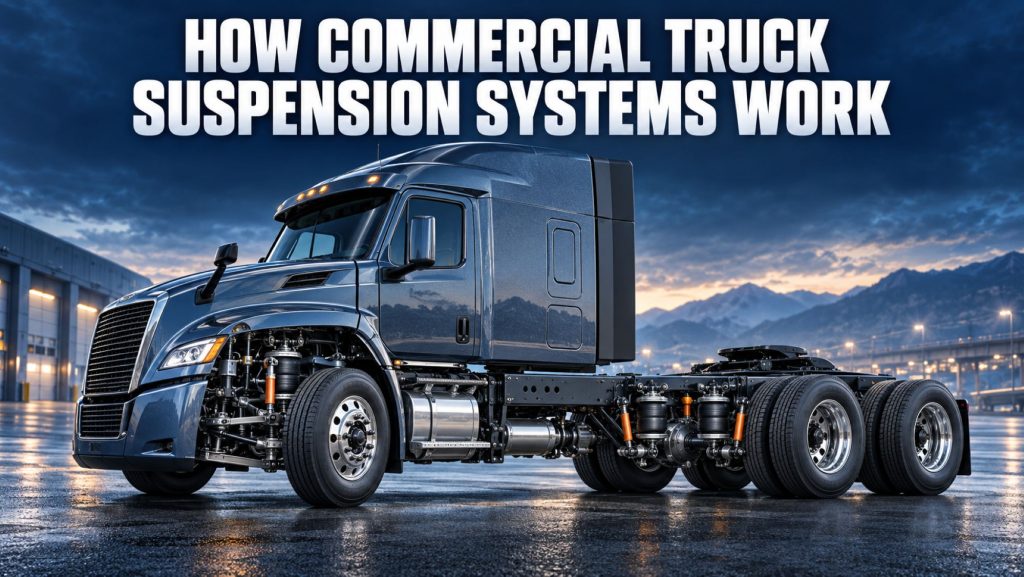
Commercial truck suspension systems connect the vehicle’s frame to its axles while supporting the truck, cargo, body, and trailer loads. They allow the wheels and axles to move in response to changing road surfaces while helping maintain stability, traction, ride quality, steering control, and proper load distribution.
A commercial truck may operate empty, at normal highway weight, or under demanding vocational and heavy-haul conditions. Its suspension must manage those changing loads while controlling movement between the frame, axles, wheels, and road.
Commercial trucks and trailers use several types of suspension systems, including air suspensions, mechanical leaf spring suspensions, steer axle suspensions, drive axle suspensions, auxiliary axle suspensions, and specialized severe-duty designs.
This guide explains how commercial truck suspension systems work, how their major components interact, and why suspension design affects ride quality, handling, traction, tire wear, stability, and load-carrying performance.
The Basic Structure of a Truck Suspension
A commercial truck suspension operates between the vehicle frame and the axles.
The basic relationship can be simplified as:
- Vehicle Frame → Springs and Suspension Components → Axles → Wheels and Tires → Road Surface
- Road forces also travel in the opposite direction:
- Road Surface → Tires and Wheels → Axles → Suspension → Vehicle Frame
The suspension helps control how those forces move through the vehicle.
Without a suspension system, bumps, potholes, uneven terrain, braking forces, and load changes would be transferred much more directly into the frame, cab, cargo, and driver.
What a Commercial Truck Suspension Does
A commercial truck suspension performs several important functions:
- Supports the weight of the vehicle
- Supports cargo, body, and trailer loads
- Connects the axles to the frame
- Allows controlled axle movement
- Absorbs and manages road impacts
- Helps keep the tires in contact with the road
- Controls body roll and frame movement
- Helps distribute weight between axles
- Supports steering stability
- Improves braking and traction
- Protects the truck, cargo, and mounted equipment
- Influences driver comfort
- Helps maintain proper ride height
Suspension systems must perform all these functions while operating under repeated loading, vibration, road shock, braking, acceleration, cornering, and changing terrain.
How a Truck Suspension Responds to the Road
When a wheel encounters a bump, the wheel and axle move upward relative to the frame.
The suspension allows this movement while the spring absorbs and stores part of the energy created by the impact. The shock absorber or damper then helps control the spring’s movement so the vehicle does not continue bouncing excessively.
A simplified sequence is:
- The tire encounters a bump or uneven surface.
- The wheel and axle move upward.
- The spring compresses or changes position.
- Suspension links guide the axle’s movement.
- Shock absorbers control the rate of movement.
- The suspension returns toward its normal position.
- The tire maintains or regains stable contact with the road.
The exact process varies according to the suspension design, axle position, vehicle application, and operating load.
Sprung and Unsprung Weight
Understanding sprung and unsprung weight helps explain suspension operation.
Sprung Weight
Sprung weight is the portion of the vehicle supported by the suspension.
It can include:
- Frame
- Cab
- Engine
- Transmission
- Fuel tanks
- Truck body
- Cargo
- Trailer structure
- Equipment mounted above the suspension
Unsprung Weight
Unsprung weight generally includes components that move more directly with the wheels and axles.
It can include:
- Axles
- Wheel hubs
- Brake assemblies
- Wheels
- Tires
- Portions of the suspension system
The suspension controls movement between the sprung and unsprung portions of the vehicle.
Heavy axles and wheel assemblies create substantial unsprung weight. The suspension must manage that weight while helping the tires follow the road surface.
Major Truck Suspension Components
Commercial suspension designs vary, but several components appear throughout many systems.
For a more detailed look at each part, see Truck Suspension Components Explained.
Springs
Springs support weight and allow movement between the frame and axles.
Common commercial-truck spring types include:
- Air springs
- Leaf springs
- Coil springs
- Rubber springs
- Elastomeric springs
- Combination spring systems
The spring type strongly influences ride characteristics, load response, durability, suspension travel, and maintenance requirements.
Air Springs
An air spring is a flexible, reinforced rubber assembly containing compressed air.
As the load changes, the suspension can add or release air to maintain the intended ride height. Air springs are widely used on highway tractors, straight trucks, buses, and commercial trailers.
Leaf Springs
A leaf spring uses one or more curved steel leaves to support weight and control movement.
Leaf springs may also help locate the axle, depending on the suspension design. They are commonly used in steer axle, vocational, severe-duty, medium-duty, and trailer applications.
Shock Absorbers
Shock absorbers help control suspension movement.
A spring can continue moving after it has been compressed or extended. Shock absorbers slow that motion by converting movement into heat through hydraulic resistance.
Worn or damaged shock absorbers can contribute to:
- Excessive bouncing
- Reduced tire contact
- Irregular tire wear
- Poor handling
- Increased component movement
- Reduced vehicle stability
Torque Rods and Control Arms
Torque rods and control arms help locate the axle and control its movement relative to the frame.
Depending on the design, they may control:
- Forward and rearward movement
- Side-to-side movement
- Axle rotation
- Braking forces
- Acceleration forces
- Pinion angle
- Axle alignment
Bushings
Bushings provide flexible connection points between suspension components.
They help absorb vibration and permit controlled movement while limiting metal-to-metal contact. Worn bushings can allow excessive axle movement and contribute to alignment problems, noise, instability, and irregular tire wear.
Hangers, Brackets, and Mounts
Suspension components attach to the frame through hangers, brackets, crossmembers, and mounting hardware.
These attachment points carry substantial loads and must withstand repeated stress. Loose fasteners, cracks, worn mounting holes, and damaged brackets can affect the entire suspension system.
Equalizers
Mechanical tandem suspensions may use equalizers to distribute load and allow movement between axles.
As one axle moves upward or downward, the equalizer helps transfer part of the load between the axles.
Height-Control Valves
An air suspension commonly uses one or more height-control valves to maintain the intended distance between the frame and axle.
If the vehicle is loaded, the frame moves downward and the valve adds air to the air springs. When weight is removed, the valve releases excess air.
This process helps maintain consistent ride height across changing loads.
Air Lines and Fittings
Air suspension systems depend on air lines, fittings, valves, tanks, and related pneumatic components.
Leaks or restrictions can prevent the suspension from maintaining proper pressure or ride height.
Axles
The suspension connects the axle assembly to the frame while allowing controlled movement.
Different suspension designs may be used for:
- Steer axles
- Single drive axles
- Tandem drive axles
- Tridem axles
- Auxiliary axles
- Lift axles
- Trailer axles
How Air Suspension Systems Work
An air suspension uses compressed air inside flexible air springs to support the vehicle.
Air is supplied by the truck’s compressed-air system or, on a trailer, through the tractor-trailer air connections and trailer reservoirs. Height-control valves regulate the amount of air in the suspension.
When weight is added:
- The frame moves lower relative to the axle.
- The height-control valve detects the change.
- Compressed air enters the air springs.
- The air springs expand and support the added load.
- The vehicle returns toward its specified ride height.
When weight is removed:
- The frame rises relative to the axle.
- The height-control valve detects the change.
- Excess air is released.
- The suspension returns toward its specified ride height.
Air suspensions can provide:
- Improved ride quality
- Automatic ride-height control
- Better cargo protection
- Adjustable suspension height in some applications
- More consistent operation across changing loads
- Reduced vibration transferred into the vehicle
Air suspension systems also introduce components that require inspection, including air springs, valves, air lines, fittings, bushings, shocks, and suspension links.
Explore these systems in the Air Suspension Systems section.
How Leaf Spring Suspensions Work
A leaf spring suspension uses curved steel spring leaves to support weight and flex as the axle moves.
When the axle moves upward, the leaf spring bends and stores energy. As the load is released, the spring returns toward its normal shape.
Depending on the design, the leaf spring may perform several functions:
- Support vehicle weight
- Absorb road impacts
- Help position the axle
- Control axle movement
- Transfer braking forces
- Transfer acceleration forces
Leaf spring suspensions are valued for their mechanical simplicity, durability, and ability to perform in demanding applications.
They are commonly found on:
- Steer axles
- Medium-duty trucks
- Dump trucks
- Construction vehicles
- Logging trucks
- Service trucks
- Severe-duty vehicles
- Commercial trailers
Mechanical suspensions can produce a firmer ride, especially when the vehicle is lightly loaded. However, their durability and straightforward design make them appropriate for many vocational and off-highway operations.
For a direct comparison, see Air Suspension vs Leaf Spring Suspension.
Explore related designs in Mechanical & Leaf Spring Suspensions.
Suspension Travel
Suspension travel is the amount of controlled movement available between the axle and frame.
Upward wheel movement is often called compression or jounce. Downward movement is commonly called rebound or droop.
Adequate suspension travel helps the wheels follow uneven surfaces without transferring every movement directly into the frame.
Too little usable travel can cause:
- Harsh impacts
- Suspension bottoming
- Reduced tire contact
- Component damage
- Poor ride quality
Excessive or uncontrolled movement can also create handling, driveline, alignment, and stability problems.
Suspension Damping
Springs support weight and absorb energy, but they do not automatically stop moving after a disturbance.
Damping controls that movement.
Shock absorbers are commonly used to reduce repeated oscillation after the suspension encounters a bump, dip, or sudden load change.
Proper damping helps:
- Keep tires in contact with the road
- Reduce repeated bouncing
- Improve steering response
- Control body movement
- Protect cargo
- Improve driver comfort
- Reduce stress on suspension components
Spring support and shock-absorber damping are different functions. A truck can have springs that still support its weight while worn shocks allow excessive movement.
Axle Location and Control
A truck suspension must do more than support vertical weight. It must also keep the axle properly positioned.
During acceleration, braking, cornering, and operation on uneven surfaces, the axle is subjected to forces in several directions.
Suspension links, leaf springs, torque rods, control arms, bushings, and mounting points help control:
- Fore-and-aft axle movement
- Side-to-side movement
- Axle windup
- Pinion-angle changes
- Braking reaction
- Acceleration reaction
- Axle alignment
If these components wear or become damaged, the axle may move outside its intended position.
This can affect handling, driveline angles, tire wear, braking stability, and overall vehicle control.
Ride Height
Ride height is the specified distance between selected points on the axle, suspension, or frame.
Proper ride height is especially important on air-suspended trucks and trailers.
Incorrect ride height can affect:
- Suspension travel
- Driveline angles
- Universal-joint operation
- Axle alignment
- Vehicle handling
- Air spring position
- Shock-absorber travel
- Fifth-wheel height
- Trailer height
- Tire clearance
Ride-height measurements and adjustment procedures vary by manufacturer and suspension model. The correct service information should be used rather than relying on appearance alone.
Load Distribution
Commercial suspension systems help distribute weight among the vehicle’s axles.
Proper load distribution is important because axle weights affect:
- Legal weight compliance
- Tire loading
- Braking
- Steering
- Traction
- Component life
- Vehicle stability
- Road and bridge loading
Tandem and tridem suspensions are designed to share weight across multiple axles. The exact distribution can change as the vehicle accelerates, brakes, turns, travels over uneven surfaces, or operates with incorrect ride height.
Air pressure in an air suspension can provide useful information about loading, but suspension pressure is not a substitute for an accurate certified scale measurement.
Articulation and Uneven Terrain
Articulation describes the suspension’s ability to allow axles and wheels to move relative to one another while maintaining useful ground contact.
This is particularly important in:
- Construction
- Logging
- Mining
- Heavy haul
- Oilfield operations
- Agriculture
- Off-highway work
- Uneven loading areas
A highly articulated suspension can help keep more tires in contact with the ground as the vehicle crosses uneven terrain.
However, suspension articulation must still be controlled to protect driveline components, brake hoses, air lines, shocks, tires, and other nearby equipment.
Roll Stability
When a truck turns, changes lanes, travels across a slope, or experiences a sudden steering input, its body tends to roll toward the outside of the turn.
Suspension design influences how much roll occurs and how quickly weight transfers from one side of the vehicle to the other.
Roll stability can be affected by:
- Center of gravity
- Cargo height
- Cargo movement
- Track width
- Suspension stiffness
- Air spring placement
- Anti-roll components
- Tire condition
- Vehicle speed
- Road surface
- Load distribution
Tankers, refuse trucks, concrete mixers, dump trucks, car haulers, and other high-center-of-gravity or shifting-load vehicles can require particular attention to suspension and stability characteristics.
The suspension contributes to stability, but it cannot overcome excessive speed, improper loading, cargo movement, poor tire condition, or unsafe operation.
Steering and Front Suspension Systems
The front suspension supports the steer axle and plays a direct role in steering response, directional stability, ride quality, and tire wear.
Commercial truck front suspensions often use leaf springs, although other configurations may be used.
Front suspension components can include:
- Leaf springs
- Spring hangers
- Shackles
- Bushings
- Shock absorbers
- U-bolts
- Axle seats
- Steering components
- Stabilizer components
Wear, looseness, damage, or misalignment at the front suspension can affect how accurately and safely the truck steers.
Explore these systems in Steer Axle & Front Suspensions.
Drive Axle Suspensions
Drive axle suspensions support the powered rear axles and must control the forces created by engine torque, braking, road impacts, and vehicle loading.
A Class 8 tractor commonly uses a tandem drive suspension, although single-drive, tridem, and specialized configurations are also used.
Drive suspension systems must help manage:
- Axle load
- Driving torque
- Braking forces
- Axle articulation
- Pinion angles
- Traction
- Frame movement
- Tandem load distribution
Highway tractors frequently use air suspensions, while vocational and severe-duty trucks may use air, mechanical, rubber, or specialized suspension designs.
Vocational and Severe-Duty Suspensions
Vocational trucks often operate under conditions that differ substantially from normal highway service.
They may encounter:
- Rough jobsites
- Uneven ground
- Repeated loading and unloading
- High centers of gravity
- Concentrated loads
- Frequent starts and stops
- Severe braking
- Off-highway terrain
- Mud, dust, water, and debris
- High suspension articulation
- Heavy auxiliary equipment
Suspensions used in these applications may prioritize durability, stability, articulation, ground clearance, and load capacity over highway ride comfort.
Explore application-specific systems in Vocational & Severe-Duty Suspensions.
Auxiliary and Lift Axle Suspensions
Auxiliary axles are added to help carry and distribute vehicle weight.
Common examples include:
- Pusher axles
- Tag axles
- Lift axles
- Steerable auxiliary axles
- Non-steerable auxiliary axles
A lift axle can be raised when it is not needed and lowered when additional axle capacity or load distribution is required.
Auxiliary suspension systems may use air springs, control valves, regulators, lift mechanisms, steer-lock systems, and load-control equipment.
Correct operation is important because improper auxiliary axle loading can affect:
- Steering
- Traction
- Braking
- Tire wear
- Legal axle weights
- Vehicle stability
- Turning behavior
Explore these systems in Auxiliary & Lift Axle Suspensions.
Trailer Suspension Systems
Commercial trailers use their own suspension systems to support the trailer frame and cargo above the trailer axles.
Trailer suspensions may use:
- Air springs
- Leaf springs
- Equalizers
- Torque arms
- Sliding tandem assemblies
- Fixed tandem assemblies
- Spread-axle configurations
- Specialized heavy-haul systems
Trailer suspension design affects:
- Cargo protection
- Trailer stability
- Axle loading
- Tire wear
- Dock height
- Trailer ride
- Braking performance
- Maintenance requirements
Truck and trailer suspensions perform related functions, but they operate within different vehicle structures and face different design requirements.
The guide Truck vs Trailer Suspension Systems provides a more detailed comparison.
Explore trailer systems in Trailer Suspension Systems.
How Suspension Affects Traction
A tire must remain in effective contact with the road to produce traction.
The suspension helps the wheels follow changes in the road surface while controlling axle movement. Poorly controlled suspension movement can cause a tire to unload, bounce, or lose consistent contact.
Traction can be affected by:
- Suspension design
- Spring condition
- Shock-absorber condition
- Load distribution
- Axle alignment
- Tire pressure
- Tire condition
- Road surface
- Differential operation
- Driver inputs
A properly maintained suspension supports traction during acceleration, braking, cornering, and operation on uneven surfaces.
How Suspension Affects Braking
Braking creates strong forces through the tires, axles, suspension, and frame.
The suspension must control axle movement and help maintain tire contact as vehicle weight shifts during braking.
Worn bushings, loose mounting components, broken springs, damaged torque rods, incorrect ride height, or ineffective shocks can reduce stability during braking.
The truck’s suspension, brakes, tires, steering, and load distribution must work together as a complete vehicle system.
How Suspension Affects Tire Wear
Suspension condition and axle alignment have a major influence on tire wear.
Suspension-related causes of irregular tire wear can include:
- Worn bushings
- Loose U-bolts
- Damaged springs
- Incorrect ride height
- Bent or damaged suspension components
- Axle misalignment
- Worn shocks
- Unequal loading
- Excessive axle movement
- Improperly adjusted auxiliary axles
Replacing tires without correcting the underlying suspension or alignment problem can allow the same wear pattern to return.
How Suspension Affects Driveline Angles
Drive axles must remain within appropriate operating angles relative to the driveshaft.
Ride height, torque-rod adjustment, axle position, and suspension condition can influence pinion angle and driveline geometry.
Incorrect driveline angles can contribute to:
- Vibration
- Universal-joint wear
- Driveline noise
- Seal damage
- Reduced component life
- Premature driveline failure
This is one reason air-suspension ride height should be checked and adjusted according to the correct manufacturer procedure.
Common Suspension Problems
Commercial truck suspensions operate under constant stress and can develop mechanical, pneumatic, and alignment problems.
Common issues include:
- Leaking air springs
- Damaged air lines
- Faulty height-control valves
- Broken or cracked leaf springs
- Worn shock absorbers
- Worn bushings
- Loose U-bolts
- Damaged torque rods
- Cracked brackets or hangers
- Incorrect ride height
- Uneven vehicle height
- Axle misalignment
- Excessive suspension movement
- Suspension bottoming
- Air leaks
- Irregular tire wear
- Unusual noises
- Driveline vibration
A single symptom does not always identify the failed component. For example, uneven tire wear may result from suspension wear, axle alignment, wheel-end problems, tire inflation, loading, or several conditions acting together.
Signs a Suspension Needs Inspection
Drivers and technicians should pay attention to changes in vehicle behavior.
Possible warning signs include:
- The truck leaning to one side
- Uneven ride height
- Excessive bouncing
- Harsh ride quality
- Clunking or knocking noises
- Air loss
- Frequent compressor operation
- Visible air spring damage
- Broken spring leaves
- Steering wander
- Poor tracking
- Irregular tire wear
- Increased vibration
- Trailer dog-tracking
- Reduced stability
- Suspension warning lights
- Components contacting the frame or other parts
Suspension problems should be inspected promptly because they can affect tires, steering, braking, driveline components, cargo, and vehicle control.
Suspension Inspection and Maintenance
Maintenance requirements vary according to the suspension type, manufacturer, vehicle, and application.
Common inspection areas include:
- Air springs
- Leaf springs
- Shock absorbers
- Bushings
- Torque rods
- Control arms
- Hangers and brackets
- U-bolts
- Mounting fasteners
- Height-control valves
- Air lines and fittings
- Axle alignment
- Ride height
- Tire-wear patterns
- Frame attachment points
- Auxiliary axle controls
- Lift mechanisms
- Electrical connections on electronically controlled systems
Technicians should also inspect for:
- Cracks
- Corrosion
- Loose hardware
- Air leaks
- Bent components
- Torn rubber
- Worn mounting holes
- Evidence of contact
- Unequal component positioning
- Missing or damaged fasteners
Inspection and adjustment procedures should follow the vehicle and suspension manufacturers’ specifications.
Why Suspension Selection Matters
Suspension selection affects how a truck performs throughout its working life.
A suspension that works well for a long-haul tractor may not be appropriate for a dump truck, logging truck, refuse vehicle, heavy-haul tractor, or specialized trailer.
Suspension choice can influence:
- Ride quality
- Cargo protection
- Vehicle stability
- Empty-vehicle ride
- Loaded ride
- Traction
- Axle articulation
- Ground clearance
- Weight
- Maintenance
- Tire wear
- Driver comfort
- Durability
- Cost
- Resale value
The best suspension is the one properly matched to the truck’s actual application.
For a detailed selection process, see How to Choose a Commercial Truck Suspension.
Factors That Affect Suspension Selection
Important considerations include:
- Truck or trailer type
- Vehicle class
- Axle configuration
- Gross vehicle weight
- Gross combination weight
- Expected axle loads
- Cargo type
- Cargo sensitivity
- Highway versus vocational use
- Road and jobsite conditions
- Required articulation
- Ride-quality priorities
- Stability requirements
- Ground-clearance needs
- Auxiliary axle requirements
- Dumping or unloading operations
- Maintenance capabilities
- Operating environment
- Weight and cost targets
- Manufacturer support
- Replacement-parts availability
A highway tractor, delivery truck, dump truck, refuse vehicle, logging truck, tanker, flatbed trailer, refrigerated trailer, and heavy-haul combination can each require different suspension characteristics.
Understanding the Major Suspension Categories
Truck Equipment Atlas organizes commercial suspension systems into several major categories.
Air Suspension Systems
Explore suspension systems that use compressed air and flexible air springs to support vehicle weight and maintain ride height.
Mechanical & Leaf Spring Suspensions
Explore leaf spring, equalizer, walking-beam, rubber, and other mechanically supported suspension designs.
Vocational & Severe-Duty Suspensions
Explore suspensions designed for construction, logging, mining, refuse, heavy haul, off-highway work, and other demanding applications.
Auxiliary & Lift Axle Suspensions
Explore suspension systems used with pusher, tag, lift, and other auxiliary axles.
Steer Axle & Front Suspensions
Explore front suspension systems that support steer axles and influence steering control, ride quality, alignment, and tire wear.
Trailer Suspension Systems
Explore air, mechanical, tandem, spread-axle, sliding, and specialized suspension systems used on commercial trailers.
Explore Commercial Suspension Systems
Truck Equipment Atlas includes educational pages and individual profiles covering commercial suspension systems used in highway, medium-duty, vocational, severe-duty, and trailer applications.
Visit the Commercial Truck Suspension Systems Library to explore suspension categories, individual systems, operating characteristics, applications, maintenance considerations, and related information.
Continue Learning About Commercial Truck Suspension Systems
This guide provides the foundation for understanding how commercial truck suspension systems operate.
Continue with the other Truck Equipment Atlas suspension guides:
- Air Suspension vs Leaf Spring Suspension
- How to Choose a Commercial Truck Suspension
- Truck Suspension Components Explained
- Truck vs Trailer Suspension Systems
Visit Equipment System Guides to explore the complete educational guide library covering suspension systems, air brakes, fifth wheels, PTO systems, hydraulics, lift axles, electrical systems, and other critical commercial-truck equipment.
Final Thoughts
A commercial truck suspension does much more than provide a smoother ride.
It supports the truck and its load, connects the axles to the frame, controls wheel and axle movement, distributes weight, maintains tire contact, and contributes to steering, braking, traction, stability, cargo protection, and driver comfort.
Air suspensions use compressed air to support changing loads and maintain ride height. Mechanical suspensions use steel, rubber, or other spring designs to provide durable load support. Steer, drive, auxiliary, and trailer suspensions are each designed around their particular positions and operating demands.
No suspension design is best for every commercial vehicle. Highway tractors, vocational trucks, severe-duty equipment, medium-duty vehicles, and commercial trailers operate under different loads and conditions.
Understanding how suspension systems work provides an important foundation for evaluating commercial trucks and trailers, recognizing suspension problems, planning maintenance, and selecting equipment appropriate for a specific operation.
Truck Equipment Atlas will continue expanding its suspension profiles, educational guides, and equipment resources as the commercial suspension library grows.