
Dana Spicer S140 Series
Quick Facts
- Manufacturer: Dana Incorporated
- Brand: Spicer
- Product Family: S140 Series
- Axle Type: Single-reduction drive axle
- Drive Configuration: Single drive axle, commonly used in 4×2 trucks
- Primary Vehicle Classes: Class 6 and Class 7
- Available Models: S17-140, S19-140, S20-140, and S21-140
- GAWR Range: 17,000 to 21,000 lb
- Nominal GCW Rating: Up to 50,000 lb in approved configurations
- Axle Ratio Range: 3.31:1 to 6.50:1
- Primary Applications: Pickup and delivery, school bus, midi bus, motorhome, municipal, and utility vehicles
- Differential Options: Standard differential, Spicer Trac-Lok limited-slip differential, and application-dependent traction options
- Gearing Technology: GenTech gearing on designated models
- Notable Option: Electromagnetic driveline retarder
- Primary Design Goal: Reduce weight, installation costs, drivetrain noise, and total ownership costs in medium-duty vehicles
Overview
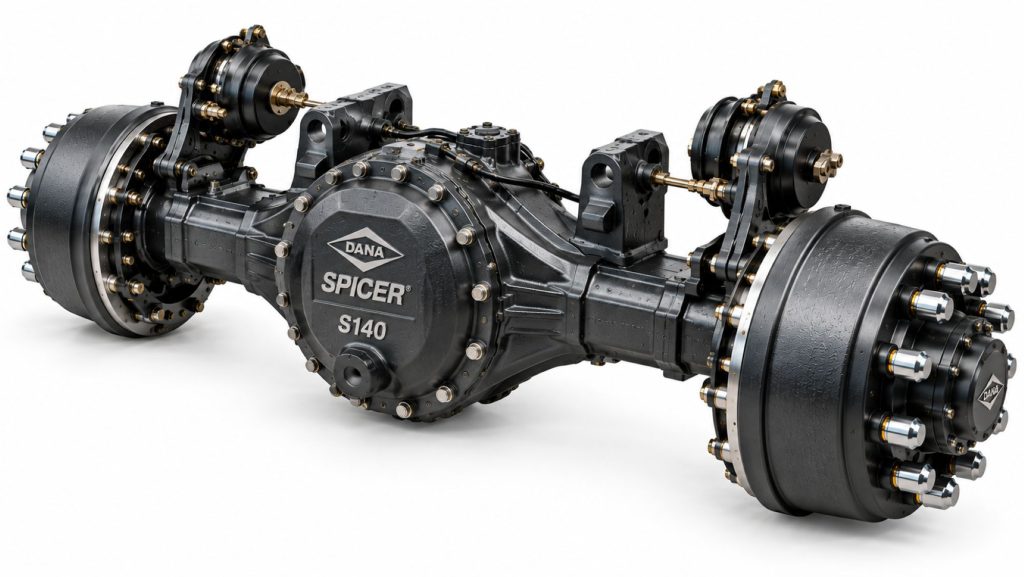
The Dana Spicer S140 Series is a family of single-reduction commercial truck drive axles designed for medium-duty straight trucks, buses, motorhomes, municipal vehicles, and utility trucks.
The family includes axle models with gross axle weight ratings from 17,000 to 21,000 pounds. Dana identifies the S17-140, S19-140, S20-140, and S21-140 as the principal models within the series.
Unlike a tandem axle that uses two connected drive axles, the S140 is a single drive axle. It is commonly installed at the rear of a 4×2 truck and performs both load-supporting and torque-transmitting functions.
The axle emphasizes low weight, broad ratio coverage, increased ground clearance, reduced lubricant requirements, and lower noise, vibration, and harshness. Its design is intended to help medium-duty vehicles carry more usable payload while simplifying installation and maintenance.
Key Characteristics
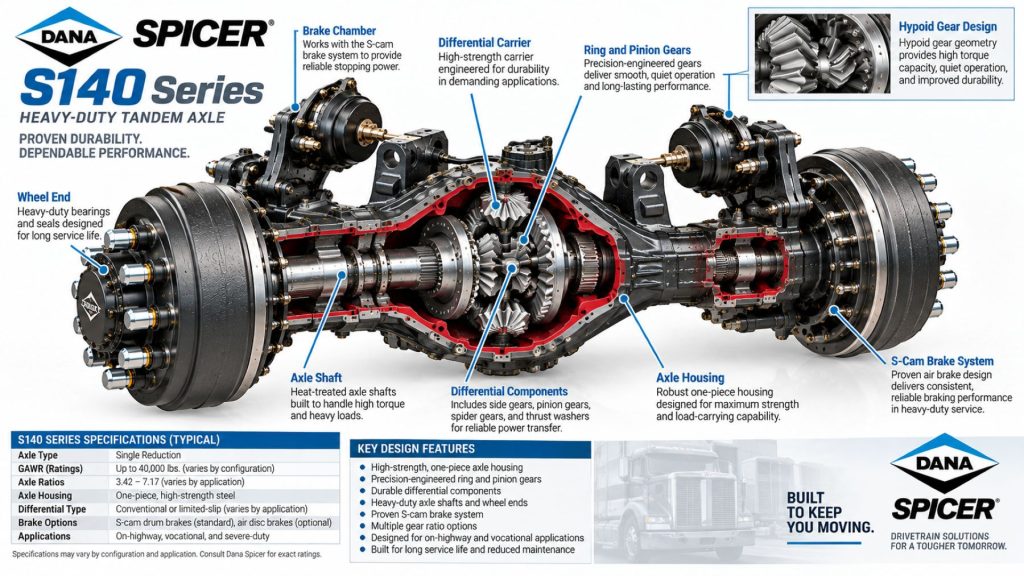
The S140 combines high-capacity gearing and bearings in a relatively compact axle assembly. Dana refers to this approach as High-Power Density technology.
Its ring gear uses a wide face width to increase gear strength and load-carrying capacity without requiring an unnecessarily large axle housing.
Designated S140 models use premium GenTech gearing. This gear technology is intended to reduce axle whine and provide an automotive-style noise level in buses, delivery trucks, motorhomes, and other vehicles where passenger and driver comfort are important.
The axle uses an integrated ring-gear and wheel-differential mounting system. Eliminating a traditional bolted connection in this area reduces complexity and removes a potential point of movement or failure.
An integral pinion cage and carrier improve structural strength while eliminating a possible lubricant leak path.
The forged steel housing is designed to provide strength while reducing weight. Its compact shape can provide approximately 23 mm, or nearly one inch, of additional ground clearance compared with some larger axle designs.
How the Axle or Differential Works
Engine torque travels through the transmission and driveshaft to the S140’s input yoke and pinion shaft. The pinion gear turns the larger ring gear inside the axle carrier.
The difference in size between the pinion and ring gear creates the final-drive reduction. For example, a 4.10:1 axle ratio means the driveshaft and pinion turn approximately 4.10 times for each complete rotation of the drive wheels.
The ring gear is connected to the wheel differential. The differential divides torque between the left and right axle shafts while allowing the two drive wheels to rotate at different speeds during a turn.
The axle shafts transmit torque from the differential side gears to the wheel ends. Because the S140 is a single-drive-axle design, it does not use the inter-axle differential or power divider found in a tandem-drive system.
When equipped with the Spicer Trac-Lok limited-slip differential, internal friction elements automatically limit excessive speed differences between the drive wheels. This helps transfer usable torque away from a slipping wheel without fully locking the axle.
For a broader explanation, see How Commercial Truck Axles and Differentials Work.
Axle Position and Function
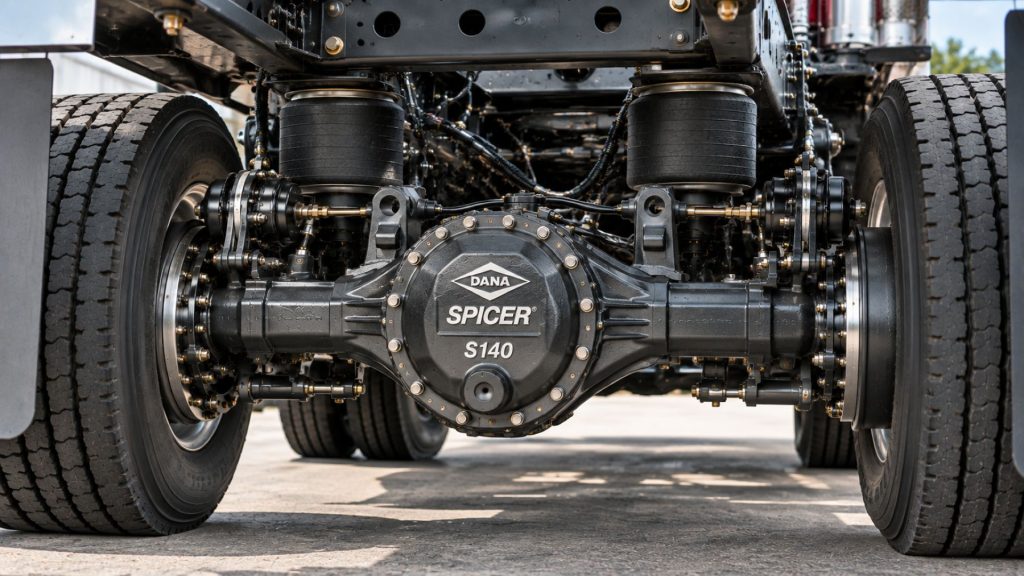
The S140 normally serves as the rear drive axle in a medium-duty 4×2 truck, bus, motorhome, or vocational vehicle.
It supports part of the vehicle’s weight, provides the final gear reduction, distributes torque between the rear wheels, and supplies the mounting structure for the rear suspension, brakes, hubs, and wheel ends.
Using one drive axle instead of a tandem can reduce vehicle weight, tire count, rolling resistance, and maintenance requirements. The tradeoff is less total axle capacity and fewer driven wheels.
The selected S140 model must match the vehicle’s certified rear gross axle weight rating, suspension capacity, tire and wheel ratings, expected payload, road conditions, and duty cycle.
Common Specifications
- Axle Design: Single-reduction single drive axle
- Common Drivetrain Layout: 4×2
- Vehicle Class: Primarily Class 6 and Class 7
- S17-140 GAWR: 17,000 lb
- S19-140 GAWR: 19,000 lb
- S20-140 GAWR: 20,000 lb
- S21-140 GAWR: 21,000 lb
- Nominal GCW: Up to 50,000 lb in approved configurations
- Published Ratio Range: 3.31:1 to 6.50:1
- Common Ratios: 3.31, 3.36, 3.42, 3.58, 3.73, 3.91, 4.10, 4.30, 4.56, 4.88, 5.29, 5.57, 6.14, and 6.50
- Nominal Ring-Gear Diameter: Approximately 13.4 inches
- Axle-Shaft Splines: 39 splines in referenced configurations
- Axle-Shaft Spline Diameter: Approximately 2 inches
- Housing Design: Hot-forged square-edge steel housing
- Housing Wall Thickness: Configuration-dependent, including approximately 9.5 mm and 11 mm options
- Differential Options: Standard differential and Spicer Trac-Lok limited-slip differential
- Brake Options: Application-specific drum or air-disc brake packages
- Additional Option: Electromagnetic retarder for approved applications
Capacity ratings and equipment vary by model and service. Final approval should come from Dana and the vehicle manufacturer.
Axle Ratios and Gearing
The S140 offers ratios from approximately 3.31:1 through 6.50:1. This broad range allows the axle to serve vehicles with substantially different payloads, tire sizes, engines, transmissions, routes, and operating speeds.
Numerically lower ratios such as 3.31, 3.36, and 3.42 can reduce engine speed during highway operation. These ratios are generally better suited to vehicles with sufficient engine torque and limited need for extreme gradeability.
Midrange ratios such as 3.73, 3.91, 4.10, and 4.30 provide a balance between highway engine speed, acceleration, startability, and grade performance.
Numerically higher ratios such as 4.88, 5.29, 5.57, 6.14, and 6.50 provide greater torque multiplication. They may be appropriate for stop-and-go operation, heavier loads, larger tires, steep grades, lower road speeds, or specialized vocational work.
Dana’s GenTech gearing is standard on designated models and may be available for certain bus and coach applications. It is designed to reduce gear noise during both powered and coast operation.
The appropriate ratio must be selected as part of the complete powertrain. Learn more in Commercial Truck Axle Ratios Explained.
Differential and Traction Options
A standard S140 wheel differential allows the left and right drive wheels to rotate at different speeds. This is necessary for smooth turning and reduced tire scrub.
The available Spicer Trac-Lok limited-slip differential automatically limits excessive wheel-speed differences when one drive wheel begins to lose traction.
Trac-Lok does not require the driver to activate a switch. It also does not require external wiring, pneumatic lines, or a cab-mounted control.
The system limits wheel slip rather than fully locking both axle shafts together. This can provide improved traction while retaining better turning characteristics than a fully locked differential.
Dana states that the S140 Trac-Lok system does not require special lubricant or friction modifiers. However, the axle should still be filled with the lubricant specified for its model, operating conditions, and warranty requirements.
Trac-Lok may also be retrofittable into certain existing S140 axles. Compatibility must be verified by model, serial number, ratio, carrier, and application before conversion.
See Open vs Locking vs Limited-Slip Differentials for an explanation of the differences between these systems.
Brake and Wheel-End Options
S140 installations may use hydraulic disc brakes, air drum brakes, or air-disc brakes depending on the chassis, vehicle class, application, and OEM axle package.
The exact brake arrangement can include different rotors, drums, calipers, chambers, slack adjusters, backing plates, ABS sensors, tone rings, hubs, bearings, and parking-brake components.
Some S140 applications can be equipped with an electromagnetic retarder mounted within the driveline system. The retarder provides supplemental braking without relying entirely on the service brakes.
Supplemental retardation can reduce service-brake heat and wear in applications involving frequent stops or extended descents. It does not replace the vehicle’s primary service and parking brakes.
Replacement wheel-end and brake components must be matched using the axle model, axle serial number, hub identification, brake family, spindle configuration, and OEM build records.
Common Applications
- Medium-duty pickup-and-delivery trucks
- Parcel and package-delivery trucks
- Food and beverage delivery trucks
- School buses
- Midi buses
- Shuttle buses
- Motorhomes
- Municipal service trucks
- Utility service trucks
- Maintenance vehicles
- Single-axle dump trucks operating within approved ratings
- Tow and recovery trucks in approved configurations
- Landscaping and construction-support trucks
- Straight trucks using a 4×2 drivetrain
- Vehicles requiring a rear GAWR between 17,000 and 21,000 pounds
Truck, Suspension, and Drivetrain Compatibility
The S140 is primarily designed for medium-duty straight trucks and buses using a single rear drive axle. It is commonly associated with 4×2 chassis configurations.
Axle compatibility depends on the selected S140 model, chassis frame, suspension, spring spacing, track width, brake system, hubs, wheels, tires, driveshaft, transmission, engine torque, and operating weight.
The housing is designed around commonly used mounting dimensions to simplify OEM installation. However, spring-seat placement, suspension brackets, track width, and driveline angles remain application-specific.
The 50,000-pound nominal GCW figure applies only to approved configurations. It does not mean that every truck equipped with an S140 can operate at that combined weight.
Vehicles with high-torque engines, severe duty cycles, large tires, steep routes, or frequent shock loading may require additional engineering review or a heavier axle family.
Advantages
- Available in four ratings from 17,000 to 21,000 pounds
- Broad ratio coverage supports many medium-duty applications
- Lightweight construction can increase usable payload
- Reduced axle weight may contribute to improved fuel economy
- Compact housing provides additional ground clearance
- GenTech gearing reduces noise, vibration, and harshness
- High-capacity gearing supports higher engine power and torque
- Wide gear-face design improves load-carrying capacity
- Integrated ring-gear mounting eliminates a traditional bolted joint
- Integral pinion cage removes a potential lubricant leak path
- Large wheel-differential gearing improves strength
- Fewer components can simplify maintenance and repair
- Reduced lubricant volume lowers fluid weight and service costs
- Trac-Lok provides automatic traction assistance
- Optional electromagnetic retarder can reduce service-brake wear
- Standardized housing and wheel-equipment dimensions simplify installation
Limitations or Considerations
- The S140 is a single-drive axle and does not provide the traction of a tandem 6×4 system
- Axle capacity varies significantly between S17-140, S19-140, S20-140, and S21-140 models
- Not every ratio is available with every model or vehicle configuration
- The lowest numerical ratios may reduce startability with heavy loads
- The highest numerical ratios increase engine speed during highway operation
- The 50,000-pound nominal GCW rating requires application approval
- Severe vocational work may require a heavier axle series
- A limited-slip differential does not provide the same traction as a fully locked differential
- Brake and wheel-end equipment varies between truck manufacturers
- Electromagnetic-retarder availability depends on chassis and driveline compatibility
- Parts must be selected using the complete axle identification
- Older and newer S140 configurations may contain different components
- Axle rating does not override suspension, tire, wheel, frame, or legal weight limits
- Dana application approval may be required for nonstandard or demanding uses
Driver and Operator Experience
The S140’s GenTech gearing is designed to reduce axle whine, especially during coast conditions. This can be particularly valuable in buses, motorhomes, and delivery vehicles where drivers and passengers spend long periods near the rear axle.
A properly selected ratio should provide predictable acceleration and acceptable grade performance without creating unnecessary engine speed during cruising.
Vehicles with numerically high ratios may feel more responsive at low speed but operate at higher engine rpm on the highway. Vehicles with numerically low ratios may cruise more quietly but require more transmission downshifts on grades.
The Trac-Lok limited-slip differential operates automatically and normally requires no driver input. Its engagement should feel smoother and less restrictive during turns than a fully locked differential.
Drivers should still avoid excessive wheelspin. Sudden traction recovery can shock-load the differential, axle shafts, driveshaft, transmission, and tires.
Maintenance and Ownership Notes
The S140 should be maintained according to Dana service literature and the vehicle manufacturer’s schedule.
Correct lubricant type and fill level are essential for protecting the ring-and-pinion gears, differential, bearings, and seals. The axle should not automatically be filled based on a generic capacity because installation angle and configuration can affect the required amount.
Routine inspections should check the pinion seal, differential cover, wheel seals, housing, breather, drain plug, fill plug, hubs, brake components, and suspension mounts.
Technicians should inspect the driveshaft, universal joints, slip joint, yokes, and fasteners for wear or looseness.
Wheel bearings should be adjusted or serviced according to the installed hub system. Brake and wheel-end service procedures may differ between hydraulic, air-drum, and air-disc configurations.
A Trac-Lok differential should be diagnosed using the correct Dana procedures. Incorrect assumptions about normal limited-slip operation can lead to unnecessary replacement.
Axle-ratio changes may require speedometer, transmission, engine, ABS, or other electronic recalibration.
Common Axle or Differential Problems
- Pinion-seal leakage
- Differential-cover leakage
- Wheel-seal leakage
- Clogged or damaged axle breather
- Low or contaminated lubricant
- Gear whine during acceleration or deceleration
- Rumbling or growling from worn carrier bearings
- Excessive ring-and-pinion backlash
- Damaged gear teeth
- Wheel-bearing looseness or overheating
- Axle-shaft or spline wear
- Differential damage caused by excessive wheelspin
- Reduced Trac-Lok torque-bias performance
- Brake contamination caused by a wheel-seal leak
- Driveline vibration from worn universal joints or incorrect angles
- Loose input yoke or pinion nut
- Housing damage caused by overloading or impact
- Noise caused by an incorrect replacement gear setup
See Common Truck Axle and Differential Problems for additional diagnostic information.
Identification Information
- Manufacturer: Dana Incorporated
- Product Family: Spicer S140 Series
- Primary Models: S17-140, S19-140, S20-140, and S21-140
- Axle Type: Single-reduction single drive axle
- Identification Sources: Axle tag, carrier tag, housing stampings, and OEM build records
- Important Information to Record: Complete model number, serial number, specification number, ratio, and truck VIN
The identification tag is normally attached to the axle housing or carrier area. Its exact location can vary by installation.
The first part of the model designation helps identify the axle’s general capacity. The complete model and suffix information may also describe gearing, differential equipment, housing, brakes, wheel ends, and other features.
Do not order components using only the S140 family name. Parts can vary among the S17-140, S19-140, S20-140, and S21-140.
If the tag is missing, use the vehicle VIN, original build sheet, housing stampings, carrier numbers, ring-gear markings, hub information, brake identification, and physical measurements.
Use How to Identify a Truck Axle or Differential before purchasing parts or a replacement assembly.
Buying Considerations
- Confirm the complete S140 model number
- Verify whether the axle is an S17-140, S19-140, S20-140, or S21-140
- Record the axle serial and specification numbers
- Confirm the gross axle weight rating
- Check the truck’s original OEM build information
- Verify the axle ratio
- Match the ratio to the engine, transmission, tires, terrain, and operating weight
- Determine whether the axle has a standard or Trac-Lok differential
- Confirm whether an electromagnetic retarder is installed
- Identify the brake system and individual brake components
- Verify hub, bearing, spindle, wheel, and tire compatibility
- Measure track width and suspension-mounting locations
- Confirm driveshaft-yoke compatibility
- Inspect the housing for cracks, corrosion, bending, and damaged mounts
- Inspect used gears for scoring, pitting, heat damage, and unusual wear patterns
- Check the pinion, differential cover, and wheel ends for leakage
- Inspect yokes, splines, universal joints, and axle shafts
- Ask for lubricant and maintenance records
- Verify that replacement components match the axle’s production date
- Confirm Dana application approval for demanding or nonstandard uses
- Include freight, core charges, lubricant, brakes, wheel ends, and installation labor in the total cost
Variants and Configurations
- S17-140 with a 17,000-pound GAWR
- S19-140 with a 19,000-pound GAWR
- S20-140 with a 20,000-pound GAWR
- S21-140 with a 21,000-pound GAWR
- Standard wheel differential
- Spicer Trac-Lok limited-slip differential
- GenTech gearing on designated models
- Standard gearing on applicable configurations
- Ratios from approximately 3.31 through 6.50
- Standard housing configuration
- Application-dependent housing wall thickness
- Hydraulic-brake configurations
- Air-drum-brake configurations
- Air-disc-brake configurations
- Electromagnetic-retarder configuration
- Pickup-and-delivery configuration
- School-bus configuration
- Midi-bus configuration
- Motorhome configuration
- Municipal configuration
- Utility-truck configuration
Comparison to Similar Equipment
Compared with a tandem drive axle, the S140 is lighter, less complex, and generally more efficient for medium-duty applications that do not need two powered rear axles. A tandem provides greater capacity and traction but adds weight, tires, gearing, lubricant, and maintenance requirements.
Compared with heavier Dana single-drive axles such as the S172 or S190 Series, the S140 focuses on medium-duty vehicles with rear axle ratings up to 21,000 pounds. The heavier families are intended for higher axle loads, greater drivetrain torque, or more severe applications.
The S140’s available Trac-Lok differential provides automatic traction assistance without the controls required by a driver-operated locker. However, it does not fully lock the axle shafts together.
Its GenTech gearing and optional electromagnetic retarder can make the S140 particularly attractive for buses, motorhomes, delivery trucks, and other applications where noise and braking demands are important.
Best Fit For
- Class 6 straight trucks
- Class 7 straight trucks
- Medium-duty 4×2 chassis
- Pickup-and-delivery operations
- Parcel-delivery fleets
- Food and beverage delivery trucks
- School buses
- Midi buses and shuttle buses
- Motorhomes
- Municipal service vehicles
- Utility trucks
- Applications requiring a 17,000- to 21,000-pound rear axle rating
- Fleets seeking reduced axle weight
- Vehicles where low drivetrain noise is important
- Operations that can benefit from an automatic limited-slip differential
- Applications suited to an electromagnetic driveline retarder
Related Truck Types
Related Truck Models
- Freightliner M2 106
- International MV Series
- International CV Series
- Kenworth T280
- Peterbilt 536
- Peterbilt 537
Related Axle and Differential Types
- Dana Spicer S172 Series
- Dana Spicer S190 Series
- Commercial Truck Drive Axles
- Truck Differentials
- Axles and Differentials
Related Equipment Systems
- Commercial Truck Transmissions
- Truck Suspension Systems
- Air Brake Systems
- Commercial Truck Tires and Wheels
Related Guides
- How Commercial Truck Axles and Differentials Work
- Single Axle vs Tandem Axle Trucks
- Commercial Truck Axle Ratios Explained
Regulatory and Compliance Notes
The published S140 axle rating describes the axle assembly’s capacity. It does not automatically establish the legal or certified weight rating of the completed vehicle.
The allowable rear axle load is limited by the lowest-rated relevant component, which may include the axle, suspension, frame, tires, wheels, hubs, brakes, or other chassis equipment.
Federal, state, provincial, and local regulations may impose weight limits below the mechanical rating of the axle.
Brake components must comply with the requirements applicable to the completed vehicle. Changes to brakes, hubs, tires, ABS sensors, tone rings, or the optional retarder can affect required safety systems.
Changing the axle ratio or tire size may require speedometer, transmission, engine, ABS, traction-control, and stability-system recalibration.
Dana application approval should be obtained when required, particularly for nonstandard, severe, or high-GCW operation.
Real World Operating Notes
The S140’s broad ratio range allows it to serve vehicles with very different working conditions. A highway-oriented delivery truck may use a relatively fast ratio, while a municipal or utility vehicle may require a numerically higher ratio for low-speed performance.
Urban delivery trucks benefit from the axle’s reduced weight because every pound removed from the chassis can potentially become usable payload.
The additional ground clearance can help utility and municipal vehicles travel over uneven surfaces, but the S140 remains a medium-duty axle and should not be treated as a specialized off-road unit unless the application is approved.
Trac-Lok can improve traction on wet pavement, snow, gravel, grass, and uneven loading areas without requiring the driver to operate a differential-lock switch.
For vehicles making frequent stops, the optional electromagnetic retarder may reduce service-brake heat and wear. Its value depends on route conditions, vehicle weight, brake system, maintenance capability, and initial cost.
Frequently Asked Questions
What is the Dana Spicer S140 Series?
The S140 Series is a family of medium-duty single-reduction drive axles for straight trucks, buses, motorhomes, municipal vehicles, and utility trucks.
Is the S140 a single or tandem axle?
It is a single drive axle. It is commonly installed as the rear axle in a 4×2 vehicle.
What models are included in the S140 Series?
The principal models are the S17-140, S19-140, S20-140, and S21-140.
What is the S17-140 rated for?
The S17-140 has a published gross axle weight rating of 17,000 pounds.
What is the S19-140 rated for?
The S19-140 has a published gross axle weight rating of 19,000 pounds.
What is the S20-140 rated for?
The S20-140 has a published gross axle weight rating of 20,000 pounds.
What is the S21-140 rated for?
The S21-140 has a published gross axle weight rating of 21,000 pounds.
What axle ratios are available?
Dana’s current S140 specification sheet lists ratios ranging from 3.31:1 through 6.50:1. Availability varies by model and application.
What is GenTech gearing?
GenTech is Dana’s low-noise gearing technology. It is designed to reduce noise, vibration, and harshness, particularly during coast operation.
What is the Spicer Trac-Lok differential?
Trac-Lok is an automatic limited-slip differential that reduces excessive wheel slip without fully locking the two axle shafts together.
Does Trac-Lok require a driver-operated switch?
No. It works automatically and does not require external wiring, pneumatic lines, or driver activation.
Does the S140 require a special limited-slip lubricant?
Dana states that its S140 Trac-Lok system does not require special lubricant or friction modifiers. The axle must still use the approved lubricant specified for the application.
Can Trac-Lok be added to an existing S140?
Dana identifies Trac-Lok as retrofittable into certain existing S140 axles. Compatibility should be confirmed using the full model, serial number, ratio, and carrier information.
What does the optional electromagnetic retarder do?
It provides supplemental driveline braking, helping slow the vehicle without relying entirely on the service brakes.
Can an S140 replace another medium-duty axle?
Possibly, but capacity alone does not guarantee compatibility. Ratio, housing, suspension mounts, track width, brakes, hubs, wheels, driveshaft, electronics, and OEM approval must all be checked.
Availability and Where to Find
The Dana Spicer S140 Series is available through participating medium-duty truck and bus manufacturers, Dana-authorized distributors, commercial truck dealers, drivetrain specialists, rebuilders, and aftermarket suppliers.
New and remanufactured carriers, gear sets, bearings, seals, differential components, axle shafts, brake parts, and wheel-end components may be available separately.
Used complete axle assemblies may also be available through commercial truck recyclers. Buyers should verify the model, capacity, ratio, housing, suspension mounts, brakes, differential, wheel ends, and overall condition before purchasing.
Current product information, specification sheets, service manuals, application guidelines, and warranty resources are available from the Dana Spicer S140 Series product page and the Dana Resource Library.
Support Trucking Families
Truck Equipment Atlas supports the mission of Grey Cross, a nonprofit dedicated to helping families of truck drivers who lose their lives while on the road. As the site grows, part of its mission is to bring awareness and support to these families.
Podcast or Video Section
Learn More Through Audio and Video
Truck Equipment Atlas will continue expanding with podcast episodes, interviews, and equipment breakdowns to help drivers and fleets better understand trucks and equipment.
Follow the Growth of Truck Equipment Atlas
Truck Equipment Atlas continues to expand with new truck profiles, trailer coverage, diesel engine pages, equipment system resources, manufacturer information, and educational guides.
Visit our Site Updates page to explore recent additions, project milestones, and upcoming resources as we continue building one of the industry’s growing commercial trucking equipment reference libraries.
View the Latest Site Updates: Truck Equipment Atlas Site Updates