
Peterbilt 520
Quick Facts
- • Manufacturer: Peterbilt Motors Company
• Truck Class: Class 8 Low-Cab-Forward Vocational Truck
• Common Configurations: Left-Hand Drive, Right-Hand Drive, Dual Drive, Right-Hand Stand-Up, Dual-Seated, Tandem Axle
• Primary Applications: Refuse Collection, Concrete Pumping, Paint Striping, Municipal Service, Recycling Operations, Specialized Vocational Work
• Common Engine Options: PACCAR MX-11, PACCAR PX-9, Cummins L9N Natural Gas, Cummins ISX12N Natural Gas
• Typical Transmission Options: Allison Automatic Transmissions
• Common Axle Setups: 4×2, 6×4, Tandem Rear Axle, Lift Axle Configurations
• GVWR Range: Up to approximately 89,000 lbs depending on configuration
• Front Axle Capacity: Approximately 12,000–20,000 lbs
• Rear Axle Capacity: Approximately 21,000–78,000 lbs depending on configuration
• Cab Style: Low-Cab-Forward Galvanized Steel Tilt Cab
• Production Status: Active Production
Overview
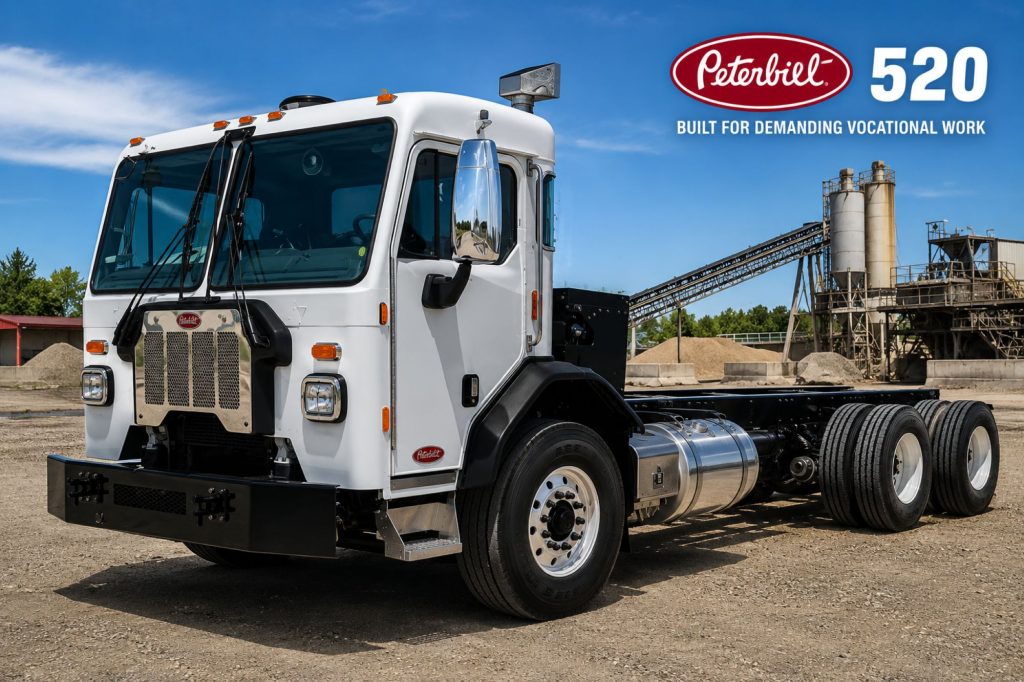
The Peterbilt Model 520 is a Class 8 low-cab-forward vocational truck designed primarily for refuse collection, recycling operations, concrete pumping, paint striping, and specialized municipal work.
Unlike conventional trucks with the engine positioned beneath a long hood, the 520 places the cab above the engine and front axle. This low-cab-forward design improves forward visibility, reduces overall vehicle length, and provides the maneuverability required for residential streets, commercial collection routes, and crowded urban environments.
The Model 520 is especially recognized for its flexible driving configurations. Depending on the application, it can be equipped with left-hand drive, right-hand drive, dual seated controls, or a right-hand stand-up driving position. These configurations allow operators to match the cab to front-loader, rear-loader, and side-loader refuse bodies.
Key Characteristics
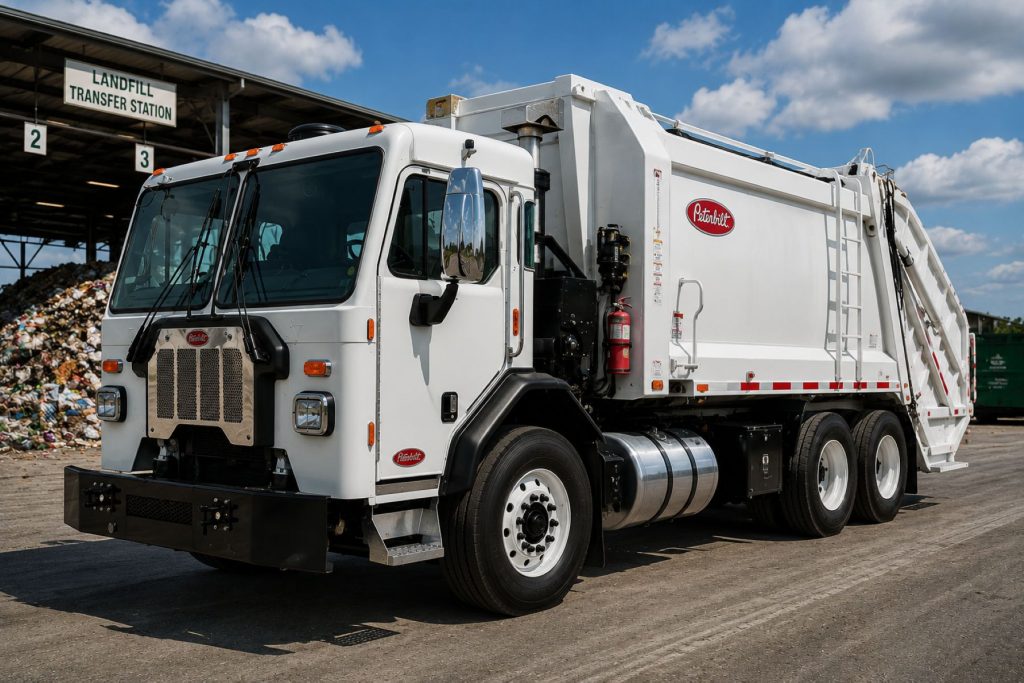
The Peterbilt 520 is built around visibility, maneuverability, repeated cab entry, vocational durability, and body-builder compatibility.
Its low-cab-forward design gives drivers a clear view of the area immediately in front of the truck. Large windows, available side-object detection, and optional advanced driver-assistance systems help drivers operate safely in residential neighborhoods, commercial properties, transfer stations, and other congested environments.
The cab features wide-opening doors, highly visible grab handles, and stair-style steps designed to make repeated entry and exit easier. This is especially important in refuse and municipal operations where drivers may enter and exit the cab frequently during a work shift.
Peterbilt also offers preconfigured frame layouts and vocational electrical architecture to simplify the installation and operation of refuse bodies, hydraulic equipment, concrete pumps, and other specialized systems.
Common Specifications
Engine Options
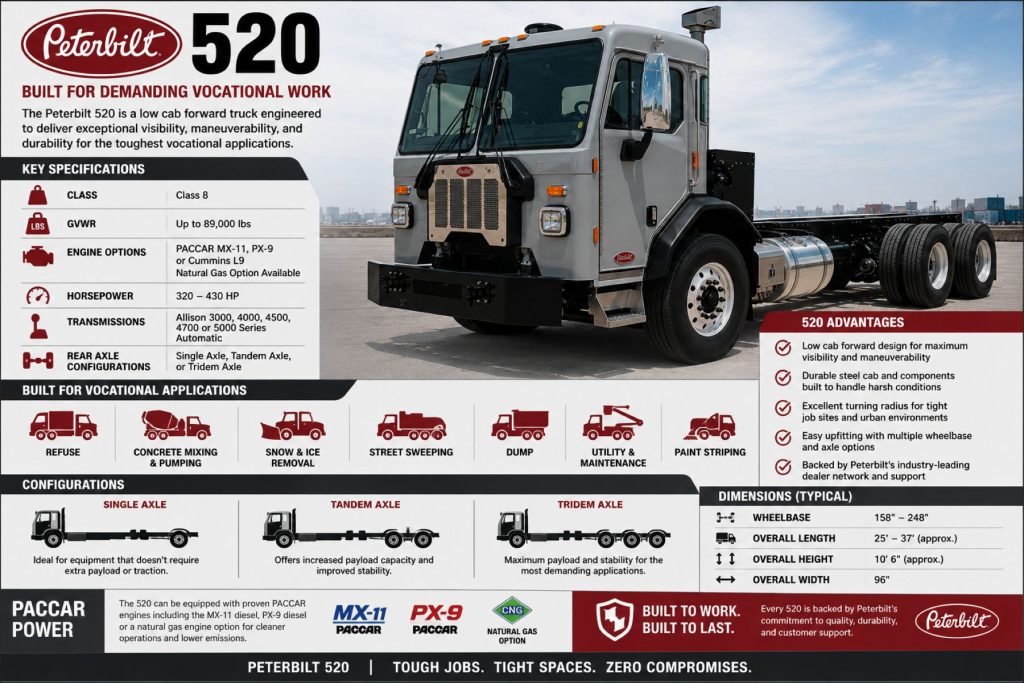
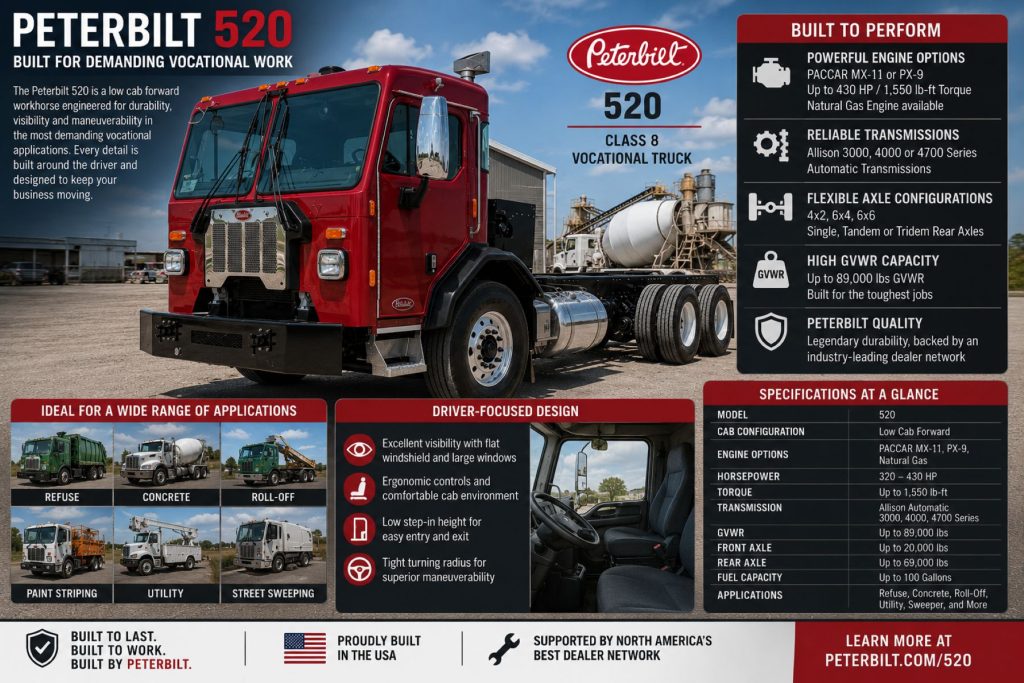
Current diesel engine options include the PACCAR MX-11 and PACCAR PX-9. Natural-gas configurations may use the Cummins L9N or Cummins ISX12N, depending on application requirements and availability.
Available horsepower generally ranges from approximately 320 to 430 horsepower, with torque ratings ranging from approximately 1,000 to 1,650 lb-ft.
Engine selection depends on vehicle weight, route conditions, vocational equipment, fuel availability, and required operating range.
Transmission Options
The Peterbilt 520 is commonly paired with Allison automatic transmissions. Automatic transmissions are well suited to refuse and municipal applications because these operations involve frequent stops, repeated acceleration, low-speed maneuvering, and extensive hydraulic equipment use.
The transmission can also be integrated with PTO and vocational body-control systems.
Axle Configurations
The 520 can be configured with single or tandem rear axles, depending on body style, payload, and route requirements.
Front axle ratings generally range from approximately 12,000 to 20,000 pounds. Rear axle capacities can range from approximately 21,000 to 78,000 pounds depending on the selected axle and suspension arrangement.
Lift axles may be added to certain vocational configurations to improve weight distribution and comply with regional axle-weight requirements.
Cab Configurations
Available cab and driving arrangements include left-hand drive, right-hand drive, dual drive, right-hand stand-up, and dual-seated configurations.
These options allow the truck to support automated side loaders, front loaders, rear loaders, concrete pumpers, paint stripers, and other specialized vocational bodies.
Cab Tilt System
The cab can tilt forward to provide access to the engine and major service components. Manual hydraulic and automated cab-tilt options may be available depending on configuration.
Common Applications
- Residential refuse collection
- Commercial refuse collection
- Automated side-loader operations
- Front-loader refuse operations
- Rear-loader refuse operations
- Recycling collection
- Concrete pumping
- Road paint striping
- Municipal service
- Transfer-station operations
- Specialized vocational equipment
Advantages
- Excellent forward visibility
- Strong maneuverability in urban environments
- Left-hand, right-hand, and dual-drive configurations
- Right-hand stand-up driving position availability
- Easy entry and exit for repeated-stop operations
- Strong vocational body compatibility
- Diesel and natural-gas engine options
- Automatic transmission availability
- High-capacity axle configurations
- Integrated PTO and hydraulic controls
- Advanced driver-assistance technology availability
- Durable galvanized steel cab structure
Limitations or Considerations
- Primarily designed for specialized vocational work
- Not intended for conventional long-haul freight operations
- Cab-over-engine design may produce a firmer ride
- Vocational bodies significantly increase vehicle cost and weight
- Hydraulic equipment requires specialized maintenance
- Frequent stop-and-go operation increases brake and tire wear
- Natural-gas configurations require suitable fueling infrastructure
- Complex body controls may require specialized technicians
- Cab must be tilted for certain engine repairs
- Used trucks should be inspected for heavy route and hydraulic-system wear
Driver and Operator Experience
The Peterbilt 520 is designed for operators who work in demanding stop-and-go environments. Its low cab position, large windshield, and cab-forward design provide strong visibility of streets, curbs, containers, workers, pedestrians, and nearby vehicles.
Wide-opening doors, stair-style steps, and interior and exterior grab handles help drivers enter and exit the cab more easily. These features are particularly important in refuse collection and municipal work, where repeated cab entry can contribute to fatigue.
Right-hand-drive and stand-up configurations allow drivers to position themselves closer to the curb and refuse containers during collection. Dual-drive configurations allow the truck to be controlled from either side, depending on the route and body operation.
Because vocational configurations vary significantly, driver comfort, visibility, control placement, and ride quality should be evaluated with the specific body and equipment installed.
Maintenance and Ownership Notes
Maintenance requirements for the Peterbilt 520 extend beyond the truck chassis and powertrain. Owners must also maintain the refuse body, hydraulic system, compaction equipment, PTO system, cameras, sensors, and specialized electrical controls.
Frequent stop-and-go operation can accelerate wear on brakes, tires, steering components, suspension parts, and driveline systems. Refuse trucks may also operate in dusty, muddy, corrosive, or debris-filled environments that require regular cleaning and inspection.
The tilt-cab design provides access to the engine and major service components. Operators should inspect the cab-tilt system regularly and confirm that all loose equipment is secured before tilting the cab.
Preventive maintenance is especially important because a problem with either the chassis or vocational body can remove the entire truck from service.
Buying Considerations
When evaluating a Peterbilt 520, buyers should determine which driving position, engine, axle arrangement, and vocational body configuration best match the intended operation.
Important considerations include:
• Refuse body type and manufacturer
• Front-loader, rear-loader, or side-loader configuration
• Left-hand, right-hand, or dual-drive requirements
• Seated or stand-up operating position
• Diesel or natural-gas engine
• Allison transmission model
• Front and rear axle capacities
• Suspension configuration
• Lift-axle requirements
• PTO and hydraulic-system capacity
• Camera and object-detection equipment
• Route length and daily stop frequency
• Local emissions and noise requirements
• Dealer and body-manufacturer support
When purchasing a used Model 520, buyers should inspect the engine, transmission, cab-tilt system, frame, axles, steering, brakes, hydraulic cylinders, compaction equipment, electrical controls, and refuse body.
Variants and Configurations
- Left-hand-drive configuration
- Right-hand-drive configuration
- Dual-drive configuration
- Dual-seated configuration
- Right-hand stand-up configuration
- Front-loader refuse truck
- Rear-loader refuse truck
- Automated side-loader refuse truck
- Recycling collection truck
- Concrete pumper
- Paint-striping truck
- Municipal vocational truck
- Diesel-powered configuration
- Natural-gas-powered configuration
Comparison to Similar Trucks
The Peterbilt 520 is commonly compared with other low-cab-forward vocational trucks used in refuse and municipal operations.
Compared with conventional vocational trucks such as the Peterbilt 567, Mack Granite, and Volvo VHD, the Model 520 provides a shorter overall vehicle layout and improved visibility directly in front of the cab.
Its low-cab-forward design is especially beneficial for refuse collection, where maneuverability, curbside visibility, repeated entry, and specialized driving positions are more important than highway aerodynamics or sleeper availability.
The 520 also differs from conventional dump and heavy-haul trucks because it is designed around vocational body integration and repeated low-speed operation rather than trailer-focused transportation.
Best Fit For
- Municipal refuse departments
- Private waste-collection companies
- Recycling operations
- Residential collection routes
- Commercial refuse routes
- Automated side-loader fleets
- Front-loader and rear-loader fleets
- Concrete-pumping companies
- Road-maintenance departments
- Vocational fleets requiring right-hand or dual-drive controls
Regulatory and Compliance Notes
The Peterbilt 520 must comply with the emissions standards applicable to its engine, fuel type, and model year. Diesel versions use modern aftertreatment systems, while natural-gas versions must meet requirements governing compressed or liquefied natural-gas fuel systems.
Axle-weight and gross-weight limits vary by state and local jurisdiction. Refuse trucks equipped with heavy compaction bodies and lift axles must be configured and loaded carefully to remain within applicable axle and bridge-formula requirements.
Drivers and fleet operators must also follow commercial vehicle inspection, air-brake, visibility, backing, workplace-safety, hydraulic-equipment, and refuse-body operating requirements.
Because the truck frequently operates around pedestrians, workers, parked vehicles, and residential property, cameras, alarms, lighting, mirrors, and object-detection systems should be inspected regularly.
Real World Operating Notes
In real-world operation, the Peterbilt 520 is valued for maneuverability, visibility, cab access, and compatibility with specialized refuse bodies.
The truck is frequently used on routes involving hundreds or thousands of stops, repeated acceleration and braking, tight turns, narrow streets, and close interaction with workers and pedestrians. Proper specification is therefore critical to controlling maintenance costs and driver fatigue.
Fleets often prioritize automatic transmissions, durable suspensions, high-capacity brakes, hydraulic-system reliability, camera coverage, and easy cab entry over traditional highway performance.
The condition and reliability of the refuse body are just as important as the truck chassis. A well-maintained powertrain cannot keep the vehicle productive if the compactor, lifting mechanism, hydraulic system, or body controls are unavailable.
Related Truck Types
• Vocational Trucks
• Day Cab Trucks
• Dump Trucks
• Concrete Mixer Trucks
Related Freight Types
• Construction & Aggregate Freight
• Bulk & Pneumatic Freight
• Specialized & Niche Freight
Related Trailer Types
• Dump Trailers
• Flatbed Trailers
• Lowboy / RGN Trailers
• Specialty Trailers
Related Equipment Systems
• Engines
• Transmissions
• PTO Systems
• Hydraulic Systems
• Axles & Differentials
• Suspension Systems
• Brake Systems
• Safety Systems
Related Guides
• PTO Systems Explained
• Lift Axles Explained
• How to Choose the Right Commercial Truck
Frequently Asked Questions
What is the Peterbilt 520 primarily used for?
The Peterbilt 520 is primarily used for refuse collection, recycling, concrete pumping, paint striping, and other specialized vocational applications.
Is the Peterbilt 520 available with right-hand drive?
Yes. The Model 520 is available with left-hand drive, right-hand drive, dual-drive, dual-seated, and right-hand stand-up configurations.
What engines are available in the Peterbilt 520?
Current engine choices include the PACCAR MX-11 and PACCAR PX-9 diesel engines. Cummins L9N and ISX12N natural-gas options may also be available depending on configuration.
What is the GVWR of the Peterbilt 520?
The Peterbilt 520 can be configured with a GVWR of up to approximately 89,000 pounds, depending on its axles, suspension, body, and overall specification.
Is the Peterbilt 520 only a garbage truck?
No. Although refuse collection is its best-known application, the Model 520 can also be configured as a concrete pumper, paint striper, recycling truck, or other specialized vocational vehicle.
Availability and Where to Find
The Peterbilt 520 is available through authorized Peterbilt dealerships and vocational-equipment distributors. New trucks are normally ordered with the drivetrain, driving position, axle capacities, frame layout, and electrical systems required for the intended vocational body.
Used Model 520 trucks are available through commercial truck dealers, refuse-equipment specialists, municipal fleet auctions, waste-management fleet resellers, and online truck marketplaces.
Because most Model 520 trucks are highly specialized, buyers should confirm that the installed body, hydraulic system, driving position, and axle configuration match the intended operation before purchasing.
Support Trucking Families
Truck Equipment Atlas supports the mission of Grey Cross, a nonprofit dedicated to helping families of truck drivers who lose their lives while on the road. As the site grows, part of its mission is to bring awareness and support to these families.
Podcast or Video Section
Learn More Through Audio and Video
Truck Equipment Atlas will continue expanding with podcast episodes, interviews, and equipment breakdowns to help drivers and fleets better understand trucks and equipment.
Follow the Growth of Truck Equipment Atlas
Truck Equipment Atlas continues to expand with new truck profiles, trailer coverage, diesel engine pages, equipment system resources, manufacturer information, and educational guides.
Visit our Site Updates page to explore recent additions, project milestones, and upcoming resources as we continue building one of the industry’s growing commercial trucking equipment reference libraries.
View the Latest Site Updates: Truck Equipment Atlas Site Updates