
Understanding Horsepower vs Torque
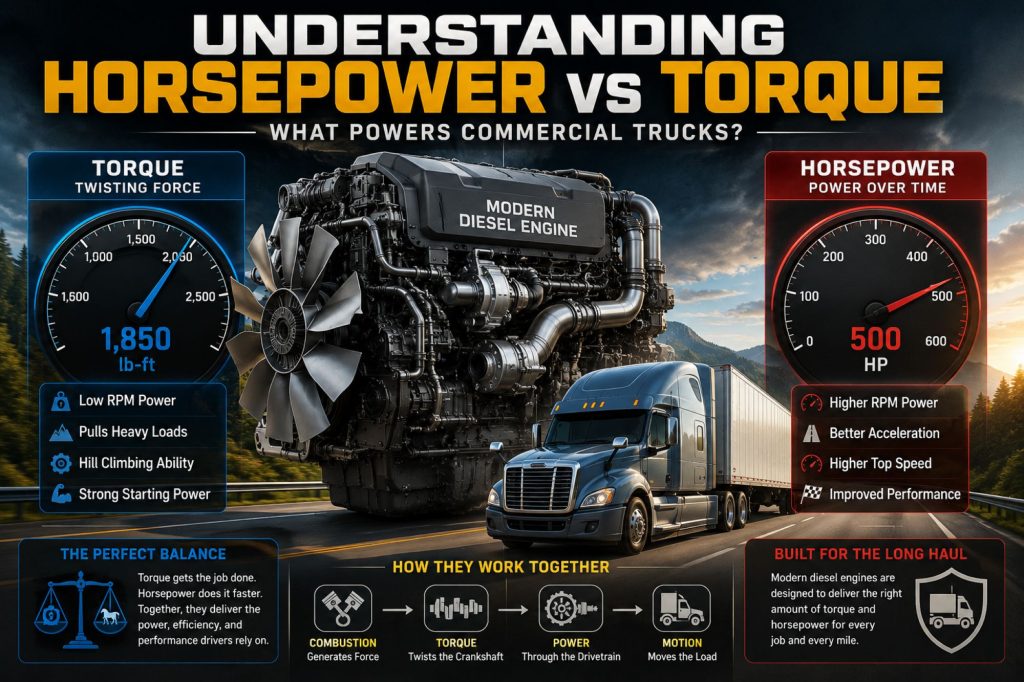
Horsepower and torque are two of the most discussed specifications in the trucking industry. Every engine manufacturer advertises both numbers, and drivers often debate which one matters most.
The truth is that horsepower and torque are closely related, but they measure different aspects of engine performance.
Understanding the difference can help owner-operators, fleet managers, and drivers choose the right engine for their operation.
This guide explains horsepower, torque, how they work together, and why both matter in commercial trucking.
Why Horsepower and Torque Matter
When shopping for a commercial truck or comparing engine options, many people focus on the biggest numbers. However, the highest horsepower or torque rating does not automatically make an engine the best choice.
Different applications require different power characteristics.
For example:
- Heavy-haul operations often prioritize torque.
- Long-haul fleets often seek a balance of horsepower and fuel economy.
- Vocational applications may require strong low-end torque.
- Regional operations may prioritize efficiency and performance.
Understanding horsepower and torque allows operators to match the engine to the work being performed.
What Is Torque?
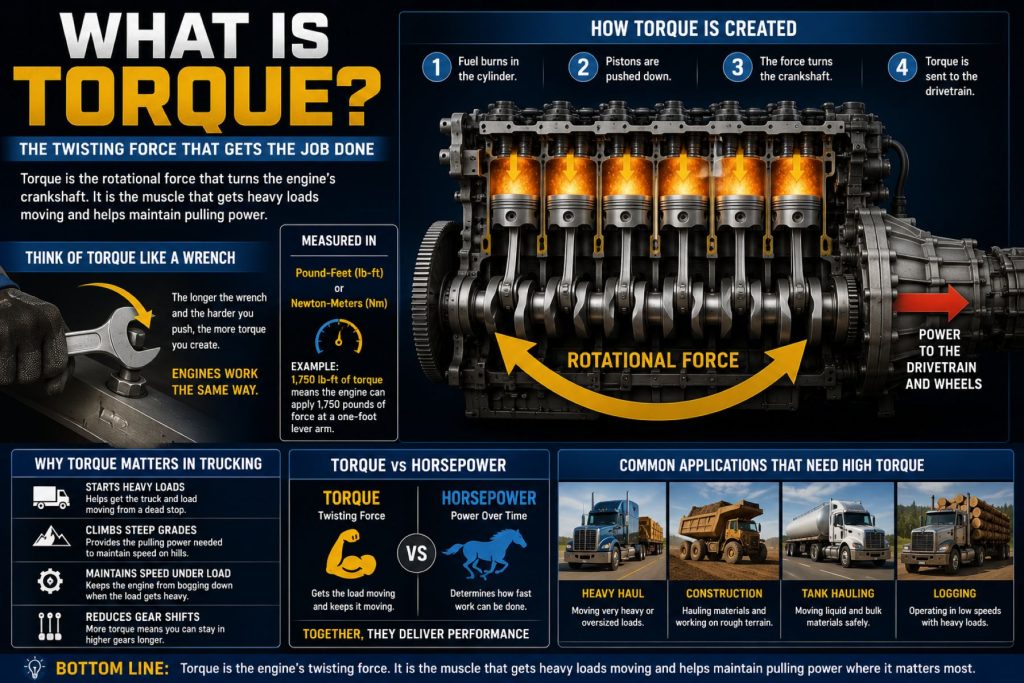
Torque is a measurement of rotational or twisting force.
In a diesel engine, torque is created when combustion pushes the pistons downward, rotating the crankshaft. This twisting force is ultimately transferred through the transmission and drivetrain to the wheels.
Torque is measured in:
- Pound-feet (lb-ft)
- Newton-meters (Nm)
Why Torque Matters
Torque is what gets heavy loads moving.
Higher torque helps:
- Start heavy loads from a stop
- Pull steep grades
- Maintain speed under heavy loads
- Improve low-speed pulling power
- Reduce excessive gear shifting
Think of Torque Like This
Imagine using a wrench to loosen a tight bolt.
The harder you twist, the more torque you apply.
Commercial truck engines operate the same way.
The engine’s torque rating determines how much rotational force is available to move freight.
What Is Horsepower?
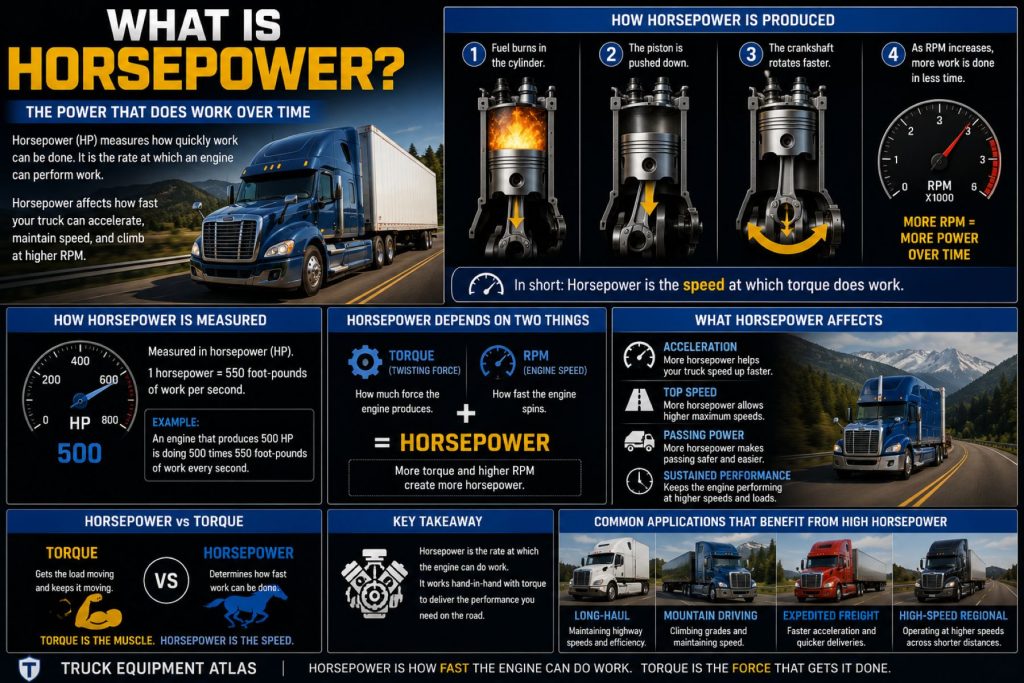
Horsepower measures how quickly work can be performed.
It represents the engine’s ability to do work over time.
Horsepower affects:
- Acceleration
- Maintaining higher speeds
- Passing performance
- Overall engine responsiveness
Horsepower is calculated using both torque and engine speed (RPM).
Two engines can produce similar horsepower numbers while delivering very different torque characteristics.
Why Horsepower Matters
Horsepower becomes increasingly important as engine speed increases.
More horsepower can help:
- Maintain highway speeds
- Improve acceleration
- Handle rolling terrain
- Support higher operating speeds
- Improve overall drivability
The Relationship Between Horsepower and Torque
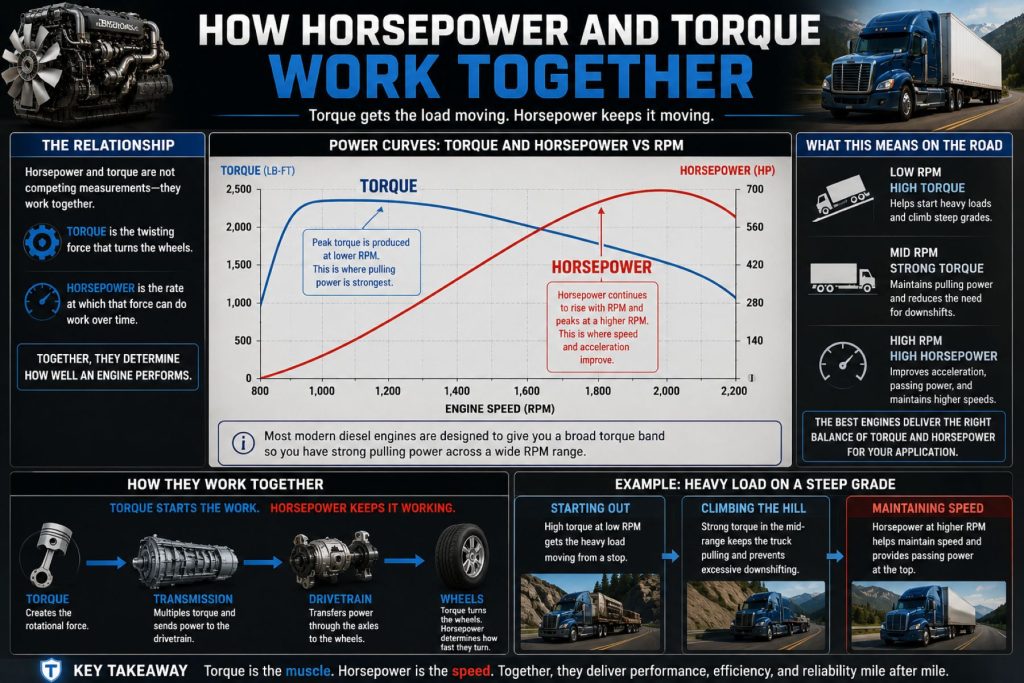
Horsepower and torque are not competing measurements.
They work together.
Torque is the force.
Horsepower is how quickly that force can be applied.
A simplified way to think about it is:
- Torque moves the load.
- Horsepower keeps the load moving efficiently.
Commercial diesel engines typically generate their peak torque at lower RPMs and their peak horsepower at higher RPMs.
This is one reason modern diesel engines can produce tremendous pulling power while operating at relatively low engine speeds.
Understanding Power Curves
Every diesel engine has:
- A torque curve
- A horsepower curve
The torque curve usually rises quickly and peaks at lower RPM.
Horsepower generally continues increasing as engine speed rises.
Modern diesel engines are engineered to maintain broad torque ranges that improve fuel economy and drivability.
Why Torque Matters in Trucking
Torque is particularly important in commercial trucking because trucks often move extremely heavy loads.
Higher torque ratings can provide:
- Better launch performance
- Improved hill climbing
- Less frequent downshifting
- Better performance at low RPM
- Improved heavy-haul capability
Applications that often benefit from high torque include:
- Heavy haul
- Logging
- Construction
- Tank operations
- Vocational trucking
Why Horsepower Matters in Trucking
Horsepower is equally important.
Without adequate horsepower, trucks may struggle to:
- Accelerate efficiently
- Maintain highway speeds
- Recover speed after grades
- Handle demanding routes
Applications that often benefit from higher horsepower include:
- Long-haul operations
- Mountain routes
- High-speed regional operations
- Expedited freight
- Oversized transportation
Real-World Examples
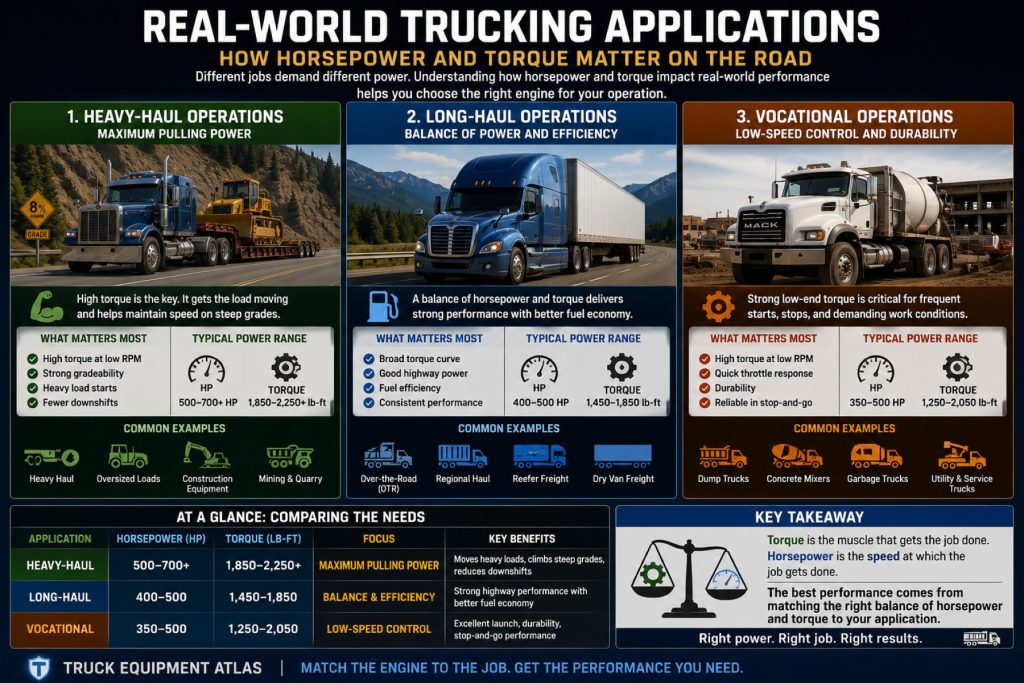
Heavy-Haul Operations
Heavy-haul trucks typically prioritize:
- Very high torque
- Strong low-end performance
- Maximum pulling capability
Long-Haul Operations
Long-haul trucks often seek:
- Balanced horsepower
- Broad torque curves
- Fuel efficiency
Vocational Operations
Vocational trucks often require:
- Strong low-speed torque
- Frequent stop-and-go performance
- Excellent launch capability
Typical Engine Ratings by Application
| Application | Horsepower Range | Torque Range |
|---|---|---|
| Regional Haul | 350–450 HP | 1,250–1,650 lb-ft |
| General Freight | 400–500 HP | 1,450–1,850 lb-ft |
| Heavy Haul | 500–700+ HP | 1,850–2,250+ lb-ft |
| Vocational | 350–500 HP | 1,250–2,050 lb-ft |
Actual ratings vary depending on manufacturer, transmission, axle ratios, and intended use.
Common Misconceptions
More Horsepower Is Always Better
Not necessarily.
Too much horsepower can increase costs and may not provide benefits for every operation.
Torque Is More Important Than Horsepower
Both matter.
A truck requires both adequate torque and sufficient horsepower.
Bigger Numbers Mean Better Fuel Economy
False.
Proper gearing, driving habits, and operating conditions often have a greater impact on fuel economy.
One Engine Rating Works for Every Operation
Different applications require different engine specifications.
There is no universal “best” horsepower or torque rating.
Choosing the Right Engine
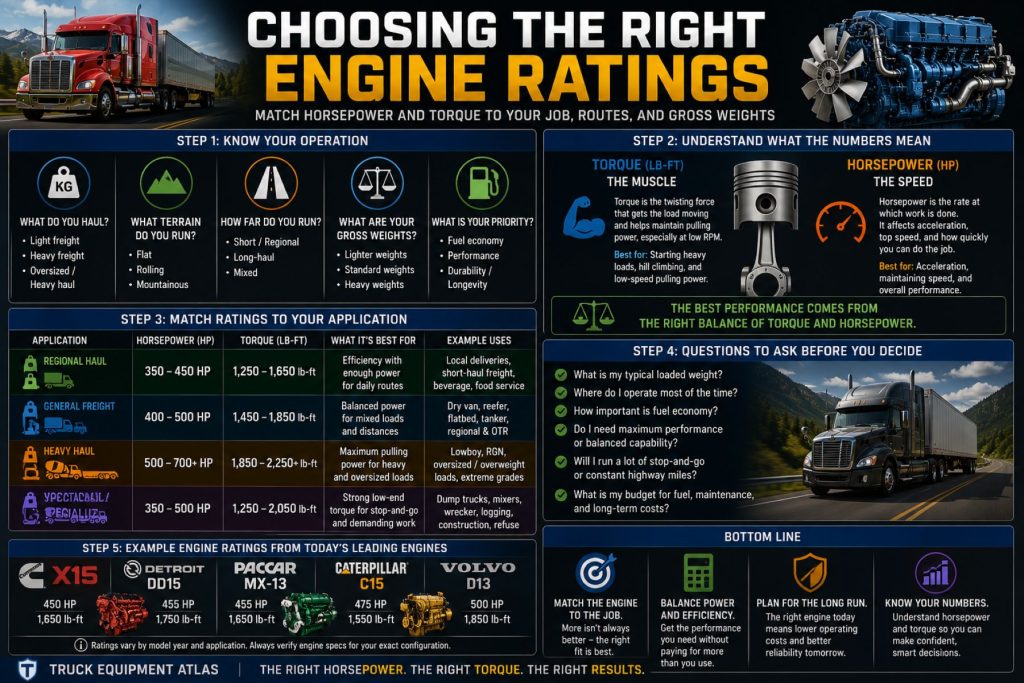
When selecting an engine, ask yourself:
What Freight Do You Haul?
Heavy freight often benefits from higher torque.
What Terrain Do You Operate In?
Mountain routes may benefit from additional horsepower.
What Gross Weights Do You Run?
Higher weights often require additional pulling power.
Is Fuel Economy a Priority?
Balanced ratings often provide excellent fuel efficiency.
Will the Truck Be Used for Multiple Applications?
Versatility may require a compromise between horsepower and torque.
Engine output must be considered alongside gearing. Learn how transmission ratios change wheel torque and how to select a transmission for the complete powertrain.
Frequently Asked Questions
What is more important, horsepower or torque?
Both are important because they work together to determine engine performance.
Why do heavy-haul trucks need more torque?
Heavy loads require greater twisting force to start and maintain movement.
Does more horsepower mean higher speed?
In many situations, yes.
Higher horsepower generally improves acceleration and speed maintenance.
Does more torque improve hill climbing?
Yes.
Higher torque helps maintain pulling power on grades.
Can too much horsepower hurt fuel economy?
Potentially.
An engine that is oversized for its application may consume more fuel than necessary.
Why do diesel engines produce so much torque?
Diesel engines are designed to create strong low-speed pulling power, making them ideal for commercial trucking applications.
Related Truck Types
Related Engines
Related Guides
- How Diesel Truck Engines Work
- Complete Guide to Semi Truck Types
- How to Choose the Right Commercial Truck
Final Thoughts
Horsepower and torque are not competing measurements—they work together to determine how an engine performs.
Torque helps move heavy loads and maintain pulling power, while horsepower determines how quickly work can be performed.
Understanding both ratings allows fleets, owner-operators, and drivers to choose engines that best match their freight, routes, and operating requirements while balancing performance, fuel economy, and long-term operating costs.