
Quick Facts
- Manufacturer: Phillips Industries
- Product Family: 3-in-1 Electrical and Air Combo Assemblies
- Product Type: Combined tractor-to-trailer electrical cable and air-line assembly
- Included Connections: One seven-way electrical cable, one red emergency air line, and one blue service air line
- Assembly Design: Three lines organized together with protective spiral wrap
- Electrical Connector Options: QCP, QCMS2 with QCP, WEATHER-TITE PERMAPLUG, M7, or zinc die-cast plugs
- Air-Line Type: Heavy-duty rubber air lines
- Common Lengths: 12, 15, and 20 feet
- Common Electrical Conductor Configuration: One 8-gauge, two 10-gauge, and four 12-gauge conductors on selected ABS assemblies
- Cable Support: Hanging clamp or QWIK-CLAMP depending on configuration
- Primary Applications: Highway tractors, regional tractors, vocational tractors, semitrailers, and converter dollies
- Primary Benefit: Keeps tractor electrical and pneumatic connections organized as a single supported assembly
- Production Status: Current product family with standard and premium configurations
Overview
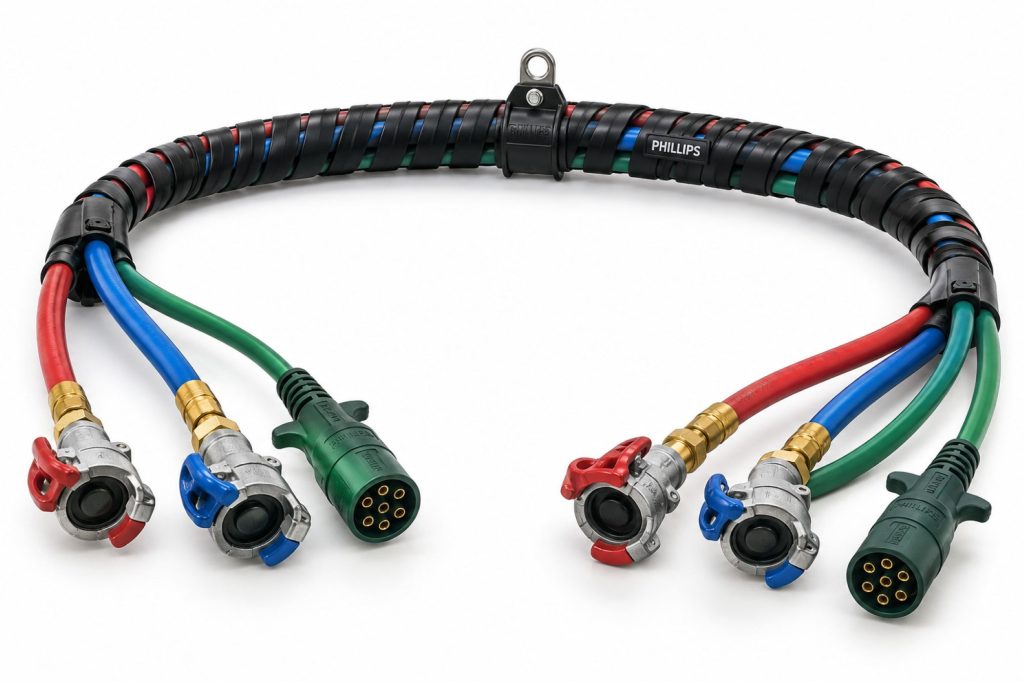
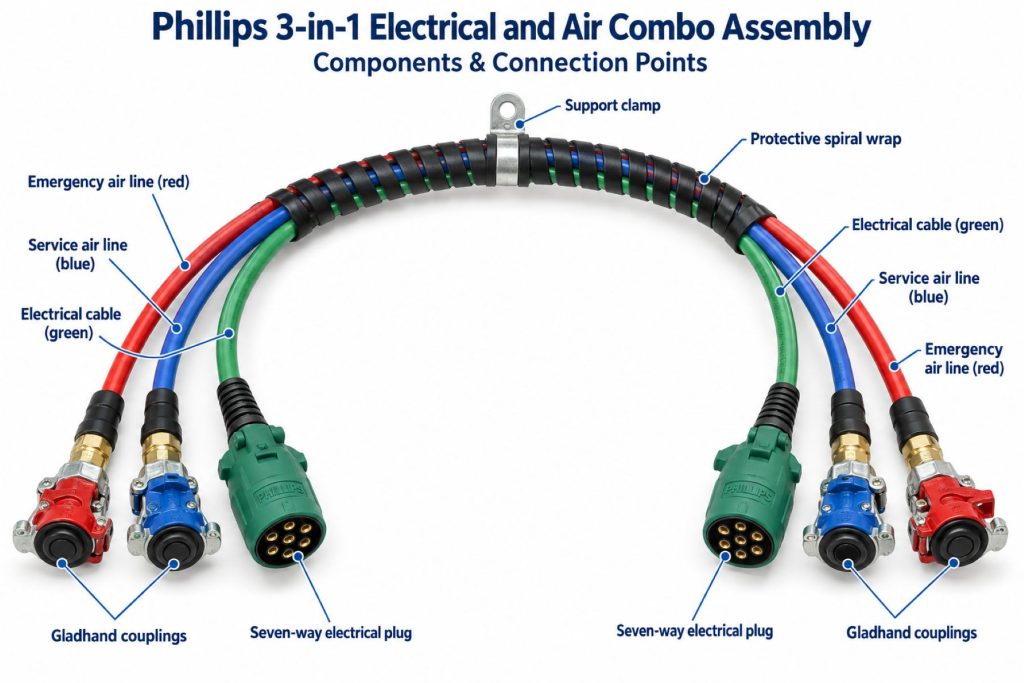
The Phillips 3-in-1 Electrical and Air Combo Assembly combines the three primary tractor-to-trailer connections into one organized unit. The assembly contains a seven-way electrical cable, a red emergency air line, and a blue service air line.
A protective spiral wrap holds the three lines together while allowing the assembly to flex as the tractor turns beneath the trailer. This design reduces loose-line movement and helps prevent individual cables and hoses from becoming tangled, dragged, pinched, or incorrectly supported.
Phillips offers several connection levels. Premium assemblies may use the QCP replaceable electrical-plug cartridge, STA-DRY QCMS2 tractor-side connection, extended trailer-side lead, cable guard, and QWIK-CLAMP support. Standard versions may use WEATHER-TITE PERMAPLUG, M7, or zinc die-cast electrical connectors.
The correct configuration depends on tractor and trailer connector types, required length, ABS wiring needs, air-line fittings, operating temperature, and fleet maintenance preferences.
Key Characteristics
- One seven-way electrical cable
- One red emergency air line
- One blue service air line
- Protective spiral-wrapped construction
- Organized back-of-cab connection system
- Resistance to kinking and abrasion
- Chemical- and abrasion-resistant electrical cable jacket
- Large air-line grips for easier handling
- Tractor-side swivel air fittings
- Multiple seven-way electrical plug options
- Available in ABS and selected non-ABS configurations
- Multiple lengths for different tractor and trailer arrangements
- Hanging clamp included with applicable assemblies
- Premium configurations include additional cable protection
Major Components
- Seven-way electrical cable
- Tractor-side electrical connector
- Trailer-side electrical connector
- Red emergency air line
- Blue service air line
- Tractor-side swivel air fittings
- Trailer-side air-line grips
- Spiral protective wrap
- Cable-support clamp
- QWIK-CLAMP on premium assemblies
- Trailer-side electrical cable guard on selected versions
- Extended trailer-side lead on premium assemblies
- Strain-relief components
- Application-specific gladhand or threaded air fittings
Product Type and Construction
The 3-in-1 is a flexible connection assembly installed between the rear of the tractor cab and the front of the semitrailer. The electrical cable and two rubber air lines remain separate functional components but are retained together by the spiral wrap.
The wrap organizes and protects the lines while permitting inspection of the individual components. Heavy-duty rubber air lines provide service- and emergency-brake connections, while the seven-way cable supplies trailer electrical circuits.
Connector construction varies by model. Available electrical ends range from serviceable premium composite connections to conventional molded or reinforced zinc die-cast plugs.
How the Electrical Component or System Works
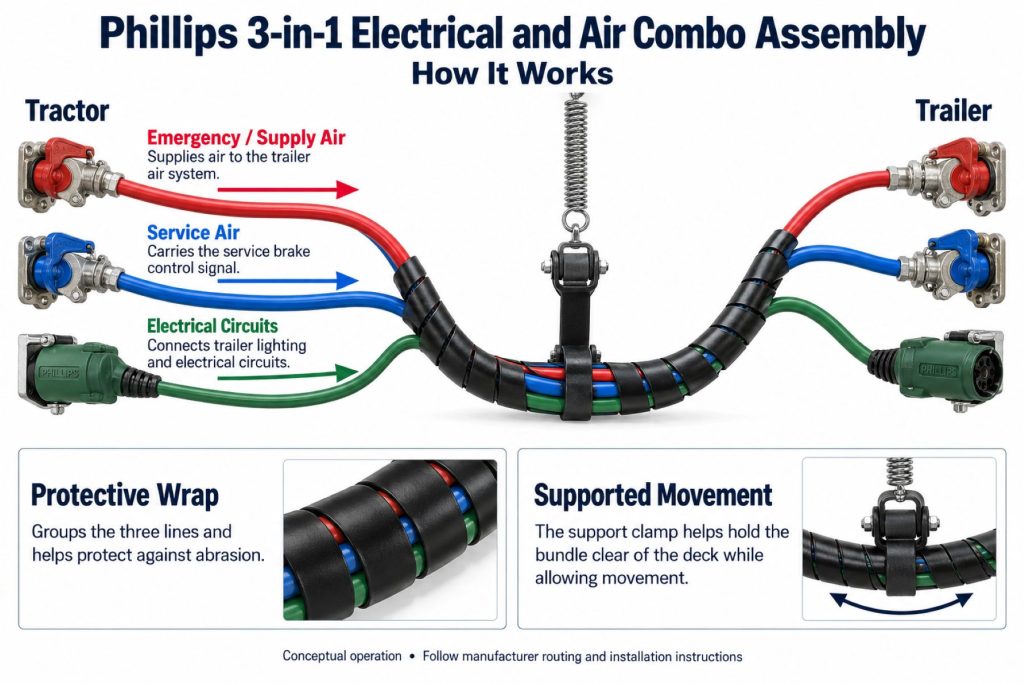
The seven-way electrical cable transfers power, ground, lighting signals, ABS power, and approved auxiliary circuits between the tractor and trailer. The red air line supplies the trailer emergency or supply circuit, while the blue line carries service-brake control pressure.
The spiral wrap causes the three lines to move as an organized assembly during normal articulation. A properly positioned support clamp carries the weight of the assembly and helps prevent the connectors from supporting the entire load.
Premium QCP and QCMS2 configurations provide serviceable or sealed electrical connections intended to reduce downtime and corrosion-related problems.
Position and Function Within the Vehicle
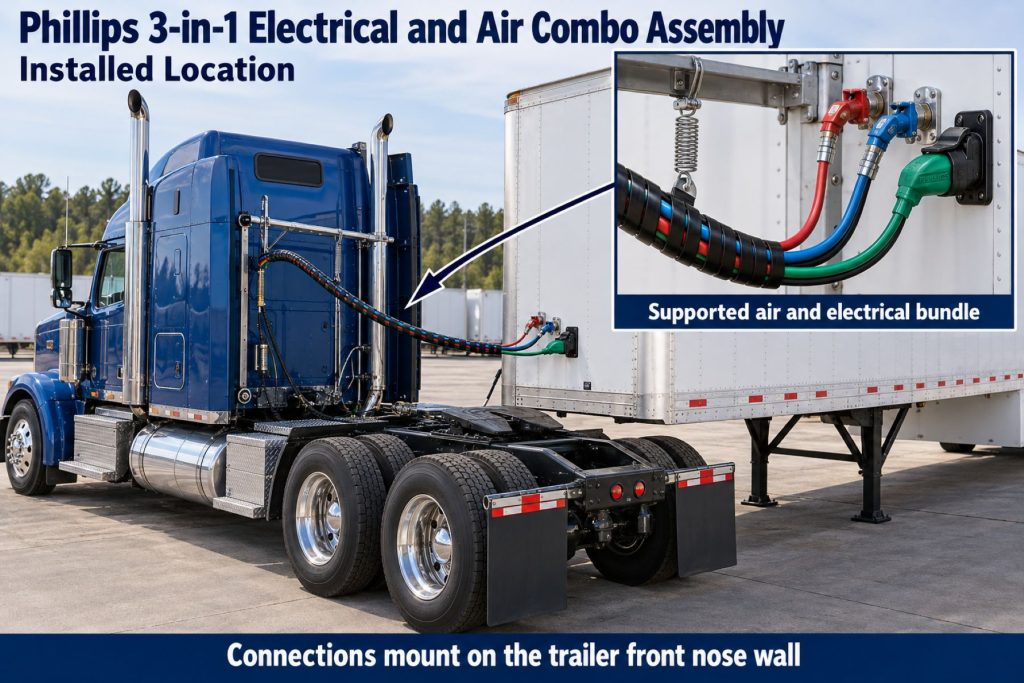
The assembly is positioned behind the tractor cab and extends to the trailer’s front electrical socket and air-brake gladhands. A tracker bar, pogo stick, spring, or other support normally suspends the assembly above the tractor deck.
Its function is to provide the removable electrical, service-air, and emergency-air connections required between a tractor and semitrailer.
Common Specifications
- Number of Combined Lines: Three
- Electrical Connection: Seven-way commercial tractor-and-trailer cable
- Air Connections: Red emergency line and blue service line
- Common ABS Conductor Configuration: One 8-gauge, two 10-gauge, and four 12-gauge conductors
- Available Assembly Lengths: 12, 15, and 20 feet depending on model
- Electrical Plug Options: QCP, QCMS2 with QCP, WEATHER-TITE PERMAPLUG, M7, and zinc die-cast
- Air-Line Material: Heavy-duty rubber
- Air-Line Identification: Red for emergency or supply and blue for service control on most configurations
- Assembly Protection: Flexible spiral wrap
- Standard Support Clamp: Application-specific Phillips hanging clamp
- Premium Support Clamp: Phillips QWIK-CLAMP part number 17-181
- Typical Electrical-System Voltage: Commercial 12-volt tractor-and-trailer systems
- ABS Compatibility: Available in configurations recommended for commercial ABS applications
Operating Capacity and Performance
Electrical capacity depends on the cable conductors, connector type, socket condition, system voltage, circuit protection, and connected trailer loads. Air-system performance depends on hose condition, fitting size, gladhand seals, tractor pressure, and trailer air-system condition.
The combined assembly does not increase the capacity of any individual electrical or pneumatic circuit. Every component must remain within its approved pressure, current, voltage, temperature, and bending limits.
Installation Position and System Function
The assembly should be mounted high enough to prevent contact with the tractor deck while remaining free to extend during turns. Its routing must provide adequate length for both left and right articulation.
The support should carry the assembly near its balance point without crushing the lines, restricting their movement, or concentrating force at the electrical plugs or air fittings.
System Voltage and Electrical Architecture
The seven-way cable is commonly used in North American 12-volt commercial tractor-and-trailer systems. Separate conductors carry ground, lighting, ABS power, and application-specific auxiliary circuits.
The electrical cable does not create or regulate power. It connects the tractor’s electrical system with the trailer wiring and equipment.
Electrical Input, Output, and Power Function
Electrical power and control signals pass from the tractor through the seven-way cable to the trailer socket and harness.
- Ground circuit
- Tail and marker lamp circuit
- Left-turn and stop-lamp circuit
- Right-turn and stop-lamp circuit
- ABS or continuous auxiliary-power circuit
- Application-specific auxiliary circuit
- Application-specific brake or control circuit
Exact circuit assignments should be verified through the applicable wiring diagram and connector standard.
Air Supply and Brake-Control Function
The red emergency line supplies compressed air to the trailer reservoirs and supports emergency-brake operation. The blue service line carries control pressure created by the tractor’s brake application.
The lines must be connected to their correctly identified gladhands. Reversing, crossing, restricting, or leaking the air lines can prevent normal trailer-brake operation.
Voltage, Current, Pressure, and Load Management
Electrical loads must remain within the capacity of the cable conductors, plug contacts, sockets, tractor wiring, trailer harness, and circuit protection.
Air pressure must remain within the operating limits of the tractor-and-trailer brake system. Hose restrictions, internal deterioration, leaking fittings, and damaged seals can reduce air delivery.
Electrical Connector Options
Phillips offers the 3-in-1 assembly with several seven-way connection designs.
- QCP: Replaceable plug cartridge for faster field service
- QCMS2 with QCP: Semi-permanent sealed tractor-side connection with a serviceable trailer-side plug
- WEATHER-TITE PERMAPLUG: Molded plug with an environmental seal
- M7: Molded, corrosion-resistant seven-way plug
- Zinc Die-Cast: Reinforced metal plug housing for conventional heavy-duty service
Air-Line and Fitting Design
Most 3-in-1 assemblies use color-coded heavy-duty rubber air lines with large grips to make coupling and uncoupling easier. Tractor-side swivel fittings simplify installation and reduce twisting during connection.
Exact fittings and gladhand arrangements depend on the selected model and whether the assembly is purchased alone or as part of a complete Phillips power-air kit.
Spiral Wrap and Cable-Support Design
The spiral wrap organizes the electrical cable and air lines while allowing them to flex. It also provides protection against abrasion and contact between the individual lines.
Standard assemblies use an application-specific hanging clamp. Premium assemblies use the Phillips 17-181 QWIK-CLAMP, which can be adjusted without tools and attached to a tracker spring or pogo-stick support.
Internal Components and Electrical Design
The electrical cable contains seven insulated conductors enclosed within a protective jacket. Premium plug options may use overmolded internal connections and replaceable exterior contact components.
The electrical portion remains functionally separate from the air lines. Damage to one line should be evaluated carefully because repairs must not compromise the remaining components or spiral wrapping.
Materials and Component Construction
- Insulated copper electrical conductors
- Chemical- and abrasion-resistant cable jacket
- Heavy-duty rubber air lines
- Flexible protective spiral wrap
- Color-coded rubber grips
- Metal air-line swivel fittings
- Composite, molded, or zinc die-cast electrical plug housings
- Brass electrical contacts
- Application-specific strain relief
- Non-corrosive cable-support clamp on premium assemblies
Wiring, Terminals, Connectors, and Grounding
The electrical plugs, sockets, cable conductors, trailer harness, tractor wiring, and grounds should be treated as one circuit. A poor ground can create lighting problems, ABS warnings, overheating, or backfeeding between trailer circuits.
Premium overmolded plugs reduce exposed internal connections, but the exterior pins, sockets, cable jacket, and vehicle wiring still require inspection.
Circuit Protection and Pneumatic Safety
Electrical circuits must use the correctly rated fuses or circuit breakers specified by the tractor and trailer manufacturers. Oversized protection can allow wiring or connector damage.
The air lines must be free of leaks, restrictions, cracking, and damaged fittings. Air-brake components should only be serviced after the vehicle is secured and pneumatic pressure is safely controlled.
Controls, Monitoring, and Diagnostics
The assembly contains no independent electronic controls. It transfers signals, electrical power, and pneumatic pressure commanded by the tractor’s lighting, ABS, auxiliary, and brake systems.
Diagnosis may require electrical voltage-drop testing, connector inspection, ABS diagnostics, air-pressure testing, leak detection, and brake-system operational checks.
Electronic Controls and Driver-Assistance Integration
The electrical cable may supply power and ground circuits required by trailer ABS, electronic lighting controls, monitoring devices, and approved auxiliary systems.
Low voltage or an intermittent connection can create ABS warnings, lighting failures, controller resets, and unreliable auxiliary-equipment operation.
Power Demand, Air Demand, and Capacity Management
The seven-way circuit should not be used for electrical loads exceeding the approved capacity of its conductors and connectors. High-current equipment may require a separate charging connection.
The air lines must supply the flow and pressure required by the trailer brake system. Restrictions, leaks, and incorrect fittings can delay reservoir charging or brake response.
Heat, Efficiency, and Pressure-Loss Management
Electrical resistance at damaged contacts creates voltage loss and heat. Loose plugs, corroded pins, overloaded circuits, and poor grounds should be corrected immediately.
Pneumatic pressure loss can result from leaking gladhands, damaged seals, cracked hoses, loose fittings, or internal hose restrictions.
Environmental Sealing and Contamination Protection
Premium QCMS2, QCP, and WEATHER-TITE configurations provide different levels of protection against moisture and road contaminants. Cable jacketing and spiral wrap add resistance to chemicals, abrasion, and weather exposure.
Disconnected plugs and air fittings should remain supported and protected instead of resting on the tractor deck where they can collect water, grease, road salt, and debris.
Duty Cycle and Operating Conditions
The 3-in-1 is designed for commercial vehicles exposed to repeated coupling, vibration, articulation, road spray, chemicals, temperature changes, abrasion, and daily brake and electrical operation.
Service life depends on correct length, cable support, operating environment, tractor-and-trailer geometry, connection frequency, maintenance, and driver handling.
Mounting and Installation
The assembly should be suspended from a properly positioned tracker bar, pogo stick, tender spring, or back-of-cab support. Phillips includes a compatible clamp with designated assemblies.
Both ends must reach their connection points without excessive tension. The assembly should remain above the tractor deck and clear of tires, frame edges, the fifth wheel, exhaust components, and driveline parts.
Wiring, Air-Line, and Installation Requirements
- Select the correct assembly length
- Confirm ABS or non-ABS electrical requirements
- Match both seven-way connection ends
- Verify service and emergency air fittings
- Install the correct support clamp
- Allow sufficient movement for full articulation
- Keep the assembly above the tractor deck
- Protect the lines against heat and abrasion
- Connect red and blue lines to their proper circuits
- Test all electrical circuits after installation
- Charge and leak-test the trailer air system
- Verify normal trailer-brake operation
Vehicle and Electrical-System Compatibility
Compatibility depends on tractor and trailer connector types, cable length, system voltage, conductor sizes, ABS requirements, air-fitting design, line routing, mounting position, and tractor-to-trailer articulation.
A 3-in-1 assembly should not be selected by length alone. Both electrical and pneumatic connections must match the complete vehicle combination.
Tractor, Trailer, and Connector Compatibility
Available plug combinations support standard seven-way sockets, QCS2 boots, QCP-compatible serviceable plugs, QCMS2 tractor-side connections, and conventional molded or zinc die-cast interfaces.
The red and blue air lines must match the tractor and trailer service and emergency connections. Adapter fittings should only be used when approved for the installation.
Related Component and System Compatibility
- Commercial seven-way trailer sockets
- Phillips QCS2 sockets
- Phillips QCP plug cartridges
- Phillips QCMS2 connections
- Service and emergency gladhands
- Tractor and trailer air-brake systems
- Trailer ABS systems
- Trailer lighting systems
- Tracker bars and pogo sticks
- QWIK-CLAMP cable supports
- Phillips power-air kits
Common Applications
- Highway tractors
- Regional-haul tractors
- Vocational tractors
- Day-cab tractors
- Dry van trailers
- Refrigerated trailers
- Flatbed trailers
- Tank trailers
- Container chassis
- Converter dollies
- Double-trailer combinations
- Commercial fleet tractor-and-trailer combinations
Advantages
- Combines three connections into one organized assembly
- Reduces tangled and crossing lines
- Protective spiral-wrapped design
- Good kink and abrasion resistance
- Color-coded service and emergency air lines
- Multiple electrical connector options
- Available in several lengths
- Includes an application-specific support clamp
- Premium versions offer replaceable electrical components
- Extended trailer-side lead reduces connector strain on premium versions
- Simplifies replacement of the complete connection assembly
- Provides a clean back-of-cab installation
Limitations or Considerations
- Damage to one line can affect the complete assembly
- The correct overall length is critical
- Improper support can damage all three connections
- Electrical connector options are not universally interchangeable
- Air fittings must match the tractor and trailer
- Spiral wrap can hide localized wear between inspection intervals
- High-current trailer equipment may require a separate connection
- A damaged cable guard or clamp can increase plug strain
- Air and electrical diagnostics remain separate procedures
- Complete replacement may cost more than replacing one individual line
Driver and Operator Experience
The grouped design gives the driver one organized assembly to position and inspect during trailer coupling. The red and blue air lines remain visually identifiable, while the seven-way electrical connection is routed alongside them.
Drivers should verify that the assembly is supported, neither air line is crossed, both gladhands are sealed, the electrical plug is fully engaged, and sufficient length remains for turning.
Controls, Indicators, and Driver Feedback
The 3-in-1 contains no independent controls. Driver feedback comes through trailer-light operation, ABS indicators, tractor and trailer air-pressure gauges, audible air leaks, and trailer-brake response.
Any lighting failure, ABS warning, slow trailer air charging, visible hose damage, or air leakage should be investigated before operation.
Common Electrical and Pneumatic Tests
- Visual inspection of all three lines
- Trailer-light operational test
- ABS power and warning-lamp test
- Electrical voltage-drop testing
- Ground-circuit testing
- Plug and socket contact inspection
- Air-line leak test
- Trailer reservoir charging test
- Service-brake application test
- Emergency-brake function test
- Gladhand seal inspection
- Full-articulation clearance inspection
Inspection and Wear Points
- Electrical plug pins and housings
- Electrical cable jacket
- Red emergency air line
- Blue service air line
- Air-line grips
- Swivel fittings
- Gladhand connections and seals
- Spiral wrap
- Cable-support clamp
- Tracker spring or pogo stick
- Trailer-side cable guard
- Strain-relief points
- Areas contacting the tractor deck or frame
- Signs of cracking, kinking, abrasion, heat, corrosion, or leakage
Cooling, Ventilation, and Environmental Requirements
The assembly does not require active cooling. It should be routed away from exhaust heat and other sources that can damage the electrical jacket, rubber air lines, grips, fittings, or spiral wrap.
Disconnected plugs and gladhands should be stored above the deck in a location protected from water, chemicals, grease, and debris.
Component Service Life and Replacement
Assembly life depends on routing, support, articulation, connection frequency, temperature, chemical exposure, abrasion, air pressure, electrical load, and driver handling.
QCP-equipped versions allow the electrical pin cartridge to be replaced separately. QCMS2-equipped versions provide additional tractor-side connection protection. Damage to the main cable, air lines, fittings, or wrap may require complete assembly replacement.
Maintenance and Ownership Notes
The entire assembly should be inspected rather than checking only the electrical plug or air lines. Wear in the support system can allow all three lines to contact the tractor deck.
- Inspect all three lines during pre-trip checks
- Keep the assembly properly supported
- Check for adequate turning clearance
- Replace damaged spiral wrap
- Inspect electrical plugs and sockets
- Maintain approved electrical corrosion protection
- Inspect gladhand seals and air fittings
- Repair air leaks immediately
- Replace damaged support clamps
- Test electrical and pneumatic systems after service
Common Electrical and Air-System Problems
- Electrical plug corrosion: Moisture, contaminated sockets, damaged seals, or improper plug storage can corrode the contacts.
- Intermittent trailer lighting: Worn contacts, a damaged cable, poor grounds, loose plugs, or trailer-harness faults may interrupt electrical circuits.
- Trailer ABS warning: Low voltage, poor grounding, connector resistance, cable damage, or an unrelated ABS fault may activate the warning.
- Air leakage: Damaged hoses, worn gladhand seals, loose swivel fittings, cracked grips, or improperly connected gladhands may release air.
- Slow trailer air charging: Hose restrictions, leaks, crossed lines, tractor air-system problems, or trailer valve faults may delay charging.
- Assembly drags on the deck: A broken support spring, incorrect clamp position, excessive length, or damaged mounting hardware may allow contact.
- Lines kink during turns: Incorrect assembly length, poor routing, damaged wrap, restricted swivel fittings, or insufficient support may be responsible.
- Repeated connector damage: Excessive tension, inadequate lead length, improper support, severe articulation, or a damaged mating connector may overload the assembly.
Safety and Service Precautions
Electrical power and air pressure should be isolated as required before the assembly is disconnected, repaired, or replaced. The vehicle must be secured against movement before brake-system service.
- Disconnect electrical power before connector repair
- Chock and secure the vehicle
- Control air pressure before opening pneumatic connections
- Never interchange the service and emergency lines
- Do not operate with cracked or leaking hoses
- Do not bypass electrical circuit protection
- Keep the assembly clear of tires and moving components
- Replace heat-damaged electrical connectors
- Perform an air-leak test after service
- Test trailer lights, ABS, and brakes before operation
- Follow Phillips and vehicle-manufacturer instructions
Identification Information
Identification may be located on the electrical cable jacket, product tag, connector housing, packaging, or vehicle maintenance records.
- Phillips manufacturer name
- Complete assembly part number
- Assembly length
- Electrical plug configuration
- ABS or non-ABS designation
- Electrical conductor sizes
- Air-line material and colors
- Tractor-side connection type
- Trailer-side connection type
- Support-clamp type
- Extended-lead or cable-guard configuration
- Tractor and trailer application information
The assembly should not be identified by appearance or length alone. Similar 3-in-1 products can use different plugs, conductors, fittings, support hardware, and electrical ratings.
Buying Considerations
- Choose the correct 12-, 15-, or 20-foot length
- Confirm ABS or non-ABS wiring requirements
- Select the appropriate electrical plugs
- Verify QCP or QCMS2 compatibility
- Match service and emergency air fittings
- Check electrical conductor capacity
- Determine whether premium cable protection is required
- Verify support-clamp requirements
- Check articulation and back-of-cab clearance
- Confirm operating-temperature requirements
- Inspect tractor and trailer sockets and gladhands
- Compare complete-assembly replacement with individual-line repair
Variants and Configurations
- 12-foot QCP-equipped ABS assembly
- 15-foot QCP-equipped ABS assembly
- 20-foot QCP-equipped ABS assembly
- 12-foot QCMS2 and QCP premium assembly
- 15-foot QCMS2 and QCP premium assembly
- 20-foot QCMS2 and QCP premium assembly
- WEATHER-TITE PERMAPLUG configuration
- M7 molded-plug configuration
- Zinc die-cast plug configuration
- ABS electrical configuration
- Selected non-ABS electrical configuration
- Standard hanging-clamp configuration
- Premium QWIK-CLAMP configuration
- QWIK-CHANGE Power Air Kit configuration
Comparison to Similar Equipment
Compared with three individually supported lines, the Phillips 3-in-1 organizes the electrical cable and two air lines into one spiral-wrapped assembly. Separate lines may provide greater individual replacement flexibility but require more routing and support management.
Compared with the Phillips QCP Quick-Change Electrical Plug, the 3-in-1 is a complete electrical-and-air assembly. QCP is one available serviceable electrical connector used on selected 3-in-1 versions.
Compared with the Phillips STA-DRY QCMS2 Electrical Connection System, the 3-in-1 combines the electrical connection with service and emergency air lines. QCMS2 may be used as the premium tractor-side electrical connection.
Compared with the Phillips 4-in-1 Electrical and Air Combo Assembly, the 3-in-1 does not include a separate high-current liftgate charging cable.
Best Fit For
- Highway tractors pulling conventional semitrailers
- Regional and distribution fleets
- Vehicles requiring organized back-of-cab connections
- ABS-equipped tractor-and-trailer combinations
- Fleets seeking simplified cable support
- Operations exposed to frequent coupling and uncoupling
- Vehicles operating in corrosive environments
- Fleets wanting serviceable premium electrical connectors
- Applications that do not require a separate liftgate charging cable
Related Vehicle and Trailer Types
- Highway and Regional Tractors
- Dry Van Trailers
- Refrigerated Trailers
- Flatbed Trailers
- Tank Trailers
- Container Chassis Trailers
- Vocational semitrailers
- Converter dollies
- Double-trailer combinations
Related Truck and Trailer Models
- Freightliner Cascadia
- Kenworth T680
- Peterbilt 579
- Volvo VNL
- International LT Series
- Mack Anthem
- Wabash DuraPlate Dry Van Trailer
- Utility 3000D Dry Van Trailer
- Great Dane Champion Dry Van Trailer
Related Electrical System Types
- Wiring, Connectors & Power Distribution
- Truck & Trailer Lighting Systems
- Seven-way tractor-and-trailer connections
- Trailer ABS electrical connections
- Combination electrical and air assemblies
- Back-of-cab cable-management systems
- Tractor and trailer air-brake connections
- Liftgate charging connections
Related Electrical Products
- Phillips QCP Quick-Change Electrical Plug
- Phillips STA-DRY QCMS2 Electrical Connection System
- Phillips STA-DRY QCS2 Electrical Connection System
- Phillips STA-DRY S7 Seven-Way Connection System
- Phillips 4-in-1 Electrical and Air Combo Assembly
- Phillips QWIK-CHANGE Power Air Kit
- Phillips QWIK-CLAMP Cable Support
- Phillips ABS LECTRACOIL Electrical Cable
Related Equipment Systems
- Electrical Systems
- Brake Systems
- Fifth Wheels & Coupling Equipment
- Telematics & ELD Systems
- Safety Systems
- Tractor air-brake systems
- Trailer air-brake systems
- Trailer ABS systems
- Trailer lighting systems
Related Guides
- Electrical System Guides
- How Commercial Truck Electrical Systems Work
- How to Inspect and Maintain Truck Wiring and Electrical Connections
- Commercial Truck and Trailer Lighting Systems Explained
- Tractor vs Trailer Brake Systems
- Air Brake Systems Explained
- How Truck ABS and Electronic Stability Control Work
Regulatory and Compliance Notes
Commercial trailer lighting, ABS, air-brake connections, electrical wiring, and pneumatic hoses are subject to applicable vehicle-safety and inspection requirements.
The assembly must be installed and maintained so required electrical and air-brake equipment operates correctly. Damaged, leaking, dragging, improperly supported, or incorrectly connected lines can place the vehicle out of service.
Real World Operating Notes
Assembly length should be selected from the actual tractor and trailer geometry. A cable that appears correct while parked straight may become too short during a sharp turn.
Two correctly positioned support points may provide better control on longer or heavier combination assemblies. The supports should carry the assembly without restricting articulation.
When one component becomes damaged, the surrounding spiral wrap should be opened or repositioned as necessary so the complete length of all three lines can be inspected.
Frequently Asked Questions
What is the Phillips 3-in-1 assembly?
It is a spiral-wrapped assembly combining one seven-way electrical cable with red emergency and blue service air lines.
Why are the three lines wrapped together?
The wrap keeps the lines organized, helps protect them against abrasion, and allows them to be supported as one assembly.
What lengths are available?
Common Phillips configurations are available in 12-, 15-, and 20-foot lengths.
What electrical connectors are available?
Options include QCP, QCMS2 with QCP, WEATHER-TITE PERMAPLUG, M7, and zinc die-cast plugs.
What do the red and blue air lines do?
The red line normally supplies the trailer emergency or reservoir circuit. The blue line carries service-brake control pressure.
Does the assembly work with trailer ABS?
Phillips offers ABS configurations with electrical conductors sized for compatible commercial trailer applications.
Can one damaged line be replaced separately?
Repair possibilities depend on the damaged component and assembly construction. Significant damage to an air line, cable, spiral wrap, or connector may require complete assembly replacement.
What is the difference between a 3-in-1 and a 4-in-1?
A 3-in-1 contains the seven-way electrical cable and two air lines. A 4-in-1 adds a separate high-current cable for equipment such as liftgate battery charging.
Why is correct cable support important?
Correct support keeps the assembly away from the tractor deck and prevents its weight from pulling directly on the electrical plugs and air fittings.
How can the correct assembly be identified?
Use the Phillips part number, length, electrical connector types, conductor sizes, ABS designation, air fittings, support clamp, and tractor-and-trailer configuration.
Availability and Where to Find
Phillips 3-in-1 Electrical and Air Combo Assemblies are available through Phillips distributors, commercial-truck dealers, trailer dealers, heavy-duty parts suppliers, fleet-maintenance providers, and truck-parts retailers.
Availability depends on the required length, electrical connectors, ABS configuration, air fittings, support clamp, cable guard, and premium or standard construction.
Current product information, part-number assistance, service resources, and distributor information are available through the Phillips Industries website.
Support Trucking Families
Truck Equipment Atlas supports the mission of Grey Cross, a nonprofit dedicated to helping families of truck drivers who lose their lives while on the road. As the site grows, part of its mission is to bring awareness and support to these families.
Podcast or Video Section
Learn More Through Audio and Video
Truck Equipment Atlas will continue expanding with podcast episodes, interviews, and equipment breakdowns to help drivers and fleets better understand trucks and equipment.
Follow the Growth of Truck Equipment Atlas
Truck Equipment Atlas continues to expand with new truck profiles, trailer coverage, diesel engine pages, equipment system resources, manufacturer information, and educational guides.
Visit our Site Updates page to explore recent additions, project milestones, and upcoming resources as we continue building one of the industry’s growing commercial trucking equipment reference libraries.
View the Latest Site Updates: Truck Equipment Atlas Site Updates