
Hendrickson ULTIMAAX Severe-Duty Suspension
Quick Facts
- Manufacturer: Hendrickson
- Product Type: Advanced severe-duty rear mechanical suspension
- Suspension Design: Rubber spring suspension with fabricated walking beams
- Suspension Position: Tandem rear axles
- Available Capacities: 46,000, 52,000, 60,000, and 70,000 pounds
- Maximum Diagonal Articulation: Approximately 17.5 inches
- Available Ride Heights: Approximately 9.5 to 13 inches, depending on capacity
- Available Axle Spacings: 52, 54, 56, and 60 inches, depending on configuration
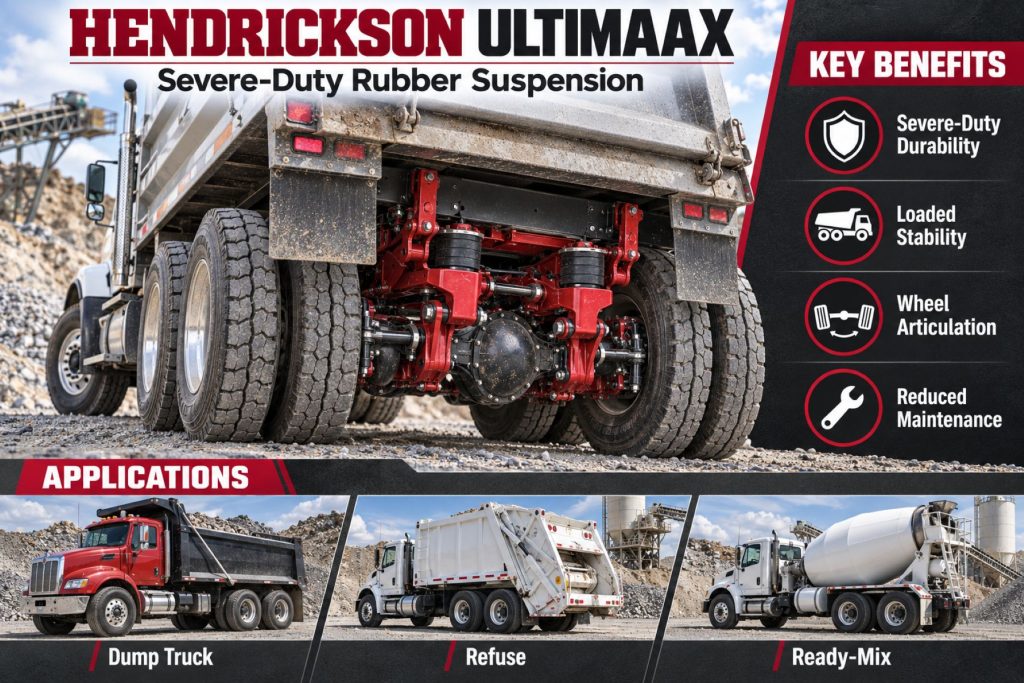
- Primary Applications: Dump, mixer, refuse, logging, crane, oilfield, mining, military, platform, and fire-and-rescue vehicles
- Lift-Axle Compatibility: Approved in properly engineered vehicle configurations
- Primary Benefits: Severe-duty durability, loaded stability, articulation, ride quality, and driveline control
Overview
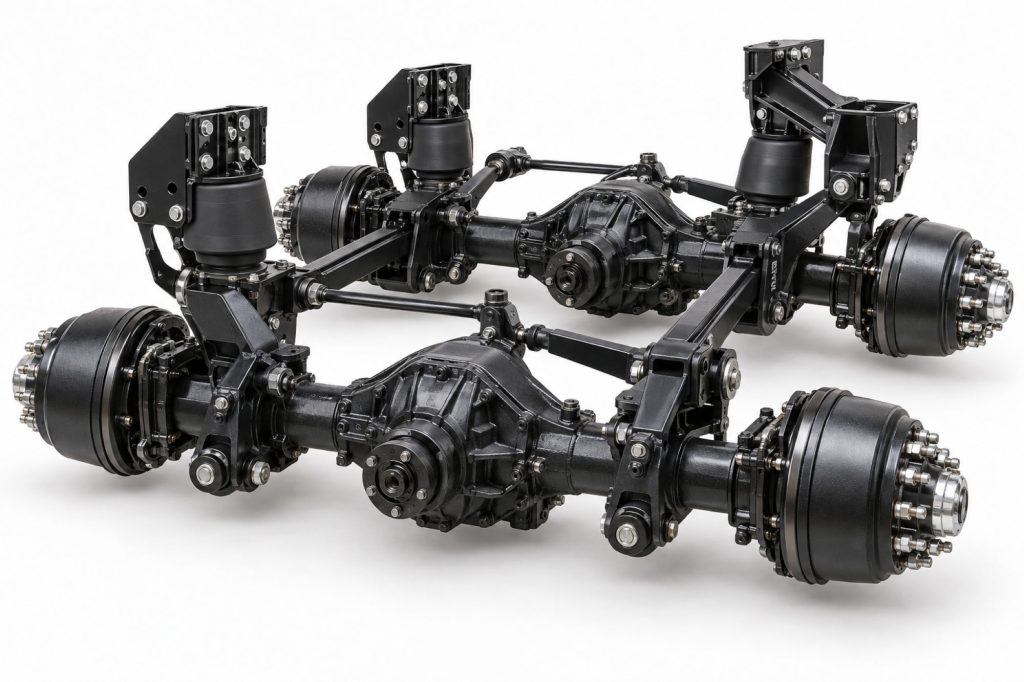
The Hendrickson ULTIMAAX is an advanced severe-duty rear rubber suspension designed for vocational trucks operating in harsh and unpredictable environments. It combines Hendrickson’s walking-beam suspension experience with fabricated equalizing beams and progressive-rate rubber springs.
ULTIMAAX is designed to provide the durability and loaded stability required by dump, mixer, logging, oilfield, mining, refuse, crane, military, and heavy vocational vehicles. Its progressive spring system also improves unloaded ride quality compared with many traditional severe-duty mechanical suspensions.
Available suspension ratings range from 46,000 to 70,000 pounds. Every listed configuration provides up to approximately 17.5 inches of diagonal articulation, helping maintain tire contact and mobility across uneven job sites.
Key Characteristics
- Advanced severe-duty rear rubber suspension
- Fabricated walking-beam design
- Progressive-rate rubber spring system
- Capacity ratings from 46,000 to 70,000 pounds
- Up to approximately 17.5 inches of diagonal articulation
- Designed for extreme vocational and off-highway environments
- Equalizing beams distribute weight between the tandem axles
- Progressive springs balance unloaded ride with loaded stability
- Optimized geometry controls body roll
- Designed to reduce suspension-induced driveline vibration
- Available for use with approved auxiliary lift axles
- Optional shock absorbers
- Different torque-rod arrangements based on suspension capacity and vehicle configuration
Major Components
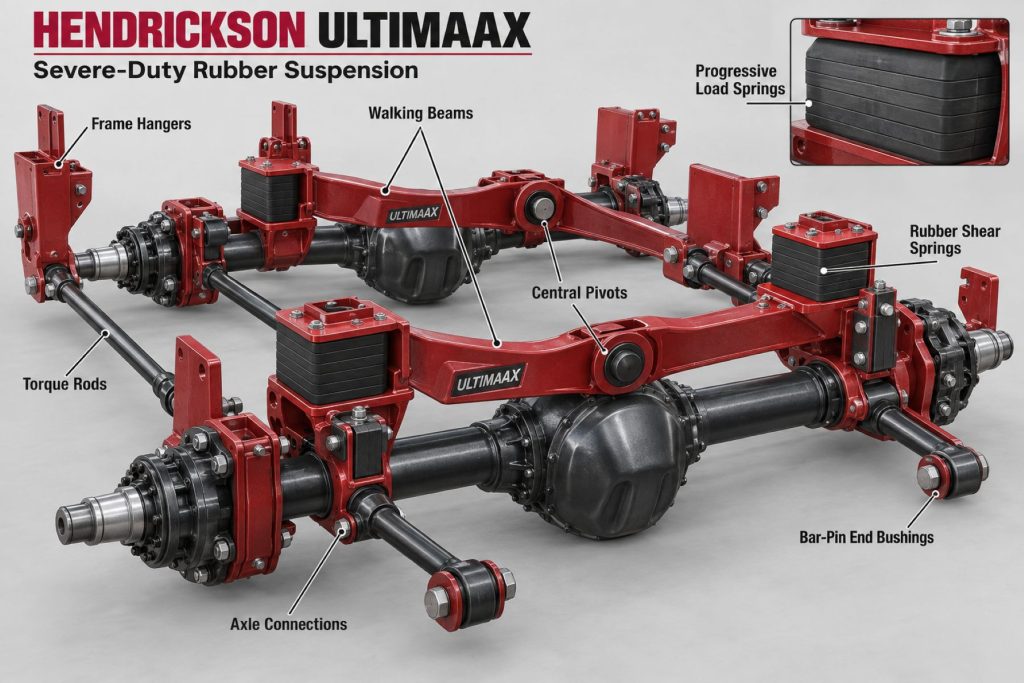
- Fabricated equalizing beams
- Progressive-rate load springs
- Shear springs
- Auxiliary spring elements where used
- Beam-end bar-pin bushings
- Suspension saddles
- Frame brackets
- Axle brackets
- Longitudinal torque rods
- Transverse torque rods or V-rods, depending on configuration
- Rebound straps or travel-control components
- Optional shock absorbers
- Alignment shims
- Spring mounting plates
- Crossmembers where required
- Structural fasteners and mounting hardware
- Tandem drive axles, brakes, and wheel ends supplied with the complete chassis
How the Suspension System Works
ULTIMAAX uses fabricated equalizing beams to connect and control the tandem rear axles. As one axle moves upward over an obstacle, the walking-beam arrangement allows the other axle to move in the opposite direction.
This movement helps equalize weight between the two axles and maintain tire contact on uneven surfaces. Up to approximately 17.5 inches of diagonal articulation is available in listed configurations.
Progressive-rate rubber springs support the vehicle above the equalizing beams. Their effective spring rate increases as the vehicle is loaded and the springs compress.
When the truck is empty or lightly loaded, the springs provide a more compliant response. As payload and suspension forces increase, the progressive springs become firmer and provide additional roll resistance and stability.
Torque rods or V-rods control longitudinal, lateral, and rotational axle movement. Optional shock absorbers damp repeated suspension motion.
Suspension Position and Function
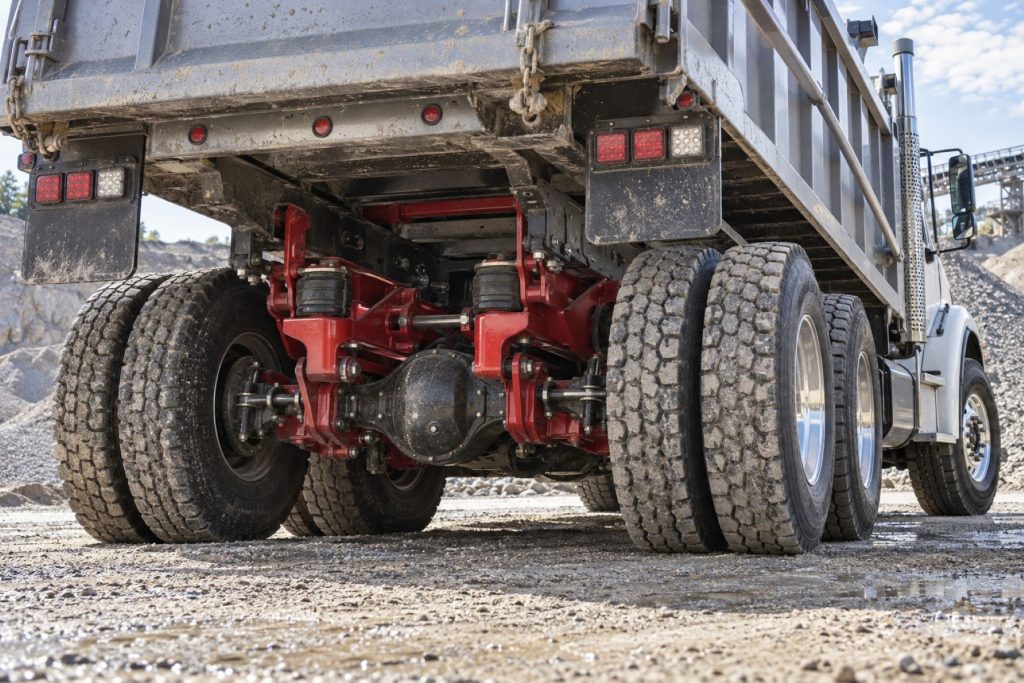
ULTIMAAX is installed beneath the rear of a heavy vocational truck. It connects the tandem rear axles to the frame and supports the chassis, body, mounted equipment, and payload.
The suspension performs several functions:
- Supports the rear portion of the truck
- Distributes weight across both tandem axles
- Allows substantial diagonal articulation
- Helps maintain tire contact on uneven ground
- Controls axle movement during braking and acceleration
- Provides roll stability for high-center-of-gravity equipment
- Absorbs road shock through progressive rubber springs
- Reduces vibration reaching the cab, chassis, and body
- Maintains rear axle position and alignment
- Supports approved auxiliary lift-axle configurations
Common Specifications
- 46K Suspension Rating: 46,000 pounds
- 46K Installed Weight: Approximately 1,179 pounds without shock absorbers
- 46K GCWR Approval: Up to 400,000 pounds
- 46K Site-Travel Rating: 70,000 pounds
- 46K Diagonal Articulation: Approximately 17.5 inches
- 46K Ride Heights: Approximately 9.5 to 13 inches
- 46K Axle Spacings: 52, 54, 56, and 60 inches
- 52K Suspension Rating: 52,000 pounds
- 52K Installed Weight: Approximately 1,198 pounds without shock absorbers
- 52K GCWR Approval: Up to 400,000 pounds
- 52K Site-Travel Rating: 75,000 pounds
- 52K Diagonal Articulation: Approximately 17.5 inches
- 52K Ride Heights: Approximately 9.5 to 13 inches
- 52K Axle Spacings: 52, 54, 56, and 60 inches
- 60K Suspension Rating: 60,000 pounds
- 60K Installed Weight: Approximately 1,570 pounds without shock absorbers
- 60K GCWR Approval: Up to 450,000 pounds
- 60K Site-Travel Rating: 85,000 pounds
- 60K Diagonal Articulation: Approximately 17.5 inches
- 60K Ride Heights: Approximately 10.15 to 13 inches
- 60K Axle Spacings: 56 and 60 inches
- 70K Suspension Rating: 70,000 pounds
- 70K Installed Weight: Approximately 1,750 pounds without shock absorbers
- 70K GCWR Approval: Up to 450,000 pounds
- 70K Site-Travel Rating: 95,000 pounds
- 70K Diagonal Articulation: Approximately 17.5 inches
- 70K Ride Heights: Approximately 10.15 to 13 inches
- 70K Axle Spacings: 56 and 60 inches
Approximately 51 pounds should be added for shock absorbers on 46,000- and 52,000-pound configurations. Approximately 56 pounds should be added for shocks on 60,000- and 70,000-pound configurations.
Capacity, Ride Height, and Axle Travel
ULTIMAAX is offered in four primary capacity ratings: 46,000, 52,000, 60,000, and 70,000 pounds. The vehicle manufacturer establishes the final gross vehicle weight rating based on the complete chassis configuration.
Ride height is measured from the centerline of the axle to the bottom of the truck frame. Available settings range from approximately 9.5 to 13 inches for 46K and 52K systems and from approximately 10.15 to 13 inches for 60K and 70K systems.
Every listed configuration provides up to approximately 17.5 inches of diagonal articulation. The vehicle manufacturer may restrict usable articulation through axle stops, tires, brake components, driveline clearances, frame equipment, or body installation.
The suspension’s site-travel rating does not override the ratings of the axles, tires, wheels, brakes, or frame.
Ride Quality and Load Distribution
The progressive-rate spring system changes its response as vehicle loading increases. When the truck is lightly loaded, the springs provide a more compliant ride. Under heavier loads, additional spring resistance improves stability and roll control.
The fabricated equalizing beams distribute weight between the two rear axles. This helps prevent one axle from carrying a disproportionate load when traveling across ruts, uneven ground, or abrupt elevation changes.
ULTIMAAX is designed to provide better ride quality than many traditional severe-duty mechanical suspensions. However, its primary priorities remain durability, stability, axle control, and off-highway mobility.
Suspension Controls and Adjustment Options
ULTIMAAX is a mechanical suspension and does not require air springs, height-control valves, air lines, or driver-operated leveling controls.
Service-related adjustments can include:
- Rear axle alignment through the bar-pin beam-end connections and approved shims
- Transverse torque-rod or V-rod adjustment where an adjustable component is installed
- Driveline-angle correction through approved vehicle procedures
- Spring selection for the approved body and operating weight
- Optional shock-absorber installation
- Axle-stop configuration established by the vehicle manufacturer
Ride height is determined mechanically by the suspension configuration, spring condition, axle brackets, saddle arrangement, and vehicle loading.
Alignment and Suspension Geometry
Correct rear axle alignment helps prevent tire scrub, vehicle dog tracking, steering correction, and increased rolling resistance. The bar-pin beam-end connection permits axle alignment through approved procedures.
Alignment should be checked after equalizing-beam removal, bushing replacement, axle-bracket service, torque-rod replacement, collision damage, or persistent tire-wear complaints.
Important inspection points include:
- Tandem axle thrust angle
- Axle spacing
- Bar-pin beam-end bushings
- Alignment shims
- Axle brackets
- Equalizing beams
- Longitudinal torque rods
- Transverse torque rods or V-rods
- Frame brackets
- Ride height
- Axle stops
- Driveline angles
Rear axle alignment can also influence front tire wear and overall vehicle handling.
Axle, Brake, and Wheel-End Options
ULTIMAAX is used with heavy-duty tandem drive axles rated for the suspension and application. Axle model, gearing, differential equipment, brakes, hubs, bearings, seals, wheels, and tires are selected as part of the complete vehicle.
Systems rated at 46,000 or 52,000 pounds generally use torque-rod arrangements suited to the vehicle. Higher-capacity 60,000- and 70,000-pound configurations may use torque rods or V-rods to provide the necessary axle control.
Drum brakes and air disc brakes may be available depending on the axle, truck manufacturer, and application.
The usable vehicle rating is controlled by the lowest-rated component. A 70,000-pound suspension does not permit 70,000 pounds on axles, tires, wheels, or brakes with lower ratings.
Common Applications
- Dump trucks
- Concrete mixer trucks
- Refuse trucks
- Logging trucks
- Oilfield vehicles
- Mining trucks
- Crane and boom trucks
- Platform trucks
- Military vehicles
- Fire and rescue apparatus
- Heavy equipment service trucks
- Specialized heavy-haul vehicles
- Construction-support equipment
- Severe-duty multi-axle trucks
Vehicle, Axle, and Frame Compatibility
ULTIMAAX compatibility depends on the truck manufacturer, frame strength, frame width, axle spacing, suspension capacity, ride height, drive-axle model, axle brackets, torque-rod arrangement, brakes, tires, and body installation.
Hendrickson approves ULTIMAAX for selected dump, concrete mixer, refuse, logging, crane, boom, and platform applications. Oilfield, mining, military, fire-and-rescue, and other severe-duty uses require the appropriate configuration and approvals.
Listed axle spacings include 52, 54, 56, and 60 inches for 46K and 52K systems. The 60K and 70K configurations are listed with 56- and 60-inch spacing.
Additional beam lengths or configurations may be available through Hendrickson engineering.
Advantages
- Severe-duty mechanical suspension
- Available capacities up to 70,000 pounds
- Site-travel ratings up to 95,000 pounds
- Up to approximately 17.5 inches of diagonal articulation
- Strong loaded roll stability
- Improved unloaded ride compared with many traditional severe-duty suspensions
- Progressive spring response
- Fabricated equalizing beams balance strength and weight
- Equalized tandem axle loading
- Reduced road shock and vibration
- Designed to control suspension-induced driveline vibration
- No suspension air system required
- Compatible with approved lift axles
- Replaceable progressive load springs
- Suitable for harsh and unpredictable terrain
Limitations or Considerations
- Heavier than lower-capacity vocational suspensions
- Unloaded ride remains firmer than most rear air suspensions
- Does not automatically maintain a constant chassis height
- Rubber spring elements require periodic inspection
- High-capacity versions require compatible heavy-duty axles and chassis components
- Vehicle axle stops may limit the available articulation
- Suspension capacity does not determine legal axle-group weight
- Site-travel ratings apply only under restricted conditions
- Replacement components differ among capacity and axle-spacing configurations
- Incorrect spring selection can affect ride height and stability
- Worn torque rods or beam-end bushings can affect axle control
- Structural suspension components must not be modified without authorization
Driver and Operator Experience
Drivers can expect strong roll control and predictable loaded handling, particularly when operating dump bodies, mixers, cranes, or other equipment with a high center of gravity.
The progressive spring design improves unloaded ride compared with many fixed-rate severe-duty suspensions. The truck will still feel firmer than a comparable air-suspension vehicle.
High articulation helps the rear tires remain in contact with uneven ground, improving mobility and traction at construction sites, mines, logging operations, and oilfield locations.
Operators should report excessive leaning, clunking, axle hop, poor tracking, changes in ride height, or unusual driveline vibration.
Maintenance and Ownership Notes
- Inspect progressive load springs for cracks, cuts, separation, or abnormal deformation.
- Check shear springs and other rubber components for deterioration.
- Inspect equalizing beams for cracks, impact damage, or unauthorized repairs.
- Check bar-pin beam-end bushings for looseness and movement.
- Inspect axle brackets and alignment shims.
- Check longitudinal torque rods and bushings.
- Inspect transverse torque rods or V-rods.
- Check suspension saddles and frame brackets.
- Inspect rebound-control components and axle stops.
- Check optional shock absorbers for leakage, damage, and worn bushings.
- Monitor rear axle alignment and drive-tire wear.
- Follow Hendrickson torque specifications for structural fasteners.
- Use the correct support procedures before removing springs, beams, or torque rods.
- Do not weld, heat, bend, drill, or straighten fabricated suspension components without manufacturer authorization.
Common Suspension Problems
- Cracked or deteriorated progressive load springs
- Damaged or worn shear springs
- Uneven mechanical ride height
- Vehicle leaning to one side
- Worn bar-pin beam-end bushings
- Movement between the beam and axle bracket
- Loose or damaged alignment shims
- Tandem axle misalignment
- Vehicle dog tracking
- Irregular drive-tire wear
- Worn torque-rod bushings
- Bent or damaged torque rods or V-rods
- Cracked or damaged equalizing beams
- Loose frame brackets or suspension saddles
- Leaking or ineffective optional shock absorbers
- Excessive axle hop
- Reduced articulation caused by damaged components or restrictive axle stops
- Driveline vibration caused by worn control components or incorrect geometry
- Suspension damage caused by overloading or impact
Identification Information
Begin identification with the vehicle identification number, manufacturer build sheet, suspension model, capacity, axle spacing, ride height, and drive-axle information.
Important identification information includes:
- Vehicle identification number
- Truck manufacturer and model
- Vehicle model year
- ULTIMAAX capacity rating
- Axle spacing
- Ride height
- Equalizing-beam part number
- Progressive spring part number
- Shear-spring part number
- Bar-pin bushing configuration
- Axle-bracket type
- Torque-rod or V-rod arrangement
- Shock-absorber configuration
- Drive-axle model
- Existing component numbers
Visual appearance alone should not be used to order ULTIMAAX parts because springs, beams, brackets, and control rods vary across capacities and applications.
Buying Considerations
- Confirm the ULTIMAAX capacity rating.
- Verify axle spacing and ride height.
- Compare suspension capacity with axle, tire, wheel, brake, and frame ratings.
- Identify the torque-rod or V-rod arrangement.
- Determine the percentage of on-highway and job-site operation.
- Inspect all progressive and shear springs.
- Check the equalizing beams for cracks or unauthorized repairs.
- Inspect bar-pin bushings, axle brackets, and alignment shims.
- Check torque rods, V-rods, saddles, and frame brackets.
- Inspect optional shock absorbers.
- Examine drive tires for alignment-related wear.
- Road-test the vehicle for leaning, clunking, axle hop, and driveline vibration.
- Review maintenance and spring-replacement records.
- Confirm parts availability using the VIN and complete suspension identification.
Variants and Configurations
- ULTIMAAX 46K: Tandem rear suspension with a nominal 46,000-pound rating.
- ULTIMAAX 52K: Tandem rear suspension with a nominal 52,000-pound rating.
- ULTIMAAX 60K: High-capacity tandem suspension with a nominal 60,000-pound rating.
- ULTIMAAX 70K: Highest listed standard configuration with a nominal 70,000-pound rating.
- Torque-Rod Configuration: Uses longitudinal and transverse torque rods to control axle movement.
- V-Rod Configuration: Uses a V-shaped control rod in approved high-capacity installations.
- Shock-Equipped Configuration: Includes optional dampers to control repeated suspension movement.
- Lift-Axle Vehicle Configuration: Approved installation used with pusher or tag axles on multi-axle vocational trucks.
- Fire-and-Rescue Configuration: Application-specific ULTIMAAX system engineered for emergency apparatus.
Comparison to Similar Equipment
Compared with the Hendrickson HAULMAAX EX, ULTIMAAX extends farther into high-capacity severe-duty applications. HAULMAAX EX is available in common 40,000-, 46,000-, and 52,000-pound vocational configurations, while ULTIMAAX reaches 70,000 pounds.
The Hendrickson HN Vocational Suspension is another rubber-spring walking-beam system. ULTIMAAX uses a newer fabricated-beam and progressive-spring architecture intended for more demanding severe-duty applications.
Compared with the Hendrickson RS Series Suspension, ULTIMAAX is designed to provide a better balance of unloaded ride, loaded stability, articulation, weight, and driveline control. RS prioritizes maximum roll stability in extra-heavy-duty applications.
The Hendrickson PRIMAAX EX is a severe-duty air suspension. It offers automatic ride-height control and greater air-suspension isolation, while ULTIMAAX avoids suspension air components and provides mechanical severe-duty durability.
Best Fit For
- Severe-duty vocational fleets
- Mining, logging, and oilfield operations
- Dump and concrete mixer trucks
- Refuse vehicles
- Crane and boom trucks
- Vehicles requiring 46,000- to 70,000-pound suspension capacity
- High-center-of-gravity equipment
- Operations requiring substantial axle articulation
- Multi-axle trucks using approved lift axles
- Fleets prioritizing durability and stability over premium highway ride comfort
Related Vehicle and Trailer Types
- Complete Guide to Semi Truck Types
- Dump trucks
- Concrete mixer trucks
- Refuse trucks
- Logging trucks
- Mining vehicles
- Oilfield trucks
- Crane and boom trucks
- Platform trucks
- Military vehicles
- Fire and rescue apparatus
- Heavy equipment service trucks
Related Truck and Trailer Models
- Freightliner 114SD
- International HX Series
- Kenworth C500
- Kenworth T880
- Mack Granite
- Peterbilt 567
- Western Star 47X
Related Suspension Types
- Mechanical & Leaf Spring Suspensions
- Vocational & Severe-Duty Suspensions
- Hendrickson HAULMAAX EX
- Hendrickson HN Vocational Suspension
- Hendrickson RS Series Suspension
- Hendrickson RT/RTE Mechanical Suspension
- Hendrickson PRIMAAX EX
- Rubber spring suspensions
- Walking-beam suspensions
- Severe-duty mechanical suspensions
- Vocational rear air suspensions
- Steel leaf-spring suspensions
Related Equipment Systems
Related Guides
- Suspension System Guides
- How Commercial Truck Suspension Systems Work
- Air Suspension vs Leaf Spring Suspension
- How to Choose a Commercial Truck Suspension
- Truck Suspension Components Explained
- Truck vs Trailer Suspension Systems
- Lift Axles Explained
- Heavy Haul Freight Guide
- Oversize Load Transportation Guide
Regulatory and Compliance Notes
An ULTIMAAX-equipped vehicle must remain within all applicable gross vehicle, axle-group, bridge-formula, tire, wheel, brake, frame, and roadway limits. The suspension’s capacity does not independently establish legal payload.
Published site-travel ratings are limited to no more than 5 percent of vehicle operation at speeds not exceeding 5 mph. Liftable pusher or tag axles should only be raised or unloaded to improve job-site maneuverability or when the vehicle is empty.
Suspension and axle site-travel ratings must not be exceeded. The suspension must be paired with axles of appropriate capacity.
All applications require compliance with Hendrickson specifications and approval from the vehicle manufacturer in the original as-built configuration.
Real World Operating Notes
ULTIMAAX is designed for vehicles that regularly encounter ruts, soft ground, uneven grades, and heavy dynamic loading. Its articulation can help maintain tire contact, but the vehicle’s axle stops, tires, body, and driveline may limit the movement available in practice.
Progressive spring condition directly affects ride and stability. Damaged, worn, or incorrect springs can cause vehicle lean, harshness, reduced articulation, or unequal loading.
A high suspension rating should not be confused with the truck’s legal axle capacity. A 70,000-pound suspension may be used to provide durability and site-travel reserve even when public-road axle limits are considerably lower.
Frequently Asked Questions
Is Hendrickson ULTIMAAX an air suspension?
No. ULTIMAAX is a mechanical rear suspension using progressive-rate rubber springs and fabricated walking beams.
What capacities are available?
Listed configurations are rated at 46,000, 52,000, 60,000, and 70,000 pounds.
How much articulation does ULTIMAAX provide?
Every listed configuration provides up to approximately 17.5 inches of diagonal articulation.
What applications use ULTIMAAX?
Approved applications include dump, concrete mixer, refuse, logging, crane, boom, and platform trucks. Properly configured systems are also used in oilfield, mining, military, and fire-and-rescue service.
Does ULTIMAAX require suspension air pressure?
No. Rubber spring elements mechanically support the vehicle.
Does ULTIMAAX maintain a constant ride height?
No. The rubber springs compress as vehicle loading increases.
What is a progressive-rate spring?
A progressive-rate spring becomes increasingly resistant as it compresses. This provides a softer response when lightly loaded and greater stability under heavy load.
Can ULTIMAAX be used with lift axles?
Yes, in approved vehicle configurations. Lift-axle operation must remain within suspension, axle, and site-travel limits.
Are shock absorbers required?
Shock absorbers are available depending on the configuration. Published base suspension weights exclude shocks.
What commonly causes an ULTIMAAX-equipped truck to lean?
Possible causes include damaged or mismatched springs, worn bushings, loose brackets, structural damage, incorrect components, or uneven vehicle loading.
Can an ULTIMAAX equalizing beam be welded?
Structural suspension components should not be heated, welded, drilled, bent, or straightened without a specific manufacturer-approved procedure.
How does ULTIMAAX compare with HAULMAAX EX?
Both are rubber-spring vocational suspensions. ULTIMAAX reaches higher capacity ratings and is positioned for more severe operating environments.
Availability and Where to Find
Hendrickson ULTIMAAX is available for approved severe-duty vocational trucks through participating vehicle manufacturers. Availability depends on the chassis, application, capacity, axle spacing, drive axles, frame, and factory option package.
Replacement springs, bushings, equalizing beams, torque rods, V-rods, shocks, brackets, alignment components, and hardware are available through Hendrickson distributors, commercial truck dealers, suspension specialists, and heavy-duty parts suppliers.
Current product specifications and application requirements are available through Hendrickson’s official ULTIMAAX product page.
Support Trucking Families
Truck Equipment Atlas supports the mission of Grey Cross, a nonprofit dedicated to helping families of truck drivers who lose their lives while on the road. As the site grows, part of its mission is to bring awareness and support to these families.
Podcast or Video Section
Learn More Through Audio and Video
Truck Equipment Atlas will continue expanding with podcast episodes, interviews, and equipment breakdowns to help drivers and fleets better understand trucks and equipment.
Follow the Growth of Truck Equipment Atlas
Truck Equipment Atlas continues to expand with new truck profiles, trailer coverage, diesel engine pages, equipment system resources, manufacturer information, and educational guides.
Visit our Site Updates page to explore recent additions, project milestones, and upcoming resources as we continue building one of the industry’s growing commercial trucking equipment reference libraries.
View the Latest Site Updates: Truck Equipment Atlas Site Updates