
Quick Facts
- Manufacturer: Truck-Lite
- Product Family: Model 60 / 60 Series
- Product Type: LED stop-turn-tail lamp
- Lighting Category: Commercial truck and trailer rear lighting
- Common Size: Two-by-six-inch oval lamp
- Primary Functions: Stop, turn-signal, and tail-light operation
- Lighting Technology: Sealed LED
- Common Diode Arrangement: 26 LEDs on standard configurations
- Common Voltage: 12 volts, with selected 24-volt configurations
- Mounting Options: Grommet, flange, flush, or surface mount depending on configuration
- Common Connection: Truck-Lite Fit ’N Forget sealed connection with application-specific PL-3 or hardwired arrangements
- Primary Applications: Commercial trucks, tractors, trailers, buses, and vocational vehicles
- Production Status: Current product family; individual configurations and availability vary
Overview
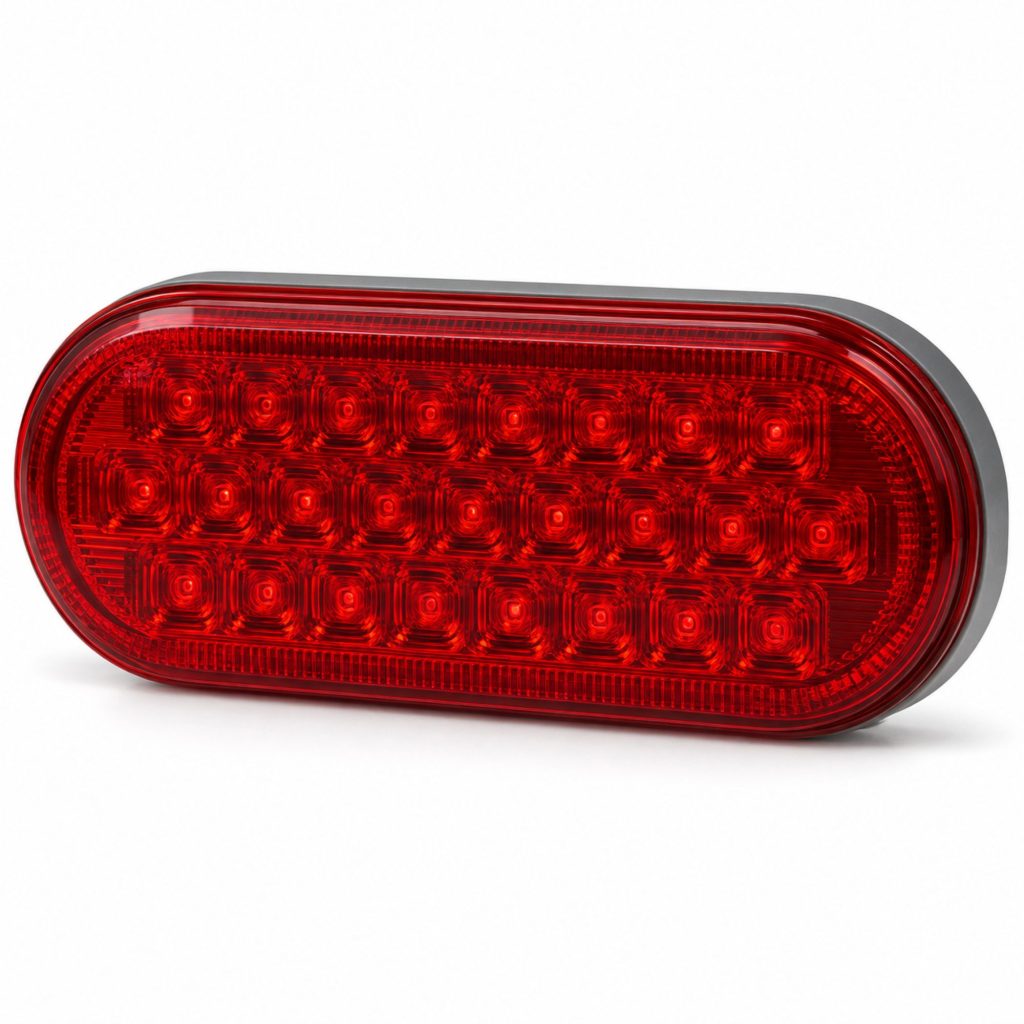
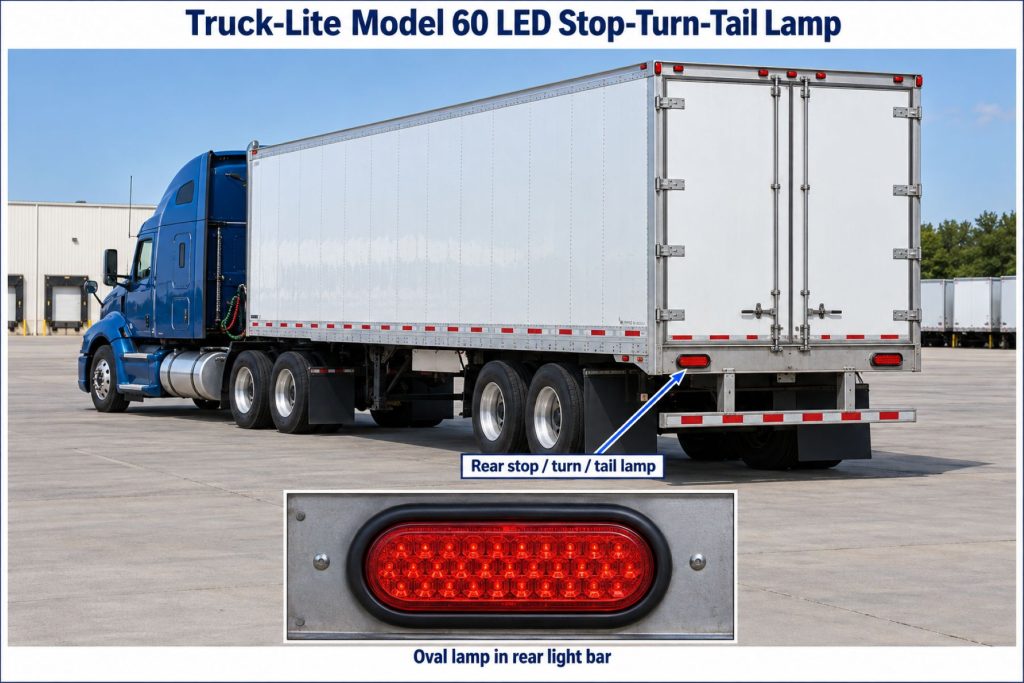
The Truck-Lite Model 60 LED Stop-Turn-Tail Lamp is a two-by-six-inch oval rear lamp designed for commercial trucks, tractors, trailers, buses, and vocational vehicles. It combines stop, turn-signal, and tail-light functions inside one sealed LED assembly.
The Model 60 format is widely used in commercial-vehicle rear panels, trailer sills, body structures, and lighting assemblies. Truck-Lite offers multiple configurations with different mounting systems, electrical connections, voltage ratings, diode arrangements, trim colors, and additional functions.
A commonly used configuration is the 60050R kit. It includes a 26-diode, 12-volt red LED lamp, black mounting grommet, and Fit ’N Forget sealed PL-3 connection. Individual lamps and flange-mounted versions are also available.
LED technology provides faster illumination, lower current demand, and greater resistance to shock and vibration than many incandescent lamps. Exact specifications must be confirmed using the individual Truck-Lite part number.
Key Characteristics
- Two-by-six-inch oval commercial-vehicle lamp
- Combined stop, turn-signal, and tail-light functions
- Sealed LED construction
- Red rear-lighting lens
- Polycarbonate lens on common configurations
- Fast LED illumination
- Lower current draw than many incandescent lamps
- Resistance to commercial-vehicle shock and vibration
- Grommet- and flange-mount options
- Fit ’N Forget sealed connection options
- 12- and selected 24-volt versions
- Individual lamps and complete installation kits
- Heated and integrated-backup configurations available
- Part-number-specific DOT, SAE, FMVSS 108, and CMVSS 108 compliance
Major Components
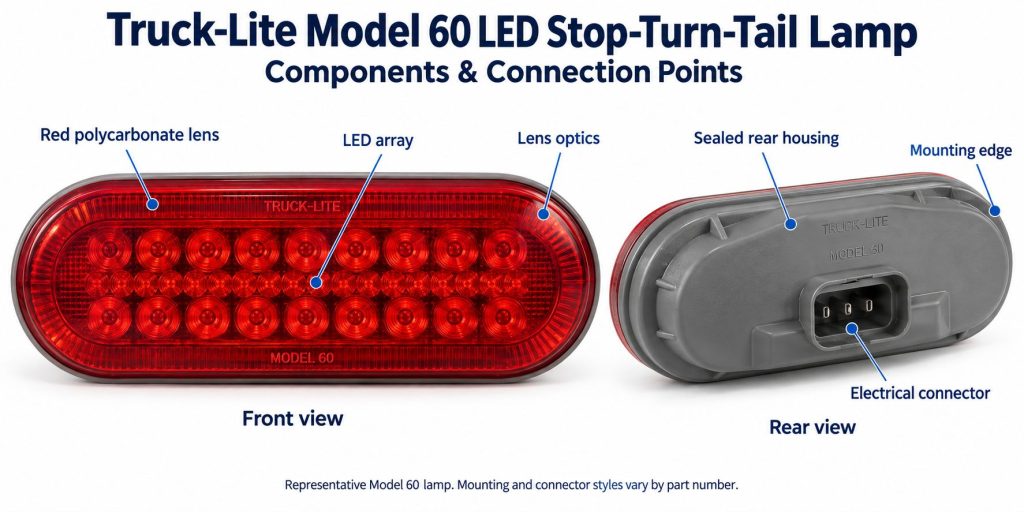
- Red polycarbonate lens
- LED light sources
- Internal circuit board
- Electronic driver components
- Optical elements
- Sealed rear housing
- Electrical terminals or hardwired leads
- Fit ’N Forget sealed connection where equipped
- PL-3-compatible plug where specified
- PVC mounting grommet on grommet-mounted versions
- Integrated mounting flange on flange-mounted versions
- Heating element on heated configurations
- Clear optical section on integrated-backup versions
Product Type and Construction
The Model 60 LED is a sealed oval lamp assembly. Its LEDs, circuitry, lens, optics, terminals, and housing are integrated into one component. The internal light sources are not intended to be replaced individually.
Common standard versions use a red polycarbonate lens and a 26-diode arrangement. The lamp may be retained by a flexible PVC grommet or supplied with an attached flange for direct mounting to the vehicle body.
Combination versions use red and clear lens areas to provide stop, turn, tail, and backup functions from one oval housing. Heated models add an internal heating element for severe winter service.
How the LED Lamp Works
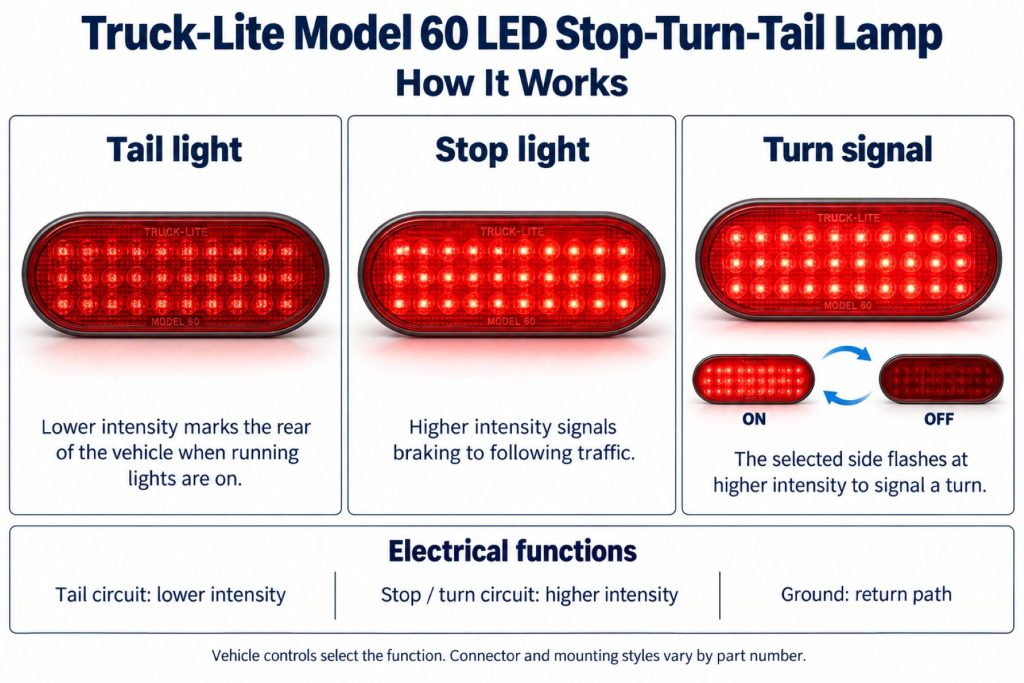
The lamp receives vehicle-system voltage through separate ground, tail-light, and stop-turn circuits. Internal electronics regulate the power supplied to the LEDs and produce the required output for each lighting function.
When the tail-light circuit is energized, the lamp produces a lower-intensity red output. Applying the service brakes or activating the applicable turn signal energizes the brighter stop-turn output.
During a turn indication, the vehicle flasher or electronic lighting controller switches the brighter circuit on and off. Combination lamps use another circuit for white backup illumination, while heated versions require a circuit for the lens heater.
Position and Function Within the Vehicle
The Model 60 is installed at the rear of a commercial truck, tractor, trailer, bus, or vocational vehicle. The oval lamp may be mounted horizontally or in another approved orientation when the selected model’s compliance information permits it.
The stop-light function warns following traffic that the vehicle is braking. The turn-signal function communicates the intended direction of travel, while the tail-light function identifies the rear of the vehicle at night and whenever vehicle lighting is required.
Common Specifications
- Product Series: Truck-Lite 60 Series
- Lamp Shape: Oval
- Common Lamp Format: Two-by-six-inch oval
- Lighting Technology: LED
- Standard Lens Color: Red
- Combination Lens Color: Red and clear on integrated-backup versions
- Common Lens Material: Polycarbonate
- Common Diode Count: 26 LEDs on standard stop-turn-tail configurations
- Common Voltage: 12 volts
- Additional Voltage: Selected 24-volt configurations
- Mounting: Grommet or flange mount on standard versions, with additional flush- and surface-mount combination versions
- Common Connection: Fit ’N Forget sealed connection with PL-3-compatible plug
- Construction: Sealed lamp assembly
- Common 60050R Kit Dimensions: Approximately 6.5 inches wide, 2.32 inches high, and 1.62 inches deep
- Compliance: Part-number-specific FMVSS 108, CMVSS 108, DOT, and SAE listings
Dimensions, current draw, diode count, connector, trim, mounting hardware, warranty, and compliance classifications vary across the Model 60 family and must be confirmed by part number.
Voltage, Current Draw, and Light Output
Most North American Model 60 applications use a nominal 12-volt electrical system. Selected 24-volt versions are available for vehicles and equipment using higher-voltage electrical architectures.
The common 60050R configuration is rated for 12 volts and uses a 26-diode lamp. Current draw differs between the lower-intensity tail-light circuit and the brighter stop-turn circuit. Other configurations may use different diode arrangements and electrical loads.
The lamp must be matched to the vehicle voltage. Installing a 12-volt lamp in a 24-volt circuit can damage the lamp, while an incorrect higher-voltage lamp may not produce the required output in a 12-volt system.
Stop, Turn, and Tail-Light Performance
The Model 60 produces separate intensity levels for tail-light and stop-turn operation. The lower tail-light output provides rear identification, while the brighter stop-turn output communicates braking or turning.
LEDs illuminate more quickly than incandescent filaments. Truck-Lite states that faster illumination can give following drivers additional reaction distance. Actual visibility depends on proper voltage, lens condition, mounting position, viewing angle, weather, and vehicle cleanliness.
Lens, Optics, and Visibility
The red lens and internal optics distribute light through the viewing angles required for approved stop, turn, and tail functions. Integrated-backup versions include a clear section that produces white rearward illumination.
Dirt, road film, snow, ice, physical damage, paint overspray, or improper mounting can reduce visible output. The lens should be cleaned with products that will not scratch or chemically damage its surface.
Housing, Circuit Board, and LED Design
The LEDs and electronic components are enclosed inside the sealed housing. Removing the incandescent filament improves resistance to vibration and eliminates routine bulb replacement.
The sealed lamp should not be opened, drilled, or modified. If its housing, lens, internal electronics, LEDs, or seals fail, the complete lamp is normally replaced.
Electrical Connection and Circuit Integration
Standard Model 60 lamps commonly use a three-terminal PL-3-style stop-turn-tail connection. Truck-Lite’s Fit ’N Forget sealed arrangement helps protect the electrical interface from moisture and contaminants.
The connection normally carries:
- Ground return
- Lower-intensity tail-light power
- Higher-intensity stop-turn power
Combination backup versions require an additional circuit and may use a four-pin or hardwired arrangement. Terminal positions and circuit assignments must be verified before installation.
Grounding and Voltage Management
A dependable ground circuit and adequate supply voltage are required for proper operation. Resistance in the ground, power wire, connector, splice, tractor receptacle, or trailer harness can cause dim output, flickering, intermittent operation, or complete failure.
Loaded voltage-drop testing should be used when diagnosing lighting problems. A corroded connection may show normal voltage without a load but fail once the lamp draws current.
Heated-Lens and Combination-Lamp Options
Selected 60 Series products include heated-lens technology intended to reduce snow and ice accumulation. Heated lamps require the correct wiring, circuit protection, connector, and electrical capacity.
Truck-Lite also offers Model 60 lamps that combine stop, turn, tail, and backup functions. These versions use red and clear optical sections and can fit selected existing Model 60 mounting openings.
Standard, heated, and combination lamps should not be treated as electrically interchangeable without confirming their part numbers and circuit requirements.
Mounting and Installation
Installation depends on the selected mounting system. Grommet-mounted lamps fit into a correctly sized oval opening using a compatible flexible grommet. Flange-mounted lamps attach directly to the vehicle body through an integrated flange.
Installation should include:
- Confirming the exact part number and system voltage
- Inspecting the mounting opening for damage or distortion
- Using the correct grommet, flange, plug, and sealing components
- Cleaning corrosion and debris from the connection
- Routing wiring away from sharp edges and excessive heat
- Providing adequate clearance behind the lamp
- Fully seating the lamp and electrical connector
- Following any required lamp orientation
- Testing every installed lighting function
Vehicle Body and Mounting Compatibility
The body or rear lighting panel must accept the selected oval lamp and provide sufficient clearance for its housing, connector, wiring, grommet, or flange.
Compatibility depends on:
- Mounting-opening dimensions
- Panel thickness and condition
- Grommet-, flange-, flush-, or surface-mount design
- Clearance behind the lamp
- Connector type and wiring length
- Vehicle-system voltage
- Required lamp functions
- Required compliance classifications
- Approved horizontal or vertical orientation
- Exposure to snow, ice, vibration, and physical impact
Vehicle and Electrical-System Compatibility
The replacement lamp must match the vehicle’s voltage, wiring, connector, circuit assignments, mounting system, electronic flasher or lighting controller, and required lighting functions.
Older vehicles designed for incandescent lamps may monitor electrical load differently. Converting to lower-current LEDs may require a compatible electronic flasher, approved load-management device, or controller programming to maintain normal turn-signal operation and fault detection.
Common Applications
- Class 7 and Class 8 tractors
- Commercial straight trucks
- Dry-van trailers
- Refrigerated trailers
- Flatbed and platform trailers
- Tank trailers
- Dump trailers
- Lowboy and equipment trailers
- Vocational trucks
- Commercial buses
- Municipal vehicles
- Service and utility vehicles
- Specialized commercial equipment
Advantages
- Combines stop, turn, and tail functions
- Fast LED illumination
- Lower current draw than many incandescent lamps
- No vibration-sensitive incandescent filament
- Sealed internal construction
- Long service potential
- Widely used oval commercial-vehicle format
- Grommet- and flange-mount choices
- Fit ’N Forget sealed connection options
- 12- and selected 24-volt versions
- Complete installation kits available
- Heated and integrated-backup options available
Limitations or Considerations
- The sealed lamp is normally replaced as a complete assembly
- Part numbers vary by voltage, mount, connector, and function
- Physical dimensions alone do not confirm electrical compatibility
- LED conversions may require compatible flashers or controllers
- Heated versions require additional circuit capacity
- Integrated-backup models require another electrical circuit
- Incorrect grommets can allow the lamp to loosen
- Connector corrosion can cause a new lamp to malfunction
- Lens contamination can reduce visible output
- Mounting orientation must follow the selected lamp’s approvals
- Warranty coverage can differ among configurations
Driver and Operator Experience
The lamp normally operates without driver adjustment. Its condition is checked during the pre-trip inspection by activating the tail lamps, service brakes, left and right turn signals, hazard flashers, and backup lights where equipped.
Drivers should report dim or intermittent output, rapid flashing, warning messages, cracked lenses, damaged mounts, water intrusion, or lamps obscured by dirt, snow, or ice.
Inspection and Wear Points
- Red or red-clear lens
- Lamp housing
- Mounting grommet
- Mounting flange and fasteners
- Rear electrical connector
- Connector seal
- Terminal condition and contact tension
- Ground circuit
- Rear-body or trailer-sill wiring
- Harness clips and strain relief
- Heating circuit on heated models
- Evidence of impact or water intrusion
Testing and Electrical Diagnosis
Diagnosis should determine whether the fault affects the ground, tail-light circuit, stop-turn circuit, backup circuit, heater circuit, or complete lamp. The opposite-side lamp may provide a useful operational comparison when both sides use the same part number.
Testing may include:
- Verifying voltage at the lamp connector
- Performing loaded supply-side voltage-drop testing
- Performing loaded ground-side voltage-drop testing
- Inspecting terminals for corrosion or damage
- Checking fuse and circuit-breaker condition
- Testing the tractor-to-trailer electrical connection
- Checking flasher or lighting-controller operation
- Inspecting wiring for abrasion and broken conductors
- Testing heater operation on heated models
Lamp, Connector, and Wiring Service Life
Service life depends on voltage quality, heat, vibration, sealing, installation, connector condition, environmental exposure, and physical damage. Removing the filament eliminates one common failure point but does not make the lamp immune to failure.
The mounting grommet, plug, terminals, wiring, and support hardware may require service before the LED assembly fails. A hardened grommet or corroded connector should be replaced instead of being reused with a new lamp.
Maintenance and Ownership Notes
Clean the lens regularly and verify operation during required vehicle inspections. Maintain secure wiring support, fully seated connectors, undamaged seals, and properly retained lamps.
Do not open, drill, paint, or modify the sealed lamp. When replacement is necessary, match the original voltage, lighting functions, connection, mounting style, compliance markings, and part number.
Common Electrical and Lighting Problems
- Lamp does not illuminate: Loss of power, poor grounding, a loose plug, damaged wiring, failed internal electronics, or an open protective device may be responsible.
- Tail function works but stop-turn does not: A separate circuit fault, damaged terminal, controller problem, wiring failure, or internal lamp fault may affect the brighter function.
- Dim output: Voltage drop, poor grounding, corroded terminals, low system voltage, or a contaminated lens can reduce visible output.
- Intermittent operation: A loose connector, poor terminal tension, broken conductor, vibration-related fault, or moisture intrusion may interrupt the circuit.
- Rapid turn-signal flashing: An incompatible flasher, failed lamp, open circuit, electronic load-monitoring issue, or LED conversion problem may change the flash rate.
- Water inside the lamp: A cracked lens, damaged housing, failed seal, or impact may have compromised the sealed assembly.
- Lamp comes loose: An incorrect, hardened, damaged, or improperly installed grommet may no longer retain the lamp.
- Connector overheats: Loose terminals, corrosion, excessive resistance, improper repairs, or circuit overloading can generate damaging heat.
- Heater does not operate: A failed heating element, damaged wiring, incorrect connector, blown fuse, insufficient voltage, or incompatible installation may prevent heated-lens operation.
Safety and Service Precautions
Secure the vehicle before inspecting or servicing rear lighting. Follow the vehicle and lamp manufacturers’ procedures and use electrical test equipment rated for the circuit.
- Disconnect electrical power before repairing damaged wiring
- Do not short connector terminals during testing
- Never substitute a larger fuse for the specified protection
- Do not look directly into illuminated high-output LEDs at close range
- Support raised bodies or equipment before working underneath them
- Protect wiring from exhaust heat, sharp edges, and moving components
- Restore seals and strain relief after service
- Test every lighting function before returning the vehicle to operation
Identification Information
Product identification may be molded, printed, or labeled on the lamp housing, lens, connector area, packaging, or vehicle build documentation.
Record the following information before ordering a replacement:
- Complete Truck-Lite part number
- Model 60 or 60 Series identification
- Vehicle-system voltage
- Stop-turn-tail or combination function
- Lens color
- Diode arrangement
- Grommet-, flange-, flush-, or surface-mount design
- Connector or hardwired configuration
- Heated or non-heated construction
- Compliance markings
- Required plug, grommet, flange, or installation kit
- Vehicle or trailer manufacturer and model
Buying Considerations
- Confirm the complete Truck-Lite part number
- Match the vehicle’s 12- or 24-volt electrical system
- Select standard stop-turn-tail or integrated-backup operation
- Choose the correct mounting design
- Verify the oval opening and available rear clearance
- Match the electrical connector and circuit arrangement
- Determine whether heated-lens operation is needed
- Confirm required SAE and regulatory classifications
- Check whether the plug, grommet, flange, or mounting kit is included
- Verify compatibility with the vehicle’s flasher or lighting controller
- Inspect existing wiring and grounds before installation
- Compare warranty coverage among configurations
Variants and Configurations
- 12-volt stop-turn-tail lamps
- 24-volt stop-turn-tail lamps
- Standard 26-diode configurations
- Alternative diode arrangements
- Grommet-mounted lamps
- Flange-mounted lamps
- Flush-mounted combination lamps
- Surface-mounted combination lamps
- Fit ’N Forget sealed connections
- PL-3-compatible connections
- Hardwired configurations
- Heated LED lamps
- Integrated stop-turn-tail and backup lamps
- Individual replacement lamps
- Complete lamp, grommet, and plug kits
Comparison to Similar Equipment
Compared with an incandescent Model 60 lamp, the LED version illuminates faster, draws less current, and eliminates the vibration-sensitive filament. The sealed LED lamp is normally replaced as an assembly instead of receiving a new bulb.
Compared with the Truck-Lite Super 44 LED Stop-Turn-Tail Lamp, the Model 60 uses a two-by-six-inch oval package instead of a four-inch-round design.
Compared with the Truck-Lite Super 60 LED Stop-Turn-Tail and Backup Lamp, the standard Model 60 provides stop, turn, and tail functions without an integrated white backup-light section.
Best Fit For
- Vehicles designed for two-by-six-inch oval rear lamps
- Commercial fleets replacing incandescent rear lighting
- Trailers exposed to frequent vibration
- Vehicles needing lower-current lighting
- Operations seeking sealed LED construction
- Fleets using Truck-Lite sealed connections
- Applications requiring grommet- or flange-mounted lamps
- Winter fleets needing heated-lens options
- Vehicles requiring an integrated backup-light option
Related Vehicle and Trailer Types
- Complete Guide to Semi Truck Types
- Dry Van Trailers
- Refrigerated Trailers
- Flatbed Trailers
- Tank Trailers
- Dump Trailers
- Lowboy Trailers
- Vocational Trucks
Related Truck and Trailer Models
- Great Dane Champion
- Great Dane Everest
- Hyundai Translead Dry Van
- Utility 3000D
- Utility 3000R
- Vanguard VXP
- Wabash DuraPlate Dry Van
Related Electrical System Types
- Truck & Trailer Lighting Systems
- Wiring, Connectors & Power Distribution
- LED stop-turn-tail lamps
- Incandescent stop-turn-tail lamps
- Backup lamps
- Clearance and marker lamps
- License-plate lamps
- Trailer wiring harnesses
Related Electrical Products
- Truck-Lite Super 44 LED Stop-Turn-Tail Lamp
- Truck-Lite Super 60 LED Stop-Turn-Tail and Backup Lamp
- Truck-Lite Model 60 Heated LED Stop-Turn-Tail Lamp
- Truck-Lite Model 33 LED Clearance and Marker Lamp
- Truck-Lite 50 Series LED Backup Lamp
- Truck-Lite Model 60 Incandescent Stop-Turn-Tail Lamp
- Phillips STA-DRY SLIM-7 Electrical System
- Phillips STA-DRY S7 Seven-Way Connection System
Related Equipment Systems
- Electrical Systems
- Brake Systems
- Telematics & ELD Systems
- Safety Systems
- Tires & Wheels
- Suspension Systems
Related Guides
- Electrical System Guides
- How Commercial Truck Electrical Systems Work
- Commercial Truck and Trailer Lighting Systems Explained
- How to Inspect and Maintain Truck Wiring and Electrical Connections
- LED vs Incandescent Commercial-Vehicle Lighting
- How to Diagnose Commercial Trailer Lighting Problems
Regulatory and Compliance Notes
The completed vehicle must maintain all rear lamps and signaling functions required for its vehicle type, dimensions, and operating jurisdiction. The selected Model 60 part number must carry the appropriate classifications for its intended position and function.
Mounting height, horizontal placement, quantity, spacing, color, visibility, orientation, and electrical operation must satisfy applicable requirements. A compliant lamp can become noncompliant if mounted incorrectly, obscured by equipment, wired improperly, or used for an unapproved function.
Real World Operating Notes
When only one lamp function fails, technicians should test the affected circuit before replacing the assembly. Stop-turn and tail functions use separate power paths even though they share one housing.
A replacement lamp will not correct low voltage, poor grounding, damaged trailer wiring, a defective tractor receptacle, or an incompatible electronic flasher. The power supply and ground should be tested under load before the lamp is condemned.
Replacement grommets are worthwhile when the existing rubber or PVC has hardened, cracked, stretched, or lost its grip. Reusing a damaged grommet may allow a new lamp to loosen or admit contaminants around the mounting opening.
Frequently Asked Questions
What is the Truck-Lite Model 60?
It is a family of two-by-six-inch oval commercial-vehicle lamps. LED versions commonly provide stop, turn-signal, and tail-light functions from one sealed assembly.
Is Model 60 the same as 60 Series?
The names are commonly used for the same Truck-Lite oval-lamp family. The individual part number remains necessary because the family includes several configurations.
How many LEDs does the lamp use?
Common standard stop-turn-tail versions use 26 LEDs. Other Model 60 configurations may use different diode arrangements.
Is the Model 60 a replaceable-bulb lamp?
The LED version is a sealed assembly and is normally replaced as a complete lamp after an internal failure. Incandescent Model 60 products also exist and should not be confused with the LED version.
Can it replace an incandescent oval lamp?
It may be suitable when the voltage, mounting opening, connector, lighting functions, photometric classifications, and electronic controls are compatible.
Is a 24-volt version available?
Yes. Selected 24-volt Model 60 LED configurations are available.
Can the lamp include a backup-light function?
Yes. Selected combination models integrate stop, turn, tail, and backup functions in one oval housing.
Why does the turn signal flash rapidly after an LED conversion?
The vehicle may use an incompatible flasher or electronic load-monitoring system. An open circuit, poor connection, or failed lamp can produce similar symptoms.
How is the correct replacement identified?
Use the complete Truck-Lite part number and verify voltage, functions, diode arrangement, mounting design, connector, compliance markings, and required installation hardware.
Availability and Where to Find
Truck-Lite Model 60 LED lamps may be available through Truck-Lite distributors, commercial-truck dealers, trailer dealers, fleet-parts suppliers, heavy-duty electrical specialists, and online commercial-vehicle parts sellers.
Availability varies by voltage, diode arrangement, mounting design, connector, lens type, heating capability, integrated functions, and part number. Current specifications and distributor information are available through the Truck-Lite website.
Support Trucking Families
Truck Equipment Atlas supports the mission of Grey Cross, a nonprofit dedicated to helping families of truck drivers who lose their lives while on the road. As the site grows, part of its mission is to bring awareness and support to these families.
Podcast or Video Section
Learn More Through Audio and Video
Truck Equipment Atlas will continue expanding with podcast episodes, interviews, and equipment breakdowns to help drivers and fleets better understand trucks and equipment.
Follow the Growth of Truck Equipment Atlas
Truck Equipment Atlas continues to expand with new truck profiles, trailer coverage, diesel engine pages, equipment system resources, manufacturer information, and educational guides.
Visit our Site Updates page to explore recent additions, project milestones, and upcoming resources as we continue building one of the industry’s growing commercial trucking equipment reference libraries.
View the Latest Site Updates: Truck Equipment Atlas Site Updates