
Quick Facts
- Manufacturer: Phillips Industries
- Product Family: STA-DRY® SLIM-7™
- Product Type: Modular commercial-trailer electrical harness system
- Series: 34 Series
- Connection Design: Slim-profile molded and sealed modular connections
- Primary Function: Distributes electrical power and control signals throughout a commercial trailer
- Primary Applications: Dry vans, refrigerated trailers, van doubles, flatbeds, container chassis, detachable goosenecks, and retrofit trailers
- Primary Benefits: Corrosion resistance, moisture protection, modular installation, and serviceable harness sections
- Production Status: Current product family; individual harnesses and modules depend on trailer configuration
Overview
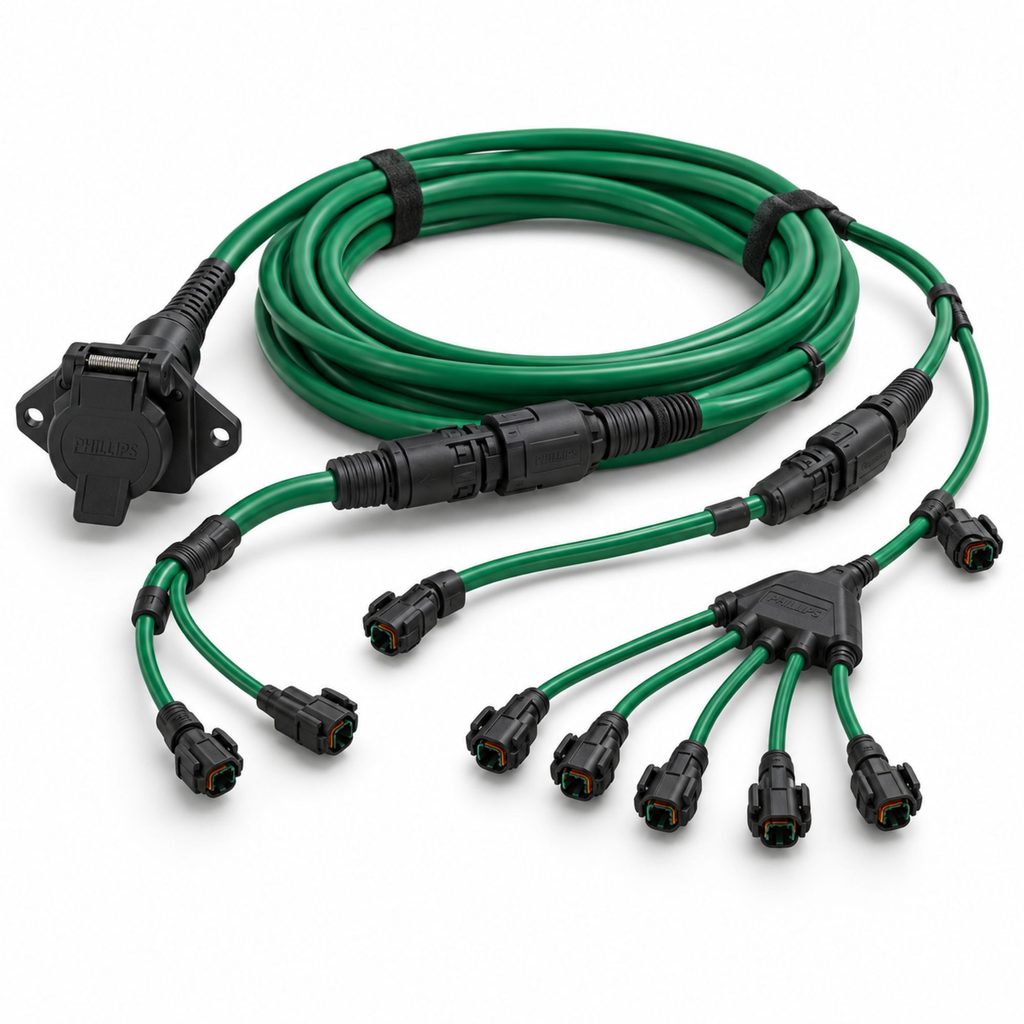
The Phillips STA-DRY SLIM-7 Electrical System is a modular wiring-harness platform designed for commercial trailers. It distributes power and electrical signals from the trailer’s front connection point to its lamps, antilock braking system, identification lighting, side markers, rear sill, and other electrically operated equipment.
The system’s slim molded connections are designed to pass through confined trailer-frame areas while protecting electrical contacts from moisture, road contaminants, and corrosion. Phillips applies corrosion-inhibiting grease to the modules and factory-tests system components.
Rather than requiring an entire trailer harness to be replaced after localized damage, the modular design allows an appropriately identified harness section or branch to be serviced individually. Exact components, cable lengths, branches, connectors, and mounting arrangements vary by trailer design.
Key Characteristics
- Modular commercial-trailer wiring architecture
- Slim-profile connections for restricted installation spaces
- Molded connections designed to resist moisture intrusion
- Corrosion-inhibiting grease applied to system modules
- Application-specific main and branch harnesses
- Factory-tested system components
- Serviceable individual harness sections
- Configurations for several trailer body and chassis types
- Connections intended for efficient installation and maintenance
- Adapter support for selected 34 Series and 36 Series components
Major Components
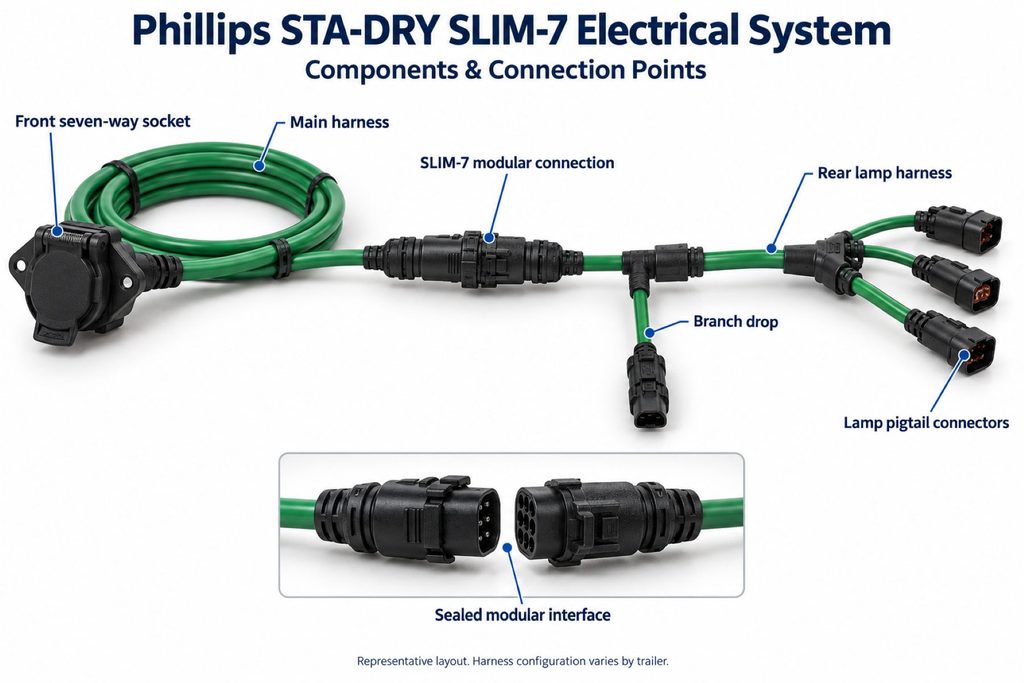
- Main trailer harness
- Mid-main harness
- Front electrical connection or nosebox interface
- ABS ECU power harness
- Front marker-light harnesses
- Mid-marker harnesses
- Rear sill harness
- Identification and license-light harness
- Molded modular connectors
- Sealing ribs and O-rings
- Corrosion-inhibiting grease
- Harness adapters where required
- Mounting clips, clamps, retainers, and protective routing hardware
Product Type and Construction
The STA-DRY SLIM-7 is a distributed electrical harness rather than a single connector or junction box. Application-specific cable assemblies join through molded modular connections to create the trailer’s electrical distribution network.
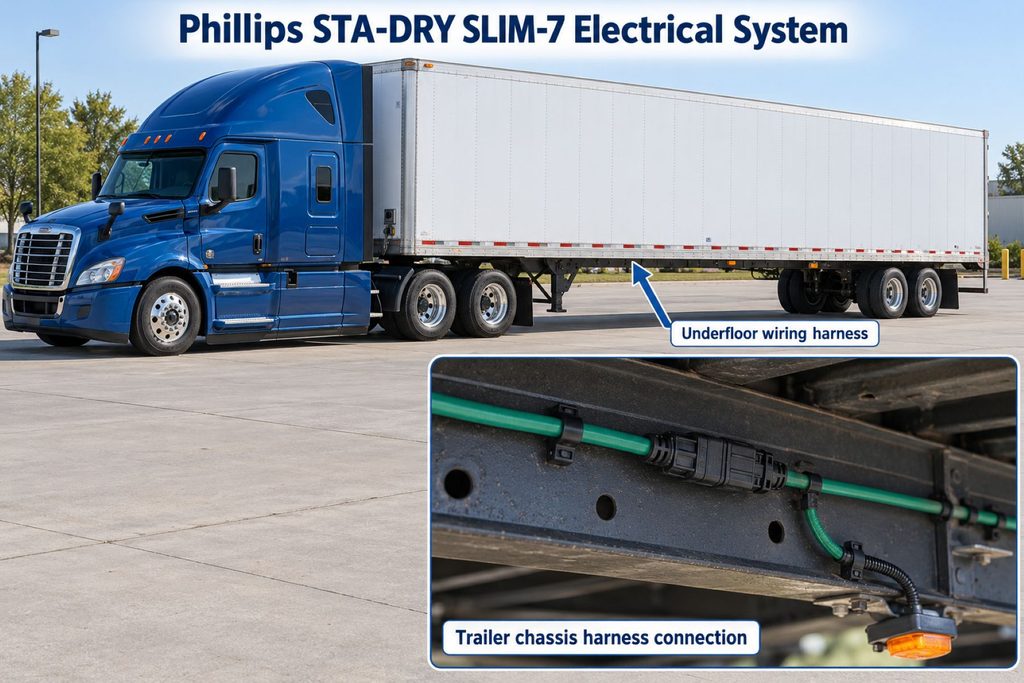
Its slim connection profile is intended to simplify routing through trailer crossmembers, frame rails, and other confined structural areas. Sealed interfaces, molded connector bodies, conductor insulation, protective cable jackets, and corrosion-resistant contact protection help the system withstand commercial-trailer operating conditions.
How the Electrical System Works
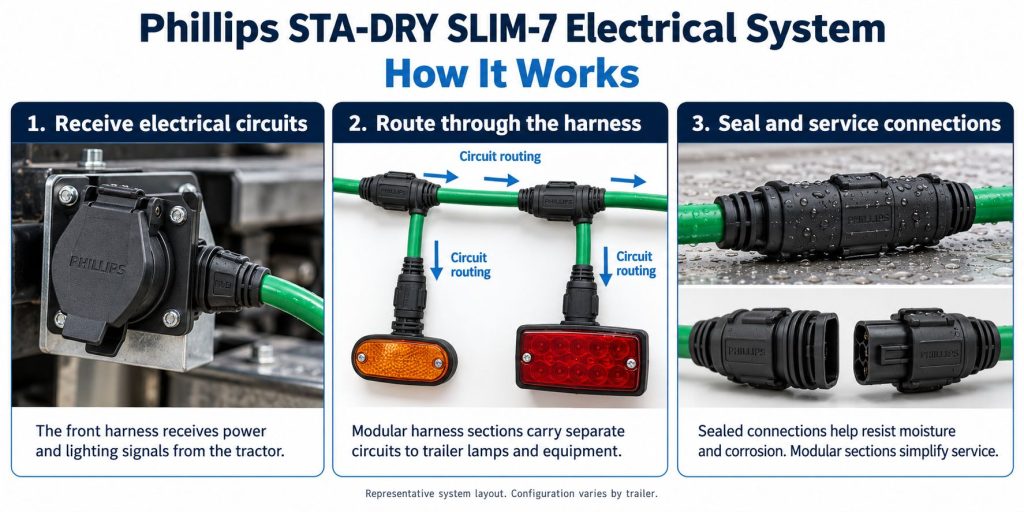
Electrical power and control signals enter the trailer through its tractor-to-trailer connection. The front connection routes the required circuits into the STA-DRY SLIM-7 main harness.
The main and mid-main harnesses carry circuits along the trailer. Application-specific branches distribute those circuits to equipment that may include:
- Clearance and identification lamps
- Side-marker lamps
- Tail, stop, and turn lamps
- License-plate lighting
- Trailer ABS power and warning circuits
- Auxiliary electrical equipment when supported by the trailer design
The molded connections maintain circuit continuity while helping isolate the contacts from water and contaminants. A correctly installed system must use compatible modules and preserve the trailer manufacturer’s circuit assignments.
Position and Function Within the Vehicle
The system is installed throughout a commercial trailer. It normally begins near the trailer’s front electrical interface and follows protected routes along the frame, body rails, crossmembers, and rear structure.
Individual branches terminate near the equipment they serve. Correct positioning protects the harness from moving suspension components, tire spray, sharp edges, excessive heat, cargo damage, and abrasion.
Common Specifications
- System Type: Modular trailer wiring harness
- Product Series: Phillips 34 Series STA-DRY SLIM-7
- Electrical Architecture: Application-specific multi-circuit trailer system
- Connector Construction: Slim molded modular connection
- Environmental Protection: Moisture-resistant sealed connections with corrosion-inhibiting grease
- Harness Lengths: Selected according to trailer length, body style, and circuit layout
- ABS Integration: Application-specific ABS ECU power harnesses are available
- Compatibility: Selected 34 Series and 36 Series components can be connected using the correct Phillips adapter
- Service Method: Individual compatible harness sections and modules can be replaced
- Part numbers, conductor arrangements, branch lengths, connector types, lamp counts, and circuit assignments must be confirmed for the exact trailer.
Voltage, Current, and Operating Capacity
The system operates as part of the trailer’s low-voltage electrical network. The allowable current for each circuit depends on the conductor size, connector design, fuse or circuit protection, lamp load, ABS requirements, and trailer manufacturer’s wiring plan.
Additional equipment should not be connected merely because an unused wire or connector is present. Added loads must remain within the capacity of the source circuit, conductors, connections, and protective devices.
Electrical Distribution and Circuit Protection
The STA-DRY SLIM-7 distributes existing trailer circuits but does not replace correctly sized fuses, circuit breakers, or electronic protection. Circuit protection may be located in the tractor, trailer nosebox, power-distribution equipment, ABS controller, or another trailer assembly.
A fuse with a higher rating should never be installed to compensate for a recurring electrical fault. The underlying short circuit, excessive load, damaged conductor, or poor connection must be located and corrected.
Connector, Terminal, and Harness Design
The defining feature of the system is its narrow molded connection. Ribs, sealing elements, and tightly fitted mating surfaces help prevent moisture and contaminants from reaching the electrical contacts.
Pre-applied corrosion-inhibiting grease provides additional contact protection. Compatible mating components must be fully seated and secured so the sealing features can function correctly.
Sealing, Corrosion, and Environmental Protection
Commercial-trailer wiring is exposed to rain, road spray, winter chemicals, dust, vibration, and temperature changes. The STA-DRY SLIM-7 uses sealed molded connections and corrosion-inhibiting grease to reduce contaminant entry at its modular joints.
Environmental protection still depends on correct installation. Damaged seals, partially engaged connectors, exposed conductors, incorrect repairs, pressure-washer intrusion, and unsupported wiring can defeat the system’s protective design.
Lighting, ABS, and Auxiliary-Circuit Integration
Application-specific harnesses can distribute power to required trailer lighting and ABS equipment. The complete arrangement depends on the trailer’s lamp count, body length, rear-sill design, side-marker positions, and ABS configuration.
Auxiliary loads require verified conductor capacity, circuit protection, grounding, connector compatibility, and compliance with the trailer manufacturer’s electrical design.
Grounding and Return-Circuit Management
Reliable grounding is essential to trailer lighting, ABS, and auxiliary circuits. A poor ground can cause dim or intermittent lamps, voltage drop, ABS faults, unwanted feedback between circuits, and heat at electrical connections.
Ground conductors, terminals, and designated frame-ground points should be kept clean, tight, and protected from corrosion. Ground continuity should be tested under load rather than judged only through a visual inspection.
Mounting and Installation
The harness should be routed according to the trailer manufacturer’s layout and the instructions for the identified Phillips configuration.
Installation should provide:
- Protection from sharp edges and abrasive surfaces
- Clearance from tires, suspension components, and moving equipment
- Separation from excessive heat
- Appropriate slack at articulating or serviceable locations
- Regular support from compatible clips and clamps
- Drip-resistant connector orientation where specified
- Fully seated and secured modular connections
- Correct strain relief near branches and terminations
Trailer Frame and Body Compatibility
The system is available in configurations for multiple trailer architectures, but harness selection must be based on more than overall trailer length.
Compatibility depends on:
- Trailer type and manufacturer
- Body length and frame layout
- Front electrical interface
- Main-harness routing path
- Rear-sill lamp arrangement
- Side-marker and identification-light locations
- ABS controller position and connector
- Number and location of electrical branches
- Required harness and lead lengths
- Existing 34 Series or 36 Series components
Electrical-System Compatibility
Every replacement harness must match the trailer’s circuit assignments, connection family, conductor configuration, ABS equipment, lighting layout, and required length. Similar-looking Phillips harnesses may serve different functions.
Phillips offers an adapter for connecting selected 36 Series STA-DRY main or mid-main harnesses to the 34 Series STA-DRY SLIM-7 system. The adapter should only be used in the combinations approved for the identified parts.
Common Applications
- 48- and 53-foot dry-freight vans
- Refrigerated trailers
- 28-foot van doubles
- Flatbed trailers
- Container chassis
- Detachable-gooseneck trailers
- New trailer production
- Trailer wiring retrofits
- Fleet trailer electrical-system replacement
Advantages
- Slim connectors can pass through restricted trailer-frame areas
- Sealed modular connections help resist moisture intrusion
- Corrosion-inhibiting grease protects electrical contacts
- Modular construction simplifies section-level service
- Application-specific configurations support several trailer types
- Factory-tested components support installation quality
- Individual branches can be replaced after localized damage
- Harness adapters support selected mixed-series service situations
- Organized harness architecture can simplify troubleshooting
Limitations or Considerations
- Part numbers must match the exact trailer configuration
- Incorrect circuit assignments can damage equipment or create unsafe operation
- Sealing performance depends on complete connector engagement
- Harnesses remain vulnerable to crushing, abrasion, heat, and impact
- Unauthorized splices can compromise environmental protection
- Similar connectors do not guarantee electrical compatibility
- Added accessories may overload an existing circuit
- Improper support can place damaging strain on connectors
- Trailer wiring faults may originate in the tractor or tractor-to-trailer cable
Driver and Operator Experience
A properly functioning system generally operates without driver adjustment. The operator primarily experiences its performance through reliable trailer lighting, ABS operation, and electrical accessories.
Drivers should report intermittent lamps, an illuminated trailer ABS warning lamp, repeated fuse failures, damaged wiring, loose hanging harnesses, overheated connectors, or electrical behavior that changes during turns or over rough roads.
Inspection and Wear Points
- Front trailer electrical interface
- Main and mid-main harness jackets
- Molded connector bodies
- Connector seals and locking features
- Harness adapters
- Crossmember pass-through points
- Clips, clamps, and retainers
- Areas near suspension and sliding equipment
- Rear-sill branches
- ABS power harness and ECU connector
- Marker-light and identification-light branches
- Ground conductors and frame-ground points
Testing and Electrical Diagnosis
Diagnosis should begin by confirming the complaint and determining whether it affects one circuit, one trailer section, or the entire trailer. Technicians should inspect both the tractor and trailer sides of the connection before replacing trailer components.
Useful tests may include:
- Source-voltage testing
- Loaded voltage-drop testing
- Ground-circuit voltage-drop testing
- Continuity testing on an isolated circuit
- Short-to-ground and short-to-power testing
- Current-draw measurement
- Connector pin and terminal inspection
- Trailer ABS diagnostic testing
A simple continuity reading does not prove that a damaged connection can carry its required current. Testing under load is often necessary to reveal resistance at corroded or loose connections.
Harness, Connector, and Component Service Life
Service life depends on installation quality, routing, connector engagement, environmental exposure, trailer duty cycle, maintenance practices, and physical damage. A correctly supported harness can remain serviceable for years, while an improperly routed cable may fail quickly.
Replacement should be considered when conductors are exposed, connector bodies are broken, seals are missing, terminals are severely corroded, insulation has hardened or melted, or previous repairs have compromised the system.
Maintenance and Ownership Notes
Inspect the system during scheduled trailer preventive maintenance and whenever lighting or ABS faults are reported. Correct loose supports, abrasion, and connector damage before conductors or terminals fail.
Do not probe sealed terminals with oversized test leads or sharp tools that spread contacts or damage seals. Use compatible diagnostic adapters, terminal tools, replacement connectors, and approved sealing procedures.
Common Electrical-System Problems
- Intermittent lighting: Loose terminals, poor grounds, damaged conductors, incomplete connector engagement, or strain on a harness branch may interrupt the circuit.
- Corroded contacts: Damaged seals, contaminant intrusion, pressure washing, incompatible repairs, or connectors left open can allow corrosion to develop.
- Repeated fuse failure: A shorted conductor, crushed harness, incorrect lamp, water-damaged component, or excessive accessory load may be responsible.
- Dim lamps: Voltage drop, poor grounding, corroded terminals, undersized repair wiring, or excessive circuit load can reduce lamp output.
- Trailer ABS warning: Loss of ECU power, poor ground continuity, harness damage, connector problems, or a separate ABS fault may illuminate the warning lamp.
- Melted connector: High resistance, loose contact tension, contamination, circuit overloading, or an incorrect repair can create damaging heat.
- Harness abrasion: Missing clips, insufficient clearance, sharp frame edges, vibration, or incorrect routing can wear through the cable jacket.
- Incorrect circuit operation: Mismatched replacement sections, crossed conductors, improper splices, or an incorrectly wired front connection may energize the wrong equipment.
Safety and Service Precautions
Disconnect or isolate the applicable electrical supply before opening circuits or performing repairs. Follow the trailer, ABS, lighting, and electrical-equipment manufacturers’ service procedures.
- Secure the tractor and trailer against unintended movement
- Use correctly rated electrical test equipment
- Never substitute a larger fuse to keep a circuit operating
- Protect wiring from sharp edges and hot components
- Do not work beneath unsupported trailer equipment
- Restore seals, strain relief, and harness support after service
- Confirm all required lighting and ABS functions before returning the trailer to service
Identification Information
System and component identification may appear on harness labels, molded connector markings, packaging, trailer build records, or electrical diagrams.
Record the following information before ordering parts:
- Trailer manufacturer
- Trailer identification number
- Trailer model and production year
- Trailer length and body type
- Phillips product family and series
- Complete harness part number
- Harness function and installed location
- Overall and branch lengths
- Connector style and terminal arrangement
- ABS manufacturer and ECU configuration
- Lamp quantity and rear-sill arrangement
- Identification and marker-light layout
Buying Considerations
- Confirm the Phillips part number whenever possible
- Match the trailer type and body length
- Verify whether the existing system is 34 Series or 36 Series
- Identify main, mid-main, branch, ABS, or rear-sill function
- Compare all connector ends and circuit positions
- Confirm required harness and branch lengths
- Check ABS ECU and warning-lamp compatibility
- Verify the number and placement of trailer lamps
- Determine whether an approved harness adapter is required
- Inspect adjacent modules before replacing only one section
- Purchase compatible mounting and protective hardware
Variants and Configurations
- Van-double systems for 28-foot trailers
- Dry-freight-van systems
- Refrigerated-trailer systems
- 48-foot trailer configurations
- 53-foot trailer configurations
- Flatbed-trailer systems
- Container-chassis systems
- Detachable-gooseneck systems
- Retrofit trailer systems
- Main harnesses in application-specific lengths
- Mid-main harnesses
- ABS ECU power harnesses
- Front and mid-marker harnesses
- Rear-sill harnesses
- Identification and license-light harnesses
- 34-to-36 Series adapter arrangements
Comparison to Similar Equipment
Compared with a conventionally spliced trailer wiring system, the STA-DRY SLIM-7 provides modular connections and application-specific harness sections. This can make damaged sections easier to identify and replace while reducing the number of exposed service splices.
Compared with the Phillips 36 Series STA-DRY system, the 34 Series SLIM-7 uses a narrower connection design intended for confined installation spaces. Selected systems can be joined with the correct Phillips harness adapter.
Compared with an isolated connector product such as the Phillips STA-DRY QCS2 Electrical Connection System, the SLIM-7 is a distributed trailer-harness platform with main, branch, lighting, and ABS circuits.
Best Fit For
- Commercial trailers requiring a modular wiring system
- Trailers with confined harness-routing spaces
- Fleets operating in wet or corrosive environments
- Dry vans and refrigerated trailers
- Van doubles
- Flatbeds and container chassis
- Detachable-gooseneck trailers
- Fleet maintenance programs using section-level harness replacement
- Compatible trailer wiring retrofit projects
Related Vehicle and Trailer Types
- Dry Van Trailers
- Refrigerated Trailers
- Flatbed Trailers
- Container Chassis Trailers
- Lowboy Trailers
- Double and Triple Trailers
Related Truck and Trailer Models
- Great Dane Champion
- Great Dane Everest
- Hyundai Translead Dry Van
- Utility 3000R
- Utility 4000D-X Composite
- Vanguard VXP
- Wabash DuraPlate Dry Van
Related Electrical System Types
- Wiring, Connectors & Power Distribution
- Truck & Trailer Lighting Systems
- ABS & Electronic Braking Systems
- Modular trailer wiring harnesses
- Sealed trailer electrical connections
- Trailer noseboxes and junction boxes
- Trailer ABS power circuits
- Trailer lighting harnesses
Related Electrical Products
- Phillips STA-DRY QCS2 Electrical Connection System
- Phillips QCP Quick-Change Electrical Plug
- Phillips STA-DRY S7 Seven-Way Connection System
- Phillips 3-in-1 Electrical and Air Combo Assembly
- Phillips STA-DRY QCMS2 Junction Box
- Phillips ABS LECTRACOIL Electrical Cable
- Phillips ABS LECTRAFLEX Electrical Cable
- Phillips STA-DRY SLIM-7 Harness Adapter
Related Equipment Systems
- Electrical Systems
- Brake Systems
- Tires & Wheels
- Suspension Systems
- Telematics & ELD Systems
- Safety Systems
Related Guides
- Electrical System Guides
- How Commercial Truck Electrical Systems Work
- How to Inspect and Maintain Truck Wiring and Electrical Connections
- Commercial Truck and Trailer Lighting Systems Explained
- Commercial Truck Electrical Connectors Explained
- How to Diagnose Trailer Wiring Problems
- How Trailer ABS Electrical Systems Work
Regulatory and Compliance Notes
The completed trailer must maintain all required lighting, conspicuity, ABS, electrical, and equipment functions applicable to its jurisdiction and operating configuration.
Electrical repairs must preserve proper circuit protection, conductor capacity, connection security, grounding, environmental sealing, and component compatibility. Modifying the harness does not authorize removal or disabling of required lamps, ABS equipment, or warning functions.
Real World Operating Notes
Many apparent trailer-harness failures originate at the tractor receptacle, tractor-to-trailer cable, trailer nosebox, ground circuit, or lamp assembly. The entire circuit should be tested before a SLIM-7 harness section is replaced.
Intermittent faults often appear only when the trailer flexes, vibrates, or becomes wet. Inspect unsupported harness sections, crossmember openings, rear-sill wiring, and connectors exposed to tire spray.
When replacing a section, compare the complete part number, length, branches, and connectors with the removed harness. Physical connection alone does not prove that the circuits are assigned correctly.
Frequently Asked Questions
What is the Phillips STA-DRY SLIM-7 Electrical System?
It is a modular commercial-trailer wiring-harness system that distributes electrical power and signals to trailer lighting, ABS, and related equipment.
Why is it called SLIM-7?
The system uses a slim seven-circuit connection design intended to fit through restricted trailer-frame and structural spaces.
Is the system waterproof?
Phillips describes its connections as moisture-proof and designed for strong corrosion protection. Actual protection depends on correct connector engagement, intact seals, proper routing, and undamaged components.
Can one damaged harness section be replaced?
Yes. Its modular design allows compatible sections and branches to be replaced individually when the correct part is identified.
Can SLIM-7 connect to a Phillips 36 Series STA-DRY harness?
Selected 34 Series and 36 Series arrangements can be joined with the correct Phillips harness adapter.
Does every trailer use the same SLIM-7 harness?
No. Harness length, branches, lamp connections, ABS wiring, and routing differ among trailer types and configurations.
What causes intermittent trailer lights?
Common causes include poor grounding, loose or corroded terminals, incomplete connector engagement, damaged wiring, excessive strain, or faults in the tractor-to-trailer connection.
Can accessories be spliced into the harness?
Accessories should only be added through an approved circuit with sufficient conductor capacity, correct protection, reliable grounding, and sealed connections.
How is the correct replacement harness identified?
Use the Phillips part number, trailer VIN and build records, installed location, harness length, connector arrangement, branch layout, ABS configuration, and lighting design.
Availability and Where to Find
Phillips STA-DRY SLIM-7 systems and replacement components may be available through Phillips Industries distributors, trailer manufacturers, commercial-trailer dealers, fleet-parts suppliers, heavy-duty electrical specialists, and online commercial-vehicle parts sellers.
Availability depends on the trailer type, harness function, required length, branch arrangement, connector design, and part number. Current product information and sales support are available through the Phillips Industries website.
Support Trucking Families
Truck Equipment Atlas supports the mission of Grey Cross, a nonprofit dedicated to helping families of truck drivers who lose their lives while on the road. As the site grows, part of its mission is to bring awareness and support to these families.
Podcast or Video Section
Learn More Through Audio and Video
Truck Equipment Atlas will continue expanding with podcast episodes, interviews, and equipment breakdowns to help drivers and fleets better understand trucks and equipment.
Follow the Growth of Truck Equipment Atlas
Truck Equipment Atlas continues to expand with new truck profiles, trailer coverage, diesel engine pages, equipment system resources, manufacturer information, and educational guides.
Visit our Site Updates page to explore recent additions, project milestones, and upcoming resources as we continue building one of the industry’s growing commercial trucking equipment reference libraries.
View the Latest Site Updates: Truck Equipment Atlas Site Updates