
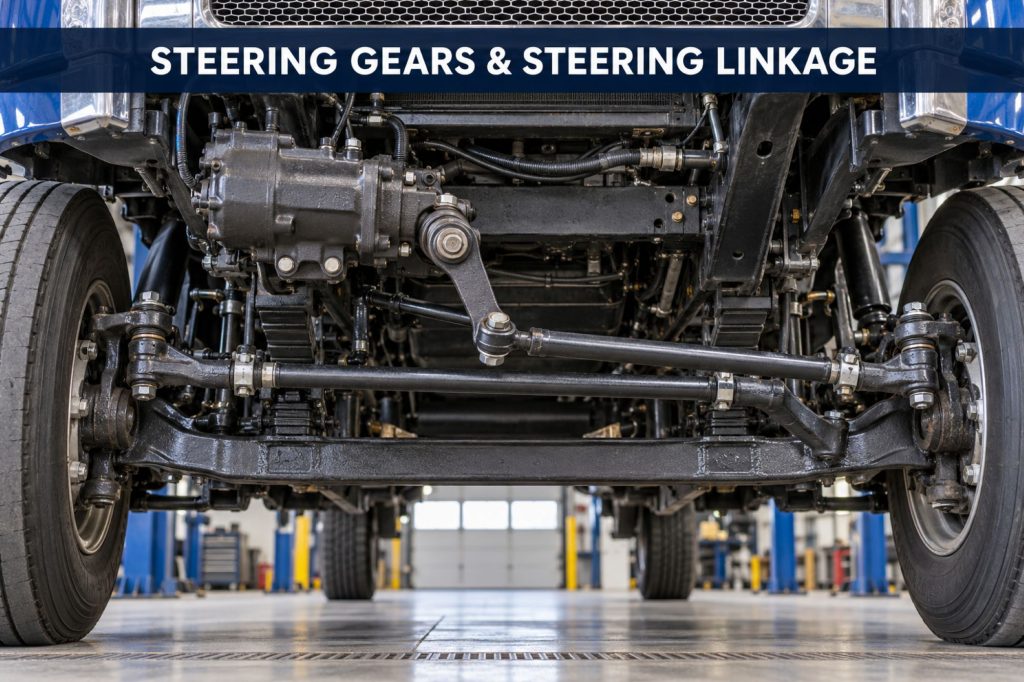
Commercial truck steering gears and steering linkage convert driver input at the steering wheel into controlled movement of the vehicle’s steer wheels.
These systems must provide precise directional control while managing heavy front-axle loads, tire forces, road impacts, suspension movement, and the repeated steering demands of highway, regional, urban, vocational, and severe-duty operation.
Truck Equipment Atlas covers hydraulic steering gears, mechanical steering linkage, pitman arms, drag links, steering arms, tie rods, steering knuckles, assist systems, inspection points, compatibility requirements, and related commercial steering products.
How Commercial Truck Steering Systems Work
The driver turns the steering wheel, rotating the steering column and intermediate steering shaft. This movement operates the steering gear, which converts rotational input into movement at the pitman arm.
The pitman arm moves the drag link, which transfers steering force to a steering arm attached to a steering knuckle. A tie rod connects the steer-wheel assemblies so both wheels turn together at the required angles.
Hydraulic pressure supplied by the power-steering pump reduces the effort required to turn the wheels. Some commercial vehicles also use auxiliary assist cylinders, dual steering gears, or electronically controlled steering assistance.
Commercial Truck Steering Gears
The steering gear is mounted to the vehicle frame and connects the steering column to the steering linkage. Most conventional heavy commercial vehicles use a hydraulically assisted recirculating-ball steering gear.
Inside the gear, steering-wheel rotation moves a worm shaft and piston assembly. Hydraulic pressure assists piston movement, and internal gear teeth rotate the sector shaft connected to the pitman arm.
The steering gear must be matched to the vehicle’s front-axle capacity, steering geometry, hydraulic system, frame mounting, pitman-arm connection, operating pressure, and application.
Major Steering-Gear Components
- Steering-gear housing
- Input shaft
- Worm shaft
- Recirculating-ball mechanism
- Hydraulic piston
- Sector shaft
- Rotary control valve
- Hydraulic pressure ports
- Hydraulic return ports
- Input-shaft seal
- Sector-shaft seal
- Internal bearings and bushings
- Mounting flange
- Adjustment components
- Pitman-arm connection
Steering Linkage Components
Steering linkage transfers movement from the steering gear to the steer wheels while allowing the suspension and axle to move beneath the chassis.
Common steering-linkage components include:
- Pitman arm
- Drag link
- Drag-link ends
- Steering arms
- Tie rod
- Tie-rod ends
- Steering knuckles
- Kingpins
- Steering stops
- Cross-tube clamps
- Castle nuts and cotter pins
- Ball studs and sockets
- Steering dampers on applicable vehicles
- Auxiliary steering arms
- Assist-cylinder connections
Linkage geometry must coordinate with the front axle, suspension, wheelbase, steering gear, tire size, wheel offset, and intended turning characteristics.
Pitman Arms and Drag Links
The pitman arm attaches to the steering gear’s sector shaft. As the sector shaft rotates, the pitman arm moves through an arc and transfers steering force into the drag link.
The drag link connects the pitman arm to the steering arm on the steering knuckle. Its ball-and-socket ends permit controlled movement as the steering and suspension operate.
Pitman-arm length, spline design, indexing, offset, and orientation must match the steering gear and vehicle application. Drag-link length and end configuration must preserve the intended steering geometry.
Tie Rods and Steering Knuckles
The tie rod connects the left and right steering knuckles so the steer wheels move together. Adjustable tie-rod ends or threaded cross tubes are commonly used to establish the vehicle’s toe setting.
Steering knuckles pivot around kingpins or another approved pivot design. The knuckles support the wheel ends while allowing the wheels to turn in response to steering-linkage movement.
Worn tie-rod ends, kingpins, steering arms, or knuckle components can cause looseness, wandering, poor return-to-center behavior, irregular tire wear, and reduced steering precision.
Single and Dual Steering-Gear Systems
Many highway trucks use one primary steering gear connected to the front steering linkage. Vehicles with higher-capacity front axles or demanding vocational applications may use dual steering gears or an auxiliary hydraulic-assist system.
A dual steering system may use a master steering gear on one side and a slave or secondary gear on the opposite side. The gears must operate together without binding, timing errors, or unequal steering movement.
Dual steering arrangements are commonly associated with heavy front-axle applications such as concrete mixers, cranes, heavy-haul tractors, refuse trucks, and specialized vocational vehicles.
Common Steering Configurations
- Single hydraulic steering gear
- Dual steering gears
- Primary gear with hydraulic assist cylinder
- Integral hydraulic power steering
- Recirculating-ball steering gear
- Front-steer axle linkage
- Rear-steer axle linkage
- Single front steering axle
- Dual front steering axles
- Multi-axle steering systems
- Steering gear with electronic assistance
- Steering gear integrated with driver-assistance technology
Steering Capacity and Operating Requirements
Steering-system capacity depends on the complete vehicle configuration rather than the steering gear alone.
Important considerations include:
- Front-axle weight rating
- Actual front-axle load
- Tire size and type
- Wheel offset
- Steering geometry
- Vehicle wheelbase
- Steering-gear ratio
- Hydraulic operating pressure
- Hydraulic pump flow
- Pitman-arm length
- Steering-arm dimensions
- Single or dual steering gears
- Highway or vocational application
- Stationary or low-speed steering demands
A steering gear with a similar external appearance should not automatically be treated as a compatible replacement. Internal ratio, sector-shaft design, input connection, valve calibration, mounting, rotation, and pressure requirements may differ.
Common Applications
- Long-haul highway tractors
- Regional-haul tractors
- Commercial straight trucks
- Delivery trucks
- Dump trucks
- Concrete mixers
- Refuse trucks
- Heavy-haul tractors
- Logging trucks
- Recovery and towing vehicles
- Utility and crane trucks
- Fire apparatus
- Transit and school buses
- Motorcoaches
- Recreational vehicles
- Terminal tractors
- Specialized multi-axle equipment
Installation and Vehicle Compatibility
Steering gears and linkage components must match the vehicle’s frame, front axle, suspension, hydraulic system, steering geometry, and wheel equipment.
Compatibility can depend on:
- Truck manufacturer and model
- Vehicle identification number
- Model year
- Front-axle manufacturer and model
- Front-axle weight rating
- Frame and mounting arrangement
- Steering-gear model and rotation
- Input-shaft connection
- Sector-shaft dimensions
- Pitman-arm design
- Drag-link length and ends
- Hydraulic pressure and flow
- Tire size and wheel offset
- Single or dual steering configuration
- Electronic steering-system integration
Steering-system installation and adjustment should follow the procedures specified for the exact vehicle and component. Unapproved changes can affect steering travel, tire clearance, alignment, component loads, and vehicle control.
Inspection and Maintenance
Commercial steering systems should be inspected during scheduled maintenance and whenever a driver reports looseness, wandering, pulling, binding, excessive steering effort, fluid leakage, or unusual steering behavior.
Important inspection points include:
- Steering-gear mounting
- Input-shaft condition
- Sector-shaft movement
- Hydraulic-fluid leakage
- Pitman-arm attachment
- Drag-link ends
- Tie-rod ends
- Steering-arm attachment
- Kingpins and steering knuckles
- Cross-tube clamps
- Castle nuts and cotter pins
- Hydraulic hoses and fittings
- Assist-cylinder connections
- Steering stops
- Front-axle alignment
- Steer-tire wear patterns
Lubrication points, hydraulic fluid, adjustment procedures, inspection intervals, and fastener requirements vary by component and vehicle application.
Common Steering Problems
- Excessive steering play: Worn drag-link ends, tie-rod ends, steering-gear components, kingpins, steering-column joints, or loose mounting hardware may create free movement.
- Vehicle wandering: Steering-linkage wear, incorrect alignment, suspension movement, tire problems, steering-gear looseness, or road conditions can reduce directional stability.
- Hard steering: Low hydraulic fluid, pump problems, restricted hoses, steering-gear damage, linkage binding, excessive front-axle load, or low tire pressure may increase steering effort.
- Steering pull: Tire-pressure differences, brake drag, alignment problems, road crown, suspension issues, or steering-component damage can cause the vehicle to pull.
- Hydraulic leakage: Damaged seals, hoses, fittings, reservoirs, pumps, or steering-gear components can allow fluid loss and reduced steering assistance.
- Poor return to center: Binding linkage, incorrect caster, kingpin problems, steering-gear adjustment, hydraulic restrictions, or damaged components can slow steering return.
Benefits
- Provides controlled vehicle direction
- Reduces driver steering effort
- Supports heavy front-axle loads
- Provides mechanical steering connection
- Supports highway and vocational applications
- Available for single and dual steering systems
- Integrates with hydraulic-assist equipment
- Can support advanced steering technology
- Uses serviceable linkage components
- Supports application-specific steering geometry
Limitations and Considerations
- Steering components are application-specific.
- Similar-looking steering gears may use different internal ratios.
- Hydraulic pressure and flow must match the gear.
- Linkage geometry must remain within vehicle specifications.
- Worn components can affect control and tire wear.
- Improper adjustment can cause binding or excessive play.
- Frame mounting must remain secure.
- Dual steering systems require coordinated operation.
- Alignment should be checked after component replacement.
- Electronic steering systems may require calibration.
Commercial Steering-Gear Products
ZF
RH Sheppard
Additional steering gears, pitman arms, drag links, tie rods, steering arms, knuckles, assist systems, and steering-linkage components will be added as the Truck Equipment Atlas Steering Gear and Linkage Library continues to expand.
Related Driveline and Steering Categories
- Drivelines & Steering Systems
- Commercial Truck Driveshafts
- Universal Joints, Slip Yokes & Center Bearings
- Power Steering Pumps & Hydraulic Assist
- Steering Columns & Driver Controls
- Advanced Steering & Lane-Keeping Systems
Related Driveline and Steering Guides
- Driveline & Steering System Guides
- How Commercial Truck Driveline Systems Work
- How Commercial Truck Steering Systems Work
- Single-Piece vs Multi-Piece Truck Driveshafts
- How to Inspect and Maintain Driveshafts and Universal Joints
- Hydraulic vs Electric-Assisted Commercial Truck Steering
- Common Commercial Truck Driveline Vibrations and Steering Problems
Related Equipment Systems
- Equipment Systems
- Axles & Differentials
- Suspension Systems
- Tires & Wheels
- Brake Systems
- PTO & Hydraulic Systems
- Electrical Systems
- Safety Systems
Expanding the Steering Gear and Linkage Library
Truck Equipment Atlas will continue expanding this section with additional steering gears, pitman arms, drag links, tie rods, steering arms, knuckles, kingpins, assist cylinders, mounting components, and replacement steering parts.
Future coverage will include steering equipment for highway tractors, straight trucks, buses, vocational trucks, severe-duty vehicles, multi-axle equipment, and specialized commercial chassis.
Explore the Complete Drivelines and Steering Systems Library
Visit the Drivelines & Steering Systems hub to explore commercial driveshafts, universal joints, steering gears, steering linkage, power-steering pumps, hydraulic-assist systems, steering columns, advanced steering technologies, product profiles, and educational guides.
Follow the Growth of Truck Equipment Atlas
Truck Equipment Atlas continues to expand with new truck profiles, trailer coverage, diesel engine pages, equipment-system resources, manufacturer information, product profiles, and educational guides.
Visit our Site Updates page to explore recent additions, project milestones, and upcoming resources as we continue building one of the industry’s growing commercial trucking equipment reference libraries.
View the Latest Site Updates: Truck Equipment Atlas Site Updates