
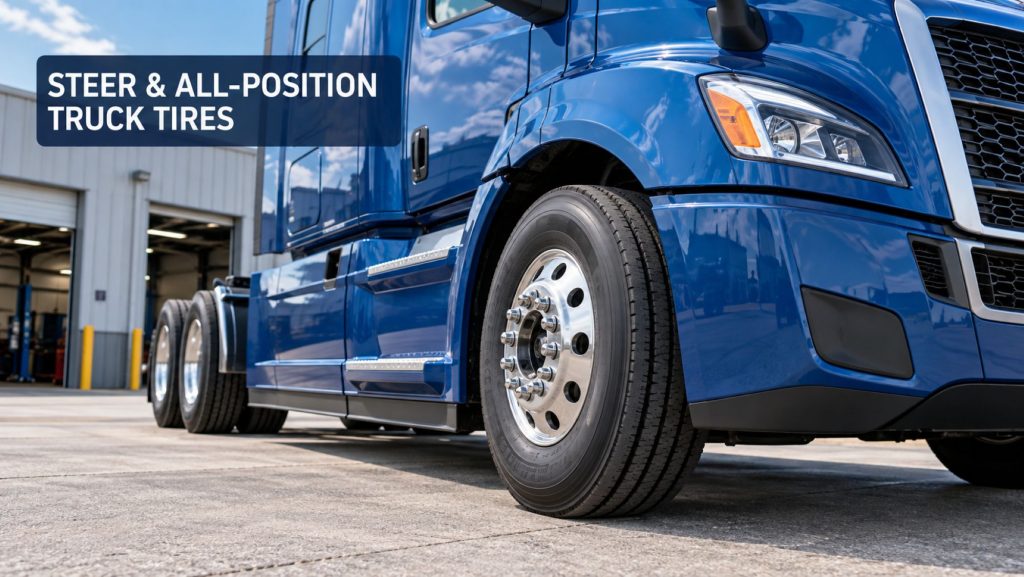
Steer and all-position truck tires are engineered to support vehicle weight, provide directional control, maintain stability, transfer braking forces, and preserve predictable handling across highway, regional, urban, vocational, bus, and specialty commercial-vehicle applications.
Steer tires are installed on a truck or tractor’s steering axle, where tire condition and performance directly affect steering response and vehicle control. All-position tires are designed for use in multiple approved wheel positions, depending on the exact tire model, size, load, vehicle, and operating application.
Truck Equipment Atlas covers steer and all-position tire construction, tread designs, available sizes, load ranges, inflation requirements, fuel-efficiency considerations, irregular-wear patterns, maintenance, vehicle compatibility, and individual tire models from major commercial-tire manufacturers.
Steer and All-Position Tires on Truck Equipment Atlas
Explore the commercial steer and all-position tires being added to Truck Equipment Atlas:
Michelin
Bridgestone
Goodyear
Continental
Yokohama
Additional long-haul, regional, urban, vocational, bus, motorcoach, mixed-service, wide-base, and specialty steer and all-position tires will be added as the Truck Equipment Atlas Tires and Wheels Library continues to expand.
How Steer Tires Work
A steer tire forms the front axle’s contact with the road. The tire supports the vehicle through compressed air contained within its casing while transmitting steering, braking, and cornering forces between the road and the truck.
When the driver turns the steering wheel, the steering system changes the angle of the steer wheels. The tire’s tread, belts, casing, sidewall, bead, and contact patch work together to produce the directional force that changes the vehicle’s path.
Steer tires also transfer braking forces and help stabilize the front of the vehicle. Their condition, inflation, alignment, loading, tread depth, and wear pattern can significantly affect steering response, braking, tracking, and driver confidence.
Steer Tires vs All-Position Tires
A steer tire is intended or approved for operation on a steering axle. Its tread pattern commonly emphasizes directional stability, water evacuation, steering response, even wear, and resistance to irregular shoulder wear.
An all-position tire is designed for use in multiple approved wheel positions. Depending on the model and application, an all-position tire may be used on steer axles, non-driven rear axles, trailers, buses, vocational vehicles, or other commercial equipment.
The term “all-position” does not mean that every tire is appropriate for every axle or operating environment. Manufacturer application information, tire size, load, inflation, vehicle type, operating speed, traction requirements, and local regulations must still be considered.
Some all-position tires may be suitable for limited drive-axle service, but they may not provide the same traction as a dedicated open-shoulder or closed-shoulder drive tire.
Major Steer-Tire Components
A commercial steer tire contains several structural and performance-related components:
- Tread
- Tread ribs
- Tread grooves
- Shoulders
- Belt package
- Radial casing
- Sidewalls
- Inner liner
- Bead bundles
- Bead fillers
- Chafer and rim-contact areas
The tread compound and pattern influence wear, wet traction, rolling resistance, heat, noise, and steering response. The casing and belt structure support the vehicle load and help maintain the tire’s operating shape.
The bead creates the tire’s connection with the wheel. Tire beads, wheel dimensions, mounting surfaces, valve equipment, and inflation pressure must all be compatible.
Ribbed Steer-Tire Tread Designs
Many highway steer tires use continuous circumferential ribs separated by grooves. This design can help provide directional stability, predictable steering, water evacuation, and even tread wear.
Common design features can include:
- Continuous center ribs
- Wide circumferential grooves
- Shoulder ribs
- Siping for wet traction
- Stone-ejector features
- Decoupling grooves
- Wear-resistant shoulder compounds
- Low-rolling-resistance tread compounds
Regional, urban, vocational, and severe-service all-position tires may use deeper tread, wider shoulders, more aggressive patterns, specialized compounds, or reinforced casing features to address turning, braking, curbing, debris, and mixed road surfaces.
Long-Haul Steer Tires
Long-haul steer tires are designed for sustained highway operation, high annual mileage, stable handling, and predictable wear.
Important long-haul characteristics may include:
- Low rolling resistance
- Even tread wear
- Directional stability
- Heat management
- Wet-weather performance
- Casing durability
- Retreadability
- Resistance to irregular shoulder wear
A tire marketed for fuel efficiency may not deliver its intended benefit if it is underinflated, overloaded, misaligned, improperly mounted, or used outside its intended application.
Regional and Urban Steer Tires
Regional and urban vehicles often experience frequent turns, braking, curb contact, start-and-stop operation, tight maneuvering, and changing loads.
Regional and urban steer or all-position tires may emphasize:
- Resistance to scrub
- Durable shoulders
- Enhanced sidewall protection
- Wet traction
- Frequent braking performance
- Long original tread life
- Casing durability
- Resistance to curb damage
These applications can include regional tractors, pickup-and-delivery trucks, refuse vehicles, buses, beverage trucks, parcel vehicles, municipal trucks, and other vehicles operating on local routes.
Vocational and Mixed-Service All-Position Tires
Vocational and mixed-service vehicles may operate between paved roads, construction sites, gravel surfaces, quarries, logging roads, industrial facilities, and other demanding environments.
All-position tires developed for these applications may provide:
- Cut- and chip-resistant tread compounds
- Stone-rejection features
- Deeper tread
- Reinforced casing construction
- Sidewall protection
- Resistance to impacts and penetrations
- Traction on loose surfaces
- Durability during on-road and off-road operation
A highway steer tire should not be substituted for a severe-service tire solely because the tire dimensions appear similar.
Common Steer and All-Position Tire Sizes
Commercial steer and all-position tires are produced in multiple wheel diameters, widths, aspect ratios, load ranges, and service ratings.
Common North American heavy-truck sizes may include:
- 11R22.5
- 11R24.5
- 275/80R22.5
- 285/75R24.5
- 295/75R22.5
- 315/80R22.5
- 385/65R22.5
- 425/65R22.5
Not every tire model is available in every size, and not every size is appropriate for every truck or axle. The selected tire must match the wheel, axle rating, vehicle clearance, load, inflation requirements, operating speed, and manufacturer application information.
Load Capacity and Inflation Pressure
Compressed air supports the vehicle load carried by a commercial tire. Correct cold inflation pressure is therefore essential for load capacity, casing shape, tread contact, steering response, heat control, fuel efficiency, and tread life.
The correct pressure depends on:
- Actual axle load
- Tire size
- Load range
- Single-tire configuration
- Wheel rating
- Vehicle-manufacturer requirements
- Tire-manufacturer load-and-inflation information
- Operating speed and application
The maximum pressure molded on a tire sidewall is not automatically the correct operating pressure for every vehicle.
Underinflation can increase heat, rolling resistance, shoulder wear, casing flex, steering instability, and the risk of tire damage. Excessive inflation can reduce ride quality, change the tread-contact pattern, and contribute to impact sensitivity or center wear.
Alignment and Steer-Tire Wear
Steer tires can reveal problems involving toe, camber, caster, axle alignment, suspension condition, wheel balance, wheel-end condition, inflation, and vehicle loading.
Conditions associated with irregular steer-tire wear can include:
- Incorrect toe
- Incorrect camber
- Improper caster
- Rear-axle misalignment
- Worn steering components
- Worn suspension components
- Loose or damaged wheel bearings
- Wheel imbalance
- Incorrect inflation pressure
- Vehicle overloading
- Brake-system problems
- Road crown and route conditions
Replacing the tire without correcting the underlying mechanical or operational cause can allow the same wear pattern to develop on the replacement tire.
Common Steer-Tire Wear Patterns
Common steer-tire wear patterns can include:
- One-sided shoulder wear
- Both-shoulder wear
- Center wear
- Feathered tread ribs
- Cupping or scalloping
- Diagonal wear
- River wear
- Spot wear
- Flat spotting
- Brake-related wear
Wear-pattern diagnosis should consider the entire vehicle rather than the tire alone. Pressure history, alignment measurements, suspension condition, wheel balance, wheel-end condition, brake operation, road surface, and route characteristics may all be relevant.
Steer-Tire Inspection
Steer tires should be inspected according to applicable regulations, company procedures, manufacturer guidance, and vehicle operating conditions.
Important inspection areas include:
- Cold inflation pressure
- Tread depth
- Uneven or irregular wear
- Cuts and punctures
- Cracks and weathering
- Bulges and casing distortion
- Exposed cords or belts
- Tread separation
- Embedded objects
- Valve stems and valve caps
- Wheel and rim condition
- Loose, damaged, or missing wheel fasteners
- Signs of excessive heat
- Evidence of contact or clearance problems
A tire showing rapid pressure loss, structural damage, severe heat, tread separation, exposed reinforcement, or another unsafe condition requires immediate evaluation under applicable procedures.
Retreading Steer and All-Position Tire Casings
Many commercial tire casings are designed to support retreading after the original tread is worn. Retreading replaces the worn tread while reusing an approved casing that has passed the required inspection and preparation process.
Casing value depends on:
- Original casing design
- Inflation history
- Load history
- Heat exposure
- Previous repairs
- Sidewall and bead condition
- Age and service history
- Professional casing inspection
Whether a retreaded tire may be used in a particular wheel position depends on applicable regulations, fleet policies, manufacturer information, tire condition, and operating application.
Common Applications
- Long-haul highway tractors
- Regional tractors
- Day-cab tractors
- Heavy-haul tractors
- Box trucks
- Pickup-and-delivery trucks
- Dump trucks
- Concrete mixers
- Refuse trucks
- Logging trucks
- Utility trucks
- Municipal vehicles
- Transit and motorcoach buses
- School buses
- Emergency vehicles
- Specialized commercial vehicles
Selecting a Steer or All-Position Tire
Tire selection should be based on verified vehicle, axle, wheel, load, route, climate, and operating requirements.
Important selection factors include:
- Approved wheel position
- Tire size
- Load range and capacity
- Wheel size and width
- Axle rating
- Vehicle clearance
- Long-haul, regional, urban, or vocational service
- Expected annual mileage
- Road surface and terrain
- Wet, snow, and winter performance
- Rolling resistance
- Original tread life
- Casing value and retreadability
- Replacement availability
- Dealer and roadside-service support
- Total cost per mile
Purchase price should not be evaluated independently from expected mileage, fuel consumption, casing value, downtime, roadside availability, maintenance support, and the consequences of using a tire outside its intended application.
Related Tire and Wheel Categories
- Drive Tires
- Trailer Tires
- Vocational & Severe-Service Tires
- Commercial Truck Wheels
- Tire Pressure Monitoring & Inflation Systems
Related Tire and Wheel Guides
- Tire & Wheel Guides
- Commercial Truck Tire Types Explained
- Steer vs Drive vs Trailer Tires
- How to Read Commercial Truck Tire Sizes and Ratings
- How to Inspect and Maintain Commercial Truck Tires
- Aluminum vs Steel Commercial Truck Wheels
Related Truck and Equipment Resources
- Tires & Wheels
- Commercial Trucks
- Axles & Differentials
- Commercial Truck Steer Axles
- Steer Axle & Front Suspensions
- Suspension Systems
- Brake Systems
- Safety Systems
- Equipment Systems
Steer and All-Position Tire Library Expansion
Truck Equipment Atlas will continue expanding its steer and all-position tire coverage as additional manufacturers, sizes, tread designs, applications, and technologies are added.
Future coverage may include:
- Additional long-haul steer tires
- Regional steer tires
- Urban and pickup-and-delivery tires
- Bus and motorcoach tires
- Vocational all-position tires
- Wide-base steer tires
- Winter-rated steer tires
- Mixed-service all-position tires
- Electric-commercial-vehicle tire designs
- Commercial steer-tire comparisons
The goal is to build an organized commercial tire reference that helps drivers, owner-operators, fleets, technicians, students, and equipment buyers understand how steer and all-position tires differ and where individual products fit within the trucking industry.
Explore the Complete Tires and Wheels Library
Visit the Tires & Wheels hub to explore steer tires, drive tires, trailer tires, vocational and severe-service tires, commercial wheels, tire-pressure monitoring systems, automatic inflation systems, product profiles, and educational guides.
Follow the Growth of Truck Equipment Atlas
Truck Equipment Atlas continues to expand with new truck profiles, trailer coverage, diesel engine pages, equipment-system resources, manufacturer information, and educational guides.
Visit the Truck Equipment Atlas Site Updates page to explore recent additions, project milestones, and upcoming resources.