
Air Disc Brakes vs Drum Brakes
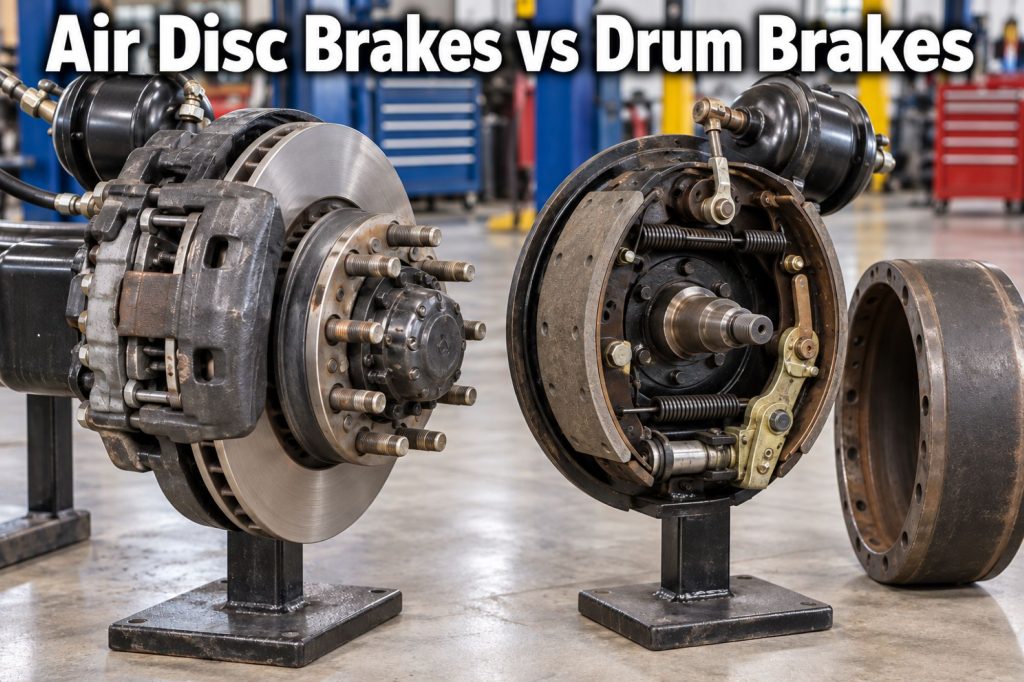
Commercial trucks and trailers commonly use two types of air-operated foundation brakes: air disc brakes and drum brakes. Both convert compressed-air pressure into mechanical braking force, but they apply friction in different ways.
Air disc brakes use a caliper to clamp brake pads against a rotor. Drum brakes typically use an S-cam mechanism to push brake shoes against the inside of a brake drum.
Both designs can provide dependable commercial-vehicle braking when correctly specified, inspected, adjusted, and maintained. However, they differ in braking consistency, heat management, inspection, maintenance, initial cost, component availability, and suitability for specific operating environments.
This guide compares air disc brakes and drum brakes, explains how each system works, and identifies the factors fleets and equipment buyers should consider when selecting a foundation-brake design.
What Is a Foundation Brake?
The foundation brake is the wheel-end portion of a commercial vehicle’s braking system.
When the driver presses the brake pedal, the Air Brake System delivers compressed air to a brake chamber or actuator. The actuator converts that air pressure into mechanical movement that applies the foundation brake.
The two primary foundation-brake designs used on air-braked commercial vehicles are:
- Air disc brakes
- S-cam drum brakes
The air system supplies and controls the braking force. The foundation brake applies friction at the wheel end to slow or stop the vehicle.
How Air Disc Brakes Work
Air Disc Brake Systems use a rotor attached to the wheel hub and a caliper mounted around the rotor.
A simplified air disc brake application follows this sequence:
- The driver presses the brake pedal.
- Compressed air enters the brake chamber.
- The chamber moves an internal actuator or pushrod.
- The actuator operates the caliper mechanism.
- The caliper presses the inner and outer brake pads against the rotor.
- Friction between the pads and rotor slows the wheel.
When air pressure is released, the caliper mechanism reduces clamping force and provides the running clearance needed between the pads and rotor.
Major Air Disc Brake Components
A typical commercial-vehicle air disc brake includes:
- Brake chamber or actuator
- Caliper
- Carrier or torque plate
- Brake pads
- Rotor
- Tappets or pressure plates
- Internal adjustment mechanism
- Slide pins or guide mechanisms
- Mounting hardware
- Wear indicators or sensors on equipped systems
The exact construction varies by manufacturer and brake model.
How Drum Brakes Work
Drum Brake Systems use curved brake shoes positioned inside a rotating brake drum.
Most heavy commercial-vehicle drum brakes use an S-cam design.
A simplified S-cam drum-brake application follows this sequence:
- The driver presses the brake pedal.
- Compressed air enters the brake chamber.
- The chamber extends its pushrod.
- The pushrod rotates the automatic slack adjuster.
- The slack adjuster turns the camshaft.
- The S-shaped cam pushes the brake shoes outward.
- The linings contact the inside of the rotating drum.
- Friction between the linings and drum slows the wheel.
When the brakes are released, return springs pull the shoes away from the drum.
Major Drum-Brake Components
A typical S-cam drum brake includes:
- Brake chamber or spring brake
- Pushrod
- Clevis
- Automatic slack adjuster
- Camshaft
- S-cam head
- Camshaft bushings
- Brake spider
- Anchor pins
- Rollers
- Brake shoes
- Friction linings
- Return springs
- Brake drum
- Dust shields on equipped systems
These components must work together while maintaining the correct brake stroke and shoe-to-drum clearance.
Air Disc Brakes vs Drum Brakes: Main Differences
| Comparison Area | Air Disc Brakes | Drum Brakes |
|---|---|---|
| Friction components | Pads clamp against a rotor | Shoes press against the inside of a drum |
| Application mechanism | Caliper | S-cam, camshaft, and slack adjuster |
| Heat exposure | Rotor is open to surrounding airflow | Friction surfaces are enclosed by the drum |
| Braking consistency | Generally consistent through repeated applications | Can be more affected by heat and adjustment |
| Brake fade resistance | Generally stronger resistance to heat-related fade | More susceptible to fade under severe heat |
| Inspection | Pad and rotor condition are often easier to observe | Detailed inspection may require removing the drum |
| Adjustment | Internal caliper adjustment | Automatic slack adjuster maintains clearance |
| Routine service | Fewer traditional foundation-brake components | More mechanical wear points and moving components |
| Initial cost | Commonly higher | Commonly lower |
| Service availability | Increasing throughout the industry | Widely understood and supported |
| Contamination exposure | Open design exposes components to road conditions | Drum encloses the friction surfaces but can retain contamination |
| Common applications | Highway tractors, trailers, buses, and newer fleets | Highway, vocational, severe-duty, trailer, and legacy equipment |
Individual performance, weight, cost, and maintenance requirements vary by brake manufacturer, model, axle rating, vehicle configuration, and application.
Braking Performance
Both systems are designed to meet the braking requirements of their intended vehicles. The important difference is often how consistently they perform as operating conditions change.
Air disc brakes provide direct clamping force against both sides of the rotor. Their design can produce a predictable response with relatively linear braking characteristics.
Drum brakes create friction by forcing curved shoes against the drum’s inner surface. Their geometry can produce a self-energizing effect that contributes to strong braking force, but performance can be influenced by adjustment, component wear, temperature, and drum condition.
Actual stopping performance depends on the complete vehicle, including:
- Vehicle weight
- Axle loading
- Tire condition
- Road traction
- Brake balance
- Air-system condition
- ABS operation
- Foundation-brake condition
- Trailer brake condition
- Driver response
- Vehicle speed
- Road grade
A vehicle equipped with air disc brakes does not automatically overcome poor tires, improper loading, inadequate maintenance, or low-traction road conditions.
Heat Management and Brake Fade
Commercial-vehicle brakes convert motion into heat. Heavier loads, higher speeds, repeated stops, and long downhill grades can generate substantial brake temperatures.
Air disc brake rotors are exposed to surrounding airflow, allowing heat to dissipate from the braking surfaces. This open design generally provides strong resistance to heat-related changes in braking response.
Drum brakes contain the friction surfaces inside the drum. Heat must travel through the drum before being released into the surrounding air.
As drum-brake temperatures increase, the drum can expand away from the brake shoes. Excessive heat can also affect friction-lining performance. These conditions can increase the risk of brake fade during repeated or severe braking.
Air disc brakes are not immune to overheating. Excessive brake use can still damage:
- Pads
- Rotors
- Calipers
- Seals
- Wheel-end components
- Lubricants
- Nearby tires and components
Drivers must use proper speed control, transmission gearing, engine brakes, and other available retarders when descending long or steep grades.
Brake Adjustment
Correct running clearance is essential for both brake designs.
Air Disc Brake Adjustment
Most commercial air disc brakes use an internal adjustment mechanism that compensates for pad and rotor wear.
The caliper must maintain enough clearance to allow the rotor to turn freely while keeping the pads close enough for a prompt brake application.
Caliper adjustment mechanisms should not be manually altered unless the manufacturer’s service procedure specifically requires it.
Drum-Brake Adjustment
Modern S-cam drum brakes generally use automatic slack adjusters.
The automatic slack adjuster rotates the camshaft and is designed to maintain the correct lining-to-drum clearance as components wear.
Excessive pushrod stroke can indicate problems involving:
- Brake adjustment
- Worn linings
- Worn drums
- Camshaft bushings
- Brake chamber installation
- Slack adjuster condition
- Incorrect component geometry
- Foundation-brake damage
Repeatedly adjusting an automatic slack adjuster without correcting the underlying problem can conceal a mechanical defect.
Inspection Differences
One of the practical advantages of air disc brakes is the ability to inspect pad wear without removing a large brake drum on many designs.
Depending on the brake model, technicians may be able to examine:
- Remaining pad material
- Rotor surface condition
- Caliper movement
- Wear indicators
- Guide-pin condition
- Chamber condition
- Mounting hardware
A complete inspection must still follow the brake manufacturer’s service procedures.
Drum-brake inspections may involve checking:
- Pushrod stroke
- Brake-lining thickness
- Drum condition
- Slack-adjuster operation
- Camshaft movement
- Camshaft bushings
- Return springs
- Brake shoes
- Rollers
- Anchor pins
- Contamination
- Cracks or heat damage
Some drum-brake conditions cannot be fully evaluated without removing the drum.
Maintenance Requirements
Air disc brakes often have fewer traditional external foundation-brake components than S-cam drum brakes. There are no conventional brake shoes, return springs, rollers, camshaft bushings, or external slack adjuster.
Common air disc brake maintenance areas include:
- Brake-pad wear
- Rotor wear and cracking
- Caliper movement
- Guide pins
- Boots and seals
- Internal adjuster operation
- Brake chambers
- Mounting hardware
- Uneven pad wear
- Wheel-end contamination
Common drum-brake maintenance areas include:
- Brake linings
- Brake drums
- Return springs
- Shoe rollers
- Anchor pins
- Camshafts
- Camshaft bushings
- Automatic slack adjusters
- Brake chambers
- Pushrod stroke
- Shoe-to-drum clearance
- Lubrication points
The simpler visible component count of an air disc brake does not eliminate the need for trained inspection and correct service procedures.
Pad Changes vs Brake-Shoe Service
Air disc brake pad replacement can often be completed without removing the wheel hub or rotor. The exact procedure depends on the caliper and vehicle configuration.
Drum-brake relining generally requires removing the brake drum to reach the shoes and related hardware. Drum removal also creates an opportunity to inspect the full foundation-brake assembly.
Service time should not be evaluated by component replacement alone. Fleets must also consider:
- Inspection time
- Wheel-removal requirements
- Parts availability
- Technician training
- Specialized tools
- Rotor or drum replacement
- Caliper replacement cost
- Downtime
- Maintenance intervals
- Warranty coverage
Rotor and Drum Wear
Air disc brake rotors and drum-brake drums are wear components.
Rotor Wear
Air disc brake rotors can experience:
- Normal friction wear
- Heat checking
- Scoring
- Cracking
- Thickness variation
- Corrosion
- Uneven surface wear
- Damage caused by worn-out pads
Rotor thickness and condition must remain within the brake manufacturer’s specifications.
Drum Wear
Brake drums can experience:
- Diameter growth
- Scoring
- Heat checking
- Cracking
- Out-of-round wear
- Hard spots
- Grooving
- Excessive heat damage
- Contamination
A drum must not remain in service beyond its allowable wear diameter or with disqualifying damage.
Brake Fade
Brake fade is a reduction in braking effectiveness caused by excessive heat or other operating conditions.
Drum brakes can experience increased shoe-to-drum clearance as the heated drum expands. Friction materials can also lose effectiveness at extreme temperatures.
Air disc brakes generally maintain a more consistent relationship between the pads and rotor as temperatures change. This contributes to their resistance to fade during repeated brake applications.
However, no foundation brake should be used as the vehicle’s only method of controlling speed on a long descent.
Water, Dirt, and Contamination
The open architecture of an air disc brake exposes the rotor and caliper to water, road salt, dirt, and other environmental conditions. The rotating rotor can shed some moisture and debris, but corrosion and contamination remain important inspection concerns.
A drum brake encloses its friction surfaces, which can provide some protection from direct exposure. However, water, oil, grease, or debris that enters the drum may become trapped and affect braking performance.
Common contamination sources include:
- Wheel-seal leaks
- Hub-lubricant leaks
- Road debris
- Water intrusion
- Improper lubrication
- Damaged boots or seals
- Chemical exposure
- Severe off-road conditions
Contaminated friction material must be evaluated and serviced according to applicable manufacturer requirements.
Weight Differences
Air disc brakes were historically associated with a greater weight penalty than drum brakes. Continued design development has reduced that difference in many applications.
The actual weight comparison depends on:
- Brake size
- Axle rating
- Rotor construction
- Drum construction
- Caliper design
- Hub configuration
- Vehicle application
- Manufacturer
Weight should be compared using the exact brake packages offered for the truck, tractor, or trailer rather than relying on a general assumption.
Initial Cost
Drum brakes commonly offer a lower initial purchase cost. They are produced at large scale, use familiar components, and are supported by a broad commercial-vehicle service network.
Air disc brakes frequently cost more when the vehicle is purchased. Fleets may accept the higher initial cost in exchange for potential operational advantages such as:
- Consistent braking response
- Strong fade resistance
- Easier friction-material inspection
- Faster pad service on some designs
- Fewer traditional moving components
- Reduced adjustment-related concerns
- Fleet brake standardization
The lowest purchase price does not always produce the lowest total operating cost.
Parts and Service Availability
Drum-brake parts and service knowledge are widely available throughout the commercial-trucking industry.
Common components such as brake shoes, drums, slack adjusters, camshafts, bushings, springs, and chambers are familiar to most heavy-truck repair facilities.
Air disc brake support has expanded significantly as the systems have become more common on tractors, trucks, buses, and trailers. However, fleets should still consider whether technicians, replacement parts, diagnostic knowledge, and manufacturer support are available throughout their operating territory.
Driver Feel and Brake Response
Drivers may notice differences between the two brake designs.
Air disc brakes are often associated with:
- Smooth application
- Predictable response
- Consistent braking feel
- Strong performance during repeated stops
- Reduced sensitivity to foundation-brake adjustment
Drum brakes can also provide smooth and effective braking when properly adjusted and maintained. However, differences in adjustment, wear, temperature, or contamination across wheel ends may affect brake balance and response.
Driver reports of pulling, delayed application, unusual noise, vibration, or changed brake feel should be inspected promptly.
Air Disc Brake Advantages
Potential advantages of air disc brakes include:
- Consistent braking response
- Strong resistance to heat-related fade
- Easier visual inspection on many designs
- Fewer traditional moving foundation-brake components
- No external automatic slack adjuster
- No S-cam or camshaft bushings
- Faster pad replacement on some configurations
- Reduced sensitivity to drum expansion
- Growing availability on trucks and trailers
- Good suitability for frequent-stop and highway applications
These benefits depend on correct installation, maintenance, component selection, and vehicle configuration.
Air Disc Brake Disadvantages
Potential disadvantages include:
- Higher initial purchase cost
- Potentially higher caliper or rotor replacement expense
- Need for model-specific service procedures
- Road-salt and corrosion exposure
- Possible limited parts availability in some service areas
- Need for technician training
- Risk of uneven pad wear if caliper movement is restricted
- Differences between brake manufacturers and designs
An air disc brake should not be serviced as though every manufacturer uses the same adjustment or repair procedure.
Drum-Brake Advantages
Potential advantages of drum brakes include:
- Lower initial cost in many applications
- Broad parts availability
- Familiar service procedures
- Extensive technician experience
- Long history in heavy commercial vehicles
- Wide range of axle and application compatibility
- Strong braking capability when correctly maintained
- Established support for vocational and severe-duty equipment
- Common component availability across large operating areas
Drum brakes remain a practical foundation-brake choice for many trucks and trailers.
Drum-Brake Disadvantages
Potential disadvantages include:
- Greater susceptibility to heat-related fade
- More mechanical wear points
- Dependence on correct pushrod stroke and adjustment
- More involved internal inspection
- Drum removal for many service procedures
- Potential wear in camshafts and bushings
- Possible brake imbalance caused by adjustment or component condition
- Retention of contamination inside the drum
- More traditional foundation-brake hardware to inspect
These disadvantages can be managed through proper inspection and preventive maintenance.
Mixed Disc-and-Drum Configurations
A commercial vehicle does not always use the same brake design at every wheel position.
Possible configurations include:
- Air disc brakes on the steer axle with drum brakes on the drive axles
- Air disc brakes on the tractor with drum brakes on the trailer
- Drum brakes on the tractor with air disc brakes on the trailer
- Air disc brakes at every wheel position
- Drum brakes at every wheel position
Mixed configurations can operate effectively when the vehicle is correctly engineered and maintained.
Brake compatibility, balance, ABS operation, axle ratings, chamber sizing, and manufacturer specifications must be considered. Brake components should never be changed solely to create a mixed configuration without proper engineering and approval.
Tractor and Trailer Brake Compatibility
The tractor and trailer operate as a combined braking system even when they use different foundation-brake designs.
During a normal brake application:
- The driver operates the tractor’s brake pedal.
- The tractor controls its service brakes.
- A control signal is sent through the trailer service line.
- The trailer relay system delivers air from the trailer reservoirs.
- The trailer foundation brakes apply.
- Tractor and trailer ABS systems monitor their respective wheel speeds.
Proper brake balance helps prevent one portion of the combination from doing an excessive share of the braking work.
Learn more about the trailer side of the system on the Trailer Brake Systems page.
Which Brake Type Is Better for Highway Trucks?
Air disc brakes can be especially attractive for highway tractors that operate at high gross combination weights, travel through mountainous terrain, or require predictable braking across long routes.
Potential highway advantages include:
- Consistent brake response
- Resistance to fade
- Easier pre-service inspection
- Reduced adjustment concerns
- Compatibility with modern electronic braking technologies
Drum brakes remain widely used in highway service because of their lower initial cost, broad support network, and proven durability.
The better choice depends on the fleet’s acquisition strategy, maintenance program, operating territory, replacement cycle, and total-cost analysis.
Which Brake Type Is Better for Vocational Trucks?
Vocational equipment may operate in mud, dust, water, construction debris, steep terrain, frequent-stop service, or severe-duty environments.
Air disc brakes may provide advantages for:
- Refuse collection
- Urban delivery
- Emergency vehicles
- Municipal fleets
- Buses
- Repeated-stop operations
- Mountainous routes
Drum brakes may remain attractive where:
- Initial cost is a major concern
- Parts standardization is important
- Existing maintenance operations are built around drum brakes
- Equipment operates far from specialized support
- A proven application already performs reliably
- Severe contamination exposure influences component selection
The operating environment must be considered along with braking performance.
Which Brake Type Is Better for Trailers?
Both air disc and drum brakes are used on commercial trailers.
Air disc brakes can provide:
- Consistent trailer-brake response
- Easier pad inspection
- Strong fade resistance
- Reduced traditional adjustment concerns
- Brake-system standardization with disc-equipped tractors
Drum brakes can provide:
- Lower trailer acquisition cost
- Broad roadside service availability
- Familiar maintenance
- Extensive compatibility across trailer fleets
- Common replacement components
Trailer utilization is an important factor. A high-mileage trailer may justify a different brake investment than equipment that operates intermittently or remains within a limited service territory.
How to Choose Between Air Disc and Drum Brakes
Important selection factors include:
- Truck or trailer application
- Gross vehicle weight
- Gross combination weight
- Axle ratings
- Highway or vocational use
- Number of daily brake applications
- Terrain and road grades
- Operating speed
- Trailer compatibility
- Fleet replacement cycle
- Initial purchase cost
- Expected maintenance cost
- Technician training
- Parts availability
- Service-network coverage
- Corrosion exposure
- Downtime requirements
- Existing fleet standardization
- Manufacturer support
Brake selection should be based on the complete vehicle and its operating duty cycle.
Can a Truck Be Converted From Drum Brakes to Air Disc Brakes?
A drum-to-disc conversion is more complex than replacing the visible wheel-end components.
A proper conversion may require evaluation of:
- Axle compatibility
- Spindle and wheel-end design
- Brake mounting provisions
- Chamber size
- Air-system balance
- Wheel clearance
- Hub and rotor compatibility
- ABS components
- Brake timing
- Axle ratings
- Vehicle certification
- Manufacturer approval
Conversion components must be engineered and approved for the specific axle and vehicle application. Fleets should consult the vehicle, axle, and brake manufacturers before attempting a conversion.
ABS and Electronic Brake Integration
Both air disc brakes and drum brakes can operate with ABS and Electronic Braking Systems.
Electronic systems may include:
- Antilock braking systems
- Automatic traction control
- Electronic stability control
- Roll-stability systems
- Wheel-speed sensors
- Pressure modulators
- Electronic control units
- Brake warning systems
ABS helps reduce wheel lock by controlling brake pressure during certain braking conditions. It does not replace proper foundation-brake inspection, adjustment, or maintenance.
The Importance of Brake Chambers and Actuators
Both foundation-brake designs depend on correctly matched and functioning actuators.
Brake Chambers and Actuators convert compressed-air pressure into the mechanical force that applies the wheel brakes.
Incorrect chamber size, excessive pushrod stroke, damaged diaphragms, broken power springs, air leaks, or improper installation can affect braking performance regardless of whether the vehicle uses disc or drum brakes.
Final Comparison
Air disc brakes generally offer more consistent braking response, stronger resistance to heat-related fade, easier friction-material inspection, and fewer traditional foundation-brake moving parts.
Drum brakes generally offer a lower initial cost, widespread service availability, familiar maintenance procedures, and a long record of reliable operation across highway, vocational, and trailer applications.
Neither design is automatically correct for every commercial vehicle.
The best choice is the system that matches the vehicle’s weight, duty cycle, terrain, operating environment, maintenance capabilities, service network, and total ownership requirements.
Continue Exploring Commercial Truck Brake Systems
Explore these related Truck Equipment Atlas pages: