
Hendrickson COMFORT AIR
Quick Facts
- Manufacturer: Hendrickson
- Product Type: Rear drive-axle air suspension
- Suspension Family: COMFORT AIR
- Primary Configurations: Single- and tandem-axle systems
- Published Capacity Range: 10,000 to 46,000 pounds across different configurations
- Common Single-Axle Capacities: 15,000 to 23,000 pounds
- Tandem Capacities: 40,000 and 46,000 pounds
- Primary Applications: Trucks, buses, electric commercial vehicles, cutaway vehicles, and specialty chassis
- Primary Benefits: Passenger comfort, driver comfort, vehicle protection, handling, and reduced maintenance
- Alignment System: Hendrickson QUIK-ALIGN
- Operating Environment: Primarily on-highway with limited off-highway use in approved configurations
- Page Slug: hendrickson-comfort-air
Overview
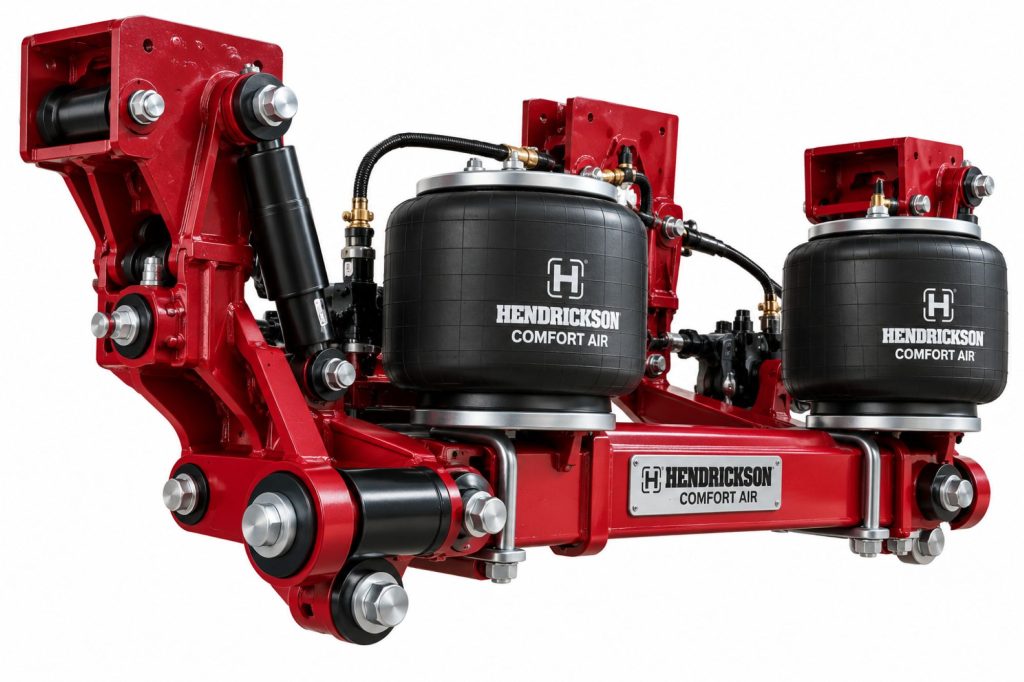
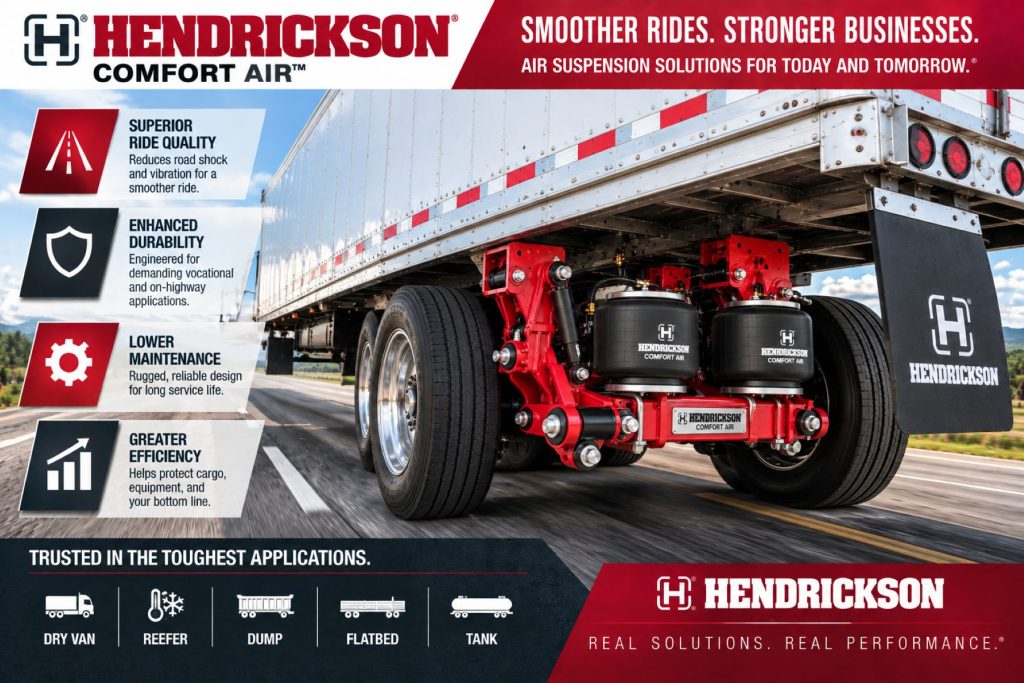
The Hendrickson COMFORT AIR is a family of rear drive-axle air suspensions designed around ride quality, passenger and driver comfort, vehicle protection, and predictable handling. It is available in single- and tandem-axle configurations for medium-duty trucks, Class 8 vehicles, buses, electric commercial vehicles, cutaway vehicles, and specialty chassis.
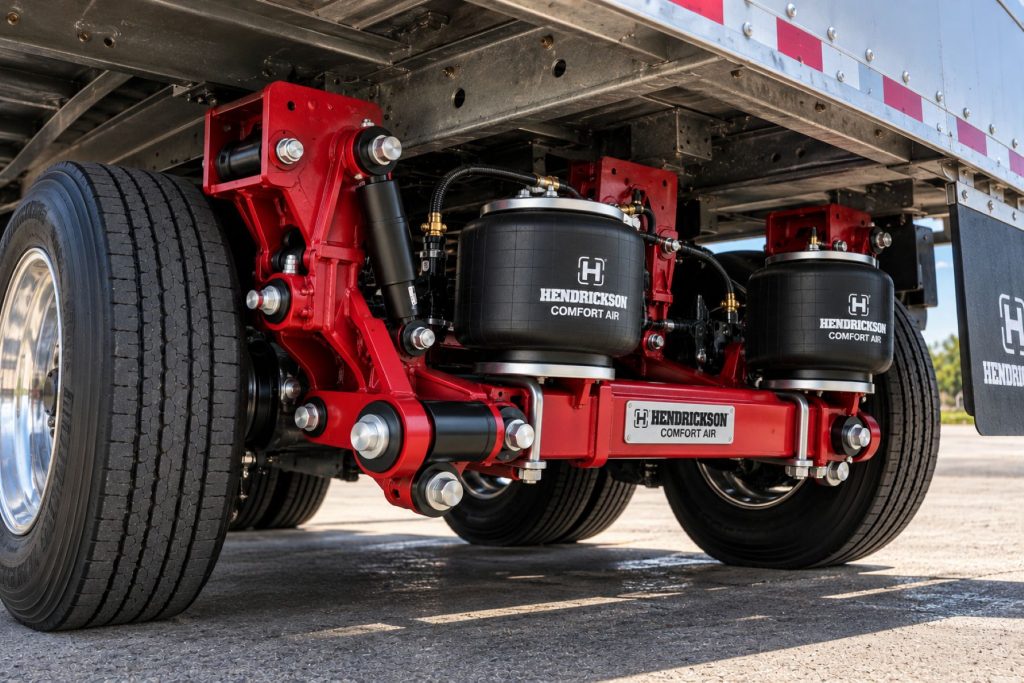
COMFORT AIR uses large air springs and extended-length main support members to reduce the amount of road shock transferred into the chassis. The suspension’s geometry is designed to provide controlled roll stiffness without making the ride unnecessarily harsh.
The product family covers specialized 10,000-pound cutaway applications, single-axle systems rated from approximately 15,000 to 23,000 pounds, and tandem systems rated at 40,000 or 46,000 pounds.
Key Characteristics
- Rear drive-axle air suspension
- Single- and tandem-axle configurations
- Designed to improve passenger and driver comfort
- Air springs adjust to changing vehicle loads
- Extended-length main support members provide a lower effective spring rate
- Suspension geometry is designed for stable and predictable handling
- QUIK-ALIGN allows axle alignment without traditional alignment shims
- Durable pivot bushings support quiet operation
- Rubber bushings require no lubrication in applicable configurations
- Wide frame-hanger footprint helps distribute loads into the chassis
- Tuned shock absorbers control suspension movement
- Special configurations are available for buses, electric vehicles, and cutaway chassis
Major Components
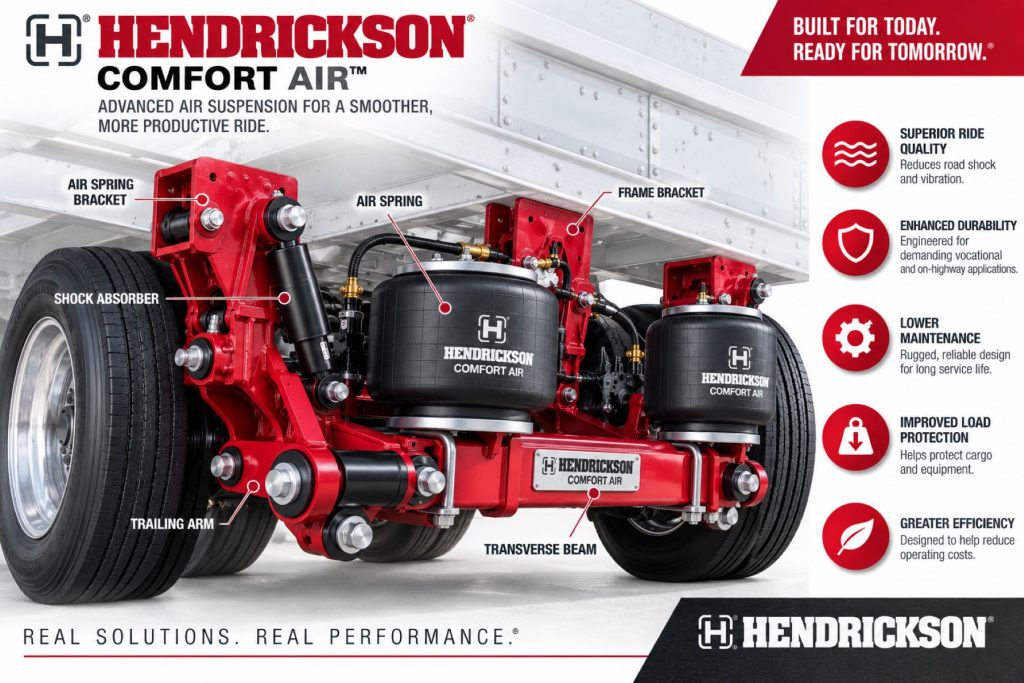
- Air springs
- Extended-length main support members
- Frame hangers
- Pivot connections
- QUIK-ALIGN eccentric and concentric alignment collars
- Pivot bushings
- Height-control valve and linkage
- Shock absorbers
- Axle clamp groups
- Top pads and lower axle brackets
- Cross channels where used
- Longitudinal torque rods where required
- ULTRA ROD or other transverse torque rods
- Axle brackets
- Air lines and fittings
- Dump or kneeling controls in applicable vehicle configurations
- Drive axle, brakes, and wheel ends supplied as part of the complete chassis
How the Suspension System Works
COMFORT AIR uses compressed-air springs to support the chassis above the rear drive axle or tandem axle group. As the vehicle crosses bumps or uneven pavement, the air springs compress and expand, reducing the amount of impact transferred into the frame, body, passengers, and driver.
The height-control valve monitors the distance between the axle and chassis. When loading changes, the valve adds or releases air to return the suspension to its specified ride height.
The main support members connect the axle to the frame and control longitudinal movement. Their extended length creates a lower effective spring rate and allows the air springs to carry more of the vertical load.
Shock absorbers damp repeated suspension movement. Transverse torque rods control side-to-side axle movement and help maintain handling during cornering.
Suspension Position and Function
COMFORT AIR is installed beneath the rear of a truck, bus, cutaway vehicle, or specialty chassis. Depending on the model, it supports either one rear drive axle or a tandem rear axle group.
The suspension performs several functions:
- Supports the rear portion of the vehicle
- Maintains the specified chassis ride height
- Absorbs bumps and road irregularities
- Reduces vibration reaching the body and passengers
- Controls longitudinal and lateral axle movement
- Maintains axle alignment beneath the frame
- Provides roll stiffness during cornering
- Protects chassis-mounted equipment from road shock
- Allows kneeling operation in applicable specialty configurations
Common Specifications
- COMFORT AIR 10K Capacity: 10,000 pounds
- COMFORT AIR 10K Typical Ground Clearance: Approximately 8.2 inches at ride height and 8.3 inches at jounce in the listed configuration
- Common Single-Axle Capacity Range: 15,000 to 23,000 pounds
- General Single-Axle Suspension Weight: Approximately 487 pounds in the listed 15,000- to 23,000-pound configuration
- General Single-Axle Ride Heights: Approximately 8.5 to 10.5 inches with straight frames
- 19K Single-Axle Weight: Approximately 460.5 pounds in the listed configuration
- 21K Single-Axle Weight: Approximately 461 pounds in the listed configuration
- 23K Single-Axle Weight: Approximately 530 pounds in the listed configuration
- COMFORT AIR 40K Capacity: 40,000 pounds
- COMFORT AIR 40K Installed Weight: Approximately 908 pounds
- COMFORT AIR 40K GCV Approval: Up to 80,000 pounds
- COMFORT AIR 40K Axle Travel: Approximately 6 inches
- COMFORT AIR 40K Ride Height: Approximately 8.2 to 8.5 inches
- COMFORT AIR 40K Axle Spacing: 56 inches
- COMFORT AIR 46K Capacity: 46,000 pounds
- COMFORT AIR 46K Installed Weight: Approximately 1,068 pounds
- COMFORT AIR 46K GCV Approval: Up to 150,000 pounds
- COMFORT AIR 46K Axle Travel: Approximately 4 inches
- COMFORT AIR 46K Ride Height: Approximately 8.7 to 9 inches
- COMFORT AIR 46K Axle Spacing: 56 inches
Specifications vary by vehicle manufacturer, model, axle configuration, main support member, frame, brakes, and intended application.
Capacity, Ride Height, and Axle Travel
The COMFORT AIR family covers a wide range of vehicle sizes. The 10K configuration is intended for cutaway and specialty vehicles. Single-axle truck and bus systems cover capacities from approximately 15,000 to 23,000 pounds, while tandem versions provide 40,000- or 46,000-pound ratings.
Correct ride height is critical to air-suspension performance. It affects air-spring position, available axle travel, shock-absorber travel, driveline angles, suspension geometry, and handling.
Published tandem specifications list approximately 6 inches of axle travel for COMFORT AIR 40K and 4 inches for COMFORT AIR 46K. Actual movement and clearance depend on the complete vehicle configuration.
The suspension rating cannot increase the approved capacity of the axles, tires, wheels, brakes, frame, or complete vehicle.
Ride Quality and Load Distribution
Ride quality is a primary purpose of COMFORT AIR. The air springs adjust to vehicle loading, while the extended-length main support members create a lower spring rate for a smoother and more compliant response.
The system’s geometry is designed to balance comfort with roll stiffness. On certain configurations, the axle center is positioned horizontally with the pivot point to create neutral roll-steer characteristics during cornering.
Single-axle systems carry the complete rear load through one drive axle. Tandem configurations divide the load between two axles according to the suspension geometry, air pressure, cargo placement, and complete chassis setup.
COMFORT AIR maintains ride height but does not correct improper cargo distribution or vehicle overloading.
Suspension Controls and Adjustment Options
The standard automatic control is the height-control valve. It adds or exhausts air as vehicle loading changes to maintain the specified ride height.
Depending on the vehicle, additional controls may include:
- Suspension dump valve
- Kneeling control
- Air-pressure gauge
- Electronic kneeling interlocks
- Door or parking-brake interlocks on passenger vehicles
- Air-pressure retention valve
- Diagnostic controls on electric buses or specialty vehicles
Kneeling features are application-specific and should only be operated according to the vehicle manufacturer’s instructions.
Alignment and Suspension Geometry
COMFORT AIR commonly uses Hendrickson’s QUIK-ALIGN pivot connection. This system uses eccentric and concentric collars to move the axle forward or rearward without conventional alignment shims.
Rotating the eccentric collar changes the axle position within the frame-hanger slot. Published product literature identifies an adjustment range of approximately one-half inch forward or rearward in applicable configurations.
Alignment should be checked after pivot-bushing replacement, collision damage, axle movement, structural suspension service, or persistent tire-wear complaints.
Important inspection points include:
- Axle thrust angle
- Ride height
- QUIK-ALIGN collars and fasteners
- Pivot bushings
- Main support members
- Transverse torque rods
- Axle clamp groups
- Frame hangers
- Tire-wear patterns
- Driveline angles
Ride height should be corrected before completing final alignment.
Axle, Brake, and Wheel-End Options
COMFORT AIR is used with compatible single or tandem rear drive axles. Axle model, gear ratio, differential type, brake configuration, and wheel ends are selected by the vehicle manufacturer.
Available installations may use drum brakes or air disc brakes. Certain medium-duty, bus, and specialty vehicles may use other application-specific brake systems.
Wheel hubs, bearings, seals, tires, and wheels must be appropriate for the axle and suspension rating. Clearance must be verified around air springs, shocks, main support members, torque rods, brakes, and frame components.
The lowest-rated component determines the usable vehicle capacity.
Common Applications
- Commercial buses
- School buses
- Electric buses
- Medium-duty trucks
- Electric commercial trucks
- Cutaway vehicles
- Shuttle buses
- Specialty passenger vehicles
- Motorhome chassis
- On-highway Class 8 vehicles
- Regional-haul vehicles
- Pickup-and-delivery trucks
- Applications requiring improved cargo or equipment protection
Vehicle, Axle, and Frame Compatibility
COMFORT AIR is engineered through vehicle-specific configurations. Compatibility depends on the manufacturer, frame width, ride height, axle rating, axle spacing, brakes, driveline angles, body configuration, and intended application.
Hendrickson publishes COMFORT AIR information for selected Hino trucks, Blue Bird buses, Lion Electric buses and trucks, Thomas Built buses, ARBOC vehicles, and other specialty chassis.
The single-axle configuration is approved for up to 10 percent off-highway use in the general listed application. More demanding duty cycles require approval from Hendrickson and the vehicle manufacturer.
Rear-engine vehicles require careful driveline-angle consideration. Hendrickson specifies a minimum 4.5-degree pinion angle for listed rear-engine applications.
COMFORT AIR should not be treated as a universal bolt-on suspension. Frame attachments, crossmembers, axle seats, driveline geometry, and pneumatic controls must match the vehicle.
Advantages
- Excellent passenger and driver comfort
- Reduced road shock and vibration
- Single- and tandem-axle configurations
- Capacity options from 10,000 to 46,000 pounds
- Automatic ride-height control
- Improved protection for the chassis, body, and mounted equipment
- Extended-length main support members provide a compliant ride
- QUIK-ALIGN simplifies axle alignment
- Alignment can be performed without traditional shims
- Durable pivot connections promote quiet operation
- Rubber bushings require no lubrication in applicable configurations
- Wide frame hangers distribute loads over a larger area
- Kneeling capability in selected cutaway and passenger-vehicle applications
- Suitable for conventional and electric commercial vehicles
Limitations or Considerations
- Requires a reliable compressed-air supply
- Air leaks can lower the vehicle or produce uneven ride height
- More pneumatic components than a mechanical suspension
- Incorrect ride height can affect driveline angles and suspension travel
- Primarily designed for on-highway operation
- General single-axle applications are limited to approved off-highway duty cycles
- Kneeling systems add controls, valves, and interlocks
- Vehicle-specific parts can differ substantially between applications
- Rear-engine configurations require proper pinion-angle setup
- Suspension capacity does not establish legal payload
- Air springs can be damaged by abrasion, heat, contamination, or interference
- QUIK-ALIGN fasteners must be tightened according to the correct procedure
Driver and Operator Experience
COMFORT AIR is intended to provide a smoother and quieter ride than many traditional mechanical rear suspensions. The benefit is especially noticeable in buses, passenger vehicles, and lightly loaded commercial trucks.
Drivers may experience reduced bouncing, vibration, and impact through the seat and cab. Passengers benefit from less road shock entering the body structure.
Operators should report a vehicle that sits low, leans, takes too long to reach ride height, bounces excessively, or causes frequent air-compressor cycling. These symptoms may indicate an air leak, damaged air spring, height-control problem, worn shock absorber, or loose suspension component.
Maintenance and Ownership Notes
- Inspect air springs for cracking, abrasion, contamination, bulging, and exposed reinforcement material.
- Check air lines, fittings, valves, and connections for leakage.
- Verify ride height at the specified maintenance intervals.
- Inspect the height-control valve and linkage.
- Check shock absorbers for leakage, dents, damaged mounts, and worn bushings.
- Inspect main support members for cracks, bending, or damage.
- Check frame hangers and their attachment to the chassis.
- Inspect pivot bushings and QUIK-ALIGN connections.
- Check transverse and longitudinal torque rods.
- Inspect axle clamp groups, U-bolts, brackets, and structural fasteners.
- Check kneeling controls and interlocks where installed.
- Inspect axle alignment and tire-wear patterns.
- Follow Hendrickson and vehicle-manufacturer torque procedures.
- Depressurize the suspension safely before removing air springs or structural components.
Common Suspension Problems
- Air leaking from an air spring, fitting, hose, or valve
- Vehicle sitting below its specified ride height
- Uneven side-to-side chassis height
- Slow suspension inflation
- Repeated air-compressor cycling
- Bent or disconnected height-control linkage
- Faulty height-control valve
- Air-spring abrasion or interference
- Leaking or ineffective shock absorbers
- Worn pivot bushings
- Loose QUIK-ALIGN fasteners
- Axle misalignment
- Irregular tire wear
- Worn transverse torque-rod bushings
- Loose axle clamp groups
- Cracked or damaged main support members
- Kneeling system failing to lower or return to ride height
- Driveline vibration caused by incorrect ride height or pinion angle
- Suspension noise from loose or worn components
Identification Information
Begin identification with the vehicle identification number, manufacturer build sheet, suspension capacity, axle arrangement, ride height, and model year.
Important identification information includes:
- Vehicle identification number
- Vehicle manufacturer and model
- Model year
- COMFORT AIR capacity
- Single- or tandem-axle configuration
- Ride height
- Axle spacing
- Drive-axle model
- Main support member number
- Air-spring part number
- Frame-hanger configuration
- Pivot-bushing number
- Shock-absorber number
- Height-control valve arrangement
- Brake type
- Kneeling or dump-valve configuration
- Existing component numbers
Because COMFORT AIR is used on many specialized chassis, components should not be selected by appearance alone.
Buying Considerations
- Confirm whether the vehicle has a single- or tandem-axle COMFORT AIR system.
- Identify the exact suspension capacity.
- Verify ride height and axle spacing.
- Compare the suspension rating with axle, tire, wheel, brake, and frame ratings.
- Determine whether the vehicle has kneeling or suspension-dump controls.
- Check whether the vehicle is rear-engine and confirm its driveline geometry.
- Inspect all air springs for cracking, abrasion, or leakage.
- Check the height-control valve and linkage.
- Inspect main support members, frame hangers, and pivot connections.
- Examine the QUIK-ALIGN fasteners and collars.
- Check torque rods, shocks, axle brackets, and wheel ends.
- Inspect tires for alignment-related wear.
- Road-test the vehicle for vibration, leaning, harshness, and poor tracking.
- Confirm replacement-part availability using the VIN and suspension identification.
Variants and Configurations
- COMFORT AIR 10K: Single-drive-axle suspension for cutaway and specialty vehicles, available with application-specific kneeling capability.
- COMFORT AIR 15K–23K: Single-drive-axle family covering capacities from approximately 15,000 to 23,000 pounds.
- COMFORT AIR 19K: Single-axle configuration used in selected truck and passenger-vehicle applications.
- COMFORT AIR 21K: Single-axle configuration used on selected buses, electric vehicles, and commercial chassis.
- COMFORT AIR 23K: Higher-capacity single-axle configuration.
- COMFORT AIR 40K: Tandem rear air suspension rated at 40,000 pounds.
- COMFORT AIR 46K: Tandem rear air suspension rated at 46,000 pounds.
- Bus Configuration: Vehicle-specific system designed for passenger comfort and body protection.
- Electric-Vehicle Configuration: Adapted for selected battery-electric trucks and buses.
- Kneeling Configuration: Lowers the vehicle body for easier passenger entry and exit in approved applications.
Comparison to Similar Equipment
Compared with the Hendrickson HAS Air Suspension, COMFORT AIR places greater emphasis on passenger and driver comfort across truck, bus, and specialty applications. HAS is oriented toward truck and tractor configurations combining highway operation with moderate vocational use.
The Hendrickson HTB Rear Air Suspension uses a torque-box architecture designed to control driveline and suspension forces. COMFORT AIR uses trailing-arm-style main support members and QUIK-ALIGN connections.
Compared with the Hendrickson PRIMAAX EX, COMFORT AIR is primarily intended for on-highway comfort. PRIMAAX EX is designed for severe vocational and heavy-haul operation.
The Hendrickson HN Vocational Suspension is a mechanical rubber suspension that does not require suspension air pressure. HN provides greater vocational emphasis, while COMFORT AIR generally provides better ride isolation.
Best Fit For
- Buses and passenger vehicles prioritizing ride comfort
- Medium-duty trucks requiring improved cargo protection
- Electric trucks and buses
- Cutaway vehicles requiring kneeling capability
- Class 8 vehicles used primarily on paved roads
- Applications requiring consistent rear ride height
- Fleets seeking reduced chassis and equipment vibration
- Operators wanting relatively simple axle alignment through QUIK-ALIGN
- Vehicles operating within approved on-highway and limited off-highway duty cycles
Related Vehicle and Trailer Types
- Complete Guide to Semi Truck Types
- Class 6 vs Class 7 vs Class 8 Trucks
- Commercial buses
- School buses
- Electric buses
- Medium-duty trucks
- Electric delivery trucks
- Cutaway vehicles
- Shuttle buses
- Motorhomes
- Specialty passenger vehicles
- On-highway Class 8 trucks
Related Truck and Trailer Models
- Hino medium-duty trucks
- Blue Bird Vision
- Blue Bird All American
- Lion Electric Type D bus
- Lion6 electric truck
- Lion8 electric truck
- Thomas Built buses
- ARBOC specialty buses
Related Suspension Types
- Air Suspension Systems
- Hendrickson HAS Air Suspension
- Hendrickson HTB Rear Air Suspension
- Hendrickson PRIMAAX EX
- Hendrickson HN Vocational Suspension
- Single-drive-axle air suspensions
- Tandem rear air suspensions
- Bus air suspensions
- Kneeling suspensions
- Vocational rear air suspensions
Related Equipment Systems
Related Guides
- Suspension System Guides
- How Commercial Truck Suspension Systems Work
- Air Suspension vs Leaf Spring Suspension
- How to Choose a Commercial Truck Suspension
- Truck Suspension Components Explained
- Truck vs Trailer Suspension Systems
Regulatory and Compliance Notes
A COMFORT AIR-equipped vehicle must remain within its gross vehicle, axle, tire, wheel, brake, frame, and roadway limits. Suspension capacity does not establish legal payload by itself.
All applications must comply with Hendrickson specifications and be approved by the vehicle manufacturer in the vehicle’s original as-built configuration.
Kneeling controls on passenger vehicles must operate with the required interlocks and accessibility systems. Repairs must preserve the vehicle manufacturer’s intended operation.
The general single-axle COMFORT AIR configuration is approved for up to 10 percent off-highway operation. Applications exceeding that duty cycle require appropriate approval.
Real World Operating Notes
COMFORT AIR provides its greatest benefit on vehicles where ride quality affects passengers, drivers, cargo, or expensive body equipment. Buses and electric commercial vehicles can particularly benefit from reduced shock and vibration.
Ride-height problems should be corrected promptly. Incorrect height can reduce axle travel, alter driveline angles, change suspension geometry, and produce harshness or vibration.
QUIK-ALIGN simplifies alignment, but its fasteners must be properly tightened after adjustment. A loose pivot connection can allow the axle to move and rapidly damage tires.
Frequently Asked Questions
Is Hendrickson COMFORT AIR a front or rear suspension?
COMFORT AIR is a rear drive-axle air-suspension family.
Is COMFORT AIR available for single and tandem axles?
Yes. It is offered in single-drive-axle and tandem-drive configurations.
What capacities are available?
The broader family includes a 10,000-pound specialty suspension, single-axle systems from approximately 15,000 to 23,000 pounds, and tandem systems rated at 40,000 or 46,000 pounds.
What is QUIK-ALIGN?
QUIK-ALIGN is Hendrickson’s pivot-connection alignment system. It uses eccentric and concentric collars to move the axle without traditional alignment shims.
Does COMFORT AIR maintain a constant ride height?
Its height-control system adds or exhausts air as vehicle loading changes to return the suspension to its specified height.
Can COMFORT AIR operate off-highway?
The general single-axle system is approved for up to 10 percent off-highway operation. Limits for other configurations should be confirmed with Hendrickson and the vehicle manufacturer.
Can COMFORT AIR provide a kneeling function?
The 10K cutaway and certain passenger-vehicle configurations can include kneeling capability.
What are common COMFORT AIR maintenance items?
Air springs, height-control valves, air lines, shocks, pivot bushings, QUIK-ALIGN connections, torque rods, main support members, axle brackets, and tires require inspection.
What causes a COMFORT AIR vehicle to sit low?
Common causes include an air leak, damaged air spring, faulty height-control valve, disconnected linkage, or insufficient air-system pressure.
Why is ride height important?
Ride height affects axle travel, air-spring geometry, driveline angles, shock movement, and overall handling.
Is COMFORT AIR suitable for severe off-road work?
It is primarily an on-highway suspension. Severe vocational or sustained off-road operation generally requires a suspension designed specifically for that duty cycle.
Can COMFORT AIR replace a mechanical suspension?
Certain vehicle-specific conversions may be possible, but COMFORT AIR is not a universal bolt-on replacement. Frame, axle, driveline, brake, and pneumatic compatibility must be confirmed.
Availability and Where to Find
Hendrickson COMFORT AIR is available as original equipment on approved trucks, buses, electric vehicles, cutaway vehicles, and specialty chassis. Availability depends on the manufacturer, vehicle model, model year, axle rating, and selected factory equipment.
Replacement air springs, height-control valves, main support members, bushings, shocks, torque rods, QUIK-ALIGN components, brackets, and hardware are available through Hendrickson distributors, commercial vehicle dealers, suspension specialists, and heavy-duty parts suppliers.
Current information is available through Hendrickson’s official COMFORT AIR single-axle product page, COMFORT AIR 40K and 46K specifications, COMFORT AIR 10K product page, and COMFORT AIR service-publication index.
Support Trucking Families
Truck Equipment Atlas supports the mission of Grey Cross, a nonprofit dedicated to helping families of truck drivers who lose their lives while on the road. As the site grows, part of its mission is to bring awareness and support to these families.
Podcast or Video Section
Learn More Through Audio and Video
Truck Equipment Atlas will continue expanding with podcast episodes, interviews, and equipment breakdowns to help drivers and fleets better understand trucks and equipment.
Follow the Growth of Truck Equipment Atlas
Truck Equipment Atlas continues to expand with new truck profiles, trailer coverage, diesel engine pages, equipment system resources, manufacturer information, and educational guides.
Visit our Site Updates page to explore recent additions, project milestones, and upcoming resources as we continue building one of the industry’s growing commercial trucking equipment reference libraries.
View the Latest Site Updates: Truck Equipment Atlas Site Updates