
Hendrickson RS Series Suspension
Quick Facts
- Manufacturer: Hendrickson
- Product Type: Extra-heavy-duty rear mechanical suspension
- Suspension Family: Hendrickson R/RS Series
- Primary Design: Equalizing beams with rubber load cushions
- Suspension Position: Tandem rear axles
- Standard RS Models: RS 403, RS 463, RS 503, and RS 523
- Published Standard Capacities: 40,000 to 52,000 pounds
- Special Application Ratings: Available up to 120,000 pounds in engineered configurations
- Primary Applications: Mining, oilfield, mixer, refuse, logging, heavy vocational, and specialty vehicles
- Primary Strength: Maximum roll stability for high-center-of-gravity and offset-load applications
- Lift-Axle Compatibility: Suitable for approved multi-axle vocational configurations
- Page Slug: hendrickson-rs-series-suspension
Overview
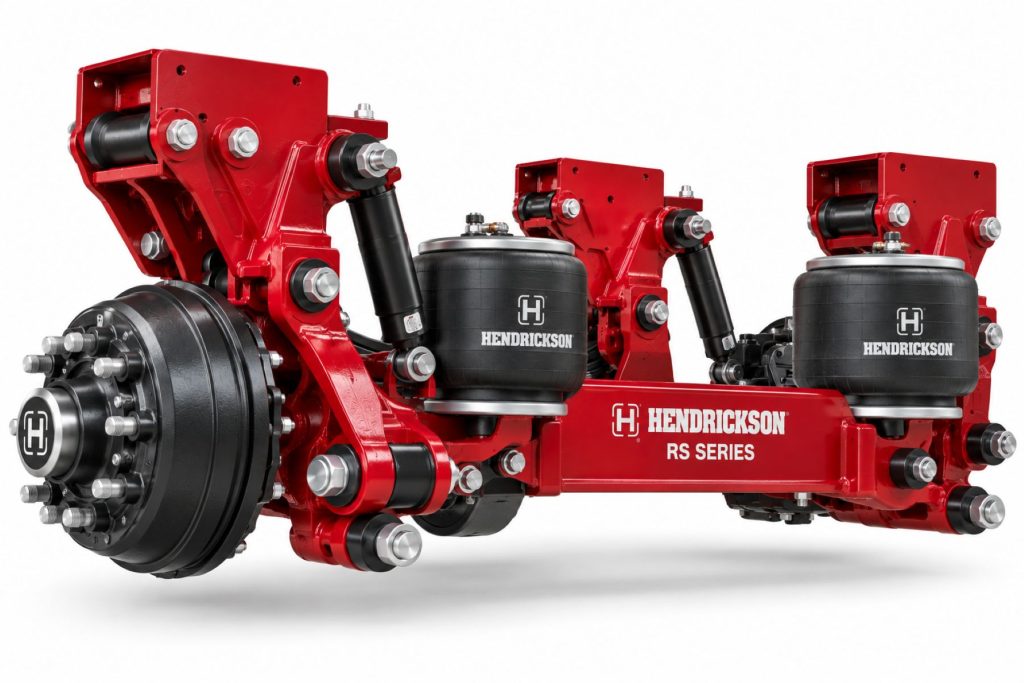
The Hendrickson RS Series is an extra-heavy-duty rear mechanical suspension engineered for severe vocational applications where maximum roll stability is essential. It combines a heavy-duty equalizing-beam structure with specially formulated rubber load cushions that support the vehicle and absorb some road shock.
The RS is commonly used on trucks carrying high-center-of-gravity bodies, offset loads, or heavy equipment that places exceptional stress on the rear suspension. Typical applications include concrete mixers, refuse trucks, mining vehicles, oilfield equipment, logging trucks, and specialized heavy-haul machinery.
Standard RS configurations are rated from 40,000 to 52,000 pounds. Hendrickson also offers application-engineered R and RS systems with ratings extending as high as 120,000 pounds.
Key Characteristics
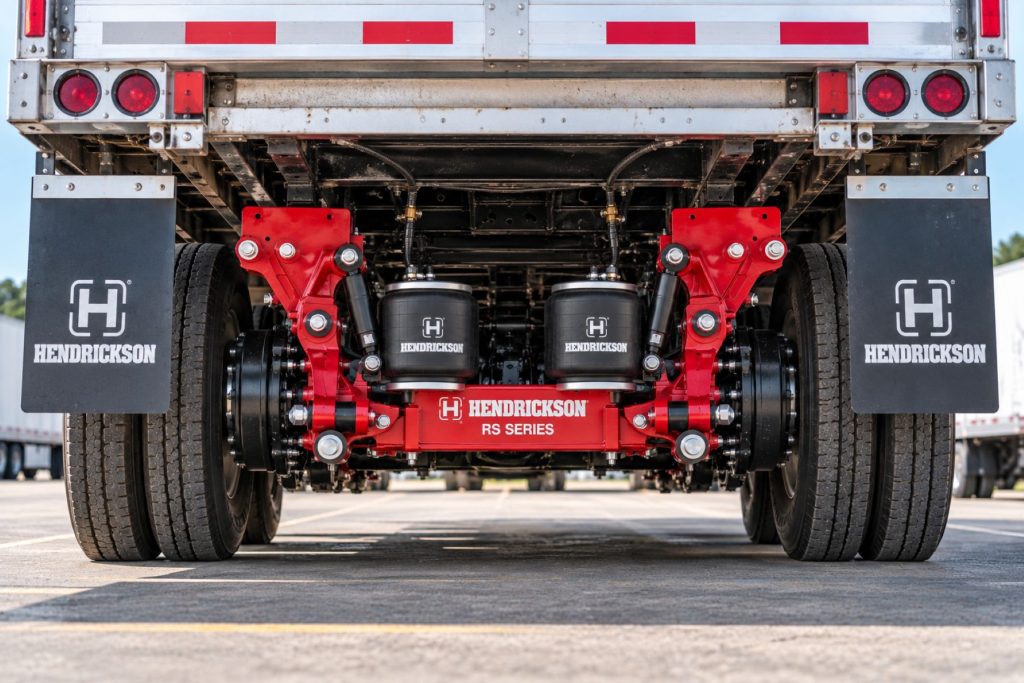
- Extra-heavy-duty tandem rear suspension
- Designed for maximum roll stability
- Rubber load cushions support the vehicle and absorb road shock
- Equalizing beams distribute load between the tandem axles
- Suitable for high-center-of-gravity vehicles
- Supports offset-load and severe-service applications
- Bar-pin beam-end connections provide axle-alignment capability
- Designed for substantial axle articulation on difficult job sites
- No air springs, height-control valves, or suspension air lines
- Available in multiple capacity ratings
- Suitable for approved vehicles using auxiliary lift axles
- Special engineered configurations available for extremely high suspension loads
Major Components
- Equalizing beams
- Rubber center load cushions
- Vertical drive bushings
- Suspension saddle assemblies
- Solid-mount saddle components
- Center cross tube
- Beam-center connections
- Bar-pin beam-end bushings
- Axle brackets
- Longitudinal torque rods
- Transverse torque rods where required
- Frame brackets
- Rebound-control components
- Alignment shims
- Spherical washers
- Saddle-cap studs
- Mounting bolts, washers, and locknuts
- Tandem drive axles, brakes, and wheel ends supplied with the complete chassis
How the Suspension System Works
The RS suspension uses equalizing beams to connect the forward and rear axles of the tandem group. As one axle rises over an obstacle, the beam pivots and transfers part of the load and movement to the other axle.
Rubber load cushions are positioned between the suspension saddle and supporting structure. These cushions compress under load, provide limited isolation from road shock, and help control movement between the chassis and equalizing beams.
Vertical drive bushings help transfer acceleration, braking, and suspension forces while controlling the position of the saddle relative to the beam structure. Torque rods provide additional longitudinal and lateral axle control.
The wide, rigid suspension architecture limits chassis roll. This makes the RS particularly effective when supporting dump bodies, mixers, refuse bodies, cranes, and other equipment with a high or uneven center of gravity.
Suspension Position and Function
The RS is installed beneath the rear of a heavy vocational truck. It connects the tandem drive axles to the frame and supports the vehicle body, mounted equipment, and payload.
The suspension performs several functions:
- Supports the rear chassis and payload
- Distributes weight across both tandem axles
- Controls roll during cornering and maneuvering
- Provides stability for high-center-of-gravity equipment
- Accommodates axle movement over uneven terrain
- Helps maintain tire contact and traction
- Transfers acceleration and braking forces into the chassis
- Controls axle position beneath the vehicle
- Absorbs a portion of road shock through rubber load cushions
Common Specifications
- RS 403 Capacity: 40,000 pounds
- RS 403 Installed Weight: Approximately 1,030 pounds
- RS 403 Site-Travel Rating: 55,000 pounds
- RS 403 Approved GVW: Up to 73,000 pounds
- RS 403 Approved GCW: Up to 160,000 pounds
- RS 463 Capacity: 46,000 pounds
- RS 463 Installed Weight: Approximately 1,086 pounds
- RS 463 Site-Travel Rating: 60,000 pounds
- RS 463 Approved GVW: Up to 80,000 pounds
- RS 463 Approved GCW: Up to 190,000 pounds
- RS 503 Capacity: 50,000 pounds
- RS 503 Installed Weight: Approximately 1,175 pounds
- RS 503 Site-Travel Rating: 65,000 pounds
- RS 503 Approved GVW: Up to 80,000 pounds
- RS 503 Approved GCW: Up to 225,000 pounds
- RS 523 Capacity: 52,000 pounds
- RS 523 Installed Weight: Approximately 1,225 pounds
- RS 523 Site-Travel Rating: 65,000 pounds
- RS 523 Approved GVW: Up to 80,000 pounds
- RS 523 Approved GCW: Up to 245,000 pounds
- Special Application Ratings: Up to 120,000 pounds with application-specific engineering
- Reference Axle Spacing for Published Weight: 54 inches
Published installed weights include the complete suspension, torque rods, axle brackets, and frame brackets. Actual weight and capacity depend on the vehicle configuration.
Capacity, Ride Height, and Axle Travel
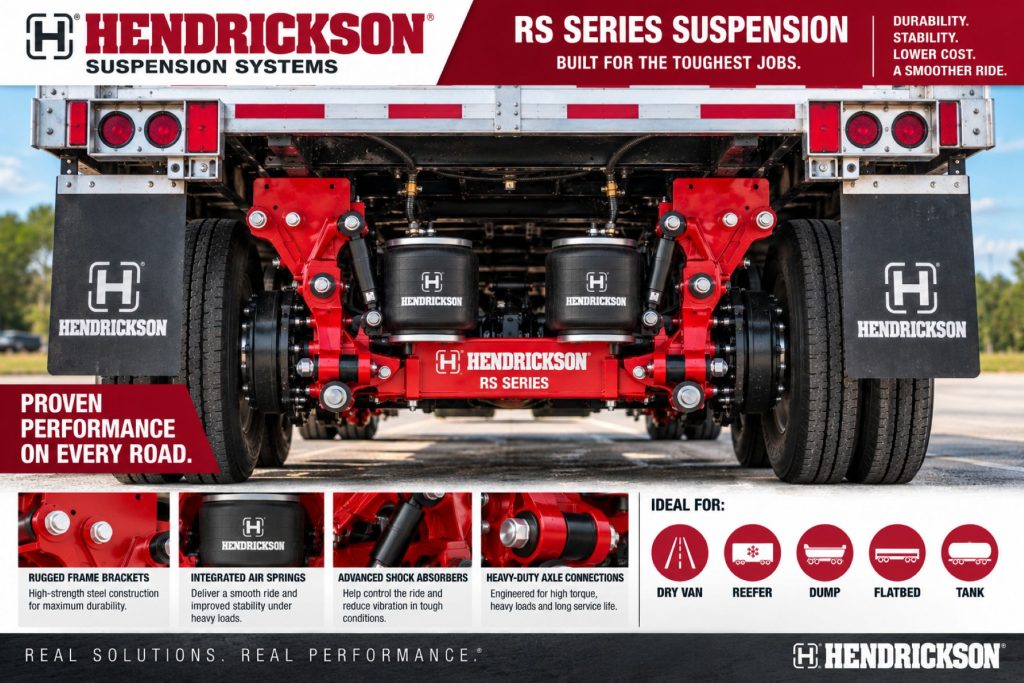
Standard RS models provide nominal suspension ratings of 40,000, 46,000, 50,000, and 52,000 pounds. Higher ratings require application-specific components and engineering approval.
The RS is a mechanical suspension and does not automatically maintain a constant ride height. Rubber load cushions compress under vehicle weight, so chassis position changes as loading increases.
The equalizing-beam design provides substantial articulation by allowing the tandem axles to move relative to one another. Exact axle travel depends on capacity, axle spacing, beam design, frame clearances, rebound controls, tires, brakes, and the complete vehicle installation.
Suspension capacity does not automatically establish the legal axle-group rating. Axles, tires, wheels, brakes, frame, body, and weight regulations may impose lower limits.
Ride Quality and Load Distribution
The equalizing beams distribute weight between the forward and rear axles, helping both axles maintain tire contact on uneven surfaces. This supports traction and reduces extreme loading of one axle when traveling across rough terrain.
Rubber load cushions provide more impact absorption than a completely rigid steel connection. However, the RS prioritizes stability and load control over premium ride comfort.
The unloaded ride can be firm, particularly on configurations designed for extreme payload or high-center-of-gravity equipment. Ride quality generally improves as the truck approaches its intended operating load.
Suspension Controls and Adjustment Options
The RS does not require driver-operated suspension controls. It has no air springs, height-control valves, suspension dump controls, or electronic leveling system.
Service-related adjustments may include:
- Rear axle alignment through the bar-pin beam-end connections
- Alignment-shim installation or removal according to approved procedures
- Transverse torque-rod adjustment where an adjustable rod is used
- Driveline-angle correction through vehicle-manufacturer procedures
- Rebound-control adjustment or component replacement
- Brake and wheel-end adjustments according to axle-manufacturer requirements
Mechanical ride height is not normally adjustable. A vehicle that sits abnormally low or unevenly may have damaged load cushions, worn bushings, structural damage, improper components, or unequal loading.
Alignment and Suspension Geometry
Correct tandem alignment helps prevent drive-tire scrub, vehicle dog tracking, steering correction, and excessive rolling resistance. The bar-pin beam-end design allows technicians to align the axles using approved shims and service procedures.
Alignment should be checked after equalizing-beam, beam-end bushing, axle-bracket, torque-rod, or frame-bracket service.
Important inspection points include:
- Tandem axle thrust angle
- Axle spacing
- Bar-pin beam-end bushings
- Alignment shims
- Axle brackets
- Equalizing beams
- Center load cushions
- Vertical drive bushings
- Longitudinal and transverse torque rods
- Suspension saddles
- Frame brackets and crossmembers
- Driveline angles
Rear suspension misalignment can contribute to both drive-tire and front-tire wear.
Axle, Brake, and Wheel-End Options
The RS is used with compatible heavy-duty tandem drive axles. Axle model, gear ratio, differential type, axle shafts, interaxle differential, brakes, hubs, bearings, seals, tires, and wheels are selected as part of the complete vehicle.
Depending on the truck and axle generation, the suspension can be paired with drum brakes or air disc brakes. Heavy-capacity applications may require specialized axles, wheel ends, tires, and brake equipment.
Dual tires or wide-base single tires require sufficient clearance around the equalizing beams, torque rods, suspension saddles, brakes, and frame.
The usable system capacity is determined by the lowest-rated connected component.
Common Applications
- Concrete mixer trucks
- Refuse trucks
- Mining vehicles
- Oilfield trucks
- Logging trucks
- Heavy dump trucks
- Crane and boom vehicles
- Heavy equipment service trucks
- Specialized heavy-haul vehicles
- Military vehicles
- High-center-of-gravity vocational equipment
- Vehicles carrying offset or uneven loads
- Multi-axle vocational trucks with approved lift axles
Vehicle, Axle, and Frame Compatibility
RS compatibility depends on the truck manufacturer, frame width, axle spacing, suspension capacity, saddle height, axle brackets, torque rods, crossmembers, driveline geometry, brake package, tires, and intended operation.
The suspension is designed for tandem rear axle groups. Special high-capacity installations may use application-specific beams, saddles, load cushions, cross tubes, brackets, and axle arrangements.
The RS can be useful on vehicles with liftable pusher or tag axles because of its stability and available capacity. The lift axles must be integrated without exceeding the suspension, drive-axle, tire, wheel, frame, or site-travel ratings.
A standard RS should not be substituted for another suspension solely because the listed capacity appears sufficient. High-center-of-gravity, offset-load, mining, and specialized applications require complete engineering review.
Advantages
- Exceptional roll stability
- Designed for severe vocational service
- Suitable for high-center-of-gravity equipment
- Supports offset and uneven load applications
- Standard capacities from 40,000 to 52,000 pounds
- Special engineered ratings up to 120,000 pounds
- Equalizing beams distribute weight between tandem axles
- Strong articulation for difficult job sites
- Rubber cushions provide some road-shock isolation
- No suspension air system required
- Bar-pin beam ends provide axle-alignment capability
- Compatible with approved lift-axle arrangements
- Relatively simple mechanical operating principle
Limitations or Considerations
- Firmer unloaded ride than most rear air suspensions
- Prioritizes stability over driver comfort
- Does not maintain a constant chassis height
- Rubber load cushions and vertical drive bushings wear with age and service
- Heavy-duty components add weight compared with some newer suspension designs
- Extremely high-capacity systems require application-specific engineering
- Suspension capacity does not determine legal vehicle payload
- Incorrect load-cushion selection can affect ride height and stability
- Worn beam-end bushings can allow axle movement and misalignment
- Replacement components vary by model, capacity, axle spacing, and production date
- Structural damage or unauthorized welding can make the suspension unsafe
- Site-travel ratings apply only under restricted conditions
Driver and Operator Experience
The RS provides a firm, stable platform for vehicles carrying mixers, refuse bodies, cranes, mining equipment, and other high-mounted loads. Drivers may notice reduced body roll compared with softer suspension systems.
The tradeoff is a firmer ride, particularly when the vehicle is empty. Road impacts and vibration can be more noticeable than with a rear air suspension.
Operators should report unusual leaning, clunking, axle hop, poor tracking, excessive vibration, or changes in chassis height. These symptoms may indicate deteriorated load cushions, worn bushings, loose brackets, axle misalignment, or structural damage.
Maintenance and Ownership Notes
- Inspect rubber load cushions for cracks, cuts, separation, distortion, or excessive compression.
- Check vertical drive bushings for wear, movement, and deterioration.
- Inspect equalizing beams for cracks, impact damage, or unauthorized repairs.
- Check bar-pin beam-end bushings and axle brackets.
- Inspect alignment shims for movement or damage.
- Check suspension saddles for cracks and wear.
- Inspect the center cross tube and its connections.
- Check longitudinal and transverse torque rods and bushings.
- Inspect rebound-control components.
- Check structural fasteners using Hendrickson torque procedures.
- Monitor tandem alignment and drive-tire wear.
- Inspect frame brackets and crossmembers for cracking or looseness.
- Keep oil, fuel, solvents, and other harmful chemicals away from rubber suspension components.
- Never weld, heat, drill, bend, or straighten an equalizing beam without an approved manufacturer procedure.
Common Suspension Problems
- Cracked or deteriorated rubber load cushions
- Excessively compressed load cushions
- Worn vertical drive bushings
- Worn bar-pin beam-end bushings
- Movement between the beam and axle bracket
- Damaged or displaced alignment shims
- Loose saddle or frame-bracket fasteners
- Cracked or damaged equalizing beams
- Worn torque-rod bushings
- Bent or damaged torque rods
- Center cross-tube damage
- Excessive vehicle lean
- Uneven chassis height
- Tandem axle misalignment
- Vehicle dog tracking
- Irregular drive-tire wear
- Clunking during acceleration or braking
- Harsh unloaded ride
- Reduced articulation caused by damaged or incorrect components
- Suspension damage caused by overloading or impact
Identification Information
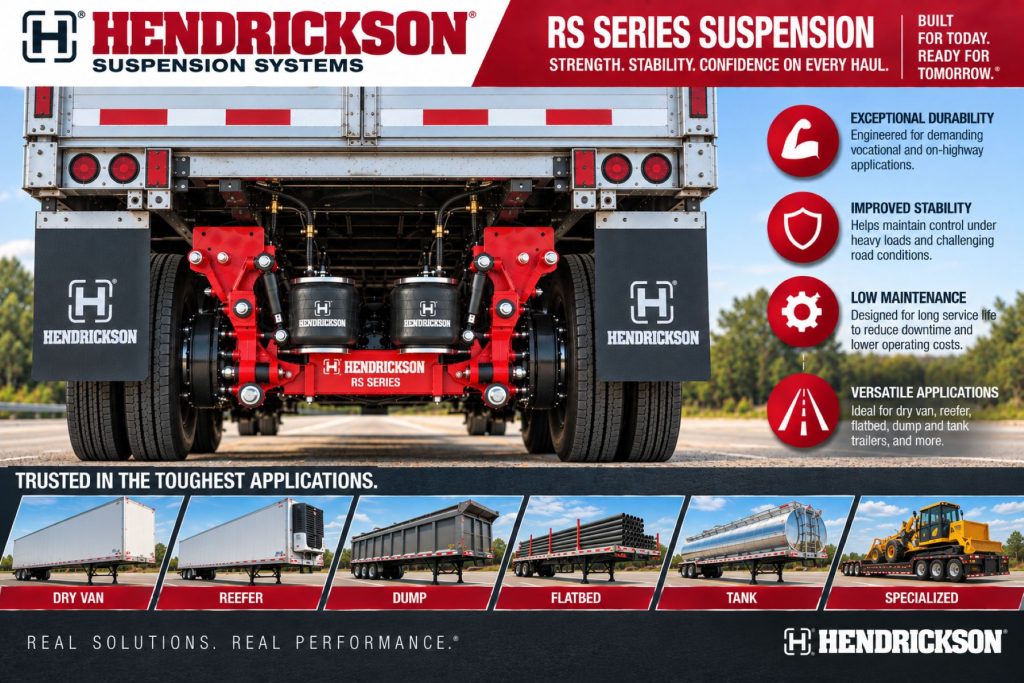
Begin identification with the vehicle identification number, manufacturer build sheet, suspension model, capacity, axle spacing, and vehicle production date.
Important identification information includes:
- Vehicle identification number
- Truck manufacturer and model
- Vehicle model year
- RS Series designation
- Complete model number
- Suspension capacity
- Axle spacing
- Saddle height
- Equalizing-beam part number
- Load-cushion part number
- Vertical drive-bushing part number
- Bar-pin bushing configuration
- Cross-tube dimensions
- Axle-bracket configuration
- Torque-rod arrangement
- Existing component numbers
RS model numbers such as RS 403, RS 463, RS 503, and RS 523 identify different nominal capacity classes. The complete vehicle and suspension configuration must still be confirmed before ordering parts.
Buying Considerations
- Confirm that the suspension is an RS rather than an R, RT, RTE, or HN system.
- Identify the complete RS model number.
- Verify the nominal suspension capacity.
- Measure or confirm axle spacing and saddle height.
- Compare suspension capacity with the axle, tire, wheel, brake, and frame ratings.
- Determine whether the vehicle carries a high-center-of-gravity or offset load.
- Inspect all rubber load cushions.
- Check vertical drive bushings for wear or movement.
- Inspect equalizing beams for cracks or unauthorized repairs.
- Check bar-pin bushings, axle brackets, and alignment shims.
- Inspect torque rods, saddles, cross tubes, and frame brackets.
- Examine drive tires for evidence of tandem misalignment.
- Road-test the vehicle for lean, clunking, harshness, and poor tracking.
- Review maintenance and load-cushion replacement records.
- Confirm parts availability using the VIN and complete suspension identification.
Variants and Configurations
- RS 403: Tandem suspension with a nominal 40,000-pound capacity.
- RS 463: Tandem suspension with a nominal 46,000-pound capacity.
- RS 503: Tandem suspension with a nominal 50,000-pound capacity.
- RS 523: Tandem suspension with a nominal 52,000-pound capacity.
- Special High-Capacity RS: Application-engineered configurations available at ratings above the standard range and potentially up to 120,000 pounds.
- Lift-Axle Vehicle Configuration: Approved installations used with pusher or tag axles on multi-axle vocational trucks.
- Transverse Torque-Rod Configuration: Adds lateral axle control for severe-duty or application-specific requirements.
- Application-Specific Load-Cushion Configuration: Rubber cushion selection matched to suspension capacity, vehicle weight, and stability requirements.
Comparison to Similar Equipment
The Hendrickson R and RS share an extra-heavy-duty equalizing-beam architecture, but they support the chassis differently. The R uses a more rigid solid-mount arrangement for maximum roll resistance, while the RS uses rubber load cushions to add impact isolation and accommodate demanding payload applications.
Compared with the Hendrickson RT/RTE Mechanical Suspension, the RS uses rubber load cushions instead of steel leaf-spring packs. The RS emphasizes maximum stability for severe-service and high-center-of-gravity applications.
The Hendrickson HN Vocational Suspension uses the VariRate rubber spring system and is designed to provide a broader balance of unloaded ride, loaded stability, articulation, and reduced weight.
Compared with the Hendrickson HAULMAAX EX, the RS is a more traditional extra-heavy-duty design. HAULMAAX EX uses newer elastomer technology and geometry to reduce weight and maintenance while improving unloaded ride.
The Hendrickson PRIMAAX EX is a severe-duty rear air suspension offering improved ride isolation and automatic height control. RS provides greater mechanical simplicity and is intended where maximum roll stability is the leading requirement.
Best Fit For
- Concrete mixers and refuse vehicles
- Mining and oilfield trucks
- Logging equipment
- Heavy dump trucks
- High-center-of-gravity vocational vehicles
- Trucks carrying offset or uneven loads
- Specialized equipment requiring maximum roll stability
- Multi-axle vehicles using approved lift axles
- Applications requiring more than 52,000 pounds of engineered suspension capacity
- Fleets that prioritize stability and durability over unloaded ride comfort
Related Vehicle and Trailer Types
- Complete Guide to Semi Truck Types
- Concrete mixer trucks
- Refuse trucks
- Mining vehicles
- Oilfield trucks
- Logging trucks
- Heavy dump trucks
- Crane and boom trucks
- Military vehicles
- Heavy equipment service trucks
- Specialized multi-axle vocational vehicles
Related Truck and Trailer Models
- Freightliner 114SD
- International HX Series
- Kenworth C500
- Kenworth T880
- Mack Granite
- Peterbilt 567
- Western Star 47X
Related Suspension Types
- Mechanical & Leaf Spring Suspensions
- Vocational & Severe-Duty Suspensions
- Hendrickson RT/RTE Mechanical Suspension
- Hendrickson HN Vocational Suspension
- Hendrickson HAULMAAX EX
- Hendrickson PRIMAAX EX
- Solid-mount rear suspensions
- Rubber-cushion mechanical suspensions
- Walking-beam suspensions
- Steel leaf-spring suspensions
- Vocational rear air suspensions
Related Equipment Systems
Related Guides
- Suspension System Guides
- How Commercial Truck Suspension Systems Work
- Air Suspension vs Leaf Spring Suspension
- How to Choose a Commercial Truck Suspension
- Truck Suspension Components Explained
- Truck vs Trailer Suspension Systems
- Lift Axles Explained
- Single Axle vs Tandem Axle Trucks
Regulatory and Compliance Notes
An RS-equipped vehicle must remain within all applicable gross vehicle, axle-group, bridge-formula, tire, wheel, brake, frame, and roadway limits. A high suspension rating does not authorize operation above the legal or manufacturer-approved capacity of the vehicle.
Published site-travel ratings apply only to restricted job-site operation. They are limited to no more than 5 percent of vehicle operation at speeds not exceeding 5 mph.
Liftable pusher or tag axles should only be raised or unloaded to improve off-highway maneuverability or when the vehicle is empty. Suspension and axle site-travel ratings must not be exceeded.
Special high-capacity RS applications require approval from Hendrickson and the vehicle manufacturer.
Real World Operating Notes
The RS is most valuable when vehicle stability matters more than unloaded ride comfort. Mixer, refuse, mining, and crane operators often place substantial weight high above or to one side of the chassis, creating forces that softer suspensions may not control as effectively.
Rubber load cushions are central to the RS system. Their condition affects chassis height, stability, vibration, and load distribution. Deteriorated or mismatched cushions should be addressed before they damage adjacent components.
Tandem alignment also deserves close attention. A high-capacity vehicle can quickly damage expensive tires when worn bar-pin bushings or shifted axle components alter the thrust angle.
Frequently Asked Questions
Is the Hendrickson RS an air suspension?
No. The RS is a mechanical equalizing-beam suspension using rubber load cushions.
What is the difference between Hendrickson R and RS?
The R uses a rigid solid-mount arrangement for maximum roll stability. The RS uses specially formulated rubber load cushions to provide some road-shock isolation while maintaining high stability.
What capacities are available?
Standard RS models are rated at 40,000, 46,000, 50,000, and 52,000 pounds. Special engineered R/RS configurations can be rated substantially higher.
What is the RS 403?
The RS 403 is the standard 40,000-pound version of the RS suspension.
Is the RS suitable for concrete mixers?
Yes. High-center-of-gravity vocational vehicles such as mixers are among the applications for which the RS is designed.
Can the RS be used with lift axles?
Yes, in approved vehicle configurations. Lift-axle operation must remain within all suspension, axle, and site-travel restrictions.
Does the RS maintain a constant ride height?
No. Rubber load cushions compress as vehicle loading changes.
What commonly causes an RS-equipped truck to lean?
Possible causes include deteriorated or mismatched load cushions, worn vertical drive bushings, damaged brackets, structural problems, or uneven loading.
Does the RS require lubrication?
Lubrication requirements depend on the installed bushings, beam connections, and vehicle configuration. The applicable Hendrickson service procedure should be followed.
Can an RS equalizing beam be welded?
Heating, welding, bending, or drilling structural suspension components should not be performed unless an approved manufacturer procedure specifically permits it.
Is the RS intended for highway tractors?
It is primarily designed for severe vocational trucks rather than conventional linehaul tractors.
Why would a fleet choose RS instead of air suspension?
RS may be preferred where maximum roll stability, mechanical simplicity, high capacity, and resistance to severe job-site conditions are more important than premium ride quality.
Availability and Where to Find
The Hendrickson RS is found on existing concrete mixers, refuse trucks, mining vehicles, oilfield equipment, logging trucks, crane vehicles, and other heavy vocational equipment. New factory availability depends on the vehicle manufacturer, model, required capacity, and current option offerings.
Replacement load cushions, bushings, equalizing beams, torque rods, cross tubes, brackets, alignment components, and hardware are available through Hendrickson distributors, commercial truck dealers, suspension specialists, and heavy-duty parts suppliers.
Current product details and specifications can be checked through Hendrickson’s official R/RS solid-mount rear suspension page, truck parts and suspension catalog, and transverse torque-rod resource.
Support Trucking Families
Truck Equipment Atlas supports the mission of Grey Cross, a nonprofit dedicated to helping families of truck drivers who lose their lives while on the road. As the site grows, part of its mission is to bring awareness and support to these families.
Podcast or Video Section
Learn More Through Audio and Video
Truck Equipment Atlas will continue expanding with podcast episodes, interviews, and equipment breakdowns to help drivers and fleets better understand trucks and equipment.
Follow the Growth of Truck Equipment Atlas
Truck Equipment Atlas continues to expand with new truck profiles, trailer coverage, diesel engine pages, equipment system resources, manufacturer information, and educational guides.
Visit our Site Updates page to explore recent additions, project milestones, and upcoming resources as we continue building one of the industry’s growing commercial trucking equipment reference libraries.
View the Latest Site Updates: Truck Equipment Atlas Site Updates