
Hendrickson AIRTEK
Quick Facts
- Manufacturer: Hendrickson
- Product Type: Integrated front air suspension and steer-axle system
- Suspension Position: Front steer axle
- Primary Axle: Hendrickson STEERTEK or STEERTEK NXT fabricated steer axle, depending on the vehicle configuration
- Common Capacities: 12,000 to 14,600 pounds for common North American truck applications
- Primary Applications: On-highway tractors, trucks, buses, motorhomes, and specialty vehicles
- Suspension Type: Air suspension with integrated mechanical support and axle-control components
- Maximum Wheel Cut: Up to approximately 55 degrees in applicable configurations
- Brake Compatibility: Drum brakes and air disc brakes
- Primary Benefits: Improved ride quality, reduced weight, consistent ride height, steering control, and driver comfort
- Page Slug: hendrickson-airtek
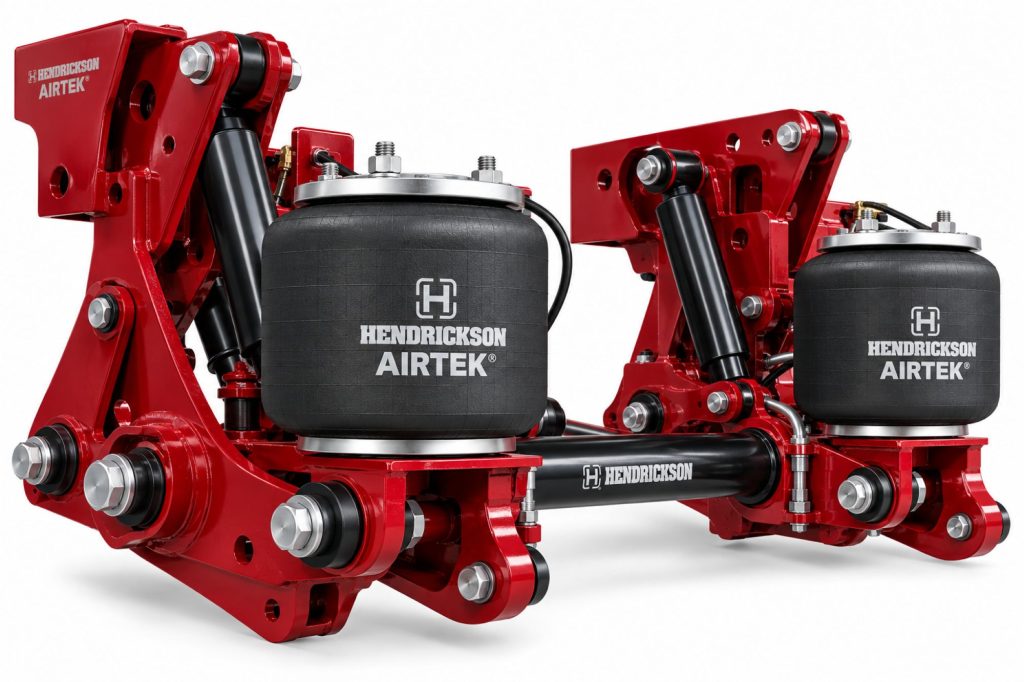
Overview
The Hendrickson AIRTEK is an integrated front air suspension and steer-axle system developed for commercial vehicles requiring improved ride quality, reduced weight, and predictable steering performance. Instead of combining a conventional forged I-beam axle with a traditional multi-leaf spring pack, AIRTEK integrates Hendrickson air-suspension technology with a lightweight fabricated STEERTEK or STEERTEK NXT steer axle.
AIRTEK is primarily used on highway tractors and trucks, although specialized versions have also been developed for buses, motorhomes, emergency vehicles, and other commercial chassis. Its air springs help isolate the cab, driver, and vehicle components from bumps and potholes while maintaining a consistent front ride height as axle loading changes.
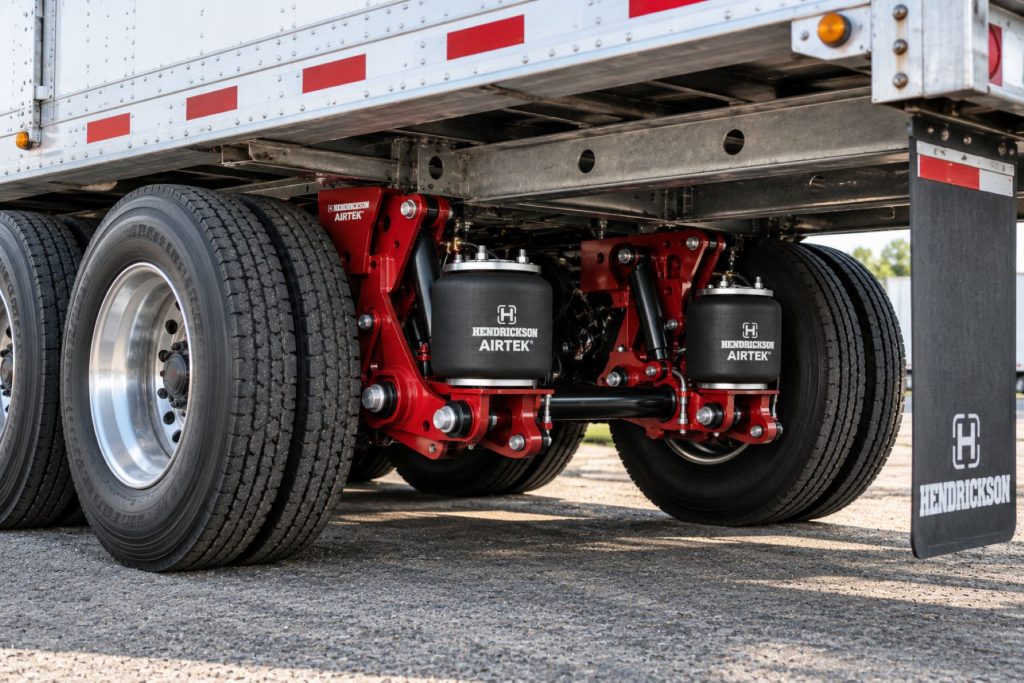
Key Characteristics
- Integrated front air suspension and fabricated steer axle
- High-volume air springs designed to improve ride quality and driver comfort
- Reduced weight compared with many forged-axle and multi-leaf spring arrangements
- Consistent front chassis height across changing operating conditions
- Designed to provide steering control and roll stability
- Up to approximately 55 degrees of wheel cut in compatible configurations
- Available with drum brakes or air disc brakes
- Offered in several capacities and vehicle-specific configurations
- Integrated axle-seat and clamp-group designs reduce component complexity
- Designed primarily for on-highway and approved specialty applications
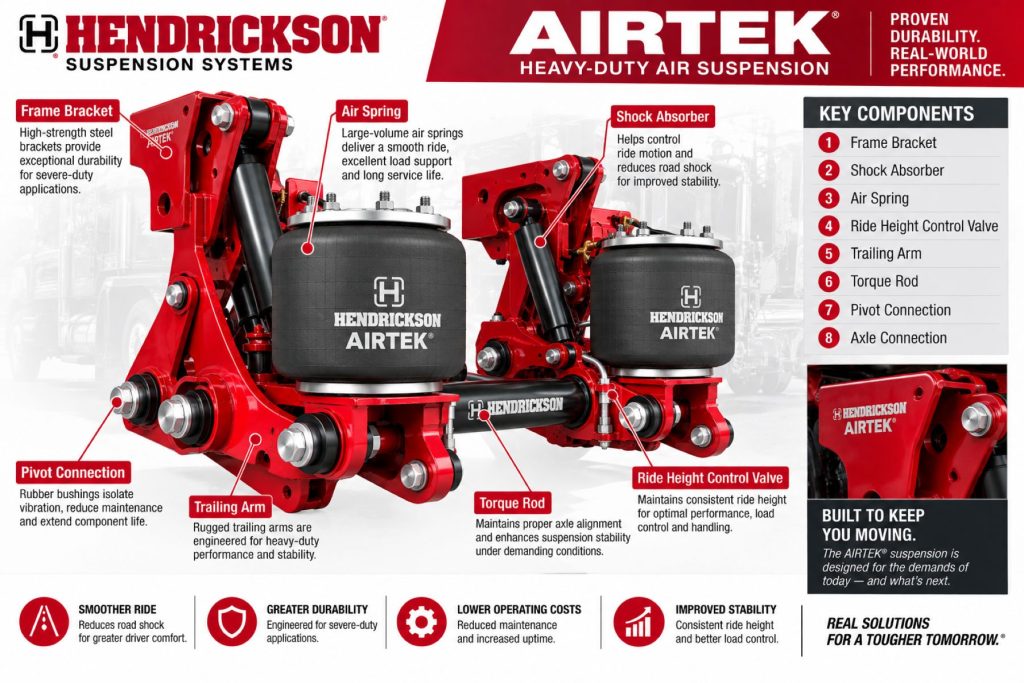
Major Components
- Hendrickson STEERTEK or STEERTEK NXT fabricated steer axle
- Front air springs
- Mechanical support or leaf-spring elements used by the particular AIRTEK configuration
- Integrated axle seats and clamp groups
- Shock absorbers
- Height-control valve and linkage
- Steering knuckles and kingpins
- Tie rod and tie-rod ends
- Drag link and steering-arm connections
- Longitudinal, lateral, or torque-control components, depending on the application
- Frame brackets and suspension hangers
- Air lines, fittings, and pneumatic controls
- Brake spiders or integrated air-disc-brake knuckles
- Wheel hubs, bearings, seals, and related wheel-end components
How the Suspension System Works
AIRTEK uses air springs to support much of the vehicle’s front-axle load while isolating the chassis from road irregularities. When the steer axle encounters a bump or depression, the air springs compress or extend, reducing the impact transferred into the cab and frame.
A height-control valve monitors the distance between the axle and chassis. When axle loading changes, the valve adds or exhausts air to return the suspension to its specified ride height. This helps maintain suspension travel, steering geometry, and consistent vehicle attitude.
Mechanical support members, axle clamps, bushings, and control components locate the axle beneath the vehicle. Shock absorbers control repeated suspension movement after the axle passes over a road irregularity.
The fabricated steer axle carries the vehicle’s front weight while the steering knuckles, kingpins, tie rod, and steering linkage allow the wheels to turn. These axle and suspension components are engineered as an integrated system rather than as unrelated assemblies.
Suspension Position and Function
AIRTEK is installed beneath the front of a truck, tractor, bus, motorhome, or specialty chassis. It supports and locates the steer axle while allowing controlled vertical movement over road irregularities.
The system performs several related functions:
- Supports the front portion of the chassis
- Controls vertical and lateral steer-axle movement
- Maintains the designed front ride height
- Absorbs bumps, potholes, bridge joints, and uneven pavement
- Provides a mounting platform for steering and brake components
- Maintains steering geometry and vehicle directional control
- Helps reduce vibration and road shock entering the cab
- Allows the front wheels to steer through the required wheel-cut range
Common Specifications
- Suspension Configuration: Single front steer axle
- Common North American Capacities: 12,000, 12,500, 13,200, and 14,600 pounds
- Suspension Weight on Certain Volvo Applications: Approximately 238 pounds for 12,000- and 12,500-pound configurations and approximately 246 pounds for 13,200- and 14,600-pound configurations, excluding the axle
- Common Axle Type: Fabricated STEERTEK or STEERTEK NXT steer axle
- Maximum Wheel Cut: Up to approximately 55 degrees in applicable installations
- Brake Options: Drum brakes or air disc brakes
- Operating Environment: Primarily on-highway
- Ride Height: Vehicle- and application-specific
- Steering Geometry: Established by the vehicle manufacturer and the specific AIRTEK installation
- AIRTEK NXT Capacities: Common configurations include 12,500- and 13,300-pound ratings
Specifications vary substantially by truck manufacturer, model, model year, ride height, frame height, axle rating, brake system, and AIRTEK generation.
Capacity, Ride Height, and Axle Travel
AIRTEK capacity must match the vehicle manufacturer’s front gross axle weight rating. Common North American truck configurations range from 12,000 to 14,600 pounds, but specialized bus, motorhome, emergency-vehicle, and international versions may use different ratings.
Correct ride height is critical because it affects available axle travel, air-spring position, shock-absorber travel, steering geometry, caster, driveline clearance, and vehicle handling. AIRTEK ride height is measured according to the procedure specified for the exact vehicle and suspension configuration.
Operating above or below the correct ride height can reduce usable suspension travel and cause harshness, bottoming, topping out, steering complaints, or accelerated component wear.
Ride Quality and Load Distribution
AIRTEK’s front air springs provide a lower effective spring rate than many traditional multi-leaf front suspensions. This helps isolate the driver and cab from potholes, pavement joints, and other road impacts.
The suspension can improve comfort under changing front-axle loads while maintaining a consistent chassis position. This is especially valuable on vehicles where fuel load, driver occupancy, mounted equipment, or cargo distribution changes the weight carried by the steer axle.
AIRTEK does not automatically redistribute weight between the steer and drive axles. Fifth-wheel position, cargo placement, body configuration, wheelbase, and auxiliary equipment continue to determine actual axle loading.
Suspension Controls and Adjustment Options
AIRTEK normally uses an automatic height-control valve to regulate air pressure and maintain the specified front ride height. The driver generally does not need to adjust the suspension during normal operation.
Service adjustments may include:
- Ride-height adjustment
- Height-control linkage adjustment
- Front axle alignment
- Caster adjustment where approved shims or wedges are available
- Toe adjustment through the tie rod
- Steering-stop adjustment
- Drag-link or steering-gear adjustment according to vehicle-manufacturer procedures
AIRTEK settings should not be changed to alter vehicle appearance or chassis height. Any adjustment must remain within Hendrickson and vehicle-manufacturer specifications.
Alignment and Suspension Geometry
Front alignment is especially important on AIRTEK because the suspension, steer axle, and steering components function as one system. Incorrect toe, caster, ride height, or axle position can cause poor tracking, steering pull, wheel shimmy, irregular tire wear, or reduced steering returnability.
Ride height should be verified before making final alignment adjustments. A suspension operating at the wrong height may produce misleading caster or steering measurements.
Important inspection points include:
- Ride height
- Toe setting
- Caster angle
- Steering-axis inclination
- Axle position beneath the frame
- Tie-rod condition
- Kingpin and bushing wear
- Steering-knuckle movement
- Wheel-bearing adjustment
- Drag-link and steering-gear condition
- Tire pressure and tread condition
Alignment procedures and acceptable measurements vary by vehicle manufacturer and AIRTEK configuration.
Axle, Brake, and Wheel-End Options
AIRTEK is commonly paired with a Hendrickson STEERTEK or STEERTEK NXT fabricated steer axle. The axle’s box-shaped fabricated construction provides rigidity while reducing weight compared with many conventional forged I-beam designs.
Available brake arrangements include drum brakes and air disc brakes. Certain configurations use an integrated air-disc-brake knuckle designed to reduce weight and component complexity.
Wheel-end equipment depends on the vehicle manufacturer and may include different hub, bearing, seal, spindle, wheel, and tire packages. The wheel ends must match the axle capacity, brake package, wheel size, tire rating, and intended vehicle operation.
Because AIRTEK is a non-driven front suspension, drive gearing, axle ratios, differential locks, and interaxle differentials do not apply.
Common Applications
- On-highway sleeper tractors
- On-highway day-cab tractors
- Regional-haul trucks
- Pickup-and-delivery vehicles
- Commercial buses
- School buses in approved configurations
- Motorhomes and recreational-vehicle chassis
- Fire and emergency vehicles with application-specific AIRTEK systems
- Specialty commercial vehicles
- Vehicles prioritizing driver comfort and reduced front-suspension weight
Vehicle, Axle, and Frame Compatibility
AIRTEK is engineered through vehicle-specific installations rather than as a universal suspension that can be fitted to any chassis. Compatibility depends on the truck manufacturer, model year, frame dimensions, front gross axle weight rating, steering gear, brake package, wheel cut, ride height, and intended application.
Technical publications are available for AIRTEK installations on selected Freightliner, Western Star, Volvo, Mack, International, Blue Bird, IC Bus, Spartan, Tiffin, and motorhome chassis. This does not mean AIRTEK is available on every model or model year produced by these manufacturers.
Retrofitting a conventional leaf-spring front suspension to AIRTEK would require extensive engineering and is generally not treated as a simple bolt-on conversion.
Advantages
- Improved front ride quality compared with many traditional multi-leaf spring suspensions
- Reduced road shock reaching the driver, cab, and chassis components
- Consistent ride height as front-axle loading changes
- Lower weight than many forged-axle and steel-spring combinations
- Integrated suspension and axle engineering
- Good steering control and roll stability for approved applications
- Up to approximately 55 degrees of wheel cut in compatible configurations
- Availability with drum or air disc brakes
- Reduced component complexity through integrated axle seats and clamp groups
- Potential payload and fuel-efficiency benefits from reduced system weight
- Vehicle-specific designs supported by Hendrickson service literature
Limitations or Considerations
- Primarily intended for approved on-highway and specialty applications
- Requires a reliable compressed-air supply
- Air leaks can lower the front of the vehicle or produce incorrect ride height
- More pneumatic components than a conventional mechanical front suspension
- Incorrect ride height can affect alignment, caster, handling, and component life
- Replacement parts must match the exact vehicle-specific AIRTEK configuration
- The integrated design requires technicians to understand both suspension and steer-axle service procedures
- Not normally suitable as a simple retrofit for a chassis originally designed around another suspension
- Front axle, tire, wheel, brake, and vehicle ratings still limit usable capacity
- Severe vocational or continuous off-highway work may require a different front-suspension system
Driver and Operator Experience
AIRTEK is designed to reduce the sharp impacts and vibration that reach the cab through the front axle. Drivers may notice a smoother response over bridge joints, broken pavement, potholes, and other road irregularities.
The system’s maintained ride height can also provide consistent steering feel and vehicle attitude as loading changes. Its available wheel cut can improve low-speed maneuverability when paired with the correct chassis and steering components.
Drivers should report excessive bouncing, front-end leaning, steering wander, wheel shimmy, unusual compressor cycling, or a vehicle that sits low after parking. These symptoms may indicate a suspension, air-system, wheel-end, tire, or steering problem.
Maintenance and Ownership Notes
- Inspect the air springs for cracking, abrasion, weathering, contamination, and exposed reinforcement material.
- Check air lines, fittings, and the height-control valve for leakage.
- Verify ride height at the vehicle manufacturer’s recommended intervals.
- Inspect shock absorbers for leakage, damaged mounts, worn bushings, or reduced damping.
- Check the integrated clamp group and mounting fasteners for looseness or movement.
- Inspect steering knuckles, kingpins, bushings, seals, and thrust bearings.
- Check the tie rod, tie-rod ends, drag link, steering arms, and steering gear.
- Inspect wheel bearings, hubs, seals, brakes, tires, and wheels.
- Check alignment when irregular tire wear, steering pull, or poor tracking develops.
- Follow Hendrickson’s lubrication and inspection requirements for the specific axle generation.
- Use Hendrickson and vehicle-manufacturer torque procedures when servicing structural fasteners.
- Hendrickson recommends appropriate inspections during predelivery, initial service, and regular preventive-maintenance intervals.
Common Suspension Problems
- Air leaking from an air spring, fitting, hose, or height-control valve
- Front of the vehicle sitting below the specified ride height
- Uneven ride height or vehicle lean
- Bent, loose, disconnected, or misadjusted height-control linkage
- Worn or leaking shock absorbers
- Loose or damaged axle-clamp components
- Worn kingpin bushings or steering-knuckle components
- Tie-rod or drag-link wear
- Incorrect toe or caster settings
- Irregular steer-tire wear
- Steering pull, wander, shimmy, or poor returnability
- Wheel-bearing looseness or improper adjustment
- Air-spring abrasion caused by interference or incorrect positioning
- Suspension topping or bottoming because of incorrect ride height
- Repeated compressor cycling caused by an air-system leak
- Noise from loose fasteners, worn bushings, or damaged mounting components
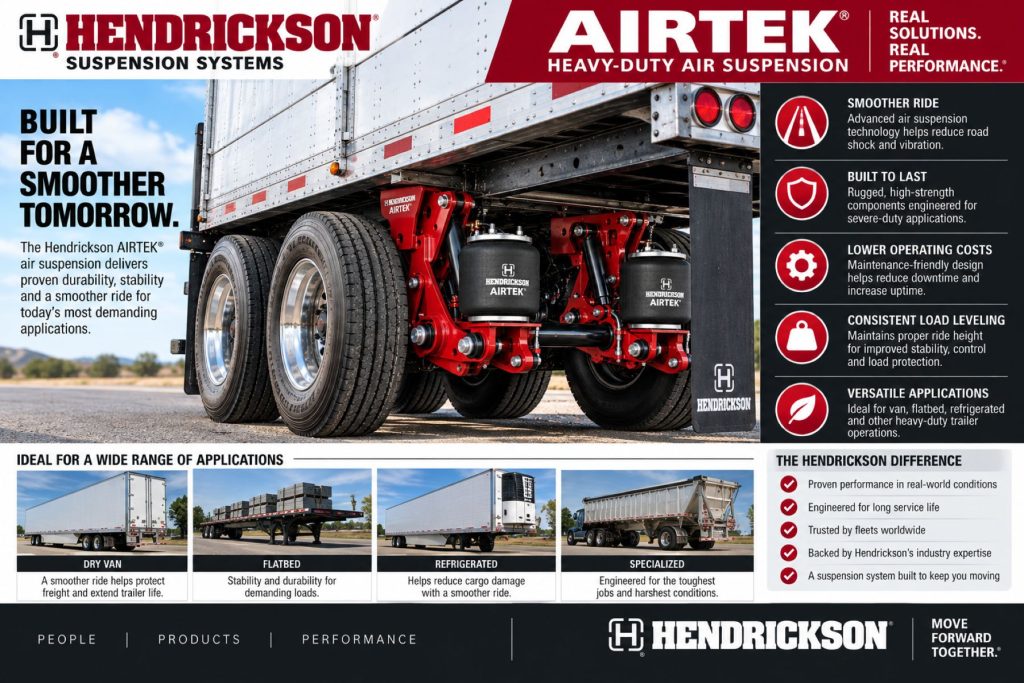
Identification Information
AIRTEK identification should begin with the vehicle identification number and the manufacturer’s build records. The truck manufacturer, model, model year, front axle rating, brake type, ride height, and axle serial information may all be needed to identify the correct components.
Inspect the axle for Hendrickson identification labels, stamped information, or part numbers. Determine whether the system uses STEERTEK or STEERTEK NXT because components and service procedures may differ.
Record the following information before ordering parts:
- Vehicle identification number
- Truck or chassis manufacturer
- Vehicle model and model year
- AIRTEK or AIRTEK NXT designation
- Front axle capacity
- Axle serial or part number
- Ride height
- Brake type and brake manufacturer
- Steering-knuckle configuration
- Air-spring and shock-absorber numbers
- Existing component numbers
Visual similarity alone should not be used to select AIRTEK replacement components.
Buying Considerations
- Confirm that the vehicle is equipped with AIRTEK rather than another Hendrickson front suspension.
- Identify whether the axle is STEERTEK or STEERTEK NXT.
- Verify the front suspension and axle capacity.
- Compare the axle rating with the vehicle’s front gross axle weight rating.
- Check the air springs for leaks, cracking, abrasion, or previous repairs.
- Confirm that the vehicle reaches and maintains its specified ride height.
- Inspect the height-control valve and linkage.
- Check kingpins, bushings, tie-rod ends, drag-link joints, and wheel bearings for movement.
- Inspect the steer tires for cupping, feathering, shoulder wear, or mismatched sizes.
- Road-test the vehicle for steering pull, wander, shimmy, harshness, and excessive bouncing.
- Inspect the shocks and axle-clamp components.
- Determine whether the vehicle uses drum brakes or air disc brakes.
- Verify the availability and cost of vehicle-specific replacement parts.
- Review alignment, kingpin, air-spring, and front-end service records.
Variants and Configurations
- AIRTEK with STEERTEK: Earlier integrated configurations pairing the front air suspension with the original fabricated STEERTEK axle.
- AIRTEK with STEERTEK NXT: Updated vehicle-specific configurations using the STEERTEK NXT fabricated steer axle.
- AIRTEK NXT: Newer integrated system using the STEERTEK NXT axle, air-suspension technology, and a lightweight integrated clamp-group design.
- 12,000-Pound Configuration: Used in selected on-highway vehicle applications.
- 12,500-Pound Configuration: Common on Class 8 highway tractors and available with selected AIRTEK and AIRTEK NXT installations.
- 13,200-Pound Configuration: Available for vehicles requiring additional front-axle capacity.
- 13,300-Pound AIRTEK NXT Configuration: Available in selected newer applications.
- 14,600-Pound Configuration: Higher-capacity version used on approved truck and specialty-vehicle chassis.
- Bus and Motorhome Configurations: Vehicle-specific systems engineered for passenger comfort, low ride height, and chassis packaging.
- Specialty and Emergency-Vehicle Configurations: Systems adapted for the capacity, stability, steering, and packaging requirements of particular vehicles.
Comparison to Similar Equipment
Compared with the Hendrickson SOFTEK, AIRTEK uses air springs to deliver a more adjustable and isolated front ride. SOFTEK uses a lightweight mechanical monoleaf arrangement and does not depend on the vehicle’s air system to support the front axle.
The Hendrickson STEERTEK NXT Suspension System centers on Hendrickson’s fabricated steer-axle technology and its integration with different suspension arrangements. AIRTEK is specifically the front air-suspension system built around compatible STEERTEK axle technology.
Compared with a conventional forged I-beam axle and multi-leaf spring suspension, AIRTEK can provide lower weight, improved ride comfort, and maintained ride height. A conventional mechanical suspension may be simpler for applications that prioritize minimal pneumatic complexity.
Best Fit For
- On-highway fleets prioritizing driver comfort
- Sleeper tractors accumulating substantial highway mileage
- Regional and pickup-and-delivery vehicles operating on paved roads
- Vehicles seeking front-suspension weight savings
- Fleets wanting an integrated steer axle and air-suspension package
- Applications requiring consistent front ride height
- Vehicles needing good maneuverability and a large wheel cut
- Bus and motorhome chassis requiring improved passenger comfort
- Operators with access to technicians familiar with air suspension and steering-system maintenance
Related Vehicle and Trailer Types
- Complete Guide to Semi Truck Types
- Day Cab vs Sleeper Truck: Which Is Right for Your Operation?
- On-highway sleeper tractors
- Day-cab tractors
- Regional-haul trucks
- Pickup-and-delivery trucks
- Commercial buses
- School buses
- Motorhomes
- Fire and emergency vehicles
- Specialty commercial chassis
Related Truck and Trailer Models
Related Suspension Types
- Air Suspension Systems
- Steer Axle & Front Suspensions
- Hendrickson SOFTEK
- Hendrickson STEERTEK NXT Suspension System
- Front air suspensions
- Integrated steer-axle and suspension systems
- Mechanical monoleaf front suspensions
- Multi-leaf front suspensions
- High-capacity vocational front suspensions
Related Equipment Systems
- Suspension Systems
- Steering Systems
- Axles & Differentials
- Brake Systems
- Tires and Wheels
- Safety Systems
Related Guides
- How Commercial Truck Suspension Systems Work
- Air Suspension vs Leaf Spring Suspension
- How to Choose a Commercial Truck Suspension
- Truck Suspension Components Explained
- Truck vs Trailer Suspension Systems
- How to Identify a Truck Axle or Differential
Regulatory and Compliance Notes
An AIRTEK-equipped vehicle must remain within its front gross axle weight rating, gross vehicle weight rating, tire capacity, wheel capacity, brake rating, and applicable roadway limits. The suspension’s nominal capacity does not authorize loading beyond the lowest-rated connected component.
Steering and suspension repairs must preserve the vehicle manufacturer’s approved ride height, alignment geometry, wheel cut, brake routing, and component clearances. Improper modification can affect steering control and vehicle safety.
Replacement components should meet the specifications for the exact AIRTEK and vehicle configuration. Welding, heating, bending, drilling, or straightening steering and axle components should not be performed unless specifically authorized by the applicable manufacturer procedure.
Real World Operating Notes
AIRTEK’s most noticeable benefit is generally improved front-end ride quality. Because the front axle is directly beneath the cab and steering system, reducing impact at this location can materially improve driver comfort.
The suspension still requires sound tires, balanced wheels, correct alignment, properly adjusted wheel bearings, and serviceable steering components. AIRTEK cannot compensate for a damaged tire, worn kingpin, loose tie rod, or incorrectly adjusted steering gear.
Ride-height diagnosis should occur early when addressing handling or tire-wear complaints. An air leak or height-control problem can change suspension geometry and produce symptoms that appear to be caused by alignment alone.
Frequently Asked Questions
Is Hendrickson AIRTEK a front or rear suspension?
AIRTEK is an integrated front air suspension and steer-axle system.
What axle is used with AIRTEK?
AIRTEK is paired with a Hendrickson STEERTEK or STEERTEK NXT fabricated steer axle, depending on the system generation and vehicle application.
What capacities are available?
Common North American truck configurations include 12,000, 12,500, 13,200, and 14,600 pounds. AIRTEK NXT is available in selected 12,500- and 13,300-pound configurations.
Is AIRTEK used on highway tractors?
Yes. On-highway tractors are among its primary applications, although vehicle-specific systems are also used on trucks, buses, motorhomes, and specialty vehicles.
Does AIRTEK improve ride quality?
AIRTEK uses high-volume air springs to reduce the road shock transferred through the front axle into the frame and cab.
Does AIRTEK maintain a constant ride height?
The height-control system adds or releases air as loading changes to return the suspension to its specified ride height.
Can AIRTEK use air disc brakes?
Yes. AIRTEK is compatible with drum and air disc brakes in approved configurations. Certain systems use an integrated air-disc-brake knuckle.
How much wheel cut does AIRTEK provide?
Compatible configurations can provide up to approximately 55 degrees of wheel cut. The actual amount depends on the chassis, steering gear, wheel and tire package, and installed components.
Is AIRTEK lighter than a traditional front suspension?
Yes. Hendrickson designed AIRTEK to reduce weight compared with many conventional forged I-beam axle and steel-spring systems. The exact savings depend on the compared configurations.
What causes an AIRTEK-equipped truck to sit low?
Possible causes include a leaking air spring, damaged air line, loose fitting, faulty height-control valve, disconnected linkage, or insufficient vehicle air pressure.
Can AIRTEK replace a leaf-spring suspension?
AIRTEK is normally engineered into the chassis by the vehicle manufacturer. Converting an existing conventional suspension would require extensive engineering and should not be treated as a basic bolt-on replacement.
Is AIRTEK the same as AIRTEK NXT?
AIRTEK NXT is a newer development of the AIRTEK concept. It combines the STEERTEK NXT axle with updated air-suspension technology and an advanced integrated clamp-group design.
Availability and Where to Find
Hendrickson AIRTEK is available through participating commercial vehicle manufacturers as a factory-installed front suspension and steer-axle system. Availability depends on the truck or chassis model, model year, front axle rating, brake package, and selected factory options.
Used AIRTEK systems can be found on compatible highway tractors, commercial trucks, buses, motorhomes, and specialty vehicles. Replacement air springs, shocks, height-control components, steering parts, axle components, and wheel-end parts are available through Hendrickson distributors, truck dealers, and heavy-duty parts suppliers.
Product details were checked against Hendrickson’s AIRTEK product literature, AIRTEK service publication for Volvo vehicles, and 2026 AIRTEK service-publication index.
Support Trucking Families
Truck Equipment Atlas supports the mission of Grey Cross, a nonprofit dedicated to helping families of truck drivers who lose their lives while on the road. As the site grows, part of its mission is to bring awareness and support to these families.
Podcast or Video Section
Learn More Through Audio and Video
Truck Equipment Atlas will continue expanding with podcast episodes, interviews, and equipment breakdowns to help drivers and fleets better understand trucks and equipment.
Follow the Growth of Truck Equipment Atlas
Truck Equipment Atlas continues to expand with new truck profiles, trailer coverage, diesel engine pages, equipment system resources, manufacturer information, and educational guides.
Visit our Site Updates page to explore recent additions, project milestones, and upcoming resources as we continue building one of the industry’s growing commercial trucking equipment reference libraries.
View the Latest Site Updates: Truck Equipment Atlas Site Updates