
Mack S38 and S40 Axles
Quick Facts
- Manufacturer: Mack Trucks
- Parent Company: Volvo Group
- Product Family: Mack S38 and S40 Series
- Axle Type: Tandem rear drive axle
- Primary Drivetrain Configuration: 6×4
- S38 Nominal Rating: 38,000 pounds
- S40 Nominal Rating: 40,000 pounds
- Primary Applications: Highway, regional, vocational, refuse, construction, and municipal trucks
- Current Published Carrier Ratios: Approximately 2.28 to 4.11, depending on configuration
- Legacy S40 Ratios: Additional ratios extending above 4.11 may be found in older vocational trucks
- Carrier Position: Top-mounted
- Ring Gear Size: Approximately 15.31 inches
- Differential Lock Options: Interaxle and application-specific interwheel differential locks
- Common Suspensions: Mack air and mechanical tandem suspensions
- Common Truck Models: Mack Anthem, Pinnacle, Granite, LR, and TerraPro
- Product Page Slug: mack-s38-and-s40-axles
Overview
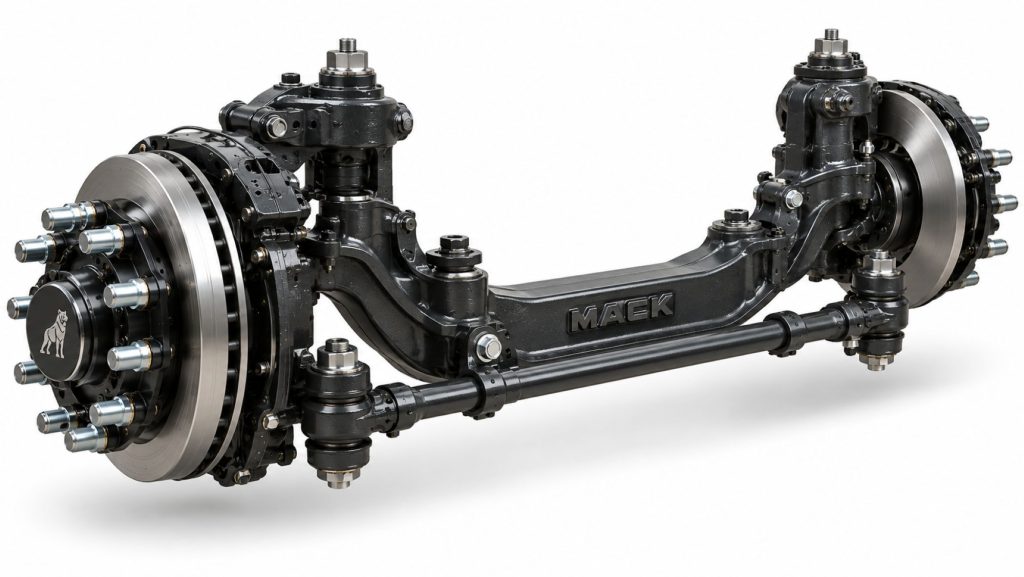
The Mack S38 and S40 are proprietary tandem drive axle families designed for Mack highway and vocational trucks. The S38 provides a nominal tandem rating of 38,000 pounds, while the S40 increases the nominal rating to 40,000 pounds.
These axles are used in conventional 6×4 trucks where both rear axles receive engine torque. They support the rear portion of the vehicle, provide final gear reduction, distribute torque among the drive wheels, and transfer propulsion and braking forces between the tires and chassis.
Mack’s top-mounted carrier design positions the main driveline and interaxle driveshaft higher than many conventional axle arrangements. This improves ground clearance around the driveline and reduces the risk of contact with rocks, debris, and uneven job-site surfaces.
Key Characteristics
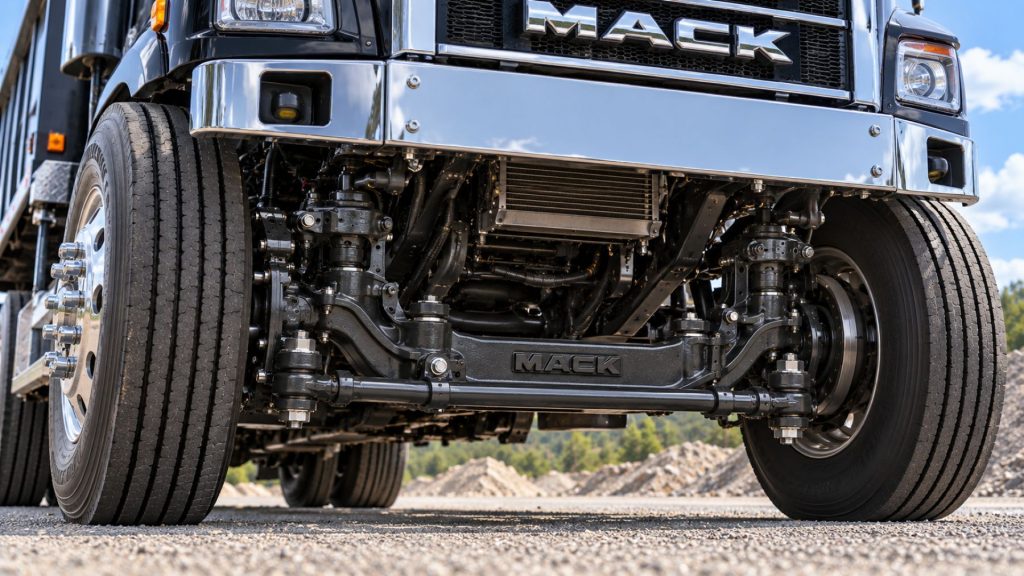
The S38 and S40 use top-mounted differential carriers. This arrangement helps keep the main and interaxle driveshafts higher and more closely aligned, supporting improved ground clearance and driveline geometry.
Mack axle housings are designed with tight manufacturing tolerances and fewer housing joints. The bowl cover is positioned on top of the housing, where it is less exposed to lubricant leakage and impact damage.
The S38 and S40 family is available with multiple ratios for highway, regional, and vocational operations. Available differential-lock systems can improve traction in snow, mud, gravel, construction sites, and other challenging conditions.
How the Axle or Differential Works
Engine torque travels through the transmission and main driveshaft to the top-mounted carrier in the forward rear axle.
The forward carrier directs torque through its ring-and-pinion gearing to the forward axle shafts. A power divider and interaxle driveline also transfer torque to the second rear axle.
Each axle contains a wheel differential that allows its left and right wheels to rotate at different speeds while turning. The interaxle differential allows the forward and rear axles to compensate for differences in rotational speed.
When additional traction is required, the driver can engage an approved power-divider lock or differential-lock system. This reduces differential action and helps distribute torque to more wheel positions.
Axle Position and Function
The Mack S38 and S40 are installed as the tandem rear drive axle group beneath compatible Mack trucks.
In a conventional 6×4 configuration, the forward and rear axles are both powered. This improves traction compared with a single-drive 4×2 or 6×2 arrangement.
The tandem supports the rear chassis, body, cargo, fifth-wheel load, or vocational equipment. It also provides final drive reduction and transfers engine torque to the road.
The actual legal axle load depends on suspension capacity, axle spacing, tires, wheels, brakes, frame ratings, and applicable weight regulations.
Common Specifications
- Axle Configuration: Tandem rear drive axle
- Primary Drivetrain Layout: 6×4
- S38 Nominal Tandem Rating: 38,000 pounds
- S40 Nominal Tandem Rating: 40,000 pounds
- S38 Highway GCW Approval: Application-dependent, with certain historical configurations listed around 50,000 to 60,000 pounds
- S40 Highway GCW Approval: Application-dependent, with certain configurations listed around 50,000 pounds
- Current Published Carrier Ratio Range: 2.28 to 4.11
- Published Ratios: 2.28, 2.47, 2.64, 2.79, 2.85, 3.08, 3.25, 3.36, 3.42, 3.55, 3.70, 3.90, and 4.11
- Legacy S40 Ratios: Selected older configurations may include ratios from approximately 2.54 through 5.66
- Ring Gear Size: Approximately 15.31 inches or 388.91 mm
- Axle-Shaft Spline Diameter: Approximately 2.10 inches or 53.3 mm
- Spline Count: 41 teeth in published carrier specifications
- Housing Wall Thickness: Application-dependent standard, DualTrac, and wide-track arrangements
- Carrier Position: Top-mounted
Exact capacity, GCW approval, ratio, carrier, housing, differential-lock, brake, and wheel-end specifications must be verified for the individual truck.
Axle Ratios and Gearing
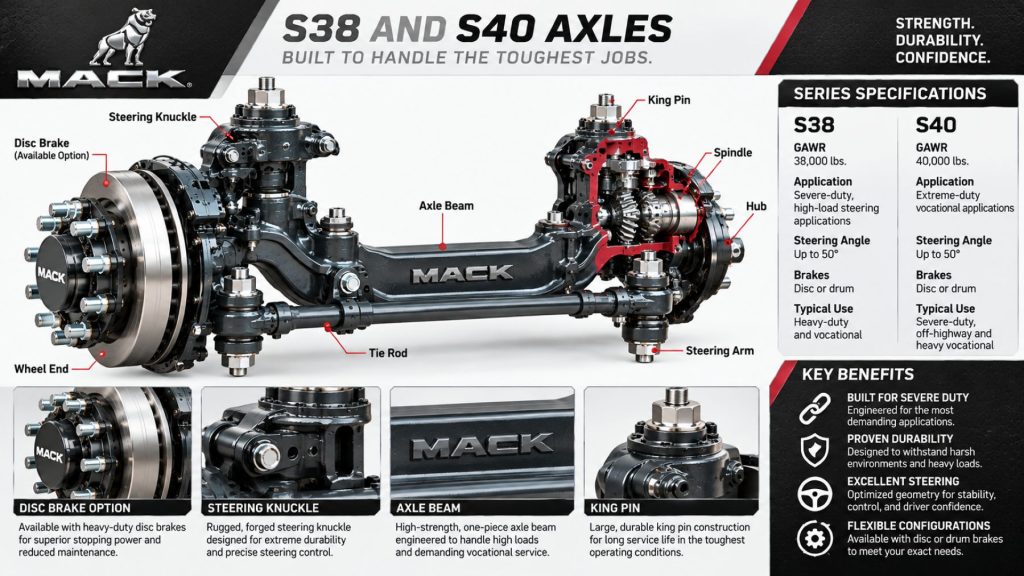
Current Mack carrier information lists ratios ranging from approximately 2.28 to 4.11 for the S38 and S40 family. This range supports highway, regional, and vocational applications.
Fast numerical ratios such as 2.28, 2.47, and 2.64 can support lower engine speeds at highway cruise. These ratios require an engine and transmission designed for powertrain downspeeding.
Midrange ratios such as 2.79, 2.85, 3.08, 3.25, and 3.36 provide a balance between highway efficiency, launch performance, and gradeability.
Higher ratios such as 3.42, 3.55, 3.70, 3.90, and 4.11 provide greater torque multiplication for heavier loads, frequent stops, grades, and lower-speed vocational work.
Older S40 axles may have ratios extending beyond the current published range. These legacy configurations must be identified by the axle tag, carrier number, and truck build records.
Differential and Traction Options
The S38 and S40 use wheel differentials in both rear axles and an interaxle differential between them.
A power-divider lock can reduce speed differentiation between the two rear axles and improve traction when operating on slippery or loose surfaces.
Application-specific interwheel differential locks may also be available. These systems provide additional traction by limiting differential action between the left and right wheels.
Mack has used different carrier and differential arrangements across production years. Differential-lock availability must therefore be confirmed from the truck’s build information rather than assumed from the S38 or S40 designation alone.
Brake and Wheel-End Options
The Mack S38 and S40 can be configured with approved air drum or air disc brakes, depending on truck model, year, application, and suspension.
Wheel-end options may include conventional hubs, aluminum hubs, dual-tire configurations, wide-base tires, and extended-maintenance bearing systems.
Mack DualTrac configurations may be used with approved wide-base tire and wheel packages. These arrangements require correct housing, hubs, bearings, wheel offsets, and suspension geometry.
The brakes, hubs, wheels, tires, and bearings must all support the intended tandem axle rating and vehicle application.
Common Applications
- Long-haul tractors
- Regional-haul tractors
- Day cab tractors
- Sleeper trucks
- Dump trucks
- Concrete mixer trucks
- Refuse trucks
- Municipal vehicles
- Snowplows
- Construction trucks
- Utility vehicles
- Transfer trucks
- Logging trucks
- Delivery and distribution trucks
- Specialized vocational equipment
Truck, Suspension, and Drivetrain Compatibility
The S38 and S40 are designed primarily for compatible Mack truck platforms. They can be paired with Mack engines, Mack transmissions, and application-approved tandem suspensions.
Common suspension arrangements include Mack air suspensions and mechanical vocational suspensions. Compatibility depends on housing design, axle spacing, track width, ride height, torque rods, mounting brackets, brakes, and intended duty cycle.
The selected axle ratio must be matched to the engine, transmission, tire size, gross vehicle weight, road speed, and terrain.
Top-mounted carriers affect driveshaft position and operating angles. Replacement axles and carriers must preserve the original driveline geometry.
Advantages
- Mack-designed tandem axle system
- 38,000- and 40,000-pound nominal ratings
- Top-mounted carrier design
- Improved driveline ground clearance
- Reduced exposure to job-site obstacles
- Favorable main and interaxle driveshaft alignment
- Multiple highway and vocational ratios
- Interaxle differential-lock capability
- Application-specific interwheel differential locks
- Integration with Mack engines and transmissions
- Compatibility with Mack air and mechanical suspensions
- Housing design with fewer potential leak points
- Suitable for highway and vocational applications
- Support through the Mack dealer network
Limitations or Considerations
- Heavier than a single rear drive axle
- More gears, bearings, seals, and shafts to maintain than a 4×2 drivetrain
- Axle ratios and carrier designs vary across production years
- Older S40 specifications may differ from current carrier information
- Not intended to replace heavier S44, S46, S52, or severe-service axle families
- GCW approval depends on the exact carrier and application
- Differential-lock options are not identical across all configurations
- Top-mounted carriers require compatible driveline geometry
- Tire circumference must remain closely matched across the tandem
- Axle capacity does not override suspension, brake, wheel, tire, or frame ratings
- Used assemblies must have matching forward and rear axle ratios
- Parts should be ordered using complete carrier and axle identification information
Driver and Operator Experience
A properly maintained Mack S38 or S40 should provide stable power delivery and predictable traction. The top-mounted carrier arrangement helps maintain favorable driveshaft angles and reduce exposure to obstacles.
Highway configurations can provide quiet operation and efficient cruising when the axle ratio is correctly matched to the powertrain.
Vocational drivers benefit from the tandem’s ability to deliver power through both rear axles. Power-divider and differential locks can improve mobility on loose, wet, snowy, or uneven surfaces.
Drivers should report new whining, clunking, vibration, wheel hop, tire scrub, or differential-lock problems before additional damage occurs.
Maintenance and Ownership Notes
Routine maintenance includes checking axle lubricant, inspecting the breathers, examining the carrier and wheel-end seals, and inspecting the main and interaxle driveshafts.
Mack publishes different lubricant replacement intervals according to duty cycle. Normal highway service can permit substantially longer intervals than severe vocational operation.
Tires should be closely matched across the tandem. Major differences in size, tread depth, inflation pressure, or construction can create continuous differential activity and premature wear.
The top-mounted carrier and housing should be inspected for leakage, loose fasteners, or impact damage. Technicians should use the specified lubricant, fill procedure, and service interval for the exact axle.
Common Axle or Differential Problems
- Carrier or housing lubricant leaks
- Pinion seal leakage
- Wheel-end seal leakage
- Restricted axle breathers
- Low or contaminated lubricant
- Ring-and-pinion gear wear
- Pinion-bearing wear
- Differential-bearing wear
- Power-divider wear
- Interaxle differential damage
- Interaxle differential-lock problems
- Interwheel differential-lock problems
- Axle-shaft damage
- Excessive backlash
- Whining or humming at road speed
- Clunking during acceleration or deceleration
- Interaxle driveshaft vibration
- Universal-joint or yoke wear
- Tire scrub caused by mismatched tires
- Wheel-bearing wear or overheating
- Housing damage caused by impact or overloading
Identification Information
- Manufacturer: Mack Trucks
- Product Family: S38 and S40 tandem axles
- Nominal Ratings: 38,000 and 40,000 pounds
- Primary Identification Source: Axle housing tag, carrier tag, or stamped assembly information
- Forward Carrier Information: Carrier model, part number, ratio, serial information, and differential-lock configuration
- Rear Carrier Information: Carrier model, part number, ratio, serial information, and differential configuration
- Vehicle Information: Mack VIN and original build sheet
- Important Chassis Information: Suspension, axle spacing, track width, brakes, hubs, wheels, and tires
- Important Drivetrain Information: Ratio, transmission, main driveshaft, interaxle driveline, and power-divider configuration
Both axle assemblies and carriers should be identified before purchasing gears, bearings, seals, axle shafts, differential components, housings, or replacement assemblies.
Buying Considerations
- S38 or S40 designation
- Exact nominal axle rating
- Truck model, year, and VIN
- Forward and rear carrier numbers
- Original axle ratio
- Engine torque rating
- Transmission model and gearing
- Gross combination weight
- Highway or vocational duty cycle
- Suspension model
- Axle spacing
- Standard, DualTrac, or wide-track housing
- Track width
- Brake type and size
- Hub and wheel-end configuration
- Interaxle differential lock
- Interwheel differential-lock availability
- Main and interaxle yoke dimensions
- Condition of gears, bearings, seals, shafts, and housings
- Evidence of overheating, lubricant contamination, impact damage, or overloading
- Parts availability for legacy configurations
Variants and Configurations
- Mack S38 tandem axle
- Mack S40 tandem axle
- S38R configurations
- SB38 configurations
- Standard-track configurations
- DualTrac configurations
- Wide-track configurations
- Highway axle ratios
- Regional-haul axle ratios
- Vocational axle ratios
- Current carrier arrangements
- Legacy S40 carrier arrangements
- Standard wheel differentials
- Power-divider-lock configurations
- Interwheel differential-lock configurations
- Air drum brake configurations
- Air disc brake configurations
- Mack air-suspension installations
- Mack mechanical-suspension installations
Comparison to Similar Equipment
The Mack S38 and S40 compete with other highway and vocational tandem axle systems rated around 38,000 to 40,000 pounds.
The PACCAR DX-40 Tandem Drive Axle is a lightweight 40,000-pound tandem designed primarily for Kenworth and Peterbilt highway tractors.
The Detroit Tandem Rear Axle offers highway and vocational ratings and integrates with Freightliner and Western Star trucks.
The Dana Spicer AdvanTEK 40 Tandem Axle is designed for efficient highway operation and powertrain downspeeding.
The Meritor 14X HE Tandem Drive Axle provides another highway-oriented 40,000-pound-class axle option.
The Mack axles’ distinguishing feature is their top-mounted carrier design and integration with Mack powertrains, suspensions, and chassis.
Best Fit For
- Mack truck operators
- Fleets wanting a fully integrated Mack drivetrain
- Highway tractors requiring 38,000- or 40,000-pound tandem ratings
- Regional-haul tractors
- Dump and concrete mixer trucks
- Refuse vehicles
- Municipal trucks
- Construction equipment
- Applications requiring additional driveline ground clearance
- Trucks using Mack air suspensions
- Trucks using Mack mechanical suspensions
- Fleets requiring two powered rear axles
- Operators with access to Mack dealer service
Related Truck Types
- Sleeper Trucks
- Day Cab Trucks
- Vocational Trucks
- Severe-Service Trucks
- Dump Trucks
- Concrete Mixer Trucks
Related Truck Models
Related Axle and Differential Types
- Commercial Truck Tandem Drive Axles
- PACCAR DX-40 Tandem Drive Axle
- Detroit Tandem Rear Axle
- Dana Spicer AdvanTEK 40 Tandem Axle
- Meritor 14X HE Tandem Drive Axle
- Commercial Truck Axles and Differentials
Related Equipment Systems
- Driveshaft Systems
- Transmission Systems
- Suspension Systems
- Brake Systems
- Tires and Wheels
- Safety Systems
Related Guides
- How Commercial Truck Axles and Differentials Work
- Commercial Truck Axle Ratios Explained
- Open vs Locking vs Limited-Slip Differentials
Regulatory and Compliance Notes
The axle, suspension, brakes, hubs, wheels, tires, and frame must all support the vehicle’s required gross axle weight rating.
The axle’s nominal rating does not independently determine the legal load. Federal, state, provincial, bridge, road, and permit requirements may impose lower limits.
Both axle carriers must use matching approved ratios. Operating a tandem with mismatched gearing can cause severe driveline binding and component failure.
Differential locks must be used according to Mack operating instructions. Improper engagement can affect vehicle handling and damage gears, shafts, tires, or the interaxle driveline.
Real World Operating Notes
The S38 and S40 provide a middle ground between lightweight single-drive arrangements and Mack’s heavier vocational axle families. They are appropriate when the truck needs tandem traction without the weight of a 46,000-pound or heavier axle group.
Top-mounted carriers provide useful driveline clearance on construction sites and uneven surfaces. The lowest components on the vehicle may still be the housing, suspension, brakes, or other chassis equipment.
Ratio selection should reflect the truck’s actual work. A highway ratio may reduce fuel consumption but provide unsatisfactory performance in low-speed, heavily loaded vocational service.
Frequently Asked Questions
What is the difference between the Mack S38 and S40?
The S38 has a nominal tandem rating of 38,000 pounds, while the S40 has a nominal rating of 40,000 pounds. Exact housings, carriers, suspensions, ratios, and application approvals may differ.
Are the S38 and S40 tandem drive axles?
Yes. They are normally used as powered tandem rear axles in 6×4 Mack trucks.
What axle ratios are available?
Current carrier information lists ratios from approximately 2.28 to 4.11. Older S40 configurations may use additional ratios extending above 4.11.
What is a top-mounted carrier?
The differential carrier and driveline input are positioned near the top of the axle housing. This raises the driveshafts and can improve ground clearance and driveline alignment.
Do these axles have differential locks?
Power-divider and application-specific interwheel differential locks may be available. The exact equipment must be confirmed from the truck’s build records.
Which Mack trucks use S38 or S40 axles?
They may be found in compatible Mack Anthem, Pinnacle, Granite, LR, TerraPro, and other highway or vocational models.
Is the S40 suitable for heavy haul?
It can support approved 40,000-pound tandem applications, but heavier or permitted heavy-haul work may require an S44, S46, S52, or higher-capacity Mack axle.
Can S38 and S40 carriers be interchanged?
Not automatically. Ratio, housing, carrier dimensions, axle shafts, differential locks, suspension, brakes, and vehicle approvals must be verified.
Why must the tandem tires be matched?
Differences in tire circumference force the interaxle differential to operate continuously. Excessive mismatch can create heat and premature wear.
What commonly causes Mack tandem axle noise?
Possible causes include low lubricant, worn gears, bearing damage, excessive backlash, driveshaft problems, tire mismatch, or incorrect previous repairs.
How can the axle be identified?
Check the axle and carrier tags, stamped assembly numbers, and the Mack build sheet associated with the truck’s VIN.
Can a current carrier replace a legacy S40 carrier?
Possibly, but only after confirming housing compatibility, ratio, axle shafts, yokes, differential controls, brakes, suspension, and any required conversion parts.
Availability and Where to Find
Mack S38 and S40 axles are available as original equipment on compatible Mack trucks. Exact availability depends on the truck model, production year, suspension, duty cycle, and powertrain.
Replacement carriers, gears, bearings, seals, shafts, wheel-end components, and complete axle assemblies may be obtained through authorized Mack dealers and qualified heavy-truck parts suppliers.
Used and remanufactured assemblies should be identified using both axle tags, carrier numbers, ratios, differential-lock configurations, suspension, brakes, and the original Mack build sheet.
Current axle information and dealer support are available through the Mack Axles and Carriers page.
Support Trucking Families
Truck Equipment Atlas supports the mission of Grey Cross, a nonprofit dedicated to helping families of truck drivers who lose their lives while on the road. As the site grows, part of its mission is to bring awareness and support to these families.
Podcast or Video Section
Learn More Through Audio and Video
Truck Equipment Atlas will continue expanding with podcast episodes, interviews, and equipment breakdowns to help drivers and fleets better understand trucks and equipment.
Follow the Growth of Truck Equipment Atlas
Truck Equipment Atlas continues to expand with new truck profiles, trailer coverage, diesel engine pages, equipment system resources, manufacturer information, and educational guides.
Visit our Site Updates page to explore recent additions, project milestones, and upcoming resources as we continue building one of the industry’s growing commercial trucking equipment reference libraries.
View the Latest Site Updates: Truck Equipment Atlas Site Updates